
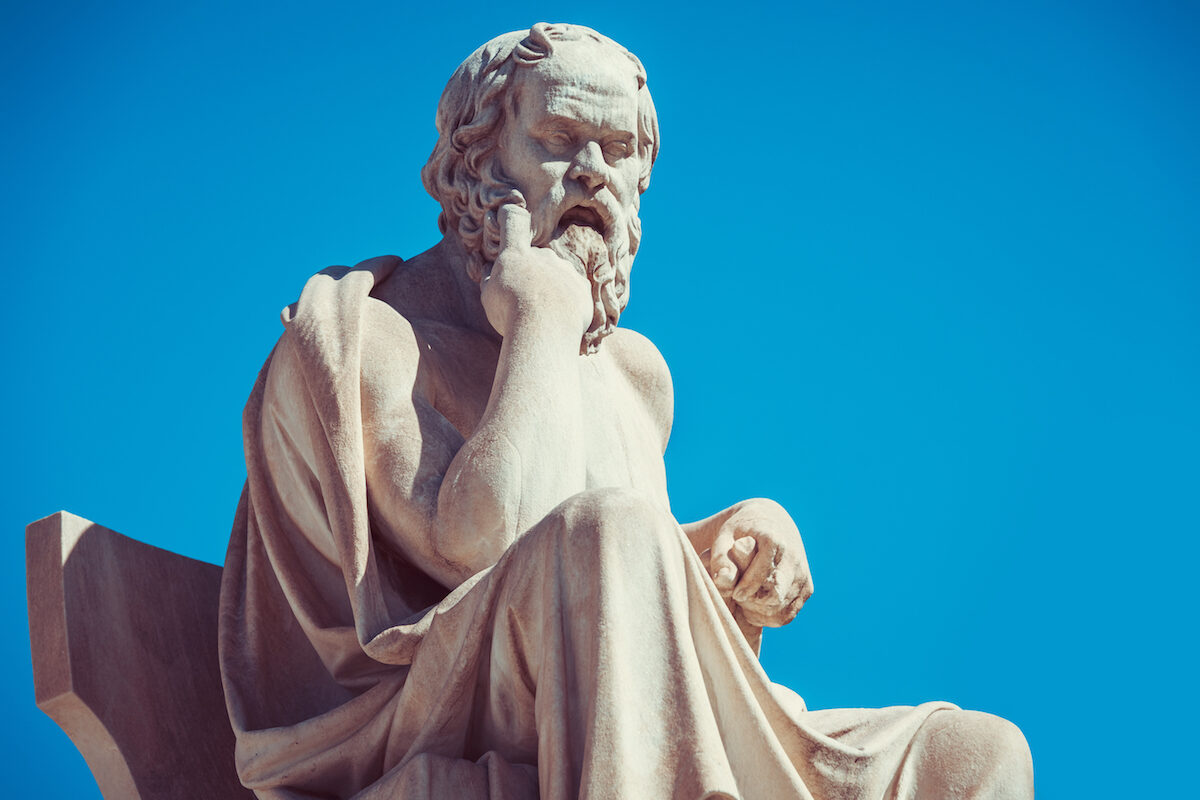
SOCRATES

Socrates of Athens was one of the most famous figures in world history for his contributions to the development of ancient Greek philosophy which provided the foundation for all of Western Philosophy. He is, in fact, known as the “Father of Western Philosophy” for this reason. He was originally a sculptor who seems to have also had a number of other occupations, including soldier, before he was told by the Oracle at Delphi that he was the wisest man in the world. In an effort to prove the oracle wrong, he embarked on a new career of questioning those who were said to be wise and, in doing so, proved the oracle correct: Socrates was the wisest man in the world because he did not claim to know anything of importance.

Plato
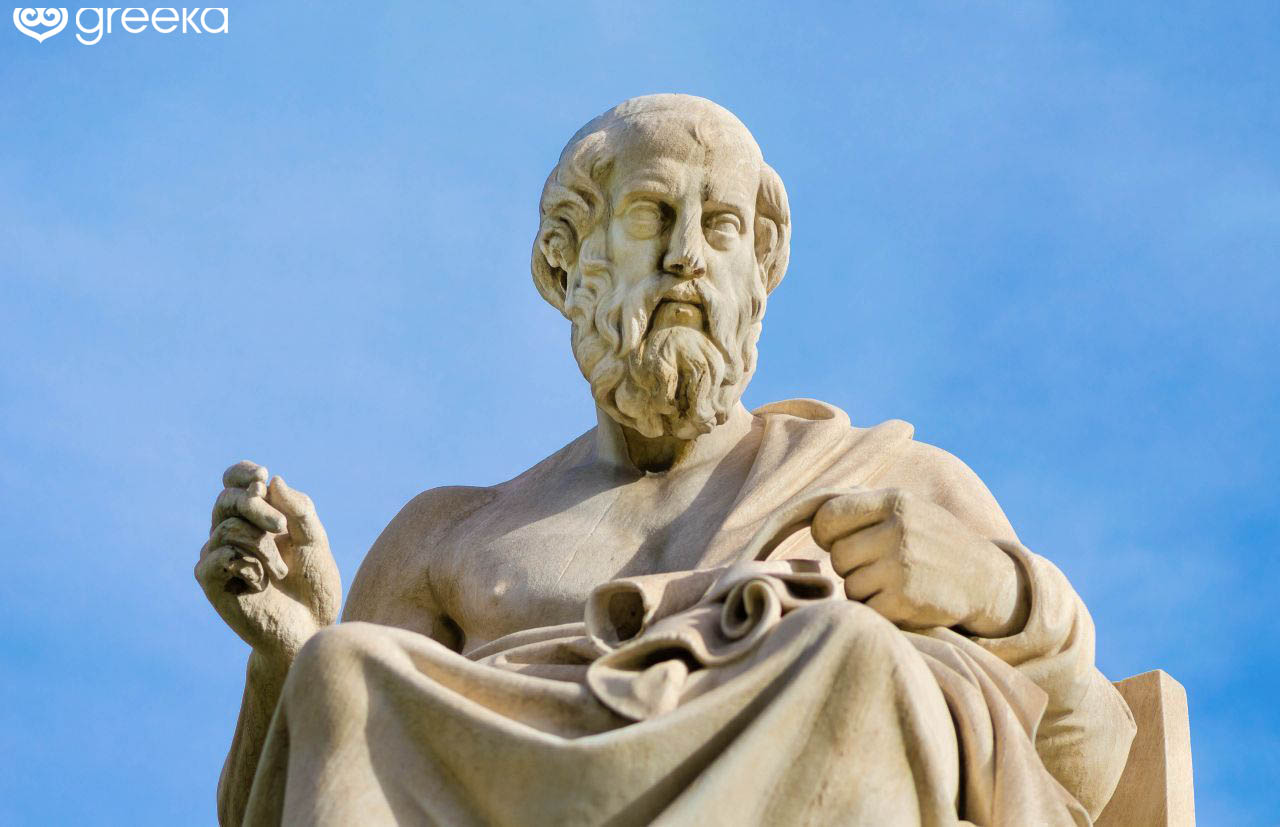
His most famous student was Plato (l. c. 428/427-348/347 BCE) who would honor his name through the establishment of a school in Athens (Plato’s Academy) and, more so, through the philosophical dialogues he wrote featuring Socrates as the central character. Whether Plato’s dialogues accurately represent Socrates’ teachings continues to be debated but a definitive answer is unlikely to be reached. Plato’s best known student was Aristotle of Stagira (l. 384-322 BCE) who would then tutor Alexander the Great (l. 356-323 BCE) and establish his own school. By this progression, Greek philosophy, as first developed by Socrates, was spread throughout the known world during, and after, Alexander’s conquests.

Early Life

Socrates was born c. 469/470 BCE to the sculptor Sophronicus and the mid-wife Phaenarete. He studied music, gymnastics, and grammar in his youth (the common subjects of study for a young Greek) and followed his father’s profession as a sculptor. Tradition holds that he was an exceptional artist and his statue of the Graces, on the road to the Acropolis, is said to have been admired into the 2nd century CE. Socrates served with distinction in the army and, at the Battle of Potidaea, saved the life of the General Alcibiades. He married Xanthippe, an upper-class woman, around the age of fifty and had three sons by her. According to contemporary writers such as Xenophon, these boys were incredibly dull and nothing like their father. Socrates seems to have lived a fairly normal life until he was told by the Oracle at Delphi that he was the wisest of men. His challenge to the oracle’s claim set him the course that would establish him as a philosopher and the founder of Western Philosophy.

The Oracle and Socrates

When he was middle-aged, Socrates’ friend Chaerephon asked the famous Oracle at Delphi if there was anyone wiser than Socrates, to which the Oracle answered, “None.” Bewildered by this answer and hoping to prove the Oracle wrong, Socrates went about questioning people who were held to be ‘wise’ in their own estimation and that of others. He found, to his dismay, “that the men whose reputation for wisdom stood highest were nearly the most lacking in it, while others who were looked down on as common people were much more intelligent”. The youth of Athens delighted in watching Socrates question their elders in the market and, soon, he had a following of young men who, because of his example and his teachings, would go on to abandon their early aspirations and devote themselves to philosophy (from the Greek ‘Philo’, love, and ‘Sophia’, wisdom – literally ‘the love of wisdom’). Among these were Antisthenes of Athens (l. c. 445-365 BCE), founder of the Cynic school, Aristippus of Cyrene (l. c. 435-356 BCE), founder of the Cyrenaic school), Xenophon, whose writings would influence Zeno of Citium, (l.c. 336-265 BCE) founder of the Stoic school, and, most famously, Plato (the main source of our information of Socrates in his Dialogues) among many others. 

Trial and Death of Socrates

In 399 BCE Socrates was charged with impiety by Meletus the poet, Anytus the tanner, and Lycon the orator who sought the death penalty in the case. The accusation read: “Socrates is guilty, firstly, of denying the gods recognized by the state and introducing new divinities, and, secondly, of corrupting the young.” It has been suggested that this charge was both personally and politically motivated as Athens was trying to purge itself of those associated with the scourge of the Thirty Tyrants of Athens who had only recently been overthrown. His execution was delayed for 30 days due to a religious festival, during which the philosopher’s distraught friends tried unsuccessfully to convince him to escape from Athens. On his last day, Plato says, he “appeared both happy in manner and words as he died nobly and without fear.” He drank the cup of brewed hemlock his executioner handed him, walked around until his legs grew numb and then lay down, surrounded by his friends, and waited for the poison to reach his heart.


Bhagavad-Gita: The Philosophical Guide

The Bhagavad Gita is one of the most well-known scriptures in Hinduism. It is a scripture that extends upon the Vedic teachings. The word ‘Bhagavad Gita’ literally translates to ‘Song of God’ and is a dialogue that took place between the Supreme Lord Shree Krishna and His devotee Arjun, when they were on the battleground of the Mahabharat war. Bhagavad-Gita has been a source of perennial wisdom and has inspired many modern thinkers such as Mahatma Gandhi, Carl Jung & Herman Hesse.

One who comes to know the Absolute Truth attains knowledge of everything.

The science of knowing the Absolute Truth is called “Brahma Vidyā.” The purpose of the Bhagavad Gita, above everything else, is to impart Brahma Vidyā, the science of God-realization.

Philosophical Teachings from Gita

  • Gunas
  • According to Gita Prakriti is made up of 3 Gunas. Sattva (Purity), Rajas (Passion and Activity) and Tamas (Ignorance). The balance of these three Gunas in humans decides the character of that person.

    1. Jnana Yog

    Jnana Yog (Path of Knowledge) emphasises on attaining self-knowledge and meta-physical knowledge. According to Jnana Yog we need to continuously seek to achieve knowledge and the answers for all this knowledge that we need to know lie within us. We do not need to seek them in external sources. The concept of Reality of Body and Soul is also explored in Jnana Yog.  It says that all souls (Atman) are a part of Brahman and all creations come from God. The present world is just 1/4th of God’s realm. Something larger awaits in the 3/4th of the other realm and we can go there only when we achieve liberation.

    2. Karma Yog

    Karma Yog (Path of Action) refers to performing one’s worldly obligations and responsibilities without attachments but involving ourselves in it. It advocates detaching the mind from the fruits of actions and doing tasks without having any expectations but staying true to the task and doing it with complete attention of mind and heart. By not having expectations, even from people we free that individual from any burden of dependency and hence make them free to follow their own path.

    Whatever you do with your body – whether you eat, dance, sing or you just sit and breathe – if you do it with involvement and joy, you become a Karma Yogi. – Sadhguru

    3. Bhakti Yog

    Bhakti refers to Path of Devotion. It means to devote ourself to God by constantly worshipping them and keeping them in our mind. Krishna reveals in Gita that he is the Supreme Being who has taken several avatars such as Brahma, Vishnu, Ram, etc.

    Krishna also distinct between positive and negative worship. If one follows a character of negative influence, they too will inculcate their negative attitude and habits. Similarly, when one worships a character of good virtues they will be positively influences and grow in the right direction. Therefore, since God is known to be perfect and the best positive influence Krishna asks to worship God through Bhakti.

    After a soul achieves knowledge of these 3 Yogs and practices them only then one can realise God, Atman and Brahman can become one and attain blissful liberation.

    Pratitya-samutpada and I-ness

    Pratityasamutpada is one of the 4 doctrines of Buddhist Philosophy. The word Pratityasamutpada translates to ‘Dependent Origination’. The doctrine claims that every effect has a cause and every phenomenon that arises is because of some cause. The Pratityasamutpada can be explained with a simple example of A (cause) → B (effect), when condition A exists only then effect B arises. And -A → -B, if condition A does not exist then effect B does not arise. In simpler terms, an effect arises only and only if there exists a cause for its rise.

    Therefore, the existence of metaphysical entities like God, soul etc is denied by this doctrine because nothing can come into existence on its own will. Everything has a cause and effect cycle, and the metaphysical entities fail to fulfil this condition. This cause and effect connection is also known as the ‘causal link or ‘causal nexus’.

    If we try to understand the translation of the word Pratityasamutpada, i.e. Dependent Origin, we can infer that the origin of every object, event or phenomenon is dependent on something else. And everything that exists in this world did not come into being on its independent will but as an effect of some cause.

    Since everything is dependent, conditional, subject to death and birth therefore Pratityasamutpada states that everything in the world is impermanent.

    Pratiyasamutpada is contained in the 2nd and 3rd noble truths. The reason why suffering comes into being is due to ‘existence’. Thus, suffering is samsara (the cycle of death and birth) and the path to eliminate this suffering is Nirvana.

    Buddha gave the 12 links of the causal wheel of dependent origin which are as followed:

    (1) Ignorance (avidya).

    (2) Impressions of karmic forces (samskara).

    (3) Initial consciousness of the embryo (vijnana).

    (4) Psycho-physical organism (nama-rupa).

    (5) Six sense-organs including mind (sadayatana).

    (6) Sense-object-contact (sparsha).

    (7) Sense-experience (vedana).

    (8) Thirst for sense-enjoyment (trsna).

    (9) Clinging to this enjoyment (upadana).

    (10) Will to be born (bhava).

    (11) Birth or rebirth (jati).

    (12) Old age and death (jara-marana).

    Avidya or ignorance, which refers to the false concept of ‘I’ or ‘Individuality’, leads to the bearing and breeding of Karma which in turn leads to rebirth, and this in turn leads to suffering in life. The consciousness is believed to be the only entity that persists even after death and this consciousness serves as the connecting link between past life and a new birth. (connecting link between old and new). Nirvana is the only way to cease his consciousness and thereby prevent rebirth and suffering.

    If we simplify this ‘I’ concept, you’ll realise how most of your life’s perspective begins with ‘I’. For instance, “I don’t want to do this.” “It’s because of me that this happened.” “I’m so not worth it.” 

    Because of this ‘I’ – ness you grow blind to the facts, situations and even the feelings of another person. That’s why you need to eradicate this egoistic ‘I’ ness and shape it to the one that’ll be beneficial for you. Not tormenting. 

    Ashtanga Yoga

    The word “Ashtanga” in Sanskrit is made up of 2 words, “Asht” which means “8” and “Anga” which means “limbs”, thus translating to “8-limbs”, which is a central theory of Yoga Philosophy. Yoga Philosophy has its roots about 5000 years BC as described in Vedic Philosophy and Tantras. Patanjali, a great sage composed this path into a Darshan (Philosophy) in his Book Patanjali Yoga Sutra. In this Sutra, he has also formulated Yoga as an Eight Limbs or Eight-Fold path.

    According to Patanjali, the path of internal purification for revealing the Universal Self consists of the following eight spiritual practices:

    1. Yama [moral codes]

    2. Niyama [self-purification and study]

    3. Asana [posture]

    4. Pranayama [breath control]

    5. Pratyahara [sense control]

    6. Dharana [concentration]

    7. Dhyana [meditation]

    8. Samadhi [absorption into the Universal]

    The first two stages are ethical preparations. A Don’ts and Do’s guide. 

    1. Yama (restraint) denotes abstinence from causing injury (violence), falsehood, stealing, and lust. 

    2. Niyama (discipline) on the other hand denotes moral culture and cultivation of good habits such as the cleanliness of body, contentment, the study of the Vedas, and devotion to God.

    The next 2 stages, i.e., Asana and Pranayama are considered to be stages of physical preparations.

    3. Asana is the adoption of steady and comfortable postures that are intended to condition the person’s body and make it supple, flexible, and healthy. Asana is accepted to be mastered only if the person is able to hold one of the prescribed postures for a long period of time without involuntary movement or physical distractions.

    4. Pranayama or breath-control is regulated inhalation, exhalation, and retention of breath. It aids in stabilizing the rhythm of breathing that encourages complete respiratory relaxation.

    5. The fifth stage, Pratyahara (withdrawal of the senses) involves control, or the ability to withdraw the attention of the senses from outward objects.

    Although the first five stages are said to be external aids to Yoga, the remaining three are considered as purely mental or internal aids.

    6. Dharana (holding on) refers to the ability to fixing one’s mind to one particular object for a long period of time. For e.g., the tip of the nose or the moon.

    7. The seventh stage, Dhyana, which is similar to Dharana in some sense, refers to meditation that is a steady contemplation of an object without any break.

    8. The last stage, Samadhi (total self-collectedness) or concentration is that stage in which the contemplative consciousness if lost in the contemplated object and one has no awareness of itself. Thus, the meditator perceives or experiences the object of his meditation and himself as one. This is also the stage where the individual gets released from samsara and attains moksha. 

    Although the eight limbs do not rank any order of performance, all 8 limbs are integral and mutually inclusive of one another and are required to be followed strictly in order to gain liberation from suffering and self. 

    If you simplify these 8 limbs paths to one that can be easily integrated in your life, your life will become better, healthier and happier. 

    Fantasy – A wizardry Land of the lost wanderers

    Photo by Mohan Reddy Atalu on Pexels.com

    We have always come across the word “Fantasy”, which is different for every person in this universe. For a poet, it is a place where they can get lost and live in those unending stories which don’t have any obstacles. Whereas for some philosophers, fantasy would be something which makes them realize as a beautiful place to live, and for saints, it would be a place where they can encounter God and live a peaceful life.

    Sometimes, Fantasy is when a dreamer dreams about their dreams. However, this is a controversial topic as for some fantasy is just a mere illusion of Thoughts.

    Although, Fantasy is where unexplored ideas pop up and due to fantasy many great personalities have contributed their best parts to the world of notions.

    However, the feeling of Fantasy gives us satisfaction to tackle the real world and provides us a sense of delight in accomplishing our dreams.

    “These mortal wizards are the explorers of their wonderland, where they traipse, fondle, gaze over their mystical thoughts.”

    The substantiality of our existence is revealed through our reality and our delusion of unrealistic thoughts. Those fictitious stories sprinting through our nerves and then vigorously to our hearts make us feel like the fairies of the fantasy land.

              We mortal beings are so devoid within ourselves but are fulfilled with the phantasm which exists within our heads forever. It is like the unrealistic elements of those magical fables which make us feel accomplished and satisfy our existence. 

                 Our existence relates to those oblivious thoughts which are every time inside us, inside our minds. Maybe this virtual world is filled with infinite fictional stories which are yet to be discovered. These never-ending illusioned stories flickering might be part of those parallel universes which is still a mystery.

                        It is the conundrum of my abundant conviction. We are the wizards of our concocted minds, which are still drifting around these mystifying islands. The mortals have a different notion.

                    The shattered humans are astray from their delusion and ponder about their fictional characters drifting in those summer haze forests, valleys which are still a blur of memories in this mortal world.

       They are emancipated with those clasped thoughts between the virtual land and the magic land. Perhaps, these fantasies are the mirage of our parallel universe, maybe it’s just the artistry of thoughts popping up out of the crafted minds.

         In those fantasies lies the stripped and naked pain or grief of those humans who are escaping from the harsh reality. The mortal beings are fragmented into deep emotions, sparkling in those never-ending illusions.

                        These artists dilute themselves in those fantasizing moments to get lost, lost from the truth. These tales are smoldering with the reality of their aura, possibly their identity lies somewhere deep under the ocean of those unreal dragons, or the mermaids which is still make oneself a bliss whenever he/she is living on those islands.

                   Being frail or fragile is the reason for he/her to be the daredevil in their cloud of thoughts. It’s very outlandish but it is the reality of oneself hiding through their existence.

    “Perhaps it’s an eerie or a bewilderment of one’s self.”

    Upanishadic Concept of Atman and Brahman

    Upanishads are one of the oldest scriptures of the world. The term Upanishad (‘upa’ near; ‘ni’ down; ‘sad’ to sit) means sitting down near; this implies the students sitting down near their Guru to learn the mysteries of life and its creation. Upanishads were written later than Vedas and are said to be derived from the different Vedas. Upanishads mainly focused on ‘spiritual enlightenment’.

    The concept of Brahman and Atman is deeply explored in the Upanishads in the form of dialogues. The dialogues can be between husband and wife, student and teacher etc. The Upanishads are extensively divided into 13 book, each of which tackles different concepts.

    In general, Upanishads attribute the quality of ‘Creator’ and ‘Supreme Being’ to Brahman. This Brahman is said to be unfathomable, thus it’s impossible for a mere human to come close to Brahman by using external measures.

    Thus the Upanishads shifted their focus from Brahman to Atman. (Self). Atman is considered to be a part of Brahman and is present within every human being. All of us are born with a spark of Divinity (God) within us and therefore it is our ultimate goal to unite this Atman (self) with the Brahman (Supreme Being) from which it formerly came.

    Thus, if we are a part of Brahman itself then there cannot lie a separation between God and human beings. Because God is dwelling within all of us and so we are inherently one with God. We do not need to look for God elsewhere. But we cannot achieve this oneness unless we realise this fact.

    Therefore, Upanishads say that inorder to be one with Brahman ‘self-actualisation’ is required.

    This concept is best expressed in the Chandogya Upanishad by the phrase Tat Tvam Asi – “Thou Art That” – one is already what one wants to become; one only has to realize it.


    According to Upanishads (related to Karma, Dhama and Rebirth) :

    Each individual was thought to have been placed on earth for a specific purpose which was their duty (dharma) which they needed to perform with the right action (karma) in order to achieve self-actualization. Evil was caused by ignorance of the good and the resulting failure to perform one’s dharma through the proper karma.

    Karma, if not discharged correctly, resulted in suffering – whether in this life or one’s next – and so suffering was ultimately the individual’s own fault.

    The transmigration of souls (reincarnation) was considered a given in that, if a person failed to perform their dharma in one life, their karma (past actions) would require them to return to try again.


    The one thing which striked me when I read the above point was the optimistic view towards Rebirth. Instead of Rebirth being called a suffering or something that one needs to get rid of, it is looked upon as a second chance to fulfill the duties we failed to achieve in our past lives. 🙂

    Therefore, it’s true that our old scriptures reveal a lot of truth that is needed in our daily life. From encouraging us to accept suffering as a natural part of life, to believing in giving ourselves second chances, Upanishads explore a lot of deep concepts that needs to be more generalised to be accessible to audience who are not Philosophy Students.

    A Look at the Four Noble Truths of Buddhism

    Buddha, the founder of Buddhism, is credited for the four noble truths. The Four Noble Truths contain the essence of Buddha’s teachings and principles that he gained after enlightenment.

    The Four Noble Truths are as followed:

    1. The truth of suffering
    2. The truth of the cause of suffering
    3. The truth of the end of suffering
    4. The truth of the path that leads to the end of suffering

    The First Truth talks about the identification and acceptance of the presence of suffering. Buddha says that life is not ideal as it often fails to live up to our expectations. The only things that are certain and unavoidable are old age, sickness and death.

    Buddhism encourages its followers to view the world with a pragmatic approach and see the world as it is. Free from any illusions or enchantments.

    The Second Truth, seeks to determine the cause of suffering.
    Buddhism says that the root-cause of all sufferings is desire and ignorance. This comes in three forms known as the Three Roots of Evil, or The Three Fires or The Three Poisons.

    Buddha says that these three roots of evil are

    1. Greed and desire
    2. Ignorance or delusion
    3. Hatred and destructive urges

    Buddha explains that desire is the craving for pleasure, material goods and immortality and all these are wants that can never be satisfied. Therefore, desiring them can only bring sufferings. Although he does clarify that there are positive desires like the desire for enlightenment, good wishes for others, desire to learn, teach etc.

    About Ignorance, Buddha says that ignorance is not being able to see the world as it actually is. He argues that, without the capacity for mental concentration and insight, one’s mind is left undeveloped, making it unable to grasp the true nature of things and leading to vices such as envy, hatred, anger and greed.

    The Third Noble Truth, the truth of the end of suffering, talks about the possibility of liberation from suffering. Buddha taught that the way to extinguish desire (the root-cause of all sufferings), is to liberate oneself from attachment.

    The Third Nobel Truth also has a dual meaning suggesting,

    1. Either the end of suffering in this life, on earth or
    2. In the spiritual life, through achieving Nirvana (after death)

    Buddha was the living example of the former.

    The Fourth Noble Truth, prescribes the method for attaining the end of suffering. This prescription is known as the Noble Eightfold Path, which is as followed.

    1. Right Understanding
    2. Right Thought
    3. Right Speech
    4. Right Action
    5. Right Livelihood
    6. Right Effort
    7. Right Mindfulness
    8. Right Concentration

    These eightfold paths are further divided into 3 themes.

    1. Good Moral Conduct (Understanding, Thought< Speech)
    2. Mediation and Mental Development (Action, Livelihood, Effort)
    3. Wisdom or insight (Mindfulness and Concentration)

    My View on the four noble truths

    I do agree to some extent that one should pursue to reduce sufferings in life. However, concentrating only on the elimination of suffering is not the ultimate goal of life, because this will deprive us from seeing the other beauties of life. When we consider pleasure and happiness as a desire that we should aim to extinguish, I believe that one would not really be able to live their life to the fullest. Life for me, is the combination of sad, happy, boring and all other moments, that challenge us to grow into a better person.

    Apart from this, the fourth noble truth, the eightfold path, is an extremely difficult thing to stick to. In our ordinary lives we as humans tend to make mistakes, tend to do wrong things and learn from them. The eightfold path requires us to be all good which is an extremely difficult command and requires one to be fully devoted to the Buddhism Teachings. This makes it extremely difficult to attain enlightenment, which is why, after Buddha, there have not been many people who were able to truly attain enlightenment in their lives.

    Purushartha

    Purushartha is a key concept in Hinduism and Indian Philosophy. The word Purushartha comes from the Sanskrit word “Purushartha”, where ‘Purush’ refers to human beings and ‘Artha’ means purpose, object of desire or meaning. 

    Together the word Purushartha translates to ‘purpose of human being’ or ‘object of desire’. There are 4 main Purusharthas or aims of human life that one must attain.

    The first Purushartha is Dharma. Dharma means truth, the right way of living or the accepted behaviours one should follow to maintain the order of things in the world. On a larger scale Dharma refers to the cosmic law or rules that created the universe. On an individual scale however, it refers to the ethics on which we should live our lives. Dharma advocates that humans should be obedient to their teachers and elders, follow law and justice and practice good virtues such as Ahimsa in life.

    The second Purushartha is Artha. Artha signifies means of life. In simpler terms it refers to wealth and materialistic things. It is believed that if you have the security of material comfort then you can live in the world with much ease. Artha does not reject the materialistic nature of the world but teaches us to accept and be content with the material benefits that we are provided with. Some of the examples that Artha include are career, love knowledge, friendships and good health.

    The third Purushartha is Kama which means ‘pleasure’. The most common misconception that people have when talking about Kama is the belief that Kama means only sexual pleasure and this is completely wrong. Kama in reality refers to sensual pleasure. Anything that provides pleasure to our 5 senses is a way to obtain Kama. For e.g. apart from sexual intercourse, humans feel pleasure while listening to music, looking at art or other aesthetic entities. Love is also a part of Kama.

    The fourth and last Purushartha is moksha. Moksha is the ultimate Purushartha as it is the most difficult to obtain. Moksha means liberation, to free or let go. In Indian Philosophy it is believed that our souls are eternal and never die. It is believed that souls just inhabit one body after another leading to a cycle of deaths and births. Moksha refers to the freedom from this cycle of birth and rebirth. It is also believed that when one attains Moksha, the soul (atman) is truly able to become one with the Ultimate Reality (Brahman). Moksha is also said to cease Karma. Because Karma is the major factor responsible for birth and rebirths. Therefore when one attains Moksha all his Karma ceases and so does his cycle of death and rebirth. In addition to all this, in Hinduism, Moksha is defined as a state of complete bliss and knowledge.

    It’s important to know the types of Purushartha as they are heavily discussed in Indian Philosophies. Each of the Purushartha, if toned down to simpler meanings can be applied to our daily modern life and help us achieve self-improvement. Because if you have a clear mind then you have a clear focus.

    The Concept of Karma and Re-birth in Hindu Philosophy

    Karma and Reincarnation are one of the central concepts of Hinduism. Although it is also a concept that is explored by many Western Philosophies. This article however is restricted to the concept that is discussed in the Indian Scriptures and Indian Philosophies. Karma and re-birth also comprise the core of Indian Philosophies as it is through this that the difficulties in overcoming suffering is measured. The path that needs to be followed in order to attain liberation or freedom from bondage is often by annihilating Karma thereby annihilating Re-birth. 

    The knowledge about laws of Karma and reincarnation is believed to be first revealed by God to sages who underwent deep and focused meditations. Thus they are considered to be direct revelations by God made to the sages (rishis) 

    The concept of Karma is simple. Action and Reaction. According to Karma every action we do will have an equal reaction. Therefore if we do good things we may get good in return and if we do bad things then we may get bad returns. However, this Karma is not limited to present human life but also extends itself to upcoming lives of humans. If the deeds that we did in this life were full of evil then our next life will also be full of suffering. 

    Reincarnation comes as a concept that mainly concerns soul. According to Hinduism soul is immortal. It never dies. It just jumps from one body to another. And this cycle of human birth, death and rebirth (jumping from body to body) is called samsara or reincarnation. 

    The reason why reincarnation happens is because our soul is on a journey to maturation. In order to evolve to its maturity and finally become one with God, the soul has to go through this cycle of reincarnation until a certain number of times. It is said that when a person dies, the soul moves to a Second Realm where it temporarily stays in some other kind of body and when the time comes for rebirth, the soul moves to earthland and again possess a physical body/form. How the next life will be and how many times one will reincarnate majorly depends on our Karmic Deeds done in this life. It is also said that when a soul completes its number of physical rebirths and reaches maturation it further undergoes a cycle of inner development which eventually makes the soul to dissolve and become one with God.

    All of these concepts are deeply explored in the Vedas and Upanishads. Most of the orthodox schools that has Vedas as their foundations also expound upon this concept with their own twists and philosophies. In some philosophy the concept of Karma and Re-birth is accepted however none of them accept God as the being who is responsible for Re-birth or Karma in any way. Philosophies such as Buddhism and Jainism do not accept the existence of God however they do believe in birth and re-birth. 

    Hence, the concept is widely explored in almost every Indian Philosophy whether they agree with it or disagree with it. 

    Charvaka Philosophy: Epistemology and Metaphysics

    Charvaka is a heterodox school of Indian Philosophy and is materialistic in nature. It believes that true knowledge can be achieved only when it is perceptible to our 5 senses and our mind. Therefore Charvaka accepts only ‘Pratyaksha’ (perception) as its epistemology. It rejects Anumana, Arthpati and Upmana because these epistemologies include pure ‘reasoning’ which is denied by Charvaka. However, it does accepts Shabda (authority/testimony) to some extent if and only if it is perceptible in nature i.e it accepts only Authorative epistemology of perceptible objects. The denial of Anuplabdhi ( non-existent/non-perception) is clear because Charvaka’s philosophy does not believe in what can’t be perceived. 

    The criticisms to Charvaka’s Philosophy are many. First, due to Charvaka accepting only one source of knowledge (Pratyaksha), it restricts knowledge. Second, perception knowledge is not always valid knowledge. For e.g hallucinations and mirages. Third, to understand the objects we perceive we require the usage of inference no matter how small. Lastly, it is impossible to have a discussion and it stands impractical if we ignore the other 5 epistemologies.

    Charvaka’s Metaphysics follows the logical consequence of it’s epistemology. There are 3 aspects to Charvaka’s metaphysics. 

    1. Acceptance of 4 elements

    Charvaka accepts only 4 elements out of the 5 i.e Air, Water, Fire and Earth. It rejects space because space can’t be perceived. Using the 4 elements Charvaka explains the creation of consciousness. It states that the 4 elements are independent and have a conscience of their own, due to which they come together and merge, leading to the creation of life or consciousness. 

    2. Denial of God. 

    Charvaka completely denies the existence of God. Charvaka states that God can’t be perceived and that which can’t be perceived does not exist. Secondly, Charvaka has already credited the 4 elements for the creation of life and therefore denies that God is the being responsible for creation. As for any other belief related to God, Charvaka states that it is purely based on human faith and has no proof. 

    3. Denial of Soul

    Since soul has a consciousness and Charvaka cannot deny consciousness Charvaka comes up with its own theory of soul. It denies the regularly accepted definition of soul i.e. soul is eternal and is a separate entity from human body. Charvaka says that soul is nothing but a body endowed with consciousness. Soul and body are one and inseparable. 

    To this there rises a criticism that if body and soul are one then why is it that the body can be perceived but the soul cannot. Thus leading to the self-contradiction of Charvaka’s own soul theory.

    Charvaka although a less known philosophy compared to others does stand with its own point. There are contradictions but what makes Charvaka a worthy philosophy is it’s courageous stance in an era where Vedas and Upanishads were everything. Charvaka has shown their strong views despite the heavy criticism. What makes interesting is their theory of Hedonism and pursuing what one wants for the satisfaction of their life. 

    Visistadvaita Philosophy

    Vedanta Philosophy is one of the Indian Orthodox Schools of Philosophy that is primarily based on Upanishads, Bhagavadgita and Brahmasutras (Prasthanatraya). The Vedanta system, with the course of time has branched off into 3 categories: Advaita, Visistadvaita and Dvaita. The Visistadvaita which is mainly taught to have been originated from Ramanuja, is in reality much older than him. Ramanuja has taken the ancient teachings of the Prasthanatraya and has given it a definite shape like others. However, since Ramanujan was the best exponent due to his excellent work, Visistadvaita rightly gets its second name from him; Ramanuja Darsana. After the death of Ramanujan, his followers were divided into Vaḍagalais and Teṅgalais which literally translates to followers of the northern schools and followers of the southern schools respectively.

    Visistadvaita is essentially a philosophy of religion. In it, reason and faith combine together to become ‘reasoned faith’. Epistemology: Visistadvaita accepts mainly 3 sources of knowledge, Pratyaksha, Anumana and Testimony of scriptures (Agama or Sabda). The three main principles of Visistadvaita are as followed:

    1. Dharmabhūtajñāna – refers to the consciousness of the individual as its attribute. It is through this consciousness that one comes to know the nature of the external world, self and Brahman. This consciousness is all-pervading, however since it is bounded by Karma, it fails to recognize this.

    2. Logical rule of aprthak-siddha-visesana – states that a quality resides in its qualified substance and is inseparable from it. They are separate but inseparable. E.g., Rationality is inseparable from man but rationality is not man.

    3. Grammatical rule of sāmānādhikaraṇya – It means the application of two terms to a single entity through connotation of its 2 modes. (implicitly)

    Visistadvaita accepts the satkaryavada (effect pre-existing in the cause) theory of Samkhya Philosophy. Visistadvaita believes that the world is a transformation of the Brahman and thus is real and not illusory. (Advaita)

    Ontology:

    Visistadvaita accepts three entities: Brahman, Jiva and Prakriti as the ultimate realities. They are aka ‘tattvatraya’. However, only Brahman is an independent reality and the other two are dependent realities. Therefore Visist (specific) Advaita (non-dualism) is a philosophy that accepts only one Reality, but with attributes or modes.

    1. Brahman (Ishavara) Brahman of Visistadvaita is the absolute of philosophy as well as the God of religion. Truth, knowledge, infinity and bliss are its attributes. He is the whole and Jiva and Prakriti are its parts. (saguna brahman?) He is also free from imperfections and any defects. According to Visitadvaita, Brahman enjoys the play of creation. It creates the universe from its cit and acit portions and remains unaffected by it. Since Brahman creates in accordance to the past deeds (Karma) hence he is impartial and good-hearted.

    2. Jiva (Cit) The Jivas are countless but they are identical in form and nature. Each Jiva is separate from its constituent attributes such as buddhi, body, mind etc. Jiva is a part of Brahman and is controlled by it. Jiva is the knower of knowledge, doer of actions, and experiencer of their results. The jivas are further divided into 3 groupss.

    (i) Bound – the jiva that has not attained moksha and is still bound to Prakriti.

    (ii) liberated – the jiva which was previously bound but attained moksha

    (iii) eternally free- the Jivas that are always free from samsara and any attachments.

    3. Prakriti The Prakriti id insentient (devoid of feeling and consciousness) and through it is the material universe formed. Prakriti is ever-changing hence it can never be the substratum for knowledge. Just as skin, flesh, seed, colour, taste and smell can all exist in the same mango simultaneously, so also cit (jiva) and acit (prakriti) can exist in Brahman.

    Means of Liberation:

    The means of liberation, is five-fold: karma(deeds), jñāna(knowledge), bhakti (devotion), prapatti (self-surrender), and ācāryābhimāna (strong faith in guru and his affectionate attachment to disciple. Prapatii is self-surrender and is for those who can’t follow the path of Karma, Jnana or bhakti. Its main characteristics are: to conceive what is in conformity with the will of God; to reject what is disagreeable to him; to seek him alone as the protector; and to surrender one’s self to him in all meekness.

    State of Liberation:

    The liberated soul has a direct vision of Brahman and is absorbed in the eternal bliss of union with him. To him, the pluralistic world remains however his pluralistic views abolishes. The distinction between him and Brahman still remains and the personality still remains. But the liberated soul forever enjoys the state of bliss by serving Brahman.