

A phoenix is a mythological bird that cyclically regenerates or is otherwise born again. Associated with fire and the sun, a phoenix obtains new life by arising from the ashes of its predecessor. Some legends say it dies in a show of flames and combustion, others that it simply dies and decomposes before being born again. Most accounts say that it lived for 500 years before rebirth. Herodotus, Lucan, Pliny the Elder, Pope Clement I, Lactantius, Ovid, and Isidore of Seville are among those who have contributed to the retelling and transmission of the phoenix motif. The phoenix symbolized renewal in general, as well as entities and concepts such as the Sun, time, the Roman Empire, Christ, Mary, and virginity.
The phoenix is best known as a being of Greek mythology, but has analogues in other traditions: including the Hindu garuda and bherunda, the Russian firebird, the Persian simorgh, the Georgian paskunji, the Arabian anqa , the Turkic Konrul, also called Zümrüdü Anka, the Tibetan Me byi karmo, the Chinese Fenghuang and zhu que, and the Japanese hō-ō .
The phoenix myth is also part of early Christian traditions. Some scholars have speculated that these early phoenix legends may have their origins in the bennu of Egyptian mythology. In the 19th century, scholastic suspicions appeared to be confirmed by the discovery that Egyptians in Heliopolis had venerated the bennu. However, the Egyptian sources regarding the bennu are often problematic and open to a variety of interpretations. Some of these sources may have actually been influenced by Greek notions of the phoenix, rather than the other way around.
Classical discourse on the subject of the phoenix points to a potential origin of the phoenix in Ancient Egypt. Herodotus, writing in the 5th century BC, gives a somewhat skeptical account of the phoenix.
To Appear:
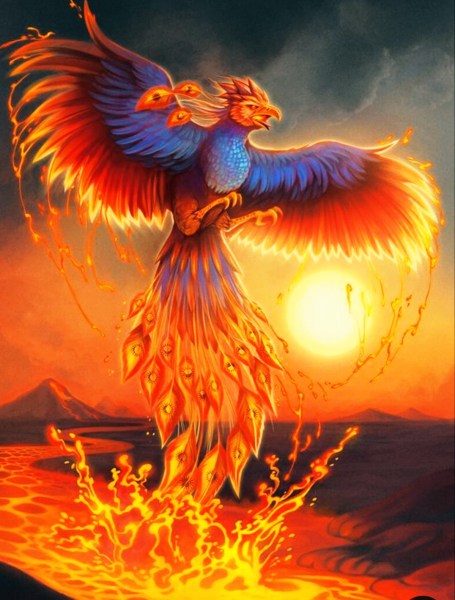
The phoenix is sometimes pictured in ancient and medieval literature and medieval art as endowed with a halo, which emphasizes the bird’s connection with the Sun. In the oldest images of phoenixes on record these nimbuses often have seven rays, like Helios (the Greek personification of the Sun). Pliny the Elder also describes the bird as having a crest of feathers on its head, and Ezekiel the Dramatist compared it to a rooster.
Although the phoenix was generally believed to be colorful and vibrant, sources provide no clear consensus about its coloration. Tacitus says that its color made it stand out from all other birds. Some said that the bird had peacock-like coloring, and Herodotus’s claim of the Phoenix being red and yellow is popular in many versions of the story on record. Ezekiel the Dramatist declared that the phoenix had red legs and striking yellow eyes, but Lactantius said that its eyes were blue like sapphires and that its legs were covered in yellow-gold scales with rose-colored talons.
Herodotus, Pliny, Solinus, and Philostratus describe the phoenix as similar in size to an eagle, but Lactantius and Ezekiel the Dramatist both claim that the phoenix was larger, with Lactantius declaring that it was even larger than an ostrich.

 Eduindex
You must be logged in to post a comment.