
Is Pluto a planet or not?

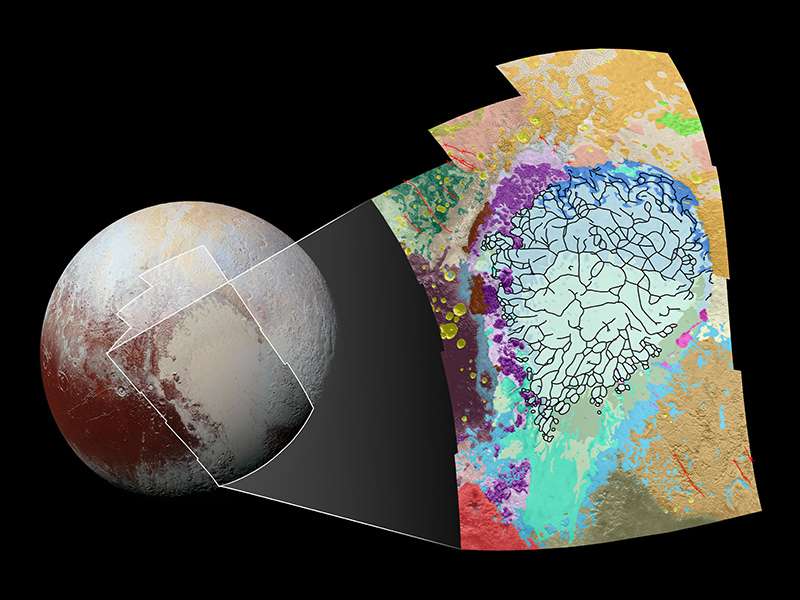
Pluto – which is smaller than Earth’s Moon – has a heart-shaped glacier that’s the size of Texas and Oklahoma. This fascinating world has blue skies, spinning moons, mountains as high as the Rockies, and it snows – but the snow is red.

Soon after Pluto was discovered in 1930, it was designated a planet, the ninth in our solar system. After Pluto was discovered, many astronomers presumed it to have been responsible for the perturbations they have observed in Neptune’s orbit. It was these perturbations that actually prompted the search for a planet beyond it. However, further observations determined that it was smaller than initially assumed. Also, after American astronomer James Christy discovered Pluto’s largest moon, Charon, in 1978, astronomers were able to determine Pluto’s mass and realized that it was a lightweight and didn’t exert a gravitational influence powerful enough to have induced the observed perturbations. Pluto was found to be smaller and less massive than all the other planets. Moreover, its orbit is highly inclined (17 degrees) relative to the ecliptic, the plane defined by Earth’s orbit around the Sun. The other planetary orbits have smaller inclinations.     

As telescopes got bigger and better, and were able to take clearer pictures of distant bodies like Pluto, astronomers began to suspect that Pluto was much, much smaller than the other planets. By the time the second Kuiper Belt object was discovered in 1992, astronomers knew that Pluto was even smaller than Earth’s moon, but it had been called a planet for so long that it retained its planetary status.

Astronomers had also known for decades that Pluto’s orbit actually crosses Neptune’s orbit. None of the other planets cross each other’s orbits, so why was Pluto’s orbit different?

Over the next few years, dozens and then hundreds more Kuiper Belt objects were discovered by astronomers, until finally, in 2005, astronomer Mike Brown discovered Eris, which is even bigger than Pluto.
  

In the early 21st century, astronomers were finding bodies of comparable size beyond Pluto, such as Sedna, Eris, Makemake, and others. These discoveries prompted the question: should the IAU confer planetary status on all these other worlds? In August 2006, the IAU convened its triennial meeting in Prague. Toward the end of this meeting, they voted on the adoption of Resolution 5A: “Definition of ‘planet.” By this newly adopted definition, a body has to fulfill three requirements to be designated a planet. First, a body has to have established a stable orbit around the Sun. Thousands of bodies meet this condition. Secondly, a body has to have developed a spheroidal shape. When a body is sufficiently large and massive, gravity will mold it into a spheroid. Pluto fulfills this condition. Third, and finally, the body has to have cleared its debris field. It has to be sufficiently massive so as to incorporate all proximate objects into it. Pluto fails on this condition, as its orbit passes close to or even within the Kuiper Belt, a region from which short periods comets originate. By adopting resolution 5A, the IAU demoted Pluto, firmly established the other eight planets as planets, and disqualified all the bodies beyond Pluto, all in one fell swoop.    
 
Although the recent observations by the New Horizons craft has shown us that Pluto is larger, more geologically dynamic, and contains a thicker atmosphere than once believed, it still doesn’t fulfill the third condition within Resolution 5A. The IAU will have to adopt a revised definition of planet in order to confer planetary status back onto Pluto.

Of course, some defiantly maintain that Pluto is still a planet and no resolution shall induce us to change our minds. 
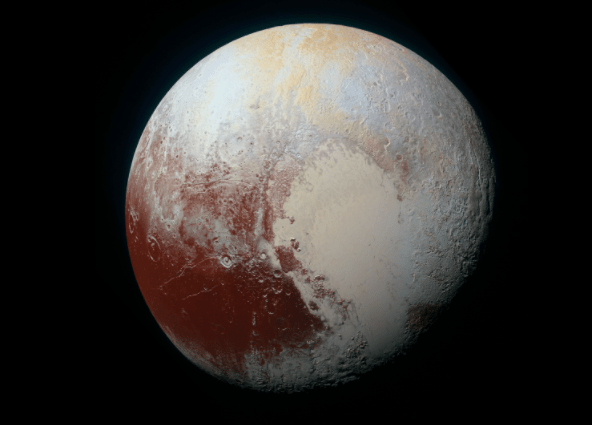
Pluto-The King of Kuiper Belt

Pluto is the ninth-largest and tenth-most-massive known object directly orbiting the Sun. It is the largest known trans-Neptunian object by volume but is less massive than Eris. Pluto is a dwarf planet in the Kuiper belt, a ring of bodies beyond the orbit of Neptune. It was the first and the largest Kuiper belt object to be discovered. After Pluto was discovered in 1930, it was declared to be the ninth planet from the Sun. Beginning in the 1990s, its status as a planet was questioned following the discovery of several objects of similar size in the Kuiper belt and the scattered disc, including the dwarf planet Eris. This led the International Astronomical Union (IAU) in 2006 to formally define the term “planet”—excluding Pluto and reclassifying it as a dwarf planet.

Some facts about Pluto

Diameter-   2300km

Orbital period-  247.8 yrs

Length of a Day-    6.39 days

Axis tilt- 123 degrees

Distance from  the Sun- 39.5AU (5.9billion km)

Moons- 5

Special features

Like other Kuiper belt objects, Pluto is primarily made of ice and rock and is relatively small—one-sixth the mass of the Moon and one-third its volume. It has a moderately eccentric and inclined orbit during which it ranges from 30 to 49 astronomical units or AU (4.4–7.4 billion km) from the Sun. This means that Pluto periodically comes closer to the Sun than Neptune, but a stable orbital resonance with Neptune prevents them from colliding. Light from the Sun takes 5.5 hours to reach Pluto at its average distance (39.5 AU).

Natural satellites

Pluto has five known moons: Charon, Nix, Hydra, Kerberos and Styx. This moon system might have formed by a collision between Pluto and other similar-sized bodies early in the history of the solar system.

Charon, the biggest of Pluto’s moons, is about half the size of Pluto itself, making it the largest satellite relative to the planet it orbits in our solar system. It orbits Pluto at a distance of just 12,200 miles (19,640 kilometers). For comparison, our moon is 20 times farther away from Earth. Pluto and Charon are often referred to as a double planet. Charon’s orbit around Pluto takes 153 hours—the same time it takes Pluto to complete one rotation. This means Charon neither rises nor sets, but hovers over the same spot on Pluto’s surface. The same side of Charon always faces Pluto, a state called tidal locking.

Pluto’s other four moons are much smaller, less than 100 miles (160 kilometers) wide. They’re also irregularly shaped, not spherical like Charon. Unlike many other moons in the solar system, these moons are not tidally locked to Pluto. They all spin and don’t keep the same face towards Pluto.

See the source image

Structure and Atmosphere

Pluto is about two-thirds the diameter of Earth’s moon and probably has a rocky core surrounded by a mantle of water ice. Interesting ices like methane and nitrogen frost coat its surface. Due to its lower density, Pluto’s mass is about one-sixth that of Earth’s moon. Pluto’s surface is characterized by mountains, valleys, plains, and craters. The temperature on Pluto can be as cold as -375 to -400 degrees Fahrenheit (-226 to -240 degrees Celsius).

Pluto has a thin, tenuous atmosphere that expands when it comes closer to the sun and collapses as it moves farther away—similar to a comet. The main constituent is molecular nitrogen, though molecules of methane and carbon monoxide have also been detected. 

When Pluto is close to the sun, its surface ices sublimate (changing directly from solid to gas) and rise to temporarily form a thin atmosphere. Pluto’s low gravity (about six percent of Earth’s) causes the atmosphere to be much more extended in altitude than our planet’s atmosphere. Pluto becomes much colder during the part of each year when it is traveling far away from the sun. During this time, the bulk of the planet’s atmosphere may freeze and fall as snow to the surface.

Exploration

The New Horizons spacecraft, which flew by Pluto in July 2015, is the first and so far only attempt to explore Pluto directly. Launched in 2006, it captured its first (distant) images of Pluto in late September 2006 during a test of the Long Range Reconnaissance Imager. The images, taken from a distance of approximately 4.2 billion kilometers, confirmed the spacecraft’s ability to track distant targets, critical for maneuvering toward Pluto and other Kuiper belt objects.

https://www.nasa.gov/audience/forstudents/k-4/stories/nasa-knows/what-is-pluto-k4.html
https://en.wikipedia.org/wiki/Pluto