
SEXISM

BY: VAIBHAVI MENON

Sexism is prejudice or discrimination based on one’s sex or gender. Sexism can affect anyone, but it primarily affects women and girls. It has been linked to stereotypes and gender roles, and may include the belief that one sex or gender is intrinsically superior to another. Extreme sexism may foster sexual harassment, rape, and other forms of sexual violence. Gender discrimination may encompass sexism, and is discrimination toward people based on their gender identity or their gender or sex differences. Gender discrimination is especially defined in terms of workplace inequality. It may arise from social or cultural customs and norms.

the term “sexism” was most likely coined on November 18, 1965, by Pauline M. Leet during a “Student-Faculty Forum” at Franklin and Marshall College. Specifically, the word sexism appears in Leet’s forum contribution “Women and the Undergraduate”, and she defines it by comparing it to racism, stating in part “When you argue that since fewer women write good poetry this justifies their total exclusion, you are taking a position analogous to that of the racist—I might call you, in this case, a ‘sexist’. Both the racist and the sexist are acting as if all that has happened had never happened, and both of them are making decisions and coming to conclusions about someone’s value by referring to factors which are in both cases irrelevant.” Also, according to Shapiro, the first time the term “sexism” appeared in print was in Caroline Bird’s speech “On Being Born Female”, which was published on November 15, 1968, in Vital Speeches of the Day. In this speech she said in part: “There is recognition abroad that we are in many ways a sexist country. Sexism is judging people by their sex when sex doesn’t matter. Sexism is intended to rhyme with racism.” Sexism may be defined as an ideology based on the belief that one sex is superior to another. It is discrimination, prejudice, or stereotyping based on gender, and is most often expressed toward women and girls.

Sociology has examined sexism as manifesting at both the individual and the institutional level. According to Richard Schaefer, sexism is perpetuated by all major social institutions. Sociologists describe parallels among other ideological systems of oppression such as racism, which also operates at both the individual and institutional level. Early female sociologists Charlotte Perkins Gilman, Ida B. Wells, and Harriet Martineau described systems of gender inequality, but did not use the term sexism, which was coined later. Sociologists who adopted the functionalist paradigm, e.g. Talcott Parsons, understood gender inequality as the natural outcome of a dimorphic model of gender. Psychologists Mary Crawford and Rhoda Unger define sexism as prejudice held by individuals that encompasses “negative attitudes and values about women as a group.” Peter Glick and Susan Fiske coined the term ambivalent sexism to describe how stereotypes about women can be both positive and negative, and that individuals compartmentalize the stereotypes they hold into hostile sexism or benevolent sexism.

Feminist author bell hooks defines sexism as a system of oppression that results in disadvantages for women. Feminist philosopher Marilyn Frye defines sexism as an “attitudinal-conceptual-cognitive-orientational complex” of male supremacy, male chauvinism, and misogyny. Philosopher Kate Manne defines sexism as one branch of a patriarchal order. In her definition, sexism rationalizes and justifies patriarchal norms, in contrast with misogyny, the branch which polices and enforces patriarchal norms. Manne says that sexism often attempts to make patriarchal social arrangements seem natural, good, or inevitable so that there appears to be no reason to resist them.
ZODIAC SHAMING

BY: VAIBHAVI MENON

If you’re the type of person who thinks astrology is garbage, this entire line of thinking is your personal hell. It’s bad enough that people believe their personalities are based on the planetary alignment at the time of their birth. Now they’re casting off whole groups of people based on that same deranged paradigm? If you’re the type of person who thinks astrology is garbage, this entire line of thinking is your personal hell. It’s bad enough that people believe their personalities are based on the planetary alignment at the time of their birth. Now they’re casting off whole groups of people based on that same deranged paradigm? In China, zodiac discrimination is a well-documented problem. A 2017 study found that 4.3 percent of college students surveyed reported suffering employment-based discrimination because of their astrological sign (Western and/or Chinese). Constellation-based recruitment has its own entry in Baidu Baiku, otherwise known as Chinese Wikipedia. Close to 30 percent of Americans now believe in astrology, a number that’s been rising steadily. Who knows how long it’ll take before zodiac discrimination becomes an institutionalized problem here?

Not all forms of labelling or grouping are bad. You can still use the zodiac to make judgements about people, R but they should be holistic, non-prescriptive observations — ones that take people’s whole selves into account. Instead of writing people off because they’re Scorpios or Geminis. People are their sign, but they’re also far more than their sign. Behavior exists on a spectrum. Just because Virgos are thought of as anal doesn’t mean they all want a vacuum cleaner for Christmas. Writing anyone off without taking time to know them isn’t just unethical, it’s a boring way to live. Obviously discrimination based on, say, racial lines, is far more pronounced in society, not to mention negative. Most astrology signs don’t outright call people stupid or lazy, though they do imply weaknesses and temperent as well as strengths. But both are arbitrary categorizations for personality that utterly lack evidence or rationale. If you believe in astrology, and truly believe that the month someone was born in determines their personality, you are prejudging people based on when their birthday is. And as ridiculous as that sounds, there are still people who pay money to see their horoscopes and make life decisions based on them, including having their perspective and behavior toward others adjust based on each person’s signs. The basic premise of astrology is that people who were born at certain times and places share distinguishing personality characteristics. Libras, for example, are said to be diplomatic, refined, idealistic, and sociable; Capricorns are responsible, disciplined, hard-working, demanding, and so on. Tens of millions of people know something about their sun signs and read their daily horoscopes. There are some interesting parallels between racism and astrology. For one thing, in both cases a person is being judged by factors beyond their control. Just as a person has no control over his or her race or skin color, they also have no control over when and where they were born. In both cases, there is a framework of belief that says, “Without even meeting or knowing you, I believe something about you:   I can expect this particular sort of behavior or traits (sneakiness, laziness, arrogance, etc.) from members of this particular group of people (Jews, blacks, Aries, etc.)” When an astrologer meets a person and finds out that person’s astrological sign, she will bring to that experience a pre-existing list of assumptions (prejudices) about that person’s behavior, personality, and character. In both cases, the prejudices will cause people to seek out and confirm their expectations. Racists will look for examples of anti-social behaviors in the groups they dislike, and astrologers will look for the personality traits that they believe the person will exhibit. Since people have complex personalities (all of us are lazy some of the time, caring at other times, etc.), both racists and astrologers will find evidence to confirm their beliefs.

What is trying to be conveyed here is that zodiac signs or anything else that can be used as a form of discrimination should be avoided. No one deserves to be treated in this manner for these reasons. It definitely shouldn’t be acceptable.

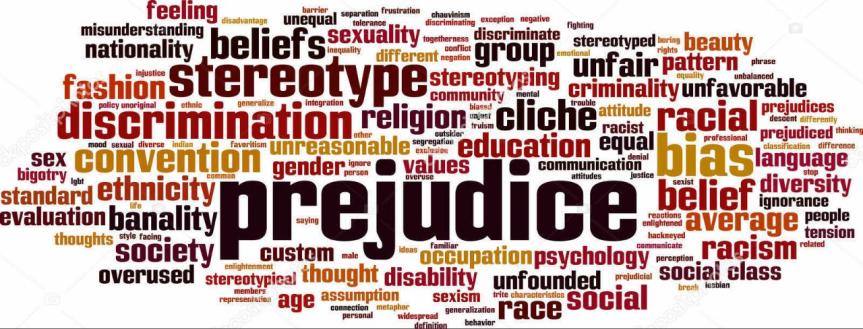
Prejudices and Stereotypes

Prejudices refers to a set attitudes towards a particular group of people. They usually refer to negative attitudes. Attitude is a state of mind or set of views with an evaluative feature. Prejudices are often based on stereotypes about the specific group.
Stereotypes refers to fixed ideas regarding the characterstics of a specific group. Usually, stereotypes consist of undesirable characteristics about the target group. All members of the group are assumed to possess these characteristics which is often not true in reality.
Prejudice is often accompanied by dislike or hatred towards members of the group. Prejudice can be seen in behaviour through discrimination. Discrimination makes a distinction between the two groups by favouring one group over other. Sometimes prejudice can lead to excessive hatred and discrimination which may even lead to mass killing of innocent people. An example of this is the holocaust of Jews by Nazi Germany. Discrimination can controlled by law but attitudes and minds sets of people cannot.
Just like any other attitude, prejudices are also learned through observation, association, exposure to information or through culture. The family, groups, personal experiences, media also play a role in learning of prejudices. In some cases it has been observed that a strong social identity towards one’s own group may cause group bias and lead to negative attitudes towards other groups and lead to prejudice.
Another reason for prejudice is scapegoating. It is a group based way of expressing frustration towards the weaker group and it leads to negative attitudes. Here the stronger group places the blame for its problems on the weaker group. The weaker group is too weak to defend itself.
https://www.bbc.co.uk/bitesize/guides/zcb42hv/revision/3#:~:text=One%20bad%20experience%20with%20a,and%20can%20lead%20to%20prejudice
Sometimes people continue to hold stereotypes because they believe that after all, there may be some truth in what people say. These sorts of beliefs are rather difficult to change as they originate in response to other stronger beliefs.
Stereotypes are also learned in the similar manner as attitudes. Stereotypes are usually formed by hearing different things about the particular group. A single bad experience with the member of a group may lead to the assumption that all members of that group behave that way.
https://blogs.hope.edu/getting-race-right/our-context-where-we-are/the-history-we-inhaled/what-are-the-causes-of-stereotypes/
Stereotypes provide grounds for prejudices which lead to discrimination. This however, is not always true. Sometimes prejudices may develop without stereotypes or may not lead to discrimination. Similarly, discrimination may be seen without prejudice. But even so, these three are often considered to be connected.
Prejudices are attitudes and are not very easy to change if once formed. In order to control it, strategies should focus on minimising the opportunities for learning prejudices or changing such attitudes at an earlier stage. Narrow social identity based on the in-group should not be emphasised and people should be encouraged to seek out truth rather than blindly believing in what they hear.
These goals can be achieved through education and information. By correcting the stereotypes that are formed on false grounds. Emphasis should be given to individual identities rather than group identities. This can weaken strong in-group bias. Increasing the contact between the two groups can remove misunderstandings, mistrust and can lead to communication which may lead to discovery of positive characteristics.