Pride, prejudice and arrogance.


Augustine, it is “the love of one’s own excellence.”

Pride:

Pride is a double edged sword.

Pride is usually considered in 2 ways
1) The feeling of satisfaction that comes from one’s own achievement or those affiliated to us.
2) Having a high opinion of oneself which sometimes expresses itself in the form of arrogance or excessive belief over one’s abilities.

The opposite of pride is humility

Prejudice:


It is described as a stereotyped attitude towards a particular social group.
There are many types of prejudices. There’s ageism, sexism, racism, those from different religions and ethnic groups, people who are overweight or underweight,  people with sexual orientations and the list is endless.
It varies according to environment who are more likely to become a target. -Prejudice does not need a base or proof. It is mostly based on an individual’s delusional theory regarded someone/something because of something they went through.

-Scientific postulates need proof, trial, and error, and goes through thorough objective examination to form a theory.
It is deduced from natural occurrences to aid the growth of every being on Earth.

-Thus there is a clear boundary between prejudice and science.
Thinking that a human born into an ethnicity they had no control over, is preposterous cannot be ever justified.
Well, I mean have thought over this.
You treat them like a monster, take away the room for growth, or won’t let them have an understanding of the world, force upon them their ancestors or someone’s act, treat their every mistake or an act of love as sin.
You are letting them realize that no matter what they do, they will always be regarded as criminals. In order to live a normal life, in order to escape from Hell on Earth, they will have no option but to take actions that align with their prejudices to have a chance at life.
Aren’t you giving birth to the one you are so wary about? How will assuming negative about someone you haven’t met going to remove the things you want?


It is humane to worry about wolves in sheep’s clothing, it is natural to protect someone you love. But hatred and pride blind not only you but also others from peace, from a true safe environment.
   The mutual understanding that prejudice exists but at the same time, trying to resolve those by complete honesty and understanding will protect you from external influences ( yes, I mean someone who wants conflicts to exist between the groups), and will give the groups a chance to make way for growth despite the differences.
It is very easy for me to say and I realize how idealistic or dreamy it seems, but without interaction between conflicting groups, without a wish to make things better for innocent ones around you, the casualties, hatred, and stereotypes are bound to grow and create wars. 

When prejudice causes a group to be treated differently than others in situations that call for equal treatment, it is called discrimination.

Arrogance:


It can simply be defined as aggressive evolution of pride, and manifested in form of extreme expression emotionally (within one’s mind or vocally).  To exaggerate one’s own worth or importance often in a pompous manner.

  • Doesn’t believe they can mistakes or faults.
  • Tries to put blame on others.
  • Creates a fearful environment.
  • Always wants to be right.

We will talk about the thin line between pride and arrogance soon in following articles. 🙂

Jane Austen-A great novelist

If you have read any novel of Jane Austen, when you hear name her name what comes in your mind is her critical comments on society not harsh but smooth, and her art of characterization. How strong she depicts female characters and male characters soft. It comes to mind that she is a kind of feminist.
Jane Austen, an English novelist. She is one of the great novelists of the 19th century. She is known for her six major novels that interpret, critique, and comment upon British society at the end of the 18th century. Her writings, the way she uses biting irony, along with her realism, humor, and social commentary made her one of the great masters of English novels. Her novels are about the typical life of normal people and families.
Jane Austen died at the age of 41 on 18 July 1817. Even after two centuries of her death, her novels are still considered as best. Austen was not so much famous during her lifetime. At that time female writers were not acceptable so like many female writers she started publishing anonymously. When they were published her works were considered as fashionable but received only a few reviews. By the middle of the 19th century, her novels were admired by various members of the literary elite. They viewed their appreciation of her works as a mark of cultivation. In early 1838 her novels were being recommended on school reading lists.
After reading her novels one can find out that in her novels she depicts characters who seem familiar to her and most of the character’s chief interest was matrimony. She, in her novels, presents criticism of rural society around her and it seems that she confines herself to the middle-class society.
Mainly the themes of the novels of Jane Austen are love and marriage. In her novel “Pride and Prejudice” the opening line says “It is a truth universally acknowledged, that a single man in possession of a good fortune, must be in want of a wife” this is one of the best opening lines of English literature which shows Jane Austen’s satirical comment on society. In her novels, a young woman falls in love with a rich and desirable man. And after all the difficulties faced by the female protagonists, everything ends very well.
The most interesting and praiseworthy thing in the novels of Jane Austen is her art of characterization. She creates living characters, minutely portrayed and well described. In her novels, males are soft than female characters. The female characters especially protagonists of novels are so bold and perfect. The way she used to present female characters, females from the 21st century can learn a lot. This shows how she imagines at that time about the freedom and rights of females. Hence, we can say that she feminized an English novel. Her most memorable characters like Darcy Elizabeth, Emma and John Thrope, etc.
Name of her famous novels
1811 – Sense and Sensibility
1813 – Pride and Prejudice
1814 – Mansfield Park
1815 – Emma
1818 – Northanger Abbey (posthumous)
1818 – Persuasion (posthumous)

Influence of Social Class in ‘Pride and Prejudice’

Social Class refers to a hierarchy in a society wherein people are grouped on the basis of their wealth status. Jane Austen’s Pride and Prejudice (1813) is acknowledged for its keen commentary on these aspects of the society. The influence of social class and the greed to climb up this social hierarchy is much of novel’s criticism.  

Austen’s works usually focus on the preoccupations of the middle class and the upper class, and are rarely focused on the Aristocrats (people with title) or the working class. But even within that, there are several other differentiations as Regency England so working for money something of low standards. They acquired wealth through property, marriage, and inheritance. For instance, although the Bingley family are economically farer than most, on the basis of class, they are considered equal or maybe even lower than that of the Bennets as they are said to have made their money through trade or business.

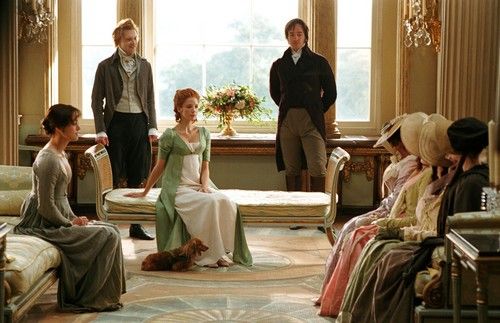
A still from Pride and Prejudice (2005)

The novel also portrays characters who react differently to class. Characters like Bingley sisters and Mr. Collins fawn over the rich and try to please them. Especially Mr. Collins who depends on largely on Lady Catherine De Borough to gain social acceptance. He does all their biddings and constantly attempts to flatter them in order to ensure his good associations with them. Lady Catherine on the other hand, is very proud of her richness and sees everyone as beneath her. The novel satirises these characters who move only in relation to class, and are portrays the conceited idea that social distinction is an important factor in judging someone’s character. Lady Catherine is so used to people doing her biddings and obeying her orders that she is taken off-guard when Elizabeth stands up for herself. She objects to Lizzy marrying Darcy due to her fear that it would indirectly affect her own social class through association. Elizabeth in return, replies that she’d marry whomever she wishes to for her own happiness.

“In marrying your nephew, I should not consider myself as quitting that sphere. He is a gentleman; I am a gentleman’s daughter; so far we are equal.”

Jane Austen (Chapter 56)

Characters such as Mr. Bingley and the Gardeners seem much more as they do not discriminate on the basis of class even if they are financially well-to-do. Darcy can be seen as an example of Austen’s ideal high-class gentleman. Despite seeming selfish and arrogant initially, he later proves that he is capable of change. His innocence also becomes evident when Lizzy talks to the residents of Pemberly. The social status of the Bennet family is threatened to a large extant when Lydia runs away with Mr. Wickham. They are saved from ‘social degradation’ only when Darcy covers up the issue with money.  

Pride and Prejudice shows that class might determine a character’s social situation, but it doesn’t signify anything about their behavior. The marriage between Elizabeth and Darcy shows that even though class restrictions are rigid, it does not determine one’s character and that love can overcome all material obstacles like class. It proves that class is ultimately an arbitrary and meaningless distinction between people.  

Reference Links:

Aspects of Wealth in ‘Pride and Prejudice’

Jane Austen’s Pride and Prejudice (Published in 1813) is considered to be a classic in literature. It has often been glossed over as a romantic novel and though it is concerned with human relationships, especially of romantic ones, Austen focuses a great deal on wealth and class. Her infamous opening quote in itself is a testament to the fact that she consciously criticized the influence of money in a society.

“It is a truth universally acknowledged, that a single man in possession of a good fortune, must be in want of a wife.”

Jane Austen (Chapter 1)

Pride and Prejudice is set in Regency England, which was a time of great political unrest and economy volatility. This was mainly due to the shift of the economy from an agrarian one to that of an industrial one. Until then, people were only mainly concerned about food and other primary needs. But the industrialization paved for more materials in the market like clothes, utensils, etc. So more the commodities, the more people wanted money to spend on such items. Thus, the need for money increased, and in the Regency England, being a gentleman was considered more important than merely being rich. And the concept of a gentleman relied highly on inheritance and people wanted to be rich without working for it.

Austen has taken care to include details of each character’s money and their economy backgrounds. The richer characters include people like Bingley who receives €500 per annum and is clearly rich enough to host balls take care of his sisters’ needs. Georgiana Darcy is said to inherit €30,000 pounds and will remain well-to-do even if she is denied legal inheritance of property. Mr. Darcy on the other hand, is a modern equivalent of a multi-millionaire who gets up to €10,000 per year and would get more from his investments. The middle-class characters include Mr. Bennet who receives approx. €2000 per year and would even be considered an upper-middle class. Mr. Wickham inherits €1000 from Darcy’s father and even more from Darcy for leaving the clergy. Although he spends it all and goes into debt, Darcy pays him again to marry Lydia. The Bennet girls on the other hand, would receive only a maximum of €40 per year until the death of their father, after which, their land would legally go to their cousin. Thus, the Bennet sisters had to marry for survival and not just to uphold class. When Elizabeth rejects both Darcy and Mr. Collins, she’s taking a huge risk by choosing happiness over financial security.

Fitzwilliam Darcy€10,000 per year + more
Georgiana Darcy€30,000 inheritance
Charles Bingley€5000 per year
Rich Characters

Mr. Bennet€2000 per year
George Wickham€1000 inheritance
The Bennet Girls€40 per year
Middle Class Characters

Austen also criticises material obsessions through characters like Mr. Wickham and Mrs. Bennet who obsesses despite not being rich, through Caroline Bingley who is pretentious and through characters like Catherine de Borough who exploit their wealth for status.

One of the criticisms against the novel is also that it unconsciously puts out the idea that you need to be rich and have money to be happy. Elizabeth who marries Darcy is happy, Jane who marries Bingley is happy, Charlotte who marries Mr. Collins is not too happy and Lydia is unhappy as she is doomed to pay off Wickham’s debts for the rest of her life. Nevertheless, the Pride and Prejudice’s detailed treatment of money adds to the novel’s realism.   

Reference Links: