

In the early models of the atom were simple, with protons and neutrons forming a nucleus and negatively charged electrons orbiting it, it seemed like a tiny solar system. In the early 1930s, however, analysis of cosmic rays and experiments with particle acceleration showed the existence of new particles by the dozen. In the early of 1960s American physicist Murray Gell-Mann and George Zweig independently conjectured that protons and neutrons were made of even more fundamental particles. They named the subatomic particles as Quark in 1964. The word quark came from James Joyce’s novel “Finnegan’s Wake” in which it is a nonsense word made by Joyce. He key evidence for their existence came from a series of inelastic electron-nucleon scattering experiments conducted between 1967 and 1973 at the Stanford linear accelerator center. Other theoretical and experimental advances of the 1970s confirmed this discovery, leading to the standard model of elementary particle physics currently in force.

Properties of Quarks
Quarks are most commonly found inside protons and neutrons. They have many properties including mass, electric, charge, and color. There are six types of quarks, up quark, down quark, top quark, bottom quark, strange quark, charm quark. They can have positive (+) or negative (-) electric charge. Up, charm and top quarks have a positive 2/3 charge. Down, strange, bottom quarks have a negative 1/3 charge. So protons are positive because there are two quarks (+2/3) ups and one down quark (-1/3), giving a net positive charge (+2/3+2/3-1/3 =1). These three quarks are known as valence quarks, but the proton could have an additional up quark and anti-up quark pair.
An anti-quark is the anti-particle of a quark and it could have other types of quarks. It includes pairs of strange quarks and anti-strange quarks, charm quarks, and anti-charm quarks. In fact, the proton has tons of quarks, anti-quarks pairs. The quarks are held together by the strong force which is carried by particles called gluons. So inside the proton, there are zillions of gluons and quarks all moving around close to the speed of light. The quarks that comprise a proton only make of 1% of the mass of that proton. A neutron consist two down quarks and one up quark which gave it an overall charge of 0. The quarks have a property called color change. It includes three color, red, blue, green and each of them is complemented with an anti-color. When we mix these three colors, we get white, that’s why proton is called colorless. The quarks change their colors constantly but, In order to maintain colorless state, the ant-color mix into it.The interaction between quarks and gluons is responsible for almost all the perceived mass of protons and neutrons and is therefore where we get our mass.

Conclusion
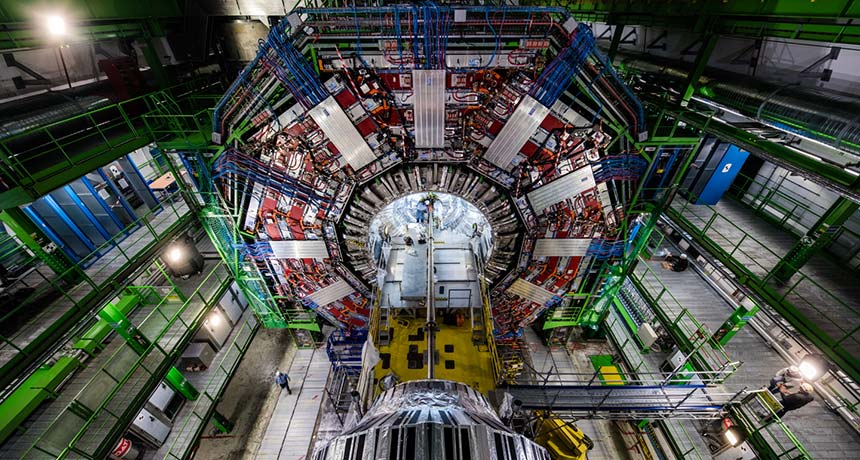
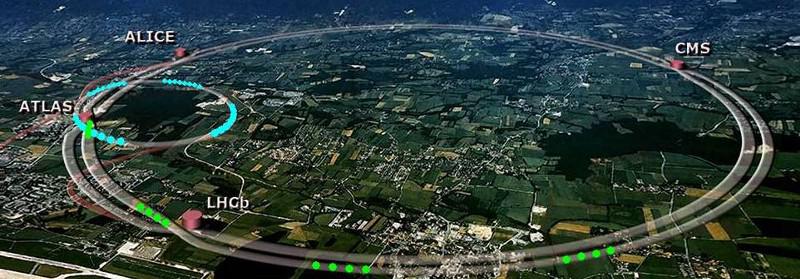
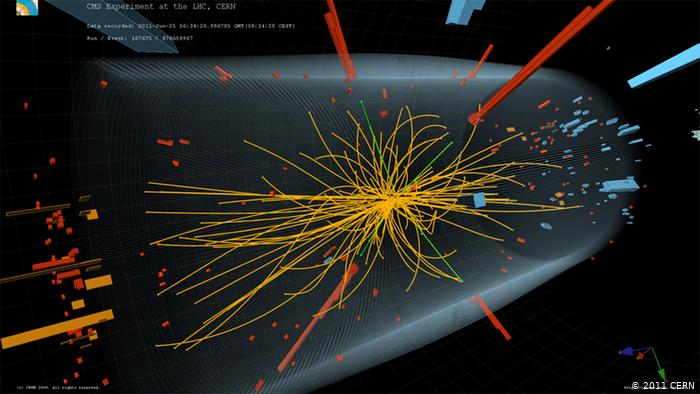
The discovery of quarks was a gradual process that took over a decade for the entire sequence of events to unfold. A variety of theoretical insights and experimental results contributed to this discovery, but the MIT-SLAC deep inelastic electron scattering experiments plays a vital role. The existence of quarks is recognized today as a cornerstone of the standard model. I numerous experiments at CERN including those at the Large Hadron Collider (LHC), physicists are measuring the properties of Gell-Mann and Zweig’s particles with ever-greater precision.
“Three quarks for muster mark!” – Author James Joyce
 Eduindex
You must be logged in to post a comment.