

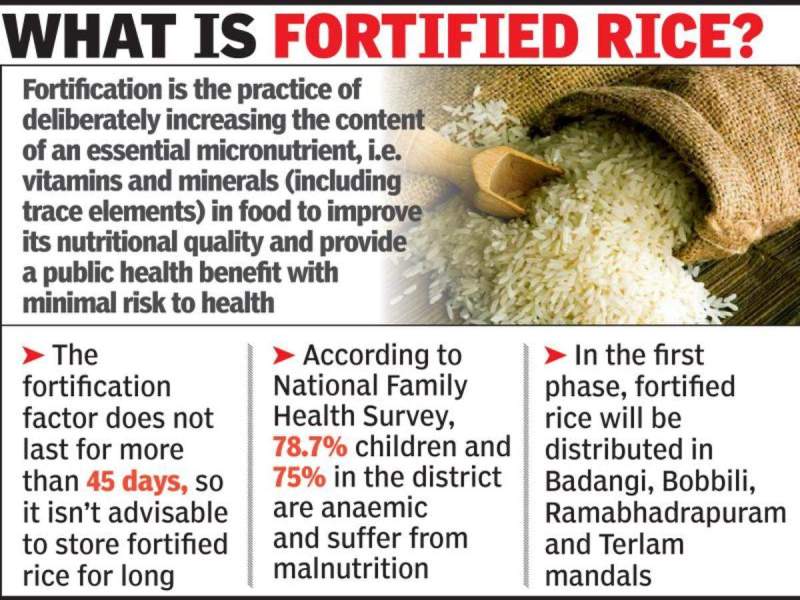
Fortification is the addition of key vitamins and minerals such as iron, iodine, zinc, Vitamin A & D to staple foods such as rice, milk and salt to improve their nutritional content.
Fortification of rice is a cost-effective and complementary strategy to increase vitamin and mineral content in diets.

According to FSSAI norms, 1 kg fortified rice will contain iron (28 mg-42.5 mg), folic acid (75-125 microgram) and Vitamin B-12 (0.75-1.25 microgram). In addition micronutrients can also be added, singly or in combination, with zinc, Vitamin A, Vitamin B1, Vitamin B2, Vitamin B3 and Vitamin B6.
Need of Food Fortification?
There is high level of malnutrition among children and women in India. A/c to Food Ministry, every second woman in the country is anemic and every third child is stunted.
India ranks 101 among 116 countries in the Global Hunger Index (GHI) 2021. In 2020 it was positioned 94th.
Rice is one of India’s staple foods, consumed by about two-thirds of the population. Therefore, fortifying rice with micronutrients is an option to supplement the diet of the poor.
Issues with the Fortification of Rice
- Inconclusive Evidence:
- Evidence supporting fortification is inconclusive and certainly not adequate before major national policies are rolled out.
- Hypervitaminosis:
- According to some studies published in the medical journal Lancet and in the American Journal of Clinical Nutrition which show that both anaemia and Vitamin A deficiencies are overdiagnosed, meaning that mandatory fortification could lead to hypervitaminosis ( a condition of abnormally high storage levels of vitamins, which can lead to various symptoms such as over excitement, irritability, or even toxicity ).
- Toxicity:
- Adding one or two synthetic chemical vitamins and minerals will not solve the larger problem, and in undernourished populations can lead to toxicity.
- A 2010 study that showed iron fortification causing gut inflammation and pathogenic gut microbiota profile in undernourished children.
- Cartelisation:
- Mandatory fortification would harm the vast informal economy of Indian farmers and food processors including local oil and rice mills, and instead benefit a small group of multinational corporations.
- Decrease Value of Natural Food:
- Once iron-fortified rice is sold as the remedy to anaemia, the value and the choice of naturally iron-rich foods like millets, varieties of green leafy vegetables, flesh foods, liver, to name a few, will have been suppressed.
There are different methods to make rice more nutritious post-harvest: Dusting, Coating, Hot or Warm extrusion.
To have a positive health impact, fortified rice needs to have good:
- Stability during transport and storage
- Retention during cooking & preparation
- Consumer acceptability
- Absorption by the body of the used micronutrients
Benefits of fortification –
- Ease of use – this is one of the biggest benefits. As a widely used staple food, it is simple to replace standard rice with fortified rice to boost the nutritional profile of a simple diet.
- Cost – the specific costs of fortified rice depend on several factors, such as the scale of the operation and the blending ratio of fortified to non-fortified kernels.
- Consistency for consumers – it looks, cooks, and tastes the same as non-fortified rice.
- Market differentiation for brands – fortified rice can also be customized for specific needs. It presents a solution for health-conscious consumers looking for new ways to reach specific health benefits.
- Reducing micronutrient deficiencies for governments and schools

 Eduindex
You must be logged in to post a comment.