SECULARISM

Secularism is defined as a doctrine where all religions are given equal status recognition and support from the state. In other words ,secularism simply means as a doctrine that promote separation of state from religion.

Secularism stands for that there should be no discrimination and partiality on grounds of religion and everyone should get an equal opportunity to follow the religion of their choice.

The tradition of secularism is inhibited In The Deep roots of the history of India. In a nation India the first face of secularism is reflected in the preamble of India where the word secular holds the most importance. Indian secularism is also reflected in its fundamental rights article 25 to 28 where the government guarantees each of its citizens the right to practice any religion.

In the words of PB Gajendragadkar ,a former Chief justice of India, secularism is defined as the state does not all loyalty to any particular religion as such it is not irreligious or anti religious it gives equal freedom to all religion.

Indian philosophy of secularism is related to “Sarva Dharma Sambhavana” ,meaning the destination of the parts followed by all religions is the same though the parts them self maybe different simply meaning secularism means equal respect to all religions.

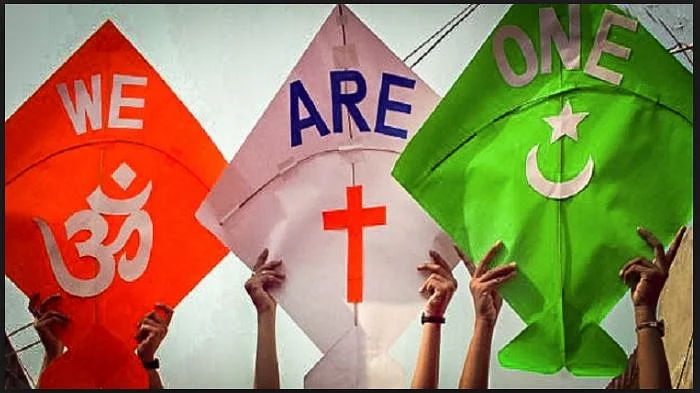
India is a secular country and India does not attached its politics with any individual religion. We Indians together celebrate every festival as well as Indians have the entire freedom and say to celebrate their religion in the country regardless of the caste and creed.

The ideology of Secularism also allows people to express their opinions and beliefs freely. As in a secular state ,no religious group can apply pressure of dominance . Through this ideology, their has been an increasing effect on the right to speech.

The history of secularism in India way backs to 1976 ,where during the 42nd Amendment of the Indian Constitution. The leaders of Independent India had visualised India,  as a country where religion is no bar for its citizens.

SECULARISM IN MODERN INDIA

India was under the control of the East India Company and the British Raj after Aurangzeb. The British East India Company pursued a divide and rule policy, yet the spirit of secularism was strengthened and enriched by the Indian Freedom Movement. The politics of “divide and rule” has contributed to some extent to the conflict of communities between different communities. The partition of Bengal in 1905 followed this policy. The Council of the Indies Act of 1909 made available to other voters for Muslims. This provision was extended by the Government of India Act 1919 to seeks in certain states, Christians in India, Europeans, and Anglo-Indians. Separate voters further extended the co-representative principle by providing separate voters to the depressed class (planned caste), women and workers (workers) through the Indian Governance Act of 1935. The establishment of the Indian National Congress in 1885, with its secular values, united people of all denominations and led the free movement to a constructive and successful path. Nehru issued a long report (1928) calling for the abolition of another voter to create a secular state. Gandhi’s secularism was based on a commitment to brotherhood in the religious community based on respect and pursuit of truth, but J.L. Nehru’s secularism was based on a commitment to scientific humanism, adorned with a progressive view of historical change.

 To conclude , Secularism allows the people of various religions to live peacefully without any fear of the majority. It safeguard democracy by limiting the powers of the majority. It ensures harmony in the nation. In absence of secularism, religious persecutions may take place which may result in dissent, conflicts or even a civil war.

Secularism

Introduction

A country is divided not based on its geographical features, but its unique citizens. Even though the underlying principle of India’s success is “Unity in Diversity”, often these differences do not play well with ethnic communities. The intrusion of religion in politics can only yield unwelcoming outcomes. This is where secularism comes in, an ideology that clearly states” Civic affairs should not have any basis in religion”. In 1851, the British writer George Holyoake coined this term, in a quest to replace the aggravating word ‘Atheism’. The main objective of this ideology is to make appropriate decisions without harming the integrity of any religion. In lamen language, he did not want secularism to be misunderstood with discrimination. Not involving certain topics in a decision-making conference does not necessarily mean we deliberately excluded them or seek to prejudice them.

Types of secularism

Based on the intensity of secularism, it can be divided into two types-hard and soft. Hard secularism is a radical option, which aims to completely disavow any stance the topic takes in political decorum. It renders any form of religious knowledge illegitimate. On the other hand, soft secularism finds its roots in neutrality, tolerance, and liberalism. It argues that attaining the “absolute truth” is not possible without proper deliberation and tolerance of religious issues in civic issues.
Secularism is also divided into three different types based on its application. These are political secularism, philosophical secularism, and socio-cultural secularism. All three overlap and are related to each other, yet they exhibit divergent traits and embody discrete meanings.

Secularism in India

India is a multi-cultural and multi-ethnic society. From harboring Muslims, Christians, and Hindus to being the home of more than a hundred languages, our diversity is one that is marveled all over the world. Keeping in mind the conflicts of interest that might arrive with this heterogeneity, our leaders came up with an effective solution to keep the integrity of politics of this country intact. With the 42nd Amendment of the Constitution enacted in 1976, we declared ourselves a secular nation.
Secularism has always been an inspiration for modern India. We identify as a just nation that gives equal rights and opportunities to all its citizens despite their race, caste, or creed. But, the controversy surrounding Indian secularism has also had its share of attention. With many critics claiming that Indian secularism is “defrauded”, a good look at the positive changes bought about by this ideology might change the way they think about our nation.

One of the best examples of the success of the secularism amendment in India is Muslim Madrassas ( religious education schools) getting government funds. Or the fact that one of our own presidents, Dr. APJ Abdul Kalam, was a Muslim. Prime Minister Manmohan Singh was a Sikh, whilst the party leader Sonia Gandhi was a Christian(Born in Italy). Time after time we have witnessed different communities get their fair share of opportunities, and produce fruitful outcomes, all because Indian secularism was, has, and will always be a success.

The term “secular” means being “separate” from religion or having no religious basis. Religion is open to one and all and is given as a personal choice to an individual without any different treatment to the latter.This is the ideology that has done wonders for the world.

The Alienation Of The Majority

Majority wins. This concept has been etched into our thinking. Right vs wrong is too abstract, but majority vs minority is appropriate as it is quantifiable. Democracy, data analysis, judicial verdicts, and other forms of decision making all function using this concept. If there’s a majoritarian will, there is a way. This is the power we have assigned to majorities. However, they sometimes feel disempowered and alienated. 

“The browning of America” is the phrase being used to describe the increasing non-white population in the USA, while the white population is decreasing. According to the 2020 census, the Whites still make up 59.7% of the population; however, this was the first time the White population, in absolute numbers, declined. The next largest group is the Hispanics (18.7%). Projections show that Whites will make up less than 50% of the population by 2045. In the same year, Hispanics will reach 24.6%, Blacks 13.1%, Asians 7.9%, and other multi-racial populations 3.8%.  The perceived effacement of the Whites has had significant consequences. Feelings of insecurity and disempowerment have made the whites resent the non-whites and has led to an increase in racism and xenophobia. Other effects include voter suppression, limiting immigration, and mass incarceration. The most prominent effects can be seen in the rise of Donald Trump, the rightward shift of the Republican party, and pernicious white nationalism. 

In a country that accepted white supremacism as the norm for decades, the effects of these drastic changes were predictable. But why does a country that shows no signs of a diminishing majority suffer through a similar predicament?  

India is a diverse country. We are home to a multitude of cultures, languages, and religions. But, we do have a clear majority. According to the latest national census, Hindus make up 79.8% of India’s population. In comparison, Muslims make up 14.2%, Christians 2.3%,  and the remaining is mostly comprised of Buddhists, Sikhs, and Jains. This division is predicted to remain stable. The Pew Research Centre has projected that in 2050, Hindus will make up 77% of the population, Muslims 18% and Christians 2%. Despite this overwhelming majority, Hindus often feel threatened by minorities and this has had devastating effects on our country. 

The perceived marginalisation of Hindus is not due to changing demographics, it stems from the fear of losing identity and power. In 1947, partition divided the subcontinent into Islamic Pakistan and secular India. Attempts to make India a theocratic state failed. While most Indians cherished secularism, certain right wing organisations hoped to accrue support for the creation of a “Hindu Rashtra”. Consecutive liberal and centrist governments ennobled this secularism that served athwart communal and divisive forces. Successive governments’ focus on welfare schemes and social justice and failure to implement a Uniform Civil Code were interpreted as minority appeasement. Coupled with propaganda created by right wing organisations, the feeling of neglect in the Hindu population led to an increase in animosity and a need to protect one’s Hindu identity at all costs. Hindus were seen as victims, not beneficiaries of secularism. The culmination of these feelings was the election of Narendra Modi and the BJP. 

The BJP is an openly Hindu nationalist party. This can be adduced by public hate mongering by BJP members, lack of condemnation for hate crimes against minorities, and active association with right wing organisations. The Babri Masjid demolition in 1992  and the Gujarat riots in 2002 were harbingers for the destructive communalism that would plague our country. Yet, Hindus felt that they needed to be protected from “the other” and elected Modi and the BJP. The ruling party has astonishingly managed to instil fear in the majority. The misrepresentation, even rewriting of history, is used to propound the need for revenge against Muslims and Christians for harm caused by the Mughal and British empires. Canards are used to arrogate that Hinduism could become a minority religion in the near future. The politics of polarisation is a tactic used by the BJP to evade responsibility for an economy that is in free fall, increasing unemployment rates, rising inflation, widespread income disparity, dismantling of democracy, and mismanagement of the COVID situation. “Sabka Saath Sabka Vikas” does not advocate for a society and economy that works for every Indian, but imbues a reassurance that Hindus will be empowered by the government. 

Sadly, state supported Hindu extremism has sown seeds of intolerance in all parts of society. There is growing hate in this country. I am going to focus on three aspects of this hatred: violence against minorities, rise of Islamophobia and misuse of anti conversion laws. 

India under the BJP has witnessed a rise in threats, harassment, harm, and murders of minorities. Events that have taken place recently are paragons. In Gurgaon (Haryana), Muslims are prevented from publicly praying on Fridays by right wing organisations. The way this is done is truly abhorrent — cow dung is spread throughout the prayer ground and chants of “Jai Sri Ram” are used to disrupt prayers. Muslims who wish to pray are continuously intimidated and those who wish to help are threatened. In Haridwar (Uttarakhand), Hindutva leaders called for a Muslim Genocide. Members of the BJP were present. The speeches made were disturbing, but the applause and cheering after each speech were sickening. India’s police have had no qualms in misusing anti terrorism and sedition laws to arrest minorities — often with no proof. However, no arrests of these chauvinists have been made yet. This inaction valorises the reprehensible hate spewed by these individuals. There was no condemnation or calls for arrest from the powers that be. Complete silence while real threats are made to Muslims proves, beyond doubt, who the BJP really serves —  Hindi, Hindu, Hindustan. 

Violent right wing organisations — such as the Rashtriya Swayamsevak Sangh (RSS), Vishva Hindu Parishad (VHS), and Bajrang Dal — are not treated as national security threats, but are seen as nationalists. Lynching of Muslims occur in broad daylight and with complete impunity. Muslims are underrepresented in our government, but overrepresented in our jails. They are also disproportionately affected by police brutality. This behaviour has infected the youth as well, as seen by the attacks on JNU conducted by the Akhil Bharatiya Vidyarthi Parishad (ABVP) — a right wing student organization affiliated with the RSS  —  in January 2020. Our cricket team members and TV advertisements aren’t safe from this Islamophobia either. Another concern is mainstream media’s deliberate ignorance of Islamophobia. Violence against Muslims is usually reported by a handful of investigative journalists and independent media houses. Reports by the mainstream media use euphemisms to avoid reporting the truth; for instance: the word “right wing activists” is used instead of violent right wing organisations or domestic terrorists. Labelling of protesting farmers as “Khalistanis”, the Citizenship Amendment Act, cow vigilantism, reprisals for violence against Hindus in other countries, the baseless arrest of Muslim journalist Siddique Kappan and Muslim comedian Munawar Faruqui are few other examples of state supported discrimination against minorities. 

Arunachal Pradesh, Chhattisgarh, Gujarat, Himachal Pradesh, Jharkhand, Madhya Pradesh, Odisha, Uttar Pradesh, and Uttarakhand are states that have laws restricting religious conversion. This article will focus on the irrationality and effects of the anti-conversion law proposed in Karnataka, my home state. The proposed bill, ironically called the Karnataka Protection of Right to Freedom of Religion Bill, 2021, passed the Legislative Assembly (lower house) by voice vote on 23rd December. The bill is expected to pass the Legislative Council (upper house) in January 2022.   

Under the ostensibly innocuous guise of protecting vulnerable Hindus, the provisions of the bill blatantly attack religious freedom. The vagueness of the bill will make it prone to radical interpretations and loopholes: Should charity be considered goodwill or allurement? Will children from marginalised sections of society be denied opportunities to create a better life for themselves at Christian educational institutions? What specific criteria must be satisfied to determine if a conversion is legal or illegal? The bill also entices public vigilantism as it allows “…any other person who is related to him [the converted] by blood, marriage or adoption or in any form associated or colleague…” to lodge complaints of such conversions. The bill oddly does not criminalize re-conversion — a provision that codifies the wishes of right wing organisations. According to section 12 of the bill, the burden of proof is on the accused, and not the prosecution — this violates traditional judicial norms. The entire bill violates the right to profess one’s chosen religion as enshrined in the constitution. The notion that the poor and marginalised sections of society convert only due to force — and not because they find the message of a different religion more meaningful — is demeaning. 

Even though the implementation of this bill has not started, its devastating effects are conspicuous. A report by the United Christian Forum (UCF), Association for Protection of Civil Rights (APCR), and United Against Hate notes that there have been 32 incidents targeting Christians and their places of worship in Karnataka this year. Karnataka ranks third among the states, after only Chhattisgarh (47) and Uttar Pradesh (66). There is a high possibility that the actual number is much higher than these reports. Since the government announced its intention to pass an anti conversion law, 5 attacks against Christians have occurred in quick succession. The People’s Union for Civil Liberties (PUCL) has also documented 39 attacks on churches in Karnataka between January and November 2021. Disruption of worship, burning of the Bible, vandalisation of worship places, threatening of priests,  prevention of Christmas celebrations in schools by right wing Hindu organizations have taken place recently. 

Karnataka is the only southern state where the BJP is in power; it therefore experiences the domineering tactic of divide and rule. It should be noted that the government did not wait for the report of the Legislative Committee to survey all Christian churches in preparation for an anti-conversion law.  Moreover, a Pew Research Centre survey found that “religious switching has a minimal impact on the size of religious groups”. With a population that comprises only 1.87% of the state’s population, claims that Christians engage in “mass conversions” that threaten the Hindus, who make up 84% of the state population are inane. The lack of data on these “mass conversions” should have halted the government’s plans to pass such a dangerous bill. The government chooses to deny Christians their fundamental right to worship just to appease right wing organisations. This divisive agenda will damage the state’s progressive reputation and enmesh the citizens in a cycle of hate. Forceful conversions are wrong, but they need to be solved through education and socio-economic empowerment, not violent mobs. 

Can we reverse the damage done? Considering recent events, it’s easy to believe that we’ve crossed the point of no return, but we must not give up. We must acknowledge that bigotry is no longer individual action, but is a part of the structural systems of our country. We must focus less on isolating and containing a few “bad apples” and more on reducing the fertile ground in which intolerant and hateful ideologies thrive. As an Op-ed argued, we are entering the Jim Crow era of Hindutva, as seen by lynchings and the notion that minorities are second class citizens. Our complicity will lead to the Nazi era of Hindutva, in other words, the fruition of the plans discussed in Haridwar.  Waiting for legislative action to counter intolerance is infructuous. There is also the possibility that this hatred does not stop with the Prime Minister — as seen by the backlash he received for his Eid greetings on Twitter. Opposition parties are also unlikely to fight for the protection of minorities in fear of alienating the majority. Only joint action by ordinary citizens of India can bring real change. 

Sadly, we’ve been desensitized and have accepted this changing social fabric as normal. The government may have legalised mob violence against minorities, but we cannot afford to remain indifferent to the current and potential sufferings that India’s minorities face. This need to establish supremacy, at all costs, does not reflect the aspirations of the Indian Hindu. However, their silence only fuels the hatred espoused by these domestic terrorists. Denying the existence of this problem is a privilege that many can ill-afford. As Martin Luther King Jr said: “In the end, we will remember not the words of our enemies, but the silence of our friends”. In the name of “protecting Hinduism”, right wing organisations propagate their vile agenda that repudiates the true values of Hinduism.  Insecurity and fear — sustained by constant propaganda — must be fought with fact and reason. We must actively speak out against hate, while overcoming the prejudices we may hold ourselves. The belief that we’re too far gone must be countervailed with hope. The fragility and impermanence of our secularism have never been this exposed. We must resist divisive powers by building a resilient unity that does not depend on the government in power.  

As a society, we must introspect and combat bigotry from the grassroot level. It is becoming increasingly difficult to live in India as a minority; the constant fear of violence and threats causes harmful emotional distress and fatigue. This new normal of division, intolerance, and hate must be replaced with a better normal of empathy, compassion and love. These may seem like naive emotions, but they are the only solutions to hate that have ever worked. 

We must realise that anti nationals are not those who oppose the policies of a temporary government, but those that threaten the very idea of India that has thrived for more than 70 years. An egalitarian society protects democracy and the rule of law; a majoritarian one produces authoritarianism and violence. The survival of our country needs every Indian. Belonging to a minority religion does not make anyone less Indian. We must not confuse chauvinism with patriotism. Our constitutionally protected diversity will help us move forward as a country, homogeneity is nothing but regressive. The government must stop focusing on the othering of Muslims and Christians and instead focus on the achievements in education, healthcare and social welfare of institutions run by minorities. Us vs them is nothing but a distraction and an attempt to paint a narrative in which minorities are disloyal to India. We must work together to save India, so that future generations can witness the plurality that we took for granted. The vestige of inclusivity we enjoy must be preserved by all of us. 

The majority is winning. The cost of this victory? The very idea of India. 

“Differences are not intended to separate, to alienate. We are different precisely in order to realize our need of one another.”

Desmond Tutu

SECULARISM- IS IT JUST A THEORETICAL CONCEPT IN INDIA?

BY: VAIBHAVI MENON

“Preamble declares India to be a sovereign, socialist, secular and democratic republic.” With the Forty-second Amendment of the Constitution of India enacted in 1976, the Preamble to the Constitution asserted that India is a secular nation. This very line from the Preamble of India raises the question that is India really a secular country? Secularism is the principle of separation of the state from religious institutions. It allows no discrimination on the grounds of religion. People are allowed to practice any religion or choose not to practice any without getting judged or discriminated by others. However various instances in India have proved to be contradictory to this statement.

India is a diverse country with many religions cultures traditions values yet at times these aspects are not respected. Religious violence in India includes acts of violence by followers of one religious group against followers and institutions of another religious group, often in the form of rioting. Some of these examples range from Exodus of Kashmiri Hindus, Gujarat communal riots (1969), Anti-Sikh riots (1984), Religious involvement in North-East India militancy, Anti-Hindu violence to Violence against Muslims, Anti-Christian violence, Anti-atheist violence. India is characterized by more ethnic and religious groups than most other countries of the world. Aside from the much noted 2000-odd castes, there are eight “major” religions, 15-odd languages spoken in various dialects in 22 states and nine union territories, and a substantial number of tribes and sects. Three ethnic or religious conflicts have stood out of late: two occurred in the states of “Assam and Punjab; another, the more widely known Hindu-Muslim conflict, continues to persist. The Assam problem is primarily ethnic, the Punjab problem is based on both religious and regional conflicts, while the Hindu-Muslim problem is predominantly religious. It is easier to outline these problems than suggest what should be done about them. In a situation of mutual distrust, almost any solution will generate controversy. Still, three solutions seem plausible. First, further decentralization of power to states would be of considerable help. This would partly address the problems in Punjab and Assam, both of which have complained of the gap between the resources they are entitled to and the resources they actually process. Second, a conscious attempt needs to be made to improve the educational attainment and economic level is easily demonstrated of Muslims whose socio-economic backwardness is easily demonstrated. The Muslim elite could do much in this respect. Special educational privileges are constitutionally sanctioned but they ought to be worked on. Modern liberal, as opposed to religious, education would be of great help. The government, for its part, could allay the apprehensions of the Muslim community by better representing Muslims in the police and paramilitary forces. Third, the secular leaders, to the extent that they exist, must make a sustained effort to reintroduce and deepen secular, socioeconomic concern in democratic politics. Partisan communal leaders and communal electoral mobilization, both within and outside the communal parties, but particularly within the ruling party, should be exposed.

From the above information it can be understood that secularism can be taken as a theoretical concept until the mindset of people can change because in the end only we can bring a change and do something about it.

Mob lynching: Politics, Law and Solution

A bare reading of the definition of lynching states,

“To punish (a person) without legal process or authority, especially by hanging, for a perceived offense or as an act of bigotry”

One clear understanding from the above-mentioned definition is that there is no place for Mob lynching in a civilized land and especially in the world’s largest democracy.

The drafters of the Indian Constitution knew that laws in the country could be twisted to challenge the Fundamental Rights which were assured to the citizens and that’s exactly why The Right to Constitutional Remedies, that is, a process to seek justice through courts, was included in it.

Also going to through the epics, it holds no substantial, memorable or any quoted reference to this stated vicious practice.

Thus, in today’s world, Lynching stands as an exception.

The biggest irony and misfortune of our country is that everything and anything is politicized for insignificant political interests and vote bank. The same is true with most inhuman and abominable activity of mob lynching.

Early political context has been witnessed in the Kherlanji massacre in 2006. It was when four people were lynched over a land dispute at Kherlanji in Maharashtra. A mob of at least 50 villagers captured Bhaiyyalal Bhotmange’s house, and lynched four members of his family. Bhotmange’s wife and their daughter were marched naked in the village and sexually abused before being brutally murdered. The attack was after these women filed a police complaint against 15 villages who thrashed a relative. And despite such chaos, there were efforts to normalise the lynching later saying it was a casteist outrage against Dalits by the politically dominant Kumbi caste.

The next lynching that shocked the nation happened in Dimapur in 2015. A mob of least 7,000 to 8,000 infuriated people broke into Dimapur Central Jail, dragged Syed Farid Khan accused in a rape case out, marched him naked, stoned him, thrashed him, dragged him for over seven kilometres. There were attempts of tying a rope to his waist from a motorcycle. Ultimately, killing him and displaying his body on a clock tower. The brutal punishment was for the rape on a superficial level but what the mob thought was that they were lynching a Bangladeshi migrant. Khan, originally from Assam, had been living in for over Dimapur eight years. What is conflicting in this case is that the medical reports about the rape initially said the woman, who filed the complaint, was raped and then denying the same. Khan’s family claimed he was framed and said that the woman invited Khan to a hotel, forced him to drink and demanded Rs 2,00,000 from him. Ironically, this horrific mob violence executed was quoted by many as an example of serving justice.

Not much time later, Dadri lynching was witnessed. A 52-year-old Muslim man, Mohammad Akhlaq and his son, were attacked by a village mob with sticks and bricks, accusing them of stealing and slaughtering a cow calf and storing and consuming beef. The son was severely injured in the attack. Akhlaq was beaten till he died. This incident in Uttar Pradesh’s Bisara village near Dadri, was the first case of a Muslim lynched by a Hindu mob in the name of cow and beef. A primary inquiry by the Uttar Pradesh Veterinary Department said the meat recovered from Akhlaq’s refrigerator was not beef but of “goat progeny”. After a year in Mathura’s forensic department, the report said that the meat was of a cow or its progeny. And not much to surprise, the report was said to be politically motivated to normalise the lynching saying the mob was “emotionally charged” since cow slaughter is an extremely emotional issue for Hindus.

India is a multi-religious, multi-cultural, multi-ethnic, multi-dimensional and diverse country where people belonging to various faiths and religious denominations live together in peace and tranquillity. In such a diverse country, mob lynching in the name of protecting cow has the potential of leading to communal disharmony which may lead to national disintegration when national integration is badly required for peace, economic development and societal upliftment of the country.

Even since, Government imposed a ban on the sale and purchase of cattle for slaughter at animal markets across India, under Prevention of Cruelty to Animals statutes in 2017, it flashed a new wave of cow vigilante throughout the country. Though the SC suspended the ban on the sale of cattle in its judgment in 2017, giving relief to the multi dollar beef and leather industries and several states where beef is one among the primary foods, there was a rise in attacks on Muslims accusing them as beef eaters. Several innocent Muslims were murdered in such mob attack.

Law and order is a state subject and therefore all State Governments should deal with this inhuman activity strictly to maintain the rule of law and its supremacy. No one should be allowed to tinker with the law and the law violators and unruly mobs that resort to mob lynching should be put behind bars and severe punishment should be given to them so that this issue will be curbed and the country is saved from disturbance and violence. The primitive mindset and mob lynching are alien to our culture and should as such be discouraged and the secular democracy saved for the welfare of its citizens without any distinction of caste, creed, color or sex. Otherwise we will stoop to the 18th century which will take us back to the days of ignorance and illiteracy.

The government, though, has taken initiatives as it has asked States to appoint a nodal officer in each district to prevent the incidents of mob lynching. It has also asked to set up a special task force to procure intelligence reports about the people who are likely to commit such crimes or who are involved in spreading hate speeches, provocative statements and fake news.

Two high-level committees have also been constituted by the Centre to suggest ways to deal with incidents of mob lynching. One of the committees is being headed by Union Home Minister and the other by Union Home Secretary. The move came a week after the SC asked the Centre to enact a law to deal with incidents of lynching and take action on mob violence. The government respecting the directions of the Apex Court on the issue of mob lynching has issued an advisory to the State governments urging them to take effective measures to prevent such incidents, and also take severe actions as per the law.

Mob lynching should be dealt with an iron hand as it has the ramification of disturbing communal amity and peace in the diverse society and as such should not be tolerated and no one should be allowed to take law into his or her hands. It cannot be associated with any particular religion as it is a criminal activity and the criminal mindset does not come into people of any specific community. Thus to associate it with majority community is unjustified. But the majority community has the moral responsibility to protect and safeguard the minorities and supplement the efforts of the Government in this regard otherwise we cannot claim to build a new India where everyone irrespective of religion and faith will be safe and sound. We can rebuild new India only when there will be peace and the sectarian and communal violence will be things of yesteryears.

Thus, mob lynching should be condemned, discouraged and curbed if we have to build a strong and new India as a big economic power.

FINITE SECULARISM?

INTRODUCTION

The word ‘secular’ is derived from the Latin word ‘saeculum’ which means a generation or an age or span of a century. The term arose from the European context of politics and derived from the attempt to prohibit the State and its property from the control of Church. A religious element was embedded in the meaning of word secular. In the Europe and other regions, secularism was closely related to the theory of progress. Over time the meaning of secularism has evolved and now the term secular means being ‘separate’ from religion, or having no religious bias. For many years the word ‘secular’ or ‘secularism’ was nowhere to be found in India (even though all the religions co-existed in harmony since ancient times). The foundation of Indian morality has been core unity, forbearance and even inter-weaving of religion. It is a definite fact that large population of Indians is associated to diverse religion lived in compassion. Slogans like – “Hindu Muslim Sikh Isaai, aapas mein hai bhai bhai(Hindus Muslims Sikhs and Christians all are brothers) are resonated down on the streets of India and binds us to moments of fraternity. This slogan expresses the essence of ‘secularism’. In year 1976 (after independence) the word ‘secular’ was added in the Preamble of the Constitution by 42nd Amendment Act. When the hon’ble Supreme Court declared the preamble as the basic structure of the Constitution of India, the word ‘secularism’ acquired a whole new status. Hence the Indian constitution stands for a secular state (there is no official religion of our country).

What is Secularism?                                                         

Secularism is a normative doctrine which seeks to realise a secular society. It is free from inter-religious and intra religious domination. It promotes freedom to practice their religion and equality between religions as well as within religions. As secularism is opposed to all forms of institutionalized religious domination, it challenges not merely interreligious but also intra-religious domination. The idea of secularism possesses a normative doctrine which seeks to realise a secular society, i.e., one devoid of either inter-religious or intra-religious domination. Put positively, it promotes freedom within religions, and equality between, as well as within, religions.[1]

CONTEMPORARY SECULARISM

Secularism is something which is argued since past and persist. Due to its direct relation with religion it is prevalent, pervasive and persuasive in community and human life. Society and culture of country evolves creating new issues and

Current Situation in India

The idea of Secularism assumes an essential job in India. Secularism here binds every one of the nexus following religion. Indian secularism remarks the connotation of godly and devout sentiment in life of human. It expects and hopes that no other religion has the confining or constraining framework of reflective knowledge; it allows all religions to discharge their scope under their true words.

The Constitution of India explicitly recognized Hindus, Muslims, Christians, Sikhs, and Parsis as different societies each with individual and free culture, pious activities and special laws. Treating the acknowledged religious societies as equals meant that they would enjoy more or less the same level of religious liberty. While religious practices and activities of religious societies were subject to few limits, it was said that the religious liberty of each of these societies would be equally conserved and defended.

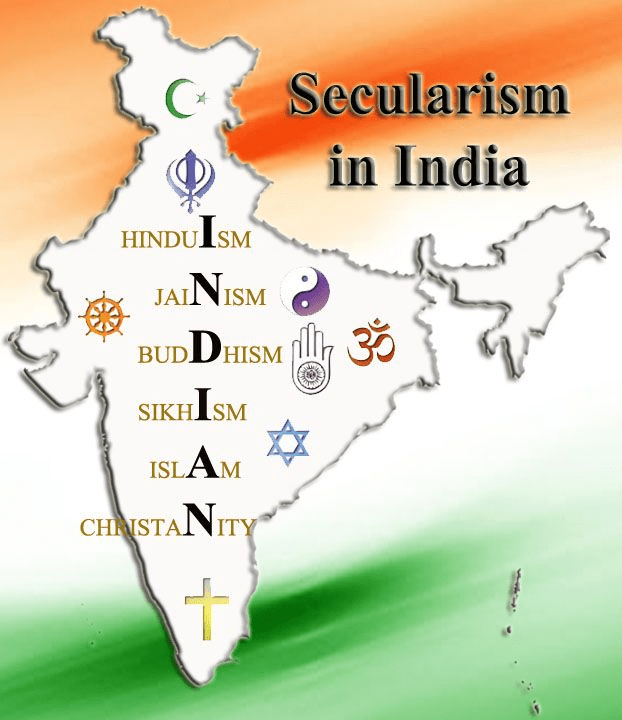
India is known for its multiculturality as for its language and religion. The Indian subcontinent is the birthplace of four major world religions—Hinduism, Buddhism, Sikhism, and Jainism. According to reported 2011 census data, 79.80% of the population of India is Hindu, 14.23% Muslim, 2.30% Christian, 1.72% Sikh, 0.70% Buddhist, and 0.37% Jain.[2] Hereby, Hindus (inclusive of Sikhs, Jains and Buddhists) establish the majority and Muslims create a minority.

IS SECULARISM LIMITED TO HINDU-MUSLIM!?

Hindu- Muslim fights has taken place during historic period in India and are still continuing (Communal riots due to Aurangzeb’s religious policy in 17th Century and now the riots and protests against Citizenship Ammendment Act). Some major ones such as Bombay riots of 1993 and Gujarat riots of 2002 has led to death of 1500+ people across the country. 

Extensive issue between both the religions has always been Babri Masjid in Ayodhya, in 1992 which was claimed by Hindus that the mosque was erected over the birthplace of the archaic god Rama. Tens of Thousands people were evicted from their homes and there was tremendous annihilation of lives and casualties in the country due to this before the Supreme Court passed a neutral and satisfactory judgement in November 2019 in the case: M. Siddiq (D) Thr Lrs v. Mahant Suresh Das & Ors.

Today, considerable controversy on secularism is Anti CAA protests and riots in several states of the country. This Act seeks to grant Indian Citizenship to persons affiliated to Hindu, Sikh, Buddhist, Jain, Parsi and Christian communities on the ground of religious minorities persecution in states of Pakistan, Afghanistan and Bangladesh. As these countries have Muslim majority, they weren’t given citizenship under the Act. The enactment of such law of government was criticised by many and led to bisection of society on the basis of religion. Also the protests have led to the deaths of quite a few rioters, casualty to protesters and police personnel, harm and loss to public and private property, the confinement of hundreds of people, and termination of local internet and phone connectivity in specified areas. The Central Government in a preliminary affidavit point by-point replied to the criticism against the Citizenship Amendment Act (CAA) and pronounced India is constitutionally secular, and also notified the Supreme Court that the CAA does not infringe any fundamental right and provisions of the constitution and therefore, the query of infringement of constitutional morality does not have to originate.

Both of these religions has been and are engaged in a vicious cycle of gaining advantage or predominance over the other. In other words, both Hindus and Muslims have developed animosity and hostility against each other which is leading to antagonistic behaviour of people. Therefore, in order to maintain better circumstances in the religion based society of ours, further steps are taken such as proscription of practices of both the religions (untouchability, triple talaq, beef ban, proselytization etc.) which is a hefty secular normative attack on both the religions.

Indian secularism has two distinct and conflicting aspects, one is complete detachment between government and religion and the other that strongly appeal government to treat each religion without discrimination. Rajeev Bhargava has explained what secularism in the Indian setting calls for is the maintenance of a “principled distance” between state and religion. This does not mean that the state cannot intervene in religion and its affairs, but that any intervention should be within the limitations prescribed by the Constitution. Sometimes this might even call for differential treatment across religions, which would be valid so long as such differentiation, as Mr. Bhargava explains, can be justified on the grounds that it “promotes freedom, equality, or any other value integral to secularism.” But Indian state i.e. government has total intervention into the matters of religion through communal politics. In other words, vote bank politics is followed by the government and the political parties in the race to form the government. Even this has led to inundation of discrete political bodies for Hindu and Muslim community, be it Bhartiya Janta Party, Aam Aadmi Party, Indian National Congress etc. whoever is instigating the idea of ‘hindutva’ and so on.

CONCLUSION

Indian secularism is the by-product of a whole civilization, as a senior literary figure, Nayantara Sahgal, remarked recently: “We are unique in the world that we are enriched by so many cultures, religions. Now they want to squash us into one culture. So it is a dangerous time. We do not want to lose our richness. We do not want to lose anything . . . all that Islam has brought us, what Christianity has brought us, what Sikhism has brought us. Why should we lose all this? We are not all Hindus but we are all Hindustani.” As mentioned above it is important for us to understand that we all are Indians and not just only a Hindu, Muslim or Christian. A sense of brotherhood is important to ensure development and growth of our country. Otherwise if religious violence continues then for sure our country will be doomed.


[1]https://indianexpress.com/article/cities/mumbai/nayantara-sahgal-we-should-not-lose-our-hindustaniyat-5560427/


[1] https://www.thehindu.com/opinion/lead/the-secular-condition/article22347527.ece