Sexual harassment include a refers to any sort of sexual behaviour that is unsolicited, overawed, abhorrent, disrespectful and humiliating. It took over decades for people to recognize sexual harassment as a real serious issue. However, it is still overlooked in the rural areas.
It is not just a single form. Any way of unwanted touch, grab or attempt to make physical contract without one’s consent, all are considered as inappropriate behaviour. Even staring and leering, someone asking for sexual favours and display of offensive and rude material by the perpetrator for others to see it also counts in. Another form may include cracking of sexual jokes and comments and making of sexual signs or gestures towards oneself. It is unacceptable for an individual to question oneself about their sexual life or humiliate oneself by absurd sexual remarks. Further, the sexual harassment also counts in indecently exposing of oneself or making salacious phone calls. Any of such form of sexual harassment is against the law.
Such inappropriate behaviour turns out to be much fatal. Sexual harassment leaves a deep impact on oneself. At times, the victims are so much stressed out that they even suffer from depression or anxiety. Apart from these, the victims often suffer by several significant psychological effects such as sleeping disorder, headaches, sexual dysfunction, plunked self esteem and many more. Furthermore, it can also cause them to withdraw from social situations. As a result, the victim starts loosing confidence and pride.
In this world, none deserves to be ill treated or be victim to any form of inappropriate behaviour and this implies to both men and women. Each and every individual has the right to live a life free from bullying, any sort of discrimination or harassment. Therefore, sexual harassment is illegal. As mentioned in Section 354 (A) of the Indian Penal Code-“A man committing any physical contact, advances involving unwelcome and explicit sexual overtures; or demanding or requesting sexual favours; or showing pornography against the will of a woman; or making sexually coloured remarks, shall be guilty of the offence of sexual harassment. It entails a punishment of rigorous imprisonment for a term which may extend to three years.”
It is essential to notice the signs or gestures if oneself feels that someone is harassing them sexually. One of such significant sign is if oneself feels uncomfortable and experience any unwelcomed physical contact. One must keep themselves updated with the policies and procedures against sexual harassment. If anyone unfortunately comes out to be a victim, then that person should try to get external information and acquire advice from people who can help them in filing a lawsuit. Similarily, one must make sure to save any evidence they get which would help them with their complaint. Likewise, one must never deal with it alone, rather try to share it with closed ones to lighten the burden.
To conclude, sexual harassment took a long time to be recognized as a real issue but now ii is no more un acknowledged. Thus, it is necessary to take effective measures against such practice and try to prevent the fatal damage that it causes to the victims. People need to understand that if someone says no it means no. However, if an individual’s no does not have any impact and is continued being subjected to sexual jokes then, its high time to realize that he/she is being sexually harassed. Therefore, it is essential to help out those who are being victim to such harassments and make the perpetrator liable for their repulsive act.
“It’s not consent if you make me afraid to say NO”
When we hear the word Sexual Harassment what we picture in our mind a girl or a woman getting harassed by a man! But sexual harassment is not a narrow term which we can use only with respect to girls or women. It is a broader term which includes harassment on all the gender.
What is the meaning of Sexual harassment?
The word sexual harassment means any form of unwelcome sexual behavior which is offensive, humiliating and intimidating. According to EEOC (Equal Employment Opportunity Commission) sexual harassment is defined as : Unwelcome sexual advances, requests for sexual favors, and other verbal or physical conduct of a sexual nature when
Submission to such conducts is made either explicitly or implicitly a term or condition of individual’s employment,
Submission to or rejection of such conduct by an individual is used as a basis for employment decisions affecting such individual, or
Such conduct has the purpose os effect of unreasonably interfering with an individual’s work performance or creating an intimidating, hostile, or offensive working environment.
Here, unwelcome does not mean “involuntary.” A victim may consent or agree to certain conduct and actively participate in it even though it is offensive and objectionable. Therefore, sexual conduct is unwelcome whenever the person subjected to it considers it unwelcome. Whether the person in fact welcomed a request for a date, sex-oriented comment, or joke depends on all the circumstances. Source: Preventing Sexual Harassment (BNA Communications, Inc.) SDC IP .73 1992 manual
Types of Sexual Harassment
Verbal or Written
Non-verbal or Visual
Physical
Verbal or Written
Here in the sense of sexual harassment verbal or written means saying, commenting, joking, or writing about someone in vulgar manner. We have often see on the road boys are shouting out to girls using words like doll, babe etc. Yes, this is also sexual harassing and that’s why it is called verbal. Following are some more examples:-
Referring someone using inappropriate or vulgar language.
Whistling at someone in an unwanted manner.
Making sexual comments on someone’s body
Making kissing sounds.
Repeatedly asking out someone who is not interested.
Spreading rumors about a person’s personal life.
Texting someone offensive joke.
Early these were very trivial matter on the roads and now-a-days it can be widely and easily seen on social media.
Non-verbal or visual
Well, this is the most trivial and probably the hardest to spot because it’s most subjective and one have to put in the shoes of the other person. For example:-
Looking a person with elevator eyes (up & down).
Staring at someone.
Following someone.
Making sexual gestures with hands or trough body movements.
Making facial expressions such as winking, throwing kisses etc.
Physical
It seems that this is very easy to recognize but it is also too complex. Many time people get confused about physical touch. Here are some examples:-
Touching someone sexually around other people.
Hugging, kissing , stroking.
Actual or attempted rape.
Touching someone’s clothing, hair, or bodily assault.
Now-a-days sexual harassment is very common in workplaces and even in educational institutions. Cases about these things can be seen frequently. For example recently in Calicut University an Mphil student leveled sexual harassment charges against an assistant professor, Haris Kodampuzha from English department. As per complaint, he used to send sensual message to the student and for this he was suspended.
There are laws all over world which protects people from sexual harassment. In there is “The Sexual Harassment of Women at Workplace (Prevention, Prohibition and Redressal ) Act, 2013” that seeks to protect women from sexual harassment at their place of work. The Act came into force from 9 December 2013. In India, the legislations talk only about sexual harassment and rape of women. Then the question is who will protect men from harassments. There is no law to shield males from the bloodthirsty act of harassment and rape. Under Indian law, there is only one section 377 of Indian Penal Code which talks about “sodomy”.377. it is written that “Unnatural offences: Whoever voluntarily has carnal intercourse against the order of nature with any man, woman or animal, shall be punished with imprisonment for life, or with imprisonment of either description for a term which may extend to ten years, and shall also be liable to fine.” Explanation: Penetration is sufficient to constitute the carnal intercourse necessary to the offence described in this section. Except this all other laws and sections are meant only for females.
While the sexual harassment of females has consistently declined in the past few years as government has made some very effective legislations in India. But sexual harassment of men is increasing day by day. Hence it is important to demand equal accesses to justice for both males as well as females. For this the legislation of government has to make laws which protect the male from various kinds of harassments and assaults at different areas. There is also a need to educate and aware people especially children and students about sexual harassment. So if they suffer from any such act then they will be able to approach to any authority or any elder person rather than suffering.
Catcalling is a form of harassment primarily consisting of unwanted sexual comments. This may include honking, wolf-whistling and indecent exposures. Most of the time, it is a man who catcalls and a woman who is catcalled.
According to surveys by Stop Street Harassment (a non-profit organization):
Nearly 95% of female respondents were honked at one or more times
Nearly 82% of female respondents were the target of a vulgar gesture at least once
Nearly 81% of female respondents were the target of sexually explicit comments from an unknown man at least once
Just over 77% of women said they were the target of kissing noises from men.
Where catcalling takes place?
Catcalling doesn’t only happen on the streets. Sexual harassers find targets on campus sidewalks, in restaurants and movie theaters, at work, inside homes – literally anywhere. Similarly, anyone can be a catcaller – including a person’s acquaintances. Online catcalling is also an issue just as severe as in-person catcalling. What’s worse, people on social media are able to say more because they are protected by a screen.
The Problems with Catcalling
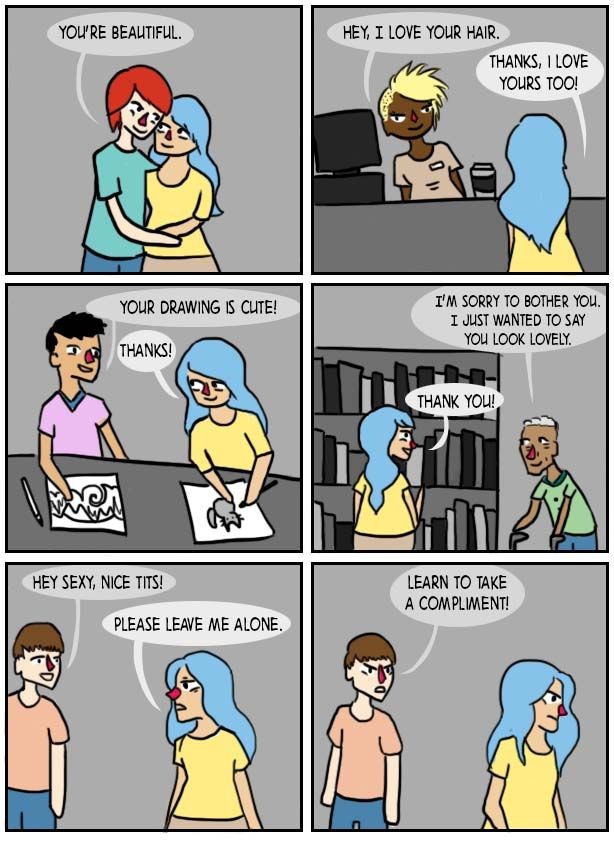
It’s disrespectful: Catcalling is uncalled-for and usually makes the victim feel exposed and uncomfortable. In some cases, catcalling is used as a method of expressing power over someone, rather than the misperception of it being a “compliment”.
It’s not impressive: Someone may catcall in order to impress their friends, or the person they are catcalling at, but it’s actually unimpressive and immature.
Catcalling is not a compliment, it’s a harassment!!
Whilst compliments and flirting can be harmless and fun, shouting at strangers is not flattering, it leaves “targets” feeling exposed.
Catcalling is degrading, demeaning, and disgusting.
Women have the right to be treated with as much respect and dignity when walking down the street as any man. Women deserve to feel safe.
How to react if you are being catcalled?
Catcallers usually look for a reaction. Don’t give them one, especially fear.
Get to a safe or crowded place as soon as you can. Seek help if needed.
If you are around other people and it’s safe, you can use a simple comeback like “that’s harassment” or “don’t do that”.
While snapping back (if you choose to do so), make sure to keep walking and don’t stop.
Avoid the use of swear words or eye contact.
If it’s online, you can block and report them. Choosing to reply is also an option (e.g., asking “would you find it okay if someone spoke to your mother or sister in that way?”).
Document it: write it down or take a picture/screenshot. By doing this you can call them out later.
Share your story if you feel comfortable.
How to intervene if someone is being catcalled?
Call out the harasser if it is safe to do so.
Create a distraction or start chatting with the target (e.g., drop your keys and ask “are these yours?”).
Approach the target afterwards to see if they need company or if there is anything else you can do to help.
Whatever you do, don’t put the person who is catcalled at greater risk (e.g., becoming aggressive).
Catcalling has become normalized, as it is often disregarded as a “joke”, or even a compliment. These are some tips to learn why this is absolutely not the case.
While displaying zero tolerance for sexual harassment of women at workplace, the Supreme Court Bench comprising of Justice Dr DY Chandrachud and Justice Ajay Rastogi have just recently on February 25, 2020 in a notable judgment titled Punjab and Sind Bank and Others Vs Mrs Durgesh Kuwar in Civil Appeal No. 1809 of 2020 have minced no words to make it abundantly clear that sexual harassment at the workplace is an affront to the fundamental rights of a woman. This was so remarked while upholding a Madhya Pradesh High Court judgment that had quashed a transfer of a woman bank employee! Very rightly so! There must be no tolerance for sexual harassment at any workplace and those indulging in it must be made to face the music of law!
Sexual Harassment At Workplace
To start with, the ball is set rolling in para 2 of this noteworthy judgment authored by Justice Dr Dhananjaya Y Chandrachud for himself and Justice Ajay Rastogi wherein it is observed that, “A senior officer of a public sector banking institution complains that her reports about irregularities and corruption at her branch and her complaints against an officer who sexually harassed her met with an order of transfer. The case involves the intersection of service law with fundamental constitutional precepts about the dignity of a woman at her workplace.”
Be it noted, para 3 then discloses that, “This appeal arises from a judgment of a Division Bench of the Indore Bench of the High Court of Madhya Pradesh dated 18 March 2019 in a Writ Appeal arising out of an order of the learned Single Judge dated 11 February 2019.”
To recapitulate, it is then remarkably laid bare in para 4 that, “The respondent was appointed as a Probationary Officer of the Punjab and Sind Bank, the first appellant, on 8 October 1998 in Junior Management Grade Scale 1. She was promoted to the post of Chief Manager in Scale IV. On 2 September 2011, the respondent was transferred to the Zonal Office at Mumbai. On 7 October 2011, she was transferred to the Branch Office at Indore. In September 2016, the first respondent was promoted to the post of Chief Manager in Scale IV. On 23 September 2016, the competent authority of the bank decided to continue her at the branch in Indore upon promotion. On 11 December 2017, the respondent was transferred from the Branch Office at Indore to the Branch Office at Saraswa in the district of Jabalpur. Intimation of the transfer was furnished to her on 14 December 2017. On 31 January 2018, the respondent submitted a representation to the Zonal Manager, recording a reference to the circulars of the bank governing the posting of women officers. She made a request for being retained at Indore. Following the earlier representation, she submitted a reminder on 15 February 2018 and a representation on 19 February 2018 to the Executive Director of the Bank.”
Women’s Fundamental Rights
After hearing both sides, the Bench then observes in para 17 that, “We must begin our analysis of the rival submissions by adverting to the settled principle that transfer is an exigency of service. An employee cannot have a choice of postings. Administrative circulars and guidelines are indicators of the manner in which the transfer policy has to be implemented. However, an administrative circular may not in itself confer a vested right which can be enforceable by a writ of mandamus. Unless an order of transfer is established to be malafide or contrary to a statutory provision or has been issued by an authority not competent to order transfer, the Court in exercise of judicial review would not be inclined to interfere. These principles emerge from the judgments which have been relied upon by the appellants in support of their submissions and to which we have already made a reference above. There can be no dispute about the position in law.”
women sexual harashment
For the sake of brevity, the key issue in real terms that is raised in para 18 is as stated that, “The real issue which the Court needs to enquire into in the present case is as to whether the order of the High Court quashing the order of transfer can be sustained, having regard to the above principles of law. The material on record would indicate that commencing from 31 December 2016 and going up to 15 November 2017, the respondent, who was posted as Chief Manager in her capacity as a Scale IV officer at Indore branch, submitted as many as six communications drawing attention to the serious irregularities which she had noticed in the maintenance of bank accounts of and transactions by liquor contractors. The contents of the complaints raised serious issues. The order of transfer was served on the respondent within a month of the last of the above representations, on 14 December 2017. On 19 February 2018, the respondent levelled allegations specifically of sexual harassment against the Zonal Manager. The bank initially constituted an ICC. The respondent raised an objection to the presence of some of the members of the Committee.”
Going forward, para 19 then stipulates that, “The report of the ICC contains a reference to the objections which the respondent raised to the members at serial numbers (ii), (iv) and (vi) above. These objections were noted in the course of the report of the ICC dated 26 February 2019. The respondent drew the attention of the Presiding Officer of the ICC to the fact that Ms Rashmita Kwatra, AGM is the spouse of a retired General Manager, who was part of the process of the transfer of the respondent. As against Ms Seema Gupta, who was nominated as an independent member, the respondent noted that she was a panel advocate of the bank and was regularly contesting cases in court involving the bank. The respondent also raised an objection in regard to the presence of Mr Vimal Kumar Attrey as a member of the Committee. The report of the Committee contains a reference to the fact that following the objections which were raised by the respondent, the Committee was reconstituted, as a result of which Ms Rashmita Kwatra and Mr Vimal Kumar Attrey were substituted by two other officers of the bank. However, Ms Seema Gupta, Advocate continue to be a member of the ICC.”
Most significantly, it is then elegantly postulated in para 20 that, “The Act was enacted to provide protection against sexual harassment of women at the workplace as well as for the prevention and redressal of complaints of sexual harassment. Sexual harassment at the workplace is an affront to the fundamental rights of a woman to equality under Articles 14 and 15 and her right to live with dignity under Article 21 of the Constitution as well as her right to practice any profession or to carry on any occupation, trade or business.”
What’s more, it is then rightly brought out in para 22 that, “Clause (c) of Section 4(2) indicates that one member of the ICC has to be drawn from amongst a non-governmental organization or association committed to the cause of women or a person familiar with issues relating to sexual harassment. The purpose of having such a member is to ensure the presence of an independent person who can aid, advise and assist the Committee. It obviates an institutional bias. During the course of hearing, we have received a confirmation from the learned senior counsel appearing on behalf of the bank that Ms Seema Gupta was, in fact, a panel lawyer of the bank at the material time. This being the position, we see no reason or justification on the part of the bank not to accede to the request of the respondent for replacing Ms Seema Gupta with a truly independent third party having regard to the provisions of Section 4(2)(c) of the Act. This is a significant facet which goes to the root of the constitution of the ICC which was set up to enquire into the allegations which were levelled by the respondent.”
Simply put, the Bench then goes on to add in para 24 that, “The material which has been placed on record indicates that the respondent had written repeated communications to the authorities drawing their attention to the serious irregularities in the course of the maintenance of accounts of liquor contractors and in that context had levelled specific allegations of corruption. The respondent was posted on 14 December 2017 to a branch, which even according to the bank, was not meant for the posting of a Scale IV officer. The sanctity which the bank attaches to posting officers of the appropriate scale to a branch commensurate with their position is evident from the Board’s Resolution to which we have adverted earlier. Admittedly, the branch to which the respondent was posted was not commensurate to her position as a Scale IV officer. There can be no manner of doubt that the respondent has been victimized. Her reports of irregularities in the Branch met with a reprisal. She was transferred out and sent to a branch which was expected to be occupied by a Scale I officer. This is symptomatic of a carrot and stick policy adopted to suborn the dignity of a woman who is aggrieved by unfair treatment at her workplace. The law cannot countenance this. The order of transfer was an act of unfair treatment and is vitiated by malafides.”
To put it succinctly, it is then observed in para 25 that, “In view of the above analysis, we are of the view that the High Court cannot be faulted in coming to the conclusion that the transfer of the respondent, who was holding the office of Chief Manager in the Scale IV in Indore branch to the branch at Saraswa in the district of Jabalpur was required to be interfered with. At the same time, a period of nearly four years has since elapsed. Despite the order of stay, the respondent was not assigned an office at Indore and had to suffer the indignity of being asked to sit away from the place assigned to a Branch Manager. Considering the period which has elapsed, it would be necessary for the Court to issue a direction, which, while sub-serving the interest of the bank, is also consistent with the need to reserve the dignity of a woman employee who, we hold, has been unfairly treated.”
Now coming to the concluding paras, para 26 holds that, “We accordingly direct that Ms Durgesh Kuwar, the respondent officer, shall be reposted at the Indore branch as a scale IV officer for a period of one year from today. Upon the expiry of the period of one year, if any administrative exigency arises the competent authority of the bank would be at liberty to take an appropriate decision in regard to her place of posting independently in accordance with law keeping in view the relevant rules and regulations of the bank, in the interest of fair treatment to the officer.”
Lastly, it is then held in para 27 that, “While affirming the decision of the High Court, the appeal is disposed of in terms of the above directions. The respondent would be entitled to costs quantified at Rs 50,000 which shall be paid over within one month.”
Summing Up the Discussion
To sum up, the crux of this latest, landmark and extremely laudable judgment is that there has to be zero tolerance for sexual offences directed against women . Those men who dare to still indulge in it have to be made to suffer most swiftly the penal consequences of their reprehensible actions! The sum and substance of this noteworthy judgment is that sexual harassment of women at workplace is an affront to the fundamental rights of a woman to equality under Articles 14 and 15 and her right to live with dignity under Article 21 of the Constitution as well as her right to practice any profession or to carry on any occupation, trade or business. The provisions of the Sexual Harassment of Women at Workplace (Prevention, Prohibition and Redressal) Act, 2013 must be strictly and swiftly implemented so that the woman victim gets the due relief at the earliest! There can be no denying or disputing it!






 Eduindex
You must be logged in to post a comment.