India’s medal in Tokyo Olympic 2020

India Medal Tally Tokyo Olympics – 1 Gold, 2 Silver, 4 Bronze, Medal table is given here. Check the Tokyo Olympic Medal tally for India from here. Tokyo Olympic 2020 is organized in Japan this year. Players from all around the world are performing to win medals for their country. India already has broken its previous record of 6 medals in a single Olympic as they have won 7 medals on Tokyo Olympic 2021 already.
India finished 48th on the medal tally in Tokyo, its highest ranking in over four decades (if one were to go by the total number of medals, India would have actually finished 33rd. However, ranking is done primarily based on gold medals won). The previous best in this period was the 51st rank finish at Beijing in 2008, when India won three medals, including Abhinav Bindra’s gold.India has finished significantly higher in the era in which it used to win gold in hockey, but that time is not really comparable both because of the dozens of countries that have come into being since then and the expansion in the number of sports and hence medals. In Moscow, for instance, India finished at 23rd rank but with just a solitary medal, the hockey gold. A repeat of that at Tokyo would have placed India at joint 63rd, a measure of how different the two eras are.In London 2012, India had finished 57th despite winning more medals than in Beijing because the medal table ranks countries by gold, silver and bronze in that order and India didn’t win a gold in London. In Rio in 2016, the medal tally crashed to just two and so did the ranking to 67th. From there, it’s now gone up nearly 20 places.

The saven warriors

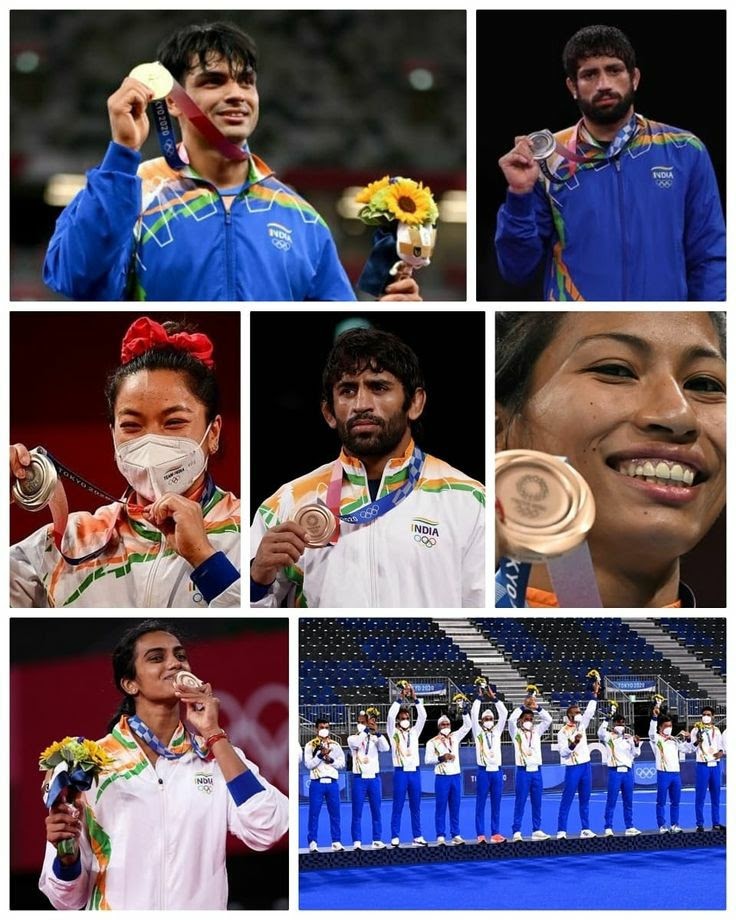
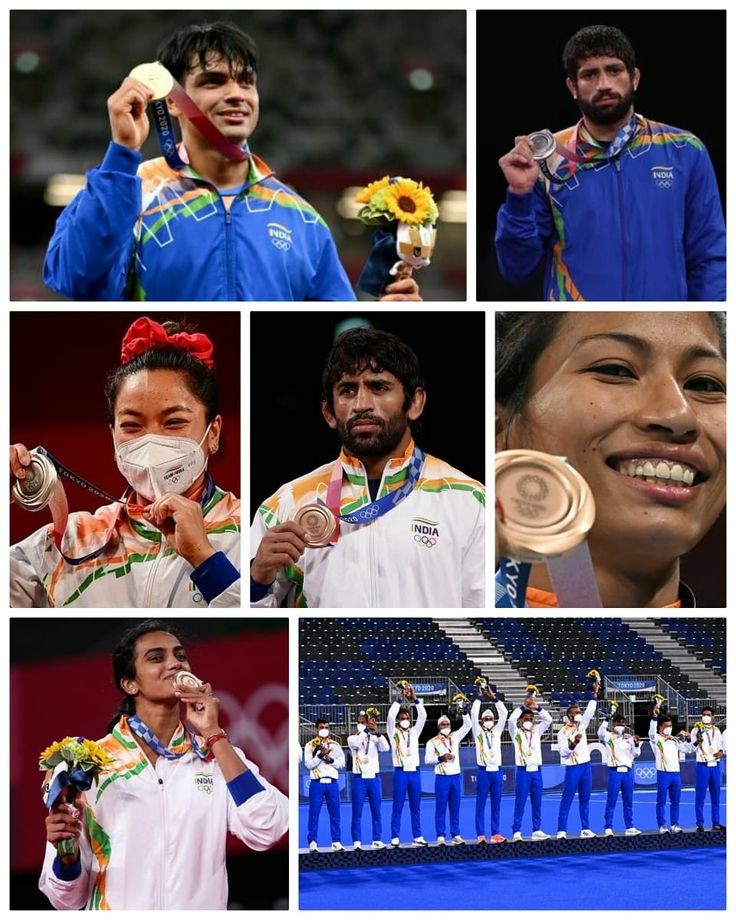
1gold, 2 silver, 4 bronze – India produced it’s richest-ever medal haul and the finest performance of all time at the 2020 Tokyo Olympics, which ended on Sunday. Here are the men and women of steel and thunder who made India proud and gave the nation something to cheer about in these dark times of a deadly pandemic.

1.neeraj chopra

There were bigger names with better records in Tokyo. But while most succumbed to the pressure of the big stage, the 23-year-old boy from Haryana’s Panipat district relished and revelled in the moment. Following his golden throw, millions became emotional on hearing the national anthem at the Olympics for the first time since Beijing 2008. A fitting climax to the story of Neeraj Chopra, who chanced upon the sport while trying to lose weight and who overcame a clutch of injuries to give Indian athletics its greatest moment on the world’s biggest sporting stage .

GameAthleteMedal
Javelin throwneeraj chopraGold

2.Saikhom Mirabai chanu

Much was expected from Mirabai Chanu at Rio 2016. She flopped, failing to make a single clean and jerk lift. The pressure to deliver was crushing at Tokyo 2020. But coached by Vijay Sharma, the amiable 26-year-old from Manipur made light work of the heavy weights to clinch a silver with a smile in the 49kg category. Redemption had never been more satisfying and sweeter for the woman who picked up logs to gather winter fuel for her family as a child.

Game AthleteMedal
Weight Lifting (49 Kg Women)Mirabai ChanuSilver

3.Ravi Kumar Dahiya

He was ranked world no. 4. But in the run-up to the Olympics, the focus was hardly ever on the 23-year-old Olympic debutant from Sonipat. Unmindful, Kumar produced a performance of stunning audacity and endurance while trailing 2-9 against opponent Nurislam Sanayev in the semis. Desperate to get out of his iron grip, the Kazakh bit him badly in his forearm but Dahiya wouldn’t let go till the tide was turned. Dahiya fought hard but lost in the final to become India’s second silver medal-winning wrestler after Sushil Kumar. A fiercely determined athlete, he could well improve upon his medal colour in 2024.

GameAthleteMedal
Wrestling (57 KG)Ravi Kumar DahiyaSilver

4.Men’s team ( hockey)

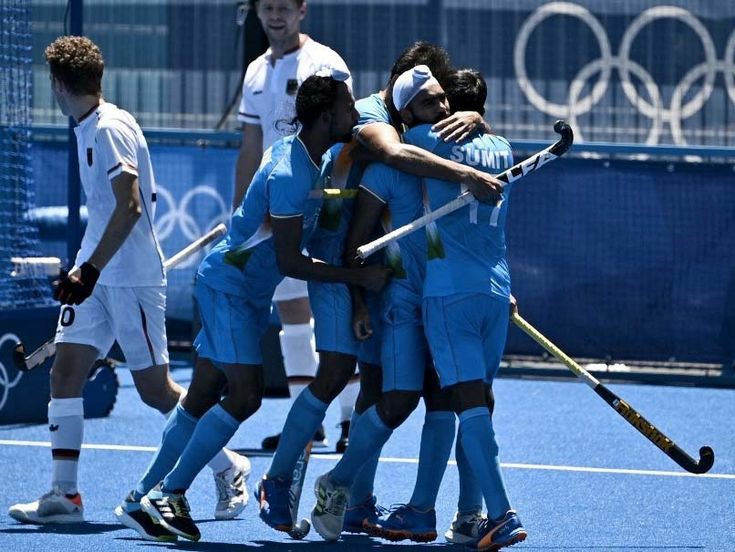
None of them was born when India last won an Olympic medal in hockey. But nothing, not even a potentially morale-sapping 7-1 loss to Australia, could stop captain Manpreet Singh’s boys from their tryst with the podium. The defeat spurred them to deliver one superlative performance after another, resulting in a bronze playoff. The match against Germany was for the ages. You can keep watching India’s 5-4 triumph for the rest of your lives. But this team holds the promise of many more wins to come.

GameAthleteMedal
HockeyIndian Hockey TeamBronze

5.pv sindhu

In the early stages in Tokyo, she looked below her best. But like a finely-tuned precision instrument, Pusarla Venkata Sindhu hit the perfect notes as the tournament peaked. She simply swatted aside Chinese He Bing Jiao 21-13, 21-15 in the bronze medal playoff to add a second Olympic medal in her kitty. When it’s PV Sindhu, once is not enough.

GameAthleteMedal
Women’s Singles BadmintonPV SindhuBronze

6.Lovlina Borgohain

Covid-19 affected her preparation. But the tall pugilist from Assam tried to make the best of the situation. She lifted LPG cylinders, worked in the paddy fields to keep fit. In Tokyo, Lovlina showed the world she could fearlessly box with the best. Five feet, nine inches tall, she used her long reach to devastating effect to fashion an amazing medal story.

GameAthleteMedal
Women’s Welterweight BoxingLovlina BorgohainBronze

7.Bajrang punia

Wrestler Bajrang Punia, also in his debut appearance at the quadrennial event, beat Kazakhstan’s Daulet Niyazbekov in the men’s 65kg freestyle wrestling playoff to claim the bronze medal. Punia, who belongs to Khuddan village in Jhajjar district, pinned Kazakhstan’s Daulet Niyazbekov.It was India’s sixth medal of the Tokyo Olympics – equalling their best-ever haul at a single edition of the Olympics.

GameAthleteMedal
Wrestling (65 Kg)Bajrang PuniaBronze

for more sports news related to Olympics visit the site link given below 👇

https://youtube.com/c/Olympics

https://youtube.com/c/TheLallantop

The legacy of Indian hockey

One of the most ancient games in the world — a crude form of the sport was played in Egypt some 4,000 years ago — the history of hockey can be traced back to 1527 in Scotland. Back then, it was called ‘hokie’ – where players hit around a small ball with sticks.However, the first version of modern-day field hockey was developed by the British sometime between the late 18th and early 19th century. It was introduced as a popular school game then and made its way to the Indian army during British rule in the 1850s.In the next few decades, national competitions like the Beighton Cup in Calcutta and Aga Khan tournament in Bombay (now Mumbai) popularised the sport further, especially in erstwhile provinces of Bombay and Punjab.

Ask any sportsperson, the pinnacle of sporting success for them is to stand on the Olympic podium and see their country’s national flag rise in that hallowed arena. It is that dream that pushes them into making sacrifices as they chase Olympic glory.The London Olympics saw India finally take steps towards realising its true potential at the Olympics. Abhinav Bindra had raised the bar in Beijing with a first ever individual Gold medal.Just one individual Gold in a country of a billion plus people. Even the six medals at London 2012 were nowhere close to the tally India should be aspiring for. But at least it was a start.

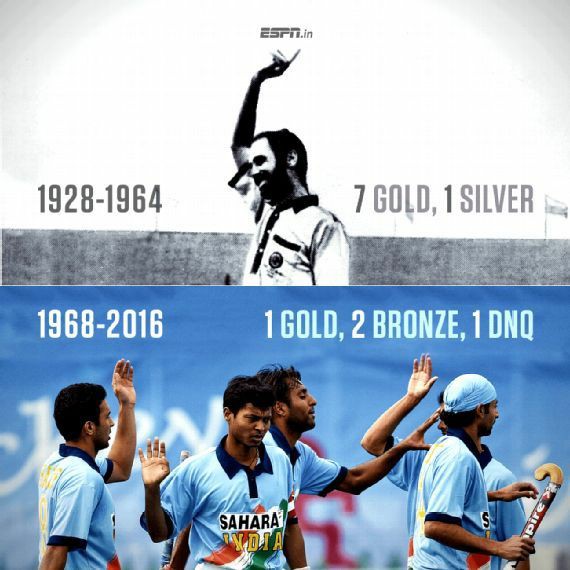
However no story of Indian sport is complete without a look back at a rich legacy. The Champions of today are inspired by past generations who have coveted Olympic glory. Only a handful have managed to attain the ultimate glory in world sport, an Olympic medal.Yet the story of India at the Olympics begins with Hockey. Very rarely has a sport been as synonymous with a country than India and Hockey. It is a rich legacy, 8 gold medals, six of those consecutive wins across four decades.

Dominance in the world of hockey

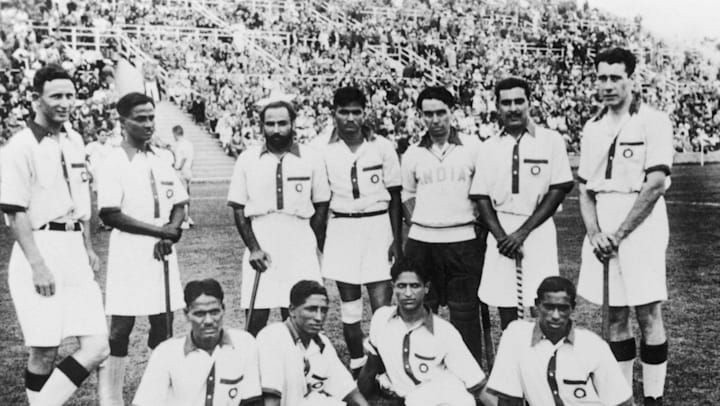
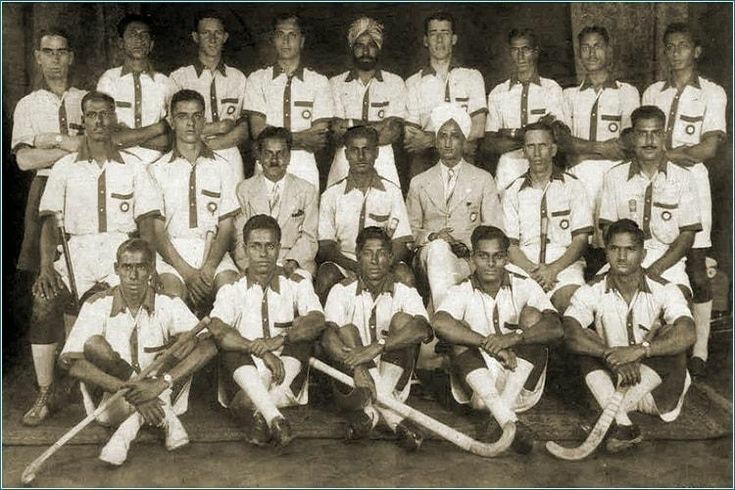
After a rocky relationship with the Olympic Games until 1924 — hockey was only played in 1908 and 1920 and dropped for the other editions — the presence of a global sports body (FIH) ensured that hockey gained permanent Olympic status starting Amsterdam 1928. The Indian Hockey Federation applied and earned an FIH membership in 1927, thus ensuring that the Indian hockey team would play its first Olympics in 1928.It was the beginning of a legacy – decorated with eight gold medals – a record till today.

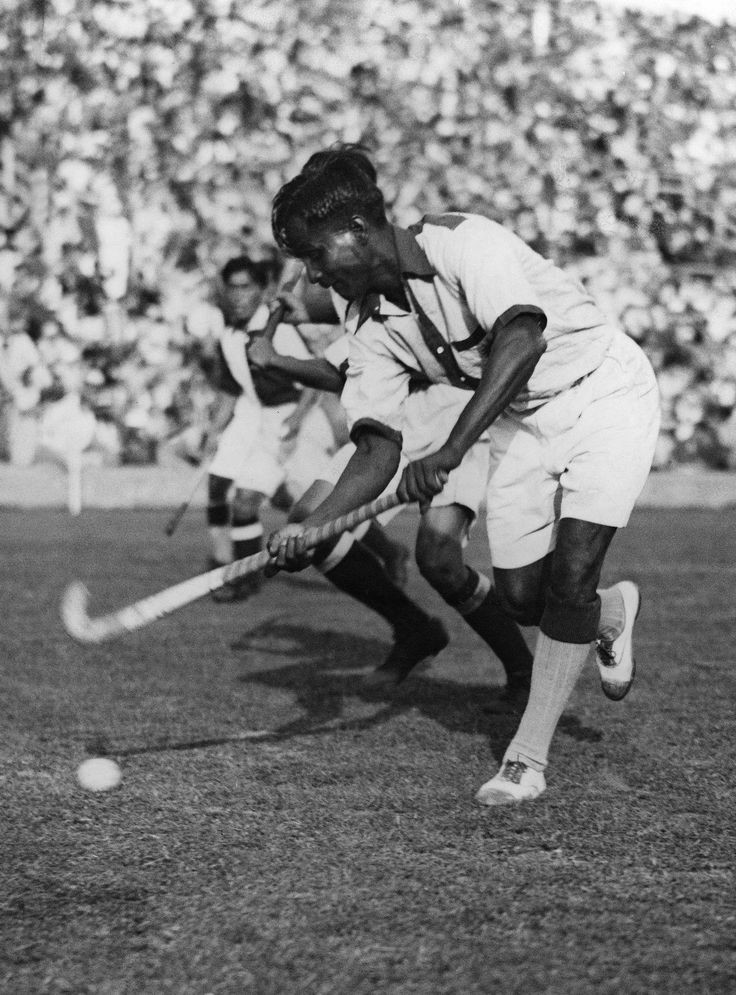
The Indian hockey team clinched the Olympic gold medal in its first attempt in 1928. India played five matches, scoring 29 goals and conceding none, with Dhyan Chand scoring 14 of them.The hockey wizard became the cornerstone of the Indian hockey team as it won two more gold medals in 1932 and 1936, completing a hat-trick of Olympic hockey golds. Dhyan Chand was made captain in 1936 in what would prove to be his final Olympic Games.

Unfortunately there were no Olympics in 1940 and 1944 due to the Second World War and that was the last the Olympics saw of Dhyan Chand. In 1948 a newly independent India had to battle not just strong teams but also cope with the exodus of players to Pakistan.When the Olympics returned after World War II in 1948, India found a new genius in the legendary Balbir Singh Sr. as he steered them to a second hat-trick of Olympic gold medals in 1948, 1952, and 1956, this time as an independent nation. The period was one of the most significant in the history of hockey in India. While Pakistan halted the gold run in the final at the 1960 Rome Olympics, India would ascend to the top step at Tokyo 1964. However, it was apparent that India’s domination of the sport was weakening. The Indian hockey team had won silver at the 1958 and 1962 Asian Games, before finally winning gold in the 1966 edition. However, India only managed a bronze at Mexico 1968, in what was then their lowest finish in the Olympics.

In 1968 and 1972 the team returned with a Bronze medal while Montreal saw the team draw a blank, unable to adjust to a change from grass to artificial turf. The pain of those campaigns is expressed by 3-time medallist Harbinder Singh, Ashok Kumar, Aslam Sher Khan and Dr Vece Paes. Hockey expanded its reach beyond the Olympics with the first Hockey World Cup held in 1971 in Spain. Though Pakistan beat Spain to win the title and India finished third, the sport was steadily gaining popularity in Europe, and innovations were underway.

While India’s representation in global hockey was largely restricted to the men, the women’s team made its first appearance in international competition at the inaugural women’s Hockey World Cup in 1974, finishing a creditable fourth.There seemed to be an upturn when the men’s team won its only World Cup title in 1975.

1980s-2008: A period of declination of performance

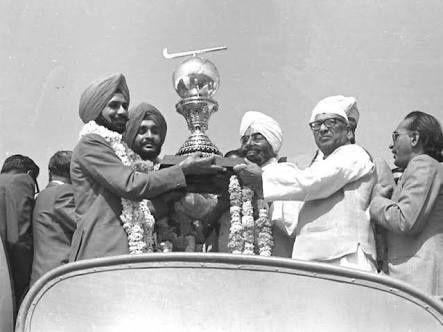
The 1980s actually began well for the Indian hockey teams.The men’s team took advantage of a depleted field to win their eighth Olympic gold at Moscow 1980 while the women’s team finished fourth in what was the first edition of women’s hockey at the Olympics.At the 1982 Asian Games in New Delhi, where women’s hockey was played for the first time, the women’s Indian hockey team clinched a historic gold at home while the men’s team won silver.

The introduction of hockey at the Commonwealth Games in 1998 provided another platform for global hockey. The Indian men’s and women’s teams finished fourth in the inaugural edition.The decline of Indian hockey hit rock bottom in 2008 when the men’s team, for the first time since 1928, failed to qualify for the Beijing Olympics.

Revival of Indian hockey

After the disappointment of 2008, the men’s Indian hockey team responded by returning to the podium at the 2010 Commonwealth Games, winning silver and the 2010 Asian Games, where they won bronze.The men’s Indian hockey team qualified for the 2012 London Olympics. Though India ended last, it represented a small bit of progress.

In the years since, Indian hockey seems to have found its feet again.The women’s team, led by Rani Rampal, won silver at the 2018 Asian Games, achieving their best ranking of ninth in the world the same year and qualified for a second-consecutive Olympics in Tokyo the following year.The men’s Indian hockey team has imbibed an attacking philosophy under new head coach Graham Reid and young captain Manpreet Singh.India played their first FIH Pro League campaign in 2020, winning games against the best in the world like Belgium, Australia and the Netherlands and rising to fourth in the world rankings, their best in history.

Indian men’s hockey team today displayed a great game of counter-attacking play as it won defeated Germany 5-4 in the bronze medal play-offs at the Tokyo Olympics today. Indian men’s hockey team won an Olympic medal after a gap of 41 years. India’s last of the eight Olympic golds came way back in the 1980 Moscow Games.The eight-time former gold-winners, who battled a heartbreaking slump in the last four decades, made the resurgence of the last couple of years count in the best way possible with an Olympic medal.

HOCKEY

Hockey is a sport in which two teams play against each other by trying to manoeuvre a ball or a puck into the opponent’s goal using a hockey stick. There are many types of hockey such as bandy, field hockey, ice hockey and rink hockey.

In most of the world, the term hockey by itself refers to field hockey, while in Canada, the United States, Russia and most of Eastern and Northern Europe, the term usually refers to ice hockey.

Games played with curved sticks and a ball can be found in the histories of many cultures. In Egypt, 4000-year-old carvings feature teams with sticks and a projectile, hurling dates to before 1272 BC in Ireland, and there is a depiction from approximately 600 BC in Ancient Greece, where the game may have been called kerētízein or because it was played with a horn or horn-like stick .[10] In Inner Mongolia, the Daur people have been playing , a game similar to modern field hockey, for about 1,000 years.

Most evidence of hockey-like games during the Middle Ages is found in legislation concerning sports and games. The Galway Statute enacted in Ireland in 1527 banned certain types of ball games, including games using “hooked” (written “hockie”, similar to “hooky”) sticks

By the 19th century, the various forms and divisions of historic games began to differentiate and coalesce into the individual sports defined today. Organizations dedicated to the codification of rules and regulations began to form, and national and international bodies sprang up to manage domestic and international competition.