
Stephen Hawking’s final theory of black holes -The Hawking radiation

When a massive star dies, it leaves a small but dense remnant core in its wake. If the mass of the core is more than 3 times the mass of the sun, the force of gravity overwhelms all other forces and a black hole is formed. Imagine the size of a star is 10 times more massive than our sun being squeezed into a sphere with a diameter equal to the size of New York City. The result is a celestial object whose gravitational field is so strong that nothing, not even light can escape it. The history of black holes was started with the father of all physics, Isaac Newton. In 1687, Newton gave the first description of gravity in his publication, Principia mathematica, that would change the world.

Then 100 years later, John Michelle proposed the idea that there could exist a structure that would be massive enough and not even light would be able to escape its gravitational pull. In 1796, the famous French scientist Pierre-Simon Laplace made an important prediction about the nature of black holes. He suggested that because even the speed of light was slower than the escape velocity of black hole, the massive objects would be invisible. In 1915, Albert Einstein changed physics forever by publishing his theory of general relativity. In this theory, he explained space time curvature and gave a mathematical description of a black hole. And in 1964, john wheeler gave these objects the name, the black hole.
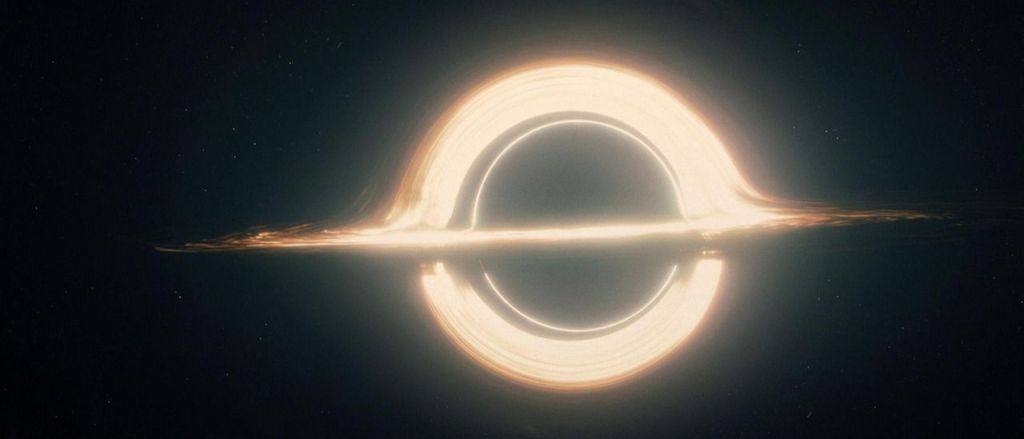
The Gargantua in Interstellar is an incredibly close representation of an actual black hole

In classical physics, the mass of a black hole cannot decrease; it can either stay the same or get larger, because nothing can escape a black hole. If mass and energy are added to a black hole, then its radius and surface area also should get bigger. For a black hole, the radius is called the Schwarzschild radius. The second law of thermodynamics states that, an entropy of a closed system is always increases or remains the same. In 1974, Stephen hawking– an English theoretical physicists and cosmologist, proposed a groundbreaking theory regarding a special kind of radiation, which later became known as hawking radiation. So hawking postulated an analogous theorem for black holes called the second law of black hole mechanics that in any natural process, the surface area of the event horizon of a black hole always increase, or remains constant. It never decreases. In thermodynamics, black bodies doesn’t transmit or reflect any radiation, it only absorbs radiation.

When Stephen hawking saw these ideas, he found the idea of shining black holes to be preposterous.  But when he applied the laws of quantum mechanics to general relativity, he found the opposite to be true. He realized that stuff can come out near the event horizon. In 1974, he published a paper where outlined a mechanism for this shine. This is based on the Heisenberg uncertainty Principe. According to the principle of quantum mechanisms, for every particle throughout the universe, there exists an antiparticle. These particles always exist in pairs, and continually pop in and out of existence everywhere in the universe. Typically, these particles don’t last long because as soon as possible and its antiparticle pop into existence, they annihilate each other and cease to exist almost immediately after their creation.

In the event horizon that the point which nothing can escape its gravity. If a virtual particle pair blip into existence very close to the event horizon of a black hole, one of the particles could fall into the black hole while the other escapes. The one that falls into the black hole effectively has negative energy, which is, in Layman’s terms, akin to subtracting energy from the black hole, or taking mass away from the black hole. The other particle of the pair that escapes the black hole has positive energy, and is referred to as hawking radiation.
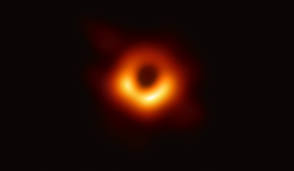
The first-ever image of a black hole by the Event Horizon Telescope (EHT), 2019

Due to the presence of hawking radiation, a black hole continues to loss mass and continues shrinking until the point where it loses all its mass and evaporates. It is not clearly established what an evaporating black hole would actually look like. The hawking radiation itself would contain highly energetic particles, antiparticles and gamma rays. Such radiation is invisible to the naked eye, so an evaporating black hole might not look like anything at all. It also possible that hawking radiation might power a hadronic fireball, which could degrade the radiation into gamma rays and particles of less extreme energy, which would make an evaporating black hoe visible. Scientists and cosmologists still don’t completely understand how quantum mechanics explains gravity, but hawking radiation continues to inspire research and provide clues into the nature of gravity and how it relates to other forces of nature.
Should more money be spent on space exploration?

Poverty still rising all over the world, COVID-19 pandemic made it even worse. About 1.89 billion people, or nearly 36% of the world’s population, lived in extreme poverty. Nearly half the population in developing countries lived on less than $1.25 a day. Why should we spend money on space exploration when we already have so many problems here on Earth? Is it really that important? It’s like What if our ancestors thought that it would be a waste of time to figure out agriculture while we can do hunting? Or why should we spend so much time on exploring new lands while we have so many problems in our land? Each year, space exploration contributes to a lot of innovations on earth. It gave answers to many fundamental questions about our existence, and a lot of questions there to be answered if only we could increase our investment on space exploration. NASA’s annual budget is 23 billion dollars but, its only 0.1% of the total revenue. even if we were to increase the international budget 20 times it would only be a small fraction of GDP. isn’t our future worth a quarter of a percent?

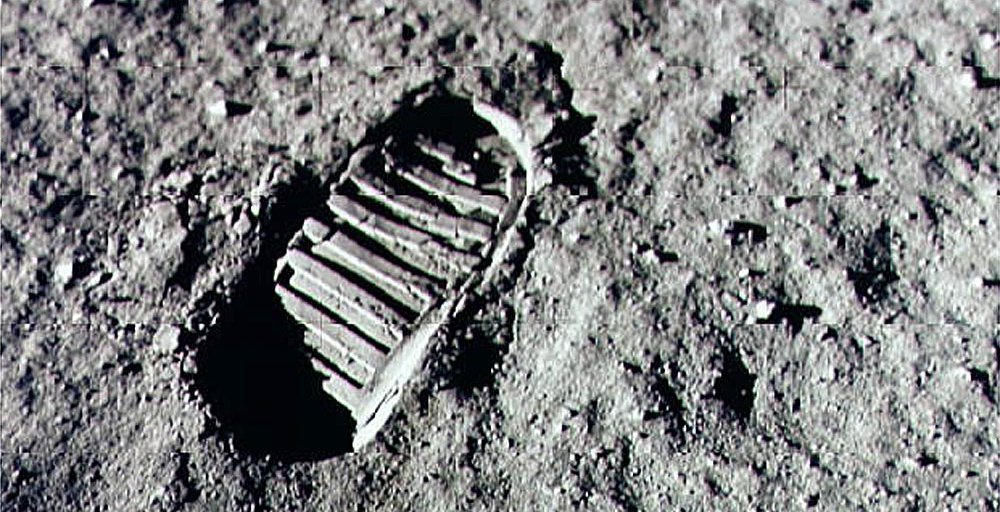
“That’s one small step for man, one giant leap for mankind”.

Benefits of space exploration:

    Improves our day to day life

       Since 1969, Neil Armstrong became the first human to ever set foot on moon, our interest in science and technology has improved a lot. In 22nd February 1978, US space agency launched the first satellite for its program of global positioning system (GPS). Currently there are 31 global positioning system (GPS) satellites orbiting the earth.Space exploration helped us to create many inventions like television, camera phones, internet, laptops, LED’s, wireless gadgets, purifying system of water and many more that we are using in our day to day life. There are nearly 3,372 active satellites providing information on navigation, business & finance, weather, climate and environmental monitoring, communication and safety.

   Improving health care

       The international space station plays a vital role in health and medical advancements. The Astronauts who works on the ISS able to do experiments that aren’t possible on earth due to the difference in the gravity. The project of Exomedicine – the study of medicine and micro-gravity, gravity has an effect on a molecular level so working in an environment where it can be eliminated from the equation allows discoveries that would otherwise be impossible. Medical advancements due to space exploration include,

  • Diagnosis, treatment, and prevention of cardiovascular diseases
  • Treatment of chronic metabolic disorders
  • Better understanding of osteoporosis
  • Improvements in Breast cancer detection
  • Programmable pacemakers
  • Laser angioplasty
  • NASA’s device with Space technology for Asthma
  • ISS plays vital role in vaccine development
  • Early detection of immune changes prevents shingles
  • Development of MRI s and CT or CAT Scans
  • And invention of ear thermometers
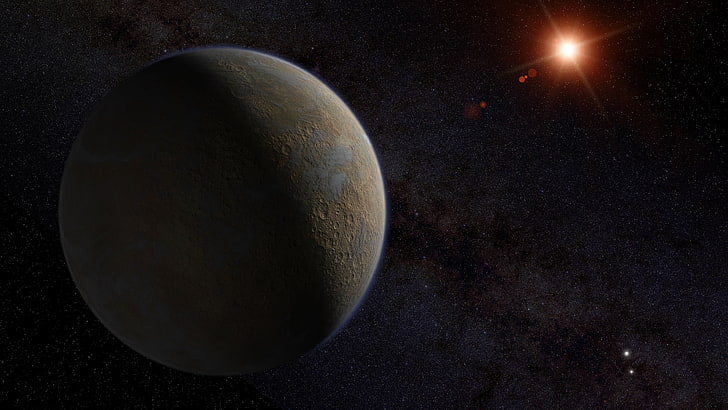
Proxima Centauri b is an exoplanet orbiting the red dwarf star Proxima Centauri

Need for space colonization

       Overpopulation is one of the major crises in our planet. Currently we have 7.8 billion people alive on earth. Experts predict that there will be 9.7 billion people by 2050 and 11 billion by 2100, our earth can carry only 9 billion to 12 billion people with the limited food and freshwater resources. That means we have to find an exoplanet with suitable conditions soon. We already went to moon 6 times, we already sent a rover to Mars. Robotic missions are cost efficient, but if one is considering the future of human race we have to go there ourselves. Elon Musk announced that SpaceX is going to send people to Mars I 2022. NASA planned to make a colony on Mars by 2030. These missions are not something we need at this moment. But it may play an important role on our future. Proxima Centauri b is an exoplanet which is 4.24 light years away from us. With our current technology, it is impossible to reach it in our lifetime. But we should make it as an aim for interstellar travel over the next 200 to 500 years. Stephen hawking said that the human race has existed as a separate species for about 2 million years. Civilization began about 10,000 years ago, and the rate of development has been steadily increasing. If the human race is to continue for another million years, we will have to boldly go where no one has gone before.

The day we stop exploring is the day we commit ourselves to live in a stagnant world, devoid of curiosity, empty of dreams. –Neil deGrasse Tyson