Warren Buffett

Warren Buffett is often treated as god of investors. He is one of the most successful investors in the world. Warren Buffett is a American business magnate, and a investor. As of now April, 2020 his net worth is $100.6 Billion making him world’s seventh wealthiest person in the world. Currently, he is the CEO and chairman of Berkshire Hathaway. In this blog, we are going to see the success story of Warren Buffett.
Early life

Warren Edward Buffett was born on August 30, 1930 in Omaha, Nebraska. He is the second oldest child to his father Howard, a stock broker and his mother Leila. He has two sisters. At a very young age he developed a interest in business and stock market. While other children of his age were playing, he was making money. At eleven years old, he purchased three shares of Cities Service at $38 per each. Soon after buying it, it price fell down to $27. Then after, he waited for the stock to made $40 and sold it. He said that it was a mistake because the stock went unto $200. This taught him the principles of investing.

Education

He began his career at Rose Hill elementary school. In 1942, he finished his elementary school and joined Deal junior high school. In 1947, when he was 17 years old, he graduated from Woodrow Wilson high school. After that, he got admitted into Wharton school of the University of Pennsylvania, after two years he transferred to University of Nebraska, complaining that he known better than his professors. Then he graduated from University of Nebraska with Bachelor of Science degree in business administration. Then, he applied to Harvard business school and was rejected because he was too young. Then he admitted to Columbia Business school of University of Columbia. In 1951, he graduated with Master of Science degree in economics.

Investment career

In 1947, when he was 17 years old, he started a company Wilson coin operated machines with his friend Donald. The business was to buy a pinball machine at $25. The business makes $50 per week for Buffett and Donald. After a year they sold it for $1200. From 1951 to 1954, he worked as a investment salesman for Buffet-Falk. In 1954, Buffett got a job at Benjamin Graham’s partnership and his starting salary was $12,000 per year(around $116,000 today). In 1956 Benjamin Graham retired and closed his partnership. At that time Buffett’s saving reached to $176,000(around $1.66 million today). Then he started Buffett Partnership Limited. By 1960, He operated six partnership. In 1962, he became a millionaire because of his partnership of total 7,178,500 in which 1,025,000 belongs to him. In 1965, he started purchasing the stock of Berkshire Hathaway. By 1967, Buffett Partnership owns 59.5 shares of Berkshire Hathaway. By May 1990, he had became a Billionaire when Berkshire Hathaway started selling there shares of class A. Apart of Berkshire Hathaway, he had also have shares in Apple, Bank of America, Coco cola, American Express, and etc.

Additional Information

Being a Billionaire, he still lives in the same house, which he bought in 1957 for $31,500. In 2006, He announced that he will donate majority of his wealth to Bill and Melinda Gates foundation. In 2010, Warren Buffett and Bill Gates started giving pledge campaign to encourage extremely wealthy people to contribute majority of wealth for philanthropic causes. In that, Buffett donated 99 percent of wealth to philanthropic causes.

Greed vs Generosity: Which Gives a Better Competitive Advantage?

Many people think that in the professional world, selfishness and greed are the characteristics that pay dividends. But the truth is, excepting win-lose situations, that the most successful people in the medium and long term are those who are the most generous in their business and personal lives.

Ambition is a desire to take on more than you can realistically accomplish, to constantly strive for improvement, to grow both personally and professionally, and, of course, the desire to generate more income. However there comes a time when ambition crosses a line, and when that happens it becomes greed. Greed is the desire to chew more than you can eat, a desire that distracts you from realistically possible goals. Greed is wanting to get more than what you have actually earned, obtaining maximum profit at minimum cost, or as an old adage has it: “Grasp all, lose all.”

Today there is an abundance of courses and books on finance, limitless knowledge on hand with a simple click. But to know what is right, to subdue the pirates of greed and to follow your trading plan- this is another story. People who look for easy money invariably find that there is no such thing, paying a heavy price for this lesson. Ego, vanity, and revenge play a part, causing people to fail on their trading accounts. This is one of the factors that explains why people might not fall into the exclusive 10% that ‘win’, and find themselves one of the 90% that lose.

Literature and film are full of greedy and stingy characters, and the moral of films like ‘A Christmas Carol’ or ‘The Wolf of Wall Street’ is always the same: the fate of the greedy is heartbreaking. Their addiction to work means that they live a lonely life, and their search for wealth means that at the end of their lives, they have only the sober memory of their friends from the Stock Exchange.

GIVE AND TAKE

People do not realize that giving without expecting something in return could be a competitive advantage, as well as making ones outlook more positive. Studies have shown that the most successful people are generous. At least this is the affirmation of Adam Grant, a psychologist and professor at Wharton and author of “Give and Take”.

A generous person builds bigger and stronger networks, improves communication with their existing contacts, and also finds it easier to interact with people outside of their core network- this gives them access to new contacts and valuable sources of information. Generous people inspire in others a predisposition, or positive receptivity, to reconnect with them, as well as a greater willingness to collaborate.

Moreover, being a giver encourages persistence because givers are able to enthusiastically motivate people, inspiring confidence, because they are liberal with praise. They create a generally positive environment. Talent is important, but the most important factor in success is persistence. And what’s even more interesting is that being a giver has an energizing effect that increases levels of happiness.

According to Bill Williams, famous trader and writer of “Trading Chaos”, people with a ‘giving’ mindset enjoy more happiness and success. For example, later in his career Bill always traded two accounts, one for himself and one for his charities. The charity account always made more money, even though he traded using the same method with both accounts. In the charity account he never veered from his strategy, while in his own account he would sometimes take a trade based on a “feel”, or get in a trade before the actual signal. This shows us the importance of sticking to a plan, but also the importance of being a ‘giver’.

Giving distracts us from our problems, adds meaning to our lives and helps us feel valued by others. This explains why avidity and egoism are the trader’s worst enemy. Having a benevolent mindset while trading helps the trader to increase performance. Happy people earn more money on average, score higher yields, make better decisions and contribute more to their organizations. Furthermore, traders who are givers are at the top of the most successful trading operations.

THE GREED EFFECT

Focusing only on money results in the ‘greedy effect’, something that all professional traders know. In fact, one of the most common pieces of (rarely followed) advice that newbies receive is to shift their focus from trade results to the trading process, analyzing and following the rules of their trading system. Another suggestion is to start reasoning in pips and ticks instead of dollars. This reduces the greedy mindset and develops a more reliable attitude.

However we can make a further effort to improve our performance by shifting our focus to be more generous. One example is trading for charitable purposes like the aforementioned Bill Williams, another could be simply committing a small part of your monthly or annual profit to microcredits, which promote a world of stability and self-sufficiency, key to overcoming poverty.

Material things can be recovered, but feelings of guilt, helplessness and loneliness cannot be solved with money. If humans would be more understanding of and generous to others, the world would be a very different place. And that is why those who practice generosity, making it part of their daily lives, experience an uplifting of their mental and emotional state, and are generally filled with more satisfaction in their professional and personal lives.

In conclusion, we see that generous people are the most successful in their daily trading performance for the reasons described above. Having a giving mindset helps professionals become part of that exclusive group, the 10% of winners.

WARREN EDWARD WAFFET

Warren Edward Buffett was born on August 30, 1930, to his mother Leila and father Howard, a stockbroker-turned-Congressman. The second oldest, he had two sisters and displayed an amazing aptitude for both money and business at a very early age. Acquaintances recount his uncanny ability to calculate columns of numbers off the top of his head

While other children his age were playing hopscotch and jacks, Warren was making money. At only six years old, Buffett purchased six-packs of Coca-Cola from his grandfather’s grocery store for 25 cents and resold each of the bottles for a nickel, pocketing a 5-cent profit. Five years later, Buffett took his first step into the world of high finance.

Find your passion

At eleven years old, he purchased three shares of Cities Service Preference at $38 per share for both himself and his older sister Doris. Shortly after buying the stock, it fell to just over $27 per share. A frightened but resilient Warren held his shares until they rebounded to $40. He promptly sold them—a mistake he would soon come to regret. Cities Service shot up to $200.1 The experience taught him one of the basic lessons of investing: Patience is a virtue.

Warren buffet rules for success

1. Find your passion

If anyone can find their passion, they can achieve success in whatever work they want.

2. Hire well

The three things in hiring to people you look for are integrity, intelligence and energy. And you should always look for first ‘integrity’ if you don’t have integrity you cannot have any of two other things in you

3. Don’t care what others think

Many people gonna tell you that why are you doing this and judge you but not caring what others think is key to success so follow your heart

4.Read, read, read

Read many books as you can because reading makes your mind clear and sharp.. Warren wuffet started reading when he was 7 years old

5. Save margin of safety

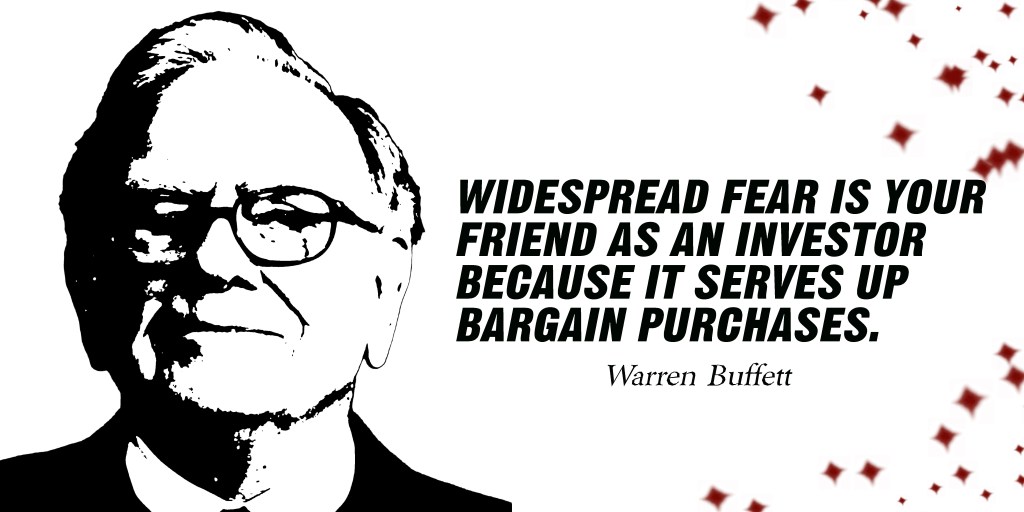
” Be greedy when everyone is fearful, and be fearful when everyone is greedy” Warren waffet once said this before investing in stock market try to save some margin of safety

6.Have a competitive advantage

In the world of competition you have to be competitive and take it as a advantage

7. Schedule for your personality

He don’t like to have things all packed for hour n hour. He also said in his one of the interview that ‘ I really get to do what I like to do, the way I wanted to do with the people we choose to around that are terrific. I’ve got everything I wanted and it’s fortunate’

8.Always be competitive

Somebody always after you but you have to ahead of them. You always wanna be in the move. When you got really great business but the danger would always there but you have to be comptitive in order to get what you want

9. Unconditional love

The best advice he received from his father that whatever you do in life and the people in your life give them unconditional love.

Stock Exchange Market ( Meaning, Definitions , Functions , Members , Stock Exchange Market in India , Trading procedure , Members)

Stock exchange Market

What is a stock exchange market?

A market is said to be an arrangement between buyers and sellers to exchange goods or services for money.
A stock exchange is a highly organised market ,where listed securities are bought and sold under a code of rules and regulations.

A stock exchange Market is also known as a ‘security exchange or ‘, ‘security market ‘ or ‘share bazar ‘.

It is an organised market for the purchases and sale of industrial and financial securities or where financial instruments like stocks, bonds and commodities are traded.

It is a platform where buyers and sellers come together to trade financial tools or securities , adhering to SEBI’s well-defined guidelines. SEBI’s responsibility is to ensure that the securities market in India functions in an orderly manner.

( About SEBI )


Definitions

” A stock exchange is an association of persons engaged in buying and selling of shares , stocks , debentures and bonds for public on commission and are guided by certain Rules and usages “
…….. Dr. K.L Garg

” A stock exchange is an organised auction market where buyers and sellers come together through their brokers ,to effect transactions in securities admitted to listing on the exchange and unlisted securities for which a market is maintained “
……… Charles W. Gerstenberg .


” A stock exchange is a marketplace where securities that have been listed thereon ,may be bought and sold for either investment or speculation “
…….. W.Pyle .

” Stock exchange means a body of individuals ,whether incorporated or not , constituted for the purpose of assisting ,regulating and controlling the business of buying , selling and dealing in securities .”
…….. Securities Contracts ( Regulation ) Act , 1956


The stock market is a market where exchange of regular activities of buying, selling, and issuance of shares of publicly-held companies take place.


Key meaning :-

• it is an organised market where securities are purchased and sold
• transaction takes place between the members or their authorized agents on behalf of the investors.
• securities refer to shares , stocks , debentures and Government bonds .
• Securities are traded in a stock exchange in a systematic manner for investment .
• only listed securities are traded in a stock market.
• functions on the basis of rules and regulations.
•It is managed by the Board Of Directors elected by the shareholders .
• brings a huge amount of capital necessary for the economic progress of a country .


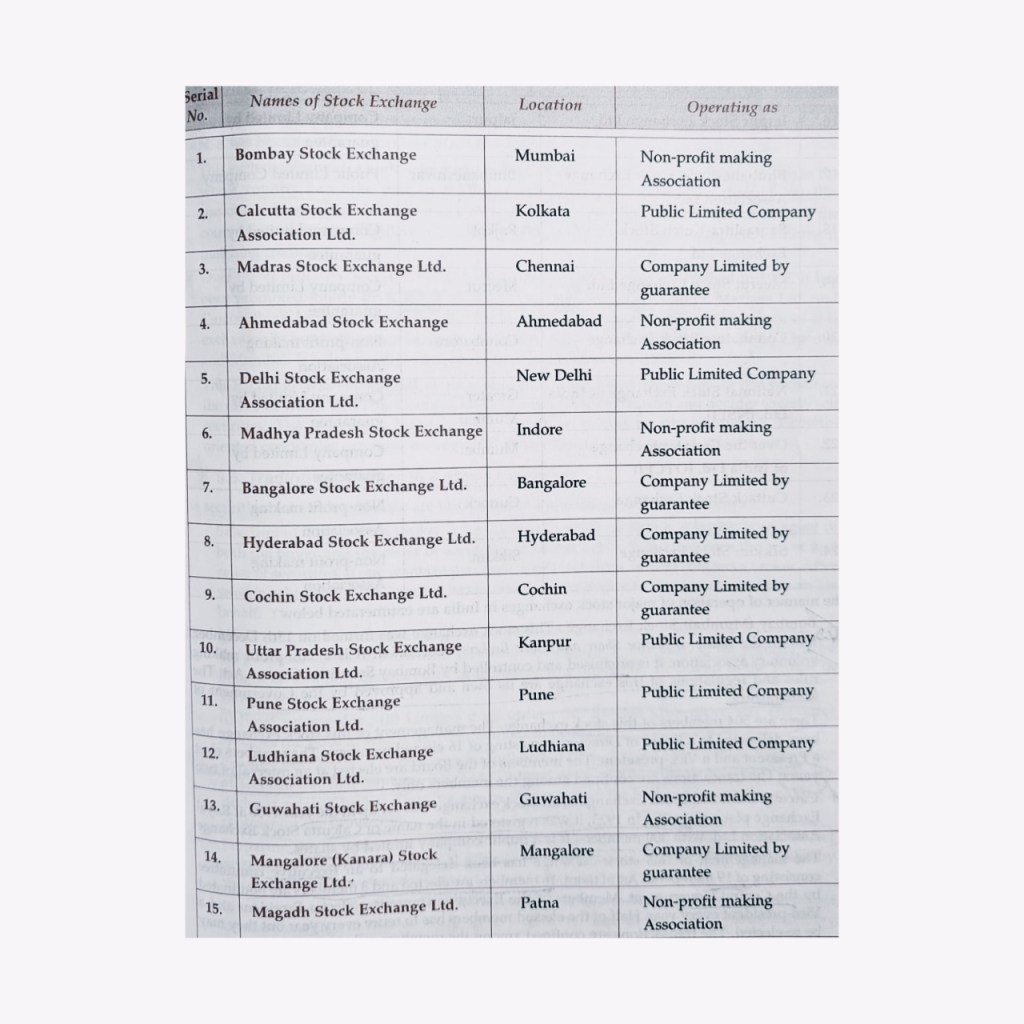
Names and locations of stock exchanges in India :-

At present there are 24 recognised stock exchanges in India .


The major stock exchanges in India :-


1: Bombay ( Mumbai ) Stock Exchange :-
This stock exchange was formed on 13th December , 1887 in the name of Native Share and Stock Brokers Association .
It is a non – profit making voluntary association . It is organised and controlled by Bombay Securities Control Act . The rules and regulations of this exchange are its own and approved by the Government of Maharashtra.


2: Calcutta ( Kolkata ) Stock Exchange :-
This stock exchange was set up in the year 1908 at Royal Exchange place , Calcutta . In 1923 , it was registered in the name of Calcutta Stock Exchange Association Ltd. with 300 members . It is a public company limited by shares .


3: National Stock Exchange ( Greater Mumbai ):- This stock exchange was recognised by the Central Government on 26th April , 1993 . The object of its establishment was to convert the exchange market into a professional market . It provides security (i.e , shares , debentures , bonds , etc.) trading facilities at the national level through satellite communications systems .


4: Over the Counter Exchange (OTCE) :-

(About OTCE )

This stock exchange was established in 1992 . It has been promoted jointly by ICICI , UTI , IFCI , IDBI , SBI , GIC ,LIC , Capital Market Ltd. and Canara Bank Financial Services Ltd. These institutions are the sponsor members of this exchange. Its head office is in Mumbai . It has four regional offices at Kolkata , Delhi , Chennai and Mumbai . It helps smaller companies to raise funds at low cost .


There are two types of stock exchange market investment :-


Primary market – Primary market creates opportunities for the issuer to issue shares and bonds , and acts as a market where companies meet their investment requirements . The companies enlist their shares for the first time in the market and sell their shares through an Initial Public Offering or IPO.

(About IPO )


Secondary market – The secondary market is a trading market platform for investors or issuers , and is also known as the stock market. It is a market where shares of a company are traded after being initially offered to the public in the primary market by the help of brokers or agents . It is a market where buyers and sellers meet directly.

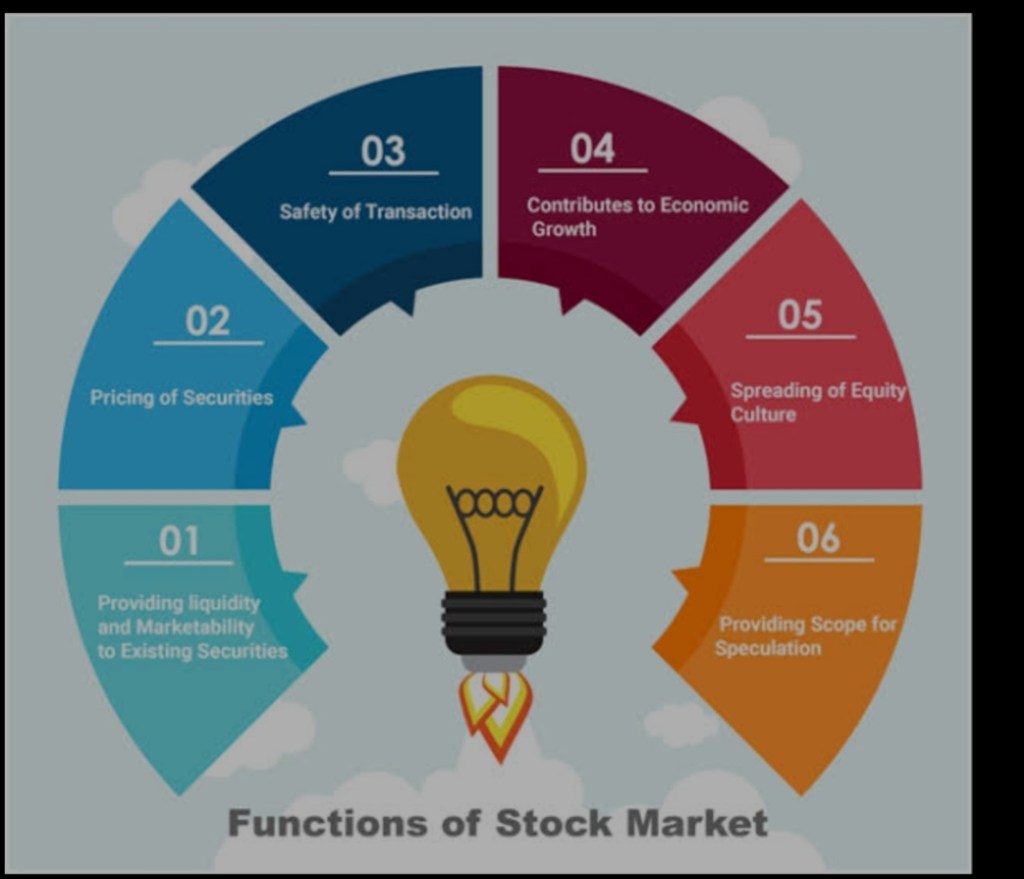
Functions and Services of a Stock Exchange:-


Stock exchange renders the following services :-

1:
Services to the Investors :-

• Investment guide :- Stock Exchange periodically publishes the quotations of listed securities. Investment can decide about purchase and sale of securities on the basis of stock exchange and quotations . Thus , the investors can get the maximum benefit from their investment.

• Liquidity of Investment :- Stock Exchanges are ready and continuous markets for purchase and sale of securities .The securities can easily be converted into cash as the needs of the investors arise .

• High Collateral Value of Listed Securities :- Listed securities in any stock high collateral value . These securities are preferred by rational investors . The securities of such companies can be sold easily . The investors have no fear of risk while trading in listed securities.

• Better use of Capital :-
The prices of shares reflect the profitability and efficiency of the company concerned . A stock exchange helps the investors in choosing good companies for their investment .

• Protection from Bad deliveries :- Securities in the stock exchanges are listed after the proper scrutiny . It prevents the trading of false and duplicate securities .

2:
Services to corporate sector

• Wide market for new securities :-
A stock exchange serves as a sales counter for new securities . Once a company gets listed in a stock exchange, it’s shares are traded freely in that exchange . Therefore , a company can raise a huge amount of capital from different types of investors.

• Increasing Goodwill of the company:-
The shares of only those companies are listed in the stock exchange which are financially sound . Therefore , listing of shares adds to the goodwill and credit standing of a company.

• Transfer of Securities at suitable prices :-
In the event of a merger or amalgamation ,the company whose securities are listed ,is in a better position than the company whose securities are not listed.

• Assist development of companies :-
A stock exchange is an essential adjunct of companies for quick capital formation . It provides a wider and a ready market for the secur of companies . It ensures higher bargaining power to companies in the event of further expansion and merger.

• Knowledge about future investment :-
Companies can get relevant information regarding trends of investment , investors choices and priorities etc., From the stock exchange on a regular basis .The companies can plan their future issue of capital on the basis of such information.

3: Services to Society :-

• Capital formation :- A stock exchange provides good investment opportunities to investors .It promotes the habit of savings and investment.

• Industrial Development :-
A stock exchange helps to mobilize public savings for the economical development of the country.This leads to industrial and commercial development .

• Utilizing scarce capital for productive purposes :- Idle lying funds can be invested in securities on account of stock exchange .

• Useful to Government :- The government plays a vital role as an entrepreneur in the promotion and management of commercial and industrial enterprises . A stock exchange helps the Government in raising sufficient funds for rapid industrial growth .


Operators In A Stock Exchange

Stock market operators are market participants who form a organise stock securities purchases and sales .

Generally found operators:-

Broker :-
A broker acts as a link between the investors and the jobber . He is a commission agent of buyer or seller of securities . A broker charges commissions from both the buyers and the sellers.
He does not specialize in any particular security .He assists in buying and selling all types of securities .

Jobber :-
Jobber can sell and purchase securities in his own name . He is a professional operator . He gets no commission for his service. His income is the profit in purchase and sale of his securities. The service of a jobber is both useful for both the investors and the stock exchange.


Speculators in Stock Exchange

On the basis of Zoological characters , speculators are of four types :-

Bull

In India , bull speculator is known as
Tejiwala “.
The stock market is called a ” bullish market ” when there are large numbers of bulls speculators .
A ‘bull’ is an optimistic speculator who buys securities with the exception of a rise in their prices . He makes purchases of Securities to be sold in future at a higher price to make profit .

Bear

In India , a ‘ bear ‘ speculator is known as a
Mandiwala “. When a stock market has large number of bears ,it is known as ” bearish market “.
A bear speculator expects a fall in the prices of securities . He sells securities with the hope of buying the same at a lower price before the date of delivery.

Stag

A ‘stag ‘ is a ” premium hunter “. He never holds securities as a permanent investment. He issues shares by the new company on the basis of their issued prospectus .He sells these shares at a premium soon after the allotment is made . The premium earned became his profit.

Lame & duck :-
A ‘lame-duck’ is a bear speculator struggling against the difficulties involved in meeting his commitments. He struggles like a duck to purchase shares so that he may deliver the same to another party . He is a bear speculator who is in no position to find shares .


Trading procedure in a Stock Exchange.

Trading in stock markets means the transfer (in exchange for money) of a stock or security from a seller to a buyer. This requires these two parties to agree on a price.


Procedure :-

• Selection of a broker
• Placing the order
• Executing the order
• Preparing the contract note
• Final settlement.