SWOT Analysis explained.

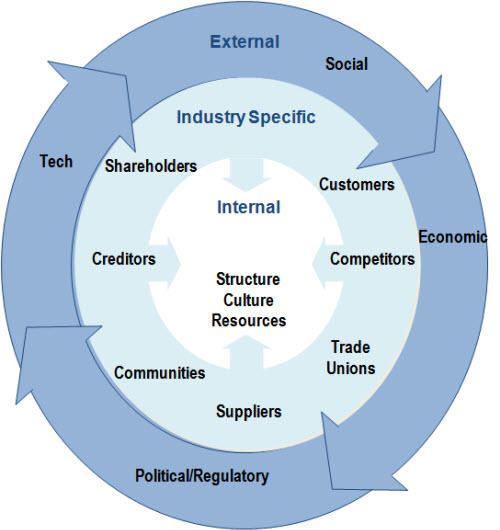
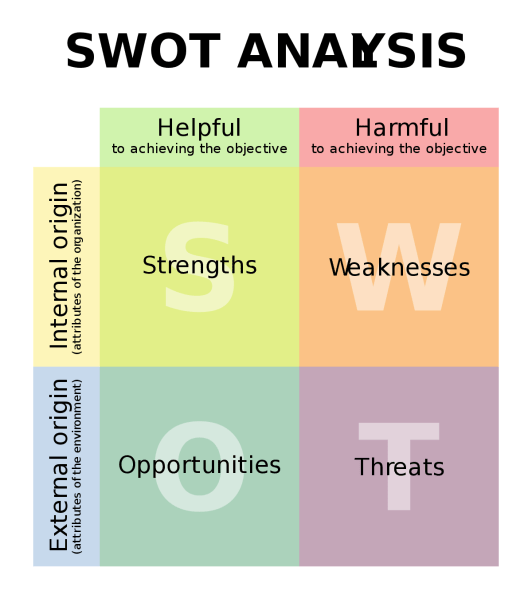
SWOT is an acronym for Strengths, Weaknesses, Opportunities and Threats. By definition, Strengths (S) and Weaknesses (W) are considered to be internal factors over which you have some measure of control. Also, by definition, Opportunities (O) and Threats (T) are considered to be external factors over which you have essentially no control.

SWOT Analysis is the most renowned tool for audit and analysis of the overall strategic position of the business and its environment. Its key purpose is to identify the strategies that will create a firm specific business model that will best align an organization’s resources and capabilities to the requirements of the environment in which the firm operates.

In other words, it is the foundation for evaluating the internal potential and limitations and the probable/likely opportunities and threats from the external environment. It views all positive and negative factors inside and outside the firm that affect the success. A consistent study of the environment in which the firm operates helps in forecasting/predicting the changing trends and also helps in including them in the decision-making process of the organization.

An overview of the four factors (Strengths, Weaknesses, Opportunities and Threats) is given below-

Strengths – Strengths are the qualities that enable us to accomplish the organization’s mission. These are the basis on which continued success can be made and continued/sustained.

Strengths can be either tangible or intangible. These are what you are well-versed in or what you have expertise in, the traits and qualities your employees possess (individually and as a team) and the distinct features that give your organization its consistency.

Strengths are the beneficial aspects of the organization or the capabilities of an organization, which includes human competencies, process capabilities, financial resources, products and services, customer goodwill and brand loyalty. Examples of organizational strengths are huge financial resources, broad product line, no debt, committed employees, etc.

Weaknesses – Weaknesses are the qualities that prevent us from accomplishing our mission and achieving our full potential. These weaknesses deteriorate influences on the organizational success and growth. Weaknesses are the factors which do not meet the standards we feel they should meet.

Weaknesses in an organization may be depreciating machinery, insufficient research and development facilities, narrow product range, poor decision-making, etc. Weaknesses are controllable. They must be minimized and eliminated. For instance – to overcome obsolete machinery, new machinery can be purchased. Other examples of organizational weaknesses are huge debts, high employee turnover, complex decision making process, narrow product range, large wastage of raw materials, etc.

Opportunities – Opportunities are presented by the environment within which our organization operates. These arise when an organization can take benefit of conditions in its environment to plan and execute strategies that enable it to become more profitable. Organizations can gain competitive advantage by making use of opportunities.

Organization should be careful and recognize the opportunities and grasp them whenever they arise. Selecting the targets that will best serve the clients while getting desired results is a difficult task. Opportunities may arise from market, competition, industry/government and technology. Increasing demand for telecommunications accompanied by deregulation is a great opportunity for new firms to enter telecom sector and compete with existing firms for revenue.

Threats – Threats arise when conditions in external environment jeopardize the reliability and profitability of the organization’s business. They compound the vulnerability when they relate to the weaknesses. Threats are uncontrollable. When a threat comes, the stability and survival can be at stake. Examples of threats are – unrest among employees; ever changing technology; increasing competition leading to excess capacity, price wars and reducing industry profits; etc.

SWOT Analysis is a strategic management tool that assists an enterprise in discerning their internal Strengths, and Weaknesses, and external Opportunities, and Threats, to determine its competitive position in the market.

SWOT Analysis

SWOT is an acronym for Strengths, Weaknesses, Opportunities, and Threats. SWOT Analysis is a planning and brainstorming tool for analyzing a person’s or an organization’s strengths, weaknesses, opportunities, and strengths. It considers the internal factors and the external factors that can positively or negatively affect our ability to achieve our goals. It also helps us to focus on the strengths, minimize the threats and make use of the opportunities to the fullest. It is a much-needed one to develop plans for future growth.

S – STRENGTHS

Strengths describe what an organization or a person excels at. They are internal, positive attributes of a person or a company. These attributes could be handled by oneself and kept within one’s control.

W – WEAKNESSES

Weaknesses stop an organization or a person from giving their best at its optimum level. They are negative factors that detract from your strengths. These are things that one might need to improve on to be competitive.

O – OPPORTUNITIES

Opportunities are openings or chances that help one for something positive to happen. They are external factors in your business environment or career that are likely to contribute to your success.

T – THREATS

Threats are anything that can negatively affect your business or career from the outside. They are external factors that you have no control over. You may want to consider having a plan B for dealing with them if they occur.

EXAMPLE SWOT OF A POPULAR PERSONALITY 

I would like to explain SWOT analysis more clearly by citing the SWOT of a famous personality. It will become easier to analyse the self SWOT if we read a few real-life examples. So, here is one such example – the SWOT of Mr. Ritesh Agarwal, Founder, and CEO of OYO. He is a great inspiration for many, especially for the younger generation. Being a college dropout, this young entrepreneur never fails to motivate the youth through his untiring attitude. Below are a few of his strengths, weaknesses, opportunities, and threats that he analysed as he emerged as a budding entrepreneur.

STRENGTHS

  • He had big dreams of starting a business since childhood as he was not interested to take over the family business or work as an employer of any company.
  • He had a great interest in Computer Programming and developed the efficiency of creating a web application by himself.
  • He had the perseverance of doing what he dreamt of despite not having family support.
  • Self-efficacy – He believed in himself and his capabilities more than anything.
  • Being committed and passionate about work.

WEAKNESSES

  • He had no confidence in his studies.
  • Lack of innovation for improving the growth.
  • Concentrating on space rather than improvising the brand.
  • Lack of conceptual clarity.
  • Over hiring of employers.

OPPORTUNITIES

  • His young age and popularity gained him attention and opportunities.
  • His unique approach that gained him success.
  • Growing demand and no international competitors at that time.
  • His idea of providing budget accommodation to people.

THREATS

  • Convincing Venture Capitalists to start the initial investments.
  • He kept the parent company at stake which he might have lost in case of failures.
  • Growing concerns about safe stay at OYO rooms and hotels especially, for the women.
  • Increasing competition in the flouring market.

Whatever may be the strengths and weaknesses, the ability to convert the threats to opportunities determines the real strength of a person. 

SUMMARY

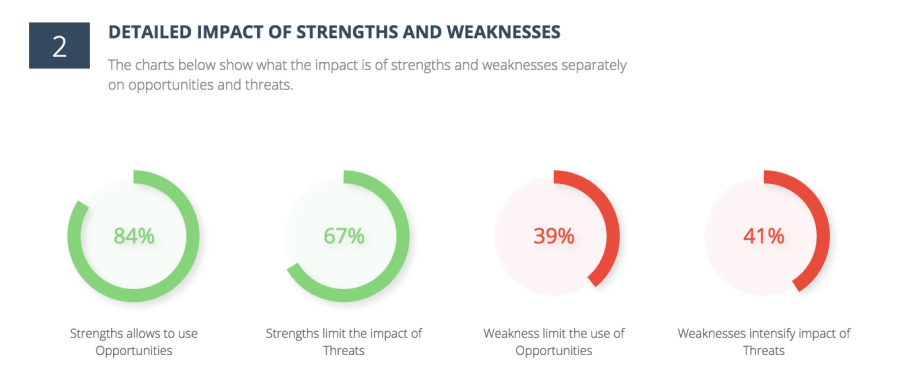
  • Take advantage of the Opportunities through its Strengths.
  • Stay strong against the Threats through its Strengths.
  • Improve Weaknesses by taking advantage of Opportunities.
  • Work to eliminate Weaknesses to avoid Threats.

SWOT in Business

SWOT is an evaluation-process of external and internal factors through the process of communication which can also be termed as empirical Analysis. This analysis is based on observations and experiments which act as strategic management. SWOT in Business stands for:

             S- Strengths

             W- Weaknesses

             O- Opportunities

              T- Threats

Swot analysis is applied in laying down the policies of large organizations. An organization, based on SWOT  analysis, can make a relative/comparative study of its strengths, weakness, opportunities, and threads. On the basis of SWOT analysis, a business organization by exploiting its strengths and opportunities can achieve its multifaced goals, by overcoming its weaknesses and rendering its threads innocuous. SWOT analysis trains us in deriving the maximum benefit from the opportunities and the strengths, it is also identified with the term (WOTS-UP).

In other words, SWOT analysis is a technique that enables a business organization to make the best use of its strengths based on the opportunities and by doing so, an organization can keep the possible threads at bay by overcoming its vulnerable areas.

INTERNAL FACTORS

 1. STRENGTH

  Every individual and every organization possesses some strengths or characteristics or peculiarities. These peculiarities are known as positive points, such as the right pronunciation or right scent in communication, vocabulary, language, command and group discussion, etc., are the positive qualities which fascinate their audience and in course of discussion or debate, satisfying the audience with a clear and valid explanation to their queries, etc., are the major strengths. An effective personality becomes the strength in organizational communication. So strength is a very important factor for anyone.

2. WEAKENESSES

Like strengths and positive assets, there are certain weaknesses in every individual or an organization. Identifying weaknesses and marking them is an important factor. These shortcomings are known as ‘Negative Points” such as faculty and erroneous pronunciation, fast or impatient articulation, inability in drawing others attention and faculty or casual-listening as an audience, non-seriousness, or a casual approach towards communication in a business organization.

– From LEGO SWAT

EXTERNAL FACTORS

3. OPPORTUNITIES

In any business, it is essential to avail of opportunities. In the career of any business organization, professional or individual, there are a plethora of opportunities which can be transformed to destinations or in other words can be described as the gateway to one’s destination, for instance, some professionals by benefiting from e-commerce, have attained a global dimension in their business.

4. THREADS

 Society and the external environment give rise to threats. Every organization, business, profession, or an individual has to go through a rigmarole or a series of difficulties/challenges, on way to success. These threads give way to opportunities, such as the discovery of new means of communication e.g., internet, e-commerce, and e-banking, etc.,

As there are always two sides to a coin, in every business or professional area, the strength and weaknesses march together. Each thread provides opportunities. In this analysis, threats, and opportunities (T-O) and weaknesses and strengths (W-S), through the equation, their interrelated analysis is done, which is also know as TOWS Analysis.