
TAJ MAHAL

15,936 Taj Mahal Photos - Free & Royalty-Free Stock Photos from Dreamstime
TAJ MAHAL

The Taj Mahal is not merely an architectural marvel. Moreover, it also portrays an emperor’s heartfelt passion for the memories of his beloved, embodied in living stone. The grand mausoleum was built between 1631 and 1648 under the orders of the great Mughal Emperor Shah Jahan. This architectural wonder, one of UNESCO’S World Heritage Sites, is situated on the right bank of the Yamuna River in the Agra District of Uttar Pradesh. It is surrounded by expansive Mughal gardens, and occupies an area of almost 17 hectares of land. The Taj Mahal is perhaps the finest example of Indo-Islamic Architecture, and is world renowned for its aesthetic appeal and architectonic beauty. The structure of the Taj Mahal comprises a complex complementary interplay of domes and arches, concave and convex surfaces, solids and voids, and light and shadow. Externally, the lush green gardens, brick red pathway, and the azure canopy garland the pristinely shimmering whiteness of the Taj Mahal, augmenting its halo to a divine level.

HISTORY

About 20,000 workers, including architects, masons, horticulture planners, artists, and carvers, each excelling in their respective fields of work, were employed by the Emperor Shah Jahan in building the Taj Mahal. The cenotaphs of Shah Jahan and his beloved wife, Mumtaz Mahal, lie side by side. The cenotaphs are richly decorated with inlay work and a marble lattice framework, which exhibit the expert workmanship and skill of the craftsmen who put their best into this historical monument. The cenotaphs are primarily for ornamental purposes, as the real graves lie in the crypt at a level lower than them. Decorations with inlaid semiprecious stones, the life-like bas reliefs, calligraphical representations of Koranic verses on the walls, the arch and dome profile of the marble building, and the perfect architectural symmetry of the entire monument are all listed among the features that make the Taj Mahal one of the most unique examples of architectural genius in the history of mankind. The Taj Mahal truly has earned its position among the greatest man-made wonders of our world.

Uniqueness

The Taj Mahal is located in the heart of the busy and densely populated historical city of Agra. Agra lies at one corner of the famous Golden Triangle of tourist destinations in India, which includes Jaipur and Delhi as its other two points. Besides the Taj, Agra has a lot more to offer to its visitors. The city also hosts two other UNESCO World Heritage Sites, namely the breathtaking Agra Fort and Fatehpur Sikri, as well a number of other historical sites. Visitors to the Taj Mahal can enjoy an enriching and unique experience when they visit this destination, both historically and culturally. Shopping is a popular activity among the tourists to Taj Mahal, as the streets leading to this picturesque monument are dotted with souvenir shops selling vibrant and unique north Indian handicrafts, jewelry, sarees, and other items. One must also not forget to try out the delectable local cuisine of the area, especially the Mughlai dishes and north indian sweets

THREATS

Taj Mahal, being one of India’s greatest prides, is afforded great precaution. Especially stringent protective measures were taken during World War II and the India-Pakistan wars in 1965 and 1971 by enclosing the building in scaffolding to protect it against the potential attacks of rival forces. Currently, however, even greater threats to this picturesque monument arise from environmental pollution. The effects of acid rain, caused by emissions from nearby factories, threaten to damage the marble of the building, yellowing it in the process. Recently, the Indian government set up the Taj Trapezium Zone to limit air pollution in the area in and around the Taj Mahal. The decline in the water levels of the Yamuna River also spells bad news for this historical monument, as the lack of moisture has led to the development of cracks and crevices in many parts of the building. The danger persists to this date, and protective measures are continuously being undertaken to improve the structural integrity of this marvellous building. Tourist footfall to the Taj Mahal has also declined in the recent years due to a rise in criminal activities in the area, and the constant hassles faced by the tourists at the hands of touts and hawkers in the streets are real concerns as well. It is thus important that tourists to the Taj Mahal remain cautious and aware of their surroundings, and avoid falling into local sellers’ traps of any kind.

TOURISM

The Taj Mahal has attracted millions of tourists for many years, due to its enchanting beauty and intriguing historical significance. According to recent statistics, about 6.9 million tourists visited this World Heritage Site in 2014 alone. The Taj Mahal is easily accessible via a variety of conveyance services, such as buses, trains, and cars. Air service to nearby Agra is limited, but tourists usually arrive at the Delhi airport in India and then travel to Agra by road or rail. Most travel itineraries of northern India include Taj Mahal on their listed agenda items, and numerous tour operators offer visitors attractive packages to this historical monument. The best time to visit the Taj Mahal is during the months stretching from October through March. Access to the site remains partially restricted on Fridays, when only Muslims are allowed to enter for attending prayer ceremonies. Most people recommend visiting the Taj during sunrise and full moon nights, as these times are when the beauty of the white marble mausoleum is said to be most fascinating, in all of its spectacular appearance.

“THERE ARE TWO KINDS PEOPLE IN THE WORLD.THOSE WHO SEEN THE TAJ MAHAL AND LOVE IT AND THOSE WHO NOT SEEN THE TAJ MAHAL AND LOVE IT”
Seven Wonders of the World

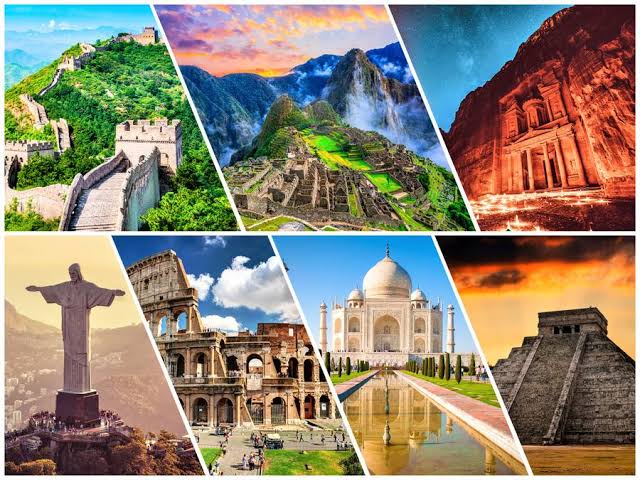
Seven wonders of the world namely The Great Wall of China, Machu Picchu, Petra, Christ the Redeemer, Colosseum, Taj Mahal and Chichen Itza. In 2000 a campaign new seven wonders of the world was launched by a Swiss Foundation in which more than hundred million votes were cast using different medium from around the world. And on 2007 the seven wonders of the world were named. According to a New York-based polling organisation it was the largest poll on record.

Great Wall of China

The Great Wall of China was build in several stretches, which later was joined by Qin Shi Huang the first Emperor of China. The well known section of the wall was built by Ming dynasty. There were various purposes to build this wall like, for the defense, imposition of duties on goods that are transported through Silk route, encouragement for trading activities, etc. It spans over 20,000 km.

Machu Picchu

Machu Picchu is located in Southern Peru. It is build in classical Inca style. It is famous for its dry stone walls made without the use of mortar. It is also known as the ‘Lost city of Inca’.It has a tropical mountain climate. It was included in UNESCO World Heritage site in 1983.

Petra

Petra is a city in Southern Jordan. The city has been inhabited as early as 7000 BC and this was the Nabataean’s capital city in their Kingdom. In 1985 Patra was announced as the World Heritage site.

Christ the Redeemer

It is a statue of the Christ which is situated in Rio de Janeiro, Brazil. The statue has a height of about 30 metres and his arm stretch 28 wide. It is located on the peak of Corcovado mountain in Tijuca Forest National Park.

Colosseum

Colosseum is located in the centre of the city of Rome in Italy it is the largest ancient as well as modern amphitheatre. It was used to host gladiatorial shows. It was built by Emperor Vespasian and his successor  Titus and modifications were made by Domition.

Taj Mahal

Taj Mahal is located on the banks of river Yamuna in Agra, Uttar Pradesh, India. It was built by Mugal Emperor Shah Jahan for his dearest wife Mumtaz. He built this in her remembrance. It is also known as the symbol of love. It is made from Marble. It was declared as UNESCO World Heritage site in 1983.

Chichen Itza

Chichen Itza is situated in Mexico. It is the largest pre-columbian city built by the Maya people. It is one of the most visited archaeological site in Mexico.

The Evergreen Mughal Architecture

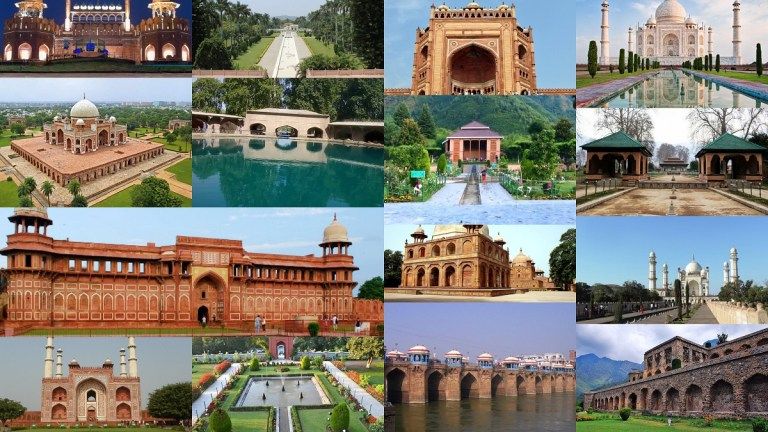
Mughal architecture, is a characteristic Indo-Islamic-Persian building style that flourished in Northern and Central India under the patronage of the Mughal emperors from the mid-16th to the late 17th century. This new style combined elements of Islamic art and architecture, which had been introduced to India during the Delhi Sultanate (1192–1398) and had produced great monuments such as the Qutb Minar, with features of Persian art and architecture. Mughal monuments are found chiefly in the northern parts of India, but there are also many remains in Pakistan. The Mughal period marked a striking revival of Islamic architecture in northern India. Under the patronage of the Mughal emperors, Persian, Indian, and various provincial styles were fused to produce works of unusual quality and refinement.

The tomb of the emperor Humayun (1564) at Delhi inaugurated the new style, though it shows strong Persian influences. The tomb was designed by a Persian architect Mirak Mirza Ghiyas. Set in a garden at Delhi, it has an intricate ground plan with central octagonal chambers, joined by an archway with an elegant facade and surmounted by cupolas, kiosks, and pinnacles. 

The first great period of building activity occurred under the emperor Akbar (reigned 1556–1605) at Agra and at the new capital city of Fatehpur Sikri, which was founded in 1569. The latter city’s Great Mosque (1571; Jami Masjid), with its monumental Victory Gate (Buland Darzawa), is one of the finest mosques of the Mughal period. The great fort at Agra (1565–1574) and the tomb of Akbar at Sikandra, near Agra, are other notable structures dating from his reign. Most of these early Mughal buildings use arches only sparingly, relying instead on post-and-lintel construction. They are built of red sandstone or white marble.

Mughal architecture reached its peak during the reign of the emperor Shah Jahan (1628–1658), its crowning achievement being the magnificent Taj Mahal. This period is marked by a fresh emergence in India of Persian features that had been seen earlier in the tomb of Humayun. The use of the double dome, a recessed archway inside a rectangular fronton, and parklike surroundings are all typical of the Shah Jahan period. Symmetry and balance between the parts of a building were always stressed, while the delicacy of detail in Shah Jahan decorative work has seldom been surpassed. White marble was a favored building material as is evidenced with the Wonder of the World. After the Taj Mahal, the second major undertaking of Shah Jahan’s reign was the palace-fortress at Delhi, begun in 1638. Among its notable buildings are the red-sandstone-pillared Diwan-I-Am (“Hall of Public Audience”) and the so-called Diwan-I-Khas (“Hall of Private Audience”), which housed the famous Peacock Throne. He established Delhi as his capital (1638) and built there the famous Red Fort (1639) which contained the imperial Mughal palace.

The architectural monuments of Shah Jahan’s successor, Aurangzeb (reigned 1658–1707), were not as numerous, though some notable mosques, including the Badshahi mosque in Lahore, were built before the beginning of the 18th century. Subsequent works moved away from the balance and coherence characteristic of mature Mughal architecture. In general, however, Mughal architecture had begun to decline during his reign, a process that would accelerate after his death. “Architecture, of all the arts, is the one which acts the most slowly, but the most surely, on the soul.” The Mughal architecture truly was a revolutionary blend of different cultures and till the present day. Some of the buildings constructed under the reign of the emperor’s are some of the most famous and well known and continue to inspire and attract millions towards its timeless design.