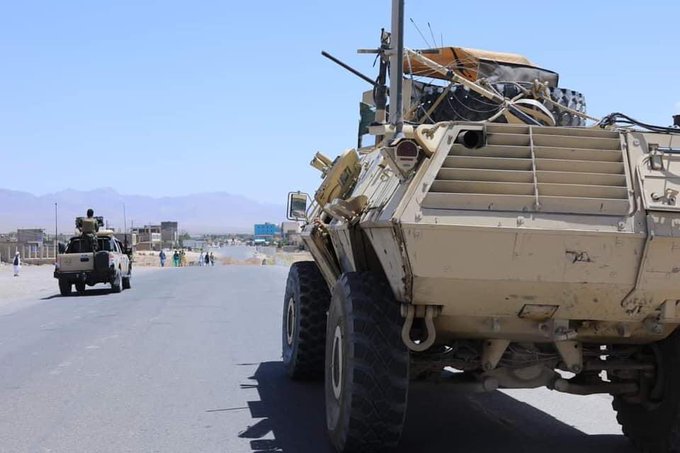
Afghan security forces have increasingly relied on airstrikes to push the militants back from cities, putting the lives of civilians at risk.
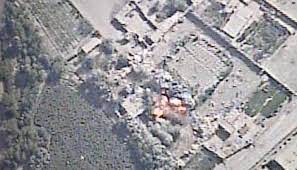
A hideout used by Taliban insurgents is seen being destroyed in an airstrike by defense forces. A video regarding the same was released by the Afghanistan government on Twitter.
— Ministry of Defense, Afghanistan (@MoDAfghanistan) August 1, 2021
In the attack that happened in Zherai district of Kandhar province, total of 20 terrorists were killed. At least 250 such insurgents have been killed while nearly 100 were wounded in battles at several major cities over the past 24 hours, Afghan army said.
As per reports three terrorist vehicles, six motorcycles, two bunkers and a significant amount of their weapons and ammunition were also destroyed.
Ministry of defense, Afghanistan in twitter quoted ” 254 taliban terrorists were killed and 97 wounded as a result of ANDSF operations in Ghazni, Kandahar, Herat, Farah, Jowzjan, Balkh, Samangan, Helmand, Takhar, Kunduz, Baghlan, Kabul & Kapisa provinces during the last 24 hours. Also, 13 IEDs were discovered & defused by ANA “.
Over the past few weeks, Afghanistan has witnessed a surge in violence as Taliban has intensified their against their attack forces and civilians.
AFGHAN VIEWS:
Afghanistan government has repeatedly dismissed the Taliban’s steady territorial progress over the summer as “lacking strategic value”.
In this regard, the Chairman of the Joint Chiefs of Staff, General Mark Miley, made a remarkable comment that the Taliban now control about half of the 419 districts centres in Afghanistan.
He added that as the Taliban seize more territory, the Afghan security forces are consolidating their positions to protect key population center’s, including Kabul.
On July 2, U.S. troops departed from the Bagram Air Base that coordinated the 20-year-long war in Afghanistan, effectively ending their military operations in the country. The exit is part of President Joe Biden’s plan to withdraw American troops from Afghanistan by September 11, the 20th anniversary of the terrorist attack on the twin towers of the World Trade Center and the Pentagon. Ever since the remaining U.S. troops began pulling out on May 1, the Taliban have made rapid territorial advances. If the Taliban had controlled 73 of Afghanistan’s 407 districts before May 1, the number of districts went up to 157 in two months as of June 29. They contest another 151 districts, which leaves 79 districts firmly in the hands of the government. The Taliban’s military offensive is focussed on the northern districts, far away from their southern strongholds, and several provincial capitals are under threat.
Why did the U.S. invade Afghanistan?
Weeks after the September 11, 2001 terrorist attacks, U.S. President George W. Bush declared war on Afghanistan, which was then ruled by the Taliban. Mr. Bush said the Taliban regime had turned down his demand to hand over al-Qaeda leaders, including Osama bin Laden, who plotted the attacks. Inside Afghanistan, the NATO coalition troops led by the U.S. quickly dislodged the Taliban regime and established a transitional government. Al-Qaeda’s leaders and key operatives fled to safe havens in Pakistan. The U.S. rejected an offer from the Taliban to surrender and vowed to defeat the insurgents in every corner of Afghanistan. In May 2003, Defense Secretary Donald Rumsfeld announced that major military operations in the country were over. The U.S. focus shifted to the Iraq invasion, while in Afghanistan, western powers helped build a centralised democratic system and institutions. But that neither ended the war nor stabilised the country.
Why is the U.S. pulling back?
The U.S. had reached the conclusion long ago that the war was unwinnable. Presidents, starting with Barack Obama, had promised to bring American troops back home from Afghanistan. But the U.S. wanted a face-saving exit. In July 2015, the Obama administration had sent a representative to the first-ever meeting between the Taliban and the Afghan government that was hosted by Pakistan in Murree. The Murree talks did not progress as the Afghan government disclosed after the first round that Taliban leader Mullah Omar had died two years earlier.
Later, President Donald Trump appointed a special envoy for Afghanistan, Zalmay Khalilzad, with a mandate to directly negotiate with the Taliban. Mr. Khalilzad and his team held talks with Taliban representatives in Doha that led to the February 2020 agreement between the U.S. and the insurgents. In the agreement, the Trump administration promised that it would withdraw all American troops from Afghanistan by May 1, 2021. President Joe Biden endorsed the Trump-Taliban deal, but pushed the deadline for withdrawal to September 11. Mr. Biden said on Friday, “We’re on track, exactly where we expected to be.”
What are the terms of the Trump-Taliban deal?
Before the Doha talks started, the Taliban had maintained that they would hold direct talks only with the U.S., and not with the Kabul government, which they did not recognise. The U.S. effectively accepted this demand when they cut the Afghan government off the process and entered direct talks with the insurgents. The February deal dealt with four aspects of the conflict — violence, foreign troops, intra-Afghan peace talks and the use of Afghan soil by terrorist groups such as al-Qaeda and the Islamic State (the IS has an Afghan unit, the Islamic State Khorasan Province, or ISKP, which largely operates from Nangarhar in eastern Afghanistan). According to the agreement, the Taliban promised to reduce violence, join intra-Afghan peace talks and cut all ties with foreign terrorist groups, while the U.S. pledged to withdraw all its troops, roughly 12,000 at the time of the signing of the agreement in February 2020, by May 1, 2021.
After the agreement was signed, the U.S. put pressure on the Afghan government to release thousands of Taliban prisoners — a key Taliban precondition for starting intra-Afghan talks. Talks between Taliban representatives and the Afghan government began in Doha in September 2020 but did not reach any breakthrough. At present, the peace process is frozen. The Taliban reduced hostilities against foreign troops but continued to attack Afghan forces even after the agreement was signed. Afghanistan also saw a series of targeted killings of journalists, activists and other civil society figures over the past many months, which the Afghan government says is a Taliban act. Kabul maintains that the Pakistan support for the Taliban is allowing the insurgents to overcome military pressure and carry forward with their agenda.
Is the Afghanistan government doomed?
The American intelligence community has concluded, according to The Wall Street Journal, that Kabul could fall within six months. None of the American leaders, from General Austin Miller to President Biden, is certain about the survival of the Afghan government. When Mr. Biden was asked this question on Friday, he didn’t say that the government would survive, but said, “They have the capacity to sustain the government”. One thing is certain — the American withdrawal has turned the balance of power in the battleground in favour of the Taliban. They are already making rapid advances, and could launch a major offensive targeting the city centres and provincial capitals once the Americans are out.
So, there could be three scenarios, according to experts. One, there could be a political settlement in which the Taliban and the government agree to some power-sharing mechanism and jointly shape the future of Afghanistan. As of now, this looks like a remote possibility. Two, an all-out civil war may be possible, in which the government, economically backed and militarily trained by the West, holds on to its positions in key cities and the Taliban expand its reach in the countryside, while other ethnic militias fight for their fiefs. This is already unfolding. A third scenario would be of the Taliban taking over the country.




 Eduindex
You must be logged in to post a comment.