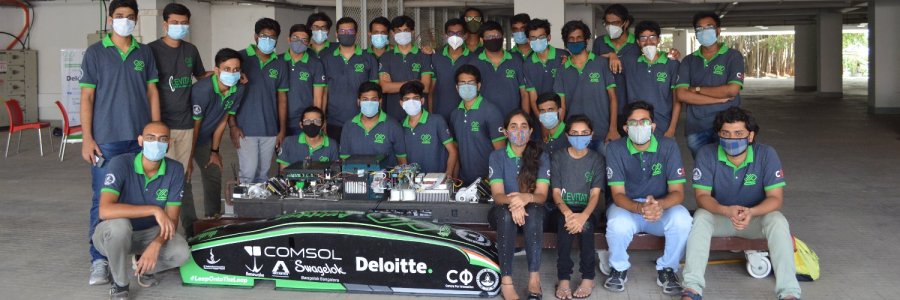
A group of students with team named “AVISHKAR” from IIT Madras have been working tremendously towards the technology behind the future of transportation, HYPERLOOP. The team comprises of forty students from various department of IIT, madras. They have been working on this new prototype hyperloop project since last November.
BUT, WHAT IS HYPERLOOP?
Basically, hyperloop is a high speed mass transportation system. A hyperloop is a super speed ground-level transportation system in which people could travel in a hovering pod inside a vacuum tube at speeds as high as 760 mph (1220 km/h).
While talking about the product, Neel said, “Hyperloop is a proposed mode of transportation in which many pods will be traveling inside a vacuum tube, capable of attaining high speeds due to no air friction and reduced air drag.” It IS the fifth and most efficient mode of transportation that the world is moving towards, he added. Further he said, “Because Hyperloop is sustainable, it works on electrical energy, we can install Solar panels on top of the tube, which could store energy and the same energy could be used to propel the hyperloop. This is way more sustainable .”
HOW DOES A HYPERLOOP WORK?
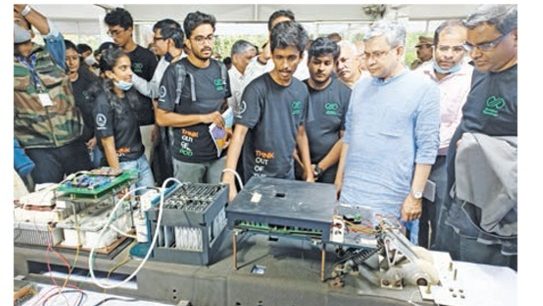
It has three major components: a tube, pod, and terminal. The tube is a large low pressure system that is sealed and tube can be constructed either above or below the ground. A pod is a coach that runs inside this controlled system and this pod employs magnetic or aerodynamic levitation along with electromagnetic or aerodynamic propulsion to glide along a fixed guideway. The terminals are used for arrivals and departures. Hyperloop is based on simple science called Magnetic levitation. But one thing that needs to be noted is, that it requires complex machinery and sensors to make a Pod travel at nearly 1000 km/h inside a vacuum tube. However the team has cracked that and named their pod “GARV”, which translates to “PRIDE”. It consists of Carbon Fiber shell, packed with advanced machinery and sensors.
STATEMENT:
Pranit, who is Head of Braking Module, said that Garv is their second Pod which is more efficient and lighter than the one they designed for SpaceX. “This time we are introducing several technologies like linear induction motor to achieve ‘contactless propulsion’ and ‘contactless braking. The motor produces a magnetic field which makes the Pod move forward and the contactless Braking has magnets which come closer to the rail, creating a Braking force and decelerating the Pod,” Pranit added.
Parth, a member of the Controls team, said, “Our team started in November. Everything we did online such as brainstorming sessions and discussions about the simulations. Once we were confident, we came back to the institute and started working on the Pod.” He said, “We are participating in European Hyperloop Week which will be conducted on 19th – 25th July and Valencia, Spain. Because of the pandemic, we are forced to compete virtually, but that is not a setback for us.”
EUROPEAN HYPERLOOP WEEK SELECTION:
With all their hard work, they have now crossed the hurdle and are qualified for the European Hyperloop Week that is to be held in Valencia, Spain from July 19 to 25. The team will participate virtually due to pandemic restrictions. With upgraded prototype, the team estimates the travel time between Chennai and Bangalore to be a mere 30 minutes ride instead of a six hours journey. They are also working on the study of energy, costs, demands and other aspects of hyperloop so as to access the economic feasibility of hyperloop in India.





 Eduindex
You must be logged in to post a comment.