The largest individual flower on Earth-Rafflesia Arnoldii

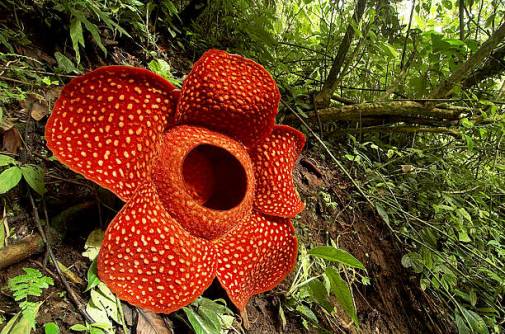
Rafflesia Arnoldii is a species of flowering plant in the parasitic genus Rafflesia. It is noted for producing the largest individual flower on Earth. It has a strong and unpleasant odor of decaying flesh. It is native to the rainforests of Sumatra and Borneo. Although there are some plants with larger flowering organs like the titan arum (Amorphophallus titanum) and talipot palm (Corypha umbraculifera), those are technically clusters of many flowers.

Rafflesia Arnoldii is one of the three national flowers in Indonesia, where it is known locally as the puspa langka or Padma paksasa. The other two being the white jasmine (Jasminum sambac) and moon orchid (Phalaenopsis amabilis). The first person to discover Rafflesia was the ill-fated French explorer Louis Auguste Deschamps in Java between 1791 and 1794, but his notes and illustrations were seized by the British in 1803 and were not available to western science until 1861.

Thailand, Rafflesia can be seen in Khao Sok National Park where the flowers are numbered and monitored by the park rangers. The regional name of Rafflesia Arnoldii is kerubut in Sumatra, cendawan biriang in the Minangkabau language in kecamatan (‘district’) of Pandam Gadang and “corpse flower” by the local people.
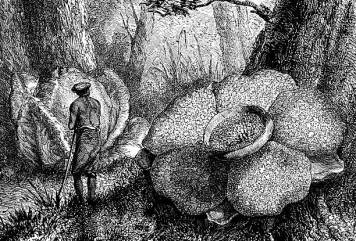
Antique illustration of Rafflesia Arnoldii

Although Rafflesia is a vascular plant, it lacks any observable leaves, stems or even roots, and does not have chlorophyll properties. It lives as a holoparasite on vines of the genus Tetrastigma. Similar to fungi, individuals grow as a mass of thread-like strands of tissue completely embedded within and in intimate contact with surrounding host cells from which nutrients and water are obtained. It can only be seen outside the host plant when it is ready to reproduce; the only part of Rafflesia that is identifiable as distinctly plant-like are the flowers, though even these are unusual since they attain massive proportions, have a reddish-brown colouration, and stink of rotting flesh. The flower of Rafflesia Arnoldii grows to a diameter of around one meter (3.3 feet), weighing up to 11 kilograms. These flowers emerge from very large, cabbage-like, maroon or dark brown buds typically about 30 cm (12 in) wide, but the largest flower bud ever recorded found at Mount Sago, Sumatra in May 1956 was 43 cm (17 in) in diameter. Indonesian researchers often refer to the bud as a ‘knop’ (knob).

Corpse flower, Rafflesia arnoldii, West Sumatra, Indonesia.

Rafflesia Arnoldii is found in both secondary and primary rainforests. The only host plant species of Rafflesia Arnoldii is Tetrastigma leucostaphylum in West Sumatra. Tetrastigma are themselves parasites of a sort, using the strength and upright growth of other surrounding plants to reach the light. The trees that Tetrastigma uses to climb up to light, are relatively limited in number of species, although they are generally the closest tree to the vine. The buds take many months to develop and the flower lasts for just a few days. The flowers are gonochorous – either male or female, thus both flowers are needed for successful pollination.

When Rafflesia is ready to reproduce, a tiny bud forms outside the root or stem of its host and develops over a period of a year. The cabbage-like head that develops eventually opens to reveal the flower. The stigmas or stamens are attached to a spiked disk inside the flower. A foul smell of rotting meat attracts flies and beetles. To pollinate successfully, the flies and beetles must visit both the male and female plants, in that order. The fruit produced are round berries filled with numerous minute seeds.

The flies like Drosophila colorata, Chrysomya megacephala and Sarcophaga haemorrhoidalis visit the late flowers. Black ants of the genus Euprenolepis may feed on the developing flower buds, perhaps killing them.

It’s conservation has not been assessed for the IUCN Red List. Ecotourism is thought to be a main threat to the species, at locations which are regularly visited by tourists the number of flower buds produced per year has decreased.

PUDUCHERRY, INDIA'S FRENCH-SPEAKING CITY

Pandit Jawaharlal Nehru, the late Prime Minister of India, referred to Puducherry as “the Window of French Culture.”

Once the French’s primary headquarters in India, Puducherry is often nicknamed “The Paris of the East”. For 138 years, the French governed the Union Territory. It once had solely French as its official language. The town’s distinctiveness is intricately bound to its exquisite city planning and Franco Tamil architecture. The city is modelled after a late-eighteenth-century fortified French port town, “bastide”. This magnificent destination has incredibly beautiful geography along the seashores, coconut trees, and a diverse range of fauna and vegetation.

The former French settlements- Puducherry, Karaikal, Mache, and Yanam are all part of the Union Territory of Puducherry. The states of Tamilnadu and Kerala surround Puducherry and Karaikal, whereas Kerala and Andhra Pradesh surround Mahe and Yanam. It has many scenic places to visit like:

Paradise Beach

Paradise Beach, often known as Plage Paradiso, is located near Pondicherry town in Chunnambar. The beach fringed with golden sand, is relatively undiscovered.  a 20- to 30-minute ferry ride over the backwaters is the only way to get here. The breathtaking ferry trip from the boathouse to the beach adds to the thrills; the backwaters on the way to the beach are lush and densely forested with mangrove plants.   A plethora of birds can be seen while on the journey. Early morning, Paradise Beach is a great spot to catch a glimpse of the eastern shore’s dawn. A number of water sports facilities are also available. Visitors can also try their hand at fishing by renting fishing rods and nets.
White Town

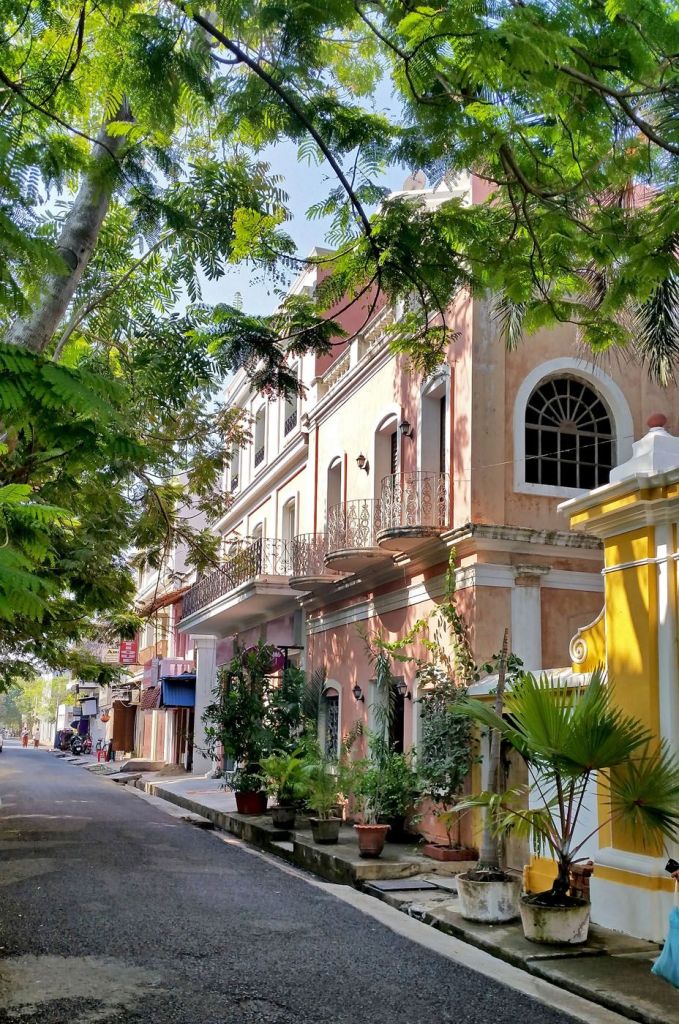
White Town, also dubbed as the French Colony of Puducherry, is a residential enclave in town with an intertwined culture of Tamils and primitive French families. The colony retains the old-world elegance, prettiness, and architecture of historic French Quarters, with cobblestone lanes and mustard yellow dwellings. The majority of them refurbished into vintage hotels, eateries, unique cafés, and art museums. The structures are typically painted in tones of pastel yellow, and the well-kept walkways are flanked with beautiful trees. White Town, known as the former French headquarters, borrows heavily from foreign culture, which is also a hallmark of the area. Furthermore, it is famed for its attractive but pricey marketplace, which is primarily comprised of boutiques, high-end labels, and stores that deal in highly customized stuff. The majority of those are still owned and operated by French nationalists.

Basilica of the Sacred Heart of Jesus

This church was built by French missionaries in 1908 and was accorded the status of Basilica in 2011. It is one of India’s 21 Basilicas and the only one in Pondicherry. The Church of the Sacred Heart of Jesus, one of Pondicherry’s most beautiful Catholic churches, is a stellar example of Gothic architecture. Biblical texts, as well as depictions of Jesus and Mother Mary, are etched in Latin on the entrance door. New Year’s Eve, Christmas Eve, and Easter Day are all lavishly celebrated in the church. The stained-glass panels of the architecture depict Christ’s life as well as the lives of the Catholic Church’s saints. The church is Pondicherry’s first basilica, the 6th in Tamil Nadu, the 20th in India, and the 50th in Asia.

Scuba Diving

Pondicherry, rich in stunning marine life, provides an unparalleled scuba diving expedition off the country’s Eastern Shore. A dive into the sea will allow you to see spectacular coral reefs as well as fascinating creatures including manta rays, kingfish, sea snakes, lionfish, butterflies, crustaceans, moray eels, and more. Whale sharks, sharks, dolphins, and turtles are all possible sightings. Pondicherry is an enticing diving destination.

Auroville Ashram

The Auroville Ashram dubbed the “Universal Town,” is an experimental township whose goal is to build a community wherein folks from all nationalities and faiths could dwell together in harmony. It was founded in 1926 by Sri Aurobindo and a disciple of Shri Aurobindo, a French Lady known as ‘Maa’ or ‘The Mother.’ The Indian government backed the initiative, and UNESCO praised it in a 1966 resolution, calling it “a project of vital importance to humanity’s future.” In 1968, the town was formally established.

The architecture of the city is as remarkable as the concept. With the famous Matrimandir in the core and gardens ringing it, the city is laid out in a circle with a radius of 1.25 kilometres. The city’s central business district, cultural corridor, peace zone, and residential zone are all located just beyond the city borders. The city is surrounded by a “green belt” that acts as a wildlife habitat, a food/timber source, and a buffer against urban development, among other things.

Scuba diving academy to come up at Chintapalli in Visakhapatnam, Andhra Pradesh

Here is some good news for all the watersport lovers in Vizag. A scuba diving academy will be coming up soon in the district, at Chintapalli. The city of beaches has been into the watersports trend, with activities like kayaking, snorkeling, jet skiing and scuba diving. Among these four, scuba diving is the more popular watersport. This watersport is not available at places in India such as Goa, Pondicherry, and the Andaman and Nicobar Islands. But fortunately, Vizag has adopted this highly thrilling and mesmerising underwater activity. 

Taking a big step towards promoting tourism in Vizag, a scuba diving academy at Chintapalli village in Visakhapatnam District. The academy will be started by Livein Adventures, a Vizag-based adventure sports firm, which operates water sports activities in the city with the support of the Andhra Pradesh Tourism Development Corporation (APTDC). This will be a first-of-its-kind scuba diving academy in Andhra Pradesh and one among very few such academies in India. The academy will come up on four acres of land at chintapalli and will be built at an estimated budget of Rs 2 crore. 

Speaking to Yo! Vizag, Balaram Naidu, of Livein Adventures, revealed, “The academy will have courses on basic diving, kayaking, and boating from October 2021. The courses will range from two days to 6 months in duration. Interested individuals, swimmers and non-swimmers, will be able to take globally certified courses on open water diving, rescue diving and advanced diving.” 

Technology and it's influence on society.

Technology can be defined as the modification of science and scientific research that has interfered with the day to day life of an individual and aim to enhance the quality as well as standard of life. World has witnessed technological advancement at very fast pace from last century and is yet to modernise even more. Citing picture of the present world without technology is next to impossible because of its involvement in every aspect of it life be it education, health, tourism etc. However, there is downside of it all as well.

Technology has helped human in many way and made interaction easier and collaborative. World has shrunk because everyone has access to the things that is otherwise seems impossible. Connecting and creating social life has became lot more easier with the help of social media and access to internet 24×7. The advancement in technology has brought about new meaning to learning and field of education by creating vibrant environment, one and for all. Rather than searching a hella huge library for one single paper, you just need one click to have access to books, journals, research papers that saves a lot of money and time as well. Students can take exams or quizzes more easily and teachers can take classes online from anywhere in the world. Imaginig world without technical advances ,in light of pandemic or catastrophe that we are facing since 2020, in nothing less than a nightmare. World would have gone under complete shutdown without aid of otherwise called as classic cliche.

Aside from education, there is profound effect in the field of health and travelling altogether. There are thousands of health apps that you can install on your android as well as windows and can have virtual appointment with doctor, deitics, or fitness coach. Likewise, you can get your air ticket or train ticket done in no time with the help of apps. Since boon and bane comes hand in hand so is the downside of the technology.

Since we are doing everything online these days so there is extended screen time that can lead to health ramifications such as insomnia, eyestrain, migraine as well as increased anxiety and depression. As whole world is confined in the screen of the mobile phone, loneliness among youngsters has multiplied several times causing serious health issue. Without technological advancements, our way of life would not be as complex. Technological influences shape the way humans act today.

A PIECE OF HEAVEN ON EARTH- ANDAMAN AND NICOBAR ISLAND.

In this article, I am going to take you to the middle of the sea. Wondering where? The island which is very famous because of our freedom fighters where they had to spend years behind the bars. Yes, you are guessing right, I am talking about Andaman and Nicobar Island. This place is heaven on the earth if you haven’t visited yet after reading this blog about Andaman and Nicobar Island, I am sure that you all will be going to book your tickets now! So, let’s start our online trip to Andaman and Nicobar.

I am going to talk about the places where I had visited in Andaman and Nicobar.

  1. Havelock
  2. Neil island
  3. Cellular Jail
  4. Ross Island

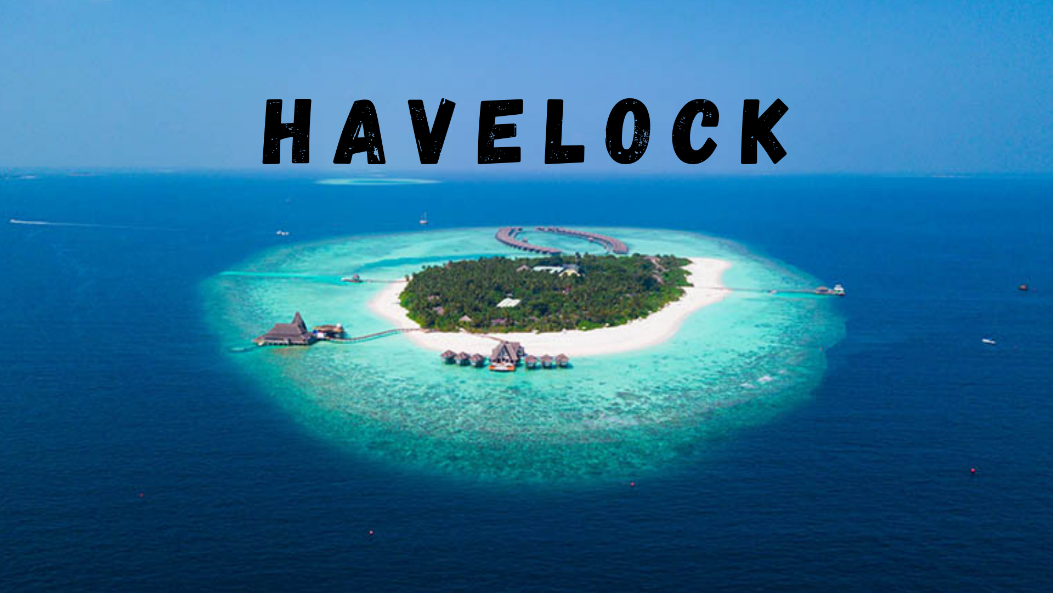
Havelock is the spotlight of the Andaman and Nicobar tourism, it is very famous for the beaches and greenery, in short, it is the feast for the eyes. Clyster clear water, white sand will definitely soothe your eyes. In 2018 our prime minister Narendra Modi has changed the name of havelock to swaraj deep. Yes I know you all want to know how to reach there, you have to book ferries and it will take 90 min to reach there. Places to visit in havelock are:

  1. RADHA NAGAR BEACH:

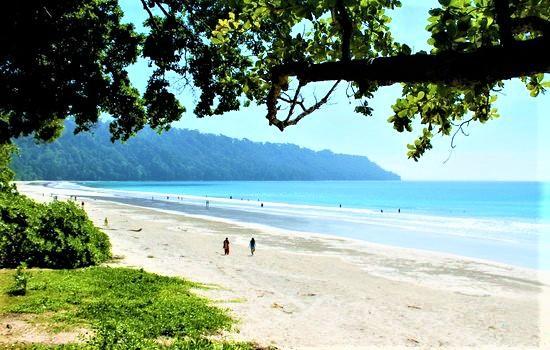
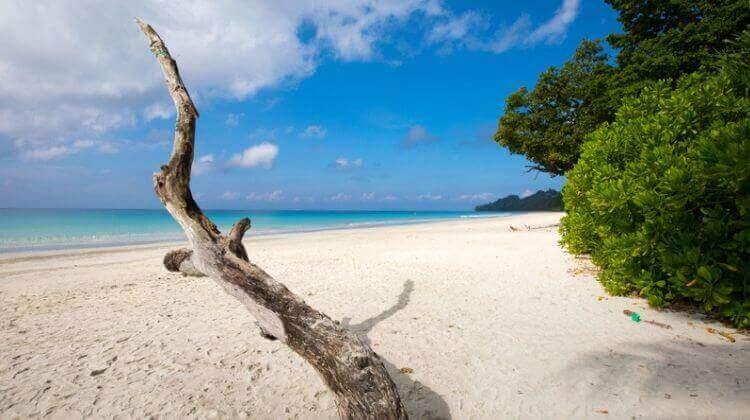
Radha Nagar beach is one of the most well-known beaches in Andaman and Nicobar and  the best beach in Asian  described by the Time magazine. sky blue sea with crystal clear water and white sand where you and enjoy your day you can play in the water you can swim in the water you can also take sun-bath there. There are large numbers of huts, benches and wooden chairs where you can sit and relax there and can enjoy the beauty of nature.

They also provide you with changing rooms where you can change you wet cloths.

  1. ELEPHANT BEACH 

Don’t judge this place by its name, you might be thinking that there must be many elephants but it is not like that. Elephant beach is very famous for water sports, it gives you numerous water activities. Let’s discuss in more details about water sports.

  • SCUBA DIVING : 

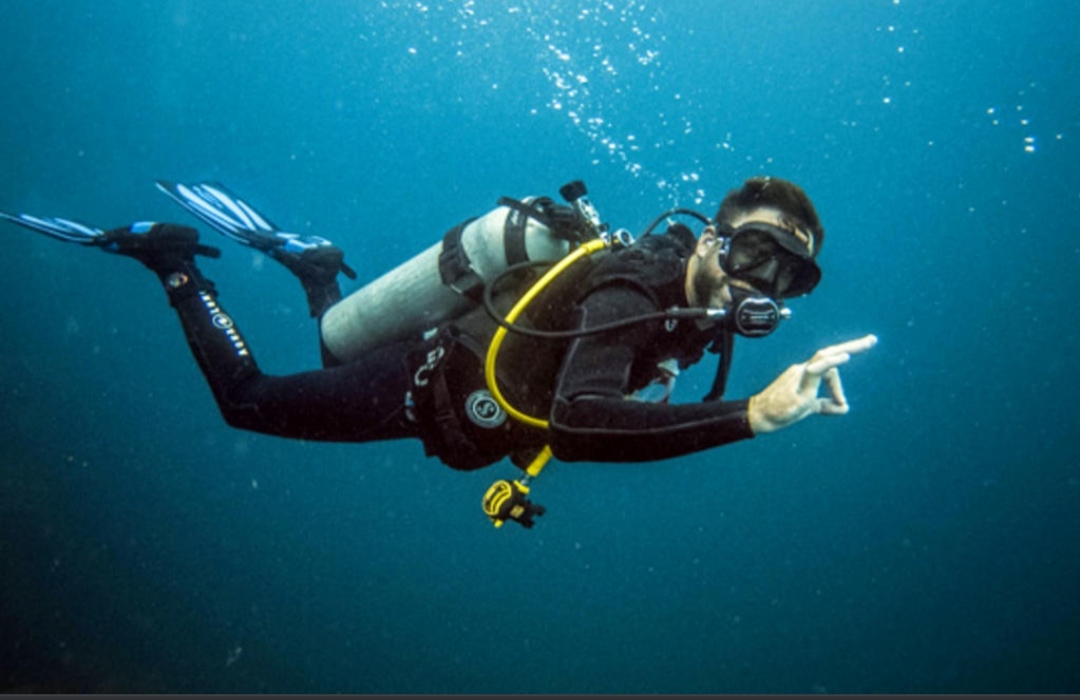
In scuba diving, you are taken under-water where you can see the breath-taking view of aquatic life. You can see untouched coral reefs, vibrant fishes, under-water vegetation and under-water ecosystem.

  • SNORKELING :

Snorkelling is little bit same as scuba diving but it doesn’t allow you to go deep inside the water, you can only go to the surface of the water and can see through your goggles, and also can swim.

  • SEA WALKING: 

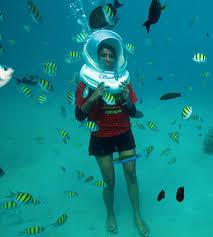
Yes, you heard right you can walk under the sea, sea walking is most unique and very adventurous. Diving and swimming are okay but have you ever imagined walking under the sea. Once you reached the bottom of the sea you will see that you will get surrounded by hoards of fishes you can actually feed them, isn’t it really exciting?

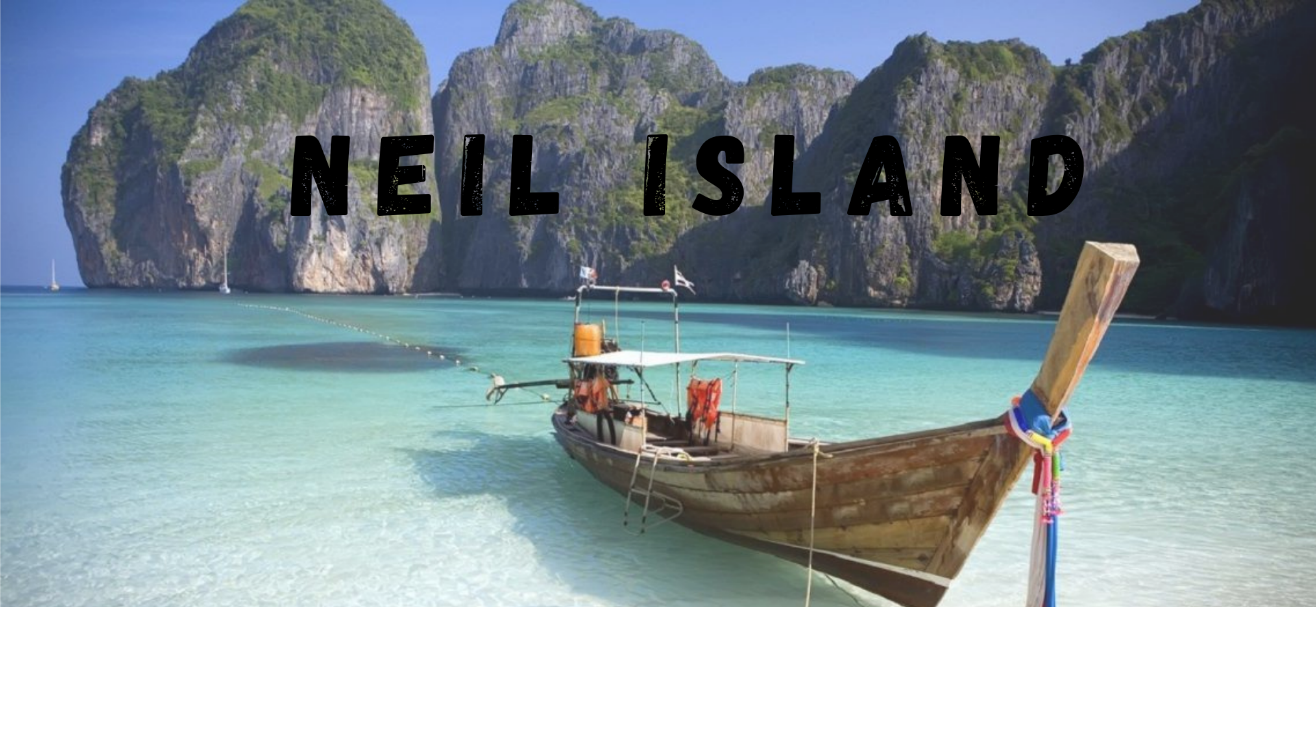
It is another island full of beaches, this island is for those who want to be far from noise, disturbance as you can find a smaller number of vehicles, market and less population. Here also you can find water sports activities like jet skiing and a glass bottom boat ride. Let me make you more clear about these water sports.

  • JET SKIING:

Jet skiing is one of the most enjoyable water sports activity as it can be enjoyed by anyone and it is available at Bharatpur Beach in Neil. It will give you a unique feeling that you are riding a bike on water. Timing for this activity is from 9AM to 4PM. I personally advise you to book jet ski as it is always available and t is cheaper than other water sports activities.

  • GLASS BOTTOM BOAT RIDE:

this activity is appropriate for those who don’t want to get wet or doesn’t want to go into the water. By the name itself, it is clear that you will be travelling on a boat which will have a see-through glass from which you can see the underwater life, you can see fishes, corals and many more.

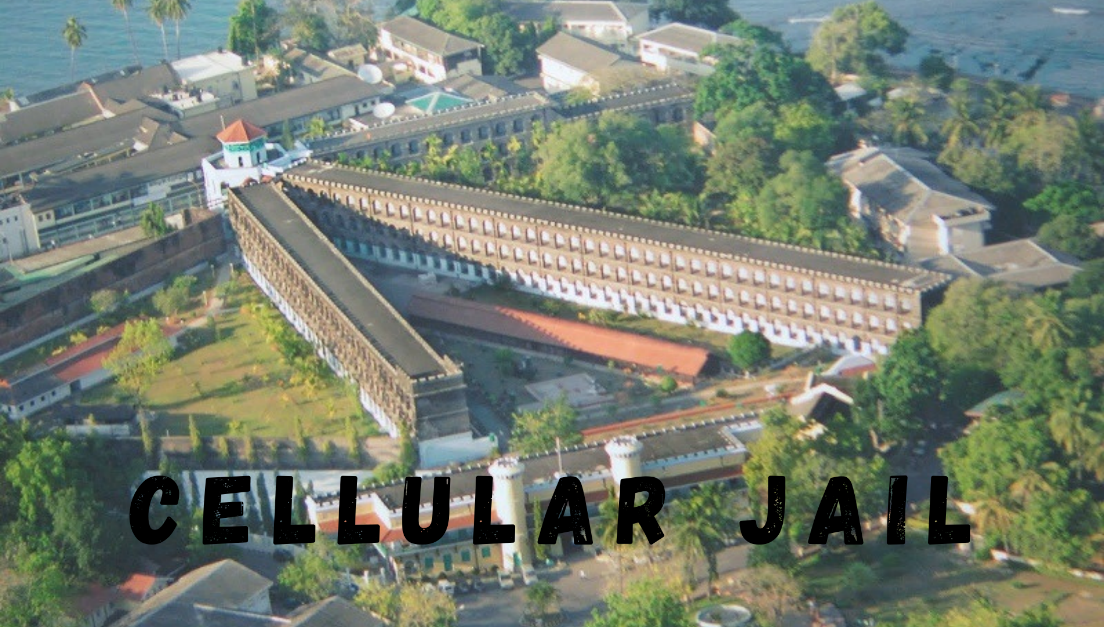
Cellular jail is one of the most historic monuments in Andaman and Nicobar, also known as kaala Pani, it will definitely give you goosebumps while exploring the jail. Every wall of the jail will tell you the story of our soldiers. There you will see how much sacrifice has been done by our freedom fighters. Britishers used to send the soldiers in this whenever they try to protest against them. You can visit the jail at 9AM to 12:30PM and 1:00PM to 5PM (except on Mondays and on national holiday)

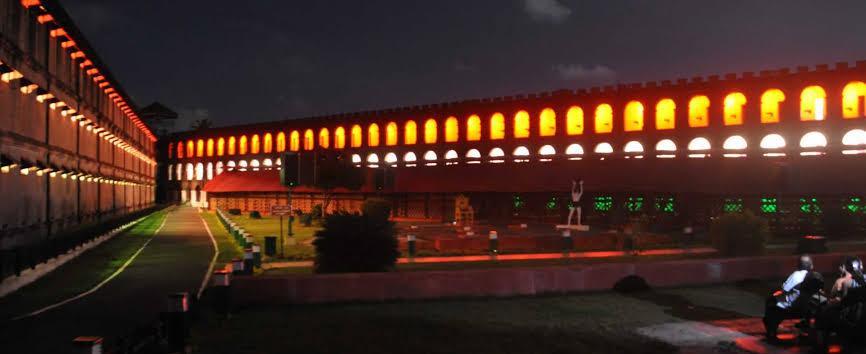
Cellular jail will provide you light and sound show, in this you will get narrated the whole story of how freedom fighters lived there how they survived there and how has been treated there. It is a must-watch show. The show is in both Hindi language and in the English language. You can enjoy this show at 6PM    (Hindi) and 7:15PM (English).

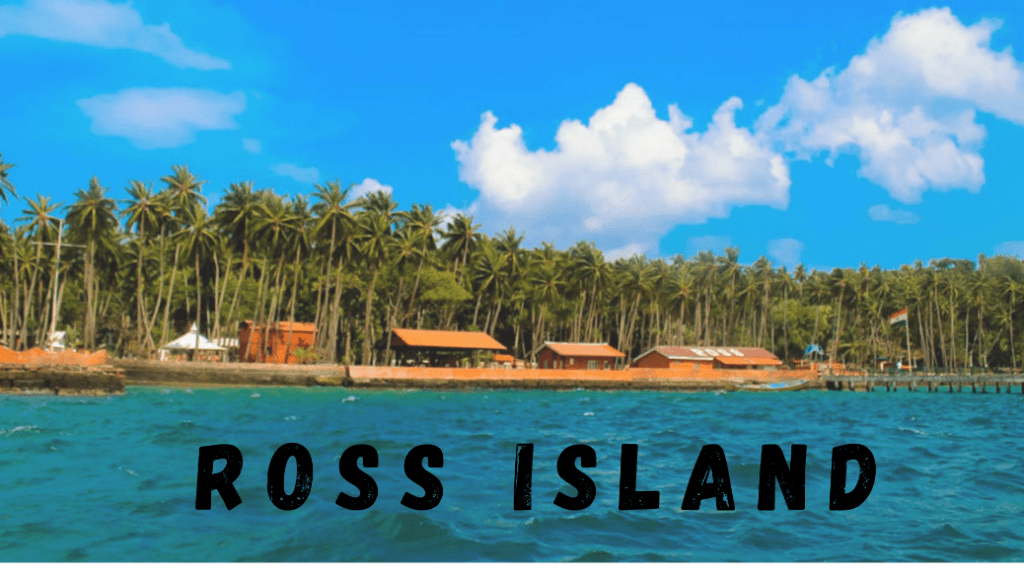
The one who is a nature lover, Ross island is a perfect place to visit. There you are surrounded by nature. There you can see animals and the best part is that they are not caged they will roam here and there. You will see rabbits, deer, peacocks roaming here and there and you can experience the beauty of the nature. You can sit there for hours in cool breeze and can also enjoy the beach view. In 2018 our Prime Minister Narender Modi has changed the name of RossIsland to Netaji Shubhas Chandra Bose island.

Next question you all will get that how one can reach there?

You can get a boat from phoenix bay jetty and it will help you to reach in 15 mins, the people over there will provide you with a life jacket also or else you can choose a helicopter tour. 

Yes, this is the short and adventurous trip of mine to Andaman and Nicobar, I am sure that after reading this article and you will definitely plan your future trip to Andaman and Nicobar. I personally suggest you to visit Andaman and Nicobar during summer months. 

A PIECE OF HEAVEN ON EARTH- ANDAMAN AND NICOBAR ISLAND.

In this article, I am going to take you to the middle of the sea. Wondering where? The island which is very famous because of our freedom fighters where they had to spend years behind the bars. Yes, you are guessing right, I am talking about Andaman and Nicobar Island. This place is heaven on the earth if you haven’t visited yet after reading this blog about Andaman and Nicobar Island, I am sure that you all will be going to book your tickets now! So, let’s start our online trip to Andaman and Nicobar.

I am going to talk about the places where I had visited in Andaman and Nicobar.

  1. Havelock
  2. Neil island
  3. Cellular Jail
  4. Ross Island

Havelock is the spotlight of the Andaman and Nicobar tourism, it is very famous for the beaches and greenery, in short, it is the feast for the eyes. Clyster clear water, white sand will definitely soothe your eyes. In 2018 our prime minister Narendra Modi has changed the name of havelock to swaraj deep. Yes I know you all want to know how to reach there, you have to book ferries and it will take 90 min to reach there. Places to visit in havelock are:

  1. RADHA NAGAR BEACH:

Radha Nagar beach is one of the most well-known beaches in Andaman and Nicobar and  the best beach in Asian  described by the Time magazine. sky blue sea with crystal clear water and white sand where you and enjoy your day you can play in the water you can swim in the water you can also take sun-bath there. There are large numbers of huts, benches and wooden chairs where you can sit and relax there and can enjoy the beauty of nature.

They also provide you with changing rooms where you can change you wet cloths.

  1. ELEPHANT BEACH 

Don’t judge this place by its name, you might be thinking that there must be many elephants but it is not like that. Elephant beach is very famous for water sports, it gives you numerous water activities. Let’s discuss in more details about water sports.

  • SCUBA DIVING : 

In scuba diving, you are taken under-water where you can see the breath-taking view of aquatic life. You can see untouched coral reefs, vibrant fishes, under-water vegetation and under-water ecosystem.

  • SNORKELING :

Snorkelling is little bit same as scuba diving but it doesn’t allow you to go deep inside the water, you can only go to the surface of the water and can see through your goggles, and also can swim.

  • SEA WALKING: 

Yes, you heard right you can walk under the sea, sea walking is most unique and very adventurous. Diving and swimming are okay but have you ever imagined walking under the sea. Once you reached the bottom of the sea you will see that you will get surrounded by hoards of fishes you can actually feed them, isn’t it really exciting?

It is another island full of beaches, this island is for those who want to be far from noise, disturbance as you can find a smaller number of vehicles, market and less population. Here also you can find water sports activities like jet skiing and a glass bottom boat ride. Let me make you more clear about these water sports.

  • JET SKIING:

Jet skiing is one of the most enjoyable water sports activity as it can be enjoyed by anyone and it is available at Bharatpur Beach in Neil. It will give you a unique feeling that you are riding a bike on water. Timing for this activity is from 9AM to 4PM. I personally advise you to book jet ski as it is always available and t is cheaper than other water sports activities.

  • GLASS BOTTOM BOAT RIDE:

this activity is appropriate for those who don’t want to get wet or doesn’t want to go into the water. By the name itself, it is clear that you will be travelling on a boat which will have a see-through glass from which you can see the underwater life, you can see fishes, corals and many more.

Cellular jail is one of the most historic monuments in Andaman and Nicobar, also known as kaala Pani, it will definitely give you goosebumps while exploring the jail. Every wall of the jail will tell you the story of our soldiers. There you will see how much sacrifice has been done by our freedom fighters. Britishers used to send the soldiers in this whenever they try to protest against them. You can visit the jail at 9AM to 12:30PM and 1:00PM to 5PM (except on Mondays and on national holiday)

Cellular jail will provide you light and sound show, in this you will get narrated the whole story of how freedom fighters lived there how they survived there and how has been treated there. It is a must-watch show. The show is in both Hindi language and in the English language. You can enjoy this show at 6PM    (Hindi) and 7:15PM (English).

The one who is a nature lover, Ross island is a perfect place to visit. There you are surrounded by nature. There you can see animals and the best part is that they are not caged they will roam here and there. You will see rabbits, deer, peacocks roaming here and there and you can experience the beauty of the nature. You can sit there for hours in cool breeze and can also enjoy the beach view. In 2018 our Prime Minister Narender Modi has changed the name of RossIsland to Netaji Shubhas Chandra Bose island.

Next question you all will get that how one can reach there?

You can get a boat from phoenix bay jetty and it will help you to reach in 15 mins, the people over there will provide you with a life jacket also or else you can choose a helicopter tour. 

Yes, this is the short and adventurous trip of mine to Andaman and Nicobar, I am sure that after reading this article and you will definitely plan your future trip to Andaman and Nicobar. I personally suggest you to visit Andaman and Nicobar during summer months. 

Economic Benefits of Biodiversity

All of us live in a world where we depend on each other for our needs. Almost all of our needs are met through biodiversity, directly or indirectly. Biodiversity refers to the variability among living organisms from all sources including terrestrial, marine and other aquatic ecosystems and the ecological complexes of which they are part, this includes diversity within species, between species and of ecosystems. Biodiversity in short is our whole environment including flora, fauna, microbes, gases and everything that constitutes our planet earth. It is the foundation of life.

Biodiversity is of great importance when it comes to its economic benefits. Here are some of the economic benefits of biodiversity.

(1) Biodiversity provides us with potential raw materials – Biodiversity provides a great diversity of materials for the construction and fuel including wood, biofuels and plant oils that are directly derived from wild and cultivated plant species.

(2) Food and fresh water – The most important services for the survival of human beings like food and water are provided by the biodiversity. Biodiversity regulates the flow and purification of water.
(3) Organic waste disposal – Biodiversity acts as an organic disposal ground for waste materials, as many things are naturally decomposed in the environment with the help of microbes present in the soil.

(4) Climate and air quality control – Trees provide shade while forests influence rainfall and water availability both locally and regionally. They also play an important role in regulating air quality by removing pollutants from the atmosphere.

(5) Nitrogen fixation – Nitrogen fixation is essential for plant growth and an insufficient quantity of it frequently limits biomass production in both natural and agricultural ecosystems. To increase production of crops, a process called biological nitrogen fixation is implemented through chemical uses, however natural biological nitrogen fixation proves to be healthier and more yielding than the commercial one.

(6) Moderates natural disasters – Extreme weather events or natural hazards include floods, storms, tsunamis, avalanches and landslides. Ecosystems and living organisms create buffer against natural disasters, thereby preventing possible damage. E.g. wetlands can soak up floodwater while trees can stabilize slopes.

(7) Species Habitat – Habitats provide everything that an individual plant or animal needs to survive. Each ecosystem provides different habitats that can be essential for species’ lifecycle.

(8) Medicinal Resources – Ecosystems and their biodiversity provide many medicinal plants used in traditional medicine and as well as provide raw materials for the pharmaceutical industry.

(9) Pollination – Insects and wind pollinate plants and trees, which is essential for propagation and development of fruits, vegetables and seeds.

(10) Biotechnology- Biodiversity has led to an important field of study in science known as biotechnology. Biotechnology refers to the technologies produced from animals, plants and microbes. Biotechnology is of utmost importance because it provides us with various beneficial products and inventions that lead to an advance in our economy and in human life.

(11) Tourism – Ecosystems and biodiversity play an important role for many kinds of tourism, which in turn provides considerable economic benefits and is a vital source of income for many countries.

These are only a few important economic benefits of biodiversity. Biodiversity as a whole has a lot more benefits and is our main sustainer of life. Therefore, we must strive to conserve our biodiversity.

INDIA IN SOUTH-EAST ASIA AND THE SAARC

regional cooperation is needed for securing trade related benefits and for utilizing collective resources for mutual benefits. This objective is realized by establishing organisations by the countries having geographical affinity. Such organisation are based on a formal agreement signed by the concerned nations. The member countries utilize each others resources to solve common problems. To attain this two regional organization that work for the socio-economic integration of south-Asian region are such as ASEAN ( associations of south Asian nations ) and SAARC ( south association of regional cooperation ). SARRC is a major regional initiative undertaken by the South- Asian countries to evolve cooperation.

India have very close relations with south east Asians countries from very beginning. South – East Asia is composed of 10 nations, namely Brunei, Cambodia, Indonesia, Laos, Malaysia, Myanmar, Philippines, Singapore, Thailand and Vietnam. In the past , India’s engagement with the South East Asian was built on the shared experience of colonialism and culture ties. But at present it is linked to trade, investment and production. South Asian association for Regional Cooperation (SAARC) was established by seven South Asian Countries, Namely India, Bangladesh, Bhutan, Maldives, Nepal, Pakistan, and Sri lanka in December 1985 in Dhaka, the capital of Bangladesh. Afghanistan was included as the eighth member of SAARC. The concept of SAARC originally mooted by the former Bangladesh President Zia-ur-Rahman, with the aim of establishing economic and cultural cooperation among the people of south Asia. Its permanent secretariat at Kathmandu in Nepal was established in 1985.

The Charter of SAARC has laid down a number of objectives to promote the welfare of the people in South East Asian countries and to improve the quality of life. It accelerates the economic growth, social progress and cultural development. It promotes the mutual trust, understanding and appreciation of each other’s problems. It works to develop the mutual assistance in the economic, social, cultural and technical and scientific field. It also works for the cross border terrorism and smuggling.

India is largest and the most populous among the SARRC countries, it also occupies 72 percent of the South Asia and about 77 percent of the population. It is also the most advanced among SAARC nations. All the members states of SAARC are of strategies importance to India and share cultural and ethnic legacies. India has focused on strengthening its relations with these countries through economic cooperation. This includes grants of unilateral tariff concessions to Bangladesh, collaborative projects including implementation of infrastructures of development projects in Myanmar, cooperation in health, education and tourism sectors in Maldives and close economic integration with sri lanka. India has made substantial construction effort , which includes a wide range of humanitarian, financial and projects assistance.

To conclude India have played major role in forging closer links among then SAARC countries and promoting regional peace, economic growth, social progress and cultural development of the area.

Impact of Covid on World Economy

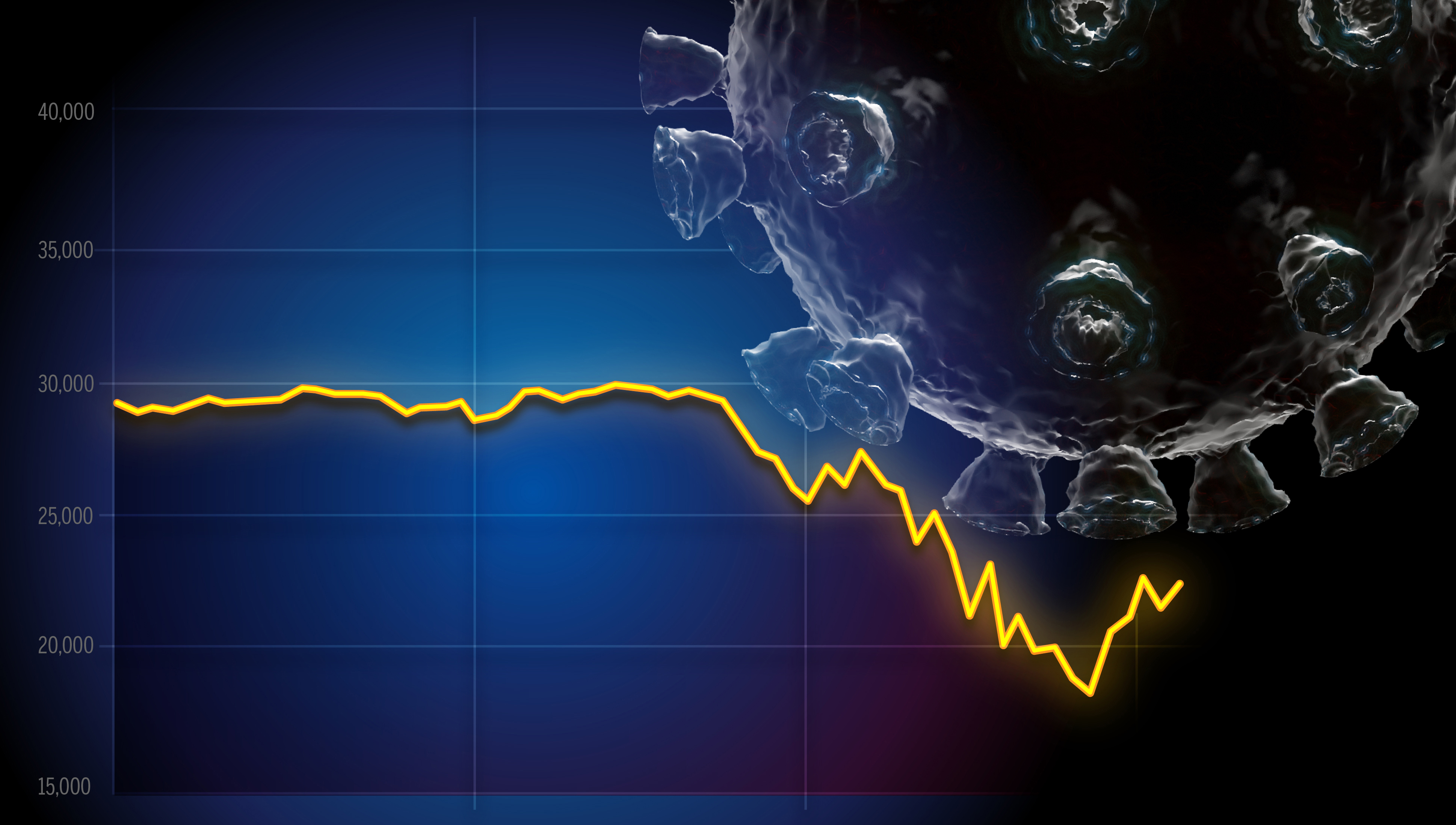
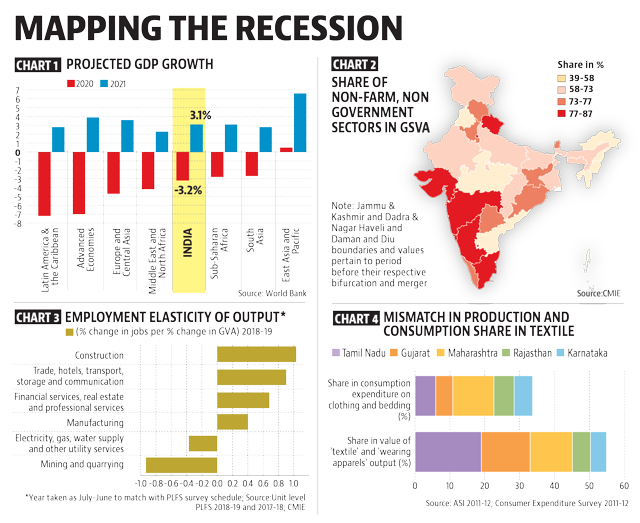
The COVID-19 pandemic has spread with alarming speed, infecting millions and bringing economic activity to a near-standstill as countries imposed tight restrictions on movement to halt the spread of the virus. As the health and human toll grows, the economic damage is already evident and represents the largest economic shock the world has experienced in decades. The June 2020 Global Economic Prospects describes both the immediate and near-term outlook for the impact of the pandemic and the long-term damage it has dealt to prospects for growth. The baseline forecast envisions a 5.2 percent contraction in global GDP in 2020, using market exchange rate weights—the deepest global recession in decades, despite the extraordinary efforts of governments to counter the downturn with fiscal and monetary policy support. Over the longer horizon, the deep recessions triggered by the pandemic are expected to leave lasting scars through lower investment, an erosion of human capital through lost work and schooling, and fragmentation of global trade and supply linkages.

The pandemic is expected to plunge most countries into recession in 2020, with per capita income contracting in the largest fraction of countries globally since 1870. Advanced economies are projected to shrink 7 percent. That weakness will spill over to the outlook for emerging market and developing economies, who are forecast to contract by 2.5 percent as they cope with their own domestic outbreaks of the virus. This would represent the weakest showing by this group of economies in at least sixty years.

Every region is subject to substantial growth downgrades. East Asia and the Pacific will grow by a scant 0.5%. South Asia will contract by 2.7%, Sub-Saharan Africa by 2.8%, Middle East and North Africa by 4.2%, Europe and Central Asia by 4.7%, and Latin America by 7.2%.  These downturns are expected to reverse years of progress toward development goals and tip tens of millions of people back into extreme poverty.

Emerging market and developing economies will be buffeted by economic headwinds from multiple quarters: pressure on weak health care systems, loss of trade and tourism, dwindling remittances, subdued capital flows, and tight financial conditions amid mounting debt. Exporters of energy or industrial commodities will be particularly hard hit. The pandemic and efforts to contain it have triggered an unprecedented collapse in oil demand and a crash in oil prices. Demand for metals and transport-related commodities such as rubber and platinum used for vehicle parts has also tumbled. While agriculture markets are well supplied globally, trade restrictions and supply chain disruptions could yet raise food security issues in some places.

IMPACT ON INDIAN ECONOMY

ILO said that pandemic is not only the world Health crisis rather it is also a Labour Market and Economic Crisis. There is also an emergence of fall in GDP 90% of countries request financial help to International monetary Fund. According to ILO 2.5 crores of employment are brought in under a situation of decline. Government regulate many programmes and activities like Social Distancing, Lockdown, Sanitisation, mask protection, Quarantine etc but still doesn’t found a correction. Lockdown mostly affects the informal area and it leads to 50% of our economic GDP. Raw materials don’t be purchased and goods out not explore in the markers and causes big unemployment.

As per the official data released by the ministry of statistics and program implementation, the Indian economy contracted by 7.3% in the April-June quarter of this fiscal year. This is the worst decline ever observed since the ministry had started compiling GDP stats quarterly in 1996. In 2020, an estimated 10 million migrant workers returned to their native places after the imposition of the lockdown. But what was surprising was the fact that neither the state government nor the central government had any data regarding the migrant workers who lost their jobs and their lives during the lockdown.

The second wave of Covid-19 has brutally exposed and worsened existing vulnerabilities in the Indian economy. India’s $2.9 trillion economy remains shuttered during the lockdown period, except for some essential services and activities. As shops, eateries, factories, transport services, business establishments were shuttered, the lockdown had a devastating impact on slowing down the economy. The informal sectors of the economy have been worst hit by the global epidemic. India’s GDP contraction during April-June could well be above 8% if the informal sectors are considered. Private consumption and investments are the two biggest engines of India’s economic growth. All the major sectors of the economy were badly hit except agriculture. The Indian economy was facing headwinds much before the arrival of the second wave. Coupled with the humanitarian crisis and silent treatment of the government, the covid-19 has exposed and worsened existing inequalities in the Indian economy. The contraction of the economy would continue in the next 4 quarters and a recession is inevitable. Everyone agrees that the Indian economy is heading for its full-year contraction. The surveys conducted by the Centre For Monitoring Indian Economy shows a steep rise in unemployment rates, in the range of 7.9% to 12% during the April-June quarter of 2021. The economy is having a knock-on effect with MSMEs shutting their businesses. Millions of jobs have been lost permanently and have dampened consumption. The government should be ready to spend billions of dollars to fight the health crisis and fast-track the economic recovery from the covid-19 instigated recession. The most effective way out of this emergency is that the government should inject billions of dollars into the economy.

The GDP growth had crashed 23.9% in response to the centre’s no notice lockdown. India’s GDP shrank 7.3% in 2020-21. This was the worst performance of the Indian economy in any year since independence. As of now, India’s GDP growth rate is likely to be below 10 per cent.

Importance of English

We all people in the world speak many languages as like Hindi, Marathi, English, British Gujarati but English is one of the most important and beautiful language in the world. It is spoken in every part of the world. It is the mother tongue of about thirty cores people and an equal number of people us English as their second languages. It has the largest vocabulary and it continues to grow up with the progress in subjects like computer, science, technology, advertising, politics, economies, etc.

Many more words are flawing into English language. Knowledge of English is essential in every walk of lief because it is widely used in almost every field like commerce, politics, film industry, tourism, etc. important books on literature, science and technology are mostly available in English.

In your future English language is very important for every people because the important of the English. This language is a state level language. English is very useful language because many important exams, business are in the English language.

English is a very rich and useful language. We must learn to read, speak and write English very well. I like English languages very very much, because this given many important benefits. English is very beautiful and very easily language to learn to all people in the world Today’s generation is a English generation. So I request to all people that they all learn English.

Problems during travelling in India

 No Doubt that some places in India are beautiful to live and to travel. India has very good places in terms of nature, history, paintings and architecture.

This is all about travelling in the sense of tourism, going on a trip of 8-10 days, residing in a hotel etc . Is travelling all about visiting  places for a few days? Is travelling limited to tourism?
India is a country, where everything is available at walking distance, every single street, even the remote one has at least 2 small or big grocery shops. People do not need to travel even one mile distances for groceries.
One reason behind that is people cannot afford a car, not even a scooter or bike. It's hard for them to walk every day for such essentials. Secondly, most people in India are daily wagers. People do not purchase anything in bulk. They purchase loose items as per the daily need, as labour here get daily wages. In short, people have low income and are daily wage earners.
All the facts mentioned above are the reasons why public transportation in India is so prompt. People prefer public vehicles for travelling not only long distances but also short distances of 5 kms.
Travelling even 5km is not an easy task here.  As a large population depends on public transportation, facilities here are at least as per the ratio of people. India always tries to uplift itself in terms of technology, but due to inefficiency in the government, results are not always successful. If a person books a train, the app doesn't work. If a person books for a car, it's inaccessible. There is no fixed rate to travel which is fixed by the government. The bus owners demand as per their wish.
I believe that life of every creature on this earth is valuable, but in India life has no value. You can save yourself from viruses and health issues, but what about accidents on the road, in a bus, in a train, on the street? What about the untrained drivers who can mess up the lives of 30-50 people in one moment? What about illegal driving? What about the driving of children under 18? What about drinking and driving? What about not wearing seat belts and helmets? What about overspeeding?
While travelling you always have a sword hanging upon you, either you travel in a bus, car or any means of transportation. Anytime, anything can happen. There is no security of life, luggage and other things. How uncertain life and travelling is here?
If such incidents happen to you, it's not even useful to complain. In this country, bribes and politics are so dominant. Laws are only made to show democracy, to show efforts made by the government to reduce crimes. No one here wants to work for the service of people and country. All people need is money and less work.
If you complain about any crime or a person who is a threat to your life, that person can bribe an inspector, and no one is going to listen to you, you will just revolve around the police station and courts.
Life is so precious, and travelling is a day to day necessity. It's good to travel with public vehicle since, one, everyone cannot afford personal vehicles, two, it will decrease traffic and pollution, but the government should take care of safety as its responsibility. Every individual should also be responsible for each other's safety on the basis of humanity.
No one should be so hard-hearted that threatening someone's life is so easy, and you have no regret for your actions. If by mistake you have hurt someone you can't face yourself. I don't know how someone can kill, end someone's life intentionally? How can someone feel proud in killing someone, murdering someone.
I wonder if life is really so cheap here. It's uncertain.

TERRORISM

The term “terrorism” refers to deliberate acts of violence that result in the harm and death of innocent individuals while also instilling fear in society. The ultimate goal is to use force to bring about political change. Terrorism, on the other hand, has nothing to do with religion. A terrorist is a terrorist, regardless of whether he or she is Hindu or Muslim.

The term “terrorism” has approximately 10,000 definitions. Supporters may refer to a group as “freedom warriors,” while opponents may refer to it as “terrorists.” States frequently use the term “terrorism” to attack political opponents. The use of violence against noncombatants to garner notoriety for a group, cause, or individual is one type of terrorism. 

Types of Terrorism:

Terrorism can be classified into two types: political terrorism, which causes widespread alarm, and criminal terrorism, which involves kidnapping for ransom. Because it is carried out by well-trained individuals, political terrorism is far more dangerous than criminal terrorism. As a result, law enforcement officials will have a tough time apprehending them in a timely manner. Terrorism has expanded both domestically and internationally. The most dangerous form of terrorism is regional terrorism. Terrorists believe that dying as a terrorist is sacred and holy, and they are willing to go to any length to achieve this goal. These terrorist organizations were formed for various reasons. 

Impact of Terrorism in India:

Terrorism, as previously stated, has a significant influence on any country. It is much the more dangerous when we consider a developing country like India. First and foremost, it instils fear in the populace. People’s mental health is affected by bomb blasts or gunfire. As a result, a number of citizens die prematurely or become crippled. The anxiety and fear that one must live with severely restricts one’s ability to live. 

Terrorism also has a significant influence on tourism. The tourism industry will suffer a setback as travellers avoid regions that are prone to terrorist attacks. Tourism provides a significant portion of India’s earnings. When such incidents occur, tourists are also terrified. Those who intended to travel cancel their plans. Those who are currently there cut their trip short and depart. 

Terrorist attacks also cause international investors to be hesitant about investing in India. Who wants to invest in a country where terrorism is a threat? They choose safer alternatives rather than taking the risk. This is a major setback for India’s economy, which relies on them. As a result, the economy suffers as a result of this. As a result of the loss of life and property caused by terrorist attacks, the cost of replacement is significant. It also leads to people fleeing the country in search of a safer environment outside of the country. India will lose a large number of prospective physicians, engineers, artists, and other professionals as a result of this.

Major Terror Attacks in India:

Over the years, India has been subjected to a number of terrorist strikes. The deadliest of them all was undoubtedly the Mumbai terror strike on November 26th, 2001. Terrorists took control of well-known locations such as Nariman House, Hotel Oberoi Trident, and Hotel Taj. They killed about 170 people and injured more than 300 more. All of the victims were either cops, security guards, or tourists. The Mumbai Train Bombings killed a lot of people. They occurred on Mumbai’s local trains and at seven different railway stations. It killed 210 people and injured 715 others.

The attack on the Indian Parliament was likewise a shock. The parliament is one of the most secure structures in the world. Three members of the parliament and six police officers were killed by the terrorist. It’s still astonishing to think that such a secure location could be targeted. To summarise, terrorism must be removed in India in order for the country to be safe and prosperous.

Space Travel – Worth It??

With the rapid increase in technology and science, we are just inch away from low earth orbit tourism. In the matter of few years we will be able to tour not the whole world but the space too. People will have the opportunity to see the beautiful curvature of Earth. SpaceX, Axiom space and Boeing , are some of the projects , that are focusing on making space tourism possible in early 2022. All these developments seems so surreal and out of fantasy. Who would not like to see the Earth from up above??

Billionaires Jeff Bezos and Richard Branson has already successfully toured the space in their own built spacecraft,this year. With this, they have created the history in the era of space travel. Richard Branson’s company Virgin Galactic is also offering tourism tickets and so far 600 tickets have been sold. The list of people flying next year includes big celebrities like Tom Hunks, Leonardo DiCaprio, Justin Bieber and Lady Gaga.It is worth to know that the cost to travel is around $250000. Thus , only 0.1% of the richest shall have the privilege to travel.

Idea of travelling space is very fascinating but the cost ( not just the price) is equally disturbing. The amount of environmental damage ot will do is unfathomable.The amount of heat generates while launching these rockets is so large that it creates a pool of ozone layer on ground, which is dangerously harmful for every living being. Virgin Galactic spacecraft produces 12kg of CO2 each mile which is 60 times greater than normal flight, also the Nitrous Oxide released from these rockets are depleting the Ozone layer in atmosphere.While only the richest will be able to afford space tourism, the rest will have to bear its negative effects. So is it worth it??

After his space tour, Jeff Bezos said, “You can’t imagine how thin the atmosphere is when you see it from above”, this is very ironic. He also hinted on moving all the polluting industries into space. All these ideas are fantastic and appreciable but it is also true that execution of such ideas will take more than 10 to 20 years and by then space tourism will be on full swing.

Many climate activists are criticizing these three billionaire ( Jeff Bezos, Elon Musk and Richard Branson ) for their space race. Every climate activists are working so hard to reduce pollution and in this scenario inclusion of space tourism seems not so good idea for them.

What is Eco-tourism

Definition

Ecotourism is now described as “responsible travel to natural regions that conserves the environment, supports local people’s well-being, and includes interpretation and education” (TIES, 2015).

Both staff and visitors are expected to participate in education.

Ecotourism has been hailed as a panacea around the world: a way to fund conservation and scientific research, benefit rural communities, promote development in poor countries, improve ecological and cultural sensitivity, instill environmental awareness and social conscience in the travel industry, satisfy and educate discriminating tourists, and some claim and bring world peace

Photo by Maria Orlova on Pexels.com

Ecotourism is a type of tourism that aims to have a low environmental impact, is environmentally friendly, and avoids the negative consequences of many large-scale tourism projects in previously undeveloped areas.

History of eco-tourism

Although the origins of the term “ecotourism” are unknown, Heizer (1965) appears to be one of the first to use it, identifying four “pillars” or principles of responsible tourism: minimizing environmental impacts, respecting host cultures, maximizing local benefits, and maximizing tourist satisfaction.

In the 1970s and 1980s, ecotourism grew out of the environmental movement’s womb. Growing environmental concerns, along with a growing discontent with mass tourism, resulted in a surge in demand for alternative outdoor experiences.

At the same time, developing countries came to recognize that nature-based tourism may be a source of foreign cash while also being a less resource-intensive alternative to forestry and agriculture.

Many Definitions of Eco-Tourism

Ecotourism, according to Ceballos-Lascurain, is “travelling to relatively undisturbed or uncontaminated natural areas with the specific goal of studying, admiring, and enjoying the scenery and its wild plants and animals, as well as any existing cultural manifestation (both past and present) found in these areas.”

Ecotourism is defined as “responsible travel to natural regions that conserves the environment and improves the well-being of local people,” according to the Ecotourism Society.

“Ecotourism is nature-based tourism that combines teaching and interpretation of the natural environment and is managed to be environmentally sustainable,” according to the Ecotourism Association of Australia.

This definition emphasises that the word “natural environment” encompasses cultural elements, and that “ecologically sustainable” refers to a fair return to the local people as well as long-term resource conservation.

Ecotourism, according to Tickell, is “travel to appreciate the world’s wonderful diversity of natural life and human culture without harming either.”

Ecotourism is a type of environmentally friendly tourism that promotes environmental and cultural awareness, appreciation, and conservation.

Photo by Mateusz Sau0142aciak on Pexels.com

Types of Eco-Tourism

We defined mass tourism as a more traditional kind of tourism development in which short-term, free-market principles predominate and profit maximization is the primary goal. Tourism development was once thought to be a desirable and generally “clean” business for nations and regions to pursue.

This was especially true in terms of gains in foreign exchange profits, job creation, and infrastructure development, such as transportation networks.

We are more prone these days to demonize or portray traditional mass tourism as a beast; a creature with few redeeming features for the destination place, its people, and its natural resource base.

This isn’t to say that “mass tourism” hasn’t generated issues; it has. There has been a legitimate need to establish an alternative way to tourism growth that mitigates the harmful effects of mass tourism.

As a result, the concept of “alternative tourism” has gained popularity. This alternate strategy has been referred to as a “competing paradigm” to mass tourism, but it may also be seen as a complimentary approach. That is, there is no such thing as “alternative tourism.”

As a result, the dispute devolves into a semantic one. It may be best to recognize that alternative tourism is a natural result of a growing awareness of tourist development and its strengths and weaknesses.

Alternative tourism is a broad phrase that refers to a variety of tourist tactics (e.g., suitable, eco, soft, responsible, people to people, and green tourism), all of which claim to provide a more environmentally friendly alternative to traditional mass tourism in specific areas.

However, as Weaver correctly points out, alternative tourism is not without its detractors. It is apparent that just because alternative tourism arose in response to mass tourism’s negative repercussions does not mean it is less destructive or better than its alternatives.

Nature of Ecotourism

Between 2008 and 2017, tourism is predicted to rise at a rate of 4.3 percent per year in real terms. Ecotourism, often known as nature-based tourism, is the fastest-growing segment of the tourism business, increasing three times faster than the overall industry.

There can be little doubt that rising environmental concerns, along with the historically common habit of travel as a means of escape to nature, are encouraging people to seek solitude with nature, resulting in an increase in the number of visitors to national parks and other protected places.

Nature-based tourism encompasses a variety of aspects. Although not all forms of travel to natural places are necessarily ecotourism, this is an important step in distinguishing nature-based tourism from ecotourism and provides us with a number of levels at which to differentiate the link between certain tourism activities and nature:

Those activities or experiences that rely on the natural world.
Those activities or experiences that are made better by the presence of nature.
Those activities or experiences that happen to take place in a natural context.
Nature-based tourism is divided into numerous categories, each of which employs a combination of these dimensions.

Camping, too, is an activity/experience that is frequently enhanced by nature. Most people would rather camp in a natural area than along the side of a busy highway.

As a result, while nature is an important aspect of these experiences, it is not the driving force behind them.

Just a story on travel and language


When I was very little, I caught the travel bug. It started after my grandparents first brought me to their home in France and I have now been to twenty-nine different countries. Each has given me a unique learning experience.

At five, I marvelled at the Eiffel Tower in the City of Lights. When I was eight, I stood in the heart of Piazza San Marco feeding hordes of pigeons, then glided down Venetian waterways on sleek gondolas. At thirteen, I saw the ancient, megalithic structure of Stonehenge and walked along the Great Wall of China, amazed that the thousand-year-old stones were still in place. It was through exploring cultures around the world that I first became interested in language.

It began with French, which taught me the importance of pronunciation. I remember once asking a store owner in Paris where Rue des Pyramides was. But when I pronounced it PYR–a–mides instead of pyr–A–mides, she looked at me bewildered with more accent on the A.

In the eighth grade, I became fascinated with Spanish and aware of its similarities with English through cognates. Baseball in Spanish, for example, is béisbol, which looks different but sounds nearly the same. This was incredible to me as it made speech and comprehension more fluid, and even today I find that cognates come to the rescue when I forget how to say something in Spanish.

Then, in high school, I developed an enthusiasm for Chinese. As I studied Chinese at my school, I marvelled how if just one stroke was missing from a character, the meaning is lost. I loved how long words were formed by combining simpler characters, so Huǒ (火) meaning fire and Shān (山) meaning mountain can be joined to create Huǒshān (火山), which means volcano. I love spending hours at a time practising the characters and I can feel the beauty and rhythm as I form them.

Interestingly, after studying foreign languages, I was further intrigued by my native tongue. Through my love of books and fascination with developing a sesquipedalian lexicon (learning big words), I began to expand my English vocabulary. If you want your child to become prompt in English, visit the website.  Studying the definitions prompted me to inquire about their origins, and suddenly I wanted to know all about etymology, the history of words. My freshman year I took a world history class and my love for history grew exponentially. To me, history is like a great novel, and it is especially fascinating because it took place in my own world.

But the best dimension that language brought to my life is interpersonal connection. When I speak with people in their native language, I find I can connect with them on a more intimate level. I’ve connected with people in the most unlikely places, finding a Bulgarian painter to use my few Bulgarian words within the streets of Paris, striking up a conversation in Spanish with an Indian woman who used to work at the Argentinian embassy in Mumbai, and surprising a library worker by asking her a question in her native Mandarin.

I want to study foreign language and linguistics in college because, in short, it is something that I know I will use and develop for the rest of my life. I will never stop travelling, so attaining fluency in foreign languages will only benefit me. In the future, I hope to use these skills as the foundation of my work, whether it is in international business, foreign diplomacy, or translation.

I think of my journey as best expressed through a Chinese proverb that my teacher taught me, “I am like a chicken eating at a mountain of rice.” Each grain is another word for me to learn as I strive to satisfy my unquenchable thirst for knowledge.

Today, I still have the travel bug, and now, it seems, I am addicted to language too.