Venus- Earth’s Twin

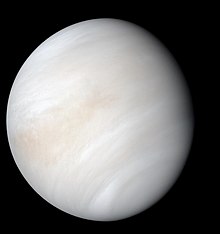
Venus is the second planet from the Sun. in our Solar System. It is the brightest natural object in Earth’s night sky after the Moon. Venus is one of the four terrestrial planets in the Solar System, meaning that it is a rocky body like Earth. It is similar to Earth in size and mass, and is often described as Earth’s “sister” or “twin”. The diameter of Venus is 12,103.6 km (7,520.8 mi)—only 638.4 km (396.7 mi) less than Earth’s—and its mass is 81.5% of Earth’s. Conditions on the Venusian surface differ radically from those on Earth because its dense atmosphere is 96.5% carbon dioxide, with most of the remaining 3.5% being nitrogen. The surface pressure is 9.3 megapascals and the surface temperature is 737 K (464 °C; 867 °F), above the critical points of both major constituents and making the surface atmosphere a supercritical fluid(distinct gaseous and liquid phases do not exist).

Some facts about Venus: 

Diameter- 12,103.6  km

Orbital period-  224.7 days

Length of a day-   117 days

Axis tilt-  177.3 degrees

Distance from the Sun- 108 million km (0.72AU)

Moons- none

Atmosphere and climate 

Venus has an extremely dense atmosphere composed of 96.5% carbon dioxide, 3.5% nitrogen—both exist as supercritical fluids at the planet’s surface—and traces of other gases including sulfur dioxide. The mass of its atmosphere is 92 times that of Earth’s, whereas the pressure at its surface is about 93 times that at Earth’s—a pressure equivalent to that at a depth of nearly 1 km (58 mi) under Earth’s oceans.

Studies have suggested that billions of years ago, Venus’ atmosphere could have been much more like the one surrounding the early Earth, and that there may have been substantial quantities of liquid water on the surface. After a period of 600 million to several billion years, solar forcing from rising luminosity of the Sun caused the evaporation of the original water. A runaway greenhouse effect was created once a critical level of greenhouse gases (including water) was added to its atmosphere. Although the surface conditions on Venus are no longer hospitable to any Earth-like life that may have formed before this event, there is speculation on the possibility that life exists in the upper cloud layers of Venus, 50 km (30 mi) up from the surface, where the temperature ranges between 303 and 353 K (30 and 80 °C; 86 and 176 °F) but the environment is acidic. The apparent detection of phosphine in Venus’ atmosphere, with no known pathway for abiotic production, led to speculation in September 2020 that there could be existing life currently present in the atmosphere.

Structure

The similarity in size and density between Venus and Earth suggests they share a similar internal structure: a core, mantle, and crust. Like that of Earth, the Venusian core is most likely at least partially liquid because the two planets have been cooling at about the same rate, although a completely solid core cannot be ruled out. The slightly smaller size of Venus means pressures are 24% lower in its deep interior than Earth’s. The predicted values for the moment of inertia based on planetary models suggest a core radius of 2,900–3,450 km.

Missions to Venus:

Many missions have been sent to Venus in the past decades. Venera 4 and 5, were the first to enter the atmosphere and send information. Venera 9  sent back the first images from Venus. Some other missions include- The Magellan Mission( a thirteen-year-long Venus radar mapping project ), The Pioneer Venus orbiters and Venus Express.

References: https://en.wikipedia.org/wiki/Venus#Atmosphere_and_climate https://en.wikipedia.org/wiki/Supercritical_fluid
Astro-Evaders Super Exclusive : A Phenomenal Journey to Universe >>>>>//

Credit : Third Party Reference

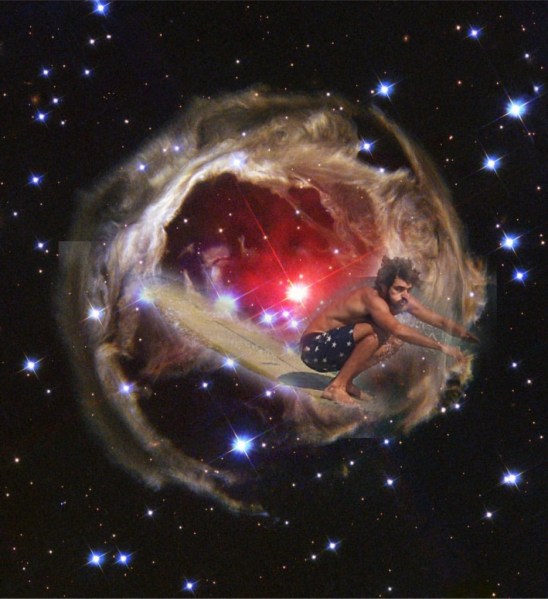
SHREDDING A SUPERNOVA.  

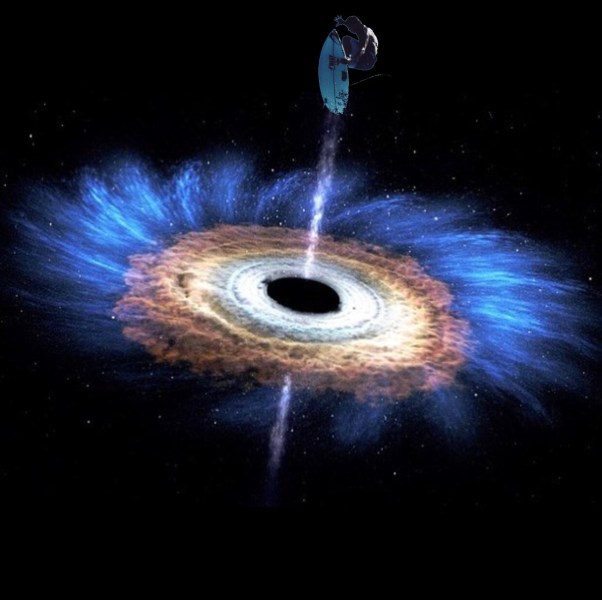
Surfing on a distant star in a galaxy far, far, away.  Walking out on the nose of your board for a cheater-five, riding a nebulous cloud through the infinite darkness of space. Getting spit out of a black hole, executing a grab-rail, carving cut-back.  Ripping a hole in the space-time continuum. Finessing the very fabric of the Universe.

Credit : Third Party Reference

WATER IS COSMIC.

All of the water on Earth came from space in exactly the form it is in now: H2O.  Water not only came from space it was created out in space.  Hundreds of millions (or even billions) of years before the solar system itself, the world’s Ocean came from an interstellar cloud somewhere in the Milky Way galaxy—formed one molecule at a time.  All of the water on Earth was delivered here when Earth was formed (within the first 100 million years or so) and what we have is what we’ve got.  There is no geological mechanism on Earth to create or destroy H20.  The Ocean (and all of Earth’s water) has literally been here forever.

Credit : Third Party Reference

The Ocean—all the water on Earth—began as the finest mist, tiny ice crystals drifting around inside an interstellar cloud. However, scientists don’t actually know how all that water gets from the interstellar cloud to our Ocean, nor do they know how much water is actually on Earth.

THE ORION MOLECULAR CLOUD.

DISTANCE FROM EARTH: A MERE 1400 LIGHT YEARS (1 LIGHT YEAR = 5.88 TRILLION MILES)

The OMC is an interstellar spring of water. This massive glowing cloud of hydrogen gives birth to thousands of stars at once.  As the stars coalesce and collapse in on themselves, they send shockwaves out through the clouds of gas which contain lots of loose hydrogen and oxygen.  When the shock waves slam the hydrogens and oxygens into each other, they often form water. There is enough water being formed in the OMC to fill all of Earth’s Oceans every 24 minutes.  Surf’s up!

Credit : Third Party Reference

The Orion Molecular Cloud is making 60 Earth Oceans every 24 hours but it is doing it across a span of space 420 times the size of our entire solar system—so even the dustiest (most dense, with the most particles) parts of the cloud are emptier than any vacuum that people can create on Earth.

VENUS

DISTANCE FROM EARTH: 162 MILLION MILES

Venus may have been our solar system’s first Ocean world —a supercritical carbon dioxide Ocean of a bubbly sort of fluid that flowed a bit more like a liquid, with bubbles that behaved more like a gas popping up where the temperature and pressure varied a bit. Here on Earth, International Surfing Day is celebrated in the Summer on the longest day of the year.  Venus boasts an endless summer—with an average surface temperature of 864° Fahrenheit (462° C)—and a single day on Venus is equal to 243 Earth days.  That’s a lot of time to surf each day!

 Venus is so hot, though, that the atmospheric pressure (92 bar or 1334 pounds per square inch pressing down on you) would be the equivalent of being 3000 feet deep in the Ocean—you would be crushed before you ever had a chance to catch a bubbling hot wave.

Credit : Third Party Reference

It’s this extreme Venusian pressure and heat that initially may have created a supercritical carbon dioxide Ocean.  Scientists are still in debate on what type of liquid—water or lava—etched Venus’ surface features which look very much like canyons, lake beds, and broad plains that may have once been sea floors. Venus no longer has liquid on its surface, the planet is dry and is not currently hot enough to melt its carbons (which make up 96% of its atmosphere).  While the surface rotates slowly, the winds blow at hurricane force, sending clouds around the planet every five days.

 Venus lacks a strong global magnetic field, which on Earth helps protect our atmosphere.  If there ever was an Ocean of water here, then Billions of years ago, a runaway greenhouse effect began raising temperatures enough (over 1340° F or 727° C) on Venus to boil off all of the water in the Ocean ( a small amount of water vapor still exist on Venus, something like 20 parts-per-million), which escaped into space due to the unrelenting solar wind.

Credit : Third Party Reference

“Should’ve been here billions of years ago, the surf was firing—before the wind got on it.” -Surfer on Venus

MARS

DISTANCE FROM EARTH: 34 MILLION MILES

Mars was once much more Earth-like, with a thick atmosphere, abundant water, and an Ocean covering nearly a third of the Red Planet.  Imagine surfing huge, slow-motion barrels. Mars has only 10% the mass of Earth and its gravitational field is only one-third of Earth’s so less gravity would produce larger yet slower moving waves compared to Ocean swells of Earth. Aerial surfing maneuvers would be extra lofty.  

Credit : Third Party Reference

However, Mars lost its protective atmosphere billions of years ago and has since lost approximately 87% of its water. Most of its remaining water is frozen in ice caps or trapped beneath the soil, but a small amount of muddy, brackish water can be seen moving down the side of Martian hills in the local summer.

Reference – https://divyanshspacetech.wordpress.com