
Space Tourism – Jeff Bezos vs Richard Branson vs Elon Musk

Hello everyone , Space Tourism will be possible. Like you go to other counties for a vacation from next year, you can go to space on a vacation. And most importantly, you wouldn’t need to undergo any training No need to become an astronaut to make this happen. Actually, friends, three people are making it possible. 

First, billionaire Richard Branson. The owner of the Virgin Group. His space tourism company is named Virgin Galactic. Second, Jeff Bezos. The owner of Amazon. His space tourism company is named Blue Origin. And third, Elon Musk. The owner of Tesla. His space company is named SpaceX. 
There was a neck-to-neck competition between the first two people to see who would be the first man in the world to go to space in their own rocket. Jeff Bezos had announced that he would do this on 20th July. After that, Richard Branson, who had originally planned to attempt this a few months later, preponed his plan. 
Richard Branson attempted this a few days ago, on 11th July. With two pilots and three other crew members he got into his Unity Spacecraft.
 This Spacecraft flew into the sky. And this mission was successful. Leaving Jeff Bezos behind, he became the world’s first man to go to space in his own spaceship. 
It’s very interesting to get to know the technical details of this feat. Because he wasn’t in a rocket that’s launched from a launchpad. Like you normally see in films or like astronauts usually travel, in a rocket. Instead, it was a kind of an aeroplane. 
You can call this aeroplane a ‘Space Plane’ because it went into space. What happened was, there is a big plane on the runway, you can call it the ‘Mother Aircraft’ this smaller Space Plane is attached to it. It’s named Unity. Initially, both planes take off from the runway together because they’re attached. And when they reach around 50,000 feet altitude, this Unity Space Plane detaches from the Mother Aircraft. And then at supersonic speed, faster than the speed of sound, it goes towards space. And when we talk about going to space here, 
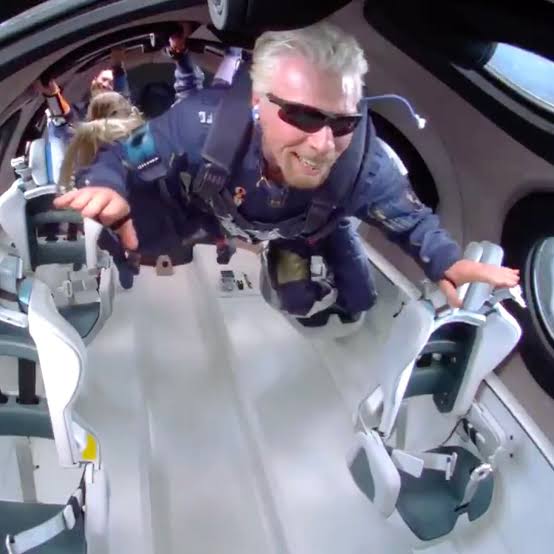
What it exactly means is that it was 88 km above the earth’s surface. If you look out of the window at that height, you’d get to see the curvature of the Earth. This was the view from this flight. And most interestingly, at this height, the passengers of the plane can experience weightlessness.
 Like the astronauts experience it. But the unfortunate thing is that, this plane doesn’t remain at that height for long. This weightlessness can be experienced for only 4 minutes on this Virgin Galactic flight. After that, this plane starts its descend. And lands on the runway like a normal aeroplane. It takes only an hour to complete this journey. And the part from the detaching of the Space Plane, reaching the top to landing back takes only 15 minutes. 
So it’s not a very long journey. We could see all the photos and videos because Richard Branson live-streamed his test flight on the internet. Another interesting thing, Among the 6 crew members, one was an Indian-born woman. This incident is historic for many reasons. 
Even though, Richard Branson wasn’t the first private civilian to go to space. Dennis Tito, an American entrepreneur, had paid $20 Million to be able to sit with the astronauts in the rocket to fly to the International Space Station and stay for 8 days. But that was different. Because he was going with the astronauts in an actual rocket. 
But you can think of this as a private aeroplane. For this reason, you may think that Richard Branson didn’t actually go to space. If you do, then you wouldn’t be the first person to think that. Jeff Bezos’ space company, Blue Origin, they mocked this on Twitter. They said that there will be an asterisk (*) next to Richard Branson’s name because he went up to the height of 88 km only. 
When globally, most scientists believe that space actually begins at the height of 100 km. This 100 km line is known as the Karman Line. Internationally, the astronauts’ organization in European countries they believe that this line at 100 km is the official boundary between our atmosphere and space. 
But in the USA, the US government and NASA believe that the boundary between the atmosphere and space starts at the height of 80 km. So in the defense of Richard Branson, it can be said that according to the US standards, he has gone into space. 
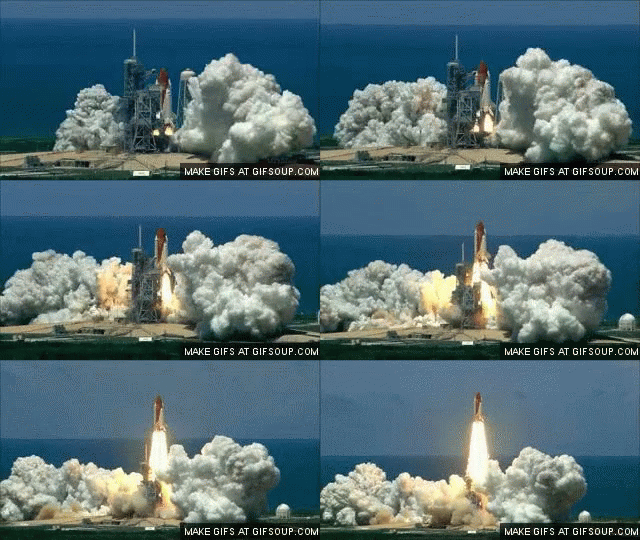
But not according to the International standards. That’s why Jeff Bezos’ company mocked him. And now when Jeff Bezos will attempt to go to space on 20th July, he will try to cross this line at 100 km. The difference is very critical here. When Jeff Bezos will attempt it, it will be in the spacecraft built by his company that’s like a rocket. So he’ll go up in a rocket. 
His company claims that not only will they reach beyond 100 km but also that the windows on this spacecraft will be huge. So that you can enjoy watching the Earth. But the windows on the Virgin Galactic’s spaceplane, were of the size of an aeroplane’s window and so quite small. Second, Blue Origin claim that their spacecraft will have an escape system that was missing in the Virgin Galactic’s spacecraft.
 Third, they claim that their rocket will not have an environmental impact because they’ll use environment-friendly fuel. The exhaust will be only water. But in the case of Virgin Galactic, Nitrous Oxide, which is very harmful, is being released. It is very damaging to the environment. If you find stories about space to be interesting,
I’ll talk about the environmental impact at the end of the video. First, let’s talk about how expensive it will be if you want to go too. What will be the cost? The price of one ticket of the Virgin Galactic’s flight will be $250,000. In Indian currency, it’ll cost around ₹20 million – ₹25 million. (₹2 crore – ₹2.5 crores) It’s up to you whether you can afford it or not. 
Our politicians can definitely afford this. 600 people have already reserved tickets for next year. There are many famous names among them. Like Justin Bieber and the actor Leonardo DiCaprio. They are expecting full commercial service by 2022. 
And Richard Branson says that eventually, the price will be lowered when more people will start using it. He says that eventually, the price of the ticket may be as low as $40,000. Around ₹3 million – ₹3.5 million. (₹30 lakh – ₹35 lakh) Definitely, today it is not something that a common man can afford. 
But once it starts, maybe 10 or 15 or 20 years down the line, I think that normal people will also be able to afford it. On the other hand, we don’t know the exact price of the ticket for Jeff Bezos’s spacecraft. But one ticket was auctioned in June, that was sold for $28 million. 
Same with Elon Musk’s SpaceX, one ticket was auctioned that sold for $55 million. But that’s a bit different because they’re proper rockets. And it’s possible that Elon Musk’s flight may take you to the International Space Station to travel. 
And the ticket cost obviously includes the training and on-flight accommodation. In the beginning when I had said that no training is required, I meant that one wouldn’t need astronaut-level training to do this.
 But you’d still be given some basic training. About how you should behave in zero gravity. And what you should do in case of any emergencies. You’d obviously be told all this. Some people may be scared after knowing all this Because they’d be undertaking a new thing and going to space they may lose their lives if there is any technical problem.
 So how realistic is it to be scared of it? It is very realistic. Because you’re going to space. So it hasn’t been tried out enough. If you do this next year, you’d be one of the first people to do so. So there are many risks. Even Richard Branson acknowledges this. He had revealed his intention of building a spaceplane in 2004. 
He thought space tourism would be possible by 2007. But after so many problems and hurdles, one of his test flights crashed in 2014. In which some people were even killed. Now, this is finally ready in 2021. His test flight has been successful. But there are many risk factors apart from the flight crashing.
 Because generally when Astronauts go into space, they are given severe training to do so. But when space tourists will go to space, they will not undergo any health checkup or fitness checkup. So we don’t know what problems they may have to face. Additionally, the impact of zero gravity on the human body, has never been studied in the long term. Because space travel is a very recent phenomenon. 
Additionally, the G-force that you’d have to face, and the radiation at that level maybe quite high. These are also some factors. Though, the Federal Aviation Administration of the USA has said that the radiation that you might experience at that height will be insignificant and not a cause for worry. But looking at the other risk factors, when you’d go to do this, obviously, they will get a form signed by you like shown in the film Zindagi Na Milegi Dobara. Before skydiving, you need to sign a liability waiver form. If there’s any harm to you, then it is your responsibility.
 The company will not bear any responsibility. Now, let’s talk about the environmental impact. Many people have criticised all three billionaires on this point. That space tourism will be something that only the rich can afford. Only the top 0.1% of people. But it will lead to so much pollution and the environmental impact of this will be so large, that it is very disproportionate.
 The other people will not get the opportunity to do this but the environmental impact on the Earth will have to be borne by the others as well. Talking about Virgin Galactic, the CO2 emissions in a normal flight per passenger per mile is at 0.2kg here you’d get 12 kg of CO2 emissions. 
A difference of 60 times. Apart from this, Nitrous Oxide, when it’ll be released into our atmosphere, it will lead to ozone depletion. You’ve learnt in school how important the ozone layer is in our atmosphere. It protects us from the ultraviolet rays of the sun. 
The second problem is that when these rockets take off from the land so much heat is generated, that the ozone levels increase at ground level. Ozone near the surface is useless. Higher in the atmosphere, it is beneficial. An increase in ozone at the ground level will be harmful to us. Losing ozone from the ozone layer will be harmful to us. And this will be the result of space tourism. 
Ozone will increase near the surface and decrease from the atmosphere. In the case of Jeff Bezos too, even if no harmful gasses are emitted from his rocket, when it takes off from the ground, it will lead to a lot of heat being generated. This again leads to a threat to the ozone levels. These are some points that we’d have to remember in the near future. When space tourism will become more common. And these billionaires will have to come up with their solution.

Elon Musk buys a ticket on Sir Richard Branson’s space flight – report

Sir Richard confirmed the purchase in an interview.

E

Elon Musk has bought a ticket on one of rival billionaire Sir Richard Branson’s spaceship flights, according to a newspaper report.

As Sir Richard prepares to fly on Virgin Galactic’s first fully crewed flight to the edge of space on Sunday from New Mexico, The Sunday Times says Mr Musk – who owns rival exploration company SpaceX – has paid for a seat on a future Virgin voyage.

Mr Musk paid a 10,000-dollar (£7,000) deposit to reserve a seat. No date for his flight has been specified.

Sir Richard confirmed the purchase in an interview with The Sunday Times, saying he might reciprocate by booking a ticket on a SpaceX flight in the future.

“Elon’s a friend and maybe I’ll travel on one of his ships one day,” he said.

Amid what has been dubbed the billionaires’ space race, SpaceX has launched dozens of rockets, including manned flights, but Mr Musk himself has not yet flown on any. The company is due to launch its first fully private spaceflight in the autumn.

Sir Richard will become the first owner-astronaut to take part in a mission, beating Amazon founder Jeff Bezos who plans to reach space in his own rocket – through his Blue Origin company – in nine days’ time.

Tourists are expected to pay some 250,000 dollars (£180,000) for a spaceflight on Virgin Galactic, which includes four minutes of zero gravity.

Virgin Galactic’s SpaceShipTwo Unity 22 launch with Richard Branson: Here’s when to watch and what to know.

On July 11, Virgin Galactic will make a giant leap toward commercial suborbital spaceflight. The company will launch its first fully crewed flight of its SpaceShipTwo space plane Unity with a special passenger on board: the company’s billionaire founder Richard Branson

Branson, three crewmates and two pilots will launch on the historic flight after being carried into launch position by Virgin Galactic’s carrier plane VMS Eve. They will take off from the company’s homeport of Spaceport America in New Mexico, with a live webcast chronicling the flight. Here’s everything you need to know about the mission, which Virgin Galactic has dubbed Unity 22.

Related: How to watch Virgin Galactic launch Richard Branson to space
More: How Virgin Galactic’s SpaceShipTwo works (infographic)

WHAT TIME IS VIRGIN’S GALACTIC LAUNCH & AND CAN I WATCH?

Virgin Galactic has not released a specific time for the actual Unity 22 launch, but the company has announced it will begin webcasting the mission at 9 a.m. EDT (1300 GMT). And it looks like it’s going to be fun. The crew will walk out to the ship about an hour earlier.

Stephen Colbert, host of The Late Show on CBS, will host the webcast along with singer Khalid (who will debut a new single during the launch), former Canadian Space Agency astronaut Chris Hadfield and future Virgin Galactic astronaut Kellie Gerardi, who will launch on a research flight in 2022.

The webcast will begin with the Unity spacecraft and its carrier plane taking off from its runway at Spaceport America, which is located 55 miles (88 kilometers) north of Las Cruces, New Mexico. 

Branson has stated that the entire flight will take about 90 minutes, including the ascent up to launch position, release, flight to space and glide back to Earth for a runway landing at Spaceport America.

Virgin Galactic will launch six people on the Unity 22 flight, although the spacecraft is designed to carry up to eight people (two pilots and six passengers).

Unity 22’s crew includes four mission specialists:

  • Sirisha Bandla, Vice President of Government Affairs and Research Operations at Virgin Galactic. She will evaluate the human-tended research experience via an experiment from the University of Florida that requires several handheld fixation tubes to be activated at various points in the flight profile.
  • Colin Bennett, Lead Operations Engineer at Virgin Galactic. He will evaluate cabin equipment, procedures and the experience during the boost phase and weightless environment inside Unity.
  • Sir Richard Branson, founder of Virgin Galactic. Branson will evaluate the private astronaut experience. He will receive the same training, preparation and flight as Virgin Galactic’s future ticket-buying astronauts and use the flight to fine ways to enhance the experience for customers.
  • Beth Moses, Chief Astronaut Instructor at Virgin Galactic. She will serve as cabin lead and test director in space. Her tasks include overseeing the safe execution of the test flight objectives. Moses has launched on Unity before.

Two veteran Virgin Galactic pilots will be at the helm of Unity during the launch. They  have both launched to space on Unity before and are: 

  • Dave Mackay: Mackay is Virgin Galactic’s chief pilot and grew up in the highlands of Scotland. He is a former Royal Air Force pilot and flew for Branson’s airline company Virgin Atlantic before joining Virgin Galactic. 
  • Michael Masucci: Michael “Sooch” Masucci is a retired U.S. Air Force colonel who joined Virgin Galactic in 2013 who racked up over 9,000 flying hours in 70 different types of airplanes and gliders during more than 30 years of civilian and military flight. 

Two other pilots will fly the VMS EVE carrier plane that will carry SpaceShipTwo into launch altitude. They are: 

  • Frederick “CJ” Sturckow: A former NASA space shuttle commander who joined Virgin Galactic in 2013 with Masucci. A retired Marine Corps colonel, he was the first NASA astronaut to join the company and flew four space shuttle missions.
  • Kelly Latimer: Latimer is a test pilot and retired lieutenant colonel in the U.S. Air Force who joined Virgin Galactic’s pilot corps in 2015. She was the first female research test pilot to join what is now NASA’s Armstrong Flight Research Centre.

The primary objective for Unity 22 is to serve as a test flight for future passenger flights by Virgin Galactic. As its number suggests, this will be the 22nd flight of Unity, but only its fourth launch to space. 

The four mission specialists will each evaluate different experiences that Virgin Galactic has promised its future customers, many of whom have already reserved trips to space with the company at $250,000 a seat. 

Bandla, for example, will test the experience of performing experiments aboard Unity during different phases of the flight, including the weightless period. Branson will take note of the flight as a paying passenger to look for ways to enhance the trip for ticket holders looking for the experience of a lifetime. 

Related: The long road to spaceflight for Virgin Galactic and Blue Origin

Moses is Virgin Galactic’s Chief Astronaut Trainer and will ensure everyone is safe in their tests while Bennet will examine Unity’s cabin performance to look for potential enhancements. 

This mission is a critical flight or Virgin Galactic, which Branson founded in 2004. VSS Unity is the company’s second SpaceShipTwo after the first, VSS Enterprise, broke apart during a 2014 test flight, killing one pilot and seriously injuring another. Virgin Galactic has made numerous safety upgrades to prevent such an accident from happening again.

The mission will begin with takeoff from Spaceport America, where Virgin Galactic has built its “Gateway to Space” terminal to serve its future customers. The crews of Unity and Eve will walk out to their vehicles at about 8 a.m. EDT (6 a.m. local time, 1200 GMT). They’ll be wearing custom Under Armour flight suits made for Virgin Galactic.

After takeoff, the carrier plane VMS EVE will haul the SpaceShipTwo VSS Unity (short for Virgin Space Ship) to an altitude of about 50,000 feet (15,000 meters), when it will drop the the spacecraft.

In Photos: Virgin Galactic’s Sleek Under Armour Spacesuits for Space TouristsAdvertisement

Virgin Galactic's first test passenger Beth Moses looks out the window of the VSS Unity during a test flight with pilots Dave Mackay and Michael "Sooch" Masucci, on Feb. 22, 2018.
Virgin Galactic’s first test passenger Beth Moses looks out the window of the VSS Unity during a test flight with pilots Dave Mackay and Michael “Sooch” Masucci, on Feb. 22, 2018. (Image credit: Virgin Galactic)

After separation, Unity will ignite its hybrid rocket motor, which uses a mixture of solid and liquid propellant, to begin the boost phase. This will carry Unity to its target altitude above 50 miles (80 kilometers), where the pilots and crew can expect up to 4 minutes of weightlessness. They will exist their seats and enjoy sweeping views of the Earth below through the many round windows that dot the space plane’s fuselage.

After that short encounter with weightlessness, the crew will climb back into their seats as Unity prepares to return to Earth. Pilots Mackay and Masucci will have “feathered” the spacectraft’s twin tail booms to provide stability during atmospheric reentry.

The feathered tail will then be locked back into place for the glide back to Earth, which will end with a runway landing at Spaceport America. The entire flight, from takeoff to landing, should last about 90 minutes, Branson has said.

WILL VIRGIN GALACTIC REALLY REACH SPACE WITH UNITY 22?

Virgin Galactic's VSS Unity spaceliner captured this view of Earth during the vehicle's first trip to space, on Dec. 13, 2018.
Virgin Galactic’s VSS Unity spaceliner captured this view of Earth during the vehicle’s first trip to space, on Dec. 13, 2018. (Image credit: Virgin Galactic)

Virgin Galactic will launch Unity to an altitude above 50 miles (80 km), which NASA, the Federal Aviation Administration and the U.S. military classify as space. They will earn astronaut wings for reaching that height.

Another widely recognized boundary of space, the Kármán line, is at an altitude at 62 miles (100 km) above Earth. The SpaceShipTwo VSS Unity won’t reach this milestone, which has led Virgin Galactic’s competitor Blue Origin (which does fly higher than 62 miles) to call out Virgin Galactic for missing that mark. 

Richard Branson has downplayed that criticism and saying that “the actual difference in experience is going to be almost non-existent,” in an interview with NPR’s Leila Fadel.

WHERE DOES VIRGIN GALACTIC LAUNCH SPACESHIPTWO FROM?

Click here for more Space.com videos…Sorry, the video player failed to load.(Error Code: 101102)Advertisementhttps://e42edf55977935dba9fbedb9fb4dde49.safeframe.googlesyndication.com/safeframe/1-0-38/html/container.html

Virgin Galactic initially launched SpaceShipTwo test flights from the company’s facilities at Mojave Air and Space Port in California. However, in 2020 the company moved Unity and its carrier craft to its permanent home at Spaceport America, where it plans to fly regular passenger flights beginning in 2022. 

Spaceport America is located near Las Cruces, New Mexico and is home to Virgin Galactic’s “Gateway to Space” terminal, a welcome center and waiting room for ticketed passengers preparing for trips to space. It also sports a large hangar designed to fit multiple SpaceShipTwo spaceplanes and the VMS Eve. Virgin Galactic has also built a new vehicle, the SpaceShip III VSS Imagine

WHEN COULD I LAUNCH TO SPACE WITH VIRGIN GALACTIC?

Click here for more Space.com videos…Sorry, the video player failed to load.(Error Code: 101102)

If you booked a trip with Virgin Galactic early and have one of the first reservations, you may get your chance to fly in space as early as 2022. If not, there’s a long wait ahead. And that’s assuming you can afford the $250,000 ticket price. 

Virgin Galactic has said it plans to begin passenger launches in 2022 after a series of final test flights in 2021. The company does have hundreds of reservations for customer flights in backlog from eager would-be astronauts that have been waiting for over 17 years (since Richard Branson first announced Virgin Galactic in 2004) for the SpaceShipTwo to finally fly. The company paused taking new reservations after the 2014 accident.

Virgin Galactic is expected to resume taking reservations for “a limited number of tickets for future spaceflights” sometime this year, according to its website.