

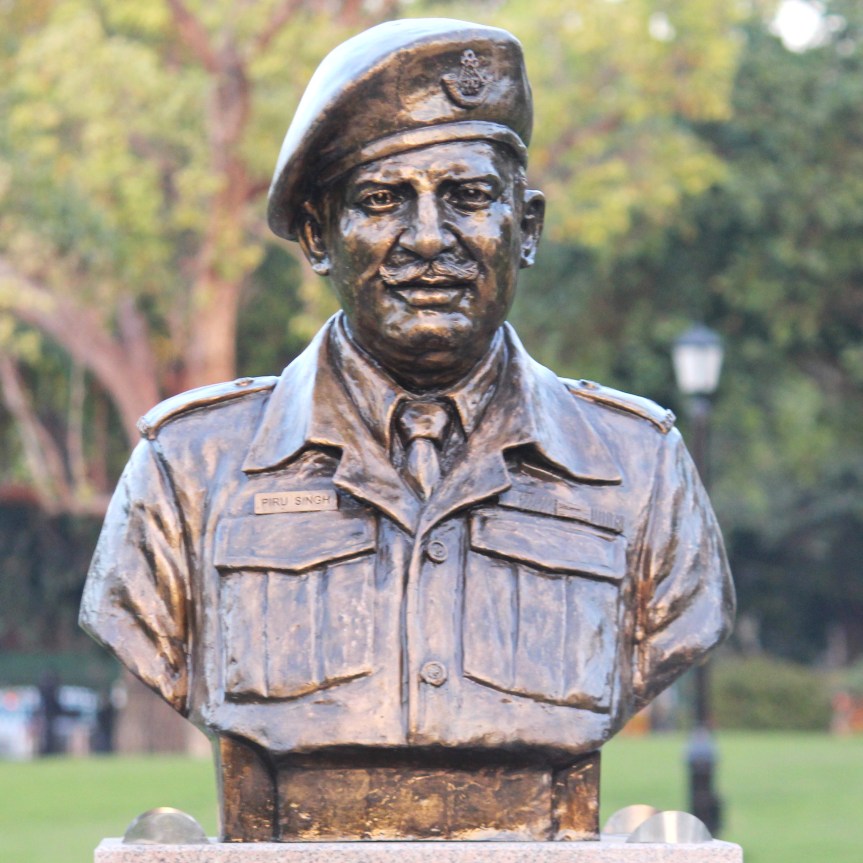
The credo of Indian Military Academy – ‘ The safety, honour, and welfare of your country comes first, always and every time. The honour, comfort and safety of the man you command comes next. Your own ease, comfort & safety comes last, always and every time.’ – is a mantra that every Indian soldier lives by. The commitment of a soldier to his duty and his sheer determination to fulfill it is something that sets him apart from the rest of the crowd. Company Havildar Major Piru Singh, the hero of battle of Darapari, was no different.
Early Life
Piru Singh was born on 20th May 1918, in Rampura village, Churu, Rajasthan.He came from an agricultural family of the warrior clan of the Rajputs. His father Lal Singh and mother Tarawati Kanwar (Jarav Devi) had seven children – three boys and four girls – with Singh being the youngest. Even as a young boy, he loved outdoor life and had an aversion to restricted environments. Singh discontinued schooling at a young age. The rest of his childhood was spent helping his father in his farm. Right from his younger days he had an inclination to join the army. Despite being rejected twice, Singh never gave up and eventually got selected on his third attempt. He joined the British Indian Army coincidentally on his 18th birthday on 20th May 1936.

Military Life
On joining, Singh was initially assigned to the 10th Battalion of the 1st Punjab Regiment at Jhelum. After completion of his training, he was transferred to the 5th Battalion of the same regiment on 1st May 1937. Surprisingly, the boy who despised school and had no interest in studies had transformed into a committed soldier who took serious interest in education. He cleared the Indian Army Class Certificate of Education and a series of other army examinations and got promoted to the rank of lance Naik within a brief span. He served on the North-West Frontier during his tenure with the 5th Battalion of the 1st Punjab regiment. It took less than a year before he was promoted from Lance Naik to the rank of Naik. In September 1941, he was posted to the Punjab Regiment Centre at Jhelum, as an instructor.
Singh was also a wonderful sportsman and represented his regiment in basketball, hockey and cross-country running at the inter-regimental and national level championships. In February 1942, he was promoted to Havildar and later to the rank of Company Havildar Major in May 1945. Until October 1945, he served the army as an instructor. He was deployed to Japan as part of the British Commonwealth Occupation Force after the Second World War, where he served until September 1947. By the time he returned from Japan, India had been partitioned and therefore the Indian army had undergone reorganization. Consequently CHM Piru Singh was transferred to the 6th Battalion of the Rajputana Rifles Regiment.
Battle of Darapari : Background
It was during this time around that the tensions between India and Pakistan were escalating, over the control of the princely state of Jammu & Kashmir. Eventually in October 1947, war broke out between the two countries.The Spring of 1948 was utilised, by the Indian Army, to rid the Kashmir valley of the infiltrators. General Thimayya, General Officer commanding Sri division, decided to launch the offensive with the main thrust along the Uri-Domel road by 161 Infantry Brigade under Brigadier L.P Sen. 163 Infantry Brigade under Brigadier Harbaksh Singh was detailed to carry out a divisionary operation towards Tithwal from Handwara. To deal with the enemy forces around the Bagh area, the Poonch Brigade was assigned to carry out a battalion operation towards Bagh. In the third week of May, Dogarpur, Trehagam and Chokibal were captured and on 22nd May, Tithwal sector was captured by the Indian forces.
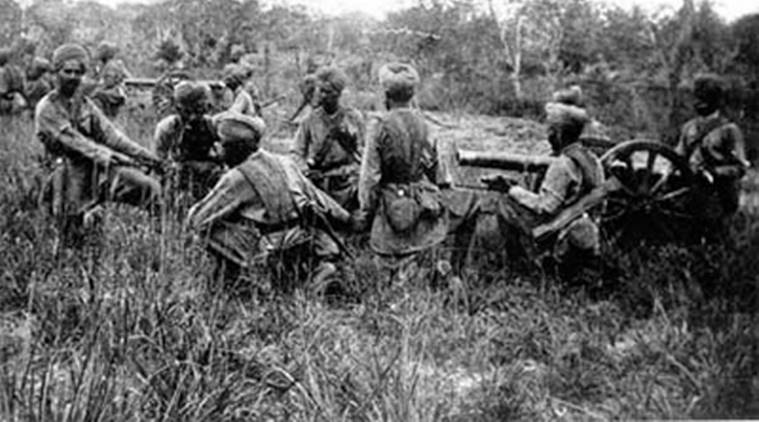
Pakistan, enraged by the setback in the Tithwal sector, launched repeated counter attacks and recaptured the village of Tithwal in the hills of Jammu and Kashmir. The Pakistani raiders launched offensive strikes in this region and captured a ring contour on the 8th of July 1948. The enemy pushed to seize control over the positions across the river Kishanganga and the Indian Army was forced to vacate their forward positions across the river. In the wake of this setback , in order to strengthen the advance on the Tithwal sector, Piru Singh’s unit – the 6th Battalion of Rajputana Rifles – was moved from Uri to Tithwal and was assigned to the 163rd Brigade. The unit took position on the Tithwal bridge.
The attacks commenced on the 11th of July. The operation went on for four days till the 15th of July. However, according to the reconnaissance report, the Pakistanis were still in command of two strategically important positions. The capture of these two positions was essential for making any further advancement. The task of securing these two features was assigned to the 6th Rajputana Rifles. Two companies – Charlie ( C ) and Delta ( D ) – were assigned to the operation. The C company was in charge of securing the second position after the D company had captured the first.
Battle of Darapari : The Day of Action
The D Company, of which CHM Piru Singh was a part, was sent to capture the Darapari feature in Tithwal sector. Darapari is a hill feature located at an altitude of over 11000 feet. The path leading to the position held by the Pakistanis had deep ravines on either side and was just about one meter wide. According to the intelligence reports received, the battalion was told that the enemy had not had enough time to dig-in intensively and hence could be dislodged without much struggle. This however proved to be inaccurate. The narrow path through which the battalion was advancing was overlooked by five hidden Pakistani bunkers ,which gave the defending troops a clear advantage in terms of position. The time constraints restricted the battalion from having a proper reconnaissance of the enemy position. In order to take advantage of the darkness, the attack to secure Darapari was planned to take place after the moon had set and was launched at 01.30 a.m on the 18th of July. As the attack advanced, the company was subjected to heavy shelling and within a matter of about half an hour, the casualty count had reached to a whooping 51. The platoon commander Subedar Bhika Singh was hit. A sinking feeling of panic had swept over them and there was absolute chaos amidst the rest of the team. It was then that Piru Singh rose to the occasion and took charge of the team and led his platoon with a determination that not even the raging bullets from the rival MMG posts could waver.
The enemy medium machine guns had been sited to cover all possible approaches. The platoon led by Singh was met with heavy firing from both flanks and a volley of grenades from the bunkers. Neither the murderous firing nor the fact that half of his platoon was either dead or wounded, could falter him. With the battle cry of ‘Raja Ramachandra ki Jai’, he rushed forward to crush the MMG post which was playing havoc with his troops. His exceptional leadership motivated the rest of the crew to follow their leader ferociously. With the curtain of grenades tearing through him, wounding him at several places, he continued to advance. He rushed to the MMG which was causing the maximum destruction and bayoneted the men on guard and occupied the post.
By this time the rest of his men were either dead or wounded and he was the sole survivor of his company. Alone and injured, but with a never-say-die attitude, Singh inched forward to achieve the objective assigned. While advancing towards the second MMG post, a grenade was thrown at him, which wounded him in the face. Neither the blood dripping from his face nor an empty reserve of ammunition could kill his spirits. He crawled out of the trench, hurling grenades at the next enemy post and then jumped to the next trench bayonetting two Pakistani soldiers to death. As Singh emerged out of the trench to attack the third bunker, he was hit in the head by a bullet. Just before he succumbed to his injuries, he had managed to throw a grenade into the enemy trench, which did a perfect job of wiping off the enemies. CHM Piru Singh had thus bravely and selflessly completed his mission before he closed his eyes for the final time.

Param Vir Chakra
His act of bravery was witnessed by the commander of the C company, who was directing fire in support of the D company. Inspired by Singh’s actions the rest of the company put up a ferocious fight and Darapari was captured against death defying odds.
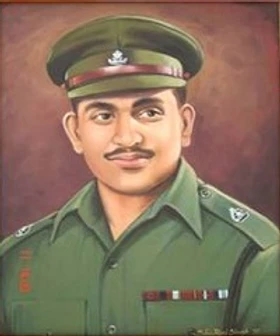
CHM Piru Singh was awarded the Param Vir Chakra for his single-handed bravery, exceptional leadership and extreme devotion to duty, posthumously. In remembrance of this brave soldier, his unit – 6 Rajputana Rifles – commemorates the Battle of Darapari every year.
Every soldier has a story buried under his gravestone and Piru Singh’s is that of his extreme courage, supreme sacrifice, exemplary leadership and above all his unconditional love for his motherland.
 Eduindex