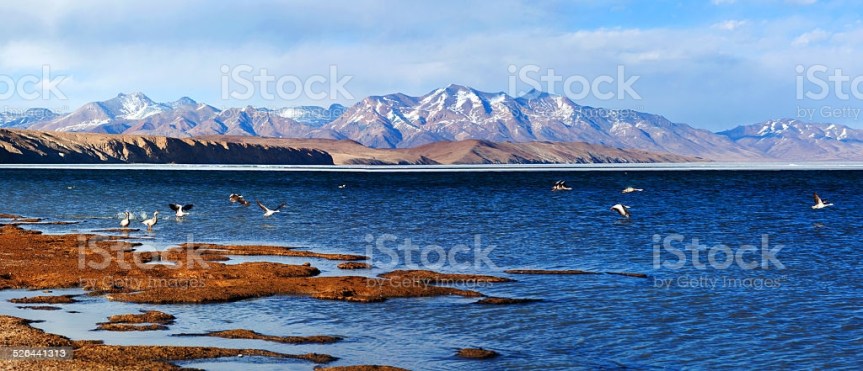
Some places have special values. Sometimes personal, and at other times, cultural and/or traditional. India, being the epicentre of Hinduism since times memorial, has a lot of such places, spread across the country and neighbourhood. One such place is Lake Manasarovar or Manas Sarovar, a freshwater lake, situated near Mount Kailash. A scene of serenity, this lake is a treat to watch in the nights, when the cosmos seemingly descends to the watery depths of the pristine blue loch.
Facts and Figures
Regarded as the holiest lake in Tibet, Manasarovar is situated in the Ngari Prefecture, which lies to the far western side of Tibet. Also known as the Swan rimbonche and Mapham Yum Tso (English: Invincible Turquoise Lake), this spot is located at an elevation of 4590m (15060 ft) from the sea level, and holds the record of being the highest freshwater lake in the world.
With a depth of 90m (300ft), this almost circular lake is situated at a distance of almost 32 kilometres from the illustrious Mt. Kailash, the waters of Manasarovar finds its sourcing and sustenance from the Kailash glacier. Situated in the vicinity of origin sources of some important rivers of the Indian subcontinent, like Sutlej, Brahmaputra, Ganga and Indus River, Manasarovar overflows into the nearby Lake Rakshastal via the Ganga Chhu channel (approx 10 km. long).
Cultural Clout
Lake Manasarovar and Mount Kailash both hold an important place in various religions, like Hinduism, Buddhism, Jainism and Bon (indigeous religion of Tibet). According to the Hindu beliefs, Manasarovar was first created in the mind of Brahma, one of the trinity of Hinduism, and later, manifested on the face of earth. Hence the name Manasarovar, which can be broken down into Manas, meaning ming and Sarovaram, meaning lake. Such was the beauty of this lake, that Lord Shiva, another deity of the Trinity, made his abode, Mt. Kailash beside this lake. Manasarovar finds mention in the Srimad Bhagavata Purana. It is said that one who takes a dip and consumes the holy water of this lake, is freed from all his/her sins and will go to Mt. Kailash, abode of Lord Shiva after the completion of their human life.
In Buddhism, Manasarovar is equated with the legendary lake Anavatapta, where Gautam Budhdha is said to have been conceived. It also appears at several other instances in the Budhdhism scriptures, and Lord Budhdha is said to have stayed, meditated and teached near this lake. At present, several monasteries can be seen dotting the circumference of Lake Manasarovar. Its importance in Jainism is due to the connection with the first Tirthankara, Rishabha, who is said to have achieved Nirvana in the Ashtapad Mountain (equated with Mt. Kailash). Similarly, in the Bon religion, this lake is associated with the sacred deity, Zhang Zhung Meri.
Being a part of that many religions, Manasarovar and Mt. Kailash has acquired the reputation of being a holy pilgrimage site. Hence, pilgrimage tours are organized from quite a few parts of the Indian subcontinent. In India, the most famous tour is the annual ‘Kailash Manasarovar Yatra’. The starting of the trek point is Darchen (in Tibet), a short road trip leads to the shores of Manasarovar. From there starts the actual trek or Yatra, which includes the circumambulation of Mt. Kailash.
With all its grandeur, Manasarovar was, is and will always be an evergreen sight to visit!
Website Reference
https://en.wikipedia.org/wiki/Lake_Manasarovar
https://www.tibettravel.org/kailash-tour/kailash-mansarovar-yatra.html
https://zeenews.india.com/spirituality/kailash-mansarovar-3-mysterious-miracles_1863270.html#:~:text=People%20who%20halt%20a%20night,are%20also%20always%20in%20movement.
Image Credit: Getty Images/iStockphoto



 Eduindex
You must be logged in to post a comment.