

Sachin Ramesh Tendulkar, popularly referred to as the God of cricket is a former international cricketer from India and former captain of the Indian national team. He is considered as the greatest batsman in the history of cricket. The famous batsman had set many records in his 24 years long and illustrious career. He is the only player to have scored one hundred international centuries, the first batsman to score a double century in a One Day International (ODI), the holder of the record for the most runs in both Test and ODI cricket, and the only player to complete more than 30,000 runs in international cricket.
Early life
Tendulkar was born at Nirmal Nursing Home in Dadar, Bombay on 24 April 1973 to a Maharashtrian family. His father, Ramesh Tendulkar, was a well-known Marathi novelist & poet and his mother, Rajni, worked in the insurance industry. Ramesh named Tendulkar after his favourite music director, Sachin Dev Burman. Tendulkar has three elder siblings: two half-brothers Nitin and Ajit, and a half-sister Savita.
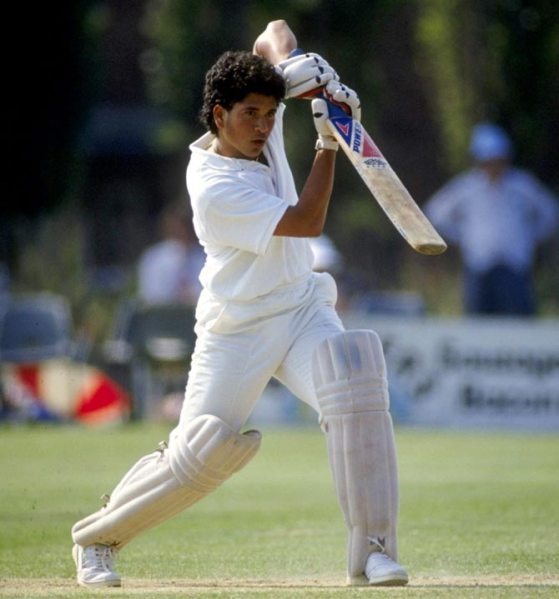
Ajit introduced the young Sachin to cricket in 1984. He introduced him to Ramakant Achrekar, a famous cricket coach and a club cricketer of repute, at Shivaji Park, Dadar. Achrekar was impressed with Tendulkar’s talent and advised him to shift his schooling to Sharadashram Vidyamandir High School, a school at Dadar which had a dominant cricket team and had produced many notable cricketers. Achrekar was the man who helped him to shape his career as a cricketer.
Career
Sachin made his International debut at the age of 16 in the year 1989 against arch rivals Pakistan, scoring 15 runs before being bowled by Waqar Younis. In his ODI debut, he was dismissed for a duck by Waqar against Pakistan in Gujranwala in 1989.
Tendulkar’s performance through the years 1994–1999 coincided with his physical peak, in his early twenties. He opened the batting at Auckland against New Zealand in 1994, making 82 runs off 49 balls. He scored his first ODI century on 9 September 1994 against Australia in Sri Lanka at Colombo. Tendulkar’s rise continued when he was the leading run scorer at the 1996 World Cup, scoring two centuries. He was the only Indian batsman to perform well in the semi-final against Sri Lanka.
In the 2003 World Cup, Tendulkar helped his team advance as far as the finals. Though India was defeated by Australia, Tendulkar, who averaged 60.2, was named the man of the tournament. A tennis elbow injury then took its toll on Tendulkar, leaving him out of the side for most of the year, coming back only for the last two Tests when Australia toured India in 2004. This was a major low point in his career.
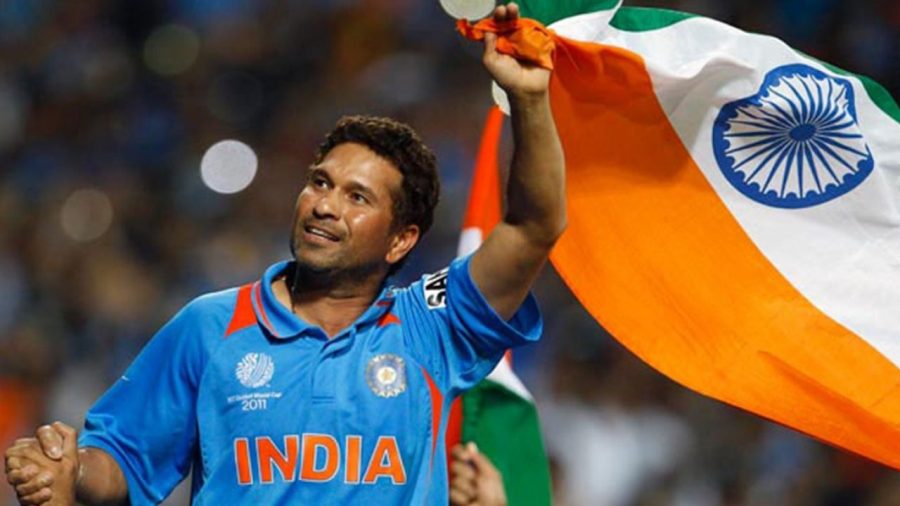
Later in his career, Tendulkar was a part of the Indian team that won the 2011 World Cup, his first win in six World Cup appearances for India.
Records and achievements
Sachin Tendulkar is the leading run scorer in Tests, with 15,921 runs, as well as in One-Day Internationals, with 18,426 runs. He is the only player to score more than 30,000 runs in all forms of international cricket (Tests, ODIs and Twenty20 Internationals). He also holds the record of the highest number of centuries in both Tests (51) and ODIs (49) as well as in Tests and ODIs combined (100). On 16 March 2012, Tendulkar scored his 100th international hundred. It came against Bangladesh in the league matches of Asia Cup 2012. He is also the only player to score fifty centuries in Test cricket, and the first to score fifty centuries in all international cricket combined. He also holds the world record for playing the highest number of Test matches (200) and ODI matches (463). In November 2011, he scored a historic “double century” in a contest against South Africa, becoming the first man in history to record 200 runs in a single innings of ODI play.
Tendulkar recieved the Rajiv Gandhi Khel Ratna award in 1997, India’s highest sporting honour, and the Padma Shri and Padma Vibhushan awards in 1999 and 2008, respectively. In 2012 Tendulkar became a member of the Rajya Sabha, the upper chamber of the Indian parliament—the first active athlete to join that body; he was nominated to the post. In 2014, he became the first sportsman to receive India’s highest civilian honour, the Bharat Ratna.
Retirement
In December 2012, Tendulkar announced his retirement from ODIs. He retired from Twenty20 cricket in October 2013 and subsequently retired from all forms of cricket on 16 November 2013 after playing his 200th Test match, against the West Indies in Mumbai’s Wankhede Stadium.
 Eduindex
You must be logged in to post a comment.