
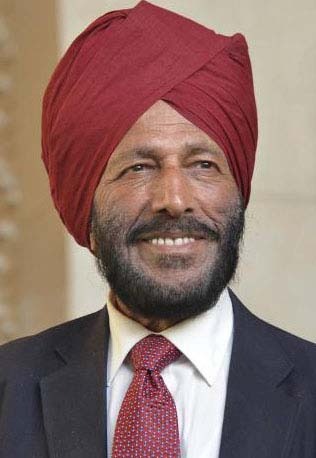
Journey of the Flying Sikh

Flying Sikh Milkha Singh dies of Covid

Overview and Early Life 

Milkha Singh, a legend in the history of Sports and Athletics was an Indian track and field sprinter born on 20th November, 1929. He was born in a Sikh family in Govindpura, a village 10 km from Muzaffargarh city in Punjab Province. He had 14 other siblings, eight of them died during the partition of India. Milkha was orphaned during the partition, when his parents were killed by a Muslim mobs in violence. He witnessed the killings. 

After seeing the deadly situation in Punjab, he decided to escape and came to Delhi, India in 1947 and lived with the family of his married sister for a short period of time. He was imprisoned in Tihar Jail for travelling in Train without ticket. His sister, Ishvar helped him in getting released. He spent his further some time at Refugee Camp , at Purana Quila and at a resettlement colony in Shahdara, both in Delhi.  

Milkha was discontented with his life and decided to become a dacoit, but was instead persuaded by his brother, Malkhan, to attempt to the recruitment to the Indian Army. He successfully gained entrance on his fourth attempt, in 1951, and while stationed at the Electrical Mechanical Engineering Centre in Secunderbad he was introduced to athletics. He had run the 10 km distance to and from school as a child and was selected by the army for special training in athletics after finishing sixth in a compulsory cross-country run for new recruits.  Singh has acknowledged how the army introduced him to sport, saying that “I came from a remote village, I didn’t know what running was, or the Olympics”.  

International Career      

He was introduced to athletics and sports when he was recruited in Indian Army, at the Electrical Mechanical Engineering Centre in Secundarbad. He represented India in the 200 and 400 m competitions held in Olympics at Melbourne in 1956. In 1958, Singh set records for the 200m and 400m in the National Games of India, held at Cuttack,  and also won gold medals in the same events at the Asian Games. He then won a gold medal in the 400m (440 yards at this time) competition at the 1958 British Empire and Commonwealth Games  with a time of 46.6 seconds. This latter achievement made him the first gold medalist at the Commonwealth Games from independent India. Before Vikas Gowda won the gold in 2014, Milkha was the only Indian male to have won an individual athletics gold medal at those Games. 

Jawaharlal Nehru tried to convince Milkha Singh to set aside his memories of his past during the Partition era, to focus on the to race successfully in 1960 against Abdul Khaliq in Pakistan, where a post-race comment by the then General Ayub Khan led to him acquiring the nickname of The Flying Sikh. At the 1962 Asian Games, held in Jakarta, Singh won gold in the 400m and in the 4 x 400m relay. He attended the 1964 Olympic Games in Tokyo, where he was entered to compete in the 400m, the 4 x 100m relay  and the 4 x 400m relay. He did not take part in either the 400m or the 4 x 100m relay and the Indian team of Milkha Singh, Makhan Singh, Amrit Pal and Ajmer Singh were eliminated when they finished fourth in the heat stages of the 4 x 400m. 

There have been claims that Singh won 77 of his 80 races, but these are spurious. The number of races in which he participated is not verified, nor is the number of victories, but he lost a 400m race at the 1964 National Games in Calcutta to Makhan Singh and he did not finish first in any of his four races at the 1960 Olympic Games or the aforementioned qualification races at the 1956 Olympics. 

Singh’s time in the 1960 Olympics 400m final, which was run on a cinder track, set a national record that stood until 1998 when Paramjit Singh exceeded it on a synthetic track and with fully automatic timing that recorded 45.70 seconds. Although Singh’s Olympic result of 45.6 seconds had been hand-timed, an electronic system at those Games had determined his record to be 45.73. 

Later Life  

Milkha was promoted from the rank of sepoy to junior commissioned officer in recognition of his successes in the 1958 Asian Games.  He subsequently became Director of Sports in Punjab Ministry of Education, a post he retired from in 1998. 

Milkha was awarded the Padma Shri, India’s fourth-highest civilian award, following his success in 1958. In 2001, he turned down an offer of the Arjuna Award from the Indian government, arguing that it was intended to recognize young sports people and not those such as him. He also thought that the Award was being inappropriately given to people who had little notable involvement as active sports people at all. He said that “I have been clubbed with sportspersons who are nowhere near the level that I had achieved” and that the award had become devalued. While sharing his wealth of experience in a college in Goa on 25 August 2014, he also said, “The awards nowadays are distributed like ‘prasad’ in a temple. Why should one be honored when he or she has not achieved the benchmark for the award? I rejected the Arjuna I was offered after I received the Padma Shri. It was like being offered an SSC [secondary school] certificate after securing a Masters degree.” 

All of Singh’s medals have been donated to the nation. They were displayed at the Jawaharlal Nehru Stadium in New Delhi and later moved to a sports museum in Patiala, where a pair of running shoes that he wore in Rome are also displayed. In 2012, he donated the Adidas shoes that he had worn in the 1960 400m final to be sold in a charity auction organized by actor Rahul Bose. 

Milkha was admitted to the intensive care unit at Fortis Hospital in Mohali on 24 May 2021 with pneumonia caused by COVID-19. His condition was, for a while, described as stable, but he died on 18 June 2021 at 11:30 PM IST. His wife, Nirmal Kaur, had died a few days earlier on 13 June 2021, also due to COVID-19.  
Rapes- deathbed for women

We live in a society where it is believed to worship Goddess or you may also say Women, as it is said that, women are like a Goddess. But as we look into today’s situation we can observe that in a society where women are believed to be Goddess are exploited, insulted, raped, discriminated against, and sexually harassed. Is this a manner in which we are worshiping a Women/Goddess? It is actually very disturbing and unacceptable. The rape cases in India are increasing at a very high rate. In 2018, 101,151 rape cases were recorded. Now here comes understanding what rape is, Rape is a type of sexual assault usually involving sexual intercourse or other forms of sexual penetration without the person’s consent.

Now the question arises, what is the major cause of Rapes in India?

Wearing short dresses which means, inviting people to take such huge steps as rape, and harassment, late-night parties, or coming late from work alone at night or even in the daytime are the major reason for Rapes in India according to the thinking of some people.

But the major reason behind this is the thinking of the people. It is just a matter of thinking and mentality of the people or the way people approach or look towards women.
It makes me disturb whenever I hear about a girl or a female suffering from this again, whether it be Dr. Priyanka Reddy Nirbhaya or any girl going through this. Now I would like to ask this question to the ones who said that Rape takes place when a girl wears short dresses, so why would a newborn baby girl or an old woman to be raped? Like seriously, the answer to this question from people’s point of view is that they were wearing appealing clothes! What is meant by this? It is how people think and their mentality.

This society is becoming a Rapist Society day-by-day with the rape culture.

There is a need to have a strong and effective law and system to eliminate this. Although the Government is taking certain measures to stop rapes, it is not enough to eliminate them. What we need is more strong, firm, and effective steps to eliminate it, and it will be a big challenge for everyone in society because it’s not that easy to stop. Eventually, it will take time. And if we didn’t start now, then it will be too late. Till then more Dr. Priyanka Reddy and Nirbhaya will be killed.

What punishment do rapists get here in India? The punishment for rape is given in section 376 of the Indian Penal Code. Except in cases provided under subsection 2 of the same section, the punishment will be rigorous imprisonment which is not less than 7 years, which may be extended to life imprisonment and fine.

A man guilty of rape in the United Kingdom is liable on conviction to life imprisonment or for a shorter term. It is a statutory offense in England and Wales, created by section 1 of the Sexual Offenses Act 2003.

Capital punishment of rape is a legal penalty in the United Arab Emirates. Under Emirati law, multiple crimes carry the death penalty, and executions are carried through either a firing squad, hanging, or stoning.

For women, rapes are like facing death. After the rape, most of the girls are killed or burned, but if left alive by any chance then she has to live with what happened to her is more difficult than death. There should be more powerful laws, and systems to stop rapes, as well as strict punishments for the culprit.

Lionel Messi threatens to leave Barcelona

After dozens of titles, hundreds of goals and countless records, Lionel Messi’s spectacular career at Barcelona could be coming to an abrupt end. There has been a controversy about Lionel Messi leaving his childhood football club. There is a lot of reasons that has been stated behind this, but there has not been any clarity on what is the actual reason to leave the Barcelona club. Messi joined the club when he was 14 years old. He has helped the club to 10 league titles and four Champions Leagues, scooping a record six Ballons d’Or for his personal contributions along the way. Articles says that the departure of the player is uncertain, but his lawyers have sent a fax outlining the desire to depart. Back in July, it was understood that Messi did not want to leave Barcelona, but it is true that the Argentina international has spoken in the past of potentially joining another club. 

Messi is soon expected to reveal the reasons and clarity for leaving Barcelona in the upcoming days. 

Ronald Koeman said, if Argentine striker Lionel Messi decides to leave, then he is not sure as to who will score goals for the club. Messi’s contract is set to end this season. “For my part and the club, let’s hope he stays with us”, he added. Rafael Nadal, a tennis player also breaks his silence on the contract leak controversy and said, “Messi is one of the best in the history of the game and if the club is willing to pay him what he wants – there is no problem. “In the end there is a player who is undoubtedly one of the best in history and he charges what the club has been willing to pay him. From there, there is no debate I think,” Nadal as quoted by Tennis World USA. 

Lionel Messi has confirmed for now that he will remain at Barcelona for another season having previously stated his intentions to leave the club. Messi’s decision, however, seems forced more than out of choice. In an Interview with Goal.com, Messi said, “I wasn’t happy and wanted to leave. I haven’t been allowed this in any way and I will stay at the club so as not to get into a legal dispute”. A 2-1 loss against Celta Vigo at Camp Nou on Sunday meant Barcelona will not win the LaLiga title this year but seems like the loss would hurt the Catalans more – as it could be the end of Lionel Messi at the Spanish club. In what seems to be the clearest hint ever, Barcelona manager Ronald Koeman has said that it would be impossible to play with Messi and he still hopes the Argentine does not leave Camp Nou.  

“We hope he will not leave because he is still the best player in the world and he has shown today. It is impossible to play without him,” Koeman told a post-match interview with Marca.