
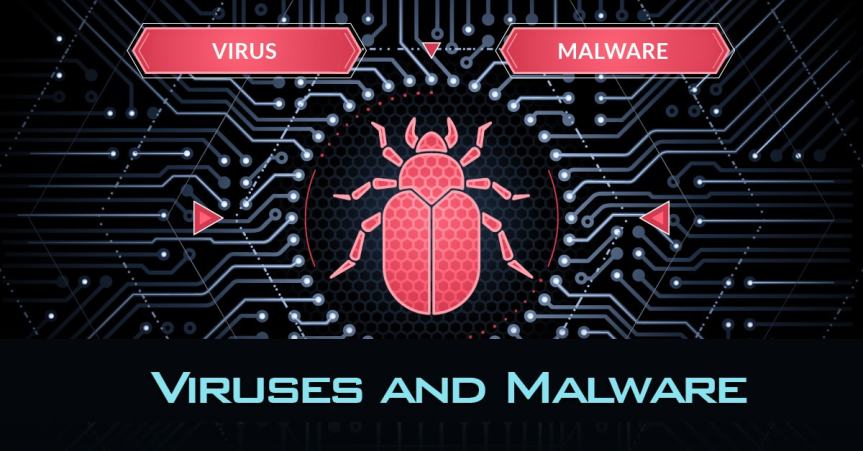
Viruses and Malicious software

A computer virus is a piece of software that can “infect” other programs by modifying them; The modification includes injecting the original program with a routine to make copies of the virus program, which can then go on to infect other programs. A virus can do anything that other programs do. The difference is that a virus attaches itself to another program and executes secretly when the host program is run.

The terminology in this area presents problems because of a lack of universal agreement on all of the terms and because some of the categories overlap. Malicious software can be divided into two categories: those that need a host program, and those that are independent.

  • Need a host program : The former, referred to as parasitic, are essentially fragments of programs that cannot exist independently of some actual application program, utility, or system program.  Examples: Viruses, logic bombs, and backdoors
  • Independent malware is a self-contained program that can be scheduled and run by the operating system.  Examples : Worms and bot programs

Backdoor or Trapdoor

A backdoor, also known as a trapdoor, is a secret entry point into a program that allows someone who is aware of the
backdoor to gain access without going through the usual security access procedures. Programmers have used backdoors legitimately for many years to debug and test programs; such a backdoor is called a maintenance hook. It Has been commonly used by developers. A threat when left in production programs allowing exploited by attackers. It is very hard to block in O/S. It requires good s/w development & update.

Logic Bomb

It is one of oldest types of malicious software. The code is embedded in legitimate program. It is activated when specified conditions met
 Eg presence/absence of some file
 Particular date/time
 Particular user
When it is triggered it typically damages system, Modify/delete files/disks, halt machine, etc.

Trojan Horse

A Trojan horse is a useful, or apparently useful, program or command procedure containing hidden code that, when invoked, performs some unwanted or harmful function. Trojan horse programs can be used to accomplish functions
indirectly that an unauthorized user could not accomplish directly, Which is usually superficially attractive. Eg game, s/w upgrade etc. When it runs performs some additional tasks. Allows attacker to indirectly gain access they do not have directly. Often used to propagate a virus/worm or install a backdoor. Another common motivation for the Trojan horse is data destruction. The program appears to be performing a useful function (e.g., a calculator program), but it may also be quietly deleting the user’s files.

Zombie

Program which secretly takes over another networked computer is called zombie. Then uses it to indirectly launch attacks. Often used to launch distributed denial of service (DDoS) attacks. Exploits known flaws in network systems.
Zombies – A Myth or a Reality?

Have you watched the popular series – “The Walking Dead”? If you have watched it, you will definitely know what exactly I am talking about. If you do not know, I will just give a brief about it. It is a series about how survivors of zombie apocalypse are trying to escape and combat the threats from the zombies and how with time, human beings formed their own communities and groups and the rise of conflict between those communities. So basically this is a series about zombie apocalypse and how they are being termed as ‘walkers’ on earth.

So what exactly are these zombies? Do they exist for real or are they just a figment of imagination? From ages, zombies are being described as flesh eating corpse with a ravenous appetite, terrorizing on the grounds like a strong robot, looking to infest on flesh. Such creatures are almost dead and oozes every signs of inhumanity.

Are these new or have they always infested the earth? Well, history says that the stories of zombies first originated in Haiti culture, where the West African slaves were brought to work on Haiti’s sugar cane plantations. But they were treated so brutally, that their life or afterlife represents the zombie culture. Other says that the Ancient Greek Civilization was the first to experience this. In fact, many skeletons which were pinned down to ground using stones were unearthed, which kind of verifies their existence.

Who is prepared for a 'zombie apocalypse'? - BBC News
Zombie Apocalyse

But there do exists some true facts about the zombies and voodoo. Voodoo is practised as a religion in some cultures like Haiti where some people believe that zombies are people who are revived by a voodoo practitioner, Bokor. It is a concoction of herbs, bones, animal parts and especially ‘tetrodotoxin’ which is a deadly neurotoxin found in marine species, which if injected in high quantities can lead to paralysis and coma. It manifest zombie like qualities among the human beings. Thinking that infected person to be dead, they usually revive and thus rose the term ‘zombie’.

But is there even a bit of truth? Medical reports suggests so. One instance was that a person named Clairvius Narcisse, who was admitted to hospital due to acute respiratory problems in 1962, but later slipped into coma and being declared as dead, was buried later. 18 years later, a man goes to Angelina Narcisse and claims to be her brother. Upon verification by doctors, that he was buried alive, he was sent off to work in the sugar plantation.

Zombies might not exist as there have been no mention of these in Old Testament or New Testament but there have been mentions of resurrections of saints and sinners in Bible. So there is a very little evidence as to whether such zombies exists or if there is even a zombie apocalypse. Not only on religious books, since the eighteenth century, there have been various literatures of spirits and ghosts. Various movies were also made such as Night of the Living Dead and World War Z, just to name a few.

It is ultimately all about perception. Disasters have always caused such huge destruction and there is always this survival of the fittest psychology which goes among us. So it might be true that zombies do not exist, but then again who are we to judge history?