Nuclear and Radiological Emergency

 Nuclear and Radiological Emergency

The growth in the application of nuclear science and technology in the fields of power generation, medicine, industry, agriculture, research and defence has led to an increase in the risk of occurrence of Nuclear and Radiological emergencies. 

India has traditionally been vulnerable to natural disasters on account of its unique geo climatic conditions and it has, of late, like all other countries in the world, become equally vulnerable to various man-made disasters. 

Nuclear and Radiological Emergency can arise in a nuclear facility at plant level leading to plant/ site or offsite emergency depending upon the extent of its impact on the surroundings. It can also take place while using radiation sources, either at Hospitals, Industries, Agriculture or Research Institutions due to loss or misplacement or due to faulty handling. The other events that can lead to Nuclear or Radiological Emergency in the public domain, include, accident of a vehicle carrying radioactive/nuclear material, due of an orphan source i.e. the source which is not under regulatory control or due to usage of radiation source/radioactive material in Malevolant activities.

Any radiation incident resulting in or having a potential to result in exposure and/or contamination of the workers or the public in excess of the respective permissible limits can lead to a nuclear/radiological emergency. 

Sad memories of the use of nuclear weapons dropped on Hiroshima and Nagasaki, and the wide publicity given to the reactor accidents at Three Mile Island (TMI) in USA and Chernobyl in erstwhile USSR, have strongly influenced the public perception of any nuclear or radiological emergency to be most often linked, erroneously though, to only these events. However, one must be prepared to face nuclear/radiological emergencies of lower magnitudes and ensure that the impact of such an emergency (which,for a given magnitude, is likely to be much greater today because of higher population densities coupled with an enhanced urban infrastructure due to economic prosperity) is always kept under control. It may be noted that better infrastructure can be helpful during such incidences in terms of enhance communication, transport and medical support. 

For improving the quality of life in society, India has embarked upon a large programme of using nuclear energy for generation of electricity. As on date, India has 20 power reactors and three research reactors in operation along with five power reactors under construction. It is also planned to explore setting up Thorium based reactors to meet its ever increasing energy needs. The country is  also at the verge of making operational the first 500MW prototype Fast Breeder Reactor (PFBR)  after a prolonged experience of operation of FBTR (Fast Breeder Test Reactor). Further, the country utilises  adioisotopes in a variety of applications in the non-power sector, viz., in the field of industry, agriculture, medicine, research, etc. Due to the inherent safety culture, the best safety practices and standards followed in these applications and effective regulation by the Atomic Energy Regulatory Board, the radiation dose to which the persons working in nuclear/radiation facilities are exposed to, is well within the permissible limits and the risk of its impact on the public domain is very low. 

However, nuclear emergencies can still arise due to factors beyond the control of the operating agencies; e.g., human error, system failure, sabotage, earthquake, cyclone, flood, etc. Such failures, even though of very low probability, may lead to an on-site or off-site emergency. To combat this, a number of system upgrades have been planned to mitigate/prevent such emergencies. However, proper emergency preparedness plans must be in place so that there is minimum avoidable loss of life, livelihood, property and impact on the environment.

Preparedness at Nuclear Facilities

The probability of a major accident at nuclear facilities leading to the release of large quantities of radioactivity into the environment is always ensured to be negligibly small. However, even in the event of a major release into the environment, the prompt and effective implementation of countermeasures can reduce the radiological consequences for the public and the environment.

Preparedness for Nuclear/Radiological Emergencies

The handling of nuclear emergencies requires coordination among different service groups of the nuclear facility. In the event of potential radiological consequences in the public domain, all the authorities at the three levels, i.e., district, state and central, will play a vital role and assist the offsite officials in effectively responding to and keeping the public informed on the precautions to be taken.

Major Responsibilities of Nuclear Power Plant Operators

This includes the arrangements required to promptly classify an emergency, mitigate the emergency, notify and recommend protective actions off the site consistent with international guidelines, protect those on site, obtain off-site assistance, conduct environmental monitoring of the affected area and assist off-site officials in keeping the public informed.

Major Responsibilities of Off-Site Officials

This includes the arrangements required to promptly implement protective actions and countermeasures in the affected area.

Emergency Preparedness for Nuclear Power Plants

Since the proper implementation of countermeasures can significantly reduce the consequences of an emergency situation, it is mandatory for all nuclear facilities that there must be a comprehensive emergency preparedness plan. Prior to the issuance of a license for the operation of a nuclear facility, the AERB ensures that the facility has the Emergency Response Manuals for the three main types of emergencies, viz., plant, on-site and off-site, and that the plans are in place to handle these types of emergencies. The operators of nuclear facilities must make an assessment of the type and quantum of release of radioactivity under various accident conditions and the extent to which it can spread into the environment.

Plant Emergency

When the radiological consequences of an abnormal situation are expected to remain confined to the plant boundary or a section of the plant, it is described as a plant emergency. Nuclear facilities in the country already have the following provisions for the detection, classification, notification and mitigation of any emergency situation:

  • Emergency operating procedures for the assessment of an emergency condition and its mitigation.
  • Pre-identification of any facility-specific, abnormal situation for classification of a plant and site emergency.
  • Facility-specific, approved nuclear emergency response plans specifying the jobs of all the functionaries who have been assigned roles during the emergency.
  • Alerting the plant personnel by sounding the emergency siren and making an emergency announcement.
  • Adequate means for communicating a notification to the emergency response organisations at the facility, the district and state authorities, CMG of DAE and the central government authorities.
  • Identified assembly locations for plant personnel and casual visitors for their accounting, and assessment of persons trapped in the radiological areas.
  • Formation of rescue teams and activation of a treatment area and decontamination centre.
  • Radiation survey around the plant and outside the plant and site boundaries.
  • Assessment of wind speed, wind direction and the affected sector around the nuclear facility.
  • Whenever required, the nuclear facility is able to mobilise the services of the ambulance and paramedical staff at its site.
  • Equipment and materials for handling a nuclear emergency are kept at a designated place of the nuclear facility and ERC (Emergency Response Centre).

On-Site Emergencies

An accidental release of radioactivity or the potential of release of activity extending beyond the plant, but confined to the site boundary, constitutes a site emergency condition. In addition to all the provisions applicable in a plant emergency, the following additional provisions are ensured:

  • Extensive radiological survey for an assessment of the radiological conditions within the site boundary of the nuclear facility.
  • Suitable prophylaxis to be made available at all assembly areas for administration to plant personnel, in case the situation demands.
  • Identification of temporary shelters within the facility/site for shifting plant personnel, in case required.
  • Provision of a fleet of vehicles for evacuation of plant personnel from the site to a safer place.
  • Provision of fixed and portable contamination monitors to check contaminated personnel/vehicles leaving the site.
  • On sensing the potential of release of radioactivity which can transgress into the public domain, the concerned district authorities are alerted to be on standby for emergency operations in the public domain.
  • Radiological monitoring of the environment in the EPZ (16 km radius around the plant).

Off-Site Emergencies

On recognising the potential for an uncontrolled release of radioactivity into the public domain, the concerned district authorities are alerted to be on standby for emergency response operations. In addition to all the provisions applicable in plant emergency and site emergency, the following additional provisions are to be ensured for handling a nuclear emergency in the public domain:

  • Pre-identification of plant conditions which can lead to an emergency in the public domain.
  • An assessment of the radiological status at the site boundary and in the public domain.

For handling of an off-site emergency condition in an NPP, there is an off-site emergency committee headed by the district magistrate of the concerned district and supported by the district subcommittee, which include chiefs of all public service departments relevant to emergency management in the district and also the Head of the Site Emergency Committee of the nuclear facility for technical advice. This committee takes decisions pertaining to the handling of a nuclear emergency outside the site boundary and ensures implementation of countermeasures such as sheltering, prophylaxis and evacuation and resettlement, including maintenance of law and order and civil amenities. All the activities pertaining to the handling of an off-site emergency are guided and coordinated from a pre-designated emergency response centre located outside the boundary of the nuclear facility. The information and broadcasting department of the district, in association with an authorised information officer, ensures the smooth flow of information to the media to avoid panic and spreading of rumours.

What is Flood

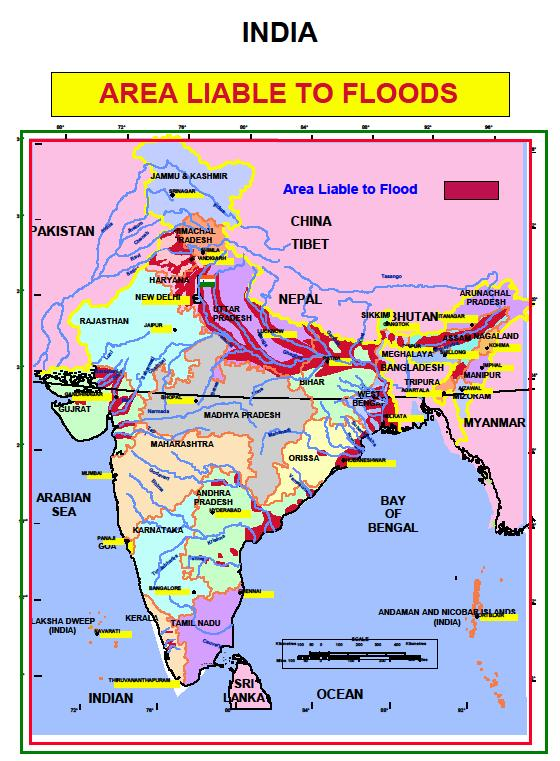
 India is highly vulnerable to floods. Out of the total geographical area of 329 million hectares (mha), more than 40 mha is flood prone. Floods are a recurrent phenomenon, which cause huge loss of lives and damage to livelihood systems, property, infrastructure and public utilities. It is a cause for concern that flood related damages show an increasing trend. The average annual flood damage in the last 10 years period from 1996 to 2005 was Rs. 4745 crore as compared to Rs. 1805 crore, the corresponding average for the previous 53 years. This can be attributed to many reasons including a steep increase in population, rapid urbanization growing developmental and economic activities in flood plains coupled with global warming.

An average every year, 75 lakh hectares of land is affected, 1600 lives are lost and the damage caused to crops, houses and public utilities is Rs.1805 crores due to floods. The maximum number of lives (11,316) was lost in the year 1977. The frequency of major floods is more than once in five years.

Floods have also occurred in areas, which were earlier not considered flood prone. An effort has been made in these Guidelines to cover the entire gamut of Flood Management. Eighty per cent of the precipitation takes place in the monsoon months from June to September. The rivers a bring heavy sediment load from catchments. These, coupled with inadequate carrying capacity of rivers are responsible for causing floods, drainage congestion and erosion of river-banks. Cyclones, cyclonic circulations and cloud bursts cause flash floods and lead to huge losses. It is a fact that some of the rivers causing damage in India originate in neighboring countries; adding another complex dimension to the problem. Continuing and large-scale loss of lives and damage to public and private property due to floods indicate that we are still to develop an effective response to floods. NDMA’s Executive Summary Guidelines have been prepared to enable the various implementing and stakeholder agencies to effectively address the critical areas for minimising flood damage.

Floods


Emergency Kit

  • Battery operated torch
  • Extra batteries
  • Battery operated radio
  • First aid kit and essential medicines
  • Emergency food (dry items) and water (packed and sealed)
  • Candles and matches in a waterproof container
  • Knife
  • Chlorine tablets or powdered water 
  • Important documents (Ration card, Voter ID card, Aadhar Card etc.)
  • Cash, Aadhar Card and Ration Card
  • Thick ropes and cords
  • Shoes

What is Urban Floods

 Urban Floods

Urban flooding is significantly different from rural flooding as urbanization leads to developed catchments, which increases the flood peaks from 1.8 to 8 times and flood volumes by up to 6 times. Consequently, flooding occurs very quickly due to faster flow times (in a matter of minutes). Urban areas are densely populated and people living in vulnerable areas suffer due to flooding, sometimes resulting in loss of life. It is not only the event of flooding but the secondary effect of exposure to infection also has its toll in terms of human suffering, loss of livelihood and, in extreme cases, loss of life.

Urban areas are also centres of economic activities with vital infrastructure which needs to be protected 24×7. In most of the cities, damage to vital infrastructure has a bearing not only for the state and the country but it could even have global implications. Major cities in India have witnessed loss of life and property, disruption in transport and power and incidence of epidemics. Therefore, management of urban flooding has to be accorded top priority.

Increasing trend of urban flooding is a universal phenomenon and poses a great challenge to urban planners the world over. Problems associated with urban floods range from relatively localized incidents to major incidents, resulting in cities being inundated from hours to several days. Therefore, the impact can also be widespread, including temporary relocation of people, damage to civic amenities, deterioration of water quality and risk of epidemics.

What to Do After Floods

  • Drink chlorinated or boiled water.
  • Take clean and safe food
  • Sprinkle insecticides in the water ponds/ stagnant water.
  • Please cooperate with disaster survey team by giving correct information.

Emergency Kit

Prepare a safety kit which should include a torch, sheets/ blankets, waterproof clothing, battery-operated radio, bottled water, first-aid kit, medication, personal valuables and personal documentation.

Guidelines

As a part of its mandate, the National Disaster Management Authority (NDMA) has made efforts to prepare the National Guidelines on Management of Urban Flooding. Even though urban flooding has been experienced over decades in India but sufficient attention was not given to plan specific efforts to deal with it. In the past, any strategy on flood disaster management largely focused on riverine floods affecting large extents of rural areas. Mumbai floods of July 2005 turned out to be an eye-opener. Realizing that the causes of urban flooding are different and so also are the strategies to deal with them, NDMA has for the first time decided to address urban flooding as a separate disaster, delinking it from floods.

URBAN FLOOD RISK IN INDIA 

There has been an increasing trend of urban flood disasters in India over the past several years whereby major cities in India have been severely affected. The most notable amongst them are Hyderabad in 2000, Ahmedabad in 2001, Delhi in 2002 and 2003, Chennai in 2004, Mumbai in 2005, Surat in 2006, Kolkata in 2007, Jamshedpur in 2008, Delhi in 2009 and Guwahati and Delhi in 2010.

A special feature in India is that we have heavy rainfall during monsoons. There are other weather systems also that bring in a lot of rain. Storm surges can also affect coastal cities/ towns. Sudden release or failure to release water from dams can also have severe impact. In addition, the urban heat island effect has resulted in an increase in rainfall over urban areas. Global climate change is resulting in changed weather patterns and increased episodes of high intensity rainfall events occurring in shorter periods of time. Then the threat of sea-level rise is also looming large, threatening all the coastal cities. Cities/towns located on the coast, on river banks, upstream/ downstream of dams, inland cities and in hilly areas can all be affected.

ISSUES IN URBAN FLOODING

Among the important cities of India, the average annual rainfall varies from 2932 mm in Goa and 2401 mm in Mumbai on the higher side, to 669 mm in Jaipur on the lower side. The rainfall pattern and temporal duration is almost similar in all these cities, which receive the maximum rainfall from the south-west monsoons. The average rainfall for the month of July in Mumbai is 868 mm and this far exceeds the annual average rainfall of 611 mm in London.

Stormwater drainage systems in the past were designed for rainfall intensity of 12 – 20 mm. These capacities have been getting very easily overwhelmed whenever rainfall of higher intensity has been experienced. Further, the systems very often do not work to the designed capacities because of very poor maintenance. Encroachments are also a major problem in many cities and towns. Natural streams and watercourses have formed over thousands of years due to the forces of flowing water in the respective watersheds. Habitations started growing into towns and cities alongside rivers and watercourses. As a result of this, the flow of water has increased in proportion to the urbanization of the watersheds. Ideally, the natural drains should have been widened (similar to road widening for increased traffic) to accommodate the higher flows of stormwater. But on the contrary, there have been large scale encroachments on the natural drains and the river flood plains. Consequently the capacity of the natural drains has decreased, resulting in flooding. Improper disposal of solid waste, including domestic, commercial and industrial waste and dumping of construction debris into the drains also contributes significantly to reducing their capacities. It is imperative to take better operations and maintenance actions.

What is Landslides

 India has the highest mountain chain on earth, the Himalayas, which are formed due to collision of Indian and Eurasian plate, the northward movement of the Indian plate towards China causes continuous stress on the rocks rendering them friable, weak and prone to landslides and earthquakes. The slow motion of the Indian crust, about 5 cm/year accumulates stress to which natural disasters are attributed. Some landslides make unique, and unparalleled catastrophes. Landslides and avalanches are among the major hydro-geological hazards that affect large parts of India besides the Himalayas, the Northeastern hill ranges, the Western Ghats, the Nilgiris, the Eastern Ghats and the Vindhyans, in that order, covering about 15 % of the landmass. The Himalayas alone count for landslides of every fame, name and description- big and small, quick and creeping, ancient and new. The Northeastern region is badly affected by landslide problems of a bewildering variety. Landslides in the Darjeeling district of West Bengal as also those in Sikkim, Mizoram, Tripura, Meghalaya, Assam, Nagaland and Arunachal Pradesh pose chronic problems, causing recurring economic losses worth billions of rupees. A different variety of landslides, characterized by a lateritic cap, pose constant threat to the Western Ghats in the South, along the steep slopes overlooking the Konkan coast besides Nilgiris, which is highly landslide prone.

Some spectacular events of tragedies are reported as Varnavat landslide, Uttarkashi District, Malpha landslide Pithoragarh district, Okhimath landslide in Chamoli district, UK and Paglajhora in Darjeeling district as well as Sikkim, Aizawl sports complex, Mizoram.These are some of the more recent examples of landslides. The problem therefore needs to be tackled for mitigation and management for which hazard zones have to be identified and specific slides to be stabilized and managed in addition to monitoring and early warning systems to be placed at selected sites.

landslide
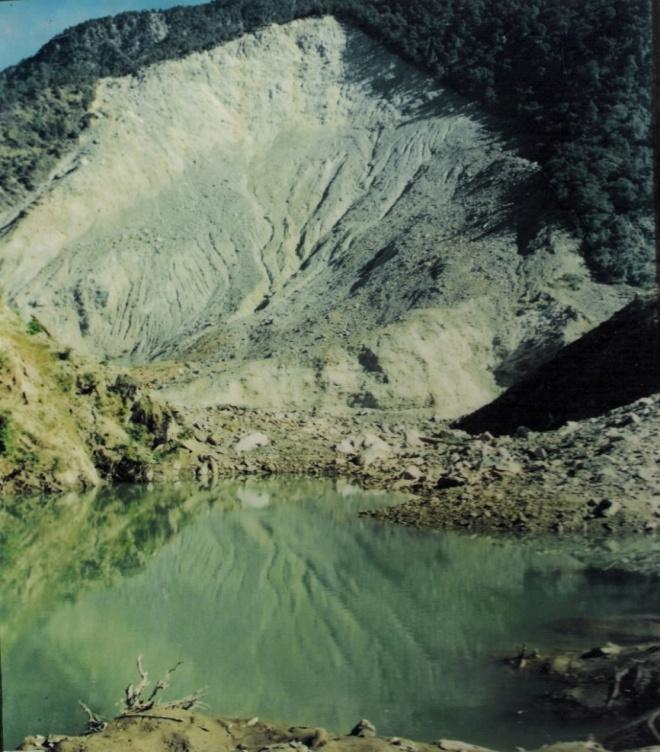
The Photograph of Okhimath landslide which formed a lake in Madhyamaheshwerganga, Rudraprayag district.

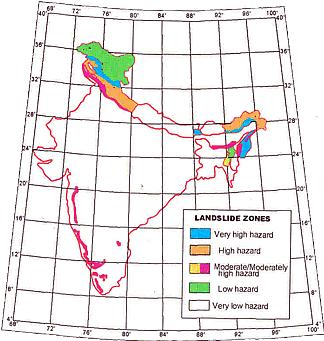
A general landslide hazard map of India shown here marks the areas of different hazard zones in various states of India; one may note that Himalayas of Northwest and Northeast India and the Western Ghats are two regions of high vulnerability and are landslide prone.

ZoneMap

NDMA guidelines are being followed for Landslide Hazard Zonation (LHZ) maps at 1: 50,000 scale and progressively larger scales for specific areas. National Remote Sensing Center (NRSC),Department of Science and Technology (DST), Council of Scientific and Industrial Research (CSIR), Indian Institute of India (IITs), Universities have done tremendous work in this regard. The NRSC Atlas on selected corridors of Uttarakhand and Himachal Pradesh has been a very useful Atlas (Please see NRSC work on Landslides). DST has funded more than 30 projects spread over India by various academic institutions the reports of which can be requested from DST (NRDMA).

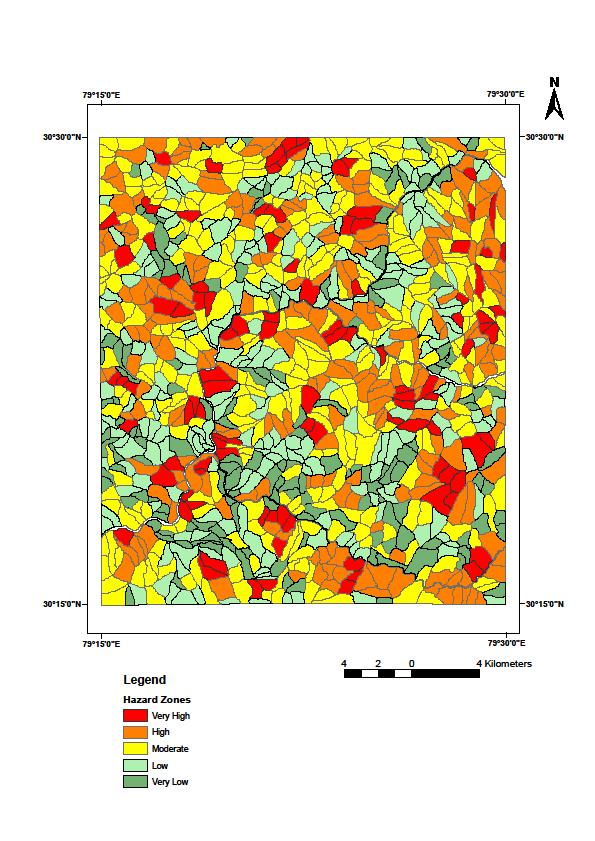
An example of LHZ map at 1: 50,000 scale from a part of Himalayas in Chamoli district (Pachauri, 1992) shown here is based upon several geological, geotechnical parameters. Such maps are being refined and relooked for higher level of verification and acceptability for public use. Approximately 15 % of the Indian landmass has to be covered by such maps at 1: 50,000 scale or higher to classify slopes in various levels of hazards. Geographical Information System (GIS) and Remote Sensing applications are being used through NRSC under a special group of GIS for LHZ at NDMA through database collection from all concerned departments and being stored through good offices of GIS and other agencies, CSIR labs, DST etc as a parallel theme on landslide mitigation.

zone

Emergency Kit

  • Battery operated torch
  • Extra batteries
  • Battery operated radio
  • First aid kit and manual
  • Emergency food (dry items) and water (packed and sealed)
  • Candles and matches in a waterproof container
  • Knife
  • Chlorine tablets or powdered water purifiers
  • Can opener.
  • Essential medicines
  • Cash, Aadhar Card and Ration Card
  • Thick ropes and cords
  • Sturdy shoes

Recover and build

Remain calm and be alert and awake, listen to warnings of heavy and prolonged period of rainfall from weather station, if your home is located below a debris covered area move away to safer place, listen to sounds of rock fall, moving debris and cracking of trees, or cracks in ground or any movement. Keep a battery operated ready for the night.

Call and help rescue teams, keep drinking water containers, first aid kit and essential medicines and avoid entering damaged houses.

Watch for flooding if close to river, help others who need help especially elderly people, children and women, seek advice from local authorities for rebuilding damaged houses, roads etc.

Report any damage of roads, power and telephone lines to concerned authorities.

What is Heat Waves

A Heat Wave is a period of abnormally high temperatures, more than the normal maximum temperature that occurs during the summer season in the North-Western parts of India. Heat Waves typically occur between March and June, and in some rare cases even extend till July. The extreme temperatures and resultant atmospheric conditions adversely affect people living in these regions as they cause physiological stress, sometimes resulting in death.

The Indian Meteorological Department (IMD) has given the following criteria for Heat Waves :

  • Heat Wave need not be considered till maximum temperature of a station reaches atleast 40°C for Plains and atleast 30°C for Hilly regions
  • When normal maximum temperature of a station is less than or equal to 40°C Heat Wave Departure from normal is 5°C to 6°C Severe Heat Wave Departure from normal is 7°C or more
  • When normal maximum temperature of a station is more than 40°C Heat Wave Departure from normal is 4°C to 5°C Severe Heat Wave Departure from normal is 6°C or more
  • When actual maximum temperature remains 45°C or more irrespective of normal maximum temperature, heat waves should be declared. Higher daily peak temperatures and longer, more intense heat waves are becomingly increasingly frequent globally due to climate change. India too is feeling the impact of climate change in terms of increased instances of heat waves which are more intense in nature with each passing year, and have a devastating impact on human health thereby increasing the number of heat wave casualties.

Higher daily peak temperatures and longer, more intense heat waves are becomingly increasingly frequent globally due to climate change. India too is feeling the impact of climate change in terms of increased instances of heat waves which are more intense in nature with each passing year, and have a devastating impact on human health thereby increasing the number of heat wave casualties.

Health Impacts of Heat Waves

The health impacts of Heat Waves typically involve dehydration, heat cramps, heat exhaustion and/or heat stroke. The signs and symptoms are as follows:

  • Heat Cramps: Ederna (swelling) and Syncope (Fainting) generally accompanied by fever below 39°C i.e.102°F.
  • Heat Exhaustion: Fatigue, weakness, dizziness, headache, nausea, vomiting, muscle cramps and sweating.
  • Heat Stoke: Body temperatures of 40°C i.e. 104°F or more along with delirium, seizures or coma. This is a potential fatal condition

Recover and Build

If you think someone is suffering from the heat:

  • Move the person to a cool place under the shade
  • Give water or a rehydrating drink (if the person is still conscious)
  • Fan the person
  • Consult a doctor if symptoms get worse or are long lasting or the person is unconscious
  • Do not give alcohol, caffeine or aerated drink
  • Cool the person by putting a cool wet cloth on his/her face/body
  • Loosen clothes for better ventilation

Emergency Kit

  • Water bottle
  • Umbrella/ Hat or Cap / Head Cover
  • Hand Towel
  • Hand Fan
  • Electrolyte / Glucose / Oral Rehydration

Why Is Centre Not Creating A Bench In West UP?

It is so disgusting, shocking and frustrating to see that BJP which is holding the helm of affairs in Centre as well as in State of UP is not listening to its own MPs both in Lok Sabha and Rajya Sabha as well as its own Union Ministers who are repeatedly demanding the creation of a high court bench in West UP yet Centre is just refusing to relent! Why is Centre so intransigent about not relenting to what is the legitimate and popular demand of the more than 9 crore people of West UP by which the litigants and seekers of justice would be saved from the unnecessary trouble of travelling so far more than 700 to 750 km on an average all the way to Allahabad to seek justice by creating a high court bench in any of the 26 districts of West UP? Why Centre pompously inaugurates 14 lane national highway by which time spent in covering the distance between Meerut and other districts to Delhi stands reduced by one or two hours but is not ready to do anything by which the people are saved from the trouble of travelling so far to Allahabad to seek justice?  
                                      Why Centre is not listening to even its own BJP MP and former Union Minister Sanjeev Baliyan who candidly pointed out to Lok Sabha Speaker in  Zero Hour that from his Muzaffarnagar constituency, Punjab and Haryana High Court, Rajasthan High Court, Madhya Pradesh High Court and above all even Lahore High Court in Pakistan which is about 498 km is nearer than Allahabad High Court which is 730 km away? He pointed out that about 15 lakh cases of West UP were pending which is more than many states pending cases! He pointed out that Maharashtra with 8 crore population has bench and 3 benches and Madhya Pradesh with 7 crore population has high court and 2 benches but West UP with more than 8 crore population has not even a bench! Taking the bull by the horns, he did not shy away from even saying that the stiff opposition by lawyers from Allahabad High Court is no ground to deny West UP a bench and said that for 10,000 lawyers of Allahabad, the neck of 8 crore people of West UP cannot be stifled! There is a lot of merit in what he has said! But why is BJP led by PM Modi not listening?
                                        Why BJP is not listening even to  Kanta Kardam who is Rajya Sabha MP  and who too has said that she will raise the demand for a bench in Rajya Sabha? She said that this is not a demand just of lawyers but is a justified demand of the people of West UP and creation of a bench here is imperative. Rajinder Agrawal who is BJP MP from Meerut rightly said that all MPs from West UP are united in demanding a high court bench for West UP.
                                       Even Gen VK Singh who is Union Minister and BJP MP from Ghaziabad has supported this legitimate demand and made the lawyers meet Union Law Minister Ravi Shankar Prasad in March and he too supported the demand for a bench in West UP! Even Union Home Minister Rajnath Singh too has reiterated time and again his firm and full support for the creation of a high court bench in West UP! Amit Shah too had assured his support for bench in West UP while meeting a delegation of lawyers in Meerut! Still why even after more than 4 years of being in power in Centre and nearly one and a half year in UP is Centre not taking any step to create a bench in West UP?
                                    We all know how Sampoornanand who was UP CM had demanded the creation of a bench in West UP from Centre in 1955 but Centre refused even though a bench was created in Lucknow in 1948 for just 12 districts but for nearly 40 districts of West UP including those now in Uttarakhand not a single bench was approved by the then PM Jawaharlal Nehru! Even ND Tiwari as UP CM had proposed the creation of a bench in West UP but Centre again didn’t accept it! Mayawati as UP CM even proposed the creation of West UP as a separate state but again Centre didn’t accept it!
                                  Now let us have a glimpse of the distance of different districts from Agra and Meerut. The distance from different districts of West UP till Allahabad varies from 600 to 800 km. But the distance from different districts to Meerut and Agra stands considerably reduced and it is Meerut which is close to most of the districts! The distance of different districts from Meerut and Agra is as follows: –
Districts                    Meerut         Agra
Meerut                      00                243
Muzaffarnagar          58                301
Saharanpur                117              360
Baghpat                     45                  248
Ghaziabad                  46                  203
Bijnore                       80                   316
Gautambuddhnagar 83                   161
Bulandshahar            69                     180
Shamli                        67                        301
Hapur                         29                        213
Sambhal                     117                      187
Amroha                      94                         226
Rampur                      146                       245
Moradabad                 130                      220
Bareilly                        195                       210
Aligarh                         133                       88
Hathras                        167                        60
Mathura                       196                        59
Etah                               203                       83
Mainpuri                      261                        113
Agra                              243                        00    
                                              The lawyers of West UP are fighting people’s struggle who are worst affected as they have to travel more than 700 to 800 km on an average all the way to Allahabad to attend court hearings and many times trains get late and many times have to travel without reservation! How many people can afford to go by plane as some lawyers of Allahabad argue? Very few!
                                       What purpose is served by creating a single bench for such a large state like UP which has maximum population more than 22 crore as UP CM Yogi Adityanath keeps mentioning repeatedly, maximum villages more than one lakh whereas no other state has more than 5000 villages, maximum MPs for Lok Sabha at 80, maximum MPs for Rajya Sabha at 31, maximum MLAs in Vidhan Sabha at 404, maximum MLAs in Vidhan Parishad at 104, maximum towns more than 900, maximum pending cases more than 10 lakh and here too West UP owes for more than half of them, maximum hate crimes, maximum Judges in high court at 160, maximum PM since independence, maximum Mayors, maximum elected representatives at all levels and is among the largest states still has just one high court bench created by Jawaharlal Nehru more than 70 years back on July 1 in 1948 but not a single for West UP even 70 years later in 2018! How can this be ever justified?
                                             Why even six months continuous strike by lawyers of 26 districts of West UP thrice as they did in 2001, three to four months strike as they did in 2014-15, two months as they did in 2010 and one month as they did in 2009 apart from the strike every Saturday and even many times on Wednesday apart from the many strike for weeks every year has failed to shake Centre in taking any concrete step for creating a high court bench in West UP? Why even the right and laudable legal advice rendered by one of the most eminent jurist of India Soli J Sorabjee in his capacity as Attorney General that,  “Centre is empowered to create a high court bench in West UP without any recommendation from the Chief Justice or Chief Minister or anyone else in this regard” failed to shake Centre in creating a bench in West UP promptly?  Why Centre even disregarded what former Chairman of Supreme Court Bar Association BN Krishnamani said so eloquently that, “Only by the creation of a high court bench in any of the districts in West UP will the people living there get real justice”? If UP can’t be given more benches and West UP can’t have even one bench then all benches in India must be disbanded right now because it is the people of West UP who are suffering the most because of no bench here and have to travel the most!
                                                     It is indisputable that as per the Section 51 of the States Reorganisation Act of 1956, the Centre can create a high court bench in any of these 3 states – UP, Bihar and Jammu and Kashmir directly by bringing it up in Parliament. BJP Rajya Sabha MP Prakash Singh Tomar himself on 25th July raised his voice demanding bench in West UP and wondered why when Centre is empowered to create a bench in UP without any recommendation from the Chief Minister or Chief Justice is not taking necessary step in this direction! Centre does not need any recommendation from State Government or the Chief Justice as has been very wrongly propagated for many decades by Centre as it wants to just avoid it on any specious pretext! After Centre declares bench for West UP, State Government has to just allot land for it.  
                                   What a national disgrace that these very 3 states – Uttar Pradesh, Jammu and Kashmir and Bihar keep on grabbing the national news headlines for all the wrong reasons as crime incidents keep multiplying very rapidly and what is worst is Centre’s irrational stand to not allow a single more bench in any of these 3 states! Why Centre even disregarded what former Chairman of Supreme Court Bar Association BN Krishnamani said that, “Only by the creation of a high court bench in any of the districts in West UP will the people living there get real justice”? Why Centre is ignoring even what Atal Bihari Vajpayee demanded the setting up of a bench in West UP as Opposition Leader way back in 1986 right inside Parliament?
                                        Why Centre fails to appreciate that if bench is created in any of the 26 districts of West UP, all the more than 9 crore people will stand to gain equally irrespective of religion, caste, creed, community or gender? Why Centre fails to appreciate that when 2 high court benches more can be created for just 4 and 8 districts of Karnataka at Dharwad and Gulbarga which already had bench at Hubli and which has just 6 crore population and not even two lakh pending cases whereas West UP has more than 5 lakh pending cases and UP more than 10 lakh similarly Maharashtra already had 3 benches at Nagpur, Panaji and Aurangabad and one more now created at Kolhapur, Assam with just about 2 crore population had 7 high court benches before Manipur, Meghalaya and Tripura were given high court itself for just 27, 29 and 36 lakh population, Sikkim with just 6 lakh population and less than 100 pending cases has high court and above all even Port Blair with just 3 lakh population has bench then why is West UP with more than 9 crore population and more than half of the total pending cases of UP has not even a single bench of high court?
                                         Why Centre is ignoring even the legitimate voices of its own leaders from West UP like Union Minister Satyapal Singh who demanded 5 benches for UP at Meerut, Agra, Jhansi, Gorakhpur and Varanasi and not prepared to create even a single bench not just in West UP but in any hook and corner of UP except continuing with the one already at Lucknow? Why Centre is clinging with the recommendation made by the Law Commission in 1956 in its fourth report that more benches should not be created while not caring for the 230th report of Law Commission made in 2009 which recommended creation of more benches and here too why just UP is being singled out?
                                        Why can’t one bench at least be approved straightaway for West UP at any of the 26 districts? Why should the more than 9 crore people of West UP be denied “speedy Justice”, “justice at doorsteps” and “affordable cheap justice”? Why should they be made to travel so far even after more than 70 years of independence? Why Lucknow has high court bench since 1948 for just 12 districts with just 62,000 square km area even though it is so near to Allahabad just 200 km away but West UP with 26 districts and more than 98,933 square km has not even a bench 70 years later in 2018? If Lucknow is capital then so are Bhopal which is capital of Madhya Pradesh, Bhubaneshwar which is capital of Odisha, Dehradun which is capital of Uttarakhand and Thiruvananthapuram which is capital of Kerala but they have neither high court nor bench! Then why both high court and bench only for Eastern UP and nothing for West UP? Why can’t this be remedied immediately?
Rajendra Singhj Jani, President Meerut Bar Association,
Chairman Of The Central Action Committee For Establishment Of High Court Bench In Western UP,
Chamber No. 7, Civil Court,
Near Western Kutchery Gate,
Meerut – 250001, Uttar Pradesh.          

Enact Law For Safety Of Soldiers Of Jammu And Kashmir

It is most hurting to see that in India, the soldiers who hail from Jammu and Kashmir and who join forces either in Army or in CRPF or in BSF or in police or in any other forces against the will of majority of those who hate India and enjoy stone pelting at forces are being mocked at repeatedly by Centre by just not providing any security to them and their family! In just few days we keep hearing soldiers from Jammu and Kashmir having been abducted at gun point and then tortured and then killed! Centre proudly spends more than Rs 560 crore on Hurriyat leaders who just hate India and always rant against India and openly swear loyalty with Pakistan but is not prepared to spend even a small mount on safety of soldiers of Jammu and Kashmir! Soldiers of Jammu and Kashmir are being repeatedly abducted from their home itself and then killed after bring tortured yet we see neither Centre nor Opposition taking it seriously! 
Truth be told, the latest to be killed is police constable Mohammad Salim Shah who was killed by suspected militants after his abduction on night of July 20 from his house. His multiple bullet injuries was found on July 21 afternoon in Qaimoh village of South Kashmir’s Kulgam district! He was brutally tortured and he was videographed which was later sent to all news channels just like in case of earlier killings so that no one from Jammu and Kashmir join forces!
Be it noted, Salim had been recently promoted and was working as a Special Police Officer and was undergoing training in Kathua! He had come home in Muthalhama of Kulgam district on leave. He is the 25th policemen killed by militants in Jammu and Kashmir this year! 
What is most reprehensible to note is that Centre and Opposition both are not raising this and feel that there is nothing wrong in spending more than Rs 560 crore on security of Hurriyat leaders whom militants always hail and feel no need to provide security to soldiers of Jammu and Kashmir! As if this is not enough, even Supreme Court whom we all or at least I can say for myself consider as “Living God” too just says nothing on it even though it feels very angry on mob killing and mob lynching which certainly deserves to be condemned in the strongest terms! But why this deafening silence on soldiers killings and stone pelters who pelt stone in favour of terrorists?
To be sure, we all saw how earlier this month in July, another police constable Javed Ahmad Dar too was abducted from his vehicle at Vehil in Shopian district and killed after being tortured by militants yet Centre feels we should just relax because at least Hurriyat leaders are safe on whom crores are being spent for their security! As if this was not enough, in June an Army soldier Aurangzeb Khan was also abducted from a private vehicle when he was going home for Eid in Shopian. His body was recovered from a Pulwama village. He was killed after being tortured similarly as he fearlessly admitted that along with Major Shukla he was responsible for killing of many terrorists! 
Bluntly put: A brave and die hard nationalist like Aurangzeb Khan can never die. His life is the biggest offering that he himself voluntarily sacrificed for the nation! No weapon, no terrorist, no Pakistan, no China or any other country can ever kill the likes of brave soldiers like Aurangzeb of 44 RR who belonged to 4 Jammu and Kashmir Light Infantry at Shadimarg in Shopian and hailed from the village Salani in Poonch district of Jammu.
Any Indian who does not feel to salute Aurangzeb can never be a true Indian! What Aurangzeb has done so willingly cannot be done even by me and I candidly acknowledge this! No award, no Bharat Ratna, no Nobel Prize, no Paramveer Chakra or any other award can ever honour Aurangzeb because Aurangzeb stands tallest above all these petty awards!
Even after being captured by terrorists and even after being tied to a tree, he did not show any sign of fear nor did he plead to be spared. He voluntarily acknowledged his brave role in eliminating several terrorists along with Maj Shukla when cross questioned by terrorists without showing any sign of fear! He could have blamed others for killing terrorists and could have escaped being killed but he dared to confront them and didn’t fear for his life nor pleaded for mercy!
Aurangzeb is our national pride, national icon and no politician, no political party can ever mock at him by denying him any award because he stands above all such petty considerations and his supreme sacrifice is the biggest testimony to it. The biggest tribute that we can pay to Aurangzeb is by adopting zero tolerance policy towards terrorists and Pakistan! No license should ever again be given to Pakistan or terrorists in the name of Ramzan to kill our soldiers by ordering forces to take no action against them because this tantamount to mocking at Ramzan which under no circumstances can ever be associated with terrorists and Pakistan who leave no opportunity to slaughter our citizens and soldiers whenever they get any opportunity to do so! Why was this unfettered license given to Pakistan and terrorists knowing fully well what they do as they have done in past also and even former PM Atal Bihari Vajpayee was compelled to revoke this so called “Ramzan ka ceasefire”? Why Supreme Court also just says nothing on it?
How long will politicians plead ceasefire for terrorists, traitors and Pakistan? How long will politicians plead “talks and dialogues” with these rogues? How long will politicians refuse to learn anything from past experiences like the brutal murder of Lieutenant Umar Fayyaz and continue appeasing terrorists and Pakistan? How long will Most Favoured Nation (MFN) status for Pakistan continue since 1996 unilaterally like unilateral ceasefire till now? How long will Pakistan enjoy benefit of Indus Water Treaty will killing our citizens mercilessly?
Mohammad Haneef Khan who is Aurangzeb’s father who is himself an ex-serviceman stands perfectly justified when he says that, “I want to ask PM Modi if he’s listening to me, why are you appeasing stone-pelters and separatists? Punish the terrorists who killed my son. Why was Ramzan ceasefire announced? Terrorists have no religion, then why operations were stopped against them during Ramzan? Why Pakistani flags are allowed to be waved openly in India?” What Mohammad Haneef has said is perfectly right and no sane person will ever question this!
How can cases be withdrawn suddenly against more than 10,000 stone-pelters by J&K State Government? How can a crime be encouraged openly by a duly elected State Government? How can Centre too endorse it by doing nothing to stop this? Does Centre favour stone pelting on our soldiers! Never saw stone pelting on such a large scale as we are now seeing in PM Narendra Damodardas Modi’s Raj!Why even Supreme Court didn’t intervene and stop Jammu and Kashmir State Government led by former Chief Minister Mehbooba Mufti from acting against India’s national interests?
Why politicians never want Pakistan to be declared a “terror state” and named “Aatankistan” as demanded by Maulana Mehmood Madani who is leader of Jamiat Ulama-i-Hind and MP from Bangalore Rajeev Chandrashekhar even though they demand the same from world at very international forum like UN? What is the real mystery behind this? Why is free license given to “traitors, terrorists and Pakistan” to kill our brave soldiers and others during Ramzan? Is Ramzan meant to kill Indians? How long will leaders fool themselves and this nation?
What is happening now so brazenly in PM Modi’s time in Kashmir is most shocking and still he keeps appearing in fitness challenge along with his cabinet colleagues like Colonel Rajyavardhan Singh Rathore who inspite of having an Army background shamelessly does “fitness exercise” even as Pakistan kills many of our BSF soldiers in Samba along with an Assistant Commandant as also Aurangzeb and a senior journalist Shujaat Bukhari who was editor of “Rising Kashmir” and bombards our border areas forcing lakhs to migrate and here too many women and children are killed! Why is all this taken so lightly? We see Rahul and Modi hugging each other in Parliament even as soldiers from Jammu and Kashmiri soldiers are being slaughtered repeatedly as has happened just recently with Mohammad Salim Shah! Pakistan merges PoK with Pakistan but our politicians don’t have the guts to ensure the “full and final merger of J&K with India! Why can’t we also act similarly?
Former CJI JS Khehar while in office as CJI had rightly said that, “How can one country have two flags, two Constitutions, two laws and two citizenship?” Why can’t Centre abrogate Article 370 and Article 35A which are most discriminatory and forbids Indians from outside the state to settle there or even appear in any exam there? What have we gained by it? Flags of Pakistan and ISIS! For how long this disgraceful appeasement will continue? No law, no Constitution, no Judge, no Court not even Supreme Court can be above the unity and integrity of India which has to be ensured under all circumstances!
What message is Centre sending by caring a damn for the repeated killings of our brave soldiers and instead appearing in news channels to issue “fitness challenge” to heroes, heroines, and others? What message is Centre sending by celebrating “Yoga Day” and caring a damn for the anger of the families of our brave soldiers like Aurangzeb who got killed because of this Ramzan ceasefire? Is this the biggest tribute that is being paid to our soldiers? Should we be proud of it? No wonder, more and more soldiers from Jammu and Kashmir are being killed!
Lieutenant Umar Fayyaz who hailed from Kashmir was slaughtered by terrorists last year. DSP Mohammad Ayyub Pandit was posted for security of Hurriyat leaders but he was himself killed after the mob was provoked by some leaders! Stone pelters in Modi’s Raj attack our soldiers openly and their helmets are thrown in gutter after being slapped who still say nothing even while they are fighting terrorists yet Supreme Court says nothing on this even though it speaks about zero tolerance for human rights violations by forces in Manipur! Is this not double standard? Why Centre always want security forces to exercise restraint and restraint and cases are lodged against them for exercising right of self-defence but cases against stone pelters are withdrawn at the drop of a hat yet not just Centre but even Supreme Court just says nothing?
Who is the great military adviser who is advising and guiding our PM and Home Minister to resort to all such foolish and self-destructive actions like Ramzan ceasefire, continuing with MFN status for Pakistan unilaterally, retaining Article 370 and Article 35A, continue spending Rs 560 crore every year from taxpayers money on Hurriyat leaders who openly shout slogans favouring Pakistan while not spending a penny on providing security to soldiers from Jammu and Kashmir, continue allowing Pakistan to take advantage of Indus Water Treaty which Modi had earlier himself criticised and many more such foolish acts? On a concluding note, soldiers like Mohammad Salim and Aurangzeb and other such Jammu and Kashmir soldiers are national icon who inspite of being tortured and beaten brutally pledge loyalty for India and for this are killed finally needs no recommendation or citation or award or anything else from any leader or politician to be respected because every true Indian will salute him always for the supreme sacrifice that he has rendered without any hesitation! But Supreme Court must now speak up very strongly for them by ordering Centre to provide security to them and their family and if this is not done that day is not far when no one from Jammu and Kashmir will ever like to join forces for a thankless nation which believes in providing security for Hurriyat and separatists and spending crores on it but not spending a penny for soldiers who love India and join forces! The earlier this is done, the better it shall be in our national interests! 
Sanjeev Sirohi, Advocate,
s/o Col BPS Sirohi,
A 82, Defence Enclave,
Sardhana Road, Kankerkhera,
Meerut – 250001, Uttar Pradesh.

SC Advocates Creating A Special Law Against Lynching

It must be stated right at the outset that in a landmark judgment with far reaching consequences, the Supreme Court 3 Judge Bench in Tehseen S Poonawalla v Union of India and others in Writ Petition (Civil) No. 754 of 2016 dated July 17, 2018 comprising of CJI Dipak Misra, Justice AM Khanwilkar and Justice Dr DY Chandrachud recommended that the Parliament may create a special law against lynching, asserting that “fear of law and veneration for the command of law constitute the foundation of a civilized society”. We all have seen that in the last few years there has been a sharp hike in the incidents of mob lynching based on rumours and speculations which many times are completely baseless! Those who indulge in mob lynching cannot be allowed to get away under the garb of “mob getting angry” over cow killing or any other cause and must be made to pay the price for their dastardly acts by ensuring that they are either hanged or made to spend their whole life behind bars!
                                      As it turned out, the Bench right at the very beginning in its landmark order made its intentions clear on citizens taking law in their own hands by holding clearly and categorically that, “Law enacted for the benefit of the society by conferring rights on the citizens and to regulate social behaviour in many a sphere, is required to be implemented by the law enforcing agencies and the citizens are duty bound to follow the law treating it as sacred. Law has to be regarded as the foundation of a civilized society. The primary goal of law is to have an orderly society where the citizenry dreams for change and progress is realized and the individual aspiration finds space for expression of his/her potential. In such an atmosphere while every citizen is entitled to enjoy the rights and interest bestowed under the constitutional and statutory law, he is also obligated to remain obeisant to the command of law. It has been stated in Krishnamoorthy v Sivakumar and others (2015) 3 SCC 467, “the law, the mightiest sovereign in a civilized country”. The majesty of law cannot be sullied simply because an individual or a group generate the attitude that they have been empowered by the principles set out in law to take its enforcement into their own hands and gradually become law unto themselves and punish the violator on their own assumption and in the manner in which they deem fit. They forget that the administration of law is conferred on the law enforcing agencies and no one is allowed to take law into his own hands on the fancy of his “shallow spirit of judgment”. Just as one is entitled to fight for his rights in law, the other is entitled to be treated as innocent till he is found guilty after a fair trial. No act of a citizen is to be adjudged by any kind of community under the guise of protectors of law. It is the seminal requirement of law that an accused is booked under law and is dealt with in accordance with the procedure without any obstruction so that substantive justice is done. No individual in his own capacity or as a part of a group, which within no time assumes the character of a mob, can take law into his/their hands and deal with a person treating him as guilty. That is not only contrary to the paradigm of established legal principles in our legal system but also inconceivable in a civilized society that respects the fundamental tenets of the rule of law. And, needless to say, such ideas and conceptions not only create a dent in the majesty of law but are also absolutely obnoxious.”    
                                      It would be pertinent to mention here that the petitioner who is a social activist has preferred this writ petition under Article 32 of the Constitution for commanding the respondent-State Nos. 3 to 8 which includes Haryana, Uttar Pradesh, Karnataka, Jharkhand, Gujarat and Rajasthan to take immediate and necessary action against the cow protection groups indulging in violence; and further to issue a writ or direction to remove the violent contents from the social media uploaded and hosted by the said groups. Mr Sanjay R Hegde who as learned senior counsel appeared for the petitioner in Writ Petition (Civil) No. 754 of 2016 submitted that no individual or vigilante group can engage himself/themselves in an activity of lynching solely on the basis of a perception that a crime has been committed. He also submits “That apart, the supremacy of law has to be recognized and if a law prescribes a punishment for a crime, it has the mechanism provided under the law to do so. The procedural and the substantial safeguards are required to be followed.” He urged with all the emphasis at his command that lynching or any kind of mob violence has to be curbed and crippled by the executive and no excuse can ever be tolerated. Stress is laid on prevention, remedial and punitive measures by him. In this regard, he has placed reliance on a recent judgment rendered in Shakti Vahini v Union of India & others 2018 (5) SCALE 51.
                                  Going forward, it must also be mentioned here that Ms Indira Jaisingh who is learned senior counsel for the petitioner in Writ Petition (Civil) No. 732 of 2017 made her own submissions. She has referred to Martin Luther King Jr. wherein he had said that law may not be able to make a man love him, but it can keep the man from lynching him. She submits that there has been a constant increase in the number of incidents in recent years as a consequence of which citizens belonging to minority communities have become victims of targeted violence which mainly originate on suspicion and at times misinformation that the victims were involved in illegal cattle trade and such other activities. It must be added here that she also referred to certain specific incidents of lynching. It is additionally argued by her that the Central Government be directed to intervene in exercise of the power conferred under Articles 256 and 257 of the Constitution to issue directions to the State Governments. Her point is valid!
                                  Moving ahead, she further urges that in the recent past, self-proclaimed and self-styled vigilantes have brazenly taken law into themselves and have targeted citizens belonging to certain communities and lower strata of the society which cannot be tolerated and it is the obligation of the Union and the States to take immediate action warranted in law to stop such activities. There can be no denying or disputing it! She has further submitted that there have been many an incident of lynching mostly by vigilante groups across the States of Maharashtra, Gujarat, Rajasthan, Uttar Pradesh, Haryana, Karnataka, Madhya Pradesh, Jammu and Kashmir and Delhi. It is her stringent stand that action is required to be taken against the perpetrators when approached by the family members of the victim.
                                      Apart from this, she has canvassed that it is the foremost duty of the Central and the State Governments to ensure that the members of the minorities are not targeted by mob violence and vigilante groups. She also contends that if the illegal actions of these lynchers are not totally curbed, there would be absolute chaos where any private individual can take law into his own hands for the enforcement of criminal law in accordance with his own judgment. What wrong has she said? Nothing wrong!
                                    Now coming to what the Supreme Court ruled after listening to submissions made from both sides. We shall discuss one by one on what all the Apex Court ruled. They are as follows: –
             On the State’s duty to maintain law and order
                                     At the outset itself, the Court asserted that it is the State’s duty to prevent any sort of mob vigilantism, observing, “The States have the onerous duty to see that no individual or any core group take law into their own hands. Every citizen has the right to intimate the police about the infraction of law. There cannot be an investigation, trial and punishment of any nature on the streets. The process of adjudication takes place within the hallowed precincts of the courts of justice and not on the streets. No one has the right to become the guardian of law claiming that he has to protect the law by any means. It is the duty of the States, as has been stated in Nandini Sundar and others v State of Chhattisgarh [2011] 7 SCC 547, to strive, incessantly and consistently, to promote fraternity amongst all citizens so that the dignity of every citizen is protected, nourished and promoted. That apart, it is the responsibility of the States to prevent untoward incidents and to prevent crime.”
                                               Furthermore, in Mohd. Haroon and others v. Union of India and another [2014] 5 SCC 252, it has been held that it is the responsibility of the State Administration in association with the intelligence agencies of both the State and the Centre to prevent recurrence of communal violence in any part of the State. If any officer responsible for maintaining law and order is found negligent, he/she should be brought within the ambit of law. No guilty officer should be spared.
                                Also, the Apex Court observed that, “There can be no shadow of doubt that the authorities which are conferred with the responsibility to maintain law and order in the States have the principal obligation to see that vigilantism, be it cow vigilantism or any other vigilantism of any perception, does not take place. When any core group with some kind of idea take the law into their own hands, it ushers in anarchy, chaos, disorder and, eventually, there is an emergence of a violent society. Vigilantism cannot, by any stretch of imagination, be given room to take shape, for it is absolutely a perverse notion. We may note here that certain applications for intervention and written notes have been filed in this regard supporting the same on the basis that there is cattle smuggling and cruel treatment to animals. In this context, suffice it to say that it is the law enforcing agencies which have to survey, prevent and prosecute. No one has the authority to enter into the said field and harbour the feeling that he is the law and the punisher himself. A country where the rule of law prevails, does not allow any such thought. It, in fact, commands for ostracisation of such thoughts with immediacy.”
           On growing mob vigilantism
                                 Truth be told, the Court made some stern and damning observations on the growing mob vigilantism and asserted that such extrajudicial attempts under the guise of protection of law would have to be nipped in the bud, “lest it would lead to rise of anarchy and lawlessness which would plague and corrode the nation like an epidemic.” It held that, “Lynching is an affront to the rule of law and to the exalted values of the Constitution itself. We may say without any fear of contradiction that lynching by unruly mobs and barbaric violence arising out of incitement and instigation cannot be allowed to become the order of the day. Such vigilantism, be it for whatever purpose or borne out of whatever cause, has the effect of undermining the legal and formal institutions of the State and altering the constitutional order.” It, therefore, highlighted the dire need for State intervention in protecting its citizens from “unruly elements and perpetrators of orchestrated lynching and vigilantism with utmost sincerity and true commitment to address and curb such incidents which must reflect in its actions and schemes”.
            Reference to American authorities
                               Be it noted, the Court also referred to rulings by the American Courts which have dealt with lynching, which at one point of time, was rampant in the American society. The Court noted that the American Courts had deplored this menace and had dealt with it with iron hands so as to eradicate the same. It then observed, “Thus, the decisions of this Court, as well as the authorities from other jurisdictions, clearly show that every citizen has to abide by the law and the law never confers the power on a citizen to become the law unto himself or take law into his hands. The idea is absolutely despicable, the thought is utterly detestable and the action is obnoxious and completely hellish. It is nauseatingly perverse.”
                     On rising intolerance
                           Truly speaking, the Bench highlighted the importance of plurality and tolerance as the building blocks of a truly free and democratic society and the need for preserving the same. It said in no uncertain terms that, “It must be emphatically stated that a dynamic contemporary constitutional democracy imbibes the essential features of accommodating pluralism in thought and approach so as to preserve cohesiveness and unity. Intolerance arising out of a dogmatic mindset sows the seeds of upheaval and has a chilling effect on freedom of thought and expression. Hence, tolerance has to be fostered and practiced and not allowed to be diluted in any manner.”
                                     Having said this, it must now be brought out here that the Apex Court then issued some guidelines to be followed. It also listed the matter on 20 August for further hearing. Those guidelines are as follows: –
A.                Preventive Measures
(i)                         The State Governments shall designate a senior police officer, not below the rank of Superintendent of Police, as Nodal Officer in each district. Such Nodal Officer shall be assisted by one of the DSP rank officers in the district for taking measure to prevent incidents of mob violence and lynching. They shall constitute a special task force so as to procure intelligence reports about the people who are likely to commit such crimes or who are involved in spreading hate speeches, provocative statements and fake news.  
(ii)                      The State Governments shall forthwith identify Districts, Sub-Divisions and/or Villages where instances of lynching and mob violence have been reported in the recent past, say, in the last five years. The process of identification should be done within a period of three weeks from the date of this judgment, as such time period is sufficient to get the task done in today’s fast world of data collection.
(iii)                   The Secretary, Home Department of the concerned States shall issue directives/advisories to the Nodal Officers of the concerned districts for ensuring that the Officer In-charge of the Police Stations of the identified areas are extra cautious if any instance of mob violence within their jurisdiction comes to their notice.
(iv)                   The Nodal Officer, so designated, shall hold regular meetings (at least once a month) with the local intelligence units in the district along with all Station House Officers of the district so as to identify the existence of the tendencies of vigilantism, mob violence or lynching in the district and take steps to prohibit instances of dissemination of offensive material through different social media platforms or any other means for inciting such tendencies. The Nodal Officer shall also make efforts to eradicate hostile environment against any community or caste which is targeted in such incidents.
(v)                      The Director General of Police/the Secretary, Home Department of the concerned States shall take regular review meetings (at least once a quarter) with all the Nodal Officers and State Police Intelligence heads. The Nodal Officers shall bring to the notice of the DGP any inter-district co-ordination issues for devising a strategy to tackle lynching and mob violence related issues at the State level.
(vi)                   It shall be the duty of every police officer to cause a mob to disperse, by exercising his power under Section 129 of CrPC, which , in his opinion, has a tendency to cause violence or wreak the havoc of lynching in the disguise of vigilantism or otherwise.
(vii)                The Home Department of the Government of India must take initiative and work in coordination with  the State Governments for sensitising the law enforcement agencies and by involving all the stakeholders to identify the measures for prevention of mob violence and lynching against any caste or community and to implement the constitutional goal of social justice and the Rule of Law.
(viii)             The Director General of Police shall issue a circular to the Superintendents of Police with regard to police patrolling in the sensitive areas keeping in view the incidents of the past and the intelligence obtained by the office of the Director-General. It singularly means that there should be seriousness in patrolling so that the anti-social elements involved in such crimes are discouraged and remain within the boundaries of law thus fearing to even think of taking the law into their own hands.
(ix)                   The Central and the State Governments should broadcast on radio and television and other media platforms including the official websites of the Home Department and Police of the States that lynching and mob violence of any kind shall invite serious consequence under the law.
(x)                      It shall be the duty of the Central Government as well as the State Governments to take steps to curb and stop dissemination of irresponsible and explosive messages, videos and other material on various social media platforms which have a tendency to incite mob violence and lynching of any kind.
(xi)                   The police shall cause to register FIR under Section 153A of IPC and/or other relevant provisions of law against persons who disseminate irresponsible and explosive messages and videos having content which is likely to incite mob violence and lynching of any kind.
(xii)                The Central Government shall also issue appropriate directions/advisories to the State Governments which would reflect the gravity and seriousness of the situation and the measures to be taken.
B.            Remedial measures
(i)                         Despite the preventive measures taken by the State Police, it comes to the notice of the local police that an incident of lynching or mob violence has taken place, the jurisdictional police station shall immediately cause to lodge an FIR, without any undue delay, under the relevant provisions of IPC and/or other provisions of law.
(ii)                      It shall be the duty of the Station House Officer, in whose police station such FIR is registered, to forthwith intimate the Nodal Officer in the district who shall, in turn, ensure that there is no further harassment of the family members of the victim(s).
(iii)                   Investigation in such offences shall be personally monitored by the Nodal Officer who shall be duty bound to ensure that the investigation is carried out effectively and the charge-sheet in such cases is filed within the statutory period from the date of registration of the FIR or arrest of the accused, as the case may be.
(iv)                   The State Governments shall prepare a lynching/mob violence victim compensation scheme in the light of the provisions of Section 357A of CrPC within one month from the date of this judgment. In the said scheme for computation of compensation, the State Governments shall give due regard to the nature of bodily injury, psychological injury and loss of earnings including loss of opportunities of employment and education and expenses incurred on account of legal and medical expenses. The said compensation scheme must also have a provision for interim relief to be paid to the victim(s) or to the next of kin of the deceased within a period of thirty days of the incident of mob violence/lynching.
(v)                      The cases of lynching and mob violence shall be specifically tried by designated court/Fast Track Courts earmarked for that purpose in each district. Such courts shall hold trial of the case on a day to day basis. The trial shall preferably be concluded within six months from the date of taking cognizance. We may hasten to add that this direction shall apply to even pending cases. The District Judge shall assign those cases as far as possible to one jurisdictional court so as to ensure expeditious disposal thereof. It shall be the duty of the State Governments and the Nodal Officers, in particular, to see that the prosecuting agency strictly carries out its role in appropriate furtherance of the trial.
(vi)                   To set a stern example in cases of mob violence and lynching, upon conviction of the accused person(s), the trial court must ordinarily award maximum sentence as provided for various offences under the provisions of the IPC.
(vii)                The courts trying the cases of mob violence and lynching may, on an application by a witness or by the public prosecutor in relation to such witness or on its own motion, take such measures, as it deems fit, for protection and for concealing the identity and address of the witness.
(viii)             The victim(s) or the next kin of the deceased in cases of mob violence and lynching shall be given timely notice of any court proceedings and he/she shall be entitled to be heard at the trial in respect of applications such as bail, discharge, release and parole filed by the accused persons. They shall also have the right to file written submissions on conviction, acquittal or sentencing.
(ix)                   The victim(s) or the next of kin of the deceased in cases of mob violence and lynching shall receive free legal aid if he or she so chooses and engage any advocate of his/her choice from amongst those enrolled in the legal aid panel under the Legal Services Authorities Act, 1987.  
C.                   Punitive measures
(i)                         Wherever it is found that a police officer or an officer of the district administration has failed to comply with the aforesaid directions in order to prevent and/or investigate and/or facilitate expeditious trial of any crime of mob violence and lynching, the same shall be considered as an act of deliberate negligence and/or misconduct for which appropriate action must be taken against him/her and not limited to departmental action under the service rules. The departmental action shall be taken to its logical conclusion preferably within six months by the authority of the first instance.
(ii)                      In terms of the ruling of this Court in Arumugam Servai v. State of Tamil Nadu (2011) 6 SCC 405, the States are directed to take disciplinary action against the concerned officials if it is found that (i) such official(s) did not prevent the incident, despite having prior knowledge of it, or (ii) where the incident has already occurred, such official(s) did not promptly apprehend and institute criminal proceedings against the culprits.
                        Simply put, the Bench directed that, “Apart from the directions we have given hereinbefore and what we have expressed, we think it appropriate to recommend to the legislature, that is, the Parliament, to create  a separate offence for lynching and provide adequate punishment for the same. We have said so as a special law in this field would instill a sense of fear amongst the people who involve themselves in such kinds of activities.” Very rightly said! Now it is up to Parliament to act and make lynching a separate offence as soon as possible as the Apex Court has directed.
                                Needless to say, it was made amply clear by the Bench that the measures that are directed to be taken have to be carried out within four weeks by the Central and the State Governments. The Bench also made it clear that, “Reports of compliance be filed within the said period before the Registry of this Court. We may emphatically note that it is axiomatic that it is the duty of the State to ensure that the machinery of law and order functions efficiently and effectively in maintaining peace so as to preserve our quintessentially secular ethos and pluralistic social fabric in a democratic set-up governed by rule of law. In times of chaos and anarchy, the State has to act positively and responsibly to safeguard and secure the constitutional promises to its citizens. The horrendous acts of mobocracy cannot be permitted to inundate the law of the land. Earnest action and concrete steps have to be taken to protect the citizens from the recurrent pattern of violence which cannot be allowed to become “the new normal”. The State cannot turn a deaf ear to the growing rumblings of its People, since its concern, to quote Woodrow Wilson, “must ring with the voices of the people.” The exigencies of the situation require us to sound a clarion call for earnest action to strengthen our inclusive and all-embracing social order which would in turn, reaffirm the constitutional faith. We expect nothing more and nothing less.”
                          All said and done, Centre must without wasting any more time further take Parliament into confidence and enact a law by which strictest punishment is provided for those who indulge in lynching. It brooks no more delay! Even Supreme Court now has stepped in and so Centre cannot afford to duck this burning issue any longer! Centre must act!
                                 No doubt, all parties must sink their petty political differences and join hands to enact a law against mob lynching so that it acts as an effective deterrent against this most reprehensible crime which is on the rise in our country since last few years! The minimum punishment should be nothing less than life term and the maximum punishment should be death penalty! Ever since Mohammad Akhlaq was lynched in UP’s Dadri in 2015 for allegedly storing and consuming beef in his house and Pehlu Khan lynched in Alwar district of Rajasthan in April 2017, there have been many similar incidents time and again but now there must be an end to it which is possible only if the strictest punishment is meted out to those who indulge in such abhorrent acts of dastardly crime! 
  
Sanjeev Sirohi, Advocate,
s/o Col BPS Sirohi,
A 82, Defence Enclave,
Sardhana Road,
Kankerkhera,
Meerut – 250001,
Uttar Pradesh.


Matrimonial Discord Can’t Be Considered As Reason For Permitting Termination Of Pregnancy: Bombay HC

In a landmark judgment with far reaching consequences which shall always be a trendsetter in the time to come, the Bombay High Court in Neelam Choudhary V/s 1. Union of India 2. State of Maharashtra 3. Ministry of Health and Family Welfare, through its Secretary in Writ Petition No. 6430 of 2018 delivered on June 19, 2018 while refusing a plea seeking termination of pregnancy held that matrimonial discord cannot be considered as a reason for permitting termination of pregnancy by invoking provisions of the Medical Termination of Pregnancy Act, 1971. Very rightly so! There can be no denying or disputing it!
                                  Bluntly put, if matrimonial discord is accepted a valid reason for permitting termination of pregnancy then many women would resort to such specious plea and many children would be killed in the womb itself! How can this be permitted to happen under any circumstances? So Bombay High Court took the right, laudable and bold decision in not allowing termination of pregnancy on the ground of matrimonial discord!
                                       To recapitulate, a married woman who was carrying pregnancy of more than 20 weeks, approached Bombay High Court contending that she does not intend to continue with the pregnancy as she intends to pursue her studies and apply for divorce. According to her, taking into account her health problem of epilepsy, it will not be advisable to continue with the pregnancy and also pursue her studies. In her plea, it was also stated that she had always cautioned her husband to have protective sex, but he did not pay any heed to the same.
                             Going forward, the petition also challenged stipulation of a ceiling of 20 weeks for an abortion to be done under Section 3 of the Act, on the ground that the said provision is ultra vires Article 14 and 21 of the Constitution of India. By way of present petition, the petitioner has sought following reliefs:
“a. For a writ of declaration or any other appropriate writ, order or direction in the nature of declaration, declaring section 3(2)(b) of The Medical Termination of Pregnancy Act, 1971 to the limited extent that it stipulates a ceiling of 20 weeks for an abortion to be done under Section 3, as ultra vires Article 14 and 21 of the Constitution of India;
b. For a writ of declaration or any other appropriate writ, order or direction in the nature of declaration, declaring that the case of the Petitioner is a fit case for exercising jurisdiction under Section 5 of the Medical Termination of Pregnancy Act, 1971.
c. For a writ of mandamus or any other writ, order, or direction in the nature of mandamus directing the Respondents to –
i constitute a Medical Committee for the examination of the Petitioner to assist this Hon’ble court in arriving at a decision on the plea of the Petitioner;
ii allow the Petitioner to undergo Medical Termination of Pregnancy at a medical facility of her choice.
d. For a writ of mandamus or any other writ, order, or direction in the nature of mandamus directing the Respondents to set up appropriate Medical Committees in each district in the State of Maharashtra to assess the pregnancy and offer MTP to the Petitioner and other women in need of the procedure beyond the prescribed 20 weeks limit.
e. For an order directing Respondent No. 1 to produce the report of MTP Committee which included the Health Secretary, Mr Naresh Dayal, former Director-General of the Indian Council of Medical Research and Dr. NK Ganguly as its members as stated in para 9 of the petition.”
                                      Truth be told, a Division Bench of Justice Shantanu Kemkar and Justice Nitin W Sambre observed that none of the medical papers produced by her certifies that there is imminent danger to her life and she has no case that foetus will not be able to survive. Para 10 of this landmark judgment says explicitly that, “From the record, it is ex-facie clear that it is the case of the petitioner that she is carrying as on date pregnancy of about 23 weeks. The petitioner got married in 2012 and started residing with her husband and in-laws in 2016. The fact remains that she is educated up to 11th standard and pursuing further studies. It is also apparent that in 2016, an NC came to be registered for an offence under section 323, 504 of the Indian Penal Code in view of the complaint lodged by the petitioner against her husband and in-laws. It is apparently clear that the said NC complaint was not further prosecuted by the petitioner. Rather, in categorical terms she has admitted that, she has started residing with her husband. Out of the said relationship, she conceived a child and presently carrying pregnancy of 23 weeks.”
                                        To be sure, the Bench further observes in para 11 that, “In the aforesaid factual background, if the claim of the petitioner is examined qua her prayer for issuance of directions for permission to terminate pregnancy, it is required to be noted that none of the medical papers which are placed on record certifies that there is imminent danger to life of the petitioner nor the condition of the foetus is incompatible with the extra uterine life. It is even not the case of the petitioner that the foetus would not be able to survive. The petitioner has also not demonstrated that continuation of pregnancy can gravely endanger the physical and mental health of the petitioner.” We thus see that petitioner’s plea is not supported by strong causes! This alone explains why her plea was rejected!
                                      As if this is not enough, para 12 of this landmark judgment further exposes the fallacies in her tall claims when it points out that, “Apart from above, it is required to be noted that the petitioner is seeking termination of pregnancy based on the cause viz. her matrimonial discord with her husband, her intention to initiate divorce proceedings and to pursue her career and improve her educational qualification. If the aforesaid cause as cited by the petitioner are examined in the light of the provisions of the Medical Termination of Pregnancy Act, 1971, same not at all recognized to form basis for accepting the prayer of the petitioner to terminate the pregnancy.” So naturally how could the Bombay High Court accept her petition for termination of pregnancy? The petition had to be rejected!
                                  Simply put, para 15 further says that, “It is not the case of the petitioner that she is of unsound mind or there is any physical or mental deformity which prompts her not to continue with the pregnancy. As observed herein before, there is no material whatsoever brought on record to substantiate the said claim.” So no prizes for guessing that her plea was bound to be rejected. She could not cite any valid cause for the abortion!
                                      Be it noted, para 22 of this landmark judgment pooh-poohed her plea for termination of pregnancy by observing that, “In the wake of law laid down and discussed herein before, the fact remains that the ground which is sought to be espoused by the petitioner seeking termination of pregnancy is no more germane to the requirement under section 3 of the Act. Her matrimonial discord cannot be considered as a reason for permitting her to have termination of pregnancy by invoking provisions of the Medical Termination of Pregnancy Act, 1971. For the eventualities which are spelt out in the petition, it is really difficult to consider and grant the request of the petitioner for permitting her to have termination of pregnancy.”
                                 It would be pertinent to mention here that para 23 further goes on to say that, “Apart from above, though the petitioner has raised a plea of challenge to provisions of Section 3 of the Act being violative of Article 14 & 21 of the Constitution of India, the petitioner has hardly tried to justify her claim as no arguments are canvassed on the said issue.” Finally and most importantly, para 24 concludes this landmark judgment by saying that, “That being so, this Court has reached to a conclusion that there is no substance in the present petition and same deserves to be dismissed and accordingly dismissed.”
                                      All said and done, this is an excellent and exemplary judgment which serves to send out a clear and categorical message that pregnancy cannot be permitted just on ground of matrimonial discord unless accompanied by other compelling grounds like threat to the life of the women or she is of unsound mind or has any physical or mental deformity! The Bench also declined to entertain the prayer challenging stipulation of 20 weeks ceiling observing that no arguments are canvassed on it. The Bench observed that the lady is seeking permission to terminate pregnancy merely by citing her matrimonial discord as the cause and pursuing her education further when the fact remains that she is carrying pregnancy out of her marital life and she is major and educated. Also, the petition was held as not maintainable as there is no medical advice to the petitioner to terminate her pregnancy of more than 20 weeks. Lastly but most importantly, all the causes that she cited for getting her pregnancy terminated did not appeal to the Bench which rejected her petition after citing the valid causes for doing so!
Sanjeev Sirohi, Advocate,
s/o Col BPS Sirohi,
A 82, Defence Enclave,
Sardhana Road, Kankerkhera,
Meerut – 250001, Uttar Pradesh.