
Merit Can’t Be Defeated On Technical Grounds: Delhi HC

It must be stated right at the very beginning that in a landmark judgment delivered on July 10, 2018 with far reaching consequences, the Delhi High Court in Jasmeen Kaur v Union of India and others in W.P.(C) 7040/2018 while holding merit over technical grounds has opened up a closed opportunity for an aspiring medico to register for the second round of counselling for deemed universities after the due date. How can merit be defeated on technical ground? So Delhi High Court very rightly stepped in and gave the much needed relief to the petitioner which she richly deserved also!
Truth be told, the present petition has been instituted on behalf of a candidate who has secured All India 24,392nd rank in the NEET UG, 2018 examination. At the time of registration for the first round of All India Counselling, the petitioner expressed her options as ‘All India Quota’ seats, as well as ‘Central University Quota’ seats. The petitioner participated in the counseling process but could not be granted admission on account of her All India merit.
Needless to say, it is an admitted position that the second round of All India Counselling for Central and Deemed Universities has commenced on 10th of July, 2018. It is scheduled to continue till the 11th of July, 2018. It is the submission of the petitioner that on account of the circumstance that she limited her options at the time of applying online for registration, to ‘All India Quota’ and ‘Central University Quota’, she has been precluded from registering afresh for the second round of counseling under the category of ‘Deemed Universities’.
As it turned out, the learned counsel appearing on behalf of the respondent no. 1 states that the portal permitting candidates to register for the second round of counseling had since been closed on the 8th of July, 2018 and the petitioner having limited her options as afore-stated in the first round, cannot be permitted to register afresh for the second round under the category of ‘Deemed Universities’ since that option had not been exercised by her earlier. It is further stated that during the process of online registration, candidates are permitted one opportunity to reset their choices and the petitioner having utilized that opportunity, cannot be permitted once again to apply for the category of ‘Deemed Universities’ as an option in the second round of counselling. On a specific query from the court, it emerges that although there are no rules or regulations that bar fresh registration to those who may have exercised limited options on an earlier occasion, the process permitting a candidate, such as the petitioner, to exercise her options at this stage would require the re-opening of the portal which would cause inconvenience and delay in the completion of the process of registration.
Truly speaking, it is very rightly pointed out in para 6 of this landmark judgment that, “It is a settled position that construction of rules or procedure which promotes justice and prevents miscarriage has to be preferred. The rules or procedure is the handmaid of justice and not its mistress [Ref: Salem Advocate Bar Association, T.N. vs. Union of India, reported as (2005) 6 SCC 344]”. Furthermore, it is also rightly pointed out in para 7 of this landmark judgment that, “In view of the foregoing, it is trite to state that merit cannot be defeated on technical grounds. It is an admitted position that considering the All India rank secured by the petitioner, she may be entitled to participate successfully in the second round of counseling for admission to a medical course conducted by the Deemed Universities.”
As it turned out, Justice Siddharth Mridul directed the Centre to open up its online registration facility for the petitioner named Jasmeen Kaur who had secured all-India 24,392nd rank in NEET UG 2018 examination but could not register for second round of counseling for admission to deemed universities since at the time of online registration, she had marked her options as ‘All-India Quota’ seats as well as central university quota seats. Para 8 of this landmark judgment says that, “In this view of the matter, the only course that commends itself in the interest of justice is to direct respondent no. 1 to permit the petitioner to register afresh for the ‘Deemed Universities’ category in the second round of counselling in accordance with law.” Very rightly so!
It cannot be lost on us that the order of the court came on Tuesday i.e., July 10, just a day before the second round of counseling was to close. Following the order, the Centre opened universities. Jasmeen had participated in the first round of counselling but could not be granted admission on account of her all-India merit. The second round of counselling for central and deemed universities began on July 10 and July 11 was the last day of counselling. 
It would be pertinent to mention here that Jasmeen’s counsel Rahul Kriplani told the court that due to the options exercised by her at the time of registration, she has now been precluded from registering afresh for the second round of counselling for deemed universities and stands to suffer the loss of a precious opportunity having already dropped one year for preparation for NEET. In the petition, advocate Kriplani said that Jasmeen had secured Rank 24,392 which puts her in the 98.07 percentile of candidates. This alone explains why the Delhi High Court ruled explicitly in her favour!
Going forward, it must also be brought oput here that in para 9 of this landmark judgment, it is pointed out that, “Needless to state that, the above direction is being issued in view of the special facts and circumstances of the present case and in view of the legal position that there is no bar for a meritorious student to be considered for admission to a medical course by all institutions who conduct such courses.” Absolutely right! How can a meritorious student be barred in such a whimsical and arbitrary manner?
Simply put, Jasmeen’s lawyer rightly argued that, “She then registered to participate in the first round of counseling and at that time opted for admission into ‘15% All India Quota of Government Colleges’ and ‘Central Universities’. It was understood that subsequently, the petitioner would be allowed to opt for ‘deemed universities’, if she did not secure a seat in the first round, as the website of the Medical Council Committee clearly stated that fresh registration was permissible at the time of second round of counseling.” He also rightly said that, “Having not secured any seat in the first counselling (since she had not picked ‘deemed universities’ as an option at the time of enrolling for the first round), the Petitioner sought to opt for Deemed Universities at the time of second round of counselling but was not being permitted to do so. She was not even being allowed to register afresh for Deemed Universities and make payment for the same. However, the information provided on the website of the Medical Counselling Committee, clearly stated otherwise. The last date for making payment and selection of colleges in the second round of counselling was Monday, 09.07.2018.”
As if this was not enough, he also informed that persons with a rank as low as 3,89,871 had obtained admission to MBBS in deemed universities in the first round of counselling. He also argued that there were around 3,100 seats remaining in the second round of counselling and the petitioner would be able to secure admission into an MBBS course of her choice if she is allowed the promised option of fresh registration. His point is certainly valid.
No prizes for guessing that his valid contentions were accepted by the Delhi High Court. His client Jasmeen got the much needed relief from the court. Before disposing of her writ petition apart from what has been stated above, it was also directed by the Delhi High Court in para 10 of this landmark judgment that, “It is further clarified that the option of registering afresh shall be available to the petitioner up till closing of the business hours today, subject to the respondent no. 1 making online registration facility available to the petitioner and informing her in this behalf.” Very rightly so!
All said and done, it is a landmark judgment delivered by Justice Siddharth Mridul of Delhi High Court. It minces no words in sending out a loud, clear and categorical message to all that, “Merit can’t be defeated on technical grounds”. This will certainly give an inspiration to the deserving candidates in future not to hesitate in taking recourse to legal action if they feel that their merit has been snubbed wrongly by the authorities and thus get their right by doing so! It is an excellent and exemplary judgment in which the Judge of Delhi High Court Justice Siddharth Mridul briefly and very forcefully articulates his stand and provides the much needed reprieve to Jasmeen who had petitioned Delhi High Court to get what she was legally entitled also but was being wrongly deprived of! It will not be an exaggeration to say that it is a “must read judgment”! There can be no denying or disputing it! 
Sanjeev Sirohi, Advocate,
s/o Col BPS Sirohi,
A 82, Defence Enclave,
Sardhana Road, Kankerkhera,
Meerut – 250001, Uttar Pradesh.

Uttarakhand HC Recommends Govt To Enact Legislation For Awarding Death Penalty For Rape Of Girls Aged 15 Years Or Below

 To begin with, a heinous crime like rape deserves zero tolerance and must be awarded the strictest punishment. Rape of girls who are aged 15 years or below is the worst crime and just like gang rape must be awarded nothing but the death penalty. There can be no justification for awarding a lenient punishment for it.
                                              Truth be told, this is exactly what the Uttarakhand High Court also ruled in its landmark ruling at the starting of January which is really commendable and deserves applaud. While confirming the death sentence handed down to a man for raping and murdering an 8-year-old girl in 2016, the Uttarakhand High Court in State of Uttarakhand Versus Karandeep Sharma @ Razia @ Raju in Criminal Reference No. 1 of 2017 with Criminal Appeal No. 156 of 2017 in its landmark judgment delivered on January 5, 2018 recommended strongly the state government to enact in three months a suitable legislation for awarding death sentence to those found guilty of raping girls of 15 years or below. Very rightly so!
                                  While craving for the exclusive indulgence of esteemed readers, it must be informed here that a Bench of Justice Rajiv Sharma and Justice Alok Singh confirmed the death sentence awarded to a convict named Karandeep Sharma who had shamelessly perpetrated the most heinous crime of rape and that too on a minor girl and thus causing her death due to pain! While dismissing his appeal and confirming the punishment, the Uttarakhand High Court expressed its grave concern about the burgeoning number of cases of crime against children in Uttarakhand. Such heinous crime deserve no sympathy and those who indulge in it must be awarded the most strictest punishment always and every time they commit it!
                                              How can such a horrifying crime be viewed sympathetically? How can such offenders be allowed to escape with a very light punishment? How can any punishment less than death sentence be justified under any circumstances?
                                           For esteemed readers exclusive indulgence, it must also be informed here that the Bench of Uttarakhand High Court while delivering a landmark judgment in this case held clearly and categorically that, “In the present case, the convict took the victim along with him. He committed rape upon her. She died during the intercourse. Thus, it was a calculated, cold-blooded and the brutal murder of an eight years’ old girl by the appellant after committing rape on her. Thus, no lenient view can be taken.” Very rightly so! There can be no denying it!    
                     Facts of the case
                               To recapitulate the entire sequence of events that led to this horrifying crime, let us start from the beginning. The victim had gone to attend a jagran with her family on the intervening night of June 25-26, 2016. While the victim’s mother and brother came back home at 1.30 am, she, her cousin and neighbour’s daughter and many children from the neighbourhood stayed back.
                                  In the morning of June 26, 2016, the victim’s father noted that she had not returned and lodged an FIR. He tried his best to trace her. When he was searching for the victim, someone told him that the body of a child was lying in the nearby field.
                                        As it turned out, he identified the body as that of his daughter. It seemed that the child was raped before being killed. Many independent persons came forward stating that they had seen the girl leaving with a person wearing thick lens of glasses who was working in the jagran as electrician.
                                   Going forward, the DNA from the body fluids found on the clothes of the victim matched with that of the convict. He was booked for offences of rape, kidnapping etc under the Indian Penal Code and the POCSO Act, and held guilty by the fast track court. Very rightly so!
                     Rarest Of Rare
                                  It cannot be lost on us that the Bench took special note of the submission of the doctor who conducted the post-mortem to say that the victim died due to asphyxia as a result of commission of rape. The doctor had further opined that as a result of commission of rape, the victim has undergone acute pain and shock and due to exertion of pressure, she was suffocated. The internal organs of the victim i.e. brain, liver, spleen and kidneys were congested.
                                       “In the instant case, the convict was depraved. He took away the girl from the religious construction. The convict stifled the victim by placing his hand on her mouth when she was forcibly raped. The cause of the death of victim is excessive pain leading to shock,” said the court denying any leniency and applying the principle of proportionality. Very rightly so! Such heinous crime offenders must be punished swiftly and strictly!
                                   Simply put, the Bench of Uttarakhand High Court held in no uncertain terms that, “The appellant has taken advantage of her young age and he committed rape upon the victim causing her death. Recoveries were effected from the convict. The act of the convict falls within the category of ‘rarest of rare’ cases. The convict was a married person.” Who can deny or dispute this? No one can!
                                           Needless to say, the Bench relied on the landmark Supreme Court judgment in Nathu Garam Vs State of UP (1979) 3 SCC 366 where the Apex Court rejected the appeal by the counsel for the appellant for lesser punishment as it did not find any extenuating or mitigating circumstances justifying the lesser punishment and strongly upheld the death sentence imposed upon the convict for causing death of a 14-year-old girl after luring her into the house for committing criminal assault. It also cited the Supreme Court case of Laxman Naik Vs State of Orissa (1994) 3 SCC 381 where the Apex Court upheld the death sentence by treating the case falling under the category of ‘Rarest of rare cases’, as it was a case of calculated, cold-blooded and brutal murder of a 7-year-old girl by her own uncle after committing rape on her.
                                          To be sure, while applying the principle of proportionality, the Bench relied on 2008 Supreme Court verdict in Shivaji @ Dadya Shankar Alhat Vs State of Maharashtra (2008) 15 SCC 269 to say that punishment awarded for a crime must nbot be irrelevant, but it should conform to and be consistent with the atrocity and brutality with which the crime has been perpetrated, the enormity of the crime warranting public abhorrence and it should ‘respond to the society’s cry for justice against the criminal’.
             Law for death if rape victim is under 15
                                    Before parting with the judgment, the Bench took note of “ever increasing crime against the children in the State of Uttarakhand”. It took notice of the report of National Crime Records Bureau under the caption “Crime Against Children (States & UTs)” for the year 2016, which says 489 cases were registered in the year 2014, 635 cases were registered in the year 2015 and 676 cases were registered in the year 2016. The Bench worryingly remarked that the ratio of cases of rape upon children is disproportionately large vis-à-vis the population of State of Uttarakhand. There can be no denying it!
                                    In essence, the Bench in the concluding part of its landmark judgment remarked that, “The Court is coming across a number of cases where the victims, aged 15 years or below, are being raped and murdered. There should be deterrence. Though, it is for the State Government to bring an appropriate legislation to impose death sentence upon the convicts who are found guilty in cases of rape, however, the Court can always make suggestions/recommendations to the State Government to bring a suitable Legislation to impose a stringent sentence upon the persons who are found guilty in the cases of committing rape on the victims aged 15 years or below. Accordingly, we recommend/suggest to the State Government to enact suitable legislation for awarding death sentence to those found guilty of raping girls aged 15 years or belowwithin three months.”
                                     In conclusion, it can be said that it was this landmark judgment which propelled the Uttarakhand State Government to enact a law providing death penalty for rape of girls aged 15 years or below! There can be no two opinions about the indisputable fact that every State Government must similarly enact a law. It brooks no more delay now!
                                       All said and done, there has to be zero tolerance for heinous crime like rape and that too against minor girls! There can be no attenuating or mitigating circumstance for such heinous crime like rape and those who dare to indulge in it must be always awarded only and only death penalty and nothing else! Here too the punishment must be implemented in the shortest possible time and not after many decades! Only then will a loud and clear message go across to all such rapists that if they dare to rape, no lawyer, no Judge and no Court would come to their rescue and award any sentence other than death!
Sanjeev Sirohi, Advocate,
s/o Col BPS Sirohi,
A 82, Defence Enclave,
Sardhana Road, Kankerkhera,
Meerut – 250001, Uttar Pradesh.

High Caste Priests Cannot Refuse To Perform Religious Ceremonies OnBehalf Of Lower Caste People: Uttarakhand High Court

It has to be conceded with grace right at the very beginning that in a landmark judgment with far reaching consequences hugely uplifting the sagging morale of lower caste pilgrims, the Uttarakhand High Court just recently on 15 June, 2018 in Pukhraj & Others Versus State of Uttarakhand and other in Writ Petition (PIL) No. 199 of 2016 warned high caste priests very strongly against refusing to perform religious ceremonies on behalf of lower caste pilgrims. It took a very stern view of the still existing practice of exclusion of the SC/ST community in Haridwar. Very rightly so!
                                         Deriding the system for its failure to protect the dignity, honour and human rights of persons belonging to lower castes, which has led to large-scale conversions, a Division Bench of Uttarakhand High Court has directed the state to ensure there was no discrimination done by upper caste priests in refusing to perform puja and other rituals for those from lower castes. The Division Bench also ordered that “all persons, irrespective of their caste, are permitted to enter/visit any temple throughout the state without any discrimination.”  This is truly commendable and must be implemented not just in Haridwar or Uttarakhand alone but should be extended uniformly in each and every part of India as early as possible!
                                            Be it noted, the order was delivered almost a month ago in mid June but its official copy was released on July 12. It was further directed that “any properly trained and qualified person can be appointed as pujari irrespective of his/her caste in temples across the state.” The court in its ruling observed that “high caste priests were not accepting alms offered by pilgrims belonging to the lower caste.” This is just not acceptable and it was conveyed in no uncertain terms by the Division Bench of Uttarakhand High Court which delivered this landmark ruling!
                      Needless to say, whenever the lower caste pilgrims face any discrimination at any place from now onwards, they can always cite this most commendable ruling which should be emulated not just by lower courts alone but also by all the high courts in India and even the Supreme Court also! It is a pathbreaking ruling which will always ensure that lower caste pilgrims don’t face any kind of discrimination in any place of worship! No wonder, it has grabbed news headlines all over!
                  Truth be told, the Bench of Uttarakhand High Court comprising of Justice Rajiv Sharma and Justice Lokpal Singh in no uncertain terms directed clearly and categorically that, “The High caste priests throughout the State of Uttarakhand shall not refuse to perform religious ceremonies/puja/rituals on behalf of the members belonging to lower castes in all the religious places/temples.” Now the high class priests have no option but to follow what has been so laudably laid down in this landmark judgment! No prizes for guessing that this landmark ruling has become a subject of discussion among all people of all categories and even newspaper headlines have not left it out!
                                       For the uninitiated, it would be pertinent to mention here that the Uttarakhand High Court was hearing a petition (PIL) filed in 2016 by people belonging to the Scheduled Castes and Scheduled Tribes, complaining about the shifting of the staircase over the Sant Ravidas temple at Har-ki-Pauri, Haridwar. The decision to shift the staircase was taken on complaints received by followers of Sant Ravidas, who were unhappy with the fact that the staircase covered the temple. The Court, however, noted that this staircase was near a Dharamshala situated in the close vicinity of the river Ganga, where the people from the petitioners’ community perform religious ceremonies. It, therefore, directed the State to consult with the members of this community before shifting the staircase. Very rightly so!
                       Not stopping here, the petitioners had further highlighted the rigid practice of untouchability in Haridwar. The petitioners had alleged that high caste priests in the city often refused to accept alms offered by pilgrims belonging to the lower caste or perform ceremonies on their behalf. Nothing can be more degrading for the lower caste people which can never be justified on any ground whatsoever!
                          To be sure, while strongly condemning and deprecating the reprehensible practice, the Uttarakhand High Court minced just no words in stating clearly that exclusion of people from temples only for the reason of them belonging to a lower caste is violative of Article 17 of the Constitution of India, which abolishes untouchability. How can this be permitted to continue with impunity on any ground? So what the Uttarakhand High Court ruled was the crying need of the hour and it didn’t err in doing so!  
                      Simply put, Uttarakhand High Court sent across a clear and categorical message that, “High caste priests cannot refuse to perform religious ceremonies on behalf of the persons belonging to lower caste. The exclusion of persons from temples open to worship to the Hindu public at large, only on the pretext that they belong to the excluded community, is violative of Article 17 of the Constitution of India. Every person to whatsoever caste he/she belongs has a right to visit/enter the temple and worship and perform religious ceremonies/rituals.” Most certainly, this land mark ruling will ensure from now onwards that the pilgrims belonging to lower castes are not discriminated against and treated on an equal footing with others. This is certainly a historic feat for which both Justice Rajiv Sharma and Justice Lokpal Singh who delivered this landmark judgment must be applauded as it is they who have made possible what was earlier considered as impossible for lower caste pilgrims to achieve!
                       Having said this, it must also be pointed out here that during the hearing, the Court’s attention was also drawn to the large-scale encroachments on the banks of the river Ganga. The Court after taking note of all such concerns and after thoroughly deliberating on it issued landmark directions as mentioned in Para 30 of this landmark judgment. Para 30 reads thus: “Accordingly, in the larger public interest, as an interim measure, the following directions are issued to the District Administration to maintain the purity and sanctity of river Ganges and the Ghats at Haridwar and also for resolving the issue of the staircase and for the removal of encroachment and un-authorized construction in the town of Haridwar and also to remove social evils prevailing in the system: –
                       Meeting with SC/ST Community before                                                                                              shifting the staircase
A.  The District administration is directed to hold parleys with the respondent no. 3 and respectable members of SC/ST community before shifting the staircase from present place to maintain peace and harmony.    
                              Removal of encroachments
B. The District administration is directed to remove all the encroachment made on both the banks of river Ganges as well as public roads and public paths in Haridwar town by issuing four weeks’ notice to the occupants who have encroached upon the government land/forest land and two weeks’ notice to the persons, who have encroached upon the public roads/public paths by permitting them to establish their possession on the encroached land/unauthorised construction by way of sale-deed or any order passed by the Competent Authority in their favour putting them into possession of the property. Special drive be launched to evict the unauthorised occupants near Chandi ghat/Chandi bridge opposite V.I.P. ghat.
Warning against discrimination
C. The High caste priests throughout the State of Uttarakhand shall not refuse to perform religious ceremonies/puja/rituals on behalf of the members belonging to lower castes in all the religious places/temples. All the persons, irrespective of their caste are permitted to enter/visit any temple throughout the State of Uttarakhand without any discrimination in the spirit of Articles 14, 15(2), 17, 19, 21, 25, 29(2), 38, 46 and 51-A of the Constitution of India. It is made clear that any properly trained and qualified person can be appointed as Poojari irrespective off his caste in the temples, as laid down by Hon’ble Supreme Court.
            Maintenance of cleanliness
D. The District Magistrate, Haridwar shall ensure cleanliness and maintaining hygienic conditions on all the ghats in Haridwar.
E. The Commissioner Garhwal Division is directed to hold inquiry against the Officers/Officials who have permitted the encroachment on the Government land/public land/public roads within a period of ten weeks from today.
F. The District administration shall install nets at Subhash Ghat and Tulsi Ghat to collect trash/garbage from the river and dispose the same in a scientific manner.
                 Beautification of temple
G. Since there is only one temple of Lord Ravi Das near the Har-ki-Pauri, the State Government is directed to take all necessary steps to beautify the temple and its surroundings after holding consultation with respondent no. 3 and respected members of the Scheduled Castes and Scheduled Tribes community within a period of three weeks from the date of production of certified copy of this order.
                              All said and done, it is a landmark ruling which treats lower caste pilgrims on the same footing as higher caste pilgrims. It enjoins upon priests of higher class not to perpetuate any kind of discrimination against them on any ground whatsoever and also not to refuse to perform religious ceremonies on their behalf. It also issues landmark directives to ensure that purity and sanctity of the river Ganges and the Ghats at Haridwar is maintained and also the issue of staircase is resolved and the encroachment is removed and also unauthorized construction in the town of Haridwar and also to remove social evils prevailing in the system.
                                    On a concluding note, it must be said with certitude that the crying need of the hour now is to ensure its swift and strict implementation if this landmark judgment is to be rendered really effective on ground! It brooks no more delay now of any kind! All kinds of discrimination against lower caste pilgrims must come to an end forthwith as ordered by the Division Bench of Uttarakhand High Court!   
Sanjeev Sirohi, Advocate,
s/o Col BPS Sirohi,
A 82, Defence Enclave,
Sardhana Road, Kankerkhera,
Meerut – 250001, Uttar Pradesh.

Uttarakhand High Court Passes String Of Directions To Make SchoolEducation Barrier Free For Children

Let me begin at the very beginning by first and foremost pointing out that in a landmark judgment with far reaching consequences, the Uttarakhand High Court in Kamal Gupta Vs State of Uttarakhand and others in Writ Petition (PIL) No. 87 of 2014 while delivering the landmark judgment  on July 11, 2018 directed the state government to appoint special educators in all government aided and unaided private schools for children with special needs and the school premises and transportation is made barrier-free. This will certainly benefit the needy children a lot. There can be no denying it!
                                    While craving for the exclusive indulgence of my esteemed readers, it must be informed here that a Bench of Uttarakhand High Court comprising of Justice Rajiv Sharma and Justice Lok Pal Singh also directed the state to take the responsibility of children with special needs whose parents are not capable of doing so and pay them a scholarship of Rs 1,000 per month. All the educational institutions throughout Uttarakhand have been directed to provide amanuensis to blind students within three months. This is truly commendable!
                               For my esteemed readers exclusive indulgence, it must be also informed here that the Uttarakhand High Court’s landmark directions came on a letter petition moved by Kamal Gupta highlighting the difficulties faced by children with special needs for pursuing an education in the educational institutions throughout the state. The Bench very rightly noted in para 23 of this landmark judgment that, “Every child with special need has a fundamental right to develop with dignity and equality. He has the right to education, health and vocational training. Children with special needs should have equal opportunities.” Very rightly said!
                                      To be sure, para 21 of this landmark judgment points out that, “According to Section 26 of the Persons with Disabilities (Equal Opportunities, Protection of Rights and Full Participation) Act, 1995, State Government should ensure that every child with a disability has access to free education in an appropriate environment till he attains the age of eighteen years and endeavour is to be made to promote the integration of students with disabilities in the normal schools. The endeavour should be made to equip the special schools for children with disabilities with vocational training facilities. The State Government is required to promote setting up of special schools in Government and private sector for those in need of special education, in such a manner that the children with disabilities living in any part of the country have access to such schools. The State Government is also required to frame the scheme for improvement in non-formal education for Children with special need. The State Government is required to set up the teacher training institution. The comprehensive education scheme is required to be provided facilities for supply of food to the Children with special need. It is the duty of the State Government to provide the education to all the children of the age of 6 to 14 years as per Article 21-A of the Constitution of India. The minimum educational qualification for special education teachers is laid down as per letter dated 11.01.2012 issued by Rehabilitation Council of India. The MOU has also been entered into between the National Council of Teacher Education and Rehabilitation Council of India.”
                              It would be imperative to mention here that after delving into various welfare provisions, Rights of Persons with Disabilities Act and the Fundamental Right to Education as mentioned in different paras of this landmark judgment, the Uttarakhand High Court ultimately passed the following mandatory directions: –
a.  The state government is directed to appoint special educators in all the government schools for children with special needs and also to ensure that special educators are appointed in government aided and unaided private schools in the state of Uttarakhand within a period of six months.
b.  All the government schools, government aided and unaided private schools in the state of Uttarakhand are directed to make building/school premises/transportation system barrier free and suitable for free movement of children with special needs.
c.   The state government is directed to set up special teachers training institutions as per Section 29 of the Persons with Disabilities (Equal Opportunities, Protection of Rights and Full Participation) Act, 1995within one year.
d.  The state government is directed to look after all the children with special needs whose parents are not able to look after them. The children with special needs require special care, compassion, passion for bringing them up in order to bring them into the mainstream and also to provide monetary incentives to the parents/guardians of the children with special needs.
e.  It shall be the responsibility of the state authorities to ensure that the children with special needs are imparted education in ordinary schools or special schools by releasing sufficient funds.
f.     The state government is directed to construct sufficient number of hostels for children with special needs as per the specifications of the Persons with Disabilities (Equal Opportunities, Protection of Rights and Full Participation) Act, 1995 and Right of Children to Free and Compulsory Education Act, 2009, within a period of one year in a cluster of four districts.
g.  The state government is directed to provide books, uniforms and other material to children with special needs for attending the school before the commencement of academic session.
h.  Children with special needs shall be paid a scholarship of Rs. 1,000 per month each.
i.      Special curriculum be prepared by taking into consideration the difficulties faced by children with special needs.
j.      All the educational institutions throughout the state are directed to provide amanuensis to blind students within three months from today.
                                     In a nutshell, it can be safely said that this landmark judgment of Uttarakhand High Court delivered by Justice Rajeev Sharma and Justice Lok Pal Singh deserves to be implemented in totality and most swiftly. It brooks no delay of any kind on any ground whatsoever! All the educational institutions must abide by it!
Sanjeev Sirohi, Advocate,
s/o Col BPS Sirohi,
A 82, Defence Enclave,
Sardhana Road, Kankerkhera,

Meerut – 250001, Uttar Pradesh.

SC Finally Decides Master Of Roster Case

Coming straight to the key point, the Supreme Court just recently on July 6, 2018 in the landmark case of Shanti Bhushan v Supreme Court of India through its Registrar and another in Writ Petition (Civil) No. 789 of 2018 (Arising out of Diary No. 12405 of 2018) refused pointblank to declare that the function of allocating cases and assigning benches should be exercised by the collegium of five senior Judges instead of the Chief Justice of India. This was what the petitioner wanted but which he failed to get. The petition which was filed by Shanti Bhushan who is an eminent and senior advocate of Supreme Court and also is the former Union Law Minister seeking such relief in his PIL were not acted upon by the Bench of Apex Court comprising of Justice AK Sikri and Justice Ashok Bhushan.
                                           Truth be told, in the writ petition Shanti Bhushan seeks the Supreme Court to clarify the administrative authority of the Chief Justice of India (CJI) as the Master of Roster and for laying down the procedure and principles to be followed in preparing the Roster for allocation of cases as mentioned in para 2 of the judgment. Shanti Bhushan had strongly contended that concentration of unbridled powers on a single person was an anathema to democracy. He, therefore, sought an end to this.
                                     As it turned out, though the petition conceded that the CJI was the master of the roster as settled by convention, it sought reforms by vesting the power of determination of roster to the collegium instead of CJI alone. The petition also stated that this power was abused in certain instances with legal malice. This abuse could be checked only by inserting the necessary reforms.
                                       At the outset, the Apex Court Bench comprising of Justice AK Sikri and Justice Ashok Bhushan expressed its welcome tone regarding the issues that were raised in the petition. The Bench stated that “matter had not been treated as adversarial in nature”. Besides, the Apex Court made it clear that it did not doubt the bona fides of the petitioner and affirmed his respectability.
                                      Going forward, the petitioner argued that the role of CJI as the ‘master of roster’ was not based on any constitutional provision. Justice AK Sikri expressly acknowledged that the Constitution is silent on the role of the Chief Justice as the ‘Master of the Roster’. However, it was added that this role was “based upon healthy practice and sound conventions which have been developed over a period of time and that stands engrafted in the Supreme Court Rules.  
                                         Simply put, the Constitution Bench decision in Campaign for Judicial Accountability and Reforms v. Union of India & Anr (2018) 1 SCC 196 Writ Petition (Cri) No. 169 of 2017 famously known as CJAR judgment was followed by the Bench. The CJAR judgment had affirmed the powers of CJI as the master of the roster. In CJAR, the Constitution Bench applied the decision in State of Rajasthan v Prakash Chand (1998) 1 SCC 1, which was rendered in the context of powers of Chief Justice of High Court. It was said in CJAR ruling that the same principle was applicable to the Supreme Court.
                                           To be sure, the Bench also extensively relied upon the decision in Asok Pande case titled Asok Pande v Supreme Court India through its Registrar and Ors., (2018) 5 SCC Scale 481. Asok Pande’s PIL, among other things, had sought a declaration that allocation of business should be done by a collegiums of three senior Judges. The CJI-led Bench of three Judges refused the prayer on two counts. Firstly, it was held that as per Supreme Court Rules, assignment of cases had to be done by CJI. The Supreme Court Rules are framed by the Supreme Court in exercise of powers under Article 145 of the Constitution. A direction cannot be issued to a rule-making authority to frame rules in a particular manner. Secondly, it re-affirmed the principle that CJI was an institution in himself and that his administrative power to allocate cases cannot be delegated to Collegium. It was held that the present Bench was bound by the decisions in CJAR and Asok Pande’s case.     
   Chief Justice cannot be substituted with the collegium
                                      It would be pertinent to mention here that the pivotal argument of the petitioner was that “Chief Justice of India” was interpreted to mean the collegiums in the Second Judges Case. The petitioner relied on this observation in the Second Judges case – “it is unwise to entrust power in any significant or sensitive area to a single individual, howsoever high or important may be the office which he is occupying. There must be checks and controls in the exercise of every power, particularly when it is a power to make important and crucial appointments and it must be exercisable by plurality of hands rather than be vested in a single individual. Therefore, extrapolation of that principle was sought with regard to CJI’s powers as the administrative head.
                               To state the obvious, the argument was not accepted holding that the Second Judge case was rendered in the context of power exercised by CJI under Article 124 for the appointment of judges. It was held that the power to allocate business was altogether different, as it is an administrative function flowing from Article 145 of the Constitution. This kind of system which is devised for the appointment of Judges cannot be replicated when it comes to the role of the Chief Justice as Master of Roster. We have to keep in mind that the Chief Justice, as the head of the Supreme Court of India, and the Chief Justices of the High Courts, have to perform many other functions, on the administrative sides in their capacities as Chief Justices. Framing of the Roster and constituting the Benches is one among them. In case the expression ‘Chief Justice’ is to be interpreted as ‘Collegium’, it would be difficult to have smooth day to day functioning of the Supreme Court, or for that matter the High Courts, observed the judgment in that regard.
                 Practical hardships
                                 It cannot be lost on us that Justice Ashok Bhushan’s judgment had discussed the rationale behind having a system of CJI allocating cases. Referring to State of Uttar Pradesh and Others Vs. Neeraj Chaubey and Others, (2010) 10 SCC 320, it was observed that “in event the distribution is not done by the Chief Justice of India, it may generate internal strife on account of hankering for a particular jurisdiction or a particular case”. “If the Judges were free to choose their jurisdiction or any choice was given to them to do whatever case they may like to hear and decide, the machinery of the Court would collapse and the judicial work of the Court would cease by generation of internal strife on account of hankering for a particular jurisdiction or a particular case” – this observation in Neeraj Chaubey’s case was extracted in Justice Bhushan’s judgment.   
                                    Truly speaking, both the Judges – AK Sikri and Ashok Bhushan accepted the submission of Attorney General KK Venugopal that allocation of business by collegiums will affect the day to day functioning of the Court. When it comes to assigning the cases to a particular Bench, it has to be undertaken by the Chief Justice on daily basis in contrast with the meetings of the Collegium for the purpose of appointment of Judges, which is infrequent. Thus, meeting of Collegium for the purpose of assigning the cases to a particular Bench on daily basis is clearly impracticable, Justice AK Sikri observed in that regard. However, both the Judges held that the listing of cases should be strictly in accordance with the Supreme Court Rules, and to that extent they agreed with the petitioner.
 Judicial Reforms the Moral Responsibility of Chief Justice
                                      To say the least, the judgment of Justice Sikri elaborated on the role of Chief Justice of India. It was stated that the Chief Justice of India was “first amongst the equals” when it comes to his judicial functions, implying that his opinion does not carry any added weightage over his colleagues. Also, when a case is allotted to a bench, that bench will have complete dominion over the case, without having to act as per the directives of any external judges. Further, Chief Justice of India carries the “leadership of the Court” acting as the spokesperson and representative of the judiciary in its dealings with the Executive, Government and the Community. For this purpose, the ‘Chief Justice’ has a general responsibility to ensure that the Court promotes change and reform as appropriate. The judicial reforms, which is a continuing process in order to ensure that there is real access to justice, also becomes the moral responsibility of the ‘Chief Justice’.
                             Judicial Qualities
                              Be it noted, both the Judges commented on the qualities to be possessed by a Judge. According to Justice Sikri those are wisdom, patience, a sense of practical reality, fairness and balance, independence of mind and knowledge of the law, moral courage or fortitude, and a total commitment that justice should be administered according to law. Justice Ashok Bhushan quoted the words of former CJI Venkatachaliah that the life of a Judge does not really call for great acts of self-sacrifice; but it does insist upon small acts of self-denial almost every day, and added that only the inner strength of Judges can ensure judicial independence. Finally, Justice Sikri signed off his judgment with the following quote from Edmund Burke – “Applaud us when we run; console us when we fall; cheer us when we recover; but let us pass on – for God’s sake, let us pass on”. No doubt, this is quite apt for the times which the Supreme Court of India currently finds itself in.
                         International Practices
                            It would be imperative to mention here what para 38 of this landmark judgment says. Para 38 says that, “Learned counsel for the petitioner has also referred to and relied on various international practices. During the submission he has referred to practices pertaining to case assignment in United Kingdom Supreme Court, High Court of Australia, Supreme Court of Canada and the practice in United States Supreme Court. The practices and function of each Court are different which has been evolved by time looking to particular background and set of facts. The practice of a Court ripens into a convention by passage of time and rich heritage of conventions are time tested which practice and conventions of this Court have ripened with time which need not be tinkered with or imitated from different international practices of different Courts. As noted above, the law laid down by this Court is that: the power of framing roster which inheres in the Chief Justice has constitutional and statutory backing and by convention it is treated as prerogative of the Chief Justice. We, thus, cannot import the international practices in the constitutional and statutory scheme of this Court.”
Transparency in allocation of cases and formulation of Benches 
                                  The learned counsel for the petitioner laid much emphasis that the procedure and manner of allocation of cases and formulation of Benches should be one which is accessible to public and there should be objective criteria of exercise of the power by the Chief Justice. It was also submitted that the manner and procedure for exercising the power should be put in public domain to allay any kind of misapprehension and to instill confidence in public in general. To this, the Apex Court Bench responded by pointing out that, “We have already noticed above that the manner and procedure for transaction of Court work is elaborately dealt with Supreme Court Rules, 2013.
                                       Furthermore, in para 40 of this landmark judgment, it was pointed out that, “Further, handbook on practice and procedure and office procedure also laid down sufficient guidelines and elaboration of the procedure which is to be followed in this Court. Thus, for transaction of business of the Court, there are elaborate rules and procedure and it cannot be said that procedure and practice of the Court is unguided and without any criteria.” Para 41 further goes on to say that, “We are, however, not unconscious of the fact that working of any system is a continuous process and each and every organisation endeavours to improve the working of its system suitable to circumstances and the need. Improvement of functioning is always a goal of every system and all organizations endeavour to improve the system, which is always a welcome step. The Supreme Court cannot be an exception to above objective and goal.” The Bench thus welcomed ways to improve the functioning of the system.        
                                          All said and done, this landmark judgment makes it abundantly clear that it is the Chief Justice of India who is the Master of the Roster. Justice Ashok Bhushan in para 16 of this landmark judgment sought to make the picture on this more clear by pointing out that, “This Court has recorded its conclusion in Para 59, which is to the following effect:-
          “59. From the preceding discussion the following broad CONCLUSIONS emerge. This, of course, is not to be treated as a summary of our judgment and the conclusions should be read with the text of the judgment:
(1)         That the administrative control of the High Court vests in the Chief Justice alone. On the judicial side, however, he is only the first amongst the equals.
(2)         That the Chief Justice is the master of the roster. He alone has the prerogative to constitute benches of the court and allocate cases to the benches so constituted.
(3)         That the puisne judges can only do that work as is allotted to them by the Chief Justice or under his directions.
(4)         That till any determination made by the Chief Justice lasts, no judge who is to sit singly can sit in a Division Bench and no Division Bench can be split up by the judges constituting the bench themselves and one or both the judges constituting the one or both the judges constituting such bench sit singly and take up any other kind of judicial business not otherwise assigned to them by or under the directions of the Chief Justice.
(5)         That the Chief Justice can take cognizance of an application laid before him under Rule 55 (supra) and refer a case to the larger bench for its disposal and he can exercise this jurisdiction even in relation to a part heard case.
(6)         That the puisne judges cannot “pick and choose” any case pending in the High Court and assign the same to himself or themselves for disposal without appropriate orders of the Chief Justice.
(7)         That no judge or judges can give directions to the Registry for listing any case before him or them which runs counter to the directions given by the Chief Justice.
                             Having said this, it must also be pointed here that Para 17 further reveals about Supreme Court rulings that, “There are series of judgments reiterating the same view as expressed by this Court in State of Rajasthan (supra). In an earlier judgment, Union of India and Another Vs Raghubir Singh (Dead) By LRs. Etc., (1984) 2 SCC 754, a Constitution Bench of this Court noticed that as a general rule of practice and convenience, the Court should sit in Divisions and each Division being constituted of judges whose number may be determined by the exigencies of judicial need, by the nature of the case including any statutory mandate relative thereto, and by such other considerations which the Chief Justice, in whom such authority devolves by convention.” Further, in para 18 of this landmark judgment, it is pointed out that in D.C. Saxena Vs Hon’ble The Chief Justice of India, (1996) 5 SCC 216, this Supreme Court made it amply clear that it is the Chief Justice’s prerogative to constitute benches and assign the judicial work and the judicial business would not hinge on the whim of a litigant.
                               Thus we see that the Apex Court Bench comprising of Justice Ashok Bhushan and Justice AK Sikri leaves no room of doubt that it is the Chief Justice who is the master of the roster and decides the allocation of cases and not the 5 seniormost Judges of the Supreme Court as was sought by the petitioner! It was also brought out by Justice AK Sikri in Para 12 of this landmark judgment that, “There is no dispute, as mentioned above, that ‘Chief Justice’ is the Master of Roster and has the authority to allocate the cases to different Benches/Judges of the Supreme Court. The petitioner has been candid in conceding to this legal position. He himself has gone to the extent of stating in the petition that this principle that ‘Chief Justice’ is the Master of Roster is essential to maintain judicial discipline and decorum and also for the proper and efficient functioning of the Court.” Very rightly said! There can be no denying or disputing it!
                                   But it was also made amply clear in this landmark judgment by Justice AK Sikri in Para 24 that, “The power of the ‘Chief Justice’ does not extend to regulate the functioning of a particular Bench to decide cases assigned to him once the cases are allocated to that Bench. A Bench comprising of puisne Judges exercise its judicial functions without interference from others, including the ‘Chief Justice’, as it is supposed to act according to law. Therefore, when a particular matter is assigned to a particular Bench, that Bench acquires the complete dominion over the case.” It also mentioned the relevant rules in this regard as pointed above! In conclusion, this landmark judgment sets to rest all the key questions that were raised so brilliantly by eminent and senior Supreme Court lawyer Shanti Bhushan by filing the PIL which ultimately led to the culmination of this landmark judgment!    
Sanjeev Sirohi, Advocate,
s/o Col BPS Sirohi,
A 82, Defence Enclave,
Sardhana Road, Kankerkhera,
Meerut – 250001, Uttar Pradesh. 

How to ensure Public Participation in Plan Formulation and Implementation

 Public participation has gradually emerged in urban planning since 1960’s. China has introduced public participation concept in urban planning practices for over 20 years. The purpose of public participation is to change the pattern of elite planning, ensure the public benefits and democratic rights, improve the feasibility and practicability of the planning schemes together with the democracy in the planning decision making process. 

The approach of planning should be shifted from top‐down to bottom‐up approach to make planning process more inclusive, comprehensive, and sustainable. Greater public acceptability is desirable, to ensure that plans are relevant. People can participate in the development process in the following realms: 

  • Pre‐plan participation in decision making in vision development, for identification of development priorities.
  • Post‐plan participation before finalization and implementation of development programmes and priorities. 
  • Participation during implementation and evaluation of development programmes and project. 
  • Participation and sharing the benefits of development, managing the assets etc. 
  • e‐Platform and crowd sourcing are coming up as new modes of obtaining feedback speedily. 

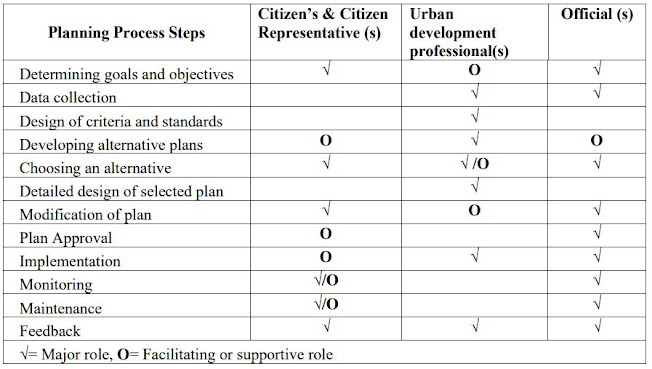
Taking into account the interest, attitude and behaviour of the people, role of urban development professionals and obligations of local authority, a system of participatory plan approach has been suggested. 

The suggested indirect participation of the people is ensured through elected representatives in the Municipal Council / Corporation and Ward committees. The direct participation can be through individuals, citizens, neighbourhood, business, consumer and other such groups. There are several mechanisms and avenues for people’s participation available today, few of these have been presented below. Such mechanisms and avenues can be used to bring wider and more interactive participation of public in planning and developmental process.

Participatory planning approach

1) Community Design Characteristics 

It is a multiple day interactive meetings, workshops and site walks/visits that fosters diverse and community sourced ideas. 

2) Advisory Committees 

Committees made up of representatives guide planning efforts over an extended period of time while regularly meeting during the planning process. 

3) Low cost Demonstrations and Transformations 

Use of blocks and day to day objects to create a low cost model of proposals for visual understanding. Relatively inexpensive temporary transformations are made to test the project and experience changes.

4) Focus Groups 

Allow small groups of stakeholders to provide their knowledge of a project area and discuss their concerns and issues with local authority staff, planning consultants etc. 

5) Other 

Citizens report card, participatory mapping and participatory budgeting etc. 
People can make contributions to the planning process at the implementation stage only if they are presented with a well-articulated and feasible framework of approaches, objectives, alternatives, etc. The participation of the people in local development programme provides the best guarantee that adequate action will be taken in the area itself. Public participation also creates an awareness of the problem and possible solutions among the people and thereby equip them as citizens to exercise choices relevant to development in a rational manner. When such a participation is institutionalized a stable base is created for decentralized exercise of power both on territorial as well as functional bases.
People’s participation has acquired greater significance in a country like ours which is striving hard since independence to bring an overall socio-economic change through democratic  processes. Community development and Panchayati Raj were aimed at securing people’s participation in the planning and execution of the programme as a vital aspect of community development. To expand the democratic basis of development policies and administrative actions public cooperation has assumed great significance. Public cooperation is sought in almost each phase of governance and the entire multifaceted development of the people m the various fields, viz., social, economic, educational, cultural and moral. Involvement and sharing of the people in the process of development, particularly m decision making, planning and implementation is in the interest of good government and good administration
In a democratic society participation gives the ordinary citizen a means of voicing his opinion and of showing by his behaviour and action that he is able to take on responsibilities. It gives the ordinary citizen a chance to show his willingness to carry out constructive public work and to demonstrate his good citizenship by other means than periodically exercising his right to vote. Participation involves a factor of determination on the part of the person participating. It is in the sense participation means self-motion. People’s participation or involvement can be better understood in four senses:Participation in decision making 
  • Participation m implementation of development programme and projects 
  • Participation m monitoring and evaluation of development programmes and projects 
  • Participation in sharing the benefits of development principles 
Public participation is the involvement of people in the creation and management of their built and natural environments. Its strength is that it cuts across tradition professional boundaries and cultures. The activity of community participation is based on the principle that the built and natural environments work better if citizens are active and involved in its creation and management instead of being treated as passive consumers. The main purposes of participation  are :
To involve citizens in planning and design decision making processes and, as a result, make it more likely they will work within established systems when seeking solutions to problems 
  • To provide citizens with a voice in planning and decision making in order to improve plans, decisions, service delivery and overall quality of the environment 
  • To promote a sense of community by bringing together people who share common goals 
Participation should be active and directed, those who become involved should experience a sense of achievement. Traditional planning procedures should be re-examined to ensure that participation achieves more than a simple affirmation of the designers or planners intentions.