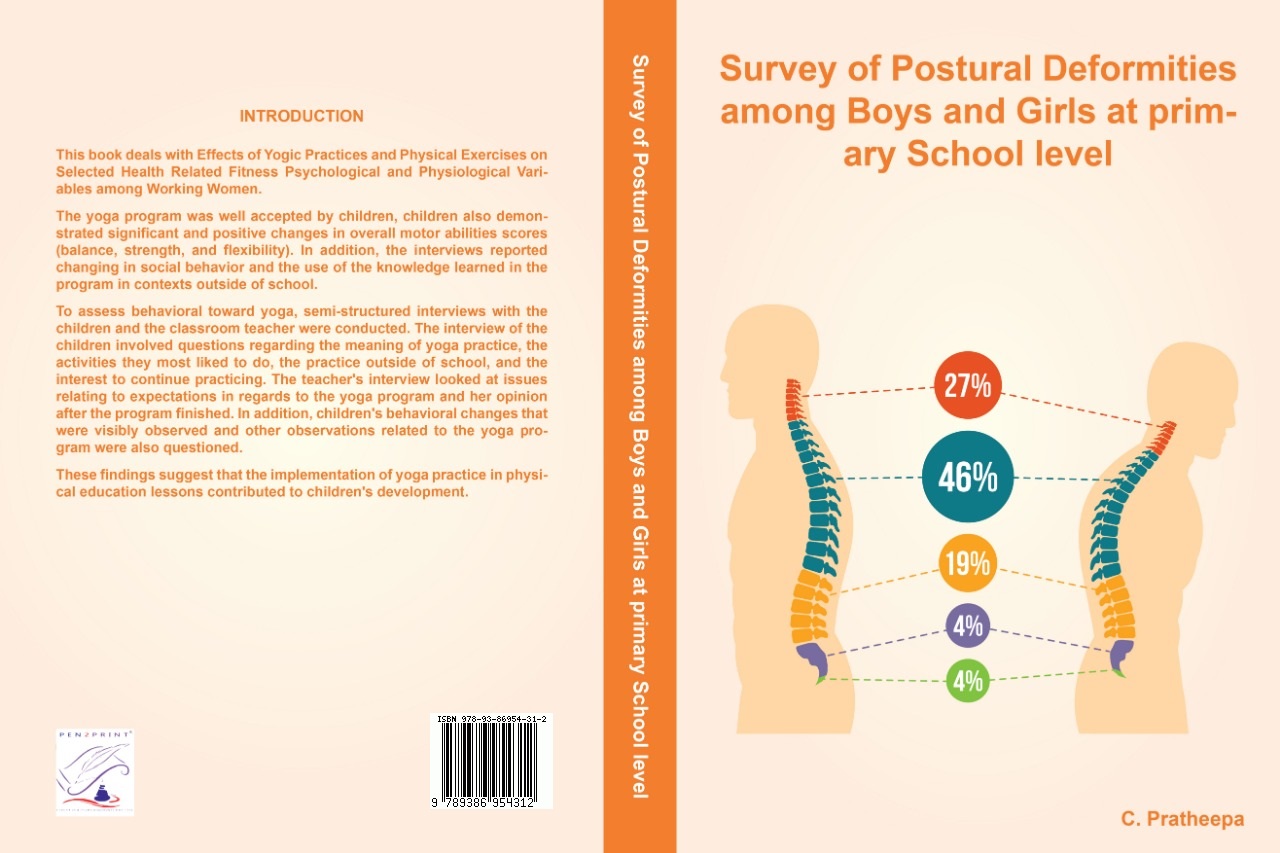
Survey of Postural Deformities among Boys and Girls at Primary School Level

The aim of the study was to identify the spine deformities and postural disorder in the monitored children and to point out the importance of children’s backbone and posture screening. Early identification of disorders, correct diagnosis, and determination of the cause of these diseases play an important role in preventing further progression 
Postural deformities are a commonly encountered problem among children. Most of the aches and pains of adults are the result, not of injuries, but of the long-term effects of distortions in posture or alignment that have their origins in childhood or adolescence. Television, video entertainment, motorized transportation, fast food and lack of regular physical activity contribute to the poor physical condition of children. Childhood obesity has increased dramatically in the past decade. Countries in economic transition from underdeveloped to developed, such as India, are particularly affected and have an increasing prevalence of obesity across all economic levels and age groups. In a developing country like India, where overweight/obesity co-exists with undernutrition, there is an urgent need to prevent unhealthy trends in diet and physical activity. 
This means that scoliosis is as prevalent as hypertension or diabetes mellitus. Identification of postural deformities at an early stage makes early treatment possible, which may, in future, prevent serious postural abnormalities. The aim of this review article is to define the concept of good posture, analyze normal postural development and postural deformities, and discuss some of the developmental factors affecting posture.

Call for Book Chapters- Research Trends in English Language and Literature

Edupedia Publications Pvt Ltd is proud to announce Call for Book Chapters for our forthcoming book titled Research Trends in English Language and Literature with ISBN no.
978-93-86954-37-4

This new title is an in-depth and accessible guide for Standard and Higher Level students of the new Language and Literature syllabus for the high schools. This lively, well-structured course book is available in both print and e-book formats and includes: key concepts in studying language and literature; text extracts from World literature (in English and in translation); international media and language sources; a wide variety of activities to build skills; materials for exam preparation; guidance on assessment; Theory of Knowledge links; and Extended essay opportunities.

Call for Book Chapters- Research Trends in English Language and Literature
Our English language and literature books, online and digital resources provide different learning methods, encouraging students to find a method that suits them, enabling them to build their confidence and perform at their best.

Features of Book

  • Address all aspects of the new English Language and Literature guide, with in-depth coverage of the new course structure and content, including the Areas of Exploration, global concerns, concepts and conceptual questions
  • Develop learners\’ understanding of the nuances of different text types, and the possibilities for connections across the syllabus, via engaging explanations, extracts and activities
  • Encourage reflection, inquiry and critical thinking through integrated support for Theory of Knowledge and Approaches to Learning, plus expert guidance on developing the new learner portfolio
  • Thoroughly prepare students for assessment via overviews of the written components, exam-style practice questions, and support for the new Internal Assessment
  • This Language and Literature Course Book is available in print, online and as a print and online pack, with additional teacher support materials provided via a free website 
  •  
  • How to Contribute Book Chapters  

    Send book chapters for this book to editor@pen2print.org 

Subsidy under the Amended Technology Upgradation Fund Scheme (A-TUFS)

The
Office of Textile Commissioner has been providing subsidy under the
Amended Technology Upgradation Fund Scheme (A-TUFS) to the investors
(including the State of Assam) and is also processing new proposals for
availing subsidy for upgradation of machines from the investors.
In
the Mega Handloom Cluster at Sivasagar in the State of Assam, private
investments are encouraged in projects which are sanctioned in the PPP
mode in 80:20 ratio, wherein Government provides 80% funding and 20%
funding is done by the investor, i.e. Special Purpose Vehicle (SPV),
which also provides the land for the project. Since 2017, Govt. of India
has released Rs. 6.91 crores for such projects in Assam with the
investor participation at Rs. 1.91 Crores. The
Office of Development Commissioner (Handicrafts) has taken up 39
clusters under AmbedkarHastshilpVikasYojna (AHVY) for the overall
development of artisans in Assam which has benefitted 4970 artisans
during the last two years.
Following two composite jute mills are enlisted in the State of Assam:
S. No.
Name of the Jute Mill
Address of the Mill
1
Assam Co-operative Jute Mills Ltd.
P.O. Silighat-782143, District- Nagaon, Assam
2
Atlanta Modular Pvt. Ltd.
NH-37, BihandNezone Tubes, West Boragaon, Guwahati, Assam.
                       
Under
North East Region Textile Promotion Scheme (NERTPS), a proposal to
establish two Eri Spun Silk Mills in Assam and Bodoland Territorial
Council (BTC) under Government Sector has been approved during 2018-19.
The Government has set up a Board for Industrial & Financial
Reconstruction (BIFR) under Sick Industrial Companies (Special
Provisions) Act with a view to timely detect sick and potentially sick
companies and for taking remedial measures.
Under
NERTPS Govt. of India, through Central Silk Board have taken measures
to increase silk production in Assam by implementing sericulture
projects in four categories viz., Integrated Sericulture Development
Project (ISDP) and Intensive Bivoltine Sericulture Development Project
(IBSDP), Eri Spun Silk Mills (ESSM) and Aspirational District (AD).  The
details of funds sectioned and released is given below:
[Rs. in crore]
Project Name
Project Cost
GoI share
Funds released Till June-19
ISDP
186.99
153.17
113.06
IBSDP
59.61
53.03
50.37
ESSP
43.06
38.18
AD
41.31
38.19
Total
330.96
282.56
163.43
A
Regional office at Guwahati is functioning to monitor the Central
Sector schemes and to address the issues related to development of
sericulture in NE region in association with the all NE States.
As
on date, no proposal to grant special packages to the Assam Cooperative
Jute Mills Ltd., Silghat, Nagaon (Assam) is under consideration.
However, preferential treatment is given in allocation of Production cum
Supply Orders (PCSOs) as per its capacity under the Jute Packaging
Materials (Compulsory Use in Packing Commodities) [JPM Act], 1987
because of its disadvantageous geographical location and limited options
for local markets.

Mega handloom cluster under Comprehensive Handloom Development Scheme

Mega
handloom cluster is taken up under Comprehensive Handloom Development
Scheme as announced by the Union Finance Minister in the respective
budget with  the financial provision. At present, there is no proposal
for inclusion of Balaramapuram in Thiruvananthapuram district of Kerala
under Comprehensive Handloom Development Scheme.


Details
of assistance provided to the weavers in Thiruvananthapuram   under
various schemes implemented by Government of India since 2014-15 are as
under:
  1. 22 Mudra loans with amount of Rs 9.00 lakh sanctioned and disbursed to the Handloom weavers.
  1. Under
    National Handloom Development Programme, one Block Level Cluster with
    total cost of Rs 185.169 lakh consisting Government of India share of Rs
    179.599 lakh sanctioned in Kollaylin covering 500 weavers.
  1. 6.736 lakh kg of yarn worth Rs 21.52 crore has been supplied to the handloom weavers of Balaramapuram at Mill gate price.
  1. Balaramapuram Saree has been registered under Geographical Indication Act.
  1. Balaramapuram
    Saree and Balaramapur Dhoti have been registered under product list of
    India Handloom Brand (IHB).  28 agencies for Balaramapuram Sarees and 30
    agencies for Balaramapuram Dhoti have been registered for production
    under IHB.
Three Block Level Clusters have been sanctioned in Gujarat under National Handloom Development Programme:
(Rs. in lakh)
Sl. No
Name of the Block/District
Total Project cost
Government of India share
Beneficiaries covered
1
Bhachau, Kutch
133.640
131.740
65
2
Wadhwan, Surendranagar
170.550
165.685
206
3
Lakhtar, Surendranagar
143.410
140.961
86
Total
447.600
438.386
357
This information was given by the Union Minister of Textiles, Smriti Zubin Irani, in a written reply in the Lok Sabha today.

Sericulture Farmers in Kolar

An
exclusive Cluster Development Project covering around 3500 farmers is
under implementation in Kolar Districtfor the development of Bivoltine
sericulture.Besides,Central Silk Board (CSB) is implementinga Central
Sector Scheme (CSS) viz. Silk Samagra “Integrated Scheme for Development
of Silk Industry (ISDSI)” for development of silk industry in the
country including Karnataka with a total outlay of Rs. 2161.68 crore for
the period of three years (2017-20).

Under
the scheme, assistance is extended to sericulture farmers for raising
of Kissan Nursery, plantation with improved incubation facility,
construction of rearing houses, rearing equipment, door to door service
agents for disinfection and input supply, support for improved reeling
units like automatic reeling units, multi-end reeling machines, improved
twisting machines and support for post yarn facilities for qualify silk
and fabric production. The State Governmentcan avail the support under
Silk Samagrafor development of sericulture in Karnataka including Kolar
district.
This information was given by the Union Minister of Textiles, Smriti Zubin Irani, in a written reply in the Lok Sabha today.

Ministry of mines organises a workshop on Effective utilization of Red Mud

In a step towards productive utilisation of bauxite residue, commonly known as the ‘Red Mud’, an interactive workshopcalled ‘Waste To Wealth’
was organized by Ministry of Mines in the capital today. The present
status regarding the generation of Red Mud and its safe disposal and
utilization were discussed. The workshop, which was presided over by Dr
K. Rajeswara Rao, Additional Secretary, Ministry of Mines,was organised
in association with theJawaharlal Nehru Aluminium Research Development
and Design Centre (JNARDDC) Nagpur.
Red
Mud is a solid waste generated during the aluminium production process.
This is an environmental concern due to presence of impurities such as
caustic soda and others minerals. Global generation of red mud is more
than 150 million tons and there exists a global inventory of more than 3
billion tons. Red mud generation in India is around 9 million tons per
year.
The
meet was widely attended by representatives from organisations like
Ministry of Environment and Climate Change, CPCB, Odisha state Pollution
Control Board, BARC, Indian Bureau of Mines, Ministry of Road
Transport, NHAI and BIS, Engineer-in-Chief of Army, top executives from
all three primary aluminium producing companies viz- NALCO, VEDANTA
& HINDALCO as well as from user industries like cement and ceramic
industry. Interacting with the stakeholders, Mr. Anil Mukim, Secretary,
Ministry of Mines asked all the stake holders to work in synergy to find
a lasting solution for productive utilisation of red mud.
The
day long deliberations were held to focus all efforts for effective
bulk utilization of red mud with necessary government support, which
will be a win-win situation for all the stakeholders. Based on the
deliberations, a roadmap will be prepared for the productive utilization
of red mud.

Integrated Scheme for Development of Silk Industry

Under
the Central Sector Scheme Silk Samagra an Integrated Scheme for
Development of Silk Industry (ISDSI) implemented by Government of India
through Central Silk Board (CSB) with a total outlay of Rs. 2161.68
crore for three years (2017-18 to 2019-20) for the overall development
of silk industry in the Country with an objective to scale up production
by improving the quality and productivity.  The scheme comprises four
major components viz. (i) Research & Development, Training, Transfer
of Technology and Information Technology Initiatives, (ii) Seed
Organizations, (iii) Coordination and Market Development and (iv)
Quality Certification Systems (QCS) / Export Brand Promotion and
Technology Up-gradation.
Features of the Scheme  
All
the four major components of Silk Samagra are interlinked with each
other and aimed at a common goal. The main objective of the scheme is to
maintain Breeders stock, Breed improvement through R&D Projects,
Development of mechanized practices, Technology translation through
Sericulture Information Linkages and Knowledge System (SILKS) Portal,
Mobile Application for Stakeholders and for seed quality monitoring,
develop technology packages, impart training on improved technology
programmes to Stakeholders, and transfer technology to the field through
front line demonstration, produce Basic & Commercial Seed of the
improved Silkworm breeds developed by the Research Institutes, encourage
Private Partnership  in Seed sector, and Maintain & Certify the
quality standards set by the R&D units for Silkworm Seed, Cocoon,
Raw Silk and Silk products covering the entire Silk value chain.
Major Interventions:
1.
Research & Development: Race improvement through development of
improved host plant varieties and improved disease resistant Silkworm
breeds through collaborative research with reputed National Research
organizations like IITs, CSIR, IISc and International research
institutes on Sericulture.
     
2.
Seed organisation: Seed production units will be strengthened to bring
in quality standards in production network, besides increasing the
production capacity to cater to the increased silk production target,
promote adopted seed rearers to generate quality seed cocoons, Private
Graineurs to produce quality seed and Chawki Rearing Centres (CRCs) with
Incubation facilities to produce and supply chawki worms,     
3.
Quality Certification /Brand Promotion: Promote Indian silk through
quality certification by Silk Mark not only in the domestic market but
also in the Export market. Besides, emphasis has been given for use of
Silkworm by-products (pupa) for Poultry feed, Sericin for Cosmetic
Applications and Product Diversification into non-woven fabrics, Silk
Denim, Silk Knit etc. for value addition.
                          
The
scheme also comprises of various beneficiary oriented components to
support Mulberry, Vanya and Post Cocoon Sectors. These interventions
cover the major areas viz. (a) Development and expansion of host plant,
(b) Strengthening and creation of Silkworm seed Multiplication
infrastructure, (c) Development of farm and post-cocoon infrastructure,
(d) Up-gradation of reeling and processing technologies in Silk, and (e)
Capacity Building through Skill development / Enterprise Development
Programme. 
The
above scheme interventions are expected to increase /improve the
production and productivity of silk. The details of expected outcome of
the scheme are as under:
      • Increase the Silk production from the level of 30,348 MTs (Metric Tonne) during 2016-    17 to 38,500 MTs by end of 2019-20,

      • Increase the production of Bivoltine Import Substitute Silk to 8500 MTs from 5266          MTs in 2016-17

      • Increasing Vanya Raw Silk production to 11,500 MTs from 9075 in 2016-17 MTs.

      • To produce International Grade Silk of 4A and above to minimize the import to bare  minimum.

      • To
        generate additional employment to about 15 lakh person by reaching 100
        lakh persons by end of March,2020 from the level of 85.10 lakh persons
        in 2016-17.