Mobile Phones and Its Evolution

Introduction

A
mobile 
phone is a portable mode of telephone that can make and receive calls.
What makes it different from telephone is its wireless mode of communication as
it allows the user to move while communicating.  
Phones have come a long way since Bell made the first call. Now we have
cellphones which need no wires. The early cellphones were bulky, hard to use
and could do only calling. However with evolution of technology, we have now
camera, music and even internet in mobiles. While the radiations from mobile
have not been proved to be substantially harmful, judicious use of mobiles is
only wise.

The First Phone

 The first
cellular mobile [1] that came in practice was invented in 1980s by Motorola.
This device was named Motorola DynaTAC 8000X. it was the first commercialized
phone that was developed by efforts begun at Bell Labs, which first proposed
the idea of a cellular system in 1947. A series of phone was manufactured in US
from 1983 to 1994 under the name in United States of America. It was first
introduced in market on September 21, 1983.
It was having normal feature of receiving and
sending messages but it was a revolution then as it took communication to a new
height. Undoubtedly it was a revolution then as it changes the concept of
interaction accelerating development at an amazing scale.  Early Cellular phones used analog CDMA technology.
The first commercially available handheld cellular
phone, Motorola DynaTAC 8000x, which hit the market in 1983 weighed in at 2
pounds. It was priced at $3,995 and offered a half-hour of talk per batter
charge.

2G, GSM, mobile internet

CDMA technique of mobile continued its regime for
almost a decade and was later replaced by Global System for Mobile
Communications (GSM) in original termed as Group Special Mobile). It was the forerunner
of the mobile data bloom. It made its first debut in Finland and termed as 2G
network [2].
Phones like the 5110 and 3300 from NOKIA became
iconic and dominated the market during 1992. Till 90s Nokia was supreme leader
in the market. Primarily internet service was availed via GPRS (General Packet
Radio Service) and moving to the faster EDGE (Enhanced Data rates for GSM
Evolution, or EGPRS).

Camera phone

Cell phone later introduced a special feature in
2000 having tiny 0.11-0.35 megapixel resolutions cameras fitted in back cover
of the mobile. In India, the earliest camera phone was the Nokia 7650.

Bluetooth, WiFi

Bluetooth was another unique feature that is still popular.
With the help of Bluetooth user can send receive text and files, photos and videos?
There is no wire needed; only devices must interconnect across short distance.
The first Bluetooth-enabled phone became available in 2000 was Ericsson T36.

3G

 3G is termed
as the third-generation of mobile phone technology standards. The main service
that 3G is associated with wireless voice telephony and broadband wireless
data, all in a mobile environment. Initially introduced in japan, in 2001 [3],
it- is very fast, efficient mobile network. 
With its varying level of speed it allowed addition of numerous applications
on mobile phone making it multitasking device.
 For example,
using 2g to download a 10 MB video or song takes usually 10 to 12 minutes but
with 3G it can be done in a minute. This made the cellphone a utility device.

 Android

It’s an operating system owned by Google and came
into existence in 2005. It runs on majority of phone these days with its
upgraded version. The first Android touchscreen device (G1) came out in 2008
for the US market. It is the modified version of Linux [4].

4G or LTE

The first 4G network, made its début in 2009 in
Sweden based on the LTE standard. Airtel, a cellular company introduced 4G
network in India. 4g relies heavily on internet as most Indian have their
strong focus on music, video and social media.

The Present of Cellular Phones

Cellular phone is now the part and partial of our life.
With upcoming features and high focus on internet availability, gave a massive
boost to mobile usage. From android phone to I phone, the significant change in
cellphones has made it a strong utility device. From keypad to smartphone,
people have witnessed a considerable change in, appearance and efficacy of cell
phones.

The Criticism

Cellular phones work on high
frequency radio waves, which essentially are radiations. These radiations are
non-ionizing. And though it has not been substantially proved, the radiations
of mobile phones have been blamed to cause many diseases including cancer.
While these claims can be neither
accepted nor rejected [5], it is wise to use mobile phones
carefully. Avoid unnecessary usage, keep it at safe distance from body, use
hands-free whenever possible- are some best practices of cellphone use.

PM pays tributes to former External Affairs Minister Sushma Swaraj

Prime
Minister Shri Narendra Modi paid tributes to former External Affairs
Minister Sushma Swaraj, at her residence in New Delhi today.

Expressing
condolence over her demise, Prime Minister said, “A glorious chapter in
Indian politics comes to an end. India grieves the demise of a
remarkable leader who devoted her life to public service and bettering
lives of the poor. Sushma Swaraj Ji was one of her kind, who was a
source of inspiration for crores of people.
Sushma
Ji was a prolific orator and outstanding Parliamentarian. She was
admired and revered across party lines. She was uncompromising when it
came to matters of ideology and interests of the BJP, whose growth she
immensely contributed to.
An
excellent administrator, Sushma Ji set high standards in every Ministry
she handled. She played a key role in bettering India’s ties with
various nations. As a Minister we also saw her compassionate side,
helping fellow Indians who were in distress in any part of the world.
I
can’t forget the manner in which Sushma Ji worked tirelessly as EAM in
the last 5 years. Even when her health was not good, she would do
everything possible to do justice to her work and remain up to date with
matters of her Ministry. The spirit and commitment was unparalleled.
Sushma
Ji’s demise is a personal loss. She will be remembered fondly for
everything that she’s done for India. My thoughts are with her family,
supporters and admirers in this very unfortunate hour. Om Shanti”.
Former External Affairs Minister Ms. Sushma Swaraj passed away last night in New Delhi.

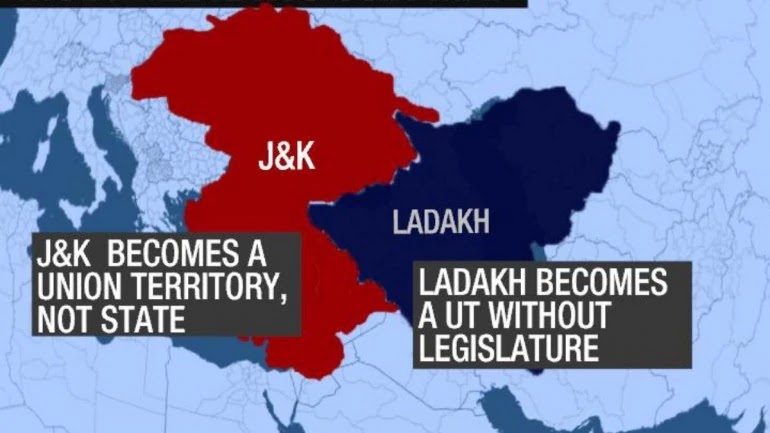
Passing of the landmark Bills on Jammu and Kashmir a momentous occasion in Parliamentary Democracy

Prime
Minister Narendra Modi today welcomed the passing of bills pertaining
to Jammu and Kashmir as “a momentous occasion in our Parliamentary
democracy”.
In
a series of tweets Prime Minister was hopeful that “Together we shall
rise and together we fulfil the dreams of 130 Crore Indians!”
He Said, “I salute my sisters and brothers of Jammu, Kashmir and Ladakh for their courage and resilience.”
The
Prime Minister further said “For years, vested interest groups who
believed in emotional blackmail never cared for people’s empowerment.
J&K is now free from their shackles. A new dawn, better tomorrow
awaits!”

Mr
Narendra Modi said, “The Bills pertaining to Jammu, Kashmir and Ladakh
will ensure integration and empowerment. These steps will bring the
youth into the mainstream and give them innumerable opportunities to
showcase their skills and talents. Local infrastructure will
significantly improve.”
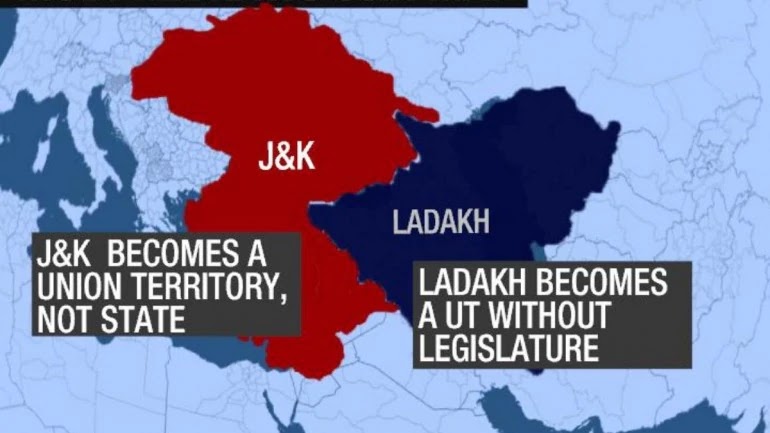
He
specially congratulated the people of Ladakh. “It is a matter of great
joy that their long-standing demand of being declared a Union Territory
has been fulfilled. This decision will give impetus to the overall
prosperity of the region and ensure better developmental facilities” he
said.
The
Prime Minister said, “The passage of key Bills pertaining to Jammu,
Kashmir and Ladakh are a fitting tribute to the great Sardar Patel, who
worked for India’s unity, Dr.BabasahebAmbedkar, whose views are well
known and Dr. SP Mookerjee who devoted his life for India’s unity and
integrity.”
He
said, “In Parliament, political parties rose to the occasion, overcame
ideological differences and took part in a rich debate that increased
the pride of our Parliamentary democracy. For that, I congratulate all
MPs, various political parties and their leaders.”
The
prime minister in a separate tweet said “People of Jammu, Kashmir and
Ladakh would be proud that MPs overcame differences and discussed the
future of these regions as well as ensuring peace, progress and
prosperity there. The widespread support can be clearly seen in the
final numbers, 125:61 in RS and 370:70 in LS.”
He
said, “India’s Vice President and Chairman of the Rajya Sabha, M
Venkaiah Naidu Garu as well as Speaker Om Birla Kota Ji conducted
proceedings of both Houses in an excellent manner, for which they
deserve praise from the entire nation.“
He
specially congratulated Home Minister Amit Shah. “Our Home Minister
Amit Shah Ji has been continuously working towards ensuring a better
life for the people of Jammu, Kashmir and Ladakh. His commitment and
diligence is clearly visible in the passage of these Bills. I would like
to specially congratulate Amit Bhai!”

WCD Minister to Felicitate States and Districts under BBBP Scheme in New Delhi

The
Union Ministry of Women and Child Developments organizing a
felicitation and award function for those Districts and States who have
successfully implemented the Beti Bachao Beti Padhao (BBBP)scheme in the country. The function will be held on 7thAugust, 2019 in New Delhi.

The
objective of the programme is to felicitate States and Districts which
are performing well in improving Sex Ratio at Birth as per Health
Management Information System (HMIS) of Ministry of Health and Family
Welfare data and excellent performance in awareness generation and
outreach.Union Ministerof Women and Child Development, Smriti Zubin
Irani will grace the occasion as chief guest and Minister of State,
Debasree Chaudhuri,will be guest of honour at the event.
The BBBP scheme launched on 22ndJanuary,
2015 has been implemented in phases. Currently, it is being implemented
in 640 districts (as per census 2011). All 640 districts are covered
through advocacy and media campaign. Moreover, out of these 640
districts, 405 districts are covered under Multi- Sectoral Intervention
in which 100% Centrally Sponsored Schemes grant is provided directly to
DM/DC for BBBP.
On
this occasion,Union Minister of WCD will be felicitating Principal
Secretaries/ Commissioners of the 5 States and District
Magistrates/Deputy Commissioners of 10 Districts (covering 9 States)
forconsistent improvement inSex Ratio at Birth. District
Magistrates/Deputy Commissioners of 10additional districts (covering 8
States)will also be felicitated for outstanding performance under
awareness generation and outreach activities.
Another
important activity on the occasion will be aslide show of innovations
by States/ Districts under Beti Bachao Beti Padhao followed by short
videos of innovative interventions undertaken by the winning States and
Districts.
The
latest reports on State/UT-wise Sex Ratio at Birth data for the period
2014-15 and 2018-19, reveal that SRB increased from 918 to 931 showing
improving trends at the national level.

PMAY(U) Awards for Beneficiaries instituted

Ministry of Housing & Urban Affairs has instituted PMAY(U) Awards for Beneficiariesfor
the first time to recognise the contribution of States/UTs, Urban Local
Bodies and Beneficiaries. This special award for beneficiaries is
likely to enthuse the States / UTs to fulfil the dream of house for
millions, a reality, and also encourage beneficiaries to build their
house aesthetically using sustainable methods. The winners will be
awarded during a National level Event. The procedure of selection for
these awards has been made transparent by linking it with the progress
being uploaded in MIS system by States/UTs.  This award is in addition
to CLSS Award for recognising the contribution of PMAY (U) Banks and
Housing Finance Companies.

The
Pradhan MantriAwasYojana(Urban)- PMAY(U)- Mission has achieved a
significant milestone of approving more than85 Lakh houses against a
demand of about 112 Lakh houses in urban areas. Out of these, around 50
Lakh houses are at various stages of construction and more than 26 Lakh
houses have already been completed.
The
highlight of the PMAY(U) awards is that it will also recognise and
reward the selected beneficiaries from each State/UT under
‘Beneficiary-led Construction’ component for building their house in a
most aesthetic and innovative manner. To facilitate this, a PMAY(U)
mobile application was launched by ShriHardeep S Puri, Minister of State
(I/C)for Housing and Urban Affairs,in February this year for direct
interface of beneficiaries with the PMAY(U) mission.The mobile app has
been designed for beneficiaries to upload high-resolution photographs
and videos clips highlighting their success stories of owning a house
under PMAY (U). These stories are an emotional recount of experiences
such as increased self-esteem, social upliftment, sense of pride and
dignity, safety and security for the family, protected environment for
girl child and children’s education. The mobile app has marked its reach
to more than 50 thousand beneficiaries so far across all States/ UTs.
The last date to participate in the Awards is 20th August ‘2019.

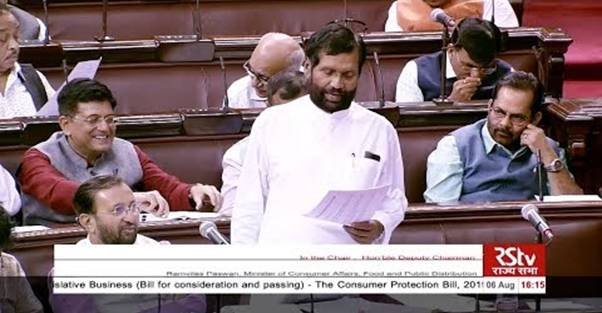
Landmark Consumer Protection Bill, 2019 gets Parliamentary approval

The
Parliament today gave its nod to the landmark Consumer Protection Bill,
2019 which aims to protect the rights of consumers by establishing
authorities for timely and effective administration and settlement of
consumers’ dispute. The Bill was passed by the Lok Sabha on 30th
July, 2019 and was passed by Rajya Sabha today through a voice vote.
The Bill will replace the more than three decades old Consumer
Protection Act, 1986.
Moving
the bill for consideration and passing in Rajya Sabha, Union Minister
of Consumer Affairs, Food and Public Distribution Shri Ramvilas Paswan
said that the new legislation would ease the overall process of consumer
grievance redressal. Shri Paswan said that this new bill will provide a
better mechanism to dispose consumer complaints in a speedy manner and
will help in disposal of large number of pending cases in consumer
courts across the nation. Shri Paswan stated that this bill was a long
pending legislation and all the recommendations of the Parliamentary
Standing Committee were incorporated in the bill except for five
recommendations.  Shri Paswan also assured all the members of Parliament
that their suggestions would be incorporated in the rules to the extent
possible within the legal framework.
The
bill, among other things, proposes setting up of a Central Consumer
Protection Authority (CCPA) to promote, protect and enforce the rights
of consumers as a class. The CCPA would make interventions to prevent
consumer detriment arising from unfair trade practices. The agency can
also initiate class action, including enforcing recall, refund and
return of products.
The
Bill also envisages simplified dispute resolution process, has
provision for Mediation and e-filing of cases.  The Consumer will be
able to file cases in the nearest commission under the jurisdiction of
which he resides.
For
the first time there will be an exclusive law dealing with Product
Liability. A manufacturer or product service provider or product seller
will now be responsible to compensate for injury or damage caused by
defective product or deficiency in services.
Additional
swift executive remedies are proposed in the bill through CCPA. There
are provisions for deterrent punishment to check misleading
advertisements and adulteration of products. Product liability provision
to deter manufacturers and service providers from delivering defective
products or deficient services. The Bill also enables regulations to be
notified on E-commerce and direct selling with focus on protection of
interest of consumers.

Parliament approves Resolution to repeal Article 370; paves way to truly integrate J&K with Indian Union

Union
Minister for Home Affairs, Shri Amit Shah, introduced two bills and two
resolutions regarding Jammu & Kashmir (J&K) in Lok Sabha today.
These are as follows:
  1. Constitution
    (Application to Jammu & Kashmir) Order, 2019 {Ref. Article 370(1)
    of Constitution of India} – issued by President of India to supersede
    the 1954 order related to Article 370.
  2. Resolution for Repeal of Article 370 of the Constitution of India {Ref. Article 370 (3)}
  3. Jammu & Kashmir (Reorganisation) Bill, 2019 {Ref. Article 3 of Constitution of India}
  4. Jammu & Kashmir Reservation (2nd
    Amendment) Bill, 2019 {Home Minister withdrew the Bill from both Houses
    as the provisions of this act would become applicable to J&K once
    article 370 gets repealed and the laws of Union of India become
    applicable there

Article
370(3) provides President of India has the powers to amend or repeal
the article by issuing a notification, based on a recommendation of
Constituent Assembly of J&K. President of India signed the
Constitution Order
2019
yesterday regarding Article 370(1), under which all the provision under
article 4 would be applicable to J&K. J&K constituent assembly
would be read as J&K Legislative Assembly. Similar changes to
article 370 have been done in the past as well.Now since President’s
rule is in force in the state, implementation of article 370 would cease
to exist when President of India issues the notification in this
regard, after this House passes the resolution.
Replying
to the debate, Shri Shah stated,”I want to state that J&K is an
inalienable part of India. There are no two versions about
that”.Parliament is the highest and fully competent bodyto make laws and
bring resolutions regarding a state of India including J&K. There
can be no question to this power of the Parliament. Shri Shah said that
for 70 years, people of India have harboured this aspiration in their
hearts that Kashmir must be an integral part of India. Article 370 was
the only roadblock to realize this goal. Home Minister thanked the Prime
Minister for this historic step to remove this roadblock for ever.
Leader
of Main Opposition Party in Lok Sabha raised the issue of how the
Centre can take this step unilaterally when Kashmir is a bilateral issue
between India and Pakistan and when the matter is pending in UN.
To this, Shri Shah retaliated and challenged the opposition that they
must clarify their stand on the floor of the House whether they support
UN meditation in Kashmir.The opposition in a way has questioned the
competence of the Parliament by raising this point, he stated.
Shri
Shah asked the members, “How can patriots of India who can sacrifice
their lives for the country not get perturbed by such a question?”In
India, things do not function on whims and fancies but on laws. I am
always ready for constructive discussion but never for destructive
debate, he added.
Speaking
on the applicability of United Nations charter on India and Pakistan to
J&K, Shri Shah said thatunder this charter, neither armed forces
would violate the territorial integrity of other country. The day in
1965
Pakistan violated this provision, the charter was violated. The
question of a referendum ended with the Pakistani aggression. Hence, the
Government of India has full rights to take any decision regarding its
territorial integrity. This was even agreed to by the UN, Home Minister
added.
Shri Shah reminded the opposition and asked who took Kashmir matter to UN and who brought a unilateral cease fire in 1948? “Had our forces given a free hand to deal with the situation, PoK would have been a part of India today”, he stated.
Introducing
the resolutions and bills on the floor of the House, Shri Shah said
that the House has been witness to many historical moments. Today once
again this House is witness to a golden day when we are going to bring
J&K truely into India’s fold.Now, local representatives would have a
voice in the hill councils. The governments would be democratically
elected and would run the local government and administration in
J&K.
Several
members have raised the apprehension about the period for which the
Union Territory status will continue for J&K. Shri Shah saidthat
regarding Ladakh, it wasa long standing demand. Further he said, “I want
to assure the people of J&K that the status of State would be
restored once the situation normalises. Secondly, PoK and Aksai Chin are
an inalienable part of JK and the seats are still part of the
legislature.J&K would have a Legislative Assembly with elected
representatives and it is a misnomer that the administration would be
run by the Centre, he assured the House.
Home
Minister explained the difference between articles 370 and 371. Article
370 was originally a temporary provision. He informed that because of
article 370, the laws of Union of India did not apply to J&K,
corruption and terrorism flourished there. Article 371 relates to
special provisions to special clauses favouring development to backward
regions in some states. Why would the Government repeal article 371 and
why is the opposition equating articles 370 and 371, he asked. Home
Minister assured the people of these states that this Government has no
intention of repealing article 371.Further, Shri Shah also classified
that Naga Accord and article 370 have no relation and no mistake
committed in the past would not be repeated by this Government.
Regarding
troop deployment and no internet facilities in J&K currently, Shri
Shah assured that there is no reason other than preventing some
nefarious elements from instigating violence in the State and no one can
stop the government to take precautionary measures to protect the peace
inside the country. He made it clear that the government would never
talk with separatist elements and those who back cross border terrorism.
The government would only talk with anyone once they are committed for
peace and development in J&K.
Taking
on the opposition about the division of erstwhile state of Andhra
Pradesh, the Home Minister said that the proposal was rejected by the
State Assembly by two-thirds majority. Even then the earlier Government
went ahead with the division without consulting all political parties.
Removing
article 370 has no communal agenda as a number of communities and
religious groups are resident of J&K that are affected equally.
Article 370 has perpetuated discrimination against the minorities
including Sikhs, Buddhists admin others. Further, Shri Shah said, in the
past 70 years over
41500
people have been killed. Should we continue on the same path and let
people die. Who is responsible for this state of affairs? Are not the
youth of J&K and Ladakh require development. For how long would we
deprive them only for vote bank politics. Repealing article 370 is not a
historic blunder, rather it is historic step to correct this historic
blunder. Such bold steps are not taken for vote bank but for the
betterment of people of J&K and for three Nation, Home Minister
stated.
Shri
Shah further said that those who favour article 370 are in opposition
to the Prevention of Child Marriage Act which could not be applied to
J&K due to article 370. Similarly other laws like Right to
Education, Land Accusation Act, Multiple Disability Act, Senior Citizens
act, Delimitation act, Whistle Blower Protection act, laws enacted for
empowerment of tribals, National Commission for Minorities, National
Council for Teacher Education, among others, could not be applied to
J&K.
How is this in favour of the people of JK to not apply these laws in the
state, Home Minister asked the House. The reason, he said, is simply
that after President’s rule was applied in J&K, all corruption cases
were opened and those who were at the receiving end are opposing the
repealing of article 370. Democracy was strangulated by the use of
article 370 for 70 years. Today, after this government came to power,
over
40000 panch and sarpanches are taking the democratic process forward and development has started.
Taking
on the cross border terrorism, Shri Shah stated that Pakistan has
misused the presence of article 370 to sow the seeds of separatism and
terrorism in J&K. I appeal to all those who favour article 370, to
ponder what benefits did the provision bring to the state. It only
prevented development and facilitated terrorism there. Only by repealing
this provision, we can bring the people to the mainstream and embrace
them with open arms.J&K is the heaven on earth and I assure everyone
that it would continue to remain so when all the laws of Union of India
become applicable to the state, he said.
The
Home Minister appealed to the House to once again ponder on all these
points and join hands with the Government to bring the people of J&K
in the mainstream of development.