Google Domains Review: Pros & Cons of Google As Domain Registrar

Google Domains is a domain name registrar owned and operated by
Google. Google rolled out the product in 2014, and is still in “beta” as
of 2019.
Google Domains is not my primary domain registrar (which is NameCheap). As a Googlephile and SEO consultant, I pretty much had to register a domain with Google Domains the day they started.
Here’s my experience so far and my full Google Domains review with pros & cons…

Disclosure
– I receive referral fees from companies mentioned on this website. All
data and opinion is based on my experience as a paying customer or
consultant to a paying customer.
Before we look at the pros & cons, there are a couple items to mention.
First, Google Domains is strictly a domain registrar.
They allow you to claim, register & manage domain names. They do
not offer complementary services such as hosting**. Google separately
offers email and business services through Google Apps. Google Apps does require a custom domain name to get started.
**except for Google Sites, which is a website builder that provides storage (but not hosting) via Google Drive.
We’ll explore this point more in the pros & cons, but it’s important to understand Google’s goal with Google Domains.
They want “getting online” simpler & less daunting for very small
and/or less tech-savvy businesses – that means getting these businesses a
domain name.
And even further, it means making the process of getting a domain as simple & transparent as possible.
Second,
it’s important to remember that a domain is not a website. It’s not
email – or any other service. It’s analogous to your address in the
offline world – it helps people locate where your property is. A domain
simply tells browsers/email/etc where to go to get whatever it wants
(website files, emails, images, data, etc).
If you want to setup a website, you’ll still need to get hosting or a website builder / eCommerce provider that provides hosting.
All that said – let’s look at the pros & cons of using Google Domains as your domain registrar.

Pros of Google Domains

Interface / Backend

Google Domains promises to be simple and transparent. And you’ll notice it right off with their homepage and backend design.
It’s so minimalist that it’s nearly blank.
Google Domains Interface
It
has Google’s trademark design ethos (aka – the nearly blank Google
Search page). Google Domains focuses on doing one thing and one thing
only – domains.
The design has no upsells, no cross-sells and no visual clutter. It’s
honestly refreshing contrasted to the typical direct response offers
from most domain & hosting companies.
Once you leave the site, you won’t even see striking retargeting ads.
On Facebook, you’ll see just classy reminder ads. No offers – just a
promise of simplicity and transparency.
When you need to point your domain to a host or website builder, it’s
all there in a single place. There’s literally just 3 options on the
backend sidebar.
Google Domains’ interface is a refreshing pro in an industry where
most small business owners have to put up with pop-ups, upsells and
confusing backends.

Integrations

Although Google Domains does not offer built-in complementary
products, it does integrate very well with the most common web apps.
It syncs simply with Google Apps (for email, storage, records, etc). And Google runs one of the best DNS servers (the system that tells a browser to go to a specific server to get files) on the Internet.
Google Domains Integration
In
fact, many webmasters will use Google’s DNS in place of their domain
registrar’s or hosting companies, which is a plus because it’s
integrated well with Google Domains.
A menu of (sponsored) common website builders is integrated directly in the “add website” drop down. It includes Shopify, Weebly, Wix, Blogger & Squarespace.
Google Domains Website Integrations
All this leads to the next pro of overall simplicity.

Simplicity

If you are setting up your own website with a hosting provider, pointing your nameservers is directly in the domain menu. It’s one click.
But it’s more than just one click on a clean interface – even advanced functions are simple to find and operate.
If you want to leave Google Domains – unlocking your domain is simple (something that other domain name registrars make quite difficult). Updating addresses are simple.
Google Domains Billing
Discovering
your billing history is simple. Since Google Domains uses your Google
Account, it’s easy to pay and maintain (it pulls from your email and
Google Wallet information).
Simplicity is the one thing Google Domains promises and they live up to it.

Transparent Value Pricing

Google Domains maintains a single price for each top level domain (TLD). .Coms are $12/year.
Google Domains Pricing
Their
pricing across the board is not the cheapest long or short term. They
are a couple dollars more expensive per year than NameCheap. And they
don’t do short-term discounting like GoDaddy.
However, Google Domains does bundle Privacy Protection with all their domains. NameCheap and GoDaddy both have this option as an upsell.
So although Google Domains isn’t the cheapest, they do offer a solid
total value pricing – and they are very transparent for what you’re
getting.
Google Domains Features

Selection of New TLDs

In 2014, ICANN, the internet’s governing body, allowed for a lot more top level domains
(TLDs). This introduced wide new selection into the domain name market,
which use to be limited to .com, .net, a few other generics plus
country-designated TLDs.
Now more businesses are looking for unique TLDs like .kitchen or
.academy among hundreds of others. The issue now is making sure your
domain registrar has all the ones you want to register.
Google Domains TLDs
There
is one catch – Google Domains does not have country designated TLDs.
It’s a US-only service and has only “generic” TLDs (plus the .us country TLD). If you want a .co.uk or .ie domain – you’ll be out of luck.
TLD Availability
But
as long as you’re US-only looking for a generic TLD, you’ll find solid
selection with Google Domains. Google Domains has almost all of them
that I’ve seen.

Cons of Google Domains

Pricing

Like I mentioned in the pros section, Google Domain’s pricing focuses
on simplicity and transparency. They include privacy in their pricing –
and are cheaper than most hosting companies that offer domain
registration.
However, when Google Domain’s pricing goes up against NameCheap or GoDaddy, they lose out. NameCheap’s pricing is transparent and consistently cheaper.
NameCheap also includes the first year of WHOIS Guard (privacy) for the first year free with this link.
GoDaddy is more expensive year to year than Google Domains. However, they also deeply discount domains in the first year.
If you are just trying to secure domains quickly & cheaply, then GoDaddy will be a better bet on price. NameCheap will still be the better long-term option.

Support

Google Domain’s interface & product is focused on eliminating any
possible need for customer support. That said – stuff happens. And when
stuff happens, you need support.
I’ve never had to use Google Domain’s support, however, their support
options are not best in the industry. Their contact forms are buried
and their phone support options are limited to US business hours. They
do offer off-hours chat/email.
Google Domains Support
Support isn’t necessarily a con – but it’s not really a reason to choose Google Domains.

Complementary Products

Google Domain’s focus on only domains is a pro – but it’s also a con.
And that’s because there are several products that almost always go with a domain. If you want to make your site secure with SSL, you’ll need an SSL certificate associated with the domain.
You can buy it separately from a third party, but from my experience, managing it with your domain is simpler.
I like to separate my domains and hosting, but many owners prefer
that their hosting and domains get bundled into one (even if it’s not
ideal from a performance perspective).
NameCheap has competitive hosting; GoDaddy offers alright basic hosting with domains. And most hosting companies offer domain registration (or even free domains) with hosting purchase (such as InMotion or Bluehost).
Those kind of products simply aren’t available with Google Domains.
So if you want that kind of convenience, then you’re out of luck.

Selection of Country TLDs

Although Google Domains has a wide selection of generic domains, they do not support country-level domains.
Google Domains Country TLDs
At first, I didn’t think this would be too much of an issue since it’s only available to US customer anyway.
However, if you are a US company with a country specific website, it
might be convenient to manage those domains together. You can do that
with companies like NameCheap, but not Google Domains.

Google Promise / Beta Status

The last con of using Google Domains as your domain provider is
Google itself. Right now at the end of 2018, the product is in “beta” –
or testing. And it’s been in Beta for almost 5+ years now.
And
while Google says that it’s a long-term project and a natural fit with
their other business products like Google Apps and Google App Engine –
Google also has a long history of shutting down well-known projects.
They killed Google Reader, iGoogle, Google Apps for Teams and Google
Glass. Google has gone through countless changes with their local
business product (aka Google Places, Google+ Local, Google MyBusiness,
etc) and even Google+ – their highest profile side project ever.
In other words, even though Google Domains has a lot of benefits with Google, domain names is not and never will be Google’s priority.
Google Domains will always be under threat of shutting down – even if
it’s doing well. If they did shut down – you wouldn’t lose your domain
name, but would have to transition companies on Google’s timeline.
NameCheap, GoDaddy, Hover
or other domain name registration companies only do domain name
registration. They might go out of business, but as long as they are
making money, they will never be unceremoniously shuttered.

The Google SEO Advantage / Disadvantage

Before looking at next steps, I have to touch on one bit of SEO
(search engine optimization) mythology. In the SEO world, there are 3
camps on Google products.
The first camp says that Google is inherently untrustworthy. They say
you should never use their products because they just spy on you and
are out to punish you. It’s all about tricking and outsmarting Google.
The second camp says that Google is SEO. They say you should use all
their products and do everything they say. Google will always prefer
their own products and will reward everyone that uses them. It’s all
about cooperating and sucking up to Google.
The third camp says that neither of the first two camps rely on
evidence or testing. The answer to all things SEO is “it depends.” Use
Google products that suit your business; don’t use Google products that
don’t work for you. Either way, focus on testing and doing the right
things for your customers.
I’m in the third camp. I have never seen any evidence that Google
Domains will “cleanse” or “un-blacklist” a domain. I’ve never seen any
evidence that domains registered with Google get an advantage in the
search results. I also have no idea why Google would even make that a
factor.
Don’t buy into SEO snake oil when you are looking for a domain name registrar.
The only tested SEO truth is that the internet is made up of domain
names. And you do need a custom domain (not a .weebly.com or
.wordpress.com or .blogspot.com subdomain) to build a long-term project
around.
The registrar you choose should be based on pricing, convenience, usability and support.

Next Steps

If you –
  • are just looking to register a few generic domains for your business
  • value simplicity and transparency
  • don’t need a wide product selection
  • don’t need a super-competitive price point
  • trust Google as a company

Google Domains FAQs from Readers

What Is Google Domains?

Google
Domains is a domain registration product from Google. You can register a
domain and “point” it to wherever your website lives.
How Does Google Domains Work?

Google
Domains works similarly to many other domain registrars, but with a
stripped down Dashboard and limited management features. You search for a
domain of your choice. If it is available, you
can register it for a period of time. During that time, you can point it
to a website of your choice with Google Domains’ dashboard.
Is Google Domains Free?

No,
Google Domains is a registrar that charges an annual domain
registration fee like other competing registrars. Your actual account is
integrated with your Google account for free, though.
Is Google Domains a Host?

No,
Google Domains is not a host. Registering a domain with them will not
give you a website. It will only reserve that domain name that you can
then point to wherever your website lives. You can browse this site to
find a website builder or host that works for you & works with
Google Domains.
Is Google Domains Good?

That
depends on what you want from a domain registrar. They have a
minimalist interface, but limited complementary products (ie, SSLs).
Their pricing is fair but a bit on the expensive side. It has Google’s
brand and is super-convenient, but also comes with Google’s “shut down
under-performing products notoriety”. Read the main review above for all
the tradeoffs – and explore other domain registrars that I’ve looked at
elsewhere on the site.
Finance Commission to visit Rajasthan

The 15th
Finance Commission headed by Chairman, Shri N.K. Singh and including
Members of the Commission, Shri Ajay Narayan Jha, Dr. Ashok Lahiri,  Dr.
Ramesh Chand and Dr. Anoop Singh  will visit the State of Rajasthan
from 16
th August to 19th August, 2019.

The
Commission will begin its visit with a meeting with the Senior
Economists including Prof. Anil Mehta,  Ms. Archana Surana,  Dr. Arvind
Mayaram,  Dr. Ashok Bapna,   Mr. Atul Sharma, Mr. Basantt Khaitan,  Ms.
Divya Maderna, Mr. Edward Dickinson, Prof. G. K. Prabhu,  Dr. Govind
Sharma,  Mr. K. B. Kothari,  Smt. Krishna Bhatnagar,  Mr. L. N.
Nathuramka,    Dr. Manjit Singh,  Prof. N. D. Mathur,    Dr. Prabhat
Pankaj,  Dr. Prashant Gupta, Mr. Rakshat Hooja,   Dr. Rima Hooja,  Prof.
S. S. Somra,    Prof. (Dr.) S. L. Kothari,          Amb. Satish C.
Mehta,  Amb. Savitri Kunadi,   Prof. T. K. Jain   and Dr. Vijay Vir
Singh.   
 
The
Commission will hold the other meeting with the representatives of the
State’s Panchayati Raj Institutions and Rural Local Bodies,
representatives of the Urban Local Bodies and the representatives of the
Political Parties of the State.  The Commission will also have a
meeting with the representatives of Trade and Industry bodies in the
State.  
         
On the second day of its visit, the Commission will have a detailed meeting with Shri Ashok Gehlot, Chief
Minister of Rajasthan alongwith his cabinet colleagues and senior
officers.  There will be a presentation to the Finance Commission on the
State Finances by PFS and also on Developmental/ Flagship Programmes of
State Govt.
The
Commission will also undertake field visits in and around Jodhpur
including an interaction with the District Administration of Balasamund.

Daring Resolve Taken By Centre On Jammu And Kashmir

It is not Sanjeev Sirohi or my best friend Sageer Khan or any of my other friends or any layman who has termed Centre’s latest decisions on Jammu and Kashmir as a daring resolve. It is senior Congress leader and former Union Law Minister who is also one of the eminent, senior lawyer of the Supreme Court – Ashwani Kumar who has called the move on Jammu and Kashmir by Centre as “a daring resolve in line with the mood of the nation”. How can anyone ignore when such an eminent senior lawyer of Supreme Court and former Union Law Minister who hails not from ruling party BJP or its ally party but from the main opposition party which is the Congress says so openly with full confidence? It is reliably learnt from many news channels that even another eminent and most experienced senior lawyer of Supreme Court who has also served earlier as Additional Solicitor General and is also a senior Congress leader Abhishek Manu Singhvi has also expressed his support to this bold decision taken by Centre!

To be sure, Ashwani Kumar further reiterated that, “The J&K gamble by the Central government has received popular national support and seems to be consistent with the national mood although history and future alone can attest to its wisdom.” He also clarified that he can’t work by diktat! Very rightly so!

There are a galaxy of other senior and eminent Congress leaders who too have hailed this daring resolve of Centre in taking steps to ensure the full integration of Jammu and Kashmir with India by virtually eliminating all the key provisions of Article 370 of the Constitution and abolishing most controversial Article 35A! I support the move on Jammu and Kashmir & Ladakh and its full integration into Union of India. There is no valid reason to oppose what Centre has done which according to me was the crying need of the hour!

No doubt, even though Congress is fulminating against revocation of Article 370 and Article 35A yet it is most heartening to note that many prominent faces of Congress party including Janardhan Dwivedi, Jyotiraditya Scindia, Deepender Hooda, Jiten Prasad, Salman Khurshid, Milind Deora among many others have expressed their solidarity with this latest move by Centre! Senior and eminent Congress leader Janardhan Dwivedi minced no words in saying that a historic blunder has been remedied today after the scrapping of Articles 35A and 370! Jyotiraditya Scindia said that he supported the Narendra Modi government’s proposed move to bifurcate the state into two Union Territories – Jammu and Kashmir and Ladakh. He tweeted minutes before the Lok Sabha voted on the resolution that, “I support the move on Jammu and Kashmir & Ladakh and its full integration into union of India. Would have been better if constitutional process had been followed. No questions could have been raised then. Nevertheless, this is in our country’s interest and I support this.”

As things stand, Congress senior leader Janardhan Dwivedi said happily that, “It is a very old issue. After Independence, many freedom fighters did not want Article 370 to remain. I had my political training under Dr Ram Manohar Lohia, who was against this Article. Personally, this is an issue of a matter of satisfaction for the nation. This historical mistake that happened at the time of independence has been rectified today, even though late, and is welcomed.” Mumbai Congress Chief – Milind Deora said that it was “very unfortunate” that Article 370 was being converted into a “liberal vs conservative debate”. He said in a tweet that, “Parties should put aside ideological fixations & debate what’s best for India’s sovereignty and federalism, peace in J&K, jobs for Kashmiri youth and justice for Kashmiri Pandits.”

Not stopping here, another Congress leader Deepender Hooda who is a three-time MP from Haryana’s Rohtak constituency said that, “I’ve always maintained that Article 370 should be scrapped. It is irrelevant and has no place in the 21st century. Abrogation of this article is in the interest of national integrity and the people of J&K which is an integral part of India. Senior Congress leader Anil Shastri also openly came out in support of Centre’s move and said that the the people are totally with the government on this issue! There can be no denying it! Kuldeep Bishnoi who is a special invitee to the Congress Working Committee also welcomed the removal of Article 370 calling it a “good decision”. He said that, “When this Article was implemented, then Nehru called it temporary. My personal view is that it is a welcome step. This amendment will be successful only when we are able to convince Kashmiris that they are a part of Akhand Bharat.” Former Union Minister RPN Singh too has backed Centre’s daring move!

Above all, even the Congress’s chief whip in the Rajya Sabha – Bhubaneshwar Kalita strongly protested against his party’s stand and said emotionally while quitting his membership in Rajya Sabha after the party asked him to issue a whip to all members for opposing the bill that, “I was asked by the party to issue a whip but this is against the mood of the nation. The party as it is on its way towards destruction and I can’t be a contributor to it.” Even Congress MLA from Rae Bareli Aditi Singh said on Twitter that, “United we stand! Jai Hind. 370”. She termed it a historic decision and urged people not to politicize it. When someone reminded that she was a Congress leader, she boldly retorted that, “Main ek Hindustani hoon (I am an Indian).” Absolutely right!

Interestingly enough, even veteran Congress leader Karan Singh who is son of J&K’s last ruler, Maharaja Hari Singh who signed the Instrument of Accession in 1947 and who was a Union Minister in the Indira Gandhi Cabinet in 1967, has been a member of CWC and worked with four generations of the Nehru-Gandhi family took a divergent stand from that of his party and said that he did not agree with a “blanket condemnation” of the government’s decision and said that it has “several positive points”. He welcomed the government’s decision to make Ladakh a Union Territory and reminded that, “In fact, I had suggested this as far back as 1965, when I was still Sadr-i-Riyasat of J&K, when I had publicly proposed reorganisation of the state.” He said that he hoped the hill councils of Leh and Kargil would “continue to function, so that in the absence of the Legislature, the grassroots opinion of the people of Ladakh are duly represented.” He minced no words to reiterate his support to scrap Article 35A and the government’s plan to initiate an exercise to redraw the contours of the Assembly constituencies. He said that, “The gender discrimination in Article 35A needed to be addressed as also the long-awaited and enfranchisement of lakhs of West Pakistan’s refugees and reservations for Scheduled Tribes which will be welcomed. There will also be a fresh delimitation which, for the first time, will ensure a division of political power between the Jammu and Kashmir regions.”

Be it noted, Union Home Minister Amit Shah who tabled the Jammu and Kashmir Reorganisation Bill, 2019 and the statutory resolutions in Rajya Sabha around 11 am after the Union cabinet met at Prime Minister Narendra Modi’s residence at 9.30 am to grant the go-ahead said that, “Article 370 was a temporary provision…how long can a temporary provision be allowed to continue…After abrogation of Article 370, Jammu and Kashmir will truly become an integral part of India.” Saying Article 370 was at the root of terrorism, Amit Shah told the House that full state status will be restored to Jammu and Kashmir at an appropriate time when normalcy returns. He rightly said that the decision to do away with the special status of J&K and to bifurcate the state into two UTs was in the supreme national interest! No denying it!

Honestly speaking, PM Narendra Modi very rightly summed up by saying that, “Nobody could pinpoint what benefit these Articles had brought to the people. These Articles only gave terrorism, dynasty politics and widespread corruption to J&K.” He also rightly said that, “Who voted in Parliament or who did not, who supported the Bill or who did not; we must move beyond all this and work together for the people of Jammu and Kashmir-Ladakh.” He also clarified that the new UT arrangement for J&K would be required for some time “but not indefinitely”. He indicated that the arrangement could change if development works happen at a quicker pace than he has envisioned.

What’s more, even Ahmad Al Banna who is the UAE’s ambassador to India was outspoken in observing that, “The reorganization of states is not a unique incident in history of independent India and it was mainly aimed at reducing regional disparity…It is an internal matter as stipulated by the Indian Constitution.” China and US have also advised Pakistan to come to terms with what has happened and not to overreact or do anything that spark more tension in the entire region! Very rightly so! Even Russia has backed India and termed it as internal matter with India having right to amend its Constitution!

Why is it that so many opposition parties like AAP, BJD, BSP, TDP, AIADMK, YSR-Congress and many others extended their unstinted support to Centre? It is because this most historic decision reflected the true sentiments of every Indian! This alone explains that why so many top leaders of Congress party also which opposed this landmark decision came out in open support of it! Why even JD(U) which initially walked out in protest has now endorsed Centre’s move to scrap Article 370? It is because many senior party leaders came out in full support of Centre’s bold move! There were rumblings of discontent even within TMC led by Mamata Banerjee and many leaders openly voiced their unstinted support for Centre’s bold move!

More importantly, another eminent and very senior Supreme Court lawyer who is also the former Attorney General of India Soli J Sorabjee too has clarified that, “The opposition has condemned the legislation as murder of democracy and betrayal of the people of J&K. In my opinion the charge is exaggerated and not tenable. The J&K Reorganization Bill and the resolutions moved by Amit Shah have been passed by both the Houses. The result is that Jammu and Kashmir now has no special status and all laws applicable to people of India including fundamental rights guaranteed by Part III of the Constitution shall be available to people of J&K. In short, J&K is now constitutionally recognized as an integral part of India.” He also sought to make it clear that, “The other favourable points are that people from other states can buy land in Kashmir which they could not do before. RTI which was not applicable before cannot now be denied. There will be no separate flag for J&K, but only one flag, the Indian tricolor.” If this is not a daring move, then what else can it be? Can anyone please tell me?

Truth be told, the first statutory resolution stated: “That this House recommends the following public notification to be issued by the President of India under Article 370(3): ‘In exercise of the powers conferred by Clause (3) of Article 370 read with clause (1) of Article 370 of the Constitution of India, the President, on the recommendation of the Parliament, is pleased to declare that, as from 5th of August, 2019, all clauses of the said Article 370 shall cease to be operative except clause (1).”

To put things in perspective, Article 370 will survive on paper but will now read “All provisions of this Constitution, as amended from time to time, without any modifications or exceptions, shall apply to the State of Jammu and Kashmir notwithstanding anything contrary contained in Article 152 or Article 308 or any other article of this Constitution or any other provision of the Constitution of Jammu and Kashmir or any law, document, judgement, ordinance, order, bye-law, rule, regulation, notification, custom or usage having force of law in the territory of India, or any other instrument, treaty or agreement as envisaged under Article 363 or otherwise.”

Going forward, the second resolution pertaining to the Bill said that the President has referred the Jammu and Kashmir Reorganisation Bill, 2019 to the House “under the proviso to Article 3 of the Constituion of India for its views as this House is vested with the powers of the State Legislature of Jammu and Kashmir, as per proclamation of the President of India dated 19th December, 2018.” Amit Shah who is Union Home Minister tabled the Bill and the statutory resolutions after Ram Nath Kovind signed the official notification, The Constitution (Application to Jammu and Kashmir) Order 2019, superseding the Constitution (Application to Jammu and Kashmir) Order 1954 under which the Constitution was applied only selectively to the State. The notification said that, “All the provisions of the Constitution, as amended from time to time, shall apply in relation to the state of Jammu and Kashmir…”

It would be pertinent to mention here that the government has added in Article 367 of the Constitution a clause 4 which makes four changes. The order said references to Sadar-i-Riyasat of Jammu and Kashmir shall be construed as references to the Governor of J&K. Similarly, references to the Government of J&K shall be construed as reference to the Governor of J&K acting on the advice of the Council of Ministers. With Opposition members expressing their dismay that the Bill to bifurcate was not even circulated, Shah introduced the Bill and statutory resolutions again promptly. Shah also introduced the Jammu and Kashmir Reservation (Second Amendment) Bill, 2019 providing for 10 percent reservation for SC, ST and OBCs in J&K which now after being passed and having received President’s assent have become a law.

In essence, this daring resolve which many term as biggest surgical strike since independence will ensure that Jammu and Kashmir will have no separate flag or Constitution. The tenure of Assembly will be for 5 years and not for 6 years. Article 356 under which President’s rule can be imposed in any state will become applicable to J&K as well. Now people from other states would be free to buy land and properties and settle down wherever they want! Those who don’t hail from J&K can now be employed in any state government job. There can now be quota for minorities like in other states. Those lakhs of people who had come from Pakistan and settled down in Jammu and who earlier could not vote in elections can now vote and also apply for any government job which they like unlike earlier when they were wrongly forbidden! RTI Act will also be applicable to Jammu and Kashmir thus empowering people in the real sense!

Now coming to its legality, many eminent lawyers have concurred with Harish Salve according to whom “Article 370 confers powers on the President to issue orders with the concurrence of the state government where the subject matter is not covered by the Instrument of Accession. Here the President has obtained the concurrence of the government of J&K. So, the order is valid.” Supreme Court Judge NV Ramana rightly refused to entertain a plea of urgent hearing by senior Supreme Court lawyer ML Sharma who said that Pakistan would move the United Nations against the Presidential order and said that, “If they go to the United Nations, can the UN stay the constitutional amendment of the Union of India?” Who is UN to meddle in the internal affairs of India? Just no one! Has UN done anything to compel Pakistan to vacate LoC and China to also vacate the territory of PoK illegally ceded by Pakistan to China? It has just been a mute spectator all these years! So how can it interfere in India’s internal matters?

In summary, it may well be said that this daring move will help the Kashmiri Pandits and other Hindus and Sikhs to return to the Kashmir Valley and settle down there and once again lead a normal life! Many benefits accruing from it have already been pointed exhaustively! Now Jammu and Kashmir women are free to marry a men of their choice residing in any part of India without losing their rights in any manner!

It may well be said that Kanwal Sibal who is India’s former Foreign Secretary rightly sums up by saying that, “India has succeeded in outflanking Pakistan. There is now no scope to discuss the issue of Kashmir with Islamabad in any “comprehensive dialogue”. All in all the Modi government has taken a risky but much needed step in the long term interest of the country and deserves applause for this.” Can any sane person question this? Certainly not!

It is now that India can confidently say that, “Jammu and Kashmir which is now a Union Territory along with Ladakh who also has been made a separate Union Territory are an integral part of India in the real sense.” What Sardar Patel was not allowed to do in Jammu and Kashmir and Ladakh what he did to other 562 princely states has now been done by the incumbent government in Centre led by Narendra Modi as Prime Minister and Amit Shah as Home Minister! Those who criticize the government’s move must remember that the governments in the past had affected 44-45 amendments to this article beginning with replacing Maharaja with Sadr-e-Riyasat in 1952. On all such occasions we find that the same Presidential Order route was adopted and this time also the same has been done!

Yes, what is extraordinary this time is that Pakistan which was gaining because of the wrong effects of Article 35A and Article 370 will now stop gaining and this alone explains that why it is so frustrated that it approached the UN Security Council which refused to meddle in between and same is the case with US and China who too advised Pakistan to behave cautiously with India! Yet Pakistan has resorted to heavy firing along border which India is responding effectively and has decided to recall its ambassador and also send India’s ambassador back to India because it is Pakistan which was directly gaining by the operation of Article 35A and Article 370 which is indisputable as is evident from Pakistan’s belligerent approach also! But now Pakistan must reconcile with the ground reality and accept that Jammu and Kashmir will henceforth be always treated as an integral part of India in the real sense! Thanks to the daring resolve by Centre to proceed ahead for integrating Jammu and Kashmir along with Ladakh with India even though many questioned its utility and some criticized it most bitterly! We must also accept that whenever something great happens, it is initially criticized as done by JD(U) initially by staging a walkout and then accepting it after seeing the groundswell of public support it received from the people cutting across party lines, religion lines, caste lines and community lines! No denying it!

Sanjeev Sirohi, Advocate,

s/o Col BPS Sirohi,

A 82, Defence Enclave,

Sardhana Road, Kankerkhera,

Meerut – 250001, Uttar Pradesh.

J&K Now Stands Fully And Firmly Integrated With India

It is a national tragedy that it has taken 72 long years to fully and firmly integrate Jammu and Kashmir with India. It is a national tragedy that when this NDA government led by PM Narendra Modi and Home Minister Amit Shah decided to take the bull by the horns and carry out the most daring step since independence to protect our supreme national interests which we all must welcome and extend our unstinted support still we see that many leaders for furthering their own vested interests are opposing it tooth and nail even though leaders even from their own party are terming it as a daring move as we see in the case of former Union Law Minister Ashwani Kumar, senior Congress leader and also an eminent and senior Supreme Court lawyer who has hailed this bold move as “a daring resolve in line with the mood of the nation”. How can anyone ignore when such an eminent senior lawyer of Supreme Court and former Union Law Minister who hails not from ruling party BJP or its ally party but from the main opposition party which is the Congress says so openly with full confidence?

It is reliably learnt from many news channels that even another eminent and most experienced senior lawyer of Supreme Court who has also served earlier as Additional Solicitor General and is also a senior Congress leader Abhishek Manu Singhvi has also expressed his support to this bold decision taken by Centre! Salman Khurshid too has hailed it and has rightly questioned that who is Pakistan to meddle in our internal matters? Did Pakistani leaders wrote our Constitution? Were our leaders totally incapable? Certainly not! Then who is Pakistan to shout and scream? No one! They should mind their own business jolly well and concentrate on addressing the endless woes of the people living there who are resenting their brutal suppression by armed forces and not giving them any basic rights!

To be sure, Ashwani Kumar further reiterated that, “The J&K gamble by the Central government has received popular national support and seems to be consistent with the national mood although history and future alone can attest to its wisdom.” He also clarified that he can’t work by diktat! Very rightly so! It gives immense satisfaction to note that so many Congress leaders have openly come out in the open to support Centre’s bold and historic move!

No doubt, even though Congress is fulminating against revocation of Article 370 and Article 35A yet it is most heartening to note that many prominent faces of Congress party including Janardhan Dwivedi, Jyotiraditya Scindia, Deepender Hooda, Jiten Prasad, Salman Khurshid, Milind Deora among many others have expressed their solidarity with this latest move by Centre! Senior and eminent Congress leader Janardhan Dwivedi minced no words in saying that a historic blunder has been remedied today after the scrapping of Articles 35A and 370! Jyotiraditya Scindia said that he supported the Narendra Modi government’s proposed move to bifurcate the state into two Union Territories – Jammu and Kashmir and Ladakh. He tweeted minutes before the Lok Sabha voted on the resolution that, “I support the move on Jammu and Kashmir & Ladakh and its full integration into union of India. Would have been better if constitutional process had been followed. No questions could have been raised then. Nevertheless, this is in our country’s interest and I support this.”

As things stand, Congress senior leader Janardhan Dwivedi said happily that, “It is a very old issue. After Independence, many freedom fighters did not want Article 370 to remain. I had my political training under Dr Ram Manohar Lohia, who was against this Article. Personally, this is an issue of a matter of satisfaction for the nation. This historical mistake that happened at the time of independence has been rectified today, even though late, and is welcomed.” Mumbai Congress Chief – Milind Deora said that it was “very unfortunate” that Article 370 was being converted into a “liberal vs conservative debate”. He said in a tweet that, “Parties should put aside ideological fixations & debate what’s best for India’s sovereignty and federalism, peace in J&K, jobs for Kashmiri youth and justice for Kashmiri Pandits.”

Not stopping here, another Congress leader Deepender Hooda who is a three-time MP from Haryana’s Rohtak constituency said that, “I’ve always maintained that Article 370 should be scrapped. It is irrelevant and has no place in the 21st century. Abrogation of this article is in the interest of national integrity and the people of J&K which is an integral part of India. Senior Congress leader Anil Shastri also openly came out in support of Centre’s move and said that the the people are totally with the government on this issue! There can be no denying it! Kuldeep Bishnoi who is a special invitee to the Congress Working Committee also welcomed the removal of Article 370 calling it a “good decision”. He said that, “When this Article was implemented, then Nehru called it temporary. My personal view is that it is a welcome step. This amendment will be successful only when we are able to convince Kashmiris that they are a part of Akhand Bharat.”

Above all, even the Congress’s chief whip in the Rajya Sabha – Bhubaneshwar Kalita strongly protested against his party’s stand and said emotionally while quitting his membership in Rajya Sabha after the party asked him to issue a whip to all members for opposing the bill that, “I was asked by the party to issue a whip but this is against the mood of the nation. The party as it is on its way towards destruction and I can’t be a contributor to it.” Even Congress MLA from Rae Bareli Aditi Singh said on Twitter that, “United we stand! Jai Hind. 370”. She termed it a historic decision and urged people not to politicize it. When someone reminded that she was a Congress leader, she boldly retorted that, “Main ek Hindustani hoon (I am an Indian).” Absolutely right! Even former Union Minister RPN Singh of Congress has welcomed it.

Interestingly enough, even veteran Congress leader Karan Singh who is son of J&K’s last ruler, Maharaja Hari Singh who signed the Instrument of Accession in 1947 and who was a Union Minister in the Indira Gandhi Cabinet in 1967, has been a member of CWC and worked with four generations of the Nehru-Gandhi family took a divergent stand from that of his party and said that he did not agree with a “blanket condemnation” of the government’s decision and said that it has “several positive points”. He welcomed the government’s decision to make Ladakh a Union Territory and reminded that, “In fact, I had suggested this as far back as 1965, when I was still Sadr-i-Riyasat of J&K, when I had publically proposed reorganisation of the state.” He said that he hoped the hill councils of Leh and Kargil would “continue to function, so that in the absence of the Legislature, the grassroots opinion of the people of Ladakh are duly represented.” He minced no words to reiterate his support to scrap Article 35A and the government’s plan to initiate an exercise to redraw the contours of the Assembly constituencies. He said that, “The gender discrimination in Article 35A needed to be addressed as also the long-awaited and enfranchisement of lakhs of West Pakistan’s refugees and reservations for Scheduled Tribes which will be welcomed. There will also be a fresh delimitation which, for the first time, will ensure a division of political power between the Jammu and Kashmir regions.”

More pertinently, how can it be overlooked what Jawaharlal Nehru had himself said in Parliament that, “Article 370, as the House will remember, is a part of certain transitional, provisional arrangements. It is not a permanent part of the Constitution. It is a part so long as it remains so. As a matter of fact, as the HM has pointed out, it has been eroded…I repeat that it is fully integrated…So we feel that this process of gradual erosion of Article 370 is going on. We should allow it to go on. That process is continuing.” He had said most unequivocally that Article 370, a temporary and transient provision will “corrode and erode itself”. Can anyone deny this also? Article 370 which was introduced into the draft Constitution by N Gopalaswami Ayyangar as Article 306A and when he proposed that Kashmir state would have special status and would be excluded from the purview of the laws that the Parliament of India would make and also would have the power to make its own laws, this was strongly objected to by Maulana Hasrat Mohani who was the member from United Provinces who asked that, “Why this discrimination?” Even Dr BR Amendkar who drafted the Constitution was not in favour of it!

For the sake of brevity, Rakesh Dwivedi who is a senior advocate in the Supreme Court sums up by saying that, “Along with bifurcation of J&K into two UTs under Article 1 of the Constitution, central control over J&K would be complete. Parliament would get power to legislate over all matters subject to the legislative powers left to J&K legislature – somewhat akin to Delhi. People of India would be able to exercise their fundamental rights in Part 3 of the Constitution in J&K also. With the concept of state subject coming to an end, the people of J&K and rest of India stand at par. This should foster equality and fraternity. This should foster equality and fraternity. We expect this political process to stabilize J&K, consolidate Ladakh and eventually lead to development of J&K. This would eliminate vested interests who were exploiting J&K unrest even while encouraging terrorists and separatists. J&K occupies a sensitive position as it is contagious to China, Afghanistan, Russia and Pakistan. With withdrawal of the US from Afghanistan being worked out, the Modi government has acted with promptitude to consolidate and strengthen the Indian position in J&K.”

Needless to say, former Union Law Minister, Finance Minister and also Defence Minister who earlier was also a senior Supreme Court lawyer Arun Jaitley very rightly said that, “The government’s move on Article 370 is a monumental decision towards national integration.” The Jammu and Kashmir Reorganisation Bill of 2019 passed recently by both Houses of Parliament will certainly usher in revolutionary changes! President Ram Nath Kovind on August 9, 2019 gave assent to a legislation for bifurcation of Jammu and Kashmir into two Union Territories – Jammu and Kashmir, and Ladakh and it will come into existence on October 31. A Home Ministry notification said that, “In exercise of the powers conferred by clause (a) of Section 2 of the Jammu and Kashmir Reorganisation Act, 2019 (34 of 2019), the central government hereby appoints the 31st day of October, 2019 as the appointed day for the purposes of the said Act.” What a tragedy that those who are now opposing removal of Article 370 forget conveniently that on September 12, 1964, it was reported that a Bill in the Lok Sabha urged that Article 370 be done away with in the interest of complete integration of the state with the rest of the country!

Be it noted, Union Home Minister Amit Shah who tabled the Jammu and Kashmir Reorganisation Bill, 2019 and the statutory resolutions in Rajya Sabha around 11 am after the Union cabinet met at Prime Minister Narendra Modi’s residence at 9.30 am to grant the go-ahead said that, “Article 370 was a temporary provision…how long can a temporary provision be allowed to continue…After abrogation of Article 370, Jammu and Kashmir will truly become an integral part of India.” Saying Article 370 was at the root of terrorism, Amit Shah told the House that full state status will be restored to Jammu and Kashmir at an appropriate time when normalcy returns. He rightly said that the decision to do away with the special status of J&K and to bifurcate the state into two UTs was in the supreme national interest! No denying it!

As it turned out, Amit Shah rose to place four matters before the Rajya Sabha which are as follows:-

1. Constitution (Application to Jammu & Kashmir) Order, 2019 issued by President of India to supersede the 1954 order related to Article 370.

2. Resolution for the repeal of Article 370 of the Constitution of India.

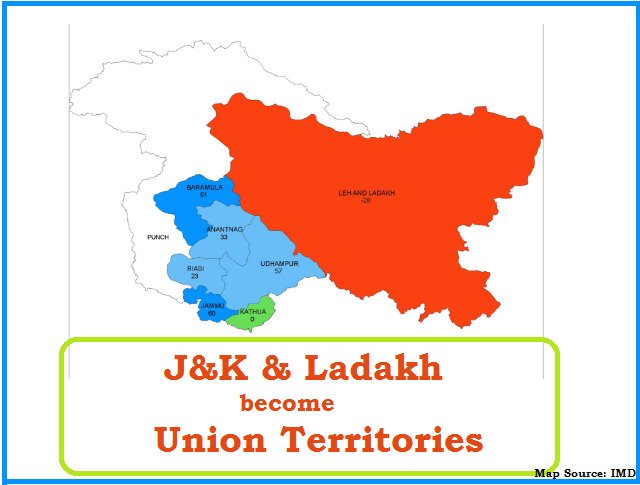
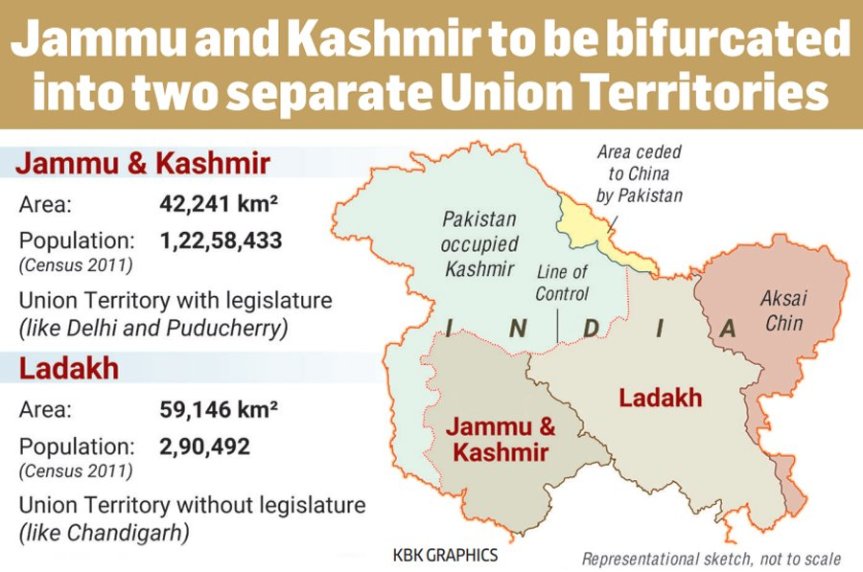
3. Jammu & Kashmir (Reorganisation) Bill, 2019 by which Jammu and Kashmir which earlier was a state was now proposed to be converted to two Union Territories – Jammu and Kashmir with legislature and Ladakh without a legislature.

4. Jammu & Kashmir Reservation (Second Amendment) Bill, 2019 providing for 10 percent reservation for SC, ST and OBCs in J&K

It cannot be lost on us that an eminent and very senior Supreme Court lawyer who is also the former Attorney General of India – Soli J Sorabjee too has clarified that, “The opposition has condemned the legislation as murder of democracy and betrayal of the people of J&K. In my opinion the charge is exaggerated and not tenable. The J&K Reorganization Bill and the resolutions moved by Amit Shah have been passed by both the Houses. The result is that Jammu and Kashmir now has no special status and all laws applicable to people of India including fundamental rights guaranteed by Part III of the Constitution shall be available to people of J&K. In short, J&K is now constitutionally recognized as an integral part of India.” He also sought to make it clear that, “The other favourable points are that people from other states can buy land in Kashmir which they could not do before. RTI which was not applicable before cannot now be denied. There will be no separate flag for J&K, but only one flag, the Indian tricolor.” If this is not a daring move, then what else can it be? Can anyone please tell me?

Truth be told, the first statutory resolution stated: “That this House recommends the following public notification to be issued by the President of India under Article 370(3): ‘In exercise of the powers conferred by Clause (3) of Article 370 read with clause (1) of Article 370 of the Constitution of India, the President, on the recommendation of the Parliament, is pleased to declare that, as from 5th of August, 2019, all clauses of the said Article 370 shall cease to be operative except clause (1).”

To put things in perspective, Article 370 will survive on paper but will now read “All provisions of this Constitution, as amended from time to time, without any modifications or exceptions, shall apply to the State of Jammu and Kashmir notwithstanding anything contrary contained in Article 152 or Article 308 or any other article of this Constitution or any other provision of the Constitution of Jammu and Kashmir or any law, document, judgement, ordinance, order, bye-law, rule, regulation, notification, custom or usage having force of law in the territory of India, or any other instrument, treaty or agreement as envisaged under Article 363 or otherwise.”

Going forward, the second resolution pertaining to the Bill said that the President has referred the Jammu and Kashmir Reorganisation Bill, 2019 to the House “under the proviso to Article 3 of the Constituion of India for its views as this House is vested with the powers of the State Legislature of Jammu and Kashmir, as per proclamation of the President of India dated 19th December, 2018.” Amit Shah who is Union Home Minister tabled the Bill and the statutory resolutions after Ram Nath Kovind signed the official notification, The Constitution (Application to Jammu and Kashmir) Order 2019, superseding the Constitution (Application to Jammu and Kashmir) Order 1954 under which the Constitution was applied only selectively to the State. The notification said that, “All the provisions of the Constitution, as amended from time to time, shall apply in relation to the state of Jammu and Kashmir…”

It would be pertinent to mention here that the government has added in Article 367 of the Constitution a clause 4 which makes four changes. The order said references to Sadar-i-Riyasat of Jammu and Kashmir shall be construed as references to the Governor of J&K. Similarly, references to the Government of J&K shall be construed as reference to the Governor of J&K acting on the advice of the Council of Ministers. With Opposition members expressing their dismay that the Bill to bifurcate was not even circulated, Shah introduced the Bill and statutory resolutions again promptly.

Let us now try and understand its practical implications also. It would be better if this is done in point form. They are as follows:-

1. Now Jammu and Kashmir is open for all citizens of India to go, do any business there or settle there or apply for any job without any hassle.

2. Now there will be no separate flag.

3. Now Indian Penal Code will replace the Ranbir Penal Code.

4. Now it will not have its own separate Constitution and the Constitution of India shall be applicable to them and they can benefit equally from it just like any other citizen of India unlike earlier!

5. All of the state’s laws, including those that are pertaining to land, property and inheritance will be nullified.

6. Now those refugees who earlier could vote in Lok Sabha elections but not in Vidhan Sabha elections or even panchayat elections will be able to cast their vote just like any other voter in any other state. This will benefit lakhs of people residing in Jammu who came from West Pakistan and settled there since independence and yet could not cast their votes. Similarly they would be eligible now to apply for any jobs unlike earlier when they could apply only for Class IV job of sweeper!

7. All laws passed by Parliament will now be equally applicable to them including those that pertain to reservation for economically weaker section and instant triple talaq.

8. Now if a Pakistani marries a women from Jammu and Kashmir, he will not get all the rights straightaway and citizenship unlike earlier when he straightaway got all the rights!

9. Now if a Indian from any other state marries a women from Jammu and Kashmir, he will get the rights to settle there and also the women will not lose any of her rights or citizenship unlike earlier!

10. Now private investment and corporate investment will increase rapidly as there is now no bar on them.

11. Ladakh will now develop more rapidly as it has been made a separate Union Territory.

12. Jammu and Kashmir legislature will continue to make laws. But certain subjects will still be with the Centre to legislate on such as land, law and order – an arrangement that is similar to Delhi.

13. Now Article 356 will be applicable to Jammu and Kashmir also.

14. Now the term of Assembly will be five years and no six years unlike earlier.

15. Now Jammu and Kashmir will be able to benefit from Central laws and RTI that is Right to Information Act along with other laws like right of child to get free and compulsory education between the age of 6 to 14.

16. Now financial emergency can also be declared under Article 360.

17. There can now be quotas for minorities just like any other state.

18. All other special privileges will also now come to an end and it will have the same rights like any other part of India.

It is a no brainer that it is now that the integration of Jammu and Kashmir has become complete. It is now that India can confidently say that, “Jammu and Kashmir which is now a Union Territory along with Ladakh who also has been made a separate Union Territory are an integral part of India in the real sense.” What Sardar Patel was not allowed to do in Jammu and Kashmir and Ladakh what he did to other 562 princely states has now been done by the incumbent government in Centre led by Narendra Modi as Prime Minister and Amit Shah as Home Minister! Those who criticize the government’s move must remember that the governments in the past had affected 44-45 amendments to this article beginning with replacing Maharaja with Sadr-e-Riyasat in 1952. On all such occasions we find that the same Presidential Order route was adopted and this time also the same has been done!

Yes, what is extraordinary this time is that Pakistan which was gaining because of the wrong effects of Article 35A and Article 370 will now stop gaining and this alone explains that why it is so frustrated that it approached the UN Security Council which refused to meddle in between and same is the case with US and China who too advised Pakistan to behave cautiously with India! Yet Pakistan has resorted to heavy firing along border which India is responding effectively and has decided to recall its ambassador and also send India’s ambassador back to India because it is Pakistan which was directly gaining by the operation of Article 35A and Article 370 which is indisputable as is evident from Pakistan’s belligerent approach also! But now Pakistan must reconcile with the ground reality and accept that Jammu and Kashmir will henceforth be always treated as an integral part of India in the real sense! Thanks to the daring resolve by Centre to proceed ahead for integrating Jammu and Kashmir along with Ladakh with India even though many questioned its utility and some criticized it most bitterly!

We must also accept that whenever something great happens, it is initially criticized as done by JD(U) initially by staging a walkout and then accepting it after seeing the groundswell of public support it received from the people cutting across party lines, religion lines, caste lines and community lines! No denying it!

It will not be an exaggeration to say that it is now that Jammu and Kashmir stands fully and firmly integrated with India! Why should anyone protest to this ‘daring move” as was very rightly hailed by Ashwani Kumar? It is heartening to note that PM Narendra Modi has in his message made clear to the people of Jammu and Kashmir that it is they who will benefit most from this landmark and momentous decision and not just few political families and he would always work for their welfare and ensure that justice is done with them in all respects!

Sanjeev Sirohi, Advocate,

s/o Col BPS Sirohi,

A 82, Defence Enclave,

Sardhana Road, Kankerkhera,

Meerut – 250001, Uttar Pradesh.