Years ago, it was felt that the root of all problems in education is the teacher. In fact, the MLLs (Minimum Levels of Learning, which served as the de fact national curriculum framework) in the late 80s and early 90s were designed to ensure \’teacher accountability\’ in terms of the minimum that would be achieved. A popular programme, Rishi Valley\’s multi-grade teaching (adopted/adapted as \’activity based learning\’ in many states) actually originated from the desire to get children to be able to learn without needing the teacher (which is why there is so much of self learning in it).
People still continue to condemn the teacher and hold him responsible for all the ills in education. However, with the proliferation of so many \’reports\’ on education all around, there is now a great sense of intolerance towards the education system itself. The belief seems to be that not only government teachers and schools but the government education system itself is condemnable. Among NGOs, academics, commentators, researchers and intellectuals the general notion seems to be gathering steam that everything and everyone in the government system is the problem!
But what is a system if not the people in it, the way they work and the frame within which they work? From that point of view, I have to say that some of the finest people I\’ve come across are \’system\’ people. Every year I get the chance to work with thousands of teachers who I see putting in 12-14 hour days when others from outside the system (e.g. NGOs) fade away after only 8 hrs of input. This is not to say everything is OK with the system or the policies or the people – it\’s just point out that a black and white view doesn\’t help. And that just as it is not possible to change a teacher while condemning him, it is not likely to be possible to improve a system while condemning it!
Years ago, it was felt that the root of all problems in education is the teacher. In fact, the MLLs (Minimum Levels of Learning, which served as the de fact national curriculum framework) in the late 80s and early 90s were designed to ensure \’teacher accountability\’ in terms of the minimum that would be achieved. A popular programme, Rishi Valley\’s multi-grade teaching (adopted/adapted as \’activity based learning\’ in many states) actually originated from the desire to get children to be able to learn without needing the teacher (which is why there is so much of self learning in it).
People still continue to condemn the teacher and hold him responsible for all the ills in education. However, with the proliferation of so many \’reports\’ on education all around, there is now a great sense of intolerance towards the education system itself. The belief seems to be that not only government teachers and schools but the government education system itself is condemnable. Among NGOs, academics, commentators, researchers and intellectuals the general notion seems to be gathering steam that everything and everyone in the government system is the problem!
But what is a system if not the people in it, the way they work and the frame within which they work? From that point of view, I have to say that some of the finest people I\’ve come across are \’system\’ people. Every year I get the chance to work with thousands of teachers who I see putting in 12-14 hour days when others from outside the system (e.g. NGOs) fade away after only 8 hrs of input. This is not to say everything is OK with the system or the policies or the people – it\’s just point out that a black and white view doesn\’t help. And that just as it is not possible to change a teacher while condemning him, it is not likely to be possible to improve a system while condemning it!
Years ago, it was felt that the root of all problems in education is the teacher. In fact, the MLLs (Minimum Levels of Learning, which served as the de fact national curriculum framework) in the late 80s and early 90s were designed to ensure \’teacher accountability\’ in terms of the minimum that would be achieved. A popular programme, Rishi Valley\’s multi-grade teaching (adopted/adapted as \’activity based learning\’ in many states) actually originated from the desire to get children to be able to learn without needing the teacher (which is why there is so much of self learning in it).
People still continue to condemn the teacher and hold him responsible for all the ills in education. However, with the proliferation of so many \’reports\’ on education all around, there is now a great sense of intolerance towards the education system itself. The belief seems to be that not only government teachers and schools but the government education system itself is condemnable. Among NGOs, academics, commentators, researchers and intellectuals the general notion seems to be gathering steam that everything and everyone in the government system is the problem!
But what is a system if not the people in it, the way they work and the frame within which they work? From that point of view, I have to say that some of the finest people I\’ve come across are \’system\’ people. Every year I get the chance to work with thousands of teachers who I see putting in 12-14 hour days when others from outside the system (e.g. NGOs) fade away after only 8 hrs of input. This is not to say everything is OK with the system or the policies or the people – it\’s just point out that a black and white view doesn\’t help. And that just as it is not possible to change a teacher while condemning him, it is not likely to be possible to improve a system while condemning it!
Years ago, it was felt that the root of all problems in education is the teacher. In fact, the MLLs (Minimum Levels of Learning, which served as the de fact national curriculum framework) in the late 80s and early 90s were designed to ensure \’teacher accountability\’ in terms of the minimum that would be achieved. A popular programme, Rishi Valley\’s multi-grade teaching (adopted/adapted as \’activity based learning\’ in many states) actually originated from the desire to get children to be able to learn without needing the teacher (which is why there is so much of self learning in it).
People still continue to condemn the teacher and hold him responsible for all the ills in education. However, with the proliferation of so many \’reports\’ on education all around, there is now a great sense of intolerance towards the education system itself. The belief seems to be that not only government teachers and schools but the government education system itself is condemnable. Among NGOs, academics, commentators, researchers and intellectuals the general notion seems to be gathering steam that everything and everyone in the government system is the problem!
But what is a system if not the people in it, the way they work and the frame within which they work? From that point of view, I have to say that some of the finest people I\’ve come across are \’system\’ people. Every year I get the chance to work with thousands of teachers who I see putting in 12-14 hour days when others from outside the system (e.g. NGOs) fade away after only 8 hrs of input. This is not to say everything is OK with the system or the policies or the people – it\’s just point out that a black and white view doesn\’t help. And that just as it is not possible to change a teacher while condemning him, it is not likely to be possible to improve a system while condemning it!
Years ago, it was felt that the root of all problems in education is the teacher. In fact, the MLLs (Minimum Levels of Learning, which served as the de fact national curriculum framework) in the late 80s and early 90s were designed to ensure \’teacher accountability\’ in terms of the minimum that would be achieved. A popular programme, Rishi Valley\’s multi-grade teaching (adopted/adapted as \’activity based learning\’ in many states) actually originated from the desire to get children to be able to learn without needing the teacher (which is why there is so much of self learning in it).
People still continue to condemn the teacher and hold him responsible for all the ills in education. However, with the proliferation of so many \’reports\’ on education all around, there is now a great sense of intolerance towards the education system itself. The belief seems to be that not only government teachers and schools but the government education system itself is condemnable. Among NGOs, academics, commentators, researchers and intellectuals the general notion seems to be gathering steam that everything and everyone in the government system is the problem!
But what is a system if not the people in it, the way they work and the frame within which they work? From that point of view, I have to say that some of the finest people I\’ve come across are \’system\’ people. Every year I get the chance to work with thousands of teachers who I see putting in 12-14 hour days when others from outside the system (e.g. NGOs) fade away after only 8 hrs of input. This is not to say everything is OK with the system or the policies or the people – it\’s just point out that a black and white view doesn\’t help. And that just as it is not possible to change a teacher while condemning him, it is not likely to be possible to improve a system while condemning it!
Years ago, it was felt that the root of all problems in education is the teacher. In fact, the MLLs (Minimum Levels of Learning, which served as the de fact national curriculum framework) in the late 80s and early 90s were designed to ensure \’teacher accountability\’ in terms of the minimum that would be achieved. A popular programme, Rishi Valley\’s multi-grade teaching (adopted/adapted as \’activity based learning\’ in many states) actually originated from the desire to get children to be able to learn without needing the teacher (which is why there is so much of self learning in it).
People still continue to condemn the teacher and hold him responsible for all the ills in education. However, with the proliferation of so many \’reports\’ on education all around, there is now a great sense of intolerance towards the education system itself. The belief seems to be that not only government teachers and schools but the government education system itself is condemnable. Among NGOs, academics, commentators, researchers and intellectuals the general notion seems to be gathering steam that everything and everyone in the government system is the problem!
But what is a system if not the people in it, the way they work and the frame within which they work? From that point of view, I have to say that some of the finest people I\’ve come across are \’system\’ people. Every year I get the chance to work with thousands of teachers who I see putting in 12-14 hour days when others from outside the system (e.g. NGOs) fade away after only 8 hrs of input. This is not to say everything is OK with the system or the policies or the people – it\’s just point out that a black and white view doesn\’t help. And that just as it is not possible to change a teacher while condemning him, it is not likely to be possible to improve a system while condemning it!
Hyderabad is an important city of India as it is endowed with many historical places, mouth-watering dishes including veg and non-veg biryani, different types of fruits and vegetables, ornamental items (pearl and related items), famous for medical tourism, etc. Hyderabad is also a city of national integration and above caste, creed, and religion all live amicably. As an example, a legendary figure may be mentioned here as known to all that Sarojini Naidu being a Bengali lady was born in Chattopadhyay/Chatterjee family in 1879 in Hyderabad and married to a Telugu man, Dr. Govindarajulu Naidu and finally settled down in Hyderabad. Her parental home was in undivided Bengal.
RTP Mela of NIRD
In this section, a case of national integration promoted by the National Institute of Rural Development and Panchayati Raj (popularly known as NIRD&PR), an autonomous organization of the Ministry of Rural Development, Government of India is presented. The NIRD&PR, apart from its academic activities, has been organizing Mela every year from 2003 where across India, rural artisans mainly self-help group (SHG) members participate with their products for scaling up of selling.
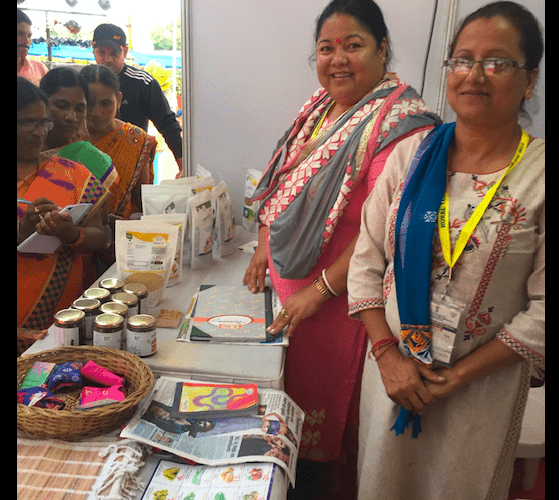
In 2019, 17th Mela held from 29 November to 3 December 2019 was inaugurated by the Governor of Telangana, Dr. Tamilisai Soundararajan on 29 November 2019. As reported by Mr Md. Khan, Sr. Consultant of RTP-NIRD&PR, in the Mela mainly women members of Self Help Groups (SHG) from 24 states across the country including Arunachal Pradesh, Meghalaya, Mizoram, Manipur, Tripura, Sikkim, J&K participated. The participation of so many states from north-east in other years of the Mela was seldom. Further, around 200 stalls were set up covering various items like veg and non-veg foods, dress materials for ladies, gents and children, different types of ornamental items, etc.
RTP Mela of NIRD
The author interacted during the time of Mela with few members who came with their products from different parts of the country. And all in unison appreciated stay, food, etc. which were provided free of cost to the guests by the NIRD&PR. Of course, travel costs had to be borne by the respective state or organisation or by the SHG may be from their corpus fund.
While interacting, Mrs Ronita, a member of Laxmi SHG, from Imphal East district of Manipur observed she (also her woman friend) was absolutely happy as for the Mela both of them could visit Hyderabad. She informed that albeit their SHG was established in January 2018 but earlier did not visit Hyderabad. Their travel cost was borne by the district officials. They brought a special variety of black rice, different types of pickles, fruit candies, etc. Both have enjoyed Hyderabad as a huge city with peaceful environment. Mrs Kamal Kumari Jamatia of Tripura, a member of Golap SHG (10 women members in SHG and all ST) also expressed her happiness as first time she attended the Mela. She brought different types of ladies dresses made by tribal women, craft and bamboo products etc. From Sikkim, two women came first time came in Hyderabad with local products such as ginger powder, raw turmeric, and other local food products. Also from Haryana two women participated as well as their first visit in Hyderabad. They brought and made in the stall different types of food items and I tasted their delicious ‘laddus’. From West Bengal of Birbhum district, two women with different types of Sarees first time attended the Mela. Also near Darjeeling area of West Bengal few Lepcha women members came who were well versed with ‘Momo’ preparation. On the spot, they prepared tasty ‘Momo’ and such taste may not be found in other restaurants. Mrs. Shalini of Kerala also expressed her happiness after participating first time in the Mela. She along with her husband participated Mela with a different types of clay items used in cooking. Although the SHG was established in 2003 with 16 women members this was their first visit.
It is evident that Mela is an important place of marketing of SHGs’ products. It acts as an important forward linkage as sellers can bring their products from far-flung areas and buyers can get within their area with reasonable price and thus both are benefitted. Further, Mela has been promoting national integration. In view of this, it is suggested that such Mela should be organised across the country more in numbers. NIRD&PR can organise two times in a year.
Dr Shankar Chatterjee
Former Professor & Head (CPME),NIRD & PR ( Govt. of India), Hyderabad, India
Former Associate Professor, Eritrea
Former Assistant Prof, Govt. Degree College, Tripura, India
Former Senior Planning Officer, Govt of Assam, India
At the outset, we need to pay attention to what has been stated so explicitly by the Apex Court in this latest, landmark and laudable judgment titled P. Gopalkrishnan @ Dileep Vs State of Kerala and Anr. In Criminal Appeal No. 1794 of 2019 (Arising out of SLP(Cri) No. 10189/2018 delivered on November 29, 2019 that a Magistrate cannot withhold any “document” submitted by the investigating officer along with the police report except when it is voluminous. Further, in case of voluminous documents, the accused can be permitted to take inspection of the concerned document either personally or through his pleader in Court. There is nothing wrong in doing so!
report news
To put things in perspective, the Bench of Apex Court hearing this case was considering Kerala film actor Dileep’s plea for handing over copy of the visuals of the alleged sexual crime committed on a Kerala actress in February 2017. It was held that the contents of a memory card in relation to a crime amount to a ‘document’ and not a ‘material object’. Very rightly so!
To start with, this latest, landmark and laudable judgment authored by Justice AM Khanwilkar for himself and Justice Dinesh Maheshwari of Supreme Court sets the ball rolling by after granting leave in para 1 by noting in para 2 that, “The conundrum in this appeal is: whether the contents of a memory card/pen-drive being electronic record as predicated in Section 2(1)(t) of the Information and Technology Act, 2000 (for short, ‘the 2000 Act’) would, thereby qualify as a “document” within the meaning of Section 3 of the Indian Evidence Act, 1872 (for short, ‘the 1872 Act’) and Section 29 of the Indian Penal Code, 1860 (for short, ‘the 1860 Code’)? If so, whether it is obligatory to furnish a cloned copy of the contents of such memory card/pen-drive to the accused facing prosecution for an alleged offence of rape and related offences since the same is appended to the police report submitted to the Magistrate and the prosecution proposes to rely upon it against the accused, in terms of Section 207 of the Code of Criminal Procedure, 1973 (for short, ‘the 1973 Code’)? The next question is: whether it is open to the Court to decline the request of the accused to furnish a cloned copy of the contents of the subject memory card/pen-drive in the form of video footage/clipping concerning the alleged incident/occurrence of rape on the ground that it would impinge upon the privacy, dignity and identity of the victim involved in the stated offence(s) and moreso because of the possibility of misuse of such cloned copy by the accused (which may attract other independent offences under the 2000 Act and the 1860 Code?”
Be it noted, para 3 then observes that, “The appellant has been arrayed as accused No. 8 in connection with offence registered as First Information Report (FIR)/Crime Case No. 297/2017 dated 18.2.2017 punishable under Sections 342, 366, 376, 506(1), 120B and 34 of the 1860 Code and Sections 66E and 67A of the 2000 Act, concerning the alleged incident/occurrence at around 2030 hrs. to 2300 hrs. on 17.2.2017, as reported by the victim.”
As it turned out, para 4 then illustrates that, “For considering the questions arising in this appeal, suffice it to observe that the investigating officer attached to the Nedumbassery Police Station, Ernakulam, Kerala, after recording statements of the concerned witnesses and collecting the relevant evidence, filed police reports under Section 173 of the 1973 Code before the Judicial First Class Magistrate, Angamaly, First police report on 17.4.2017 and the second on 22.11.2017. When the appellant was supplied a copy of the second police report on 15.12.2017, all documents noted in the said report, on which the prosecution proposed to rely, were not supplied to the appellant, namely, (i) electronic record (contents of memory card); (ii) Forensic Science Laboratory (for short, ‘the FSL’) reports and the findings attached thereto in C.D./D.V.D.; (iii) medical reports; C.C.T.V. footages and (iv) Call data records of accused and various witnesses etc.”
To put things in perspective, para 5 then envisages that, “It is noted by the concerned Magistrate that the visuals copied and documented by the forensic experts during the forensic examination of the memory card were allowed to be perused by the appellant’s counsel in the presence of the regular cadre Assistant Public Prosecutor of the Court, in the Court itself. After watching the said visuals, some doubts cropped up, which propelled the appellant to file a formal application before the Judicial First Class Magistrate, Angamaly for a direction to the prosecution to furnish a cloned copy of the contents of memory card containing the video and audio footage/clipping, in the same format as obtained in the memory card, alongwith the transcript of the human voices, both male and female recorded in it.”
It cannot be lost on us that it is observed in para 6 that, “The Magistrate vide order dated 7.2.2018, rejected the said application, essentially on the ground that acceding to the request of the appellant would be impinging upon the esteem, decency, chastity, dignity and reputation of the victim and also against public interest.”
It also cannot be lost on us that it is then envisaged in para 7 that, “Aggrieved by the above decision, the appellant carried the matter to the High Court of Kerala at Ernakulam (for short, ‘the High Court’) by way of Cri.M.C. No. 1663/2018. The learned single Judge of the High Court dismissed the said petition and confirmed the order of the Magistrate rejecting the stated application filed by the appellant. The High Court, however, after analyzing the decisions and the relevant provisions cited before it, eventually concluded that the seized memory card was only the medium on which the alleged incident was recorded and hence that itself is the product of the crime. Further, it being a material object and not documentary evidence, is excluded from the purview of Section 207 of the 1973 Code.”
To say the least, it is then pointed out in para 8 that, “The appellant being dissatisfied, has assailed the reasons which found favour with the trial Court, as well as the High Court. The appellant broadly contends that the prosecution case is founded on the forensic report which suggests that eight video recordings were retrieved from the memory card and that the video files were found to be recorded on 17.2.2017 between 22:30:55 hrs. and 22:48:40 hrs. The same were transferred to the stated memory card on 18.2.2017 between 09:18 hrs and 09:20 hrs. Be it noted that the original video recording was allegedly done by accused No. 1 on his personal mobile phone, which has not been produced by the investigating agency. However, the memory card on which the offending video recording was copied on 18.2.2017 was allegedly handed over by an Advocate claiming that the accused No. 1 had given it to him. He had presented the memory card before the Court on 20.2.2017, which was sent for forensic examination at State FSL, Thiruvananthapuram. After forensic examination, the same was returned alongwith FSL report DD No. 91/2017 dated 3.3.2017 and DD No. 115/2017 dated 7.4.2017. A pen-drive containing the data/visuals retrieved from the memory card, was also enclosed with the report sent by the State FSL.”
More importantly, it is then stated in para 9 that, “Be that as it may, the prosecution was obviously relying on the contents of the memory card which have been copied on the pen-drive by the State FSL during the analysis thereof and has been so adverted to in the police report. The contents of the memory card, which are replicated in the pen-drive created by the State FSL would be nothing but a “document” within the meaning of the 1973 Code and the provisions of the 1872 Act. And since the prosecution was relying on the same and proposes to use it against the accused/appellant, it was incumbent to furnish a cloned copy of the contents thereof to the accused/appellant, not only in terms of Section 207 read with Section 173(5) of the 1973 Code, but also to uphold the right of the accused to a fair trial guaranteed under Article 21 of the Constitution of India. The trial Court rejected the request of the appellant on the ground that it would affect the privacy and dignity of the victim, whereas, the High Court proceeded on the basis that the memory card is a material object and not a “document”. It is well known that a cloned copy is not a photo copy, but is a mirror image of the original, and the accused has the right to have the same to present his defence effectively. In the alternative, it is submitted, that the Court could have imposed appropriate conditions while issuing direction to the prosecution to furnish a cloned copy of the contents of memory card to the accused/appellant.”
Most importantly, it is also rightly underscored in para 32 that, “It is crystal clear that all documents including “electronic record” produced for the inspection of the Court alongwith the police report and which prosecution proposes to use against the accused must be furnished to the accused as per the mandate of Section 207 of the 1973 Code. The concomitant is that the contents of the memory card/pen-drive must be furnished to the accused, which can be done in the form of cloned copy of the memory card/pen-drive. It is cardinal that a person tried for such a serious offence should be furnished with all the material and evidence in advance, on which the prosecution proposes to rely against him during the trial. Any other view would not only impinge upon the statutory mandate contained in the 1973 Code but also the right of an accused to a fair trial enshrined in Article 21 of the Constitution of India.”
Equally important if not more is what is then stated in para 41 which postulates that, “We are conscious of the fact that Section 207 of the 1973 Code permits withholding of document(s) by the Magistrate only if it is voluminous and for no other reason. If it is an “electronic record”, certainly the ground predicated in the second proviso in Section 207, of being voluminous, ordinarily, cannot be invoked and will be unavailable. We are also conscious of the dictum in the case of Superintendent and Remembrancer of Legal Affairs, West Bengal vs. Satyen Bhowmick & Ors. (1981) 2 SCC 109, wherein this Court has restated the cardinal principle that accused is entitled to have copies of the statements and documents accompanying the police report, which the prosecution may use against him during the trial.”
Making the picture more clear on this, it is then pointed out in para 42 that, “Nevertheless, the Court cannot be oblivious to the nature of offence and the principle underlying the amendment to Section 327 of the 1973 Code, in particular sub-Section (2) thereof and insertion of Section 228A of the 1860 Code, for securing the privacy of the victim and her identity. Thus understood, the Court is obliged to evolve a mechanism to enable the accused to reassure himself about the genuineness and credibility of the contents of the memory card/pen-drive from an independent agency referred to above, so as to effectively defend himself during the trial. Thus, balancing the rights of both parties is imperative, as has been held in Asha Ranjan (supra) and Mazdoor Kisan Shakti Sangathan (supra). The Court is duty bound to issue suitable directions. Even the High Court, in exercise of inherent power under Section 482 of the 1973 Code, is competent to issue suitable directions to meet the ends of justice.”
What’s more, it is then added in para 43 that, “If the accused or his lawyer himself, additionally, intends to inspect the contents of the memory card/pen-drive in question, he can request the Magistrate to provide him inspection in Court, if necessary, even for more than once alongwith his lawyer and I.T. expert to enable him to effectively defend himself during the trial. If such an application is filed, the Magistrate must consider the same appropriately and exercise judicious discretion with objectivity while ensuring that it is not an attempt by the accused to protract the trial. While allowing the accused and his lawyer or authorized I.T. expert, all care must be taken that they do not carry any devices much less electronic devices, including mobile phone which may have the capability of copying or transferring the electronic record thereof or mutating the contents of the memory card/pen-drive in any manner. Such multipronged approach may subserve the ends of justice and also effectuate the right of accused to a fair trial guaranteed under Article 21 of the Constitution.”
In a nutshell, it is then rightly held in para 44 that, “In conclusion, we hold that the contents of the memory card/pen drive being electronic record must be regarded as a document. If the prosecution is relying on the same, ordinarily, the accused must be given a cloned copy thereof to enable him/her to present an effective defence during the trial. However, in cases involving issues such as of privacy of the complainant/witness or his/her identity, the Court may be justified in providing only inspection thereof to the accused and his/her lawyer or expert for presenting effective defence during the trial. The court may issue suitable directions to balance the interests of both sides.” Very rightly so!
Exams – Oh it\’s really annoying for many kids. Parents think it would be a strategy to evaluate their kid’s performance or to monitor their growth level. But under any circumstances, it should be nevertheless a burden to a kid. It’s okay for them to be lazy (but not all the time), As a parent, I would suggest you to handle your kids in a way they can share their feelings or they don\’t want to hide anything from you. While handling your kids don\’t be a parent all the time or don\’t be rude to them, you can eventually spend time with them while playing or while sharing your breakfast or dinner. I can hear your thoughts “I am already held up with my office work, then how should I need to take care of these things”.
First have it in your mind whatever earnings or how many pence you earn is only for your kids not for anyone and the important thing is “You can\’t buy the Time” once the time is wasted then it can\’t be brought back, so as a parent it is your responsibility to allocate your time accordingly top your kids, this can leads a great way to avoid all the phobias they are getting during their exams.
Diet:
Having a proper diet before your exam or while preparing for your exam matters the most. Try to have more fruits and avoid the foods which don\’t suit you, since it might cause diarrhea, nausea, headaches and etc, makes you feel so sick. Please don\’t force them to have more food since it might cause them to feel sleepy during exams. Try to give them more protein-rich foods, ask them to munch on healthy snacks like dried fruits, cereals, and pulses. Avoid taking more oily foods.
More Liquids:
Keeping yourself hydrated is an important thing while preparing yourself for the exam. Try to have more water and liquids juices, this can help to maintain your diet level and make your feel light without dieting. Some may feel like nausea before their exam since they would have prepared a lot for their exam, they lack their sleep level, so in these cases, its better to avoid having heavy breakfast- fruit juice or a glass of milkshake would be very fine to have, without collapsing yourself.
Proper Sleep:
The day before or a few days before the exam creates a lot of pressure on all those who were facing that, it\’s quite common for everyone to face that stress. But getting proper sleep is the only way to handle that. Without proper sleep, you will be feeling restless all the time and this itself creates a kind of pressure for yourself. Even this plays a major role in your kid\’s digestion process, so ensure that they get a regular sleep in their exam times.
Play Hours:
Kindly monitor their playtimes, don\’t be very strict but try to engage them more with the indoor games, try to keep them away from video games & mobile phones. Try to schedule a time for their gadget usage. Most probably try to avoid the outdoor games, since there are more chances for them to get hurt or with the climatic changes they can even fall sick. So it\’s better to allocate the timings if you find the time you can too indulge in their activity.
Handling Stress:
Stress is very common for the kids, even if it is very stressful for their parents too. Kids just need encouragement & guidance from you. Understand! every kid is different, so setting up a target blindly sometimes creates more stress for you both. So don\’t trouble or put yourself in a problematic situation and be more stressed. Be cool, sit with them, help them in the place where they are struggling, motivate them.
Anxiety Level:
Don\’t be afraid of getting poor marks, you can try to give your best. Try to focus on the topics before the exam schedule, this can reduce your burden on the exam timings. Take a deep breath, this makes you feel relaxed.
No parents will be rude to their kids, but sometimes it’s nature to be strict with their kids for their activity, this is mainly because to ensure their obedience, their wellness and fixing up a good career path. The other main hurdle is, if you found out your baby is lying to you, then it is a call for you and you just need to take some diversion in your parenting activity.
Business news has become a reality show. Where are the many important economic issues facing the world ? Where is the reasoned debate ? I had hoped that the dry area of economics and business would be the last to succumb to trivialisation and sensationalisation. Alas, it has already fallen.
Take the case of the Nirav Modi – Punjab National Bank fraud that has hit the headlines in India. It is a massive fraud and yet try as I might, and despite the millions of words written and aired on this (the favourite word is scam – in India everything is a scam), I am not able to make out what exactly happened. There isn’t one journalistic piece on what exactly happened in detail, why it happened and how can it be prevented. Instead the predominant coverage is that because of the same surname as the Indian Prime Minister, the opposition Congress Party has been going around calling Nirav Modi as “Chhota Modi” (Smaller Modi) although there is absolutely no evidence of any relationship. Both the parties are blaming each other loudly (from what news has come out, this appears to be a plain banking fraud with no link to politics).
The two finest business newspapers in the world – Financial Times of the UK and the Wall Street Journal have become obsessed with Trump. No, I don’t want to read anything about him, thank you.
The Economist remains the only “good” read. Alas, this blogger’s subscription is having some niggles and there has been no issue to read for a month.
Can we examine America pumping itself with steroids? They are reducing taxes, increasing military spending, increasing social spending and presuming to invest in infrastructure at the same time, and that too when the country is near full employment. This is deficit financing on a staggering scale , being done by the party that ostensibly hates deficits.
Can we examine the Brexit issue in terms of what exactly the trade deal issues are ? Can we examine China’s pile of debt ? Can we marvel at Europe overtaking the US in economic growth – yes that happened last quarter. Can we think about the boom in India’s indirect tax revenues ?
Instead I am being told that a Transavia flight made an emergency landing because a passenger refused to stop farting.
I am happy to address the 15th Higher Education Summit 2019 organised by the Federation of Indian Chambers of Commerce and Industry in collaboration with the Ministry of Human Resource Development and the Ministry of Commerce and Industry. This global conference has come to occupy a vital place in the thought leadership forum on higher education. We have a large and diverse gathering of stakeholders from India and abroad participating in the event. I am sure you will find this edition as enriching as the previous ones.
Higher education as a public-policy issue enjoys primacy the world over. It is seen as a fundamental enabler of social, economic, scientific and intellectual progress and advancement. In the case of India, we have a distinguished history of higher education to inspire us as we work to strengthen and illuminate our universities as fonts of knowledge and learning. India has been home to the oldest university in the world. At its peak in the 7th century CE, the Nalanda University had 10,000 students from all over Asia enrolled in its campus. The methods of teaching prevalent in these ancient temples of learning and the emphasis on critical analyses could be of relevance as we look at modern trends in pedagogy.
Investing in people through higher education and education in general has an omnibus impact on nation-building. The investment is made once but the dividends are realised in perpetuity. Recently, I had gone to Mysore to join the centenary celebrations of the enlightened “Monarch – Democrat” Jayachamaraja Wadiyar, the late Maharaja of Mysore. He was a pioneer in higher education who generously invested in his people. The lead that the Maharaja took in empowering people several decades ago, today provides the strong foundation of technological transformation that we see in Bengaluru, Mysuru and the adjoining areas. A country such as ours that wishes to transform itself within a short span of time, must transform its higher education journey first.
Ladies and gentlemen,
Higher education is a subject close to my heart, both for personal and professional reasons. I have myself experienced its power and potential to bring about intra-generational change and mobility. As President of India, I am Visitor to 152 Universities and Institutes of Higher Learning. I have had the opportunity to interact with Vice-Chancellors and Directors of almost all of them. India with over 990 Universities is home to one of the largest higher education ecosystems in the world. We are constantly at work to improve their standards and convert them into global knowledge hubs. We have just begun nationwide consultations on the New Education Policy. It would lay out the path for transforming Indian education landscape suited to 21st century needs.
The world of tomorrow will be driven by knowledge, machine-intelligence and digital pathways. To prepare ourselves for this transformation and to leverage its limitless opportunities, we have to recast our higher education with new courses and deeper research-orientation. Ideation, innovation and incubation should be given primacy in our curriculum. India has the third largest scientific human resource pool in the world. If we establish robust academia-industry linkages, we have the potential to become the R&D capital of the world. And along with science, liberal arts and humanities must get equal attention – for fruits of technology have to be ultimately made relevant to people, communities and cultures. The connectedness of disciplines is not a mere reality today, but the inner core of knowledge itself. I am happy that our Universities have already made progress with inter-disciplinary approach, combining courses in mathematics with music, and artificial intelligence with animal husbandry. Much more work is required on this account.
Ladies and gentlemen,
Another important aspect that we need to attend is how to bring pedagogical changes in our education system. Spirit of inquiry, critical thinking and an overall culture of looking at what, how and why of issues and perspectives needs to be nurtured. Creativity, imagination and thought in the minds of our students have to be unlocked and its exuberance allowed to flow and flower. To bring about this educational renaissance, we would require attitudinal adjustments and openness about new concepts on several fronts: at the level of academic leadership; at the level of student-teacher engagement; and at the level of technology integration. These would only be possible if there is a vision to move forward and a committed urge to make things happen. In this context, I would like to commend the programmes initiated by the Ministry of Human Resource Development – LEAP that is “Leadership for Academicians Program” and ARPIT that is “Annual Refresher Programme in Teaching”. While LEAP aims to build leadership and vision among higher education administrators, ARPIT is geared to improve pedagogical skills of our teachers.
Earlier I had talked about our ancient universities. They had a learning culture where ideas and concepts were constantly tested and subjected to verification and critical analyses. The system that produced a Panini, an Aryabhat, a Charak, or a Kautilya must have been robust. We must use modern tools to reopen wisdom stored in our countless knowledge traditions, even as we optimize the opportunities of a machine-intelligence age. An open learning culture will foster the spirit to innovate and give new wings to Atal Innovation Centres established in our Universities.
Ladies and gentlemen,
Our economic needs are immense. Over the next several decades, India will witness tremendous growth leading to higher standards of living for its people. All this demands that we bring new energy and dynamism in our higher education profile. Programmes for vocational education, apprenticeship and internship are needed for combining theoretical and practical knowledge streams. We have to also draw and learn from global institutions and experiences.
At the same time, India’s diverse higher education ecosystem offers immense opportunities for the world at large. The forces of globalisation pose their own imperatives for making learning a cross-cultural experience and an integrated construct. To promote India as a global knowledge destination, the Government of India has begun a “Study in India” programme to attract international students. Our Universities have also been developing international networks for faculty, student, pedagogy and knowledge exchange. Making our higher education ecosystem world class will also give a wider choice to Indian students who go abroad seeking quality education.
Ladies and Gentlemen,
The world of higher education is an expansive one. For it to grow and empower us, we need support from all stakeholders – policymakers, educationists, researchers, entrepreneurs and others. Given the socio-economic reality of our country, public institutions will play a lead role. But along with it, the private sector must continue to contribute to national efforts. We will also have to look at innovative models of funding to boost research and scholarship. Just last month, I had the pleasure to launch the IIT Delhi Endowment Fund. This is the first of its kind Fund in India and is based on the contribution of the alumni. The Fund within a very short span has raised Rupees 250 crore and has a target to raise 1 billion US dollars for supporting academic excellence and research at IIT Delhi. I impress upon FICCI Higher Education Committee to galvanize greater people’s participation in strengthening our higher education system.
Ladies and gentlemen,
As we talk of higher education as a public good, a critical bearing in the Indian context is how to deal with regional imbalance in the quality of education. We are trying to narrow the gap but a lot more initiatives are required. Another related aspect is the rural-urban divide that we see in the field of higher education. Our Founding Fathers, Mahatma Gandhi and Rabindranath Tagore had paid detailed attention to it, be it the Medical College in Wardha or the Visva Bharati in Santiniketan. I had the opportunity to visit both these illustrious campuses this year. For our inclusive growth and progress, we have to take inspiration from them and build on their ideas. In this effort, technology platforms such as digital classrooms, e-learning and National Digital Library can be a key enabler.
Ladies and gentlemen,
I have put forth some of my ideas on higher education before you. It is now for you, the stakeholders, to flesh out the way forward. And as you deliberate and discuss, I would remind you of an old saying in Sanskrit, and I quote : “ सा विद्या या विमुक्तये” that is “true learning is that which liberates”. Let us together create that university, that classroom, that curriculum, that culture which allows our students to realize their fullest potential as a human being, in service of our people, our nation and the world.
The myth of the sedate and peaceful Sunni traditionalist was refuted by a single event: the atrocity of September 11, 2001. On a clear sunny autumn day as the office workers grabbed a morning coffee on their way to work, as early morning bond traders were calling their floor traders in the Chicago pits, and Jersey secretaries emerged from the subway in the sub-basement of the World Trade Center, this modern metropolis was jolted by an inexplicable attack unimaginable by civilized men and women. A jumbo jet crashed into the north tower of the World Trade Center disintegrating on impact and spreading debris and fire onto the street below.
Puzzled, almost everyone believed it had to have been an accident until the second jet hit the south tower. No one would have imagined that this was methodically planned for years, carefully rehearsed, and undertaken with full intention to deliberately cause the greatest number of deaths, chaos and terror. No demands were made, no military maneuvers followed, nothing tangible was gained except the pure satisfaction of the act itself. Just like the rise of Hitler and Stalin, intellectuals can’t grasp the significance of this event – including conservative intellectuals. This act was understood – not here in America or in Europe – but throughout the Islamic world. The response was immediate: delight and deliverance.
Cheers erupted among celebrating Arabs in the West Bank. Throughout Saudi Arabia there was pride and satisfaction. “I don’t know a man, woman, or child who was not happy about what happened in the US [on 9/11/2001]” says Abdullah Al-Sabeh, a professor of psychology at Riyadh’s Imam Muhammed bin Saudi Islamic University. 24 Soon we would find out that the master mind behind this movement was admired by the majority in many Islamic countries. The Muslim denials, perfunctory and with a wink to their brethren, was punctuated with the typical blame that is part of the humiliation process of every Islamic attack: you brought it on yourself. Without missing a step, they quickly contradicted themselves by denying it was Islamic in origin – and followed up with charges of racism for even thinking such things. To this day it is common to hear Muslims blame 9/11 on Zionists or President Bush while taking quiet satisfaction that their folk hero, bin Laden, has still not been brought to justice.
One of the few accurate descriptions of the Islamic reaction can be found in Benjamin and Simon’s book, “The Age of Sacred Terror.” 25
“Bin Laden’s popularity is remarkable. The Arab street exulted in the September 11 attacks and acclaimed him a hero in the mold of Saladin. The mood was encapsulated by Radwa Abdallah, a university student who, sitting in a McDonald’s in Cairo, told a Wall Street Journal reporter that when she heard about the carnage at the World Trade Center and the Pentagon, ‘Everyone celebrated. People honked in the streets, cheering that finally America got what it truly deserved.’ Op-eds in regional newspapers reflected Radwa’s sentiments. … Public opinion in Saudi Arabia, where polling is difficult to conduct because political self-expression can be dangerous, matched the Egyptian reaction to the attacks in one survey, where 94 percent of the respondents applauded bin Laden’s actions.”
To this day, the Islamic attack of 9/11 is not understood. This was first and foremost a religious act. That is hard for Americans to fathom given the religions they know. Islam, however, is very different. Islam is a warrior religion at its core. It is an imperialistic religion bend on world domination and, at the height of Islamic power, conquered most of the known world. The religion had been marginalized during the 20th century as Arabs and other Muslims desired to modernize and adapt socialism – the dream of the intellectuals during the time most Islamic countries came of age in the post-colonial period. During the last few centuries, Islam was often mechanically practiced and only lip-service given to its warrior triumphalism. But as the socialist ideal faded and the global rise of identity politics, with the emphasis of indigenous culture authentic to each demographic group, the Islamic revival became a reality.
The difference between dead ritual and animated belief is not uncommon during stages of a religion. One can imagine during the centuries of the Jewish Diaspora, from the shettels of Russia to the ghetto of Venice, the phrase “next year in Israel” was said without a shred of conviction or hope of ever living to see that day – until the mid 20th century, as Israel became a reality, these words became alive and potent. So to, the Muslim practice of Jihad in its primary meaning atrophied to mere words. It didn’t seem possible to regain the glory of Islam when it ruled what seemed like the world and reduced the infidels to constant humiliation as second class citizens called dhimmis. The Islamic attack of 9/11 was a reaffirmation of the Jihadist spirit – it was indeed a religious act meant to galvanize the believers and recruit men for the Jihad. And in accord to Islamic practice, a reaffirmation of Islamic superiority involves the humiliation of the dhimmis.
There were ample reports from Americans who were in Islamic countries during the attack. Few were reported in the media. One American in Saudi Arabia relates what for her was a puzzling state of affairs. She said there was a considerable amount of anger and hostility towards Americans after the attack. She and others agreed that there was clearly an increase in hatred – again afterwards. Of course, you’d expect hatred and anger to motivate and lead to such atrocities. But here cause and effect seemed reverse. The events of 9/11 galvanized the Islamic world. This was a re-affirmation. The Jihadist spirit, which lay dormant and implausible, became real again. This was a profound religious act but not of any religion imagined in the West.
Westerners were puzzled. Who would deliberately kill innocent individuals quietly going about their lives among other civilized people gathered from all over the world in the peaceful and productive activity of trade? What kind a sick person would spend years to plan this atrocity as their final act of life? Who would bring such shame and disgrace to their cause and their people? This was incomprehensible to any rational civilized person. No one would step forward to even categorize the event correctly. The media continued to call it a tragedy. Some called it a horrible tragedy – a redundancy which elicited snide commentary from CNN’s Christiane Amanpour. Now, a tragedy is when your car’s breaks fail and you drive off a cliff. The two planes didn’t hit the World Trade Center because of a mechanical malfunction. This was far more than just a tragedy – although it was obviously that. This was a deliberate vicious attack – it was an atrocity. That’s the missing word that people avoided. Why?
The silence after 9/11 was more than a respect for the families of the victims. It continued too long. What was missing was a righteous anger that should have surfaced after a respectful period of mourning. But without intellectual guidance it continued to lay buried, unexpressed, and formless – perhaps shared only in private. There were those who were ready and eager to demonize America and thus blame the victim. However, the subliminal anger was sensed leaving most critics to complain that there was an atmosphere of censorship. America was in no mood to hear about the so-called grievances of dark-age savages or theories about how we upset these barbarians. The anger is there and it continues to grow.
Lucy Kellaway of the Financial Times is one of my favourite columnists. One of her specialities is to roast companies that spew out meaningless bullshit in their communications and press releases. She even hands out annual Golden Flannel Awards for the worst corporate gobbledygook.
She\’s at her best today canning Mondelez (The Oreos to Cadbury company). The company\’s marketing head quit and this is what they had to say about finding a successor
\” Our search for a successor will focus on finding a digital-first, disruptive and innovative leader who can build on Dana’s legacy and mobilise breakthrough marketing in a rapidly changing global consumer landscape\”
Every word is a cliché and the sentence says absolutely nothing other than mouth inanities. Does it make you any wiser who they are going to hire ?
She has , over the years, mocked at meaningless drivel, quoting such outstanding examples as these
From Burberry – \”In the wholesale channel, Burberry exited doors not aligned with brand status and invested in presentation through both enhanced assortments and dedicated, customised real estate in key doors\”
Or this from E Bay – \”We are passionate about harnessing our platform to empower millions of people by levelling the playing field for them\”
Have you stopped to think about the nonsense that is shovelled each day. Infosys is doing an \”orderly ramp down of about 3000 people\”, ie sacking them. Citibank was \”optimising the customer footprint across geographies \” ie, er firing people. What about grandiose words for mundane things . Speedo\’s swimming cap is a \”hair management solution\”, another\’s aluminium doors are \”entrance solutions\” and Siemen\’s healthcare business is \”Healthineers\”.
We ourselves mouth such fluff often – We want to touch base . We are moving forward. We are solutioning for a client. We are mitigating risks by risk management. We are at a \”workshop\” where somebody is droning through 200 slides and the rest are supposedly paying attention. We are tele commuting.
How about some good old plain English for a change. Something the Queen would approve of. Declare the next week as a fluff free week. Speak in simple English. If you cannot, try Gurmukhi ! A language where fundamentally jargon and flowery language is impossible.
A passing note to American readers. I know the English language is strange to you, but you may want to try and learn it !!
Business news has become a reality show. Where are the many important economic issues facing the world ? Where is the reasoned debate ? I had hoped that the dry area of economics and business would be the last to succumb to trivialisation and sensationalisation. Alas, it has already fallen.
Take the case of the Nirav Modi – Punjab National Bank fraud that has hit the headlines in India. It is a massive fraud and yet try as I might, and despite the millions of words written and aired on this (the favourite word is scam – in India everything is a scam), I am not able to make out what exactly happened. There isn\’t one journalistic piece on what exactly happened in detail, why it happened and how can it be prevented. Instead the predominant coverage is that because of the same surname as the Indian Prime Minister, the opposition Congress Party has been going around calling Nirav Modi as \”Chhota Modi\” (Smaller Modi) although there is absolutely no evidence of any relationship. Both the parties are blaming each other loudly (from what news has come out, this appears to be a plain banking fraud with no link to politics).
The two finest business newspapers in the world – Financial Times of the UK and the Wall Street Journal have become obsessed with Trump. No, I don\’t want to read anything about him, thank you.
The Economist remains the only \”good\” read. Alas, this blogger\’s subscription is having some niggles and there has been no issue to read for a month.
Can we examine America pumping itself with steroids? They are reducing taxes, increasing military spending, increasing social spending and presuming to invest in infrastructure at the same time, and that too when the country is near full employment. This is deficit financing on a staggering scale , being done by the party that ostensibly hates deficits.
Can we examine the Brexit issue in terms of what exactly the trade deal issues are ? Can we examine China\’s pile of debt ? Can we marvel at Europe overtaking the US in economic growth – yes that happened last quarter. Can we think about the boom in India\’s indirect tax revenues ?
Instead I am being told that a Transavia flight made an emergency landing because a passenger refused to stop farting.







 Eduindex
You must be logged in to post a comment.