Are teachers villains or victims?

At some point or the other in their lives, almost everyone has held the view: \’If only teachers did their work better, so many problems would be solved…\’  Schools would be so much better off, isn\’t it? Education would be great and our lives very different as a result; in fact, society itself would change, if only teachers did their work better.

People who think thus are, of course, only being \’nice\’. Because there are any number of others who have less \’nice\’ ways of putting it. \’Bloody teachers, curse them, they don\’t work at all. They\’re never there in school, and when they\’re there they don\’t teach. And if they teach, they don\’t teach properly, beat children, and don\’t even know themselves what they\’re supposed to teach. All they\’re interested in is their salaries, and making money from the grants that flow to the school.\’

In fact, this is unfortunately a very widely held view, especially among officials, supervisors, trainers and others who are in any way responsible for and towards teachers. Condemn them, point out all their flaws (exaggerate where it helps) and hold them accountable for all the ills of the education system. Teacher condemnation remains the starting point of many discussions related to improving education.

Anyone who spends time in school trying to implement what teachers are asked do on a daily basis soon finds that motivation has a way of evaporating rather rapidly. You\’re supposed to teach children of one class, but you find yourself teaching more than one class, of children at different ages, with huge variations among them.  Often, you don\’t know their language, and whatever you do, so many of them seem not to be getting it at all (partly also because they cannot attend regularly). Far from support, you get indifference (often derision) from those who are supposed to support you (head teachers, community representatives, supervisors, officials). Soon, if you happen to be from another area than your posting, you start trying to get yourself transferred.

Those \’above\’ them are not immune to exploiting teachers either – using their services to support their own administrative tasks, or even asking them to pay bribes for getting their travel allowance or even school grants (I came across a state where teachers used to be paid only Rs.400 as the TLM grant, with someone siphoning off Rs.100!).

But this doesn\’t mean teachers should absent themselves from school or beat children up, you would say. It\’s true, they shouldn\’t. It\’s just that it\’s so hard (and rare) to experience success as a teacher that it\’s not so surprising. Perhaps our system is victimizing teachers such that they\’re becoming villains? Or do you think they\’re only victims? Or are they really villains?

Turn the world vegetarian

Humans love eating meat. Vegetarians and vegans (this blogger is a vegetarian) don’t stand a chance. In quite a few countries in the world, you simply have to starve if you are a vegetarian.  In many others, your only ordering choice in a restaurant is likely to be an apology of a salad, that could more appropriately be fed to a cow !
Any chance that you can turn the human race into vegetarians ? Well, at least one company thinks so. The aptly named Impossible Foods based in California (where else)  would like to try. An interesting Q&A with the founder that I read in the Guardian, prompted this post.
The logic for turning the human race vegan is impeccable. The largest environmental impact that humans have created is from rearing animals for food – cows being the primary culprit. The resources utilised – water, land, etc – per pound of meat is also the largest. The absolutely atrocious conditions in which we rear and kill farm animals has to be a permanent blot on the human species (pig farmers in Iowa – are you listening ?) And if the population of farm animals decreases, there is a better chance of wildlife prospering,  as one of the chief causes of habitat loss is grazing. 
Of course, this is not going to happen. Go back to the first sentence of this post. 
I however have this feeling, totally unsubstantiated by data, that this might be a long term trend. Technology in food production is on the cusp of a revolution. After all humans don’t eat meat because they like to kill animals. They eat it because they love the taste. If, and when, plant based foods are engineered to taste like meat, there is every chance that people will start to switch. Especially if it is cheaper.  And then, slowly, the ethical side of it will start to play a part. If you can satisfy your nutrition and the craving for taste without killing, why wouldn’t you do it. After all, if many of the meat eaters actually saw how their meat was being produced, a good proportion will turn vegetarians immediately !
But this is not going to happen in a hurry. Impossible Foods is just a fad and, this being California, fads are always welcome. But good luck to them. I might even come out of retirement and open the India branch – at least it will get me into the good books of the awful gau rakshaks !
But one day, in the distant future, maybe 100 generations later, our descendants will look upon with horror at “prehistoric man” for killing and eating animals. And maybe somebody will read my post from the archeological archives and pronounce me as a prescient wise man !
By the way, the photo is that of a veggie burger .

What does ‘Education For Freedom’ mean to You?

Usually, it seems to mean: to become free from want. In the sense of being able to stand on one’s own feet, by being able to earn a livelihood or having a job (much more the last, in our case). But what education seems to be doing, in our context at least, is to create wants.
Just because a person has crossed, say, secondary education, ‘traditional’ work no longer seems to be enough for him, whether he has been prepared for any other career or not. And of course if a person does get a job, the desire to be more and more like the ‘educated’ and upwardly mobile – leads to more and more and more wants…
At the other end of the spectrum of views on this, freedom from want is seen as getting rid of the wants! When education is more religious and ‘environmental’, it helps a person realize that his wants are really few and that he is at his most free when helping others, and reducing from the earth the burden of bearing him. A nation of ascetics is an interesting idea but probably not a very desirable one!

So that leaves us the vast space in between the two extreme views (of ‘want more’ and ‘want nothing) on ‘education for freedom’. Where do you find yourself on this? Is this the lens from which to look at ‘education for freedom’? Is this even a worthwhile question in our times? What do you think?

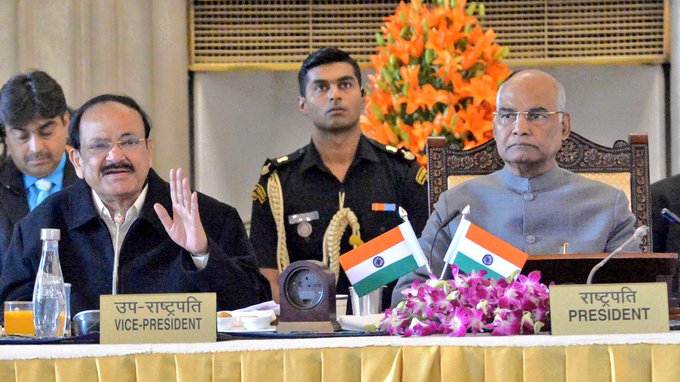
Ensure that the Government’s transformational programmes taken up are effectively implemented – Vice President

The Vice President, Shri M. Venkaiah Naidu said today that India is witnessing a rapid transformation in all spheres and that the Prime Minister’s clarion call of ‘reform, perform and transform’ has given a new sense of urgency and direction to the country, and the Governors should ensure that the momentum is maintained and tangible outcomes are achieved through collective and collaborative efforts.

Addressing the concluding session of 50th Governors’ Conference at Rashtrapati Bhawan today, Shri Naidu said that Governors, with their vast experience, can play an active role in shaping India’s development path.

Shri Naidu said that there cannot be a better time than now for us to make our “Ek Bharat” a “Shrestha Bharat”. The Vice President called upon the Governors to promote this spirit of ‘Bharatiyata’.

He drew their attention towards the rich cultural traditions and linguistic, literary heritage of each state, and stressed the need for its preservation.

“You must support efforts to preserve local culture, festivals and food varieties. You must encourage healthy foods and healthy lifestyle. You must encourage the preservation of local art forms and programmes that support local artisans and craftsmen”, he told the Governors.

He also asked them to ensure that local languages get their due place in administration and wherever public interfaces exist.

Calling the language as the repository of the culture of a region, Shri Naidu urged the Governors to actively encourage state governments to preserve and promote mother tongues and use them as a medium of instruction at least at the primary school level.

Shri Naidu also drew the Governors’ attention to certain colonial practices which need to be reviewed. For example, addressing high dignitaries as Excellency and adopting the cap and gown dress in the university convocations can be modified to bring in an essential Indian touch.

Expressing concern over the unsustainable water use, the Vice President called for urgent need for water conservation.

Lauding the Government’s aim to double farmers’ incomes and make agriculture remunerative and sustainable, he mentioned several structural reforms being introduced in farm sector.

Calling ‘agriculture as the basic culture’ of the country, he emphasised a greater need for effective ‘lab-to-land’ transmission of knowledge and promotion of diversification of crops, as well as supplementation of on-farm income through horticulture, dairy, poultry and pisciculture.

The Vice President further said that in the field of higher education, the focus will have to be on encouraging innovation and continuous quest for excellence. Research and teaching facilities have to be benchmarked against the best in the world, he added.

The two-day conference at Rashtrapati Bhavan was presided over by the Hon’ble President of India, Shri Ram Nath Kovind. Shri Amit Shah the Union Home Minister, Shri Ravi Shankar Prasad, Minister of IT & Communication, Law and Justice, Shri Gajendra singh Shekhawat, Minister of Jal Shakti, Shri Narendra Singh Tomar, Minister of Agriculture and Farmer Welfare , Shri Arjun Munda, Minister of Tribal affairs as well as the Governors of States and Lt. Governors and Administrators of UTs were among the dignitaries who attended the Conference.

*****

Pseudo Solutions for Real Educational Problems

Ask an intelligent question and get a ________ reply!
Here\’s an experiment. It seems to work well with functionaries from educational systems in India, Bangladesh and several other countries in South Asia and beyond.
Bring together a group of educational personnel such as academic supervisors, district and state / provincial educational officials. Pose a critical educational problem before them. Of the kind that they probably deal with on a daily basis, such as:
  • How to improve learning among children? Or
  • What action to take so that classroom processes become more interactive than they are at present? Or
  • How to enable children to enjoy learning mathematics (rather than being afraid of it)? Or
  • How to ensure and increase teacher attendance?

 Now, monitor the responses you get. They will usually include answers such as:
Teachers must be dedicated / devoted to the profession.
  • We must ensure that the system functions well.
  • We must increase monitoring and do it properly.
  • Teachers must be made aware of their responsibilities.

That didn\’t surprise you, did it? These are the typical answers one hears (you can probably increase the list greatly). But why should these answers worry us?
Because these answers are positively dangerous!
Either they reveal that our education system is in the hands of people who don\’t know what to do. Or, what is worse, it is in the hands of those who know what to do but are trying to hide behind these kinds of answers.
You can decide for yourself – after taking a look at the explanation below.
THE RICH VARIETY OF PSEUDO SOLUTIONS
The key issue is that instead of actions and concrete steps, those responsible come up with other things instead. From an educational planning point of view, a step or an action is something that you have to do, that you can set in a clear time-frame, that can be budgeted, broken down into clear parts to be implemented. It is not a vague statement of good intent.
And by coming up with statements that are not actions or steps, those making these statements are actually preventing solutions from really coming about. Here\’s how.
Give a quality instead of an action
A commonly offered \’solution\’ – \’teacher must be dedicated to his profession\’ – is not an action but a quality, the outcome of many other steps that we would have to take. Since those talking are often even responsible for recruiting teachers (and they did not take into account whether the potential teacher had a sense of \’dedication\’ or not), they need to discuss exactly how this dedication will now be ensured. E.g. by conveying to teacher that they matter, are valued, by visiting them, developing and disseminating performance standards (and using them to identify good performance, in an objective manner), or by setting role models in the form of the seniors themselves following a code of conduct, or a thousand other activities…. But instead of concrete action, we are presented sermons. Basically, offering a quality instead of a step merely looks like a ploy to avoid the necessary!
Defer the solution through \’action\’ that keeps on requiring further action
Do you remember those little \’Russian\’ dolls we used to get long ago – you lifted one and found another doll inside it, and another one inside, and so on. This variety of \’pseudo-solution\’ is just like those dolls. Here, the proposed solution is nothing but a guise to postpone committing oneself to actual action. For instance, you commonly hear suggestions such as \’Teachers must be trained properly\’, which begs the question: \’What should we do to ensure that teachers are trained properly?\’ Answer: \’We must have proper trainers.\’ But: \’How will we get proper trainers?\’ Answer: \’By recruiting them properly.\’ And so on. The solution is never really in your grasp; it keeps on evading you because it contains in itself yet another question, the answer to which contains another one…. Even Socrates with his Socratic Method would have had a tough time pinning down the actual action required. Lesser mortals like us just go mad and give up!
Show resolve, not necessarily solve!
Here, the answer to the critical problem is in the form of some very resolute-sounding statement. It gives the feeling that people are \’very serious\’ about doing something (never mind if scratching the surface shows that it can\’t really be converted into action). Pseudo-solutions of this category sound like this: \’We must ensure discipline.\’ Or \’We have to cover every single school.\’ Or \’The inputs must be made regularly.\’
Nothing wrong with these statements, except that they are only resolutions and not clear steps or concrete action. They don\’t take into account that the present action, which is so strongly being proposed to be improved, may itself not be the right action to start with. Or may not even have anything wrong to begin with. For instance, before concluding that inputs must be made regularly, we need to take into account that perhaps the inputs may be inappropriate, and making them regular will not help. Also, the feeling is that having said that they will be regular, what are the steps to make them regular? (E.g. use of scheduling software and training everyone it its use, or interactions to discuss the needs of the different components of our programme in terms of regularity as well as the nature of inputs needed, and exploring whether more than just regularity it is how well they are implemented that needs to be improved…)
Once again, the feeling is that having declared something solemnly, it will now happen. Unfortunately, it doesn\’t.
Everyone except us!
This is encapsulated in statements that exhort everyone to pull up their socks (or equivalent), except the people making these statements. Hence in a discussion on the kind of improvements required to increase the effectiveness of an educational system or a programme, it will be said that teachers must be devoted / dedicated, that supervisory staff must be capable, that managers must be professional and administrators sensitive and flexible apart from being committed. Such statements will be made about categories other than that of the solution givers, of course! And of course it is still not clear as to how the suggested change will be brought about.
The monitoring myth
For some reason as yet not very clear, a lot of proposed solutions have to do with monitoring – it is pointed out that monitoring is very poor, ineffective, irregular, and several other words that I\’m sure you can reel off. Well, excuse me, but monitoring is extremely limited as a solution. A commonly used example: I\’m monitoring the weight of a child regularly and it keeps on decreasing – all this regular monitoring does not help me if I don’t know what to do – the kind of nutrition to ensure, how to obtain / procure and prepare the required nutrients and enable the child to ingest these in an appropriate manner over the required period… I can keep monitoring without necessarily bringing about any improvement.
The dangerous part is the feeling that programmes and systems work only if they are monitored. Not necessarily – in order to work well, those involved need to feel that they are doing something worthwhile, that someone cares that they are there, that the task is challenging yet doable and enjoyable, that they are equipped to do it, enjoy doing it and are supported in their actions. Under these circumstances monitoring can indeed play a role to enhance effectiveness, but it is no substitute for the basics that need to be in place. It\’s a little bit like a car that has a very good speedometer and odometer (monitoring devices), but no engine (implementation requirement)! Good monitoring is not necessarily equal to good implementation.
An accompanying myth is that better planning is the solution. In fact, if you look at the kind of technical professionals brought in by donor agencies, multilaterals, development partners and even governments, there seems to a far greater concentration on the planning and the monitoring/evaluation parts, but very little on the stuff that comes in between the two – i.e., implementation! And that is why, when educational functionaries are asked to come up with solutions or steps that will lead to specific outcomes, they tend to suggest action related to better planning and monitoring, rather than improved implementation.
The thesis, and a question
So that\’s the thesis – that when asked to identify actions / steps / solutions to address critical educational issues, those responsible come up with things that might look like them but are not the real thing. And it is this that has kept us back, preventing the huge amounts of money and effort being invested from translating into reality.
But if this is actually the case, is it due to sheer incompetence, or is it a deliberate ploy to ensure that real change does not happen (because behind it all, people are very uncomfortable with an education system that actually works). If you\’re a conspiracy theorist too, let me know!

The Tsunami We Don\’t Always See

Our hearts go out to the sufferings of people in Japan. The pictures of the tsunami rushing in and engulfing everything in sight, wreaking havoc – will stay with us. Our sympathies and support should – and will – be available to help our fellow human beings in whatever way we can.
Our horror – and the desire to do something – would obviously be even more if we saw something similar happening all around us. And in a way something similar is happening all around us, only it is not as dramatic as a physical tsunami, making it a little difficult to be noticed by most people. It is what I would call the tsunami of poor quality of education that is hitting a million schools and tens of millions of children, its impact likely to be visible over the years rather than right now, instantly, in front of our eyes.
The Tsunami Around Us
No this is not alarmist, but an effort to put across a real picture and the urgency with which it needs to be recognized and acted upon. Every day, in hundreds of thousands of locations across the country, children make their way to the school. Around a quarter of them may find their teacher not there. This number alone is staggering, ranging as it would between one and two million teachers. MILLION! And if each teacher has 30 children in his class, you can estimate the number but not really conceive how enormous it is. And it is huge not just in terms of numbers, but for each child who loses a day of learning, and does so for many days every month, it is incalculable.
Had the facilities or the teachers not been available we could have cried over our fate in terms of being an underdeveloped country. But having the infrastructure (over 98% children have a school within a kilometre, and most buildings are not bad) and teachers actually in place (though the number of vacancies is still very large) – it is horrifying to watch or at least it should be, for there doesn\’t seem to be a sense of horror, or as much of it as would shake the country into action.
However the story doesn\’t end there. It is when \’teaching\’ takes place that the impact on children is often at its greatest. Decades ago, the Yashpal Committee\’s report on The Burden of the School Bag had detailed the \’burden of incomprehension\’ a majority of children bear. And it is difficult to see if things have changed dramatically, despite changed curricula, textbooks, the use of TLM, evolving assessment patterns, new training programmes… The number of children attending school – and their diversity – too has grown in leaps and bounds, while the approach to handling their needs has remained fairly static. Hence, survey after survey shows that – despite a degree of improvement – we continue to be far from the levels of learning desired (and possible).
But it is when it comes to the process that the greatest deadening effect takes place. Rote memorization, \’explanation\’ ina language not necessarily understood by children, a disregard for the needs of children who are too poor to be able to attend regularly, (an often active) discrimination in the classroom, are the lot of a majority of our children. If you doubt this, all you have to do is visit any 10 government schools in different locations, especially those away from \’headquarters\’.
This is not to say that all government schools are bad and that the \’bad\’ is restricted to government schools. It is to point out that even if only a third of schools are like the ones described above (and the number is surely more than that), it adds up to literally hundreds of thousands of schools and tens of millions of children – a slow tsunami of poor quality education that is surely wreaking havoc on the potential of our children, our country.
Dealing With It
So after all this panic, what do we do?
As in any disaster, stay calm! First recognize that there is a problem and accept that something must be done about it.
Second, realize that you are the right person to do something about it. Anyone is, everyone is. Every small action counts. Even if you smile at a child, say an encouraging word to a teacher, raise this issue with friends, relatives and colleagues, you are doing something.
Third, if you are willing to be more proactive or are already active, please do look at the urgency of the situation. Children cannot wait for us to learn or get our act together slowly. We need to quickly:
  • Establish the minimum conditions that must obtain. These are well laid out in the RTE (Right to Education) and its rules. Raise this issue wherever you can, and directly with the school or education authorities.
  • Encourage and support the community and the school management committees (SMCs) drawn from among the community to become more active. You can help in setting them up, in record keeping, in setting the agenda, in follow up, in helping ensure that teachers take them seriously and that they in turn don\’t take an adversarial position vis-à-vis teachers. You can use your position to ensure that the educational agenda is not hijacked by the money-making or power-gaining agenda.

If you are a Head Teacher, supervisor, CRC-BRC / district level teacher educator or officer:
  • Model the kind of behaviour you want from teachers
  • Share practical steps they can take in their classes, especially in terms of activity-based teaching (see the many entries in this blog for support)
  • Encourage teachers to be innovative, support them. If they ask questions, don\’t be dismissive (pass on the questions here if you can answer them!)

If you are a planner / policy-maker / decision- maker, please start by not dismissing what you have just read here. It is real, and it is happening – and it\’s on a gargantuan scale. On any given day, the number of children who are in school and not learning is more than the population of many countries – and it is a shame. What kind of performance standards can you set in place? What kind of outcomes can you insist on? How can you prepare the institutions and the system to deliver this, monitor them effectively and enable an ongoing improvement? Once again, the many entries in this blog would be helpful – and you could always share issues you would like others to provide suggestions / inputs on.
As surely as Japan will recover from the huge earthquake and the devastating tsunami, we can deal with this too. But first we have to see it as an emergency and address it. With all our might.

The Tsunami We Don\’t Always See

Our hearts go out to the sufferings of people in Japan. The pictures of the tsunami rushing in and engulfing everything in sight, wreaking havoc – will stay with us. Our sympathies and support should – and will – be available to help our fellow human beings in whatever way we can.
Our horror – and the desire to do something – would obviously be even more if we saw something similar happening all around us. And in a way something similar is happening all around us, only it is not as dramatic as a physical tsunami, making it a little difficult to be noticed by most people. It is what I would call the tsunami of poor quality of education that is hitting a million schools and tens of millions of children, its impact likely to be visible over the years rather than right now, instantly, in front of our eyes.
The Tsunami Around Us
No this is not alarmist, but an effort to put across a real picture and the urgency with which it needs to be recognized and acted upon. Every day, in hundreds of thousands of locations across the country, children make their way to the school. Around a quarter of them may find their teacher not there. This number alone is staggering, ranging as it would between one and two million teachers. MILLION! And if each teacher has 30 children in his class, you can estimate the number but not really conceive how enormous it is. And it is huge not just in terms of numbers, but for each child who loses a day of learning, and does so for many days every month, it is incalculable.
Had the facilities or the teachers not been available we could have cried over our fate in terms of being an underdeveloped country. But having the infrastructure (over 98% children have a school within a kilometre, and most buildings are not bad) and teachers actually in place (though the number of vacancies is still very large) – it is horrifying to watch or at least it should be, for there doesn\’t seem to be a sense of horror, or as much of it as would shake the country into action.
However the story doesn\’t end there. It is when \’teaching\’ takes place that the impact on children is often at its greatest. Decades ago, the Yashpal Committee\’s report on The Burden of the School Bag had detailed the \’burden of incomprehension\’ a majority of children bear. And it is difficult to see if things have changed dramatically, despite changed curricula, textbooks, the use of TLM, evolving assessment patterns, new training programmes… The number of children attending school – and their diversity – too has grown in leaps and bounds, while the approach to handling their needs has remained fairly static. Hence, survey after survey shows that – despite a degree of improvement – we continue to be far from the levels of learning desired (and possible).
But it is when it comes to the process that the greatest deadening effect takes place. Rote memorization, \’explanation\’ ina language not necessarily understood by children, a disregard for the needs of children who are too poor to be able to attend regularly, (an often active) discrimination in the classroom, are the lot of a majority of our children. If you doubt this, all you have to do is visit any 10 government schools in different locations, especially those away from \’headquarters\’.
This is not to say that all government schools are bad and that the \’bad\’ is restricted to government schools. It is to point out that even if only a third of schools are like the ones described above (and the number is surely more than that), it adds up to literally hundreds of thousands of schools and tens of millions of children – a slow tsunami of poor quality education that is surely wreaking havoc on the potential of our children, our country.
Dealing With It
So after all this panic, what do we do?
As in any disaster, stay calm! First recognize that there is a problem and accept that something must be done about it.
Second, realize that you are the right person to do something about it. Anyone is, everyone is. Every small action counts. Even if you smile at a child, say an encouraging word to a teacher, raise this issue with friends, relatives and colleagues, you are doing something.
Third, if you are willing to be more proactive or are already active, please do look at the urgency of the situation. Children cannot wait for us to learn or get our act together slowly. We need to quickly:
  • Establish the minimum conditions that must obtain. These are well laid out in the RTE (Right to Education) and its rules. Raise this issue wherever you can, and directly with the school or education authorities.
  • Encourage and support the community and the school management committees (SMCs) drawn from among the community to become more active. You can help in setting them up, in record keeping, in setting the agenda, in follow up, in helping ensure that teachers take them seriously and that they in turn don\’t take an adversarial position vis-à-vis teachers. You can use your position to ensure that the educational agenda is not hijacked by the money-making or power-gaining agenda.

If you are a Head Teacher, supervisor, CRC-BRC / district level teacher educator or officer:
  • Model the kind of behaviour you want from teachers
  • Share practical steps they can take in their classes, especially in terms of activity-based teaching (see the many entries in this blog for support)
  • Encourage teachers to be innovative, support them. If they ask questions, don\’t be dismissive (pass on the questions here if you can answer them!)

If you are a planner / policy-maker / decision- maker, please start by not dismissing what you have just read here. It is real, and it is happening – and it\’s on a gargantuan scale. On any given day, the number of children who are in school and not learning is more than the population of many countries – and it is a shame. What kind of performance standards can you set in place? What kind of outcomes can you insist on? How can you prepare the institutions and the system to deliver this, monitor them effectively and enable an ongoing improvement? Once again, the many entries in this blog would be helpful – and you could always share issues you would like others to provide suggestions / inputs on.
As surely as Japan will recover from the huge earthquake and the devastating tsunami, we can deal with this too. But first we have to see it as an emergency and address it. With all our might.

The Tsunami We Don\’t Always See

Our hearts go out to the sufferings of people in Japan. The pictures of the tsunami rushing in and engulfing everything in sight, wreaking havoc – will stay with us. Our sympathies and support should – and will – be available to help our fellow human beings in whatever way we can.
Our horror – and the desire to do something – would obviously be even more if we saw something similar happening all around us. And in a way something similar is happening all around us, only it is not as dramatic as a physical tsunami, making it a little difficult to be noticed by most people. It is what I would call the tsunami of poor quality of education that is hitting a million schools and tens of millions of children, its impact likely to be visible over the years rather than right now, instantly, in front of our eyes.
The Tsunami Around Us
No this is not alarmist, but an effort to put across a real picture and the urgency with which it needs to be recognized and acted upon. Every day, in hundreds of thousands of locations across the country, children make their way to the school. Around a quarter of them may find their teacher not there. This number alone is staggering, ranging as it would between one and two million teachers. MILLION! And if each teacher has 30 children in his class, you can estimate the number but not really conceive how enormous it is. And it is huge not just in terms of numbers, but for each child who loses a day of learning, and does so for many days every month, it is incalculable.
Had the facilities or the teachers not been available we could have cried over our fate in terms of being an underdeveloped country. But having the infrastructure (over 98% children have a school within a kilometre, and most buildings are not bad) and teachers actually in place (though the number of vacancies is still very large) – it is horrifying to watch or at least it should be, for there doesn\’t seem to be a sense of horror, or as much of it as would shake the country into action.
However the story doesn\’t end there. It is when \’teaching\’ takes place that the impact on children is often at its greatest. Decades ago, the Yashpal Committee\’s report on The Burden of the School Bag had detailed the \’burden of incomprehension\’ a majority of children bear. And it is difficult to see if things have changed dramatically, despite changed curricula, textbooks, the use of TLM, evolving assessment patterns, new training programmes… The number of children attending school – and their diversity – too has grown in leaps and bounds, while the approach to handling their needs has remained fairly static. Hence, survey after survey shows that – despite a degree of improvement – we continue to be far from the levels of learning desired (and possible).
But it is when it comes to the process that the greatest deadening effect takes place. Rote memorization, \’explanation\’ ina language not necessarily understood by children, a disregard for the needs of children who are too poor to be able to attend regularly, (an often active) discrimination in the classroom, are the lot of a majority of our children. If you doubt this, all you have to do is visit any 10 government schools in different locations, especially those away from \’headquarters\’.
This is not to say that all government schools are bad and that the \’bad\’ is restricted to government schools. It is to point out that even if only a third of schools are like the ones described above (and the number is surely more than that), it adds up to literally hundreds of thousands of schools and tens of millions of children – a slow tsunami of poor quality education that is surely wreaking havoc on the potential of our children, our country.
Dealing With It
So after all this panic, what do we do?
As in any disaster, stay calm! First recognize that there is a problem and accept that something must be done about it.
Second, realize that you are the right person to do something about it. Anyone is, everyone is. Every small action counts. Even if you smile at a child, say an encouraging word to a teacher, raise this issue with friends, relatives and colleagues, you are doing something.
Third, if you are willing to be more proactive or are already active, please do look at the urgency of the situation. Children cannot wait for us to learn or get our act together slowly. We need to quickly:
  • Establish the minimum conditions that must obtain. These are well laid out in the RTE (Right to Education) and its rules. Raise this issue wherever you can, and directly with the school or education authorities.
  • Encourage and support the community and the school management committees (SMCs) drawn from among the community to become more active. You can help in setting them up, in record keeping, in setting the agenda, in follow up, in helping ensure that teachers take them seriously and that they in turn don\’t take an adversarial position vis-à-vis teachers. You can use your position to ensure that the educational agenda is not hijacked by the money-making or power-gaining agenda.

If you are a Head Teacher, supervisor, CRC-BRC / district level teacher educator or officer:
  • Model the kind of behaviour you want from teachers
  • Share practical steps they can take in their classes, especially in terms of activity-based teaching (see the many entries in this blog for support)
  • Encourage teachers to be innovative, support them. If they ask questions, don\’t be dismissive (pass on the questions here if you can answer them!)

If you are a planner / policy-maker / decision- maker, please start by not dismissing what you have just read here. It is real, and it is happening – and it\’s on a gargantuan scale. On any given day, the number of children who are in school and not learning is more than the population of many countries – and it is a shame. What kind of performance standards can you set in place? What kind of outcomes can you insist on? How can you prepare the institutions and the system to deliver this, monitor them effectively and enable an ongoing improvement? Once again, the many entries in this blog would be helpful – and you could always share issues you would like others to provide suggestions / inputs on.
As surely as Japan will recover from the huge earthquake and the devastating tsunami, we can deal with this too. But first we have to see it as an emergency and address it. With all our might.

The Tsunami We Don\’t Always See

Our hearts go out to the sufferings of people in Japan. The pictures of the tsunami rushing in and engulfing everything in sight, wreaking havoc – will stay with us. Our sympathies and support should – and will – be available to help our fellow human beings in whatever way we can.
Our horror – and the desire to do something – would obviously be even more if we saw something similar happening all around us. And in a way something similar is happening all around us, only it is not as dramatic as a physical tsunami, making it a little difficult to be noticed by most people. It is what I would call the tsunami of poor quality of education that is hitting a million schools and tens of millions of children, its impact likely to be visible over the years rather than right now, instantly, in front of our eyes.
The Tsunami Around Us
No this is not alarmist, but an effort to put across a real picture and the urgency with which it needs to be recognized and acted upon. Every day, in hundreds of thousands of locations across the country, children make their way to the school. Around a quarter of them may find their teacher not there. This number alone is staggering, ranging as it would between one and two million teachers. MILLION! And if each teacher has 30 children in his class, you can estimate the number but not really conceive how enormous it is. And it is huge not just in terms of numbers, but for each child who loses a day of learning, and does so for many days every month, it is incalculable.
Had the facilities or the teachers not been available we could have cried over our fate in terms of being an underdeveloped country. But having the infrastructure (over 98% children have a school within a kilometre, and most buildings are not bad) and teachers actually in place (though the number of vacancies is still very large) – it is horrifying to watch or at least it should be, for there doesn\’t seem to be a sense of horror, or as much of it as would shake the country into action.
However the story doesn\’t end there. It is when \’teaching\’ takes place that the impact on children is often at its greatest. Decades ago, the Yashpal Committee\’s report on The Burden of the School Bag had detailed the \’burden of incomprehension\’ a majority of children bear. And it is difficult to see if things have changed dramatically, despite changed curricula, textbooks, the use of TLM, evolving assessment patterns, new training programmes… The number of children attending school – and their diversity – too has grown in leaps and bounds, while the approach to handling their needs has remained fairly static. Hence, survey after survey shows that – despite a degree of improvement – we continue to be far from the levels of learning desired (and possible).
But it is when it comes to the process that the greatest deadening effect takes place. Rote memorization, \’explanation\’ ina language not necessarily understood by children, a disregard for the needs of children who are too poor to be able to attend regularly, (an often active) discrimination in the classroom, are the lot of a majority of our children. If you doubt this, all you have to do is visit any 10 government schools in different locations, especially those away from \’headquarters\’.
This is not to say that all government schools are bad and that the \’bad\’ is restricted to government schools. It is to point out that even if only a third of schools are like the ones described above (and the number is surely more than that), it adds up to literally hundreds of thousands of schools and tens of millions of children – a slow tsunami of poor quality education that is surely wreaking havoc on the potential of our children, our country.
Dealing With It
So after all this panic, what do we do?
As in any disaster, stay calm! First recognize that there is a problem and accept that something must be done about it.
Second, realize that you are the right person to do something about it. Anyone is, everyone is. Every small action counts. Even if you smile at a child, say an encouraging word to a teacher, raise this issue with friends, relatives and colleagues, you are doing something.
Third, if you are willing to be more proactive or are already active, please do look at the urgency of the situation. Children cannot wait for us to learn or get our act together slowly. We need to quickly:
  • Establish the minimum conditions that must obtain. These are well laid out in the RTE (Right to Education) and its rules. Raise this issue wherever you can, and directly with the school or education authorities.
  • Encourage and support the community and the school management committees (SMCs) drawn from among the community to become more active. You can help in setting them up, in record keeping, in setting the agenda, in follow up, in helping ensure that teachers take them seriously and that they in turn don\’t take an adversarial position vis-à-vis teachers. You can use your position to ensure that the educational agenda is not hijacked by the money-making or power-gaining agenda.

If you are a Head Teacher, supervisor, CRC-BRC / district level teacher educator or officer:
  • Model the kind of behaviour you want from teachers
  • Share practical steps they can take in their classes, especially in terms of activity-based teaching (see the many entries in this blog for support)
  • Encourage teachers to be innovative, support them. If they ask questions, don\’t be dismissive (pass on the questions here if you can answer them!)

If you are a planner / policy-maker / decision- maker, please start by not dismissing what you have just read here. It is real, and it is happening – and it\’s on a gargantuan scale. On any given day, the number of children who are in school and not learning is more than the population of many countries – and it is a shame. What kind of performance standards can you set in place? What kind of outcomes can you insist on? How can you prepare the institutions and the system to deliver this, monitor them effectively and enable an ongoing improvement? Once again, the many entries in this blog would be helpful – and you could always share issues you would like others to provide suggestions / inputs on.
As surely as Japan will recover from the huge earthquake and the devastating tsunami, we can deal with this too. But first we have to see it as an emergency and address it. With all our might.

The Tsunami We Don\’t Always See

Our hearts go out to the sufferings of people in Japan. The pictures of the tsunami rushing in and engulfing everything in sight, wreaking havoc – will stay with us. Our sympathies and support should – and will – be available to help our fellow human beings in whatever way we can.
Our horror – and the desire to do something – would obviously be even more if we saw something similar happening all around us. And in a way something similar is happening all around us, only it is not as dramatic as a physical tsunami, making it a little difficult to be noticed by most people. It is what I would call the tsunami of poor quality of education that is hitting a million schools and tens of millions of children, its impact likely to be visible over the years rather than right now, instantly, in front of our eyes.
The Tsunami Around Us
No this is not alarmist, but an effort to put across a real picture and the urgency with which it needs to be recognized and acted upon. Every day, in hundreds of thousands of locations across the country, children make their way to the school. Around a quarter of them may find their teacher not there. This number alone is staggering, ranging as it would between one and two million teachers. MILLION! And if each teacher has 30 children in his class, you can estimate the number but not really conceive how enormous it is. And it is huge not just in terms of numbers, but for each child who loses a day of learning, and does so for many days every month, it is incalculable.
Had the facilities or the teachers not been available we could have cried over our fate in terms of being an underdeveloped country. But having the infrastructure (over 98% children have a school within a kilometre, and most buildings are not bad) and teachers actually in place (though the number of vacancies is still very large) – it is horrifying to watch or at least it should be, for there doesn\’t seem to be a sense of horror, or as much of it as would shake the country into action.
However the story doesn\’t end there. It is when \’teaching\’ takes place that the impact on children is often at its greatest. Decades ago, the Yashpal Committee\’s report on The Burden of the School Bag had detailed the \’burden of incomprehension\’ a majority of children bear. And it is difficult to see if things have changed dramatically, despite changed curricula, textbooks, the use of TLM, evolving assessment patterns, new training programmes… The number of children attending school – and their diversity – too has grown in leaps and bounds, while the approach to handling their needs has remained fairly static. Hence, survey after survey shows that – despite a degree of improvement – we continue to be far from the levels of learning desired (and possible).
But it is when it comes to the process that the greatest deadening effect takes place. Rote memorization, \’explanation\’ ina language not necessarily understood by children, a disregard for the needs of children who are too poor to be able to attend regularly, (an often active) discrimination in the classroom, are the lot of a majority of our children. If you doubt this, all you have to do is visit any 10 government schools in different locations, especially those away from \’headquarters\’.
This is not to say that all government schools are bad and that the \’bad\’ is restricted to government schools. It is to point out that even if only a third of schools are like the ones described above (and the number is surely more than that), it adds up to literally hundreds of thousands of schools and tens of millions of children – a slow tsunami of poor quality education that is surely wreaking havoc on the potential of our children, our country.
Dealing With It
So after all this panic, what do we do?
As in any disaster, stay calm! First recognize that there is a problem and accept that something must be done about it.
Second, realize that you are the right person to do something about it. Anyone is, everyone is. Every small action counts. Even if you smile at a child, say an encouraging word to a teacher, raise this issue with friends, relatives and colleagues, you are doing something.
Third, if you are willing to be more proactive or are already active, please do look at the urgency of the situation. Children cannot wait for us to learn or get our act together slowly. We need to quickly:
  • Establish the minimum conditions that must obtain. These are well laid out in the RTE (Right to Education) and its rules. Raise this issue wherever you can, and directly with the school or education authorities.
  • Encourage and support the community and the school management committees (SMCs) drawn from among the community to become more active. You can help in setting them up, in record keeping, in setting the agenda, in follow up, in helping ensure that teachers take them seriously and that they in turn don\’t take an adversarial position vis-à-vis teachers. You can use your position to ensure that the educational agenda is not hijacked by the money-making or power-gaining agenda.

If you are a Head Teacher, supervisor, CRC-BRC / district level teacher educator or officer:
  • Model the kind of behaviour you want from teachers
  • Share practical steps they can take in their classes, especially in terms of activity-based teaching (see the many entries in this blog for support)
  • Encourage teachers to be innovative, support them. If they ask questions, don\’t be dismissive (pass on the questions here if you can answer them!)

If you are a planner / policy-maker / decision- maker, please start by not dismissing what you have just read here. It is real, and it is happening – and it\’s on a gargantuan scale. On any given day, the number of children who are in school and not learning is more than the population of many countries – and it is a shame. What kind of performance standards can you set in place? What kind of outcomes can you insist on? How can you prepare the institutions and the system to deliver this, monitor them effectively and enable an ongoing improvement? Once again, the many entries in this blog would be helpful – and you could always share issues you would like others to provide suggestions / inputs on.
As surely as Japan will recover from the huge earthquake and the devastating tsunami, we can deal with this too. But first we have to see it as an emergency and address it. With all our might.

The Tsunami We Don\’t Always See

Our hearts go out to the sufferings of people in Japan. The pictures of the tsunami rushing in and engulfing everything in sight, wreaking havoc – will stay with us. Our sympathies and support should – and will – be available to help our fellow human beings in whatever way we can.
Our horror – and the desire to do something – would obviously be even more if we saw something similar happening all around us. And in a way something similar is happening all around us, only it is not as dramatic as a physical tsunami, making it a little difficult to be noticed by most people. It is what I would call the tsunami of poor quality of education that is hitting a million schools and tens of millions of children, its impact likely to be visible over the years rather than right now, instantly, in front of our eyes.
The Tsunami Around Us
No this is not alarmist, but an effort to put across a real picture and the urgency with which it needs to be recognized and acted upon. Every day, in hundreds of thousands of locations across the country, children make their way to the school. Around a quarter of them may find their teacher not there. This number alone is staggering, ranging as it would between one and two million teachers. MILLION! And if each teacher has 30 children in his class, you can estimate the number but not really conceive how enormous it is. And it is huge not just in terms of numbers, but for each child who loses a day of learning, and does so for many days every month, it is incalculable.
Had the facilities or the teachers not been available we could have cried over our fate in terms of being an underdeveloped country. But having the infrastructure (over 98% children have a school within a kilometre, and most buildings are not bad) and teachers actually in place (though the number of vacancies is still very large) – it is horrifying to watch or at least it should be, for there doesn\’t seem to be a sense of horror, or as much of it as would shake the country into action.
However the story doesn\’t end there. It is when \’teaching\’ takes place that the impact on children is often at its greatest. Decades ago, the Yashpal Committee\’s report on The Burden of the School Bag had detailed the \’burden of incomprehension\’ a majority of children bear. And it is difficult to see if things have changed dramatically, despite changed curricula, textbooks, the use of TLM, evolving assessment patterns, new training programmes… The number of children attending school – and their diversity – too has grown in leaps and bounds, while the approach to handling their needs has remained fairly static. Hence, survey after survey shows that – despite a degree of improvement – we continue to be far from the levels of learning desired (and possible).
But it is when it comes to the process that the greatest deadening effect takes place. Rote memorization, \’explanation\’ ina language not necessarily understood by children, a disregard for the needs of children who are too poor to be able to attend regularly, (an often active) discrimination in the classroom, are the lot of a majority of our children. If you doubt this, all you have to do is visit any 10 government schools in different locations, especially those away from \’headquarters\’.
This is not to say that all government schools are bad and that the \’bad\’ is restricted to government schools. It is to point out that even if only a third of schools are like the ones described above (and the number is surely more than that), it adds up to literally hundreds of thousands of schools and tens of millions of children – a slow tsunami of poor quality education that is surely wreaking havoc on the potential of our children, our country.
Dealing With It
So after all this panic, what do we do?
As in any disaster, stay calm! First recognize that there is a problem and accept that something must be done about it.
Second, realize that you are the right person to do something about it. Anyone is, everyone is. Every small action counts. Even if you smile at a child, say an encouraging word to a teacher, raise this issue with friends, relatives and colleagues, you are doing something.
Third, if you are willing to be more proactive or are already active, please do look at the urgency of the situation. Children cannot wait for us to learn or get our act together slowly. We need to quickly:
  • Establish the minimum conditions that must obtain. These are well laid out in the RTE (Right to Education) and its rules. Raise this issue wherever you can, and directly with the school or education authorities.
  • Encourage and support the community and the school management committees (SMCs) drawn from among the community to become more active. You can help in setting them up, in record keeping, in setting the agenda, in follow up, in helping ensure that teachers take them seriously and that they in turn don\’t take an adversarial position vis-à-vis teachers. You can use your position to ensure that the educational agenda is not hijacked by the money-making or power-gaining agenda.

If you are a Head Teacher, supervisor, CRC-BRC / district level teacher educator or officer:
  • Model the kind of behaviour you want from teachers
  • Share practical steps they can take in their classes, especially in terms of activity-based teaching (see the many entries in this blog for support)
  • Encourage teachers to be innovative, support them. If they ask questions, don\’t be dismissive (pass on the questions here if you can answer them!)

If you are a planner / policy-maker / decision- maker, please start by not dismissing what you have just read here. It is real, and it is happening – and it\’s on a gargantuan scale. On any given day, the number of children who are in school and not learning is more than the population of many countries – and it is a shame. What kind of performance standards can you set in place? What kind of outcomes can you insist on? How can you prepare the institutions and the system to deliver this, monitor them effectively and enable an ongoing improvement? Once again, the many entries in this blog would be helpful – and you could always share issues you would like others to provide suggestions / inputs on.
As surely as Japan will recover from the huge earthquake and the devastating tsunami, we can deal with this too. But first we have to see it as an emergency and address it. With all our might.

Missing the Aim(s) of Education!

It\’s a perennial struggle to define what we really want out of education. That is, it is a struggle for those who are vested with the responsibility of developing the curriculum, materials, evaluation and the like. For others, such as parents, things are reasonably clear. Which is where part of the problem lies.
The common man, or the consumer, or the parents of children who come to a majority of our schools, have no doubt at all that the purpose of education is to prepare children so that they can get a job (and be a worry off their heads). Many others – such as owners of private schools – boast that they get hundred percent results in the various examinations. Implying that the purpose of education is to get children to pass through examinations with flying colours (and what the purpose of the examinations is of course well known to all!)
And if you ask teachers in government schools, the ones who actually teach and are considered \’sincere\’, they will usually come out with statements such as: \’to develop a citizen, for all round development, someone with values, someone who can be called an educated person.\’
But when it comes to developing the curriculum we are somehow so reluctant to agree with these commonly held perceptions. We want something better, higher, more durable (our own approximation of the Olympics motto?) \’To produce someone who has a deep sense of values\’ is one of the most common aspirations. But what kind of values? And what to do about the fact that values are so relative (e.g. in certain situations, you actually get a medal for killing a man!). What is needed in order to be able to exercise values appropriately in a contextual and relative manner? And is that more a cognitive rather than ethical function (e.g. identifying options, weighing them against each other on various criteria, etc.)?
\’Education should develop the right kind of sanskars / culture in the student\’ is the next most popular choice. But whose culture are we talking about? A teacher trying to teach children how to use a handkerchief to blow their nose was left aghast when they reacted with amused horror as he put his handkerchief back into his pocket – they said they always threw things away after blowing their nose with rather than putting them back into their pocket! In a context as diverse as ours where the good manners of one group are easily the bad manners of others would we not end up simply extending the social control of dominant cultural group/s?
Unable to resolve this we move to discussing: what kind of society do we want to see? What would we consider a developed society? Where everyone has a job and the per capita income is high (back to jobs as the most important criterion?).  Slowly the discussion moves to recognizing the diversity in society and the need for each group / person to respect the \’other\’ and cherish, even celebrate this diversity. The need for a dynamic society that is able to overcome the divides of caste and class, race and gender is emphasized. A society where collaboration is valued and practiced, where resources are more equitably distributed and opportunity is available to each person to better his or her lot is portrayed as the desired one.
So what are the qualities needed in the children emerging from our schools in order that this vision come close to reality. Now a little more concrete set of indicators emerges – self-confidence, autonomy, decision-making ability, the ability to accept one\’s own shortcomings and confront / improve them, a more scientific attitude that helps them question given conclusions and arrive at their own inferences, and so on.
So how would this impact the subjects we are teaching? Here again we run into difficulties – since, despite our best efforts, we continue to be the prisoners of our past. The kind of ideas that come up are: include a lesson on self-confidence and one on self-dependence as well, have guidance and counselling, do scouts and guides\’ activities, and the like. As if a lesson in self-confidence or the description of a great person\’s life will help attain self-dependence!
When this is explored further, the true import of some of these \’small indicators\’ begins to sink in. To ensure that children develop self-confidence, for example, they need to experience challenges as well as successes, repeatedly.  This will generate the necessary self-belief. Clearly, then, instead of simply teaching in the regular way and appreciating the child\’s efforts, the teacher instead needs to challenge the child – by introducing tasks of which some part children can do, along with others that they would find difficult. Then it would be important to ask children to plan it by themselves, share and justify their plan to a larger set of friends and finally implementing it on their own. The experience of this implementation needs to be discussed so that lessons may be drawn for the next time. It is repeated experiences of this kind that lead to self-confidence.
For each of the changes / developments we want in our children, identifying its implications is a harrowing task. Not only is it difficult to know what to do so that the desired outcomes happen (e.g. how do you \’teach\’ to accept one\’s limitations and also go beyond them?), the emerging discussion tends to doubly challenge long-held notions and deep-rooted practice. (Such as supporting children as they learn on their own rather than teaching them as we are used to.) And if these are the qualities we desire in our children, we are really left wondering why it is that we should be teaching things such as physics or chemistry or past participle and geometric progression.

As we progress further in defining the aims of education, we seem to be moving further away from \’education\’ itself as we know it and into something that is still quite undefined and yet to be evolved. Somehow even as we define the aims, we seem to be missing them.

ROLE OF N.C.E.R.T. IN PROMOTING THE QUALITY OF TEACHER EDUCATION

               The National Council of Educational Research and Training was established in New Delhi on 1stSeptember, 1961 for providing academic support in improving the quality of school education in India. It is the academic adviser to the Ministry of Human Resource Development (HRD) of the Government of India. It is concerned with all problems of school education in the country, and endeavors to improve such education through developing various programmes of research, publication, extension training. NCERT also provides technical advice to states as to how to improve the standard of state science exhibitions and their exhibits for national science exhibitions.

          NCERT has the National Institute of Education located at Delhi. NCERT has a large publishing house. It published model text-books, hand-books, guide books and children’s literature or supplementary reading materials. NCERT possesses a production workshop with huge qualities of materials flowing in and flowing out. The central Institute of Education which is a constituent college of the University of Delhi maintained by the NCERT and provides facilities for courses of study leading to the B.Ed and M.Ed degrees. NCERT maintains four regional colleges of education at Ajmer, Bhopal, Bhubaneswar and Mysore. NCERT assists several states in their curriculum development, writing of text books and reviewing of school text-books.
        The success of the NCERT will depend on the extent to which it gains confidence of the entire country and gets accepted by the professional group of various states in the field of school education. The impact of NCERT text books on the classroom practices has been tremendous. Beside CBSE affiliated schools, the organizations like the Kendriya Vidyalaya Sanghatan (KVS) and the Navodaya Vidyalaya Sanghatan use NCERT text books. One hopes and wishes that the NCERT’s vision is spelt out soon through a policy decision/declaration in which all undefined aspects of text book preparation and production are spelt out clearly.
ESTABLISHMENT
          Ministry of Education of Indian Government established NCERT in 1961. NCERT is an autonomous-organization, working as an academic using of the Ministry of education. It assists the said Ministry in the formulation and implementation of its policies and programmes in the field of education. It is expected to encourage student teachers and teacher educators to conduct educational research. In order to fulfill these maintain objectives, it has established National Institute of Education (NIE) at Delhi and four regional colleges of education at Ajmer, Bhopal, Bhubaneswar and Mysore. It also works collaboration with the departments in the states, the universities and institutes, following objectives of school education. It also maintains close-contact with similar national and international institutions throughout the world. It communicates result of its researches to a common man by publishing books and journals.
            The establishment of NCERT in 1961 was a major step taken for the development of school education which involves teacher education also. Amongst the significant contribution of NCERT are:
·         Revamping of Elementary and Secondary Teacher education curriculum.
·         Reorganizing of student teaching and evaluation.
·         Institution of All-India surveys on teacher education.
·         Focus on continuing education of teachers through establishments of centers of continuing education.
·         Recognition to contributions to education by outstanding school teachers and teacher educators through a scheme of national awards.
STRUCTURE
               The general body is the policy making body of the NCERT with the Union Minister for Human resource Development as its president. All the Ministers of Education in the states and union territories are its members. Besides, experts in the field of education are also nominated as members. Its membership pattern helps in taking policy decisions at the highest level.
             The governing body of the NCERT is the Executive Committee, again with the Union Minister for Human resource Development as its ex-officio president. The union minister for education is its ex-officio vice president assisting the executive committee is three standing committees dealing with finance, establishment matters and programmes.
            The principal executive and academic of the NCERT is the director who is assisted by the joint director and the secretary. All of them are appointed by the government of India.
OBJECTIVES OF NCERT
·        To launch, organize and strengthen research works in various aspects of education.
·        To ensure success of the process, a good no of curricular/learning materials have to be brought out by the NCERT.
·        To arrange for pre-service and in-service training at the higher level.
·        To provide guidance and counseling services on large scale.
·        To establish a National Institute of Education and manage for the development of research and higher training for educational administration and teachers.
·        To publish necessary textbooks, journals and other literature for achieving the objectives.
·        To organize extension centers in training institutes with the cooperation of state governments and extend facilities pertaining to new methods and technologies among them.
MAJOR FUNCTIONS OF NCERT
          The functions of NCERT broadly relate to (a) research and development, (b) in-service and pre-service training, and (c) extension and dissemination work- all these tuned to achieve the main objective of improving the quality of school education.
The NCERT, therefore
·         Develops curriculum, instructional and exemplar materials, methods of teaching, techniques of evaluation, teaching aids, kits and equipments, learning resources, etc.
·         To monitor the administration of NIE/ Regional colleges of education.
·         To prepare and publish study material for students and related teacher’s handbooks.
·         Organizes pre-service and in-service training of teachers, teacher educators and other educational personnel;
·         To undertake aid, promote and co-ordinate research in all branches of education for improving school-education.
·         Conducts and promotes educational research.
·         To search talented students for the award of scholarship in science, technology and social sciences.
·         Disseminates improved educational techniques and practices and research findings.
·         To undertake functions assigned by the Ministry of education (now HRD) for improving school-education.
·         Acts as a cleaning house for ideas and information on all matters relating to school education and teacher education.
CONSTITUENT UNITS
            The National Council of Educational Research and Training (NCERT), with six constituents has been serving the cause of qualitative improvement of school education since its inception in 1961.
The constituents of NCERT are:
·          Fourteen departments of the National Institute of Education (NIE) at NCERT headquarters, New Delhi.
·         Central Institute of Educational Technology (CIET), NIE campus, New Delhi.
·         Pandit Sunderlal Sharma Central Institute of Vocational Education at Bhopal.
·         Educational Research and Innovation Committee (ERIC) at NIE campus, New Delhi.
·         Four Regional Institutes of Education at Ajmer, Bhopal, Bhubaneswar and Mysore.
        The programmes formulation is based on the National Policy of on education, interactions with the state education authorities, assistance sought by the central educational organizations, and the assessment of educational needs of the country for qualitative improvement of school education by the faculty of the NCERT.
NATIONAL INSTITUTE OF EDUCATION (NIE)
         The NIE’s activities are mainly confined to (a) research and development (b) in-service training and (c) publishing and dissemination programmes. The NIE also develops prototypes of science kits which are in fact mini-laboratories for schools. Other important areas of its work are the non-formal education for out-of-school children, early childhood education, and education of the disabled and programmes for the educationally backward minorities
          In order to fulfill the objectives of NCERT, NIE functions through nine departments, seven units and two cells as under:
Departments of NIE
v  Academic Departments
v  Production Departments
v  Department of Math’s Education
v  Department of Textbooks
v  Department of Teacher Education
v  Department of Teaching Aids
v  Department of Educational Psychology Publication Department
v  Department of Educational Psychology Workshop Department
v  Department of Text-books.
Units of NIE
v  National Talent Search Unit
v  Survey and Data Processing Unit
v  Policy, Planning and Evaluation Unit
v  Library and Documentation Unit
v  Vocationalisation of Educational Unit
v  Examination Reform Unit
v  Examination Research Unit
Cells of NIE
v  Primary Curriculum
v  Journals Cell
 CENTRAL   INSTITUTE OF EDUCATIONAL TECHNOLOGY (CIET)
              The CIET is the sixth constituent unit of the NCERT. It aims at promoting the use of educational technology, particularly mass media, for improving and spreading education in the country, and for developing an alternate system of education.
             The CIET develops (a) software in mind educational needs, (b) trains personnel working in the field of educational technology, (c) conducts research and evaluation systems, programmes and materials, (d) documents and disseminates information concerning educational media and technology.
            The CIET is equipped to take up programmes covering most of the areas of educational technology, viz., distance education, educational television, radio, films and low cost material.
Functions of CIET are as under:
·         To encourage the use of educational technology in the spread of education.
·         To organize training programmes in connection with school-broadcasting and educational television.
·         To develop learning aids based on educational technology.
REGIONAL INSTITUTES OF EDUCATION (RIE):
                 The council has four Regional Colleges of Education (RCEs) one at Ajmer, Bhopal, Bhubaneswar and Mysore. These campus colleges with the demonstration multipurpose schools attached to them. Such schools help the faculty to develop methodologies and test them in the actual classroom situation. Each college has modern laboratories, well -equipped library and residential quarters.
            All the RCEs conduct in-service training programmes both for school teachers and teacher educators. Besides teaching and extension work, the colleges also take up research and development programmes. Now they are converted in Regional Institutes of Education.
RESEARCH AND PROFESSIONAL GROWTH
             The Educational Research and Innovations Committee (ERIC) of the NCERT funds research programmes taken up by scholars both within and outside the council. The projects, however, are to have a direct bearing on either school education or teacher education. The ERIC also holds periodic conferences of educational research workers. Having funded publication of surveys of educational researches in India earlier, it has now taken upon itself the task of compiling such research volumes as well.
           The NCERT offers financial assistance to professional associations in the field of education for holding annual conferences and publishing journals.
PUBLICATIONS
    The publishing programme of the NCERT is a part of its total effort to improve the quality of school education. The NCERT textbooks published in English, Hindi and Urdu languages have the unique distinction of being at once attractive and inexpensive. These textbooks are freely adopted by states under their nationalized textbook programme. They are also used widely in schools affiliated to the Central Board of Secondary Education, Kendriya Vidyalayas, Jawahar Navodaya Vidyalayas, Tibetan schools and several public schools. The NCERT brings out a wide variety of publications such as (a) research literature, (b) school textbooks including workbooks and teachers guides, (c) general books for children of different age groups, and (d) educational journals viz., Indian Educational Review (quarterly), Journal of Indian Education and Bharatiya Adhunik Shiksha(bi-monthlies), School Science(quarterly), The Primary Teacher and Primary Shikshak (both quarterlies), and NCERT Newsletter and Shaikshik Darpan (both news magazines primarily meant for in-house circulation.
              The NCERT also brings out supplementary readers under the ‘Reading to learn’ and National Integration Series. These books are specially written keeping in view the needs of school children, to promote a healthy reading habit in them.
            The NCERT develops ‘National Curriculum Frameworks’ in which, among other things, the policy directives of the National Policies on Education are kept in view. The textbook development programme of the NCERT is supposed to be guided, inter alia, by the provisos of the National Curriculum Framework. Among other things, the societal concerns mentioned in the National Curriculum Framework should find reflection in the textbooks developed by the NCERT.
INTERNATIONAL RECOGNITION
          The NCERT’s international cooperation ranges from working with the United Nations institutions like UNESCO, UNICEF, UNDP, UNFPA etc., to assisting third world countries. The NCERT is one of the major institutions to assist the Ministry of Human Resource Developing for implementing cultural exchange agreements between India and other countries. The NCERT has been implementing a number of UNICEF assisted and UNESCO sponsored programmes and project with the help of states and union territories. The NCERT is also implementing and monitoring the UNFPA funded project on population education in both the formal and non-formal education sectors.
        Over the years the NCERT has stimulated professional growth of teachers, teacher educators, educational administrators and other educational personnel by involving them in most of its programmes including seminars, workshops, conferences and orientation programmes-through which it works. The NCERT’s work covers the entire spectrum of school education ranging from planning to evaluation. Its programmes benefit all the children from 3 and half to 18 years of age and also those who aspire to be teachers or are already in the profession.
PROGRAMMES AND ACHIEVEMENTS
           NCERT’s programmes are within the parameters of school education. A interface in the area of vocational education between the NCERT and the UGC is already in operation. The NCERT is also collaborating with IGNOU in training courses through distance education mode. It has been involving the Directorate of Adult Education in organizing programmes for training the faculty of District Resource Units of the District Institutes of Education and Training (DIETs) and principals of DIETs.
           The NCERT-CIET contributes substantial number of Educational Television and Radio programmes for children and teachers in the context of the Programmes of Mass Orientation of School Teachers (PMOST). The NCERT and the Doordarshan collaborated effectively. With the main emphasis on universalization of elementary education, NCERT has organized Special Orientation of Primary Teachers (SOPT) in collaboration with the respective states. The NCERT has been now advising and assisting the states under the Centrally Sponsored District Primary Education Programme.
         The department of women studies set up in the NCERT to formulate and implementing projects/programmes for promoting education for girls, who constitute a major segment of non-enrolled population has conducted studies and developed instructional strategies for them.
          NCERT has been providing technical support to the states in the planning and implementation of various programmes to promote vocationalisation at the plus two stages. It has also been engaged in development of competency-based curricula for different vocational courses, development of guidelines for implementing different aspects of vocationalisation of education, development of syllabi and instructional materials, training of vocational teacher educators, teachers and other personnel.The NCERT has developed a framework for semesterisation in collaboration with Boards of Secondary and Senior Secondary Education.
         NCERT has also developed conceptual materials related to educational evaluation, preparation of criterion-referenced texts and the training of test item writers in different subject areas. It has also developed a sample cumulative card along with procedures for maintaining records of pupil’s achievement and guidelines for introduction of grading and scaling in examinations. NCERT has also undertaken a programme to identify talented children in rural areas as per requirement of admission to Navodaya Vidyalays.
CONCLUSION
          National Council of Educational Research and Training (NCERT) is an apex resource organization set up by the Government of India, to assist and advice the central and state Governments on academic matters related to school education. NCERT also provides technical advice in how to improve the standard of science based education. The NCERT performs the important functions of conducts and promotes educational research, improve educational techniques, practices and research findings, develops curriculum instructional and exemplar materials, methods of teaching, techniques of evaluation, teaching aids etc. The NCERT offers the pre-service and in-service training of teachers at various levels such as pre-primary, elementary, secondary and higher secondary and also in such areas as vocational education, educational technology, guidance and counseling and special education. NCERT has a large publishing house. It publishes model text books, hand-books, guide books and children’s literature or supplementary reading books. The constituents of NCERT are NIE, CIET, ERIC, RIEs etc. NCERT aims at bringing about improvement of education through various kinds of educational technologies.  It is a major step taken for the development of school education which involves teacher education also. 

Fatwa issued against bin Laden

It is possible that this is good news. However, let’s consider the other possibilities.

1. This cleric is in Spain (or occupied Andalusia as Islamists think of it). The rules of a Muslim living in a non-Muslim-ruled land are very different. Mohammad’s life illustrates how to behave. In the first half of his religious career, he was in Mecca trying to preach his religion in a hostile setting. During this period he talked about tolerance. During his second period, in Medina, he became repressive, bellicose, and strident as time progressed. Dissenters were silenced by death. Medina, a town originally founded by Jews, had an agricultural economy. Unwilling to do honest work, he plundered the caravans traveling to Mecca even the in holy month (if it’s for Islam, exceptions are allowed). He ethnically cleansed Medina of Jews and established a totalitarian type rule with imperialist aims. In less that a century, his follows conquered most of what was believed to be the world.

It is proper for a Muslim to use lies and deception in the cause of advancing Islam (taqqiya). Can we believe this fatwa or is it tactical? If this fatwa was issued by leading clerics in Islamic countries it would be far more significant – especially if issued simultaneously by religious leaders in several countries. The doctrine of ijma holds that a consensus of learned leaders of the community (ummah) will never be wrong.

2. Bin Laden is no Mohammad. After 9/11 there were street rallies for bin Laden in several Islamic countries. However, after he and his cronies were routed from Afghanistan in weeks, these rallies ceased. His actions have caused the loss of two major territories to American hegemony. He has since to regain power or execute another major terrorist attack against America.

Let’s remember, Mohammad wasn’t the guy who died on a cross but a warrior who conquered Arabia and left a military to conquer what seemed like the world. Muslims don’t like losers. Jesus never ruled and his followers lived in persecution during the 1st three hundred years of Christianity. During Islam’s 1400 years Christians lived in oppression as second class citizens groveling for favors from Muslims. Now bin Laden is on the run living in caves like the early Christians. What could more humiliating by Muslim standards?

Thus, maybe the fatwa is real – not because of a change of heart or moderation among Muslims – but because bin Laden is a loser.

I give just two possibilities for your consideration. I could give many more. We won’t know until there is a pattern of such rulings – in Islamic countries.

Agree with Red Ed


I never thought I would never agree with anything in Mr Miliband\’s economic policy. If you are wondering who Mr Miliband (or Red Ed as he is sometimes called) is, he is the head of the Labour Party in the UK. In case you haven\’t been looking, there is a general election about to happen in the UK, which nobody in the world other than the most dedicated Anglophile (this blogger is one) has even noticed. Such is the UK\’s relevance in the world today – how far has the Empire fallen.
Red Ed, is called so, because he is just one step short of being a Commie in economic policy. So how is it that I can agree anything at all with him ?
Well, he has just announced that he will control the infamous zero hour contracts that seems to be so popular with big employers in the UK.  I have blogged on this before and I find this practice an abomination.
Zero hour contracts are where you enter into a contract with a company which is as one sided as a contract can ever be. You are bound to the company – you have to come to work as soon as the company calls you. The company is bound to nothing – they don\’t have to call you even once. You sit every morning by the telephone, not knowing if you have work that day or not. If you are called, you have rush to work. They may call you to work for 1 hour, 3 or 5 or 8 – that is their choice. You have to take it and are paid by the hour. You can\’t work anywhere else because if you are called and you don\’t turn up instantly, you are fired. Obviously there are no benefits – no leave, no retirement benefits, no medical benefits, no nothing.
Predictably, Britain\’s companies are shouting down Red Ed.  They must be ashamed of their two facedness. Why don\’t the bosses be on zero hour contracts. On the days, when they are goofing around doing nothing, they shouldn\’t get paid. Not one senior manager in the UK is on zero hours contract. Frankly, they should all be – if they turn up for work only every alternate day, the company would actually do better. In the television interviews that are part of the election campaign, David Cameron, UK\’s Prime Minister and the leader of the Conservative Party had to admit that he himself could not live on a zero hours contracts. Red Ed has gleefully said that if something is not good enough for UK\’s Prime Minister, its not good enough for the people !
Both ends of the spectrum relating to employment are wrong. In the Red corner is France – with guaranteed life time employment, a million benefits and no obligation to work (in the public sector, at least). In the Blue corner is the UK where an employee is treated as a piece of shit and not a human being.  Both these systems deserve to be thrown into the dustbin.