The Case for Children\’s News Programmes

Imagine regular news programmes for children

While advertising and entertainment programmes have begun to cater to children\’s needs, for some reason news channels have ignored children altogether! Imagine a regular children\’s news programme, at a fixed time, presented in a lively way, as something for children to look forward to daily. It could be on radio and better still, on TV.


What such programmes could contain

While national and international events would figure in it, children\’s news would focus on the world as seen by children. Background information would make the news more accessible, along with activities that can be done at home or school. There might even be discussions and debates on issues that children have views and opinions on, along with scope to engage with the channel through phone calls / sms / email.


Newspapers too

And perhaps newspapers would follow with some space for children\’s news, based on what came on TV the previous night. This would not only enable greater understanding of the news itself, it would greatly boost higher order literacy (apart from newspaper circulation). This would also provide teachers with more current material for use in different classes across a range of subjects!


Many benefits

The immediate benefits for the channels themselves would be in terms of developing loyal viewers for the future (and perhaps an expanded revenue source through increased advertising range).


However, the longer term implications for children themselves, for society and the country would be enormous.


  • Children who have had the opportunity to engage with a world beyond their immediate environment would develop cognitively and socially (well exceeding the abysmal levels attained at present!) 
  • Focusing the programming at special groups (e.g. girls, or children with disabilities or the rural poor or those who need help to learn the state language – such as tribal children – or English) would dramatically increase learning opportunities for the marginalized and the disadvantaged.
  • Wide spread use of such programmes would also help harness the demographic dividend India has at the present.


If handled sensitively, this could help create a nation where plurality is cherished and the narrow confines of identity are not allowed to become a source of conflict.

The Case for Children\’s News Programmes

Imagine regular news programmes for children

While advertising and entertainment programmes have begun to cater to children\’s needs, for some reason news channels have ignored children altogether! Imagine a regular children\’s news programme, at a fixed time, presented in a lively way, as something for children to look forward to daily. It could be on radio and better still, on TV.


What such programmes could contain

While national and international events would figure in it, children\’s news would focus on the world as seen by children. Background information would make the news more accessible, along with activities that can be done at home or school. There might even be discussions and debates on issues that children have views and opinions on, along with scope to engage with the channel through phone calls / sms / email.


Newspapers too

And perhaps newspapers would follow with some space for children\’s news, based on what came on TV the previous night. This would not only enable greater understanding of the news itself, it would greatly boost higher order literacy (apart from newspaper circulation). This would also provide teachers with more current material for use in different classes across a range of subjects!


Many benefits

The immediate benefits for the channels themselves would be in terms of developing loyal viewers for the future (and perhaps an expanded revenue source through increased advertising range).


However, the longer term implications for children themselves, for society and the country would be enormous.


  • Children who have had the opportunity to engage with a world beyond their immediate environment would develop cognitively and socially (well exceeding the abysmal levels attained at present!) 
  • Focusing the programming at special groups (e.g. girls, or children with disabilities or the rural poor or those who need help to learn the state language – such as tribal children – or English) would dramatically increase learning opportunities for the marginalized and the disadvantaged.
  • Wide spread use of such programmes would also help harness the demographic dividend India has at the present.


If handled sensitively, this could help create a nation where plurality is cherished and the narrow confines of identity are not allowed to become a source of conflict.

The Case for Children\’s News Programmes

Imagine regular news programmes for children

While advertising and entertainment programmes have begun to cater to children\’s needs, for some reason news channels have ignored children altogether! Imagine a regular children\’s news programme, at a fixed time, presented in a lively way, as something for children to look forward to daily. It could be on radio and better still, on TV.


What such programmes could contain

While national and international events would figure in it, children\’s news would focus on the world as seen by children. Background information would make the news more accessible, along with activities that can be done at home or school. There might even be discussions and debates on issues that children have views and opinions on, along with scope to engage with the channel through phone calls / sms / email.


Newspapers too

And perhaps newspapers would follow with some space for children\’s news, based on what came on TV the previous night. This would not only enable greater understanding of the news itself, it would greatly boost higher order literacy (apart from newspaper circulation). This would also provide teachers with more current material for use in different classes across a range of subjects!


Many benefits

The immediate benefits for the channels themselves would be in terms of developing loyal viewers for the future (and perhaps an expanded revenue source through increased advertising range).


However, the longer term implications for children themselves, for society and the country would be enormous.


  • Children who have had the opportunity to engage with a world beyond their immediate environment would develop cognitively and socially (well exceeding the abysmal levels attained at present!) 
  • Focusing the programming at special groups (e.g. girls, or children with disabilities or the rural poor or those who need help to learn the state language – such as tribal children – or English) would dramatically increase learning opportunities for the marginalized and the disadvantaged.
  • Wide spread use of such programmes would also help harness the demographic dividend India has at the present.


If handled sensitively, this could help create a nation where plurality is cherished and the narrow confines of identity are not allowed to become a source of conflict.

The Case for Children\’s News Programmes

Imagine regular news programmes for children

While advertising and entertainment programmes have begun to cater to children\’s needs, for some reason news channels have ignored children altogether! Imagine a regular children\’s news programme, at a fixed time, presented in a lively way, as something for children to look forward to daily. It could be on radio and better still, on TV.


What such programmes could contain

While national and international events would figure in it, children\’s news would focus on the world as seen by children. Background information would make the news more accessible, along with activities that can be done at home or school. There might even be discussions and debates on issues that children have views and opinions on, along with scope to engage with the channel through phone calls / sms / email.


Newspapers too

And perhaps newspapers would follow with some space for children\’s news, based on what came on TV the previous night. This would not only enable greater understanding of the news itself, it would greatly boost higher order literacy (apart from newspaper circulation). This would also provide teachers with more current material for use in different classes across a range of subjects!


Many benefits

The immediate benefits for the channels themselves would be in terms of developing loyal viewers for the future (and perhaps an expanded revenue source through increased advertising range).


However, the longer term implications for children themselves, for society and the country would be enormous.


  • Children who have had the opportunity to engage with a world beyond their immediate environment would develop cognitively and socially (well exceeding the abysmal levels attained at present!) 
  • Focusing the programming at special groups (e.g. girls, or children with disabilities or the rural poor or those who need help to learn the state language – such as tribal children – or English) would dramatically increase learning opportunities for the marginalized and the disadvantaged.
  • Wide spread use of such programmes would also help harness the demographic dividend India has at the present.


If handled sensitively, this could help create a nation where plurality is cherished and the narrow confines of identity are not allowed to become a source of conflict.

The Case for Children\’s News Programmes

Imagine regular news programmes for children

While advertising and entertainment programmes have begun to cater to children\’s needs, for some reason news channels have ignored children altogether! Imagine a regular children\’s news programme, at a fixed time, presented in a lively way, as something for children to look forward to daily. It could be on radio and better still, on TV.


What such programmes could contain

While national and international events would figure in it, children\’s news would focus on the world as seen by children. Background information would make the news more accessible, along with activities that can be done at home or school. There might even be discussions and debates on issues that children have views and opinions on, along with scope to engage with the channel through phone calls / sms / email.


Newspapers too

And perhaps newspapers would follow with some space for children\’s news, based on what came on TV the previous night. This would not only enable greater understanding of the news itself, it would greatly boost higher order literacy (apart from newspaper circulation). This would also provide teachers with more current material for use in different classes across a range of subjects!


Many benefits

The immediate benefits for the channels themselves would be in terms of developing loyal viewers for the future (and perhaps an expanded revenue source through increased advertising range).


However, the longer term implications for children themselves, for society and the country would be enormous.


  • Children who have had the opportunity to engage with a world beyond their immediate environment would develop cognitively and socially (well exceeding the abysmal levels attained at present!) 
  • Focusing the programming at special groups (e.g. girls, or children with disabilities or the rural poor or those who need help to learn the state language – such as tribal children – or English) would dramatically increase learning opportunities for the marginalized and the disadvantaged.
  • Wide spread use of such programmes would also help harness the demographic dividend India has at the present.


If handled sensitively, this could help create a nation where plurality is cherished and the narrow confines of identity are not allowed to become a source of conflict.

The Case for Children\’s News Programmes

Imagine regular news programmes for children

While advertising and entertainment programmes have begun to cater to children\’s needs, for some reason news channels have ignored children altogether! Imagine a regular children\’s news programme, at a fixed time, presented in a lively way, as something for children to look forward to daily. It could be on radio and better still, on TV.


What such programmes could contain

While national and international events would figure in it, children\’s news would focus on the world as seen by children. Background information would make the news more accessible, along with activities that can be done at home or school. There might even be discussions and debates on issues that children have views and opinions on, along with scope to engage with the channel through phone calls / sms / email.


Newspapers too

And perhaps newspapers would follow with some space for children\’s news, based on what came on TV the previous night. This would not only enable greater understanding of the news itself, it would greatly boost higher order literacy (apart from newspaper circulation). This would also provide teachers with more current material for use in different classes across a range of subjects!


Many benefits

The immediate benefits for the channels themselves would be in terms of developing loyal viewers for the future (and perhaps an expanded revenue source through increased advertising range).


However, the longer term implications for children themselves, for society and the country would be enormous.


  • Children who have had the opportunity to engage with a world beyond their immediate environment would develop cognitively and socially (well exceeding the abysmal levels attained at present!) 
  • Focusing the programming at special groups (e.g. girls, or children with disabilities or the rural poor or those who need help to learn the state language – such as tribal children – or English) would dramatically increase learning opportunities for the marginalized and the disadvantaged.
  • Wide spread use of such programmes would also help harness the demographic dividend India has at the present.


If handled sensitively, this could help create a nation where plurality is cherished and the narrow confines of identity are not allowed to become a source of conflict.

Fear of Flying

In the normal world of business, companies are supposed to treat their customers with kids gloves. And customers are supposed to be very partial to the brands that they buy. It’s all supposed to be a love love relationship .

Not so in the airline industry. Customers absolutely loath airlines. The act of flying is considered by most flyers, especially the regular ones, as next only to root canal surgery.  And airlines (mostly) hate their customers. They are little more than cattle, in their eyes. And everybody associated with the act of flying hates everybody else. The security folk are hated by all. Most airports in the world are glorified cattle pens. And yet the industry is booming. The rash of incidents being reported from the US will simply pass over. The hate hate relationship is alive and kicking and will simply continue thriving.

Why is this so ?  Two reasons primarily, in my view

– One, there is no option but to fly.
– Two,  customers care for nothing else but price. All the talk of wanting service is humbug.

We all moan about how seats have become cramped, food has disappeared altogether, everything costs extra , security lines are impossible, etc etc. And yet , if there was a flight that costed $1, but required you to stand on one leg throughout the flight, we’ll cheerfully take it. And therein lies the problem.

Take India and the case of New Delhi . I had the misfortune of flying from there a couple of days ago and hence this post.

There are two domestic terminals in Delhi. One is swank, large, with lots of space, small security lines and can compare favourably with the best in the world. The three airlines that use this as the base are very good, serve complimentary food, are generally on time and don’t charge ridiculous extras. The other terminal is a disgrace – crowded worse than a train station, no place to even sit, and  a close approximation of a pig pen. The airlines that are based here charge extra for everything, offer no complimentary food and bus you to the plane worse than a Mumbai local. But this lot are generally cheaper than the other lot by say Rs 500; maybe Rs 1000. Absolutely no prizes for guessing which one the passengers prefer.

We really should stop complaining about how airlines treat us. Until we are prepared to open our wallets a little more.

    Why Measuring Learning Outcomes Does Not Improve Accountability in Education – Or Outcomes

    In the last few years, the clamour for measuring learning outcomes and using that as a means to ensure accountability has grown louder. In fact the current Five Year Plan insists that learning outcomes be measurable and be measured. Corporate houses funding various foundations and NGOs are big on learning assessment and look to it as a means of bringing about improvement. Many sensible people are voicing views to the effect that if a teacher is unable to generate learning outcomes, he should be shoved aside and replaced by someone better. And, of course, the feeling persists that we are not measuring the quality of learning enough.
    This is unfortunate. Not because measuring outcomes is not important or somehow wrong but because the present formulations of the issue are simplistic to the extent that they prevent underlying issues to be addressed. Here is how.
    First, it is not as if the quality of learning is not being measured, or has not been measured in the last 20 years. The first all-India survey of learning levels was conducted by the NCERT in 1995, and there have been many since. Several large-scale independent studies of students’ learning levels have been run, including ASER and surveys of Education Initiatives. Small-scale learning assessments have been conducted for innumerable research studies (e.g. of 1 lakh children in Tamil Nadu to assess the state’s Activity Based Learning Programme) or pilot projects (for instance, several states have piloted their textbooks and used learning achievement as a benchmark). And of course at least hundreds (if not thousands) of NGOs/NGO-run programmes (often in government schools) have incorporated assessment as an effectiveness measure.
    There are thus any number of assessments available – and they\’ve been telling us for the last twenty years that our children are not learning. Only, this doesn’t seem to have resulted in improved learning, thus questioning the assumption behind the clamour for measurement.
    This is a little like weighing a child to assess the level of nutrition – unfortunately, merely weighing the child will not lead to better nutrition… Something else is clearly required, and that doesn’t seem to be happening.
    Second, insisting on having \’measurable\’ outcomes is hugely misleading – just because you can measure something doesn\’t make it more worthwhile (e.g. we do want students to be creative or considerate or civic though there are no easy measures for these). Several of the assessments mentioned suffer from this. Thus an Adivasi child who displays great resourcefulness, knowledge of the environment and concern for others would be called poorly educated since the ‘tests’ measure only basic literacy and numeracy.
    Measuring outcomes would be useful only when we measure what matters most to us. Not whether a child can read something aloud but whether he can form an opinion on it and give the reasons behind them. Not whether a child can do calculations but whether she can apply it in real world contexts to solve problems or take a decision. Some of these may be hard to measure, but it would be useful to remember that it is not the purpose of education to be assessable, but the purpose of assessment to measure what is considered most worth learning.
    Third, measuring outcomes does not account for contexts and tends to disadvantage (and label) those facing adverse conditions. Which then makes it even more difficult for them to improve. There are many teachers who work very hard in difficult conditions – but don\’t attain the kind of outcomes expected because the curriculum assumes children will be able to attend daily or speak the school language at home (and several other such notions), which don\’t apply to the children they work with (some 60-70% in India). We\’ll end up shoving these teachers out if we take the advice to replace them – instead of overhauling the system which has designed itself in such a way that marginalized children WILL fail.
    Fourth, there is a danger that the present focus on outcomes is actually obfuscating – instead of increasing – accountability. India\’s challenges now arise from its success in rapidly expanding the school system to bring in so many children. The consequence is that we now have students (at all levels) who traditionally never attended schools – working children, migrant groups, girls from various communities, children with disabilities, socially excluded communities…. the list is endless. What this means is that while the nature of our students has changed, the curriculum, pedagogy and assessment remain as they used to be and so, the DESIGN ITSELF leaves these learners out.
    At a second level, when it comes to implementation, there is a tendency in those responsible to ignore laxity on the assumed ground that it is only happening to those who do not matter. (Just as it is easier to ask a poor person to push a stalled car rather than a well-dressed one, similar prejudices operation in all facets of our society, including government officials.) Even now, therefore, it is mainly those from better-resourced families who continue to succeed, and we continue to have poor education for the poor. So the accountability really needs to be demanded at the level of the system (NCERT, MHRD, Departments of Education) and state / district / block officials.
    As long as people keep pointing fingers at teachers as the main villains, the really responsible will continue to escape accountability. For instance, when the NCERT\’s own national survey shows low levels of learning, why does nothing happen to anyone at any level, including the NCERT itself (whose curriculum has been taken by many states now performing poorly)? How come officials at various levels continue exactly as they have been for decades with impunity when every measure  brings out dismal levels of learning in their watch? Recently, when our group, IgnusERG assessed class 9 students in a district we found 68% of them to be at class 4-6 levels, 7% below class 3 level, and only 4% at the class 9 level where they were expected to be. When this finding is shared, everyone finds a way to blame some one else!
    Finally, let me leave you with this – in the current form, knowledge of outcomes attained does not help bring about improvement. Most states will be implementing SLAS (State Learning Assessment Survey) in the coming months. But once a state finds out it is performing poorly, say, in mathematics, that will not inform it of the reasons why this is so. It could be the poor curriculum (e.g. overambitious expectations) or weak syllabus (less time allocated than required), or inappropriate pedagogy (no use of concrete materials at an early age) or bad textbooks (poorly sequenced or giving discrete rather than contextual examples) or demotivated teachers or insufficient teaching time (because the state continues using teachers for non-teaching tasks even after RTE and court orders to this effect) or home vs school language issues or at least 10 other problems that can be named, each of which can seriously lead to poor outcomes. So where will the improvement begin?
    The point, as mentioned earlier, is: do ask for outcomes, but don\’t keep it simplistic, or we\’ll continue to get the poor outcomes we\’ve been documenting over the last 20 years.

    English rendering of PM’s address in the 6th Episode of ‘Mann Ki Baat 2.0’ on 24.11.2019

    My dear countrymen, welcome to ‘Mann Ki Baat’. Today’s episode begins with the young people of the young nation; their enthusiasm, patriotism and the sense of selfless service that envelops them. As you know, every year, the fourth Sunday of the month of November is celebrated as NCC Day. Generally speaking, our young generation is more likely to remember ‘Friendship Day’, without fail. But there are many people who, equally keep in mind NCC Day. So let’s talk about NCC today. I too will get an opportunity to refresh a few memories. At the outset on the occasion of NCC, Day, I extend my best wishes to all NCC Cadets, both former & present. More so, since I too have been a cadet once; I consider myself to be a cadet even, today. All of us know that India’s National Cadet Corps, NCC is one of the largest uniformed youth organizations of the world.

    It is a Tri-services organization comprising the Army, the Navy and the Air Force. NCC means, cultivating the qualities of Leadership, patriotism, selfless service discipline & hard work as an integral part of one’s character; the thrilling journey of imbibing them into one’s habits. To discuss more about this journey, let’s call up a few young people, who have made a name for themselves in the NCC. Let’s talk to them.

    PM: Friends, how are you?

    Tarannum Khan : Jai Hind, Hon’ble Prime Minister

    PM: Jai Hind

    Tarannum Khan: Sir, this is Junior under Officer Tarannum Khan

    PM: Tarannum, where are you from?

    Tarannum Khan: I belong to Delhi sir.

    PM: Okay. So how many years have you been with the NCC?
    How were your experiences?

    Tarannum Khan: Sir I was enrolled in the NCC in 2017; these
    three years have been the best years of my life.

    PM: Great… it’s nice to hear that

    Tarannum Khan: Sir, I would like to share my best experience during an ‘Ek Bharat – Shreshth Bharat’ Camp. This camp was held in August and had children from the North Eastern Region, NER too. We stayed with those cadets for 10 days. We learnt elements from their way of life, their lifestyle. We were introduced to their language. We learnt a lot about their tradition & culture. Such as ‘Vaizomi’ means ‘Hello,’ how are you? Similarly, during our Cultural Nite they taught us their dance. It is called Tehra. And they taught me wearing the ‘Mekhla’ attire. Believe me, our Delhi group was looking pretty, as well as our friends from Nagaland. We also took them around on a tour of Delhi; we showed them the National war Memorial & India Gate too. There we treated them to Delhi’s snack ‘Chaat’ & also the Bhelpuri. But they found it a bit hot & spicy. They told us they generally like having a soup, along with a few boiled vegetables. So they didn’t like it much. But, other than that, we clicked a lot of pictures with them and shared many experiences.

    PM: Are you still in touch with them?

    Tarannum Khan: Yes Sir. We still contact each other.

    PM: Great. That’s good

    Tarannum Khan:  Yes sir

    PM: Who else is there with you?

    Hari G.V: Jai Hind Sir

    PM: Jai Hind

    Hari G.V: This is senior under Officer Sri Hari G.V. I belong to
    Bengaluru, Karnataka.

    PM:And where do you study?

    Hari G.V: Kristujayanti College, Bengaluru Sir.

    PM: Okay, in Bengaluru?

    Hari G.V: Yes sir.

    PM: So, tell me

    Hari G.V: Sir, I came back from the youth Exchange Programme,
    Singapore just yesterday.

    PM: That’s great

    Hari G.V: Yes sir

    PM: So you got an opportunity to go there!

    Hari G.V: Yes sir

    PM: How was your experience in Singapore?

    Hari G.V: Six countries had come together, there, comprising United Kingdom, United States of America, Singapore, Brunei, Hong Kong & Nepal. Here we learnt an exchange on combat lessons & International Military exercises. Our performance there was one of its kind. It was here that we learnt water sports and adventure activities. Sir, the Indian team won the Water Polo tournament. And in the cultural segment, we were adjudged as overall performers. They admired our Drill & word of command, sir.

    PM: Hari, how many of you were there?

    Hari G.V: 20 of us Sir. We were 10 boys & 10 girls.

    PM: Okay. Were they from different States of India?

    Hari G.V: Yes sir.

    PM: Fine. Your friends must be eager to listen to your experiences. I liked it. Who else is there with you?

    Vinole Kiso: Jai Hind Sir

    PM: Jai Hind

    Vinole Kiso: This is senior under Officer Vinole Kiso. I belong to the North Eastern Region, Nagaland State sir.

    PM: Yes Vinole. Tell us about your experience.

    Vinole Kiso: Sir, I’m studying B.A. History (Honours) at St. Joseph’s College, Jakhama (Autonomous). I joined NCC in the year 2017. It was the greatest & the best decision of my life Sir.

    PM: With NCC, where all did you get a chance to travel to?

    Vinole Kiso: Sir NCC taught me a lot, and gave me many opportunities.

              I would love to share one of my experiences. This year in June I attended a camp. It was the combined Annual Training Camp held at Sazolie College, Kohima. 400 cadets attended the Camp.

    PM: So, all your friends in Nagaland must be eager to know about the various places in India, you visited, what all you saw! Do you share all your experiences with them?

    Vinole Kisu: Yes sir.

    PM: Who else is there with you?

    Akhil: Jai Hind Sir, this is Junior under Officer Akhil.

    PM: Yes Akhil, tell me

    Akhil: I belong to Rohtak, Haryana Sir.

    PM: Okay

    Akhil: I am doing Physics Honours from Dayal Singh College, Delhi University.

    PM: That’s good.

    Akhil: Sir, the best thing I like about the NCC is discipline.

    PM: Great!

    Akhil: It has made me a more responsible citizen Sir. I love the drill and the uniform of a NCC cadet.

    Prime Minister: How many camps you have had a chance to attend?  What places did you get the opportunity to visit?

    Akhil: Sir, I have done 3 camps. I recently was a part of the attachment camp at Indian Military Academy, Dehradun.

    Prime Minister: How long was that camp?

    Akhil: Sir, it was was a 13-day camp.

    Prime Minister: Good

    Akhil: Sir, there I witnessed from close quarters how officers are inducted into the Indian Army … and after that my resolve to become an officer in the Indian Army has become even firmer.

    Prime Minister:Great …

    Akhil: And Sir, I also participated in Republic Day Parade! It was a matter of great pride for me and my family.

    Prime Minister: Well done…

    Akhil: My mother was much happier than me, sir. When We used to get up at 2 in the morning to go and practice on Rajpath, the enthusiasm in us was worth seeing! People from the rest of the contingents also encouraged us quite a lot. It was while marching on Rajpath, we had goosebumps!

    Prime Minister: All right I got a chance to have a word with all four of you, and that too on NCC Day. It is matter of joy for me because I also had the good fortune to be an NCC Cadet in my village school as a child, so I know that this discipline, this uniform, enhances the confidence level, all these things I had a chance to experience as an NCC Cadet during childhood.

    Vinole:Mr. Prime Minister I too have a question.

    Prime Minister: Sure,ask!

    Vinole: That you have also been a part of NCC

    Prime Minister: Who? Is that Vinole speaking ?

    Vinole: yes sir, yes sir

    Prime Minister: Yes, Vinole please tell me.

    Vinole: Did you ever get punishment?

    Prime Minister: (laughing) That means that you people get
    punishment?

    Vinole: Yes sir.

    Prime Minister: No! It never happened because I was in a way quite disciplined! But yes once a misunderstanding crept up. While we were at camp I climbed a tree. At first sight it seemed that I had broken some rule but later everyone came to realize that a bird was stuck in a kite string. So I climbed the tree to save it. So, at first it seemed that there would be some disciplinary action against me, but later I garnered a lot of praise. So I had a different sort of experience in this manner!

    Tarannum Khan: Sir, it was great to know that.

    Prime Minister: Thank you.

    Taranum Khan: This is Taranum speaking.

    Prime Minister: Yes Tarannum, tell me…

    Tarannum Khan: If you permit sir, I would like to ask you a question?

    Prime Minister: Yes, please tell me.

    Tarannum Khan: Sir, in your messages you have told us that every
    Indian citizen should visit to 15 places in 3 years. Would you like to tell us what places we should visit? And what was the one place that made you feel good rather best?

    Prime Minister: Well I have always had a certain fondness for the Himalayas.

    Tarannum Khan: Yes …

    Prime Minister: But even then I will urge the people of India that if you love nature,

    Tarannum Khan: Yes Sir.

    Prime Minister: Dense forests, waterfalls, If you want to see a unique type of environment, then I tell everyone to go to the North East.

    Tarannum Khan: Yes sir.

    Prime Minister: I always tell this fact and because of this I hope Tourism will also increase a lot in the North East; the economy will also benefit a lot and the dream of ‘Ek bharat! Shrestha Bharat!’ will also get strengthened there.


    Tarannum Khan: Yes sir.


    Prime Minister: But there are lot of places everywhere in India which are worth visiting, worth studying, worth imbibing.

    Shri Hari G.V. : Prime Minister sir, I am Shri Hari speaking!

    Prime Minister: Yes Hari Please tell me.

    Shri Hari G.V. : I want to know from you;had you not been a politician, what would you have been?

    Prime Minister: Now this is a very difficult question because every child goes through multiple phases in life. Sometimes one wants to become this, sometimes one wants to become that, but it is true that I never had the desire to go into politics, nor ever thought about it, but now that I have reached here,I keep thinking howI can work for the welfare of the country with all my heart, and the mere thought that ‘Where would I have been if I hadn’t been here’ should never enter my thought. Now, wherever I am, I should live life to the fullest and I should wholeheartedly work ceaselessly for my country, not worrying whether it is day, or night. I have now dedicated myself for this purpose only.

    Akhil: Prime Minister …

    Prime Minister: Yes …

    Akhil: If you are so busy during the day, then I’m curious to know whether you get time to watchTV, movies or read books?

    Prime Minister: By the way, I was always fond of reading books since it is not a time bound activity. I have never had any interest in watching films, nor do I watch TV with the same intent. I watch very little. Earlier I used to watch Discovery channel for the sake of curiosity. And I used to read books.But these days I am unable to read and due to Google, the habit of reading has deteriorated because if you want to seek a reference, then you immediately find a shortcut. So like everyone certain habits of mine have also been spoiled. Ok,friends, I loved talking to you all very much and through you I wish the very best to all the NCC cadets. Thanks a lot my friends, Thank You!

    All NCC cadets: Thank you very much Sir, Thank You!

    Prime Minister: Thank you, Thank You.

    All NCC cadets: Jai Hind Sir

    Prime Minister: Jai Hind

    All NCC cadets: Jai Hind Sir

    Prime Minister: Jai Hind, Jai Hind

    My dear countrymen, we should never forget that Armed Forces Flag Day is celebrated on the 7thof December. This is the day when we pay homage to our brave soldiers, for their valour, their sacrifices; we also contribute.Only a sense of respect does not suffice. Participation is also necessary and every citizen should come forward on the 7thof December and everyone should possess the flag of the Armed Forces on that day; everyone should also contribute. Come. On this occasion, let us express our gratitude for the indomitable courage, valour and spirit of dedication of our Armed Forces and remember the brave soldiers.


    My dear countrymen, by now you must be familiar with the Fit India Movement. CBSE has taken a commendable initiative of introducing the concept of ‘Fit India week’. Schools can celebrate ‘Fit India week’ anytime during the month of December. There are many types of events to be organized with regards to the aspect of fitness. This includes quiz, essays, articles, paintings, traditional and local sports, yogasana, dance,sports and games competitions. Students as well as their teachers and parents can also participate in the Fit India Week. But don’t forget that Fit India doesn’t mean just exercising the mind or making fitness plans on paper or merely looking at fitness apps on the laptop or computer or on a mobile phone. Not at allyou’ve to sweat it out. The food habits have to change. The habit of maximising focus activity should be inculcated.

    I appeal to the school boards and management of all the states of the country that Fit India Week should be celebrated in every school, in the month of December. This will inculcate the habit of fitness in our daily routine. In the Fit India Movement, schedules have been drawn for ranking schools in accordance with fitness. The schools that achieve this ranking will also be able to use the ‘Fit India’ logo and flag. The Schools can declare themselves as Fit by visiting the Fit India portal. Fit India three star and Fit India five star ratings will also be given. I appeal that all schools should enroll in the Fit India ranking system and Fit India should become innate to our temperament. That it become a mass movement and bring awareness is what we must strive for!

    My dear countrymen, our country is so large…so full of diversity. It is so ancient… that so many things just slip our mind…and that’s quite natural. But I do wish to share something with you. I happened to glance at a comment on the MyGov portal a few days ago. Mr Ramesh Sharma from Nagaon in Assam has written this comment. He writes, that a festival is being celebrated on Brahmaputra river. It’s called Brahmaputra Pushkar. This festival was held between 4th and 16th November, and people had come from all corners of the country to take part in this Brahmaputra Pushkar.  Weren’t you also surprised to hear this? See, that’s the thing, this is such an important festival, and our forefathers have fashioned it in a way that once you hear the full details, you will be even more surprised. But unfortunately, the extent to which this should have been publicized, the extent to which this information should have been disseminated to every corner of the country, it isn’t done. And it is also true, that this event in a way signifies the concept of one country-one message. And that we are all ONE. It fills us with that feeling, it energises us.

    First of all let me thank Shri Ramesh for having shared his thoughts with the entire country through the Man Ki Baat forum. You have also agonized about the fact that such an important event is not adequately publicized, not discussed as much as it should be. I can empathise with you.

    Not many people in the country know about this. Well, if someone would have given it the moniker “International River Festival”, or used some other highfalutin lingo to reference it, well then, it might have resulted in some sort of discussion around this topic in the country.

    My dear countrymen, Pushkaram, Pushkaraalu, Pushkaraha. – have you ever heard these terms? Do you know what these are? Let me tell you. These are the different names by which festivals organized on 12 different rivers across the country are called. One river every year…that means it would recur on that particular river after 12 years…and this festival is held sequentially every year in 12 different rivers spread across the country …and it lasts for 12 long days. Just like the Kumbh festival, this too, encourages the concept of national unity.  And echoes the philosophy of “Ek Bharat-ShreshTh Bharat” (One India Best India)…Pushkaram is a festival in which the greatness of the river, the glory of the river, the importance of the river in our lives…all these are brought forth naturally.

    Our forefathers put a lot of emphasis on nature, on environment, on water, on land, on forests.

    They understood the importance of rivers, and tried to inculcate a positive mindset towards rivers in the society. They constantly strove to conflate the river with the cultural stream, the stream of tradition, and with the society. And the interesting thing is that, not only did it bring the society closer to the rivers, it also brought people closer to each other. Last year the Pushkaram was held on the TaamirabaraNi river in Tamil Nadu. This year it was held on the Brahmaputra river. Next year it will be held in Telangana, Andhra Pradesh and Karnataka on the Tungabhadra river.

    In a way, you can travel to all these 12 places, as part of a tourist circuit as well. Here I would like to appreciate the warmth and hospitality of the people of Assam, who acted as wonderful hosts for pilgrims from all over the country. The organizers also paid great attention to cleanliness. They ensured plastic free zones. Bio-toilets were also provided at many places. I hope that this ancient festival, that has helped create a positive mindset towards rivers among us, will continue to bring our future generations also closer to the rivers. Nature, environment, water – all these things should not only be part of our tourism – they should also be a part of our lives.

    My dear countrymen, young Shweta writes in from Madhya Pradesh on the NaMo app. And she says, sir, I am studying in Class 9, and there is still a year to go before I sit for my board examinations. But I regularly listen to your conversations with students and exam warriors. The reason I am writing to you is that you have not yet shared with us the scheduled date for your next interaction on examinations. Please schedule it at the earliest. If possible, please schedule it in January.

    Friends, this is something I really like about the “Man Ki Baat” programme. The love and sense of entitlement with which my young friends complain to me, instruct me or give suggestions to me – I really am gladdened by them. Shveta ji, you have raised this issue at an opportune time. Exams are round the corner…so like every other year, we need to discuss examinations. And you are right, that this program needs to be scheduled a bit earlier.

    After the last exam interaction, many people have written in with suggestions to make it more effective. Some have even complained that it was held too close to the date of the exam. And Shweta is right that I should conduct it in the month of January. The HRD ministry and the MyGov team are jointly working on it. It will be my endeavour to hold this discussion on exams in the beginning or middle of January. Student friends across the country have two opportunities. One, they can become part of this through their respective schools. Alternatively, they can be part of the program being conducted here in Delhi. Students participating in the Delhi event will be selected through the MyGov portal. Friends, we have to banish the fear of examinations collectively. I want to see my young friends smiling during examinations, their parents should be stress-free, teachers should be assured. We have been constantly striving to achieve this objective – through the Man ki baat program, through the “Discussions on Examinations” Townhall or through the Exam Warriors book. Students, parents and teachers from across the country have taken this mission forward, and I am grateful to all of them. We will all celebrate the upcoming program on Examination Discussion together – I cordially invite you all.

    Friends, in the last edition of Man Ki Baat, we had discussed the 2010 Allahabad High Court Judgment on the Ayodhya issue. And I have referred to how we had maintained peace and harmony back then. Whether it was before the verdict, or after the verdict. This time too, when the Supreme Court pronounced its judgment on 9th November, 130 crore Indians once again proved, that for them, national interest is supreme. The values of peace, unity and goodwill are paramount in our country. When the verdict on Ram Mandir was pronounced, the entire country embraced it with open arms. They accepted the verdict with ease and with peace. Today, through the Man Ki Baat program, I would like to appreciate and thank my countrymen. I am particularly grateful to them for the patience, restraint and maturity shown by them. On the one hand, a protracted legal battle has finally come to an end, on the other hand, the respect for the judiciary has grown in the country. In the truest sense, this verdict has also proved to be a milestone for the judiciary in our country. After this historic verdict of the Supreme Court, the country has moved ahead on a new path, with a new resolve…full of new hopes and aspirations. It is my hope and wish that New India imbibes this feeling and forges ahead in a spirit of peace, unity and goodwill. It is the wish of each one of us.

    My dear countrymen, our civilization, culture and languages preach the message of unity in diversity to the entire world. 130 crore Indians belong to a country about which it is said, “The taste of the water changes after every couple of kilometers, the lingo changes every few miles. Hundreds of languages have blossomed and flourished in our country for centuries. At the same time, we are also concerned about the possible extinction of these languages and dialects. Recently I read a story from Dhaarchulaa in UttaraakhanD. That gave me a lot of satisfaction. After reading that story, I got to know how people are coming forward to promote their languages. In innovative ways…I was attracted to this story from Dhaarchulaa since I too have stayed there while travelling. It has Nepal on one side, Kali Ganga on the other side – so it’s natural that my attention was drawn to this story from Dhaarchulaa. There are many people of the Rang community who inhabit Dhaarchulaa in PithauraagaRh. They converse among one another in the Ranglo language. They are quite saddened by the fact that the number of people who speak this language is rapidly dwindling. And then, one fine day, they got together and resolved to save their language. And in no time, people from the Rang community joined in. You will be amazed to hear that there are only a handful of people in this community. Roughly, their number is estimated to be around ten thousand. But in order to save the Ranglo language, everyone contributed their mite. Be it an 84 year old elderly man Diwan Singh, or a 22 year old youth Vaishali Garbyaal. Be it a professor or a trader, everyone contributed – in whatever way they could. In this mission, ample use was also made of the social media. Many WhatsApp groups were formed. Hundreds of people were connected to this mission through these groups. This language does not have a script. It finds usage only in the spoken form. So, people started posting stories, poems and songs. They started correcting each other’s language (errors). So, in a way WhatsApp became a kind of classroom, where everyone was a student and a teacher at the same time. There is an effort to conserve the Ranglo language in all this ?? Different kinds of programs are being held, magazines are being published, and social institutions are also assisting in this effort.

    Friends, another important thing to note is that the United Nations has declared 2019 as the “International Year of Indigenous Languages”. That means, efforts are being made to conserve those languages which are on the verge of extinction. Hundred and fifty years ago, the father of modern Hindi Bharatendu Harishchandra had also said

    “The progress of one’s language, is the source of one’s overall progress

    All progress is meaningless if one’s mother tongue is neglected”

    That means, no progress is possible without the knowledge of one’s mother tongue. This initiative of the Rang community, thus, is sure to be showing the path to the rest of the world. If you too, have been inspired by this story, then start using your language or dialect from today. Inspire the society and your family to do so.

    Towards the end of the 19th century, Mahakavi (Great Poet) Subramanya Bharati had said, and he had said in Tamil.

    मुप्पदु कोडी मुगमुडैयाळ- Mupppadu kODi mugam uDai yaaL

    उयिर् मोइम्बुर ओंद्दुडैयाळ- uyir moim bura onDruDaiyaaL

    इवळ सेप्पु मोळी पधिनेट्टूडैयाळ ivaL seppu mozhi padineTTuDaiyaaL

    एनिर्सिन्दनैओंद्दुडैयाळ enil sindanai onDruDaiyaaL

    And he said it back then, I am referring to the second half of the 19th century. And he said that Mother India has 30 crore faces, but one body. She speaks 18 languages, but thinks as one.

    My dear countrymen, there are times when mundane things in life enrich us with a great message. Just the other day, I was reading a story in the media on scuba divers. This is a story that can be inspiring for all Indians. One day, these scuba divers, who impart training in Vishakhapattanam, were obstructed by plastic bottles and pouches on their way back from sea on Mangamaripetta beach. While cleaning the litter, they found the matter grave. They were appalled at the way our sea is being littered with garbage. For the last many days, these divers go up to 100 mts. away from the coast; dive deep and take out the garbage lying around. And I am told that just within 13 days ie 2 weeks, they have removed more than 4000kg of plastic waste from the sea. This small beginning by the divers is being transformed into a big mission.
    They are being helped by local people now. Local fishermen have also started to help them by all means.

    Pondering over, taking inspiration from these scuba divers, if we too, take a pledge to rid our surroundings of plastic waste, “Plastic Free India” can become a new example for the whole world.

    My dear countrymen, the 26th of November is just two days away.. This day is special for the whole country. This is especially important for our republic since we celebrate this day as Constitution Day. This year it is even more special as we are completing 70 years of the adoption of the constitution. This occasion will be marked by a special programme inParliament followed by many other events organised across the country throughout the year. Let us pay our respects and gratitude to all the members of the constituent assembly. Our constitution guards the rights and dignity of every citizen which has been ensured owing to the farsightedness of the architects of our constitution.

    I pray that the ‘Constitution Day’ reinforces our obligation towards upholding the constitutional ideals and values thus contributing to nation building. After all, this was the dream of the makers of our constitution.

    My dear countrymen, winter is knocking on the door. We can feel the pink of the season all around us. Parts of the Himalaya have begun to don sheets of snow, but this is the season of the ‘fit India movement’ too. You, your family, your friends, your friend circle, your companions, should not miss the opportunity. Use the weather to your advantage to take the ‘Fit India Movement ‘forward.

    Many good wishes. Many thanks.

    ******

    Are teachers villains or victims?

    At some point or the other in their lives, almost everyone has held the view: \’If only teachers did their work better, so many problems would be solved…\’  Schools would be so much better off, isn\’t it? Education would be great and our lives very different as a result; in fact, society itself would change, if only teachers did their work better.

    People who think thus are, of course, only being \’nice\’. Because there are any number of others who have less \’nice\’ ways of putting it. \’Bloody teachers, curse them, they don\’t work at all. They\’re never there in school, and when they\’re there they don\’t teach. And if they teach, they don\’t teach properly, beat children, and don\’t even know themselves what they\’re supposed to teach. All they\’re interested in is their salaries, and making money from the grants that flow to the school.\’

    In fact, this is unfortunately a very widely held view, especially among officials, supervisors, trainers and others who are in any way responsible for and towards teachers. Condemn them, point out all their flaws (exaggerate where it helps) and hold them accountable for all the ills of the education system. Teacher condemnation remains the starting point of many discussions related to improving education.

    Anyone who spends time in school trying to implement what teachers are asked do on a daily basis soon finds that motivation has a way of evaporating rather rapidly. You\’re supposed to teach children of one class, but you find yourself teaching more than one class, of children at different ages, with huge variations among them.  Often, you don\’t know their language, and whatever you do, so many of them seem not to be getting it at all (partly also because they cannot attend regularly). Far from support, you get indifference (often derision) from those who are supposed to support you (head teachers, community representatives, supervisors, officials). Soon, if you happen to be from another area than your posting, you start trying to get yourself transferred.

    Those \’above\’ them are not immune to exploiting teachers either – using their services to support their own administrative tasks, or even asking them to pay bribes for getting their travel allowance or even school grants (I came across a state where teachers used to be paid only Rs.400 as the TLM grant, with someone siphoning off Rs.100!).

    But this doesn\’t mean teachers should absent themselves from school or beat children up, you would say. It\’s true, they shouldn\’t. It\’s just that it\’s so hard (and rare) to experience success as a teacher that it\’s not so surprising. Perhaps our system is victimizing teachers such that they\’re becoming villains? Or do you think they\’re only victims? Or are they really villains?

    When Is It GOOD To Get Angry?

    Have you ever noticed that we get angry (or at least show it) only with those who we think are weaker than us? Thus it seems OK for parents or teachers to be angry with children, for officers and trainers to shout at teachers. But if children are angry with adults, even if they are in the right and the adult is in the wrong, it is considered NOT OK! And teachers, when upset with their so-called \’superiors\’ either keep quiet or make some sort of mild protest. Only occasionally does it boil over, and when it does, it is again considered NOT OK!
    So what is the view we should take? Is it a good idea not to get angry at all? This is the advocated position of many. In fact there are training programmes (including those for teachers) on anger management (i.e., about managing the anger we show to those who we consider our \’inferiors\’). These include things called \’positive discipline\’ and \’emotional punishment\’ – as if it is OK to do the same old thing in another way.
     In case this is not clear, the \’same old thing\’ means the belief that it is OK for adults to have power over children, or for some to be considered \’superiors\’ of others. The \’anger management\’ and \’positive\’ approach does not question this right to discipline or punish – it only says \’do it less violently please, but do it because you have a right to do it.\’ Something wrong there, isn\’t it?
    The other approach would be – get angry wherever you should! That is, if you are in the right, get angry with your boss or with the adult (if you are a child or an adolescent), if they are in the wrong. Do I hear you clicking your tongue again? Something doesn\’t sound QUITE OK about this, isn\’t it? How can those who are \’below\’ scream at those who are \’above\’? You fear it will lead to conflict, division and general breakdown of order (i.e. of who should listen to whom).
    Hmm, perhaps this kind of all-round getting angry business won\’t really help. We\’re too scared of it anyway.

    But it also seems there are areas where we SHOULD GET ANGRY – and we don\’t. When a child is molested or deprived or hurt or demeaned – we don\’t see much anger. When teachers who really want to teach better and teach differently are ridiculed to the extent that they give up trying to improve – we see NO anger. When a girl is brutalized (or even killed) because she refused to get married at 14, we don\’t seethe with anger! When an education system is run year after year and the children who\’ve invested their entire childhood in it, emerge without any learning to show for it – we are simply not consumed with anger!

    Cure or Prevention: the Health Education Dilemma

    There is no doubt that educating children on health issues is absolutely important. But the moment we begin this, a major problem crops up. What should the thrust of health education be in a context like ours? It\’s not as simple as it appears.

    If we were to talk of prevention, we find ourselves making invalid assumptions. For instance, we start with \’washing hands with soap regularly prevents disease\’. But the problem is, say a huge proportion of children and the community, \’there is not enough water even to drink, how do we wash hands with soap?\’ Next we say, \’you must eat green leafy vegetables\’. However, the response: \’hey, there isn\’t enough food to eat in the first place, let alone leafy vegetables\’. The list is endless. The bottom-line: poverty is at least as important a health issue as lack of health education.

    On the other hand, emphasizing prevention has its own limitations. For example, when discussing scabies it is common to find the use of neem being advocated. Though neem is commonly available, it is not exactly always useful in all cases of scabies. Medical advice should be sought rather than relying only on such suggestions. As they say, it can be dangerous to be armed with half-baked information.

    So what do we do? Not talk about health at all?

    No, we do need to educate our children on health. But the emphasis has to be on educate rather than merely plying them with information. In concrete terms this implies helping children perceive the causal links between different factors in their immediate environment and their health. How the body works, what it is affected by and how it responds to different factors, and how our own actions (individually and collectively) impact upon it — these are some of the components of what contemporary health education should be like.

    This would naturally require scope for exploration, projects and activities. The pedagogy involved should help children arrive at their own conclusions, especially in terms of actions they could take. Here\’s an example of what might be a good health education activity (for grade 3 students, assisted by their teacher):

    Take two small plates — put a little dal water in one, and a little sweet tea in the other. Set these plates in the sun and let the fluids dry. After a while, touch both of them with your fingers – one of them feels sticky and the other doesn\’t. Why do you think this is so?

    Next, take a knife (let your teacher do this!). Cut a cucumber and feel the knife edge carefully. Now cut a piece of jaggery and feel the edge again (carefully!). Which item left a more sticky knife edge? Why?

    So when we eat, which items are more likely to continue sticking to our teeth? And what will happen if they remain there (discuss with your teacher)? So what do we need to do? 

    That\’s it. There\’s no need really to give a long lecture of oral hygiene, full of facts and figures and information on exactly how to hold the brush etc. etc. All that sounds so platitudinous that children instinctively \’switch off\’ (as do adults when lectured!). The intention is that by helping children arrive at their own conclusions, we increase their stake in taking appropriate health-related action. And hence the increased chance that the understanding will actually translate into behavior!

    IMPORTANCE OF ECLECTIC APPROACH IN EDUCATION

      Philosophy of education can refer to either the academic field of applied philosophy or to any of educational philosophies that promote a specific type or vision of education, and/or which examine the definition, goals and meaning of education. Education and philosophy are closely inter-related. If philosophy is love of knowledge then education is acquisition of knowledge. For a long time education was regarded as a disciplinary process and learning by attempt was important for student. After that child-centered education laid an emphasis on presenting education according to the child’s interest. Today these two contradictory forms come to a compromise. Interest has been admitted as the fundamental truth for attraction of the child, and once interest is created; even attempt would not be uninteresting to him. But neither is complete in itself; hence, co-ordination between two is necessary. The study of educational philosophy helps an educationalist to critically evaluate his own practices and make necessary changes in his practice. Philosophy has the potential for provoking revolutionary changes, revises and rejects some of our beliefs, develops analytical and logical skills and reasoning. Educational philosophy clarifies concept and analyses propositions, beliefs and theories of education. A philosophy vision is essential to understand the new trends in the educational systems especially the contemporary educational movements.
    MEANING OF ECLECTICISM
                Eclecticism has been derived from the verb root “elect”. To elect means to choose and pick up. The good ideas, concept and principles from various schools of thought have been chosen, picked up and blended together to make a complete philosophy. Thus eclecticism is a philosophy of choice. Eclecticism is nothing but fusion of knowledge from all sources. It is a peculiar type of educational philosophy which combines all good ideas and principles from various philosophies. Eclecticism is a conceptual approach that does not hold rigidly to a single paradigm or set of assumptions, but instead draws upon multiple theories, styles, or ideas to gain complementary insights into a subject, or applies different theories in particular cases. It can sometimes seem inelegant or lacking in simplicity, and eclectics are sometimes criticized for lack of consistency in their thinking. It is, however, common in many fields of study.
    NEED OF ECLECTIC PHILOSOPHY IN EDUCATION
                We live in such an era when dogmatic adherence to a particular philosophy is foolish and is quite harmful. The world is changing very fast. Values are changing rapidly. We require a dynamic outlook and mental flexibility to have an all-round adjustment and optimal development. No philosophy contributes to all aspects of education. Idealism based on spirituality. Naturalism based on materialism. Pragmatism is between the two. While idealism is famous for its high and lofty aims of education, pragmatism is famous for its brilliant principles and curriculum, naturalism for its method of education. No philosophy is full-fledged to provide all things. But we want an integral education for complete living. If we synthesis all good ideas and principles with the best materials of all these philosophies we have to adopt an eclectic approach by harmonizing the conflicting ideologies and blend them together. We have to find unity in diversities through eclectic approach. 
    DEVELOPMENT OF ECLECTIC TENDENCY IN EDUCATION
                Due to eclectic tendency, we find in modern education the influence of all the philosophies and tendencies of education. According to his doctrine of naturalism, Rousseau emphasized child-centered education. In modern education also child is developed according to his nature. Pestalozzi has stated that education is the development of the inherent capacities of a child and as such education should develop to the fullest extent the physical, mental and moral capacities of a child. After Pestalozzi, Herbart declared moral character as an aim of education and emphasizing curriculum construction advocated five formal steps of teaching. The third protagonist of psychological tendency, Froebel, insisted that educational process should follow the laws of Nature and considering the child’s nature as good emphasized that education should allow complete development of the child through self activity. He argued for a free and unfettered environment for the development of the child and inculcation of sociability.
                After the advent of psychological tendency, the stage was occupied by scientific tendency. Herbert Spencer insisted that for complete living scientific subjects should occupy a prominent place in the curriculum. He tried to correlate education with actual life and uphold the importance of individualism. But we see that sociological tendency in education developed out of scientific tendency. According to sociological tendency, education is required to create such socially citizens who do not prove parasite on others but lead a life of self-reliance. For this purpose emphasis for vocational, technical and universal education began to given.
                Eclectic tendency has also exercised its influence in the solution of those problems which seemed, at one time, very complex and insoluble. This tendency has brought about a synthesis between the individual and social aims. Both the aims are not contradictory but complimentary and mutually contributory. Another problem to be tackled in the field of education has been of ‘interests’ and ‘efforts’. In ancient times, there ruled the disciplinary concept of education which upheld the use of ‘efforts’ in utter disregard of the child’s interests. Hence, subjects were given importance with a view to their difficulty and efforts of children to learn them. Due to eclectic tendency both the factors, interests and efforts, are brought together to form a harmonious synthesis of the two to emphasize that a child needs the use of both, the interests as well as efforts, for his fullest development.
                The third problem is of ‘freedom’ and ‘discipline’. The burning question had been how much freedom and how much discipline, should be provided and enforced. Eclectic tendency has solved this problem quite satisfactorily. Today freedom and discipline, stand integrated as one concept, as two sides of the same coin. Today the hard, rigid and repressionistic concept of discipline stands discredited and through impressionistic and sublimation processes, self-reliance, obedience, self-confidence, self-planning and managing are inculcated in children. This leads to self-discipline. Today freedom means all conductive opportunities for self-development and allowing the same opportunities to other as well. This is possible when each individual adheres to self-discipline and allows others the same rights for self-development through self-efforts, self-experiences and self investigation of new truths. Modern progressive education contains all the essential merits of all the philosophies and tendencies of education. The credit of this synthesis and unified integration goes to eclectic tendency.      
    ECLECTIC TENDENCY AND EDUCATION
                Philosophy of life has a powerful impact on education. Because eclectic tendency is gaining wider appreciation and acceptance in the life of an individual today, therefore the influence of this tendency on this education is natural. It reflects a harmonious synthesis of all those dynamic ideals and principles. Under the influence of eclectic tendency, all the previous ideologies and tendencies are influencing the following aspects of education.
     AIMS OF EDUCATION
                The question has always been arising whether the aim of education is to educate the child for society or for individual progress. The aim of modern education has become individual progress and development and social service. We have seen in the philosophy of Nunn that there is no difference between individual and universal progress. Here comes the role of eclectic tendency. If we look into Prof. Horne’s definition this tendency becomes quite evident. According to him, education is a high adjustment of a physically and intellectually developed conscious individual to his intellectual, emotional and volitional environment. In this definition perfect fusion of psychological, scientific and sociological tendencies.
    TEACHING MATERIAL
                Teaching material is no more an important matter, the earning of which should be compulsory for the students, as it is a truth or combination of truths. Modern teaching material is a brief form of civilization and a record of the standards of progress and values of civilization. The civilization of one period cannot be suitable to another period; therefore, it would have to be changed on the basis of needs and changes. Teaching material is helping student to familiarize themselves with life as teaching is the preparation for life. Therefore, the process of knowing life would also remain changing.
     METHOD OF TEACHING
                Method of teaching is used in order to experiment this material of civilization on the child and to bring desirable changes. This method should be used naturally by the teacher. The knowledge of children, knowledge of modern interests and problems, suppressing the rigid method of teaching and taking the broader meaning of teaching method-all these are symbolical of the teacher’s ability. Therefore, a teacher should have a knowledge of every method. The burden of the modern teacher has increased because he has to apply new methods with a view to the children’s knowledge for the changing age, and the progress of the society. Regarding the method of teaching the kernel of all philosophy is ‘method’ according to ‘circumstances’, taking in view the interest of the child. Their emphasis is on motivating instruction, which is the result of the curriculum growing out of the present experiences of children. They have assigned a place for drill and concede the supreme importance of freedom both as an end and as a means to achieve the end. Among method they have a special advocacy for problem solving, which they believe, is on consonance with life’s demands. Importance of direct experience is recognized by lending their support to ‘play-way’ and ‘learning by doing’. The above mentioned eclectic tendency is visible not only in the field of education but in every field of education. This tendency is carrying us to a good age where we would be able to establish new ideals, values and standards over narrow and corrupt feelings. 
     DISCIPLINE
                With regard to discipline none of the schools of the philosophies supports ‘pressionism’. Freedom or free-discipline is their keyword. All the philosophers wish the mature children to play their part in making decisions about the affairs of the schools. They should not be pushed around against their consent. Discipline through knowledge and knowledge through experience is the under-current of all educational philosophies. The teacher’s role as a friend, guide, and philosopher, the director of the class, arranger of the experiences to the child, etc. is prominent in modern educational scene.
    EMPHASIS ON THE TRAININTG OF TEACHERS
                Under the influence of eclectic tendency more and more teacher-training institutions are being opened to provide training to teachers for various grades and levels of education.
    SECULAR FORM OF EDUCATION
                In ancient and medieval times, provision of education was made by religious institutions. But, under the influence of eclectic tendency, modern education has broken off from religious bonds and has become material and worldly.
    PLACE OF SCHOOL
                Under the influence of sociological tendency, the function of school is to prepare dynamic citizens to participate in the social activities successfully. As such, school is now regarded as a miniature society to develop dynamic, enterprising and resourceful citizens.
                Above discussion makes it crystal clear that modern education has drawn from all the tendencies namely-psychological, scientific and sociological to a very great extent and this process of synthesizing and gainfully imbibing is known as eclectic tendency.
    ADVANTAGES OF ECLECTIC APPROACH
     It is the nature of man that he likes change. He wants new and novel ways in every field of work. The same is the case with learning process. Learners always like something new and exciting. This approach is broad and may include every kind of learning activity and saves learner from monotony. It is more appropriate for Pre School learning but not less beneficial in the class rooms. It is helpful in all kinds of skills in stimulating a creative environment and gives confidence to the learners. In this approach children discovers and instill good ways of learning. Above all this approach gives a chance to our common sense to mould and shape our method according to the circumstances and available materials of teaching aids.
     DRAWBACKS OF ECLICTIC APPROACH
                There may be gaps in learning, if you are frequently switching curriculum. This approach can lack disciplined learning and allow for laziness. Without grabbing to one approach, curriculum choices and overall directions can be confusing and overwhelming.
     CONCLUSION

    The conception of education today is very broad and that our educational thinking in its totality has been affected not by one single philosophical thought or tendency but by the cumulative experience of past generations in the field of education. Our educational ideals and practices may consequently be traced to various sources all of which have been harmoniously blended to determine the present-day educational principles and practices

    Islam and its Denial – Part II

    A conservative gives up on liberal democracy
    After a heartening show of bravery by Iraqis voters, in the face of continuous terrorist attacks, some of our conservative friends are ready to surrender Iraq to Islamic theocrats. As I say again and again that democracy is not enough. However, one notable conservative, Andrew Apostolou of the Foundation for the Defense of Democracies, has this to say about a prospective Islamic theocracy:

    “But to bewail the victory of the UIA as a triumph for Islamic fundamentalism and Iranian influence, to eulogize an Iraqi liberalism that never was, is to misunderstand the US role in Iraqi domestic politics. By removing the strategic threat of Saddam Hussein, the US gave Iraqis the right of self-determination that the dictator and his Ba’ath Party had denied them. That right means allowing Iraqis to elect Shi’a Islamists, not the US picking winners.” link

    This sounds oddly familiar. Flash back to the 1960s, it’s the Vietnam War, and Lyndon Baines Johnson is President. His left-liberal supporters said something very similar: we are fighting for the self-determination of the South Vietnamese; if they vote in the communists – so be it. This is what Ayn Rand said at the time:

    “They tell us that we must defend South Vietnam’s right to hold a ‘democratic’ election, and to vote itself into communism, if it wishes, provided it does so by vote – which means that we are not fighting for any political ideal or any principle of justice, but only for unlimited majority rule, and that the goal for which American soldiers are dying is to be determined by somebody else’s vote.” from Capitalism: the Unknown Ideal”

    As Rand continues she eloquently blasts the altruistic notion that we serve without judgment for whatever values the others wish to pursue. She notes that the idea that we should be concerned with our defense, first and foremost, was smeared as nationalist, isolationist, and dictatorial. Now, we have conservatives who will declare victory even if the most virulent supremacist ideology – Islam – assumes power. Islam is the antithesis of everything we stand for and an imperialist ideology bent on our destruction. And in the process, women, secularists, and other opponents in Iraq, will be dispensed with in a manner we’ve seen before. Mr. Apostolou apparently doesn’t realize that conservatives are supposed to stand for individual rights – not mob rule. Perhaps he might re-read Tocqueville and discover what “tyranny of the majority” means.

    During the heyday of communism, apologists and fellow travelers used to say that communism was a different kind of democracy – not a multi-party bourgeois democracy – put a proletarian democracy. Now we have Mr. Apostolou telling us that “Democracy, unlike dictatorship, has no single mold.” So what might we expect, Mr. Apostolou? It “is unlikely to resemble anything out of the Federalist Papers. Rather, a federal Iraq will have a strong ethnic and religious flavor.”

    But maybe Mr. Apostolou isn’t really sad at this prospect. He says, “We have no right to ask Iraqis to cast off the very ethnic and religious heritage that Iraqis want participatory politics to preserve for no other reason than that it does not fit our paradigm of democracy. Intellectuals may wish to live in a pure republic where ethnicity and religion do not matter, but most Iraqis do not.”

    So individual rights and constitutional protection of these rights are just “our paradigm of democracy?” And we apparently value them “for no other reason” save a subjective “wish to live in a pure republic where ethnicity and religion do not matter?” A multi-cultural conservative! Or perhaps he’s the kind of conservative that believes religion should be the law of the land. And, of course, Islam is just their religion.

    Some conservatives are just in denial about Islam as many left-liberals were in denial about communism. Or perhaps they aren’t.

    The tortoise may overtake the hare

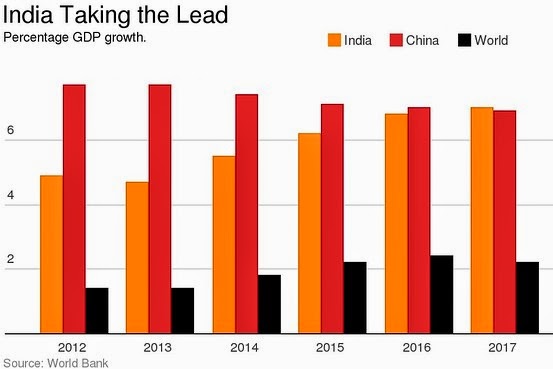
    Sometime in 2015, or more likely 2016, or maybe 2017, India will overtake China as the fastest growing large economy in the world.  It could potentially be a historic moment, for India and the world. The opportunity is India\’s to grasp, or equally likely, drop.
    China\’s economy is slowing. Its GDP growth for 2014 (announced in an incredible 19 days after the year end) was 7.4 %. For the first time in 30 years, its GDP growth is below its own target of 7.5%. China\’s statistics are to be taken with a pinch of salt. Apart from the gargantuan task of measuring GDP for such a large country and number of people, its numbers are also, let us say, \”approved\” by the Communist Party. It was very likely that in the heady days, for a long period, China actually under reported its GDP. Growth was at such a frenetic pace that the Party was doing all it can to dampen the numbers. Now, its quite likely that the announced 7.4% is probably a tad overreported.  China\’s is a huge economy. Growing at that breakneck speed is no longer possible. The economy is slowing. Make no mistake; the growth rate , for its size, is still stunning, but the inevitable slowdown is starting. China is starting to slowly transform into a more mature economy.
    Enter India. Its financial year ends in March and for 2014-15 and for the first three quarters it grew by 5.3%. That is still a full 2% below China\’s. But the trajectory is upwards. The World Bank last week estimated that India\’s growth rate would overtake China\’s in 2017. Goldamn Sachs estimates that it will happen in 2016. The IMF has just announced that it expects that to happen in 2015 itself. It is estimating India will grow by 6.5% and China by 6.3 %. We shall see.
    Maybe, just maybe,  India\’s time in the sun is about to come. It has a strong government which is betting on development as the plank for reelection. It has a young and large work force. It is a slow elephant prone to many stumbles and disappointments in the past and could flatter to deceive again. But something tells me that this time India may actually do well. If there is a sustained period for say 10 years, when India is the fastest growing large economy, it will have profound consequences both for the country and for the world. 
    For Indians, it may be the chance, finally, to start winning on \”Garibi Hatao\” (eliminate poverty).  For the world, somebody must take China\’s place in leading global growth. India is the natural, and preferred choice. Geopolitically, a rising India will also contribute to a multipolar world and manage the \”risks\” of the China ascendancy. Just as China\’s rise from the 1990s transformed the world, the same could happen all over again with India.
    Wishful thinking ?? Maybe. But for reasons this blogger cannot explain, this time, it looks different. Its India\’s turn to \”win the World Cup\”. It\’s cricketing fortunes may be on the wane but its economic fortunes couldn\’t be better.  The first step will be on February 28th when the first real budget of the BJP government is presented. If its a cracker, then that might be the start of India\’s ascent.
    It may be the best time to be an Indian.