D for Discipline, D for Democracy!

The moment the word \’discipline\’ is mentioned in a gathering of teachers or educational functionaries (or even parents or community members), it acquires a special meaning, as in \’children have to be kept in discipline\’. Here, the quintessential role of the teacher is that of the \’shepherd\’ (with stick and all), and children are seen as unruly sheep that have no mind of their own and need \’order\’ in their lives. I hope this sounds as dated in the reading as it does in the writing!

Perhaps this is more the case in Asian societies. Apart from most Indian states, I\’ve found myself caught in this discussion  in Bangladesh, Afghanistan, China, Nepal, Sri Lanka, Cambodia, Laos… and there\’s an amazing unity of thought across these varying geographies and cultures! Children need to be guided and taught — if their errors are not corrected as soon as the occur, it will be too late to correct them later on! (All this is said in a deep, sonorous tone to emphasize its seriousness.)

Interestingly, these are also cultures that teach you to respect your elders (whether they have any quality other than age or not!). In short, in societies where control has a role to play, \’discipline\’ comes to mean doing the will of the powerful (because they are adult, or older or richer or occupy a \’position\’). These are also the same places where the guru or the master or the preceptor is venerated (i.e. given a status next to God herself).

This sits a little uneasily with the clamor for greater democracy in the classroom. Active / joyful learning is now advocated in most of the countries mentioned. In India, the recently enacted Right to Education actually mandates activity-based classrooms where children will construct their own knowledge. The National Curriculum Framework 2005 makes an eloquent plea for \’democracy in the classroom\’, where collaboration and partnership with children (rather than their \’sincerity and obedience\’) will be the hallmark of quality.

As you can guess, change is a long way coming. Despite the fact that democratic classrooms are \’Official Policy\’ backed by law, and nearly a decade and a half of yearly rounds of in-service teacher training emphasizing the virtue of active learning,  classroom teaching tends to remain teacher-directed, instruction-based, with asking questions and offering one\’s opinions being considered almost a sin on the part of children.

When reports last came in, thus, D for Discipline was clearly winning over D for Democracy!

Has Anyone Asked Teachers This Yet?

Over the last two decades, as the number of teachers has grown, so too has a certain attitude towards them. This comes up in different ways in the various interactions we have – during school visits, meetings at cluster or block level, workshops and training programmes for different groups of personnel, and informal interaction at all levels. Somehow, the discussion ends up at the teacher\’s door. And the following statement springs forth: \’Teacher is at the heart of the matter sir; only when teacher improves can anything improve.\’
This is then followed by a long list of what teachers are not good at, including examples such as (this is a mild list!):
  • Teachers don\’t practice Quality Teaching
  • Are not able to \’go according to the level of children\’
  • Don\’t make use of psychology (I assume this means something called \’child psychology\’)
  • Application is missing – teachers are not linking concepts to practical life.
  • They show a lack of Social Awareness
  • Don\’t go for innovative activities
  • Don\’t do voluntary service
  • Don’t give examples while teaching
  • Don\’t pin accountability for the task given (i.e. don\’t take responsibility themselves)
  • Fail to develop or revive the interest to teach
  • Are not flexible to change their mentality
  • Don\’t give individual attention to children
  • Are not patient
  • Don’t make use of case study
  • Don\’t take a friendly approach
  • Are poor listeners
  • Have no tolerance
  • Are partial
  • Reluctant
  • Lazy
  • Lack in adaptation, and don\’t update their knowledge
  • Are in a hurry to get the product rather than being bothered about the process
  • Expect more with little effort!

Believe it or not, this is an actual list produced by participants in a workshop (which also included teachers!) and is also typical of most parts of the country.
But when asked to name any strengths that teachers have, what you usually get are blank stares or a scrawny, reluctant list of maybe four points, such as:
  • Covers syllabus in time
  • Preparing children for getting marks.
  • Good in lecturing (encouraging rote learning)
  • Conducting special coaching for those falling behind

As you can see, no shortage of left-handed compliments here!
Typically, when asked if they\’ve actually asked teachers what they\’re good at, or what they feel they\’re not good at, the people who make the above statements tend to draw a blank! However, when teachers themselves are asked what they\’re not good at, their statements include points such as these:
  • In trying to address the average student, I\’m unable to take care of those who are falling behind
  • I find it difficult to make the subject interesting for some students
  • If parents can\’t help children with their homework, I find it difficult to help the child in class

Clearly, there\’s a perception mismatch between teachers and those tasked with appointing, deploying, orienting, developing, mentoring and monitoring teachers. It might be a little too much to ask, but the following seem clearly required;
  • There\’s a need to listen to teachers before coming to the kind of conclusions we have come to
  • In order to go beyond impressions, systematic observation and research are required
  • How about finding out the strengths teachers have and how to build on them
  • Finally, what is the system doing to make some of its own dire predictions about teachers become true?

The REAL Reasons Why Change Is So Difficult In Education

If you\’re not in the government but are working to bring about change in education in India, you\’re likely to be using one or a mix of the following strategies:
1. Protest against whatever is going wrong
2. Provide data and evidence that things are not working (and occasionally, for what is working)
3. Intervene in policy and decision-making to the extent possible
4. Develop working models and ask the government or others to take them up
5. Actually take over or supplement the delivery function on behalf of the government
(As of now I can\’t locate any other strategy in use – but if you are using another one, do let me know so it can be part of this list.)
Here\’s a quick look at what each of these strategies involve and the kind of impact they seem to be having. (This is only a broad overview and not a nuanced analysis.)
Strategy 1: Protest against whatever is going wrong
From small village committees carrying their demands to block/districts officials, to state-wide forums of NGOs as well as the national RTE forum/s (there seem to be a few of these), various pressure groups have exerted themselves to protest against much that is not being done by the government.


The general notion seems to be that if you criticize the system or are able to make a serious protest – the system will somehow listen and start improving. As of now, there is no evidence that it really does. (It\’s very good in showing that it does, though! Look at all the advertisements issued by state governments where they list their achievements, including in education.) 
Results: Unsure impact. Getting a decent hearing is not easy, and even where there is a hearing, there is no guarantee that there will be an impact.
Strategy 2: Provide data and evidence that things are not working (and occasionally, for what is working)
The assumption is that if the system and decision-makers realize how wrong things are, or evidence is provided on what works and what doesn\’t, there will be appropriate changes and things will improve. Or that investment will be made on what is known to work. Partly based on this, a large number of think tanks have emerged (mainly comprising of western educated professionals) and produce a number of evidence-based documents every year. INGOs, donors and now VCs/similar funding agencies also take this view and back such efforts. The expansion of CSR and corporate supported initiatives all bring in this emphasis on \’in data we trust\’.
Unfortunately, there is not enough data to show that our education system ever pays serious attention to data on student learning, or classroom processes – and makes a difference accordingly. (That it should is another matter – the fact is that it doesn\’t.) Though a huge amount of data is collected, and the system itself does a great deal of the collecting, its impact on actual functioning is extremely limited. (For instance, which curricula or textbooks in any state have been influenced by such evidence-based approaches? Or by the NCERT\’s own data from country-wide surveys of learning levels, or even by ASER?) Where the data is used to some extent – as in the case of DISE – its actual reliability is in question. Attendance data, for example, is routinely manipulated to ensure that others can also get to \’eat\’.  
The system has a way of being blind to facts right before its nose. For instance, with a PTR norm of 30:1, in the foreseeable future (i.e. next 30 years), the \’typical\’ school in India will be the small school multi-grade (with 90-100 children in 5 classes, with 2-3 teachers) – implying that a majority of teachers will be teaching in multi-grade situations. Yet all curricula and training presently assume a mono-grade situation and believe that multi-grade will only be an exception. 
Result: Data flows off the system, usually like water off a duck\’s back. \”That\’s not how decisions are made\” – is a commonly heard statement in government offices, which indicates that there are other reasons why things are done the way they are done!


For those NGOs, donors, VCs and others hoping that \’evidence-based\’ and \’data-driven\’ strategies can actually persuade the system to bring about changes, especially those that make a real difference to the lives of the marginalized and the disempowered, there is a serious need to re-examine this strategy.
Strategy 3: Intervene in policy and decision-making to the extent possible
If you\’ve worked hard to reach a position where you can impact policy or decision-making, this is the strategy you would use. The late Vinod Raina is a good example of this, being part of CABE and involved in drafting of the RTE. Not everyone can achieve the status of being an \’eminent\’ invitee to important bodies and hence this is an option only a very few can access. (And even if invited, having an actual say is very difficult – in typical \’high-power\’ meetings, participants speak turn by turn, and the Chairman then winds up the meeting!) Most people/organizations trying this route reach only the point where they are part of certain committees or perhaps even the various groups related to the Planning Commission, such as the Steering Committee, etc.
Results: As the fate of some of the crucial RTE provisions shows, the more things change, the more they remain the same! I know this is not exactly true – sometimes, some of the things improve. And sometimes they worsen, as the total mis-communication on CCE indicates. Policies, decisions, projects and programmes all run the risk of being hijacked by mediocre implementation, corruption and deliberate diversion to benefit certain groups. Overall, this strategy definitely gives less than optimal results in today\’s context (everybody cannot be a Vinod Raina!). The primary reason is that it is governance itself which is the key issue, which often fails to get addressed here.
Strategy 4: Develop working models and ask the government or others to take them up
Eklavya, Digantar, Bodh, Srujanika and hundreds of other organizations and projects have implemented pilot projects, started schools, even initiated small interventions within the government system — with a view to generate models that will hopefully be \’replicated\’ or scaled up within the government set up. In fact, government programmes such as DPEP and SSA also incorporate an \’innovation\’ budget head that enables the setting up of such models that might eventually be expanded to the larger system.
Results: The history of upscaling shows that powerful models often lead to 
•   conflict (as was the case with the Hoshangabad Science Teacher Programme in MP, or the DPEP pedagogy upscaling in Kerala), or to 
•   a major reduction in quality of the original (as in ABL in TN, where only 22% children reached age-appropriate learning levels, as shown in a state-wide study facilitated by me when the programme was at its peak; or in the case of KGBV models that initially started well when run by NGOs)
The rest of the efforts don\’t really reach scalability, or if they do, they somehow fizzle out without leaving much impact. (Take Digantar\’s schools in Jaipur, Srujanika\’s effort in Odisha or the \’Active Schools\’ of Latur, Maharashtra, or the \’Kunjapuri\’ model in HP or indeed the various \’Model Schools\’ set up by the government itself in many states. This is really an endless list.)
Strategy 5: Actually take over the delivery function on behalf of the government
Several organizations are actually working on the ground with the government to improve the service delivery. They could be corporate houses who are taking over the management of schools (as is the case with the Bharti foundation running hundreds of schools for the Government of Haryana) to Azim Premji Foundation, which is creating its own channels (district schools up to the Education University). [As of now, I\’m keeping vendors – such as those IT companies implementing Computer Aided Learning on a Build-Own-Transfer model – out of this discussion, as they see themselves more as \’solution-providers\’ rather than change facilitators.]
Results: The jury is still out on the kind of strategy being implemented by the two organizations mentioned above. However, large-scale efforts of the kind where a group/programme actually took over the government\’s functions — such as Lok Jumbish (funded by SIDA initially) or Shiksha Karmi, or APPEP in AP (funded by the then ODA of UK), or Janshala (run by five UN agencies) in some 20+ districts in the country, or the Child-Friendly Schools project of Unicef in many parts of the country — all generated a great deal of energy in their time and people talk of them with much fondness even now, but those areas still struggle with quality of learning in government schools. 
Even in the NGO sector, many programmes / projects that appeared to have achieved a great deal, now do not show the expected dramatic improvement still surviving on the ground. Take the case of all the areas where Pratham ran its Read India project. If Pratham has stopped working in an area over three years ago, the levels of reading in that area are now likely to be of concern (even if they had improved earlier), and are a part of the \’declining levels of learning\’ being documented in ASER.
In the early days of DPEP, when it was seen as \’different\’ from government, states such as Haryana, Assam, Karnataka, UP made radically different textbooks and training (taking over the functions of the SCERTs and DIETs), actually implementing high-energy, high-quality training over 2-3 years across the state. Yet today many of these states are at the forefront of the quality crisis.
Bottom-line: you can bring about change as long as you are there, but things go back to what they used to be once you\’re not there!
So what is it that makes change in education so difficult? 
Perhaps we need to face up to what really lies behind things being bad in the first place. We tend to assume that there\’s an inability to make things better. But what if it has more to do with the ability to keep things as they are? This might a little more deliberate than the systemic \’inertia\’ we\’re used to talking about (though not necessarily as a conscious conspiracy). To begin \’appreciating\’ this, take a look who loses what if education, especially in the government system, actually improves.  
•   TEACHERS will find their income from private coaching reduced/lost altogether (this is starkly clear in secondary education, which is one reason why improving classroom processes in secondary schools is very difficult). 
•   PRINCIPALS and OFFICIALS will not have control over teachers/SMCs who teach well and have community support. (Wherever quality improvement efforts have succeeded, conflicts of this kind have increased. Eventually, the more powerful section \’wins\’. Several state governments – or rather the education ministers – have had VECs or SMCs reconstituted since they didn\’t find them \’convenient\’; another example: look at how the provision for SMCs to select books for their school libraries is being subverted through various means.)
•   OFFICIALS will also find academically strong teachers/HMs/SMCs and even students do not easily \’comply\’ – corruption will be difficult to practice. (When more teachers start teaching well, school inspectors always end up making less money. When anyone \’lower\’ in the hierarchy is empowered, those \’above\’ have a problem. And as everyone knows, whenever students ask questions, they\’re told: \’shut up and don\’t act over-smart!\’)
•   POLICY-MAKERS will have to create a whole lot of new jobs for the large numbers of the newly educated. (This is clearly not an easy thing to do – and one way to deal with this is to keep people in education for longer, as appears to be the case behind the recent shift to a FOUR YEAR graduation programme in Delhi University, despite various other claims being made for it.)
•   The POLITY will have to face voters who can think and ask questions of them. (In 2000, one political leader actually stopped a state curriculum from being implemented on the grounds that \’if this is what children learn, who will ever vote for us?\’)
•   Since the majority of people are in some way of the other \’under\’ someone, the questioning of authority will mean that all kinds of HIERARCHIES will be under threat if education really improves – age, seniority, caste, class, gender, ethnicity, religion! (When young girls refuse to get married, or children ask for reasons behind what they\’re being told to do, or groups raise voice against discrimination – you can be sure that someone powerful has a problem, and usually manages to find a \’solution\’. From rising wages for domestic labour to resenting the \’lower\’ classes accessing \’higher\’ levels of goods – such as mobile phones – the middle class too is not comfortable with the spread of education.)
All of which is sufficient to ensure the quality of education will not improve, isn\’t it? Sure, buildings will be built, as will handpumps and toilets, books will be printed and teachers appointed – since these are opportunities for \’side\’ income and asserting control over resources and people, or appearing to hand out largesse and thus earning \’gratitude\’. However, the actual change in the nature of teaching learning processes, a shift in the kind of relationships practiced, and the levels of learning outcomes attained, especially for the marginalized – does not take place at the same pace at which the provisioning grows. In fact, it is much, much slower, if not actually negative at times.
The \”system\’s\” strategies
And how is this ensured? Why does increased provisioning not lead to desired change? As anyone familiar with implementation at the field level will know, a number of powerful strategies are used to to ensure that the \’others\’ don\’t get what \’we\’ have today.  
•   neglect (take the case of DIETs, which continue to be ignored even after the new Teacher Education Scheme; or the case of hard to reach groups such as street children, working children, migrant groups, or those with disability; or how the north-east itself is missing from our history books; or how the knowledge of women is not reflected in the curriculum)
•   selective poor performance (the same government machinery that can do a fairly good job in conducting elections somehow fails at ordinary execution in education; an analysis of which files take the longest to move as against their expected time, will provide a good insight into this)
•   siphoning off inputs meant for the needy (from mid-day meals that kill children, buildings that need to be abandoned within ten years due to poor construction, textbooks on poor paper – name an input and you\’ll find that what reaches children is well below what should; this includes the teacher\’s time, which is the minimum the state should be able to guarantee, but is not able to due to the absenteeism that is allowed)
•   wasting time in doing things that appear to be important but are not (such as organizing \’functions\’ or \’attending\’ to a visiting officer or collecting data on a whole range of issues, which in turn is not used much either), 
•   rewarding the mediocre (as is common, officers \’attach\’ certain teachers for their administrative chores, thus relieving them from teaching; and of course everyone knows that the way \’up\’ the system hierarchy is not mainly through good work…)
•   demonizing and harassing the committed (anyone who works sincerely is usually called \’mad\’ by others; those who stand up for children and community are often hounded, as can be seen by the number of allegations that they face)
•   creating designs that ensure perpetuation of marginalization (e.g. expecting children to attend school every single day no matter how poor, deprived or ill they are; or using only \’state\’ language instead of mother-tongue) – and many other such \’devices\’. 
Supplementing all this is, of course, the common strategy of deliberate discrimination in the actual teaching learning process, something far too well-known for it to be elaborated upon…

In many ways, such strategies are used in the larger community and society as well, to ensure that that those who have been put in their place, remain in that place. As I was recently reminded by a Facebook comment, ‘If everyone gets educated who will till the fields and who will pick up your trash?’ As anyone above the age of 20 will recall, when mobile phones became cheap, many of the then chatterati were dismayed that ‘even plumbers, vegetable sellers and maids now have mobile phones’. And as can be seen in the middle class response to the admission of children from economically weaker sections in private schools under the RTE (‘they will spoil our children’s education’) – the word ‘system’ should perhaps include the larger society and its network of exploitative relationships in which everyone is complicit.
Thinking ahead
You already know all this very well, of course, and in repeating it here the intention is not to imply that nothing can be done or to mount a raving critique of how bad things are. Instead, in the interest of children, especially those from marginalized backgrounds, this is an appeal to recognize that the \’system\’ has far more powerful strategies than those seeking to do \’good\’ are able to put into practice – and the results are visible everywhere.
Should we stop using the five strategies mentioned earlier? No, but it would be better to take a longer, deeper view than we tend to take at present. Perhaps we need to stop underestimating the difficulty of the task and take into account that it is not the system\’s incompetence at making things better but its competence in keeping things the way they are that needs to be addressed.
What this calls for is a better understanding of the situation, of our own unwitting involvement in perpetuating it – and far, far smarter strategies.  

ROLE OF NAAC IN PROMOTING QUALITY IN HIGHER EDUCATION

Education plays a vital role in the development of any nation. Therefore, the higher education is to be the best on both quantity and quality. There has been a great increase in the number of Universities and Colleges in India. To check and assess the quality of these institutions, an autonomous and independent organization called The National Assessment and Accreditation Council (NAAC) was established by the University Grants Commission (UGC) of India in 1994.


 Its Job is to assess and accredit the institutions of higher education in India. It came into existence as a result of the recommendations by the National policy on Education (1986) and the Programme of Action (POA-1992) that had stressed on enhancing and improving the quality of higher education in the country. In spite of the built-in regulatory mechanisms that aim to ensure satisfactory levels of quality in the functioning of Higher Educational Institutions (HEIs), there had been no specific modalities to assess and ensure the quality of education imparted by them. To address this issue, the NAAC has been instilling a momentum of quality consciousness amongst Higher Educational Institutions, through a process of assessing their strengths and weaknesses and motivating them for continuous quality improvement. The NAAC after considering the Institutional Assessment and Accreditation application of the intent institution declares the Institutional Eligibility for Quality Assessment (IEQA) status for the institution.

HIGHER EDUCATION
In a society full of diversity, ideologies and opinions, higher education means different things to different people. According to Ronald Barnett there are four predominant concepts of higher education:
i)                   Higher education as the production of qualified human resources.
ii)                 Higher education as training for a research career.
iii)               Higher education as the efficient management of teaching provision.
iv)               Higher education as a matter of extending life chances.
QUALITY IN HIGHER EDUCATION
Approaches to quality in higher education in most countries have started with an assumption that, for various reasons, the quality of higher education needs monitoring. At root, governments around the world are looking for higher education to be more responsive, including:
·         making higher education more relevant to social and economic needs;
·         widening access to higher education
·         expanding numbers, usually in the face of decreasing unit cost
·         Ensuring comparability of provision and procedures, within and between institutions, including international comparisons.
Quality has been used as a tool to ensure some compliance with these concerns. Thus approaches to quality are predominantly about establishing quality monitoring procedures.
NAAC AND HIGHER EDUCATION
The performance of the colleges affiliated with universities, autonomous colleges and universities is assessed after every five years. The programme of assessing an institution is based on international practices and experiences which the academicians, intellectuals and officials connected with the NAAC receive. It inspects the infrastructure, facilities and also assesses the performance and academic excellence of the teachers of an institution. It gives grades on the basis of performance and prospects of an institution.
 NAAC – VISION AND MISSION
VISION
To make quality  defining element of higher education in India through a combination of self and external quality evaluation, promotion and sustenance initiatives.
 MISSION
v  To arrange for periodic assessment and accreditation of institutions of higher education or units thereof, or specific academic programmes or projects;
v  To stimulate the academic environment for promotion of quality of teaching-learning and research in higher education institutions;
v  To encourage self-evaluation, accountability, autonomy and innovations in higher education;
v  To undertake quality-related research studies, consultancy and training programmes, and
v  To collaborate with other stakeholders of higher education for quality evaluation, promotion and sustenance.  
Guided by its vision and striving to achieve its mission, the NAAC primarily assesses the quality of institutions of higher education that volunteer for the process, through an internationally accepted methodology.
 FUNCTIONS OF NAAC
NAAC has been entrusted with the following functions, which are expected to reflect the above mentioned vision, mandate and core value framework.
 PRIMARY FUNCTIONS:
To assess and accredit higher education institutions which include the following:
v  Assessing and Accrediting Institutions/ Departments/ Programmes
v  Evolving appropriate instruments of accreditation and fine tuning them whenever necessary.
v  Identifying, enlisting and creating a pool of dependable assessors.
v  Providing appropriate training to assessors.
v  Preparing in-house pre-visit documents for the perusal of assessors.
v  Co-coordinating the ‘on-site’ visit to its effective completion.
COMPLEMENTARY FUNCTIONS
To organize promotional activities related to quality in higher education, and Assessment & Accreditation, which include the following:
v  Develop pre- and post-accreditation strategies
v  Disseminate the NAAC processes and quality enhancement mechanisms through relevant publications
v  Organize Seminars/Workshops/ Conferences to share and discuss education quality-related issues.
v  Provide guidance to institutions for preparing their Self-study Reports (SSRs)
v  Partner with stakeholders for promoting A/A
v  Promote the establishment of Quality Assurance units
o   Internal Quality Assurance Cells(IQAC)
o   State level Quality Assurance Co-ordination Committee (SLQACC)
o   State Quality Assurance Cell (SQAC)
v  Establish collaborations with other National and International professional Agencies of A/A
ELIGIBILITY OF HEIs:
ELIGIBILITY CRITERIA OF HEIS FOR NAAC A&A:
The NAAC has adopted its New Methodology of Assessment and Accreditation from 1st April 2007.
1                    Universities recognized under Sections 2f, 2f and 12B of the UGC Act of 1956 or established under Section 3 of the UGC Act, which have completed 5 years since establishment or with a record of at least 2 batches of students having completed their degree programs, whichever is earlier.
2                    All Universities recognized under Section3 of the UGC Act are eligible, regardless of the number of years of establishment.
3                    Colleges/Institutions/Autonomous Colleges, affiliated to a Recognized University, and Constituent Colleges coming under the jurisdiction of Recognized Universities which have the same record as mentioned in the case 1
4                    Institutions coming under the jurisdiction of Professional Regulatory Councils are eligible if they are duly recognized by the Concerned Councils.
5                    Any other Institutions/Units may also be taken up for Assessment and Accreditation by NAAC, if directed by the UGC and/or Ministry of Human Resources Development, Govt. of India.
VALUE FRAMEWORK OF NAAC
The changes in the education system as a result of the impact of technology, private participation, and globalization and the consequent shift in values have been taken into consideration by the NAAC while formulating the following core values for its accreditation framework.
i)                  CONTRIBUTING TO NATIONAL DEVELOPMENT
The HEIs have a significant role in human resource development to cater to the needs of the economy, society and the country as a whole, thereby contributing to the development of the Nation. It is therefore appropriate that the Assessment and Accreditation process of the NAAC looks into the ways HEIs have been responding to and contributing towards National Development.
ii) FOSTERING GLOBAL COMPETENCIES AMONG STUDENTS
With liberalization and globalization of economic activities, the demand for internationally acceptable standards in higher education has grown.  Therefore, the accreditation process of the NAAC needs to examine the role of HEIs in preparing the students to achieve core competencies (innovative and creative) to face the global requirements successfully.
(iii) INCULCATING VALUE SYSTEM AMONG STUDENTS
The HEIs have to shoulder the responsibility of inculcating the desirable value systems (values commensurate with social, cultural, spiritual, moral etc.)  amongst the students. The NAAC assessment therefore examines how these essential and desirable values are being inculcated in the students by the HEIs.
(iv)PROMOTING USE OF TECHNOLOGY:
To keep pace with the developments in other spheres of human endeavor, the HEIs have to enrich the learning experiences of their wards by providing them with the state-of-the-art educational technologies.
 (v) QUEST FOR EXCELLENCE:
Excellence in all that the institutions do will contribute to the overall development of the system of higher education of the country as a whole. This \’Quest for Excellence\’ could start with the preparation of the SAR of an institution. Another step in this direction could be the identification of the institution\’s strengths and weaknesses in various spheres/criteria.
The five core values as outlined above form the foundation for assessment of institutions that volunteer for accreditation by the NAAC.
ACCREDITATION
CRITERIA AND PROCESSES FOR ACCREDITATION
Since the accreditation framework of the NAAC is expected to assess the institution\’s contributions towards the five core values mentioned above, the NAAC has integrated these into the seven criteria identified for Assessment and Accreditation, which are:
1. Curricular Aspects
2. Teaching-Learning and Evaluation
3. Research, Consultancy and Extension
4. Infrastructure and Learning Resources
5. Student Support and Progression
6. Governance and Leadership
7. Innovative Practices
At NAAC, a five-stage process of external quality monitoring/assessment is undertaken covering:
(i)                        On-line submission of a Letter of Intent (LoI)
(ii)                      Submission of Institutional Eligibility for Quality Assessment (IQEA) required in the case of certain HEIs coming forward for assessment and accreditation for the first time and feedback to the applicant institution regarding specific improvements needed for reaching the threshold level of quality for applying for the comprehensive Assessment and Accreditation by NAAC
(iii)            Preparation and submission of Self-Study Report (SSR)/ Self-Appraisal Report (SAR)/ Re-accreditation Report (RAR), as the case may be, by the HEIs
(iv)            On-site visit by Peer Teams for validation of the SSR/SAR/RAR and reporting the assessment outcome to the NAAC and
(v)                       The final decision by the Executive Committee of the NAAC.
THE ASSESSMENT OUTCOME
There are two outcomes of Assessment and Accreditation: The qualitative part of the outcome is called Peer Team Report and the quantitative part would result in a Cumulative Grade Point Average, a letter grade and a performance descriptor. The final declaration (1st April 2007) of the accreditation status of an institution is as given below
Range of Institutional Cumulative Grade Point Average (CGPA)
Letter Grade
Performance Descriptor
3.01 – 4.00
A
Very Good (Accredited)
2.01 – 3.00
B
Good (Accredited)
1.51 – 2.00
C
Satisfactory (Accredited)
≤ 1.50
D
Unsatisfactory (Not accredited)
Institutions which secure a CGPA equal to or less than 1.50 will be intimated and notified by the NAAC as \”assessed and found not qualified for accreditation\”.  The accreditation status is valid for five years from the date of approval by the Executive Committee of the NAAC.
BENEFITS OF ACCREDITATION
Helps the institution to know its strengths, weaknesses, opportunities and challenges through an informed review
v  Categorizes internal areas of planning and resource allocation
v  Enhances collegiality on the campus
v  Outcome of the process provides the funding agencies with objective and systematic database for performance based funding
v  Initiates institution into innovative and modern methods of pedagogy
v  Gives the institution a new sense of direction and identity
v  Provides the society with reliable information on the quality of education offered by the institution
v  Gives employers access to information on standards in recruitment
v  Promotes intra-institutional and inter – institutional interactions.
REACCREDITATION
RE-ASSESSMENT
Institutions which would like to make an improvement in the accredited status in institutional grade may volunteer for re-assessment after completing at least one year, but not after the completion of three years. 
RE-ACCREDITATION
Re-Accreditation Report (RAR) should be submitted to the NAAC by the first half of the fifth year, so that the process of assessment visits could be completed by the end of the fifth year. The NAAC will endeavor to expedite the re-accreditation process to complete within six months after receiving Re-Accreditation Report. The re-accreditation by the NAAC will look upon how far the institution has achieved the objectives enshrined in the five core values mentioned earlier and assesses how it has progressed during the accredited period.  In particular, the re-accreditation makes a shift in focus in assessing the developments with reference to three aspects –
(i)               QUALITY SUSTENANCE
During the first assessment for accreditation, the NAAC\’s process would have triggered quality initiatives in many aspects of functioning of the HEIs resulting in significant changes in the pedagogical, managerial, administrative and related aspects of functioning of the accredited institutions. These changes have a direct bearing on the quality of education and re-accreditation will consider how these initiatives have been sustained during the accredited period. 
(ii)            QUALITY ENHANCEMENT
The re-accreditation would give due credit to the quality initiatives promoted by the first assessment and the consequent quality enhancement that has taken place.
(iii)          ACTION BASED ON THE ASSESSMENT REPORT
Re-accreditation will address how HEIs have taken steps to overcome the deficiencies mentioned in the first assessment report and also build on the strengths noted in the report and will prepare a Re-Accreditation Report (RAR) accordingly.
IMPACT AND REACHOUT OF NAAC
 IMPACT OF NAAC
ü    Created better understanding of Quality Assurance among the HEIs
ü    Generated keen interest and concerns about Quality Assurance among the stakeholders
ü    Helped in creation of institutional database of the accredited institutions
ü    Encouraged the institutions to get more funds from the funding agencies
ü    Facilitated regulatory agencies to make use of accreditation for funding
ü    Triggered Quality Assurance activities in many of the HEIs
ü    Activated a \’Quality Culture\’ among the various constituents of the institution
REACHING OUT OF NAAC
Reaching out to the stakeholders is an essential component of the NAAC\’s image building process. This is done through
§     Regular correspondence with the institutions
§     Awareness programmes, region-wise
§     Assessors\’ Interaction Meetings
§     Meetings of Directors of Higher Education
§     Newsletter : NAAC News
§     Website: http://www.naac.gov.in
§     Press conferences and press releases
§     Special articles in newspapers and magazines on the NAAC activities
§     Directory of Accredited Institutions.
MOUS WITH GOVERNMENT AND NATIONAL AND INTERNATIONAL AGENCIES
The NAAC has entered into a number of MoUs/collaborations with Governments and National & International Agencies, as listed below:
NATIONAL:              
 (1) NAAC-NCTE, (2) NAAC-DCI
 INTERNATIONAL:
(1) with Commonwealth of Learning (COL), Canada, (2) with Higher Education Quality Committee (HEQC) of the Council on Higher Education (CHE), South Africa, (3) with Australian Universities Quality Agency (AUQA), (4) with British Council/ Higher Education Funding Council for England (HEFCE), Quality Assurance Agency (QAA), UK, (5)with United Nations Educational, Scientific and Cultural Organization (UNESCO), (6) with International Network for Quality Assurance Agencies in Higher Education (INQAAHE), (7) with Asia Pacific Quality Network (APQN).
 FUTURE OF ACCREDITATION SYSTEM
The criteria currently adopted by the two systems- All India Council for Technical Education (AICTE) and NAAC for assessment are just the physical and measureable parameters like space, faculty strength, publication etc., There are suggestions that the accreditation should also asses the “process parameters” too. In addition the quality assessment should include the system of several other factors like management, administration, transparency, ethics, and so on.
Above all, the assessment should also consider the “outcome parameters” such as the performance of the products of the programme or institutions. But this is not possible by the visit or inspection which last for a few days. The National Knowledge Commission (NKC) and the Yashpal Committee (YPC) on Renovation and Rejuvenation of Higher Education in India have accorded high priority to the issues concerning accreditation in education sector with different approaches. The NKC has suggested licensing of a large number of private organizations to undertake the accreditation responsibility. The YPC has suggested that the accreditation responsibility be entrusted to a carefully chosen non-profit organization in the public domain.
A Brainstorming Session on the “Role of NAAC in the Changing Scenario of Higher Education” was held at NAAC Campus on 11 Sep, 2009 which was chaired by Prof. Yashpal.Theobservations/recommendations from the session are:
Ø    NAAC has done a reasonably good job in the field of Assessment & Accreditation with greater credibility
Ø    Social diversities including gender and location aspects may be taken into consideration for future Accreditation exercises.
Ø    The idea of private accreditation agencies should be discouraged but the members were not averse to multiple accreditation agencies.
Ø    The assessment and accreditation methodology of NAAC needs to be strengthened.
CONCULSION
There is a growing concern that quality monitoring has to be about improving what is delivered to stakeholders, even where this requires some substantial reconsideration of the higher education. Accountability still remains a priority in many systems and there is a concern that credibility through accountability has to be established first and then improvement will follow. Real enhancement is internally driven. If enhancement is also intended to develop the transformative ability of students, then quality monitoring needs to adopt a transformative framework, rather than simplified operationalisations such as fitness for purpose. Only if external quality monitoring is clearly linked to an internal culture of continuous quality improvement that focuses on identifying stakeholder requirements in an open, responsive manner will it be effective in the long run. Quality monitoring is in need of a `paradigm shift\’ that turns it from an accountability tool to a fundamental support in the development of a culture of continuous improvement of the transformative process. Hope NAAC will act upon this.


Islam and its Denial – Part VI

Andrew Sullivan describes the Republican Party as divided between two types of conservatives: “conservatives of doubt and conservatives of faith.” While his terms may not get the divide right – liberty isn’t based on skepticism – his extensive description does raise a number of important points.

In passing, however, I was surprised to read that he believes the conservatives of faith understand the threat of fundamentalist Islam. He notes: “Both groups were passionately anti-communist, even if there were some disagreements on strategy and tactics. Today, both groups are just as hostile to Islamist terrorism and fundamentalism.”

I’ve pointed out that two big name conservatives are anything but hostile to Islamic fundamentalism: Dinesh D’Souza and Andrew ApostolouDaniel Pipes points out that the current administration hopes Hezbollah becomes part of the next Lebanese election and government. Recent election results in Saudi Arabia shows the fundamentalists have won. My bet is that this will not worry conservatives close to the administration. Indeed, I argue they’ll praise the election. In that post I express my concern:

Apparently, some people believe that parliamentary institutions will change the way people think. This, of course, reverses cause and effect. History shows that a liberal democracy with constitutional protections for individual rights was a result of powerful ideas and cultural changes over a period of centuries. Now, we are told, the reverse is true. There is a “parliamentary dialectic” that holds that these institutions will create the acceptance of the ideas liberty and tolerance. The classic counter example is the Weimar Republic – which voted Hitler into power.

But why do conservatives believe this “parliamentary dialectic”? Marxists used to believe in “dialectical materialism” that holds that your relationship relative to the means of production determines your consciousness. Workers would have a revolutionary consciousness resulting in the overthrow the capitalist parasites, or something ridiculous as that. Closer to home, moderate leftists used to believe in the “housing dialectic” which holds that poor housing … causes poverty and crime. They built housing projects. Need I explain the morale of the story?

Conservatives have entered the fray with the latest version: hold elections and people will become humane and tolerant! If this policy was in place a decade ago, we’d have an Islamist government in Algeria …. We’d have criticized the military in Turkey for its role in that country’s “guided democracy” with the result of an Islamist regime years sooner. We’d have criticized Mubarack for cracking down on the Muslim Brotherhood who, we’d say, should be running for office if not running the country.

Why are our conservative friends acting like utopian leftists of years past?

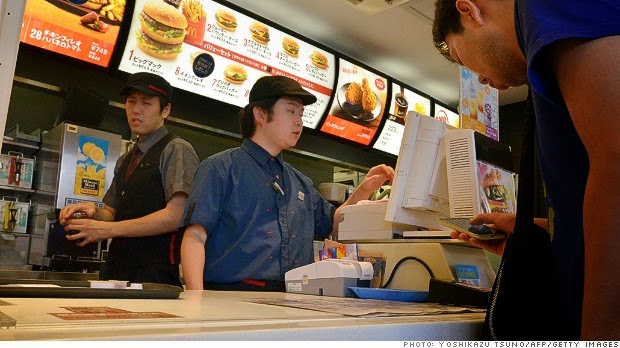
No french fries in Japan

If you go to a McDonald\’s in Japan, be prepared for no french fries (freedom fries ?). Or, at best, if you smile nicely at the young girl, you might get a small fries. No wolfing down the one tonne abomination called large fries. The end of the world has arrived !! What on earth has happened ?
Well, the problem is not in Japan, but in the US. There is a big mess in the ports on the US West Coast. McDonald\’s ships frozen fries to Japan through these ports. Shipments are getting massively delayed. McD don\’t make french fries in Japan at all – all of it is sourced from the US. Hence the problem in Japan.
What is the mess on the US West Coast ports ? Well, almost everything is a mess. They account for more than half of all US maritime trade and the two ports of Los Angeles and Long Beach account for some 40% of US shipping.  There are are a number of problems across all these ports.
Firstly there is a labour dispute going on. The union and the management of these ports have been negotiating for 7 months now and have made no headway. As usual, pay, working hours, etc etc are in dispute. Now the Pacific Maritime Association, the management group, wants President Obama to intervene and appoint a mediator. As if the President has nothing else to do. Solve your problems yourselves, you lot. I thought businesses wanted governments to leave them alone, not intervene. Well, this speaks of the real demands of businesses from governments – leave us alone when the times are good and come in and pick up the pieces when times are bad.
Secondly, as is happening in almost everywhere in the US, infrastructure is not keeping pace. Container ships have doubled in size and yet US ports have made little investments to handle such behemoths. This is a general problem with US infrastructure everywhere – ports, airports, roads, whatever. Everything is slowly going down and there is little money to spend on them. The citizens of the US would rather spend on dropping bombs on others (Defence),  doling themselves out (Social Security) and cossetting the elderly, even if they are comatose (Medicare). The crumbling of infrastructure is slow and therefore incrementally not noticed. It takes an infrequent visitor to see how far the US has slipped. Today, the drive from JFK to Manhattan, is inferior to the drive from Bangalore Airport to Whitefield – and that really says something.
The third problem, of all things, is a shortage of truck chassis to haul containers in and out. I have no idea why this is so. And apparently there are more factors, unique to the region and specific to the industry.
This is a real shame. When economic growth is at a huge premium, surely you cannot afford to lose because of bad planning, poor infrastructure and intransigent unions.
Ah well; Mr Tamaguchi has to simply control his craving for fries. Perhaps the union workers in Long Beach are concerned about his cholesterol levels ! It just goes to show, how in today\’s interconnected world of business, a completely unrelated problem in one corner of the world might have repercussions in the other corner. And \”drastic repercussions\” if you are like Mr Tamaguchi looking for his fix.

Oink Oink; I am taking over the world

What do you think the purpose of agriculture is ? To feed people, right ? Wrong ! The purpose of agriculture is to feed pigs. Very shortly more than half the crops grown in the world will be used to feed pigs. This was the astounding revelation I read in The Economist here.
The problem is  China.  The staple diet of the Chinese is not rice or wheat – it is pork.  Pork is eaten in astounding quantities, every day, every meal.  In India, governments fall over the price of onions, in China they will fall over the price of pork. So much so that the Consumer Price Index is jokingly referred to as the Consumer Pork Index !
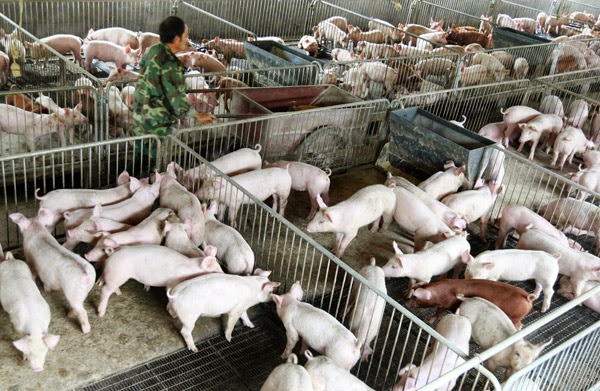
The Economist article throws out mind boggling implications of this Chinese fixation with eating a pig. The Amazon rainforest  is being cleared in Brazil to grow soya to feed Chinese pigs. The Chinese are buying up land all over Africa and Latin America, not to feed their people , but to feed their pigs. One of the biggest source of water and soil pollution in China is pig waste. One fifth of the emissions produced in the world is from livestock and the biggest contributors to this are American cows and Chinese pigs, through their flatulence of all things. Pig farming has become so intense in China that they are like factories – pigs are born and live all their life in metal pens, they never see sunlight, they are all artificially bred, they are given antibiotics with every feed , they are fattened beyond their natural size and they are killed as soon as they become big. Because of the routine dosing of antibiotics, they are also one of the sources for the emergence of antibiotic resistant bacteria.
The Chinese government is so obsessed with pork prices that it appears to be having a “pig bank” to stabilize pork prices. This comprises both of pork and live animals. Presumably the live  animals form the porcine wing  of the Communist Party.  They also have to subsidise pork production – by an astounding $22bn in 2012 , it appears.
There is little chance of turning the Chinese into vegetarians. They don’t even have a word for vegetarianism in Mandarin – this blogger knows to his cost !!  Their gobbling up of pigs is only bound to increase. Hollywood should forget about movies such as The Zombie Apocalypse. Instead, they should try The Porcine Apocalypse !!

I should have the right to vote out Trump

I am an Indian citizen. I have no right to vote in the US elections. That\’s fine – US citizens can make their own choices on who to govern them. But when the US starts passing laws that affect the world, expects global compliance and which  have global consequences, then I am not prepared to keep quiet.

Nowhere is the US effect more on other country citizens than in the area of finance. If it starts a war, as it did in Iraq, at least I am not affected too much and its unlikely that the US will start a war with India. But Trump, by the act of trying to roll back Dodd Frank,  is directly affecting me and is therefore fair game in being virulently criticised.

Dodd Frank what ? Yes that\’s a fair question as unless you are a student of economics you may not have come across the Dodd Frank Act. Here\’s the context in layman terms

– Remember the financial crisis of a decade ago. It was caused by global financial behemoths (mainly US based) going crazy
– Post the crisis, the Obama administration enacted the Dodd Frank Act to govern the conduct of financial institutions. Massive compliance requirements were brought in and severe restrictions and policing was introduced on what they could and could not do.
– At the time, the Republican Party was in the phase of \”Hell No\”. Therefore the law was not passed on a bipartisan basis. It was mostly a Democratic Party legislation.
– Republicans hated it, largely because they hated anything Obama did. The big finance companies and banks absolutely loathed it.
– The law is complex, fiddly, adds huge costs of compliance and is an absolute nuisance for those in the finance business. All true.  But we have seen what havoc they can wreck on the world if they are let loose. So their complaints should simply be met with a stonewall.
– This is one perfect example of a bad law being infinitely better than no law.
– The consequence of another financial meltdown is that I, an Indian citizen, will have to pay for it even though Indian financial institutions played absolutely no part in creating the mayhem. Like it or not there\’s no \”Buy American\” in finance. Finance is global.

Trump is now trying to loosen the provisions of the Dodd Frank Act.  Thankfully he cannot repeal it as he needs 60 votes in the US Senate and he does not have them as the Democrats are now the party of \”Hell No\”. But he can dilute it considerably and that\’s what he is starting to do. An Executive Order came out on Friday. Thankfully for now,  the Order is just asking somebody to do something , as most Executive Orders thus far have been.  Nothing really has happened.

But it will happen. Trump\’s cabinet and advisers are full of Wall Street types. They have a vested interest in undoing the Act .  They must be resisted with every force. And I\’ll loudly call for Trump to be resisted on this one. As should you, whatever nationality you are. It affects you and me.

Dodd Frank has lots of faults. It\’s 2300 pages long. That alone is enough to tell you that Ramamritham has run amok. BUT, before anybody tries to do anything with it, he has to prove that it will improve controls and not dilute it.

For, you see, if you want to be really scared, do not think of nuclear war with North Korea. Or Arctic melt down. Or an asteroid hitting the earth. Get mortally terrified with just this one statistic. The total value of financial derivatives in the world at this moment is some $1.5 quadrillion. By comparison the world\’s  GDP is $80 trillion

WCD Ministry Invites Applications for Nari Shakti Puraskar 2019

Ministry of Women and Child Development has invited applications for Nari Shakti Puraskar for the year 2019. The National Award is given annually to individuals, groups, institutions in recognition of their exceptional work towards the cause of women empowerment, especially for vulnerable and marginalized women.

Nearly 40 Nari Shakti Puraskar will be given awayon International Women’s Day observed on 8th March 2020.

Details of eligibility criteria and guidelines are available on www.narishaktipuraskar.wcd.gov.in portal. Applications/ nominations must be submittedonline on the portal for consideration. The last date for submission of applications/ nominations is 7th January 2020.

The Ministry of Women and Child Developmentis the nodal Ministry for the welfare of women and has been celebrating International Women’s Day every year by felicitating eminent organisations and institutions for the distinguished services rendered by them in the field of women empowerment with the Nari Shakti Puraskar.


Year end Review of M/O Social Justice and Empowerment & DEPwD

The vision of the D/o Social Justice & Empowerment is to build an inclusive society wherein members of the target groups can lead productive, safe and dignified lives with adequate support for their growth and development. It aims to support and empower its target groups through programmes of educational, economic and social development and rehabilitation wherever necessary. The mandate of the Department of Social Justice & Empowerment is empowerment of the socially, educationally and economically marginalised sections of the society including (i) Scheduled Castes (ii) other Backward Class (iii) Senior Citizens (iv) Victims of Alcoholism and Substance Abuse (v) Transgender Persons (vi) Beggars (vii) Denotified and Nomadic Tribes (DNTs) (viii) Economically Backward Classes (EBCs) and (xi) Economically Weaker Section (EWS)

1. TRANSGENDER PERSONS (PROTECTION OF RIGHTS) ACT 2019 TO PROVIDE FOR PROTECTION OF RIGHTS OF TRANSGENDER PERSONS & THEIR WELFARE

The Transgender Persons (Protection of Rights) Bill 2019 was passed by the Parliament and received the assent of President of India on 5th December, 2019. It was passed by the Rajya Sabha on 26th November, 2019 and already passed by the 17thLok Sabha on 5th August, 2019. The Act will make all the stakeholders responsive and accountable for upholding the principles underlying the Act. It will bring greater accountability on the part of the Central Government and State Governments/Union Territories Administrations for issues concerning Transgender persons. The Act will benefit a large number of transgender persons, mitigate the stigma, discrimination and abuse against this marginalized section and bring them into the mainstream of society. It will lead to greater inclusiveness and will make the transgender persons productive members of the society.

  1. VAYOSHRESHTHA SAMMAN TO EMINENT SENIOR CITIZENS AND INSTITUTION

The President of India Shri Ram NathKovind presented the “VayoshreshthaSamman” to the eminent senior citizens and institutions in recognition of their services towards the cause of the elderly persons, to mark the “International Day of Older Persons”, at a function in New Delhi on October 03, 2019.

The experience of Senior Citizens are the Plethora of wisdom. The coveted VayoshreshthaSamman was instituted in the year 2005 and was upgraded to the status of National Awards in the year 2013. The National Awards were presented in 13 different categories. Since 2014-15, the Ministry has disbursed Rs. 190.62crores to 1595 NGOs towards the maintenance of old age homes across the country.

https://i0.wp.com/164.100.117.97/WriteReadData/Gallery/PhotoGallery/2019/Oct/H2019100377617.JPG

  1. NATIONAL SURVEY ON EXTENT AND PATTERN OF SUBSTANCE (DRUG) ABUSE IN INDIA

The Department of Social Justice & Empowerment has assigned the National Survey on Extent and Pattern of substance (Drugs) Abuse in India to National Drug Dependence Treatment Centre (NDDTC), AIIMS, New Delhi, which is completed. National Action Plan for Drug Demand Reduction (NAPDDR) for 2018-25 has also been prepared and implemented, which aims at reduction of adverse consequences of drug abuse through a multipronged strategy involving education, de-addiction and rehabilitation of affected individuals and their families. Since 2014-15, under the scheme the total number of beneficiaries are 4,98,247.

  1. MOU SIGNED BETWEEN DAIC AND DICCI TO EMPOWER SC AND ST COMMUNITIES THROUGH RESEARCH ON DALIT ENTREPRENEURSHIP

A Memorandum of Understanding (MoU) was signed between Dr. Ambedkar International Centre (DAIC), Ministry of Social Justice and Empowerment and Dalit Indian Chamber of Commerce and Industry (DICCI) in New Delhi on 20th June, 2019 in the presence of Shri Thaawarchand Gehlot, Union Minister of Social Justice & Empowerment. The overall motives of this MoU is the empowerment of SC and ST communities through research on Dalit entrepreneurship, empowerment, skill development capacity building among SC/ST women and youth, impact of different schemes of the Government on socio-economic conditions of SC and ST and other similar subjects.

  1. EMPOWERING SCs& STs
  • Scheme of Dr. Ambedkar Chairs aims to provide well-funded Centres of learning to intellectuals, academicians and students to undertake studies and research with an intention to understand assess and disseminate ideas and thoughts of Dr. B.R. Ambedkar.
  • Dr. Ambedkar Scheme for Social Integration through Inter-Caste Marriages is to appreciate the socially bold step of an Inter-Caste marriage, taken by the newly married couple and to extend financial incentive to the couple to enable them to settle down in the initial phase of their married life.
  • Dr. Ambedkar Foundation National Essay Competition Scheme is to encourage writing on social issues, among the Students of Schools / Colleges / Universities / Institutions and arouse their interest in Dr. Ambedkar’s thoughts on fundamental social issues like social justice, removal of untouchability, caste based prejudices, removal of inequality and discrimination, social democracy, national integration, communal harmony etc.
  1. 17TH RUN AGAINST DRUG ABUSE

The Union Minister for Social Justice and Empowerment Shri ThaawarchandGehlot took part in the 17th Run Against Drug Abuse”, on the occasion of ‘International Day Against Drug Abuse & Illicit Trafficking’, in New Delhi on June 26, 2019. Since 2014-15, Department of Social Justice & Empowerment has released Rs. 210.68 Crores towards the Central Sector Scheme of Assistance for Prevention of Alcoholism and Substance (Drugs) Abuse. Under the scheme the total number of beneficiaries are 4,98,247 and Since 2014-15, Ministry has assisted 1777 projects of the 1082 NGOs throughout India.

https://i0.wp.com/164.100.117.97/WriteReadData/Gallery/PhotoGallery/2019/Jun/H2019062670058.JPG


DEPARTMENT OF EMPOWERMENT OF PERSONS WITH DISABILITIES (DEPWD)

DEPwD was created in order to give focused attention to Policy issues and meaningful thrust to the activities aimed at welfare and empowerment of the Persons with Disabilities.It acts as a Nodal Agency for matters pertaining to disability and Persons with Disabilities including effecting closer coordination among different stakeholders: related Central Ministries, State/UT Governments, NGOs etc. in matters pertaining to disability.

Its vision is to build an inclusive society in which equal opportunities are provided for the growth and development of Persons with Disabilities so that they can lead productive, safe and dignified lives.Its mission is toempower Persons with Disabilities, through its various Acts/Institutions/Organizations and Schemes for rehabilitation and to create an enabling environment that provides such persons with equal opportunities, protection of their rights and enables them to participate as independent and productive members of society.

ACHIEVEMENTS OF DEPwD

  1. Cabinet has approved the proposal of establishment of National Institute of Mental Health Rehabilitation (NIMHR) at Sehore, Madhya Pradesh which has been registered as a society under Madhya Pradesh Society Registration Act, 1973 on 28th May 2019, with the objective to promote mental health rehabilitation using an integrated multidisciplinary approach and developing trained professionals in the area of mental health rehabilitation. It is being set up on a piece of 25 acre of land allotted by the Government of Madhya Pradesh along Bhopal-Sehore highway in Madhya Pradesh. Pending construction of permanent site, NIMHR has been made functional from a temporary accommodation provided by the Govt. of Madhya Pradesh at Old Zila Panchayat Bhawan, Sehorew.e.f 30.09.2019. It is providing rehabilitation and clinical services and also runs Certificate Course on Care Giving (CCCG). CPWD has invited tender for construction of building on turnkey/EPC mode and the bids are under evaluation.
  1. India’s First Country Report on Status of Disability and Implementation of United Nations Convention on Rights of Persons with Disabilities (UNCRPD)was submitted in November,2015 was considered and successfully adopted by United Nations on 03rd September this year along with certain recommendations.
  2. The Government has approved setting up of a Centre for Disability Sports at Gwalior, Madhya Pradesh with a view to provide contemporary training facilities for Divyang Sportspersons at par with leading countries in the world. The work order for setting up of the Centre has been issued to CPWD. A Project Monitoring Committee and a Governing Body has been constituted by the Department on 28.08.2019 to monitor the project implementation and overall supervision.
  3. A Cultural Event “Divya Kala Shakti: Witnessing Ability in Disability” was organised on 23rd July, 2019. The event showcased the talents of children and youth with disabilities from different parts of the country. It was held in the august presence of Hon’ble President of India, Hon’ble Vice-President of India, Hon’ble Prime Minister of India, Hon’ble Speaker of Lok Sabha, Hon’ble Council of Ministers and Hon’ble Members of both the Houses of Parliament.


https://i0.wp.com/164.100.117.97/WriteReadData/Gallery/PhotoGallery/2019/Jul/H2019072471134.JPG


  1. The Extension Centre of National Institute of Empowerment of Persons with Multiple Disabilities (NIEPMD) at Andaman & Nicobar Islands has been upgraded to Composite Regional Centre on 19th June, 2019.
  2. DEPwD has developed a Management Information System (MIS) Portal for stakeholders of Accessible India Campaign (AIC). Shri ThaawarchandGehlot, Union Minister for Social Justice and Empowerment launched the MIS portal on 18.09.2019.MIS portal will bring all the nodal Ministries, and States/UTs on a single platform for monitoring the progress being made against each target of AIC. The portal will be useful in maintaining all the function on digital platform and capture data on a real-time basis.
  3. Secretary, DEPwD Participated In 22nd Session of UN Committee on CRPD at Geneva (09 SEP 2019). India is a signatory of the United Nations Convention on Rights of Persons with Disabilities (UNCRPD). It ratified this Convention on 01-10-2007 in pursuance of Article 35 of the Convention. India submitted its First Country Report on Status of Disability in India in November 2015. The UN Committee on CRPD in its 22nd Session took up India’s First Country Report for consideration during 2nd & 3rd September 2019 at UNHRC, Geneva.
  4. Observation of World Mental Health Day by DEPwD on 10th October, 2019. DEPwD observed the “World Mental Health Day” on 10th October, 2019. The Department undertook a series of

activities during the week by its various National Institutes to raise awareness about Mental Health issues including identification of early signs to prevent aggravation and rehabilitation/mainstreaming of successfully cured mentally ill persons.


  1. The Vice President of India Shri M. Venkiah Naidu Conferred National Awards for Outstanding Work Done Towards Empowerment of PwDs on International Day of Persons with Disabilities (3rd December, 2019. He conferred the National Awards on Individuals, Institutions, Organizations and State/District etc. for their outstanding achievements and work done towards empowerment of Persons with Disabilities (PwDs).  Union Minister for Social Justice and Empowerment Shri ThaawarchandGehlot presided over the function. Ministers of State for Social Justice & Empowerment Shri Krishan Pal Gurjar, Shri RamdasAthawale and Shri Rattan Lal Kataria also graced the occasion.


https://i0.wp.com/164.100.117.97/WriteReadData/Gallery/PhotoGallery/2019/Dec/H2019120382225.JPG


Union Ministers Dr Harsh Vardhan and Smt.Smriti Irani discuss areas for promotion of scientific temper among women

The Union Minister of Health and Family Welfare, Science & Technology and Earth Sciences, Dr. Harsh Vardhan and Union Minister for Women & Child Development Smt. Smriti Irani discussed areas for promotion of scientific temper among women in the country and convergence of efforts of different ministries in this direction, at a meeting held here today. The Secretary, Department of Science and Technology, Prof. Ashutosh Sharma,DG (CSIR)/Secretary (DISR), Dr Shekhar C. Mande, Secretary, Ministry of Earth Sciences, Dr. M. Rajeevan, and senior officers of Ministry of Science &Technology and Ministry of Women and Child Development were also present in the meeting.

Dr. Harsh Vardhan said that the purpose of the meeting is to discuss the issues faced by women in scientific field and identify ways and means for promoting scientific temper among women in our country. The Government aims to promote women-centric schemes, activities and programmes with a view to encourage more and more women to opt for carriers in Science and Technology including in scientific research, Dr Harsh Vardhan said.

Smt. Smriti Irani said that the Ministry of Science & Technology should undertake research to identify the hurdles and challenges that women face while choosing carriers in the field of Science and Technology. She said that convergence of efforts of different ministries are essential to achieve the aim of higher scientific temperament among women. She proposed that workshops should be conducted for leaders of scientific institutions to educate them to be sensitive towards gender equality. Smt. Smriti Irani also emphasized upon efforts to promote scientific skills among women.

During the meeting, various issues came up for discussion. The theme of ‘Women in STEM (Science, Technology, Engineering and Mathematics)’ and ‘STEM through Women’ were discussed. It was informed that Government has taken various initiatives, including Biotechnology Career Advancement and Re-orientation Programme (BioCARe), National Women Bio-scientist Award, WInER Award (Women in Entrepreneurial Research) and Golden Jubilee Biotech Park for Women (Chennai). It was also mentioned that about 15,000 women have been trained so far in the areas such as food processing, handicraft, herbal medicines, agriculture, pottery, ICT, waste utilisation etc. under the Technology Development and Utilisation Programme for Women (TDUPW).

Both the Ministers agreed that more effort are required to be made to popularise the existing schemes pertaining to increasing participation of women in the field of Science and Technology in synergy with the schemes already being run by Ministry of Women and Child Development and Ministry of Human Resource Development.

The Women Scientists Scheme (WOS) and Consolidation of University Research for Innovation and Excellence in Women Universities (CURIE) were also discussed.

Among other initiatives, ‘Vigyan Jyoti’ project was also discussed where aim is to create a quality pipeline from High school to top institutions (IITs, NITs and Central Universities) emphasising under-represented areas of STEM by a holistic focus on culture, training, finances, role-models, awareness and confidence.

After extensive deliberations, the Ministers agreed to identify the areas of collaboration and to define a concrete roadmap, where the initiatives can be taken by the Ministries of Science & Technology and Ministry of Women and Child Development.


New Restructured Railway Board to focus on providing better services to its customers : Shri Vinod Kumar Yadav, Chairman, Railway Board

Shri Vinod Kumar Yadav, Chairman Railway Board has said restructuring of Railway Board was a long pending reform suggested by many reform committees constituted on Railways.  The reforms as suggested by various committees from time to time including Prakash Tandon Committee (1994) have been largely adopted.  Addressing media persons, Shri Yadav said that the idea of restructuring the Railway Board is to provide cohesiveness and consequently better services to passengers and freight customers.  In the new restructured Railway Board, there will be one CRB/CEO and four members on functional basis Member Infrastructure, Member Rolling Stock & Traction, Member Operation & Business Development and Member Finance.  Independent Members will be inducted in Railway Board as non-executive Members who will be in advisory role.  They will not be involved in day-to-day functioning of Railways. The modalities of restructuring the Railway Board will be decided by alternative mechanism.   Exact number of non-executive Members will be decided by Government.  The idea to unify all eight services of Indian Railways into one service namely Indian Railways Management Service is to break the departmentalism and make officers work in cohesion for the development of Railways.

Shri Yadav said that officers of Indian Railways only will be considered for CEO post and no outsider will be posted as CEO. Secondly career growth of Indian Railways officers is assured.  No officer of Indian Railways shall be at disadvantage in this new restructured service.    He also added that offering apex level to the General Managers is a step to empower them for a better coordination with State authorities to take decisions swiftly and independently.  This will enable Railway Board to concentrate on policy framing, strategic planning and coordination of Zonal Railways.

Shri Yadav said that the priority of Indian Railways is to improve infrastructure and remove the bottlenecks.  Indian Railway is aiming to run trains at 160 kmph on Kolkata-Delhi and Delhi-Mumbai corridor.  We are hopeful that 3000 route kilometres of dedicated freight corridor will be completed by 2021.  In next 10 years, Indian Railways will have independent dedicated freight corridor on all freight routes.  Indian Railways aims to run trains on demand and redevelop stations under PPP mode.

In last five years, Railways investment has increased 3 to 4 times and projects have been prioritized into supercritical and critical to speed up upgradation of infrastructure. Railways has set a high growth target and to achieve this nimble and cohesive decision-making is the foremost requirement.


SG/MKV

Monthly Production Report for November, 2019

  1. rude oil production during November, 2019 was 2614.29 TMT which is 8.69% lower than target and 5.98% lower when compared with November, 2018. Cumulative crude oil production during April-November, 2019 was 21724.76 TMT which is 5.39% and 5.85% lower than target for the period and production during corresponding period of last year respectively. Unit-wise and State-wise crude oil production is given at Annexure-I. Unit-wise crude oil production for the month of November, 2019 and cumulatively for the period April-November, 2019 vis-à-vis same period of last year has been shown in Table-1 and month-wise in Figure-1.

Table-1: Crude Oil Production (in TMT)

Oil Company Target November (Month) April-November (Cumulative)
2019-20 (Apr-Mar) 2019-20 2018-19 % over last year 2019-20 2018-19 % over last year
Target Prod.* Prod. Target Prod.* Prod.
ONGC 22153.90 1805.53 1673.22 1705.41 98.11 14175.62 13638.33 14146.94 96.40
OIL 3424.90 280.36 260.17 272.93 95.33 2264.54 2147.00 2241.63 95.78
PSC Fields 9463.34 777.17 680.90 802.31 84.87 6521.08 5939.43 6686.67 88.82
Total 35042.15 2863.06 2614.29 2780.65 94.02 22961.24 21724.76 23075.24 94.15

Note: Totals may not tally due to rounding off.                                       *: Provisional


Figure-1: Monthly Crude Oil Production 


Unit-wise production details with reasons for shortfall are as under:


    1. Crude oil production by ONGC during November, 2019 was 1673.22 TMT which is 7.33% lower than the target and 1.89% lower when compared with November, 2018. Cumulative crude oil production by ONGC during April-November, 2019 was 13638.33 TMT, which is 3.79% and 3.60% lower than target for the period and production during corresponding period of last year respectively.


  • ESP issues in wells of NBP and Ratna R-series fields.
  • Increase in water cut in certain wells of Mumbai High, Heera, Neelam and B-173A fields.
  • Sub-sea leakage in some well fluid lines of MH Asset leading to flow restriction.
  • Power shut downs & electrical faults in Mehsana.
  • Decline in pressure & increase in water-cut in Kesanapalli West field in Rajahmundry     and Lakwa field in Assam.


    1. Crude oil production by OIL during November, 2019 was 260.17 TMT which is 7.20% lower than monthly target and 4.67% lower when compared with November, 2018. Cumulative crude oil production by OIL during April-November, 2019 was 2147.00 TMT which is 5.19% and 4.22% lower than target for the period and production during corresponding period of last year respectively. Major reasons for lower production is less than planned contribution from workover wells and drilling wells.


    1. Crude oil production by Pvt/JVs during November, 2019 was 680.90 TMT which is 12.39% lower than the monthly target and 15.13% lower than November, 2018. Cumulative crude oil production by Pvt/JVs during April-November, 2019 was 5939.43 TMT which is 8.92% and 11.18% lower than target for the period and production during corresponding period of last year respectively. Reasons for shortfall in production are as under:


  • RJ-ON-90/1-MANGLA (CEIL): Delay in making 45 FM-1/4 infill wells on line. Lag in liquidating the inventory of planned work overs and production optimization jobs. ESP failure in some wells.
  • Operational issues in Bhagyam, Aishwarya and ABH fields. (CEIL)
  • CB-ONN-2005/9 (Mercator): Oil production from Jyoti-1 is stopped. Well closed for long term pressure build up study and could not be put back in production due to non-grant of EC for development campaign.


Natural Gas

  1. Natural gas production during November, 2019 was 2563.41 MMSCM which is 6.57% lower than the monthly target and 6.16% lower when compared with November, 2018. Cumulative natural gas production during April-November, 2019 was 21209.55 MMSCM which is 6.40% and 2.64% lower than target for the period and production during corresponding period of last year respectively. Unit-wise and state-wise natural gas production is given at Annexure-II. Unit-wise natural gas production for the month of November, 2019 and cumulatively for the period April-November, 2019 vis-à-vis same period of last year has been shown in Table-2 and month-wise in Figure-2.

Table-2: Natural Gas Production (MMSCM)

Oil Company Target November (Month) April-November (Cumulative)
2019-20 (Apr-Mar) 2019-20 2018-19 % over last year 2019-20 2018-19 % over last year
Target Prod.* Prod. Target Prod.* Prod.
ONGC 25848.00 2030.00 1893.85 2091.42 90.55 16750.98 15919.90 16219.27 98.15
OIL 3309.59 274.30 228.20 226.88 100.58 2260.29 1851.81 1828.14 101.29
PSC Fields 5395.20 439.29 441.36 413.47 106.74 3649.65 3437.85 3736.31 92.01
Total 34552.79 2743.59 2563.41 2731.77 93.84 22660.93 21209.55 21783.71 97.36

Note:  Totals may not tally due to rounding off.                                      *: Provisional


Figure-2: Monthly Natural Gas Production


    1. Natural gas production by ONGC during November, 2019 was 1893.85 MMSCM which is 6.71% lower than target and 9.45% lower when compared with November 2018. Cumulative natural gas production by ONGC during April-November, 2019 was 15919.90 MMSCM which is 4.96% and 1.85% lower than target for the period and production during corresponding period of last year respectively.


  • Partial Shutdown of VA (Vashistha) & S1 plant for maintenance Job in Eastern Offshore.
  • Less gas off take by OTPC, Tripura.
  • Less offtake by gas consumers in Cauvery & Rajahmundry Assets and no gas off-take in Jodhpur & Silchar Assets.
    1. Natural gas production by OIL during November, 2019 was 228.20 MMSCM which is 0.58% higher than the production of corresponding month of last year but lower by 16.81% monthly target. Cumulative natural gas production by OIL during April-November, 2019 was 1851.81 MMSCM which is 1.29% higher than the production during the corresponding period of last year but 5.80% lower than the cumulative target. Reasons for shortfall in production are as under:


  • Environmental loss (Bandh and miscreant activities).
  • Less offtake by M/s. BVFCL due to major repeated unscheduled maintenance issue.


    1. Natural gas production by Pvt/JVs during November, 2019 was 441.36 MMSCM which is 0.47% higher than monthly target and 6.74% higher than November, 2018. Cumulative natural gas production by Pvt/JVs during April-November, 2019 was 3437.85 MMSCM which is 5.80% and 7.99% lower than target for the period and production during corresponding period of last year respectively. Reasons for shortfall in production are as under:


  • RJ-ON/6: Production is lower due to less offtake by consumers. Production also lower due to zone pressure depletions in some wells, water ingress and tubing damage. (FEL)
  • Sohagpur West: Dewatering wells gas breakout awaited, slow gas ramp up in pilot wells and scaling in producing wells. (RIL)


.

  1. Refinery Production (in terms of crude oil processed)


Refinery production during November, 2019 was 21900.62 TMT which is 11.17% higher than the target for the month and 3.75% higher when compared with November, 2018. Cumulative production during April-November, 2019 was 169555.04 TMT which is 0.93% higher than the target for the period but 1.22% lower than production during corresponding period of last year respectively. Unit-wise production is given at Annexure-III. Company-wise production for the month of November, 2019 and cumulatively for the period April-November, 2019 vis-à-vis same period of last year has been shown in Table-3 and month-wise in Figure-3.


Figure 3: Monthly Refinery Production   


Table 3: Refinery Production (TMT)

Oil Company Target November (Month) April-November (Cumulative)
2019-20 (Apr-Mar) 2019-20 2018-19 % over last year 2019-20 2018-19 % over last year
Target Prod.* Prod. Target Prod.* Prod.
CPSE 147944.81 11237.87 12572.54 12651.15 99.38 95630.55 96230.25 100385.07 95.86
IOCL 71900.25 5004.44 6090.08 6223.98 97.85 46285.12 46952.97 48134.67 97.55
BPCL 30900.00 2700.00 2700.98 2568.42 105.16 20329.99 20585.96 20538.59 100.23
HPCL 16499.00 1079.00 1520.37 1545.57 98.37 10692.00 11393.18 12350.94 92.25
CPCL 10400.00 900.00 788.63 627.28 125.72 6740.00 6688.47 6827.83 97.96
NRL 2799.80 125.40 118.71 253.49 46.83 1913.90 1759.48 1935.64 90.90
MRPL 15400.00 1425.00 1346.26 1428.39 94.25 9640.00 8791.63 10559.03 83.26
ONGC 45.76 4.04 7.53 4.02 187.55 29.54 58.55 38.36 152.62
JVs 18755.00 1538.00 1730.29 1532.98 112.87 12505.00 13141.41 11411.28 115.16
BORL 7800.00 640.00 657.83 490.21 134.19 5200.00 5103.57 3086.90 165.33
HMEL 10955.00 898.00 1072.46 1042.77 102.85 7305.00 8037.85 8324.38 96.56
Private 88040.52 6924.09 7597.78 6924.09 109.73 59852.88 60183.37 59852.88 100.55
RIL 69145.00 5913.97 5939.81 5913.97 100.44 46515.17 46340.49 46515.17 99.62
EOL 18895.52 1010.11 1657.97 1010.11 164.14 13337.71 13842.89 13337.71 103.79
TOTAL 254740.32 19699.96 21900.62 21108.21 103.75 167988.43 169555.04 171649.23 98.78

Note: Totals may not tally due to rounding off.                       *: Provisional


    1. CPSE Refineries’ production during November, 2019 was 12572.54 TMT which is 11.88% higher than the target for the month but 0.62% lower when compared with November, 2018. Cumulative production by CPSE refineries during April-November, 2019 was 96230.25 TMT which is 0.63% higher than target for the period but 4.14% lower than production during corresponding period of last year respectively. Reasons for shortfall of refinery production in some CPSE refineries are as under:


  • IOCL, Mathura and Paradip: Lower due to deferment of shutdown.
  • IOCL, Panipat: Lower than plan due to high due to high DHDT and SKO feedstock.
  • BPCL, Kochi: Lower due to operational issues.
  • HPCL, Visakh: Lower due to primary unit shutdown.
  • CPCL, Manali: Lower due to raw diesel containment because of increase in duration of DHDT M&I and revamp shutdown.
  • NRL, Numaligarh & MRPL, Mangalore: Lower due to HSD ullage constraint.


3.2    Production in JV refineries during November, 2019 was 1730.29 TMT which is 12.50% higher when compared with the production of November, 2019 and 12.87% higher than the target for the month. Cumulative production by JVs refineries during April-November, 2019 was 13141.41 TMT which is 5.09% and 15.16 higher than the target for the period and production during corresponding period of last year.

3.3    Production in private refineries during November, 2019 was 7597.78 TMT which is 9.73% lower than the target as well as corresponding month of last year. Cumulative production by private refineries during April-November, 2019 was 60183.37 TMT which is 0.55% higher than the target as well as corresponding period of last year.

3.4    Refinery-wise details of the capacity utilization and production of petroleum products during the month of November, 2019 and cumulatively for the period April-November, 2019 vis-à-vis April-November, 2018 are given at Annexures – IV and V respectively.

Click here to see Annexure I

Click here to see Annexure II

Click here to see Annexure III

Click here to see Annexure IV

Click here to see Annexure V

***

KVIC Distributes 1000 Bee Boxes, 100 Pottery Wheels and Leather Kits in Agartala

To commemorate 150th Birth Anniversary of Mahatma Gandhi and to support the weaker section of the society in Agartala, Khadi and Village Industries Commission (KVIC) organized a distribution of 1000 Bee Boxes, 100 Pottery Wheels and 100 Advanced Leather Tool kits 100 Farmers, 100 Potters and 100 Leather Artisans recently in which Chief Minister of Tripura Shri Biplab Kumar Deb was Chief Guest, in presence of Chairman, KVIC Shri VK Saxena.

Complementing the efforts of KVIC, Chief Minister Shri Deb expressed hope that, this mega equipment distribution and Capacity Building drive will create a livelihood and will provide employment to 700 people. He further said that programs like Honey Mission, Empowerment of Leather Artisans and Kumhar Sashaktikaran Mission will not only instill self-confidence but give a much required boost to strengthen the weaker section of the society. It is an endeavor to reach out to the maximum number of people and help them achieve a life of respect and dignity.

Shri Saxena said, “Aligned with the vision of Prime Minister, our endeavor is to provide livelihood opportunities as well as alternate source of income to the rural farmers and other artisans, who otherwise adopt to menial labor or migrate to big towns or cities for daily wage jobs. The objective of this event is not only to empower the rural artisans and help them gain confidence in bee keeping, pottery and leather artistry, but also improve their quality of life. Tripura has a lot of potential of Bee Keeping and Pottery because of large scale cultivation of rubber plants and use of traditional terracotta products in their households.”

The event witnessed a huge turnout of artisans from nearby districts of Agartala. Nearly 20% of the beneficiaries of the equipment distribution were women, and around 80% of the total beneficiaries belonged to the marginalized communities.


Union HRD Minister Shri Ramesh Pokhriyal ‘Nishank’ launches5 documents covering the 5 verticals of Quality Mandate in Higher Educational Institutions

Union Human Resource Development Minister Shri Ramesh Pokhriyal ‘Nishank’ launched the 5 documents developed by UGC covering the 5 verticals of Quality Mandate in New Delhi today. These five documents cover evaluation reforms, eco-friendly and sustainable university campuses, human values & professional ethics, faculty induction and academic research integrity.

PKP_4249.JPG

Speaking on the occasion Shri Nishank said that to improve the quality in Higher Educational Institutions, University Grants Commission has adopted the Higher Education Quality Improvement Programme Mandate. The quality mandate aims at evolving higher education system to equip country’s next generation with vital skills, knowledge and ethics for leading a rewarding life.

Union Minister of Human Resource Development ShriRamesh Pokhriyal ‘Nishank’ said that student evaluation plays a crucial role in improving thequality of Higher Education in the country. In order to make student assessment moremeaningful, effective and linked to ‘Learning Outcomes’, the report ‘Evaluation Reforms inHigher Educational Institutions in India’ is very timely and beneficial for HEIs.

PKP_4221.JPG

Further referring to SATAT- Framework for Eco-Friendly and Sustainable Campusdevelopment in Higher Educational Institutions, he said that the framework encouragesuniversities to adopt reflective policies and practices to enhance the environmental quality of thecampus and to adopt sustainable green and sustainable methods in its future.

Recognising the need to discuss and streamline the process that helps to infuse the culture ofhuman values and ethics in educational institutions, UGC has also developed a policyframework- “MulyaPravah – Guidelines for Inculcation of Human values and ProfessionalsEthics in Higher Educational Institutions”.

PKP_4237.JPG

In addition, he hoped that the Guidelines for Guru-Dakshta – A guide to Faculty InductionProgramme (FIP) will fulfill its main objective to sensitise and motivate the faculty to adoptlearner centred approaches, ICT integrated learning and new pedagogic approaches to teaching-learning, assessment tools in higher education

Speaking on the occasion, the Minister emphasized the importance of promoting highquality research and creation of new knowledge by faculty members. He lauded UGC’s effortsfor setting up a Consortium for Academic and Research Ethics (UGC-CARE) to continuouslymonitor and identify quality journals across disciplines. He also hoped that CARE website andReference List of Quality Journals will be useful to create more awareness and help the cause ofpromoting academic integrity and ethical publishing.