Month: December 2019
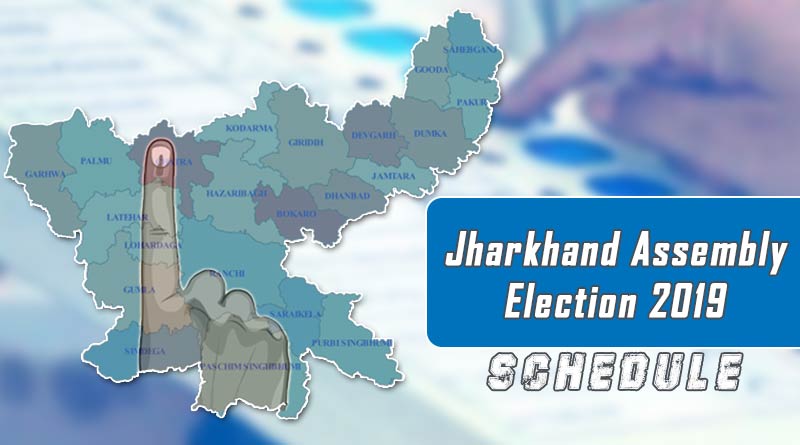
Fact Sheet on Jharkhand Legislative Assembly Election (Phase -2)
JHARKHAND (Phase-2), Date of Poll 7th December, 2019
Number of Recognized State parties: Four(04)
(a) AJSU Party
(b) Jharkhand Mukti Morcha
(c) Jharkhand Vikas Morcha (Prajatantrik)
(d) Rashtriya Janata Dal
- Assembly Constituencies: Twenty (20), Districts: Seven (07)
List of 20 (Twenty) Assembly Constituencies of Jharkhand going to poll in Phase-II
| PHASE-II
|
||
| Sl.NO. | Name of District | No. and Name of Assembly Constituency |
| 1. |
East Singhbhum |
44-Baharagora |
| 45-Ghatsila (ST) | ||
| 46-Potka (ST) | ||
| 47-Jugsalai (SC) | ||
| 48-Jamshedpur East | ||
| 49-Jamshedpur West | ||
| 2. |
Seraikella-Kharsawan |
51-Seraikella (ST) |
| 57-Kharsawan (ST) | ||
| 3. |
West Singhbhum |
52-Chaibasa (ST) |
| 53-Majhgaon (ST) | ||
| 54-Jaganathpur (ST) | ||
| 55-Manoharpur (ST) | ||
| 56-Chakradharpur (ST) | ||
| 4. |
Ranchi |
58-Tamar (ST) |
| 66-Mandar (ST) | ||
| 5. |
Khunti |
59-Torpa (ST) |
| 60-Khunti (ST) | ||
| 6. | Gumla | 67-Sisai (ST) |
| 7. |
Simdega |
70-Simdega (ST) |
| 71-Kolebira (ST) | ||
2.1.1 Smallest and largest Constituencies:-By Area
| By Area | Name of Constituency | Area( in square kilometers) | |||
| Smallest | 48-Jamshedpur East | 34.52 | |||
| Largest | 55-Manoharpur (ST) | 2028.21 | |||
| 2.1.2 Smallest and largest Constituencies:-By Size of Electorate. | ||||||
| By Size of Electorate | Name of Constituency | Size of Electorate | ||||
| Smallest | 54-Jagannathpur (ST) | 1,74,337 | ||||
| Largest | 49-Jamshedpur West | 3,56,965 | ||||
| 2.1.3 Electorate size-wise composition. | |||||
| Size of Electorate | No.& Name of Assembly Constituencies | ||||
| Less than 1 Lakh | ——- | ||||
| 1 Lakh-1.50 Lakh | ——- | ||||
| 1.50 Lakhs 2 Lakh | 53-Majhganon (ST)
54-Jaganathpur (ST) 55-Manoharpur (ST) 56-Chakradharpur (ST) 59-Torpa (ST) 71-Kolebira (ST) |
||||
| More than 2 Lakh | 44-Baharagora
45-Ghatsila (ST) 46-Potka (ST) 47-Jugsalai (SC) 48-Jamshedpur East 49-Jamshedpur West 51-Saraikella (ST) 57-Kharsawan (ST) 52-Chaibasa (ST) 58-Tamar (ST) 66-Mandar (ST) 60-Khunti (ST) 67-Sisai (ST) 70-Simdega (ST) |
||||
- Electors:
3.1.1 By Sex
| Male | Female | Others | Total | |
| Population (Projected 2019) | 38,47,006 | 38,20,865 | —— | 76,67,871 |
| Size of Electorate | 24,31,511 | 23,93,437 | 90 | 48,25,038 |
| EPIC Issued To | 24,31,511 | 23,93,437 | 90 | 48,25,038 |
3.1.2 NRI & Service Voters.
| Number of NRI Voters | 5 | |||||
| Number of Service Voters | 10492 | |||||
| 3.2 Age and Sex-wise Composition of Electorate | ||||||
| Male | Female | Others | Total | |||
| 18-25 years | 412571 | 401319 | 32 | 813922 | ||
| 25-40 | 964443 | 969845 | 41 | 1934329 | ||
| 40-60 | 776757 | 745336 | 15 | 1522108 | ||
| >60 | 277740 | 276937 | 02 | 554679 | ||
- No. of EVMs& VVPATs to be used in the elections:
| BU required for poll and Reserve @ 125% of PS (Including 5%Training and Awareness) | CU required for poll and Reserve @ 125% of PS (Including 5%Training and Awareness) | VVPAT required for poll and Reserve @ 135% of PS (Including 5%Training and Awareness) |
| 9788 | 7583 | 7886 |
- Total no. of Polling Stations: 6,066
State-Jharkhand
Phase wise (I-V)Phase-II
1.1 Total No of candidates (Male, Female& Others):
| Candidates | Total Number of Candidates |
| Male | 231 |
| Female | 29 |
| Others | ——— |
| Total | 260 |
1.2 No. and Name of AC with Maximum and Minimum Number of Candidates:
| 1 | No & Name of Assembly Constituency with Maximum number of candidates | 48- Jamshedpur East
49- Jamshedpur West |
20 |
| 2 | No & Name of Assembly Constituency with Minimum number of candidates | 51- Saraikella (ST) | 7 |
1.3 Party wise list of Candidates:
| Party Name | M | F | ||
|
10 |
Party-wise list of candidates: |
BJP | 18 | 2 |
| BSP | 14 | 0 | ||
| CPI | 2 | 0 | ||
| CPIM | 1 | 0 | ||
| INC | 6 | 0 | ||
| NCP | 1 | 0 | ||
| AITC | 5 | 1 | ||
| AJSU | 10 | 2 | ||
| JVM(P) | 16 | 4 | ||
| JMM | 13 | 1 | ||
| Registered Political Parties (other then recognized National and State) | 78 | 13 | ||
| Independents | 67 | 6 | ||
| Total | 231 | 29 |
…
Pseudo Solutions for Real Educational Problems
- How to improve learning among children? Or
- What action to take so that classroom processes become more interactive than they are at present? Or
- How to enable children to enjoy learning mathematics (rather than being afraid of it)? Or
- How to ensure and increase teacher attendance?
- We must ensure that the system functions well.
- We must increase monitoring and do it properly.
- Teachers must be made aware of their responsibilities.
Have you read Das Kapital or …
Muslims, who lie on principle (taqiyya), will insist you can only understand Islam by reading the Koran. After you read it in English, you’ll be told you can only understand it by reading it in Arabic. If you learn Modern Arab, you’ll still be hampered as the Koran is written in Classical Arabic. Of course, all this is bull just to intimidate you to accept the party line. After all, was it unfair to be critical of Nazism without reading Mein Kampf in German? Or should you ignore the 100 million that have died under communism because you didn’t read Das Kapital?
The Koran actually isn’t hard to understand. Amber Pawlik systematically analyzes the Koran and subjects it to a scientific analysis (over here). Half of the verses of the Koran are vitriol against the Infidels. Most of the rest is about Allah, believers and the judgment day. Only about 5% concerns itself with ethics for living this life.
Pawlik illustrates how you can sample the Koran and get a representative picture that continues to holds with further study. Thus, you can verify her results without spending years and years of worthless study. After all, we’re not talking about some esoteric detail; we’re talking about the general tenor and message of the religion.
Here are some super quotes from Amber:
“In order to judge Islam, I did what most Islam apologists and most Muslims (many of whom are illiterate) did not do: I read the Koran.”
“There is no moral system outlined in the Koran – with the exception of allowing men to beat their wives, sleep with their slaves, and there is an occasional, ‘give to the poor.’ There certainly is no unequivocal ‘Do not kill’; ‘Do not steal’; or ‘Do not lie,’ let alone any other insight into how to behave properly as a human being. Most of the ‘moral’ guidance given in the Koran is not a restraint on humans but permission to do what they want – mostly for men to do what they want.” … “Indeed, the Koran gives men full right to have sex with female slaves and their allotted four wives.”
“What has a tendency to shock most people about Islam and the Koran is its belief in predestination … the Koran says that it is Allah who causes people to believe or not believe.” … “Almost the entire Koran is dedicated to delegating to infidels an inferior status. They are called blind, stupid and ignorant. No proof is given of why they should believe.” … “All of this sets up for what the Koran, at heart, is: one long battle cry against infidels.” … “Muslims are taught to wage war on nonbelievers. It is written in plain language. Muslims are to fight until nonbelievers convert or pay alms. All else are to be killed.” “Everything about Islam prepares its people to be fighters. It riles them with hatred. It prods them to fight.”
“The terrorists who attacked us on September 11, 2001 did not do so in the name of their country or for any demand, such as money or land: they did it openly and proudly in the name of Islam. They were not misguided; they were in every way Islamic.“ … “Islam is a fighting ideology with an uncanny hatred for those who don’t believe as they do. But don’t take my word for it. Please, by all means, read the Koran for yourself.”
Read her whole report and analysis. If you are still in doubt put the Koran to the test yourself. It’s not that hard. It’s easier than reading Das Kapital … in English!
In defence of TPP
* The fear of loss of jobs in the US , which is the chief complaint of the trade unions
* The fear of increased economic activity creating more pollution and climate change, which is the chief objection of the environmentalists
* The enforcement of intellectual property rights, which is the chief objection of Medicines Sans Frontiers
A French soap opera is about to unfold
What does \’taking pride in being an Indian\’ mean?
- celebrate the uniqueness and successes of those who are \’different\’ from us – whether belonging to different religion, ethnicity, language, region, profession…
- not spit out in the open anywhere (surprised? well, this is a leading cause of diseases like TB still being active and killing people)
- stop complaining about what is wrong (hoping someone else will do something about it) and start taking small steps to make things better, and also urging others to do the same (there\’s power in numbers!)
- not restrict their sense of identity to a state or a region or a sub-set of India…
- taking the responsibility of being at one\’s best (whether in health, or talent or work or socializing) so that one can ADD to what is already good in India
- taking responsibility of keeping one\’s immediate surroundings at the best we can (in terms of things being well-organized and clean/hygienic as well as in an \’ecological\’ sense)
- not simply keep harping on the \’golden days\’ of India\’s past but be aware of what we are at present… and hence
- not be afraid to face what is really wrong, accept it and work to changing it (e.g. recognize the \’ugly Indian\’ who jumps lines, is rude and selfish, flouts rules and grins when he gets away with it. Or, of course, the bigger issues of poverty, security, discrimination…)
What does \’taking pride in being an Indian\’ mean?
- celebrate the uniqueness and successes of those who are \’different\’ from us – whether belonging to different religion, ethnicity, language, region, profession…
- not spit out in the open anywhere (surprised? well, this is a leading cause of diseases like TB still being active and killing people)
- stop complaining about what is wrong (hoping someone else will do something about it) and start taking small steps to make things better, and also urging others to do the same (there\’s power in numbers!)
- not restrict their sense of identity to a state or a region or a sub-set of India…
- taking the responsibility of being at one\’s best (whether in health, or talent or work or socializing) so that one can ADD to what is already good in India
- taking responsibility of keeping one\’s immediate surroundings at the best we can (in terms of things being well-organized and clean/hygienic as well as in an \’ecological\’ sense)
- not simply keep harping on the \’golden days\’ of India\’s past but be aware of what we are at present… and hence
- not be afraid to face what is really wrong, accept it and work to changing it (e.g. recognize the \’ugly Indian\’ who jumps lines, is rude and selfish, flouts rules and grins when he gets away with it. Or, of course, the bigger issues of poverty, security, discrimination…)
What does \’taking pride in being an Indian\’ mean?
- celebrate the uniqueness and successes of those who are \’different\’ from us – whether belonging to different religion, ethnicity, language, region, profession…
- not spit out in the open anywhere (surprised? well, this is a leading cause of diseases like TB still being active and killing people)
- stop complaining about what is wrong (hoping someone else will do something about it) and start taking small steps to make things better, and also urging others to do the same (there\’s power in numbers!)
- not restrict their sense of identity to a state or a region or a sub-set of India…
- taking the responsibility of being at one\’s best (whether in health, or talent or work or socializing) so that one can ADD to what is already good in India
- taking responsibility of keeping one\’s immediate surroundings at the best we can (in terms of things being well-organized and clean/hygienic as well as in an \’ecological\’ sense)
- not simply keep harping on the \’golden days\’ of India\’s past but be aware of what we are at present… and hence
- not be afraid to face what is really wrong, accept it and work to changing it (e.g. recognize the \’ugly Indian\’ who jumps lines, is rude and selfish, flouts rules and grins when he gets away with it. Or, of course, the bigger issues of poverty, security, discrimination…)
What does \’taking pride in being an Indian\’ mean?
- celebrate the uniqueness and successes of those who are \’different\’ from us – whether belonging to different religion, ethnicity, language, region, profession…
- not spit out in the open anywhere (surprised? well, this is a leading cause of diseases like TB still being active and killing people)
- stop complaining about what is wrong (hoping someone else will do something about it) and start taking small steps to make things better, and also urging others to do the same (there\’s power in numbers!)
- not restrict their sense of identity to a state or a region or a sub-set of India…
- taking the responsibility of being at one\’s best (whether in health, or talent or work or socializing) so that one can ADD to what is already good in India
- taking responsibility of keeping one\’s immediate surroundings at the best we can (in terms of things being well-organized and clean/hygienic as well as in an \’ecological\’ sense)
- not simply keep harping on the \’golden days\’ of India\’s past but be aware of what we are at present… and hence
- not be afraid to face what is really wrong, accept it and work to changing it (e.g. recognize the \’ugly Indian\’ who jumps lines, is rude and selfish, flouts rules and grins when he gets away with it. Or, of course, the bigger issues of poverty, security, discrimination…)
What does \’taking pride in being an Indian\’ mean?
- celebrate the uniqueness and successes of those who are \’different\’ from us – whether belonging to different religion, ethnicity, language, region, profession…
- not spit out in the open anywhere (surprised? well, this is a leading cause of diseases like TB still being active and killing people)
- stop complaining about what is wrong (hoping someone else will do something about it) and start taking small steps to make things better, and also urging others to do the same (there\’s power in numbers!)
- not restrict their sense of identity to a state or a region or a sub-set of India…
- taking the responsibility of being at one\’s best (whether in health, or talent or work or socializing) so that one can ADD to what is already good in India
- taking responsibility of keeping one\’s immediate surroundings at the best we can (in terms of things being well-organized and clean/hygienic as well as in an \’ecological\’ sense)
- not simply keep harping on the \’golden days\’ of India\’s past but be aware of what we are at present… and hence
- not be afraid to face what is really wrong, accept it and work to changing it (e.g. recognize the \’ugly Indian\’ who jumps lines, is rude and selfish, flouts rules and grins when he gets away with it. Or, of course, the bigger issues of poverty, security, discrimination…)
What does \’taking pride in being an Indian\’ mean?
- celebrate the uniqueness and successes of those who are \’different\’ from us – whether belonging to different religion, ethnicity, language, region, profession…
- not spit out in the open anywhere (surprised? well, this is a leading cause of diseases like TB still being active and killing people)
- stop complaining about what is wrong (hoping someone else will do something about it) and start taking small steps to make things better, and also urging others to do the same (there\’s power in numbers!)
- not restrict their sense of identity to a state or a region or a sub-set of India…
- taking the responsibility of being at one\’s best (whether in health, or talent or work or socializing) so that one can ADD to what is already good in India
- taking responsibility of keeping one\’s immediate surroundings at the best we can (in terms of things being well-organized and clean/hygienic as well as in an \’ecological\’ sense)
- not simply keep harping on the \’golden days\’ of India\’s past but be aware of what we are at present… and hence
- not be afraid to face what is really wrong, accept it and work to changing it (e.g. recognize the \’ugly Indian\’ who jumps lines, is rude and selfish, flouts rules and grins when he gets away with it. Or, of course, the bigger issues of poverty, security, discrimination…)
Ramamritham falls in love
What happens when you seriously try to empower children, teachers and community through large scale education initiatives?
Though obviously much must have been done over the decades till the 80s, my experience ranges from mid-80s, when I was part of a team working on such classroom practices, textbooks and educational designs from 1986 onwards. Implementation of the programme called Prashika (Prathamik Shiksha Karyakram) focused on marginalised groups, with the team living in a tribal area as well as in a rural, deprived pocket and introducing the innovation in government primary schools. The work in Prashika was pathbreaking in many, many ways (integration of 5 subjects at the primary level, incorporation of multiple local languages, a hugely localised textbook/workbook that could only be completed with each child contributing, called Khushi-Khushi – still not matched anywhere, I believe). It provided hope that much was possible despite the difficulties faced and informed many of the later efforts that followed, both in the government and the NGO sector.
Later in DPEP – particularly Kerala, Assam, Karnataka, Haryana, UP, Bihar, TN, Nagaland and later with SSA Gujarat further work was done. Localised training, contexualisable textbooks (some really brilliant stuff still not matched anywhere – and that\’s a professional opinion), teacher determined assessment system, involvement of community knowledge, children constructing local histories / local environment books, peer learning and assessments, textbooks that would be \’complete\’ only along with a set of 50 district-specific books kept in the school library…. many, many innovative and large scale measures were conceived and actually implemented using a strategically developed implementation plan.
In each first five states we were able to see 2-3 years of implementation, development of hundreds / thousands of teachers who implemented contextualised learning, a high degree of in-class practice backed by supportive, localisable material. These states changed their position in the national achievement surveys too, with Kerala rising to the top (it had been fairly close to the bottom before this, below Bihar in the first national survey). In the case of Gujarat, field testing was done in 630 schools, researched by MSU Baroda with very encouraging findings.
However, as long as we were not visibly successful there were no problems. When change began to be visible on some scale and a palpable sense of energy was witnessed among teachers and communities, alarm bells began to ring. in each of these states, the powers that be – especially at state level, state institutions, administrations, political parties – found that this went against the command-and-control structures conducive to them being able to assert their authority. Schools didn\’t want to be told what to teach when and how – they had their own plans. Empowered teachers / school heads / even some VECs refused to kowtow to mediocre ideas or corruption oriented bosses – leading to huge conflicts all over the place. Unfortunately these never got reported, recorded or researched. The results were mass scale transfers, cases against state project directors who encouraged this (Kerala SPD was charge sheeted, Karnataka SPD given punishment posting in North Karnataka, Assam SPD sent to conflict zone during worst riots, Bihar SPD transferred to PHED and later kept without posting), the re-casting of State Resource Groups from those selected for tested capabilities to those stocked with ex-officio positions, the emasculation of the BRC-CRC structures from genuine teacher support institutions into data collection centres (believe it or not, we did have functional BRCs CRCs at one time!), the centralisation of powers away from the VECs and re-casting into SMCs with a different function, and major shift in recruitments away from districts to states (in one state the Education Minister held a Recruitment Mela in a stadium to personally appoint 3000 para-teachers).
Interestingly, Prashika in MP faced a similar adminstrative backlash and was closed down.
Yes, like it or not, this is what ideas of empowerment through education come up against – and they fall short not because of lack of any purity in the idea itself or absence of rigour, but because after a point when it goes into implementation an idea is something else, and not its original pure self. You might look at the actual work and find it is not \’up to the standard\’ – yet when trying to create it for those who need education the most, other aspects need to be taken into account. Basically, empowering the weak is clearly seen by the strong as disempowering them – and the empire strikes back! One of the outcomes is that a few years later, it appears as if nothing has been done, and people gear themselves up to again come up with \’innovative\’ ideas, often weaker than might already have been tried, uninformed by the past.


You must be logged in to post a comment.