7 Ways to Retain Optimism (Even If You Work In Improving Elementary Education!)

Got you, didn\’t it! Sooner or later, you hit a wall. There\’s a feeling that nothing works. That the system is so overwhelming that hardly anything can be done. Eventually, if you\’re someone trying to improve elementary education – whether as a teacher or resource person or administrator – you find yourself unwillingly accepting that the poor quality of education will continue to prevail in hundreds of thousands of classrooms.
Ok, so that\’s stated a little too strongly. But there is grain of truth there! Which is why, in the interest of millions of children, we need to look at how to retain the enthusiasm and optimism we started out with. So here are some ways to preserve your cheer, mental health and youthful looks despite the years you\’ve put in.
1. Think \’how\’, not \’should\’
Much too often we find ourselves talking about what \’should\’ be happening. Slowly the discussion slides into a list of things we are dissatisfied with – teachers not working, infrastructure remaining poor, lack of leadership, absence of commitment…. You can hear the pitch rising, can\’t you? Keep the pitch raised and you\’re bound to have a stressed heart!
To retain your desire to make things better (and keep your heart healthy), it would be so much better to talk of the how. What ordinary things can a teacher do? E.g. smile at children, read the textbook before the class, solve a puzzle herself to find out how much fun it is, read aloud a book to children once in a while – nothing that requires an \’order\’ or funding or special mandate or skill or training. Similarly, what can a head teacher do, burdened as she is with administrative tasks made difficult by lack of support? Share and delegate (e.g. make it fun for other teachers to participate and work as a group), discuss some of the records maintained in the school (e.g. connect children\’s attendance rates and test performance), and so on.
As you can see, you would have something doable to share. Chances are, some of the ideas might actually get picked up – in which case don\’t forget to really appreciate the person implementing them.
2. Focus on outcomes, not inputs
This is much more if you\’re a planner, administrator, supervisor, programme leader. Very often we\’re so focused on the inputs flowing from our side that we ignore what these are for. Thus it seems important to see whether material is supplied or not, the number of days of in-service training covered, physical targets fulfilled – and then one day it suddenly turns out that all this has not had much impact. We\’re left feeling that all our effort didn\’t amount to much, and a sinking feeling starts to grow. Of course we don\’t tell anyone else about it but we\’re aware it\’s there, isn\’t it?
How to overcome this situation? After all, inputs have to be provided. Sure they have – but for a purpose. It might be more useful to take a look at what all this is meant to bring about. For instance, the issue is not whether material is supplied or not but whether it is used as intended by children. This suddenly makes us see that we need to focus on training, incorporate this into the monitoring and academic support, share examples with teachers, encourage children and parents to lose inhibitions and start using material in school and at home… All of which, if done even on a small scale and only partially successful, has the wonderful effect of making you feel giddy with success. Pessimism – gone!
3. Be incremental
This point is so commonsensical and obvious that it gets ignored. Don\’t try to do everything or too much in one go (especially if you are at the district / sub-district level). For instance, for any teacher to make a real change in the classroom processes, some 40 different practices are likely to change. Try doing a full \’training\’ and expect all these changes – there\’s only chaos. Teachers do try but fail – no one\’s sure what to start with, the sequence in which to implement these changes, the steps to be taken. All it takes is one or two failures for teachers and schools to feel that nothing much can be done, that it\’s all too difficult, and doesn\’t work and is therefore not worth the effort. Soon, you begin to feel the same and are a pale shadow of the enthusiastic person who set out on a journey of change.
To get back on track on this journey, scale things down a little. Expect only a few changes at a time. E.g.
  • Give teachers a list of 6-8 possible changes (ranging from calling each child by the name, to making use of activities given in the textbooks to encouraging children to ask questions).
  • Ask them to select only 3-4 from this list (making a choice generates ownership and commitment); discuss the steps they need to take in order to bring about these changes.
  • Encourage them to make a 2-3 month implementation plan around these steps and help them monitor themselves and each other to see if the changes are actually happening.
  • Extend this cycle at the end of each 2-3 month period. Over a year or two, a dramatic change would occur – only it would have been less noticed as it happened, more successful, and breeding optimism rather than pessimism.

For those in the know, this is precisely what ADEPTS is all about and has made a positive change happen in over 22,000 (that\’s right, 22 thousand) schools in Gujarat.
4. Enter with questions, leave with (people\’s) ideas
Trainers, facilitators and academics trying to communicate with teachers end up being frustrated very soon – \’they don\’t pay any attention to whatever we say\’ is a common complaint. To which the reply is – why should they? The days are over when someone followed your ideas / views / instructions simply because you came from a so-called \’superior\’ level such as a university or senior position in the hierarchy. No, people will do things differently only if they are convinced and feel like doing it from inside. Our role is to touch people\’s hearts and minds rather than trying to shape them or fill them with our views.
How can one do this? It\’s so simple that I\’m almost ashamed to mention it! Don\’t enter a training session or a meeting with a list of things to tell. Instead, concentrate on a few key questions to ask. Questions that will generate response, reflection, and provoke people into coming out with their own views and ideas. For instance, ask questions such as:
  • If material is so easy to generate, why should we supply anything? What do you think?
  • Suggest ways in which you can use a library along with the textbook?
  • Shouldn\’t we trust children and get them to mark their own attendance instead of the teacher spending time on it?
  • When children don\’t understand decimals, exactly where do you think the problem lies?

Don\’t believe me, try it out and see what happens. At any rate, the tired old complaint will not be heard any more.


5. Don\’t see people as they are but as they\’re going to be…
Anyone who\’s responsible for helping people be different usually ends up using phrases such as \’dog\’s tail that can never be straightened\’. But that\’s because they see people as they actually are rather than what they can be like. Try this out the next time you\’re in such a situation – 
  • Look at your students / participants / team members and visualise them as being different. 
  • What qualities can you visualise them as having? 
  • What ways do you seem them adopting to make good use of the capabilities they already have? 
  • And what do you see yourself learning from them?

Gives you a different perspective, doesn\’t it? Every time I\’ve worked with a group that has been called \’difficult\’, this is what has helped me make good friends with the participants and support them in changing themselves. Not exactly rocket science, and works very well too. End result? You can imagine…
6. The system is people too
When you work on an impersonal, solid thing called a \’system\’, it\’s hard to see it changing. Indeed, it has an inertia of its own because it has usually arrived at some degree of stability over the years – and here you are, trying to destabilise it for reasons of your own! Why on earth would it meekly go along?
But if you look upon a system as a number of people bound in a set of relationships, you have several entry points where there didn\’t seem to be any in the beginning. There are bound to be persons in the system trying to make good things happen (if nothing else, just the law of averages determines that there have to be at least a few of these). Can you locate such persons? Is there a way of interacting with them, perhaps even bringing together a few of them? Can you change a few persons at a time? Is there an activity that would support or recognize their efforts, and given them the feeling that they\’re not alone? And when success (even small success) happens and is recognized, the circle of those willing to engage and dialogue, grows. With it grows the possibility of real change happening, thus reducing the chances of your growing old before your time out of sheer frustration and pessimism.
7. This is where I need your help
Please be so kind as to let me know the 7th (and 8th, and 9th) way…

Five Questions to Ask Your Election Candidate (English Version)

IGNUS-PAHAL
The one who fights for children’s rights!                         Is the one who will get our vote!
Five Questions On Our Children’s Rights
This election may affect your children.  Especially if your would-be representative in legislative assembly keeps the following in mind.
·       Education – good / quality education – is everyone’s right. Especially after the RTE, education in every government school should be such that everyone finds it good. But even very poor parents are removing their children from government schools and making sacrifices to send their children to private schools.
Ask your would-be representative – Question 1: What will you do to ensure appropriate and quality education in government schools?
·       Teachers’ salaries have gone up. They now get training from time to time to enable good education for children. There is provision for mid-day-meals, school uniforms, play equipment, learning material – all free. But there is demotivation among teachers. They feel neglected. They feel as if they are not being respected.
Ask your would-be representative – Question 2: What will you do so that teachers take interest in their work and are committed to the good education of their children?
·       According to RTE the responsibility of running/managing the schools will now be with community and panchayats. But the community and the panchayats feel: how can we give any advice to the school? They do not find themselves capable of advising / supporting schools. And they feel this is not even their work.
Ask your would-be representative – Question 3: What will you do to enable the active involvement of community and panchayats in improving education in our schools?
·       Community and parents both expect that education will ensure children’s development as well as employment. But now people say: All this education is going to lead only to unemployment, so it is better that the child be engaged in some wage-earning work right away.
Ask your would-be representative – Question 4: What will you do so that every member of the community is aware and committed towards the education of their children?
·       If we look at the money spent on education, most of it is used for salries, infrastructure and maintenance. Crores of rupees are spent every year on this. Even then our schools and education offices look dirty and disorganized compared to private institutions. And the people responsible for improving education for children cannot even be heard talking about it.
Ask your would-be representative – Question 5: What will you do so that government schools and education offices look attractive? So that people in the system not only think of children’s improvement but also do what is needed?
Your views will have an impact, won’t they? But only if you raise these questions! Give your vote only if you get an answer! So go ahead, ask questions, get others to ask, and let us know!!

IMPORTANCE OF POST LITERACY AND CONTINUING EDUCATION

    The idea of a Learning Society was first forward by the United Nations Educational Scientific and Cultural Organization (UNESCO) in its famous report, titled “Learning to be “. According to these report, a learning society is one in which all agencies of a society are educational providers; not just those primary responsibility is education. Similarly all citizens should be engaged in learning, taking full advantage of the opportunities provided by the learning society. True to these words, Kerala has always been a learning society. The educational and social reforms of Maharajas, the relentless efforts of Christian missionaries, the educational pursuits of Nair Service Society, the contribution of Sree Narayan Movement and a galaxy of social reforms laid a strong educational base in Kerala.

        India has very rich and long history of education: education which has been passed on from one generation to the next of thousands of years in various fields of knowledge. People passed on skills along with the rigor of knowledge and human values. It was an integrated kind of an education.
      The concept of continuing education, post literacy or lifelong learning has been embedded in almost all traditional philosophies. Continuing education is seen as going far beyond what is already practiced, particularly in the developed countries such as upgrading with refresher training, retraining and conversion or promotion courses for adults. It should open up opportunities for learning for all, for many different purposes.
      Education should enable people to develop awareness of themselves and their environment and encourage them to play their social roles and work in the community. It should help keep pace with the development of new knowledge of today particularly in the domain of information and communication technology. It should help acquire new skills to face global competitiveness. Therefore, continuing education, post literacy or lifelong learning will soon become a reality for all people. Lifelong learning means learning throughout life. It is not confined to childhood or youth but takes place in mature adulthood as well as in older age. This is a major change from traditional approaches to education and learning.

ADULT EDUCATION

             Adult education is a powerful auxiliary and an essential incentive to primary education. The concept of adult education has brought a new hope for adults who could not get opportunity of receiving education during their school years. Through various programmes and techniques of social education, the illiterate farmers in the fields, laborers in the factories and others can be acquainted with the latest developments taking place in their on fields and thus they can be made happier and useful citizens who would understand their rights and duties given to them in the constitution of free India.
       Adult education is very much needed to change the various facets of the life of our adults. It is essential so that the masses may be trained in various habits to enable them to lead a happier life. Literacy will provide them opportunities of reading and writing and will liberate them from the chains of ignorance. Adult education will bring them in close contact with their community and country’s cultural heritage.
      Adult, continuing education and post literacy is one of the prestigious programmes of University Grants Commission. In American and European Universities, this programme enjoys much importance while in Indian Universities; it is struggling to survive within the University system.
     In India the unique style of interpretation of Adult education is Adult Literacy (3Rs). We are focusing on Total Literacy, Residual Literacy, post literacy, continuing education etc. The scope of Adult education is unlimited. In India at the beginning, the priority was given to adult literacy and it is the time for ‘Mission for Continuing education’. Adult education is a vibrant, fueled by expanding demand and interest with broad range of possibilities in both public and private sector.
        In Academic Adult Education, being ‘adult’ does not refer to age, but rather the mode of study and the objective of the students.  Adult education within universities is an open non-formal system of education which is aiming at complementing and supplementing the requirement of students and community and contributing to the principles of Lifelong learning.

POST LITERACY

Post literacy or post literacy education is a concept used in Adult education programs aimed at recently illiterate or ‘neo-literate’ adults and communities. Unlike continuing education or further education, which covers secondary or vocational topics for adult learners, post literacy programs provide skills which might otherwise be provided in primary education settings. Post literacy education are programmes  which aim to maintain and enhance basic literacy, numeracy and problem solving skills, giving individuals sufficient general basic work skills enabling them to function effectively in their societies. Post literacy programmes are designed for adults who want to strengthen their literacy skills. They may be immigrants, slum-dwellers or elderly rural poor.

                 Jana Shikshan Nilayam (JSN) or People’s Centre of Learning was conceived and introduced in 1988 as an innovative institutionalized framework for post literacy with a view to arresting the unfortunate and recurring phenomenon of relapse of neo-literates into literacy on the one hand and for promotion of a learning society on the other. A set of comprehensive guidelines on location of JSN, selection, training and placement of Prerak, procurement of materials and the modality of conducting the plethora of activities in the JSN were also issued to State Government and other agencies interested in setting up the  JSNs. National Literacy Mission is also a technology mission in as it seeks to harness the finding of scientific and technological research to improved the pace and quality of the programme  and to create a better teaching- learning environment. 
OBJECTIVES OF POST LITERACY
The major objectives of the post literacy programme are:
®                Organize activities for the sustenance of basic literacy and awareness among the neo-literates;
®                Ensure retention of literacy skills and up gradation of skills, especially of women;
®                Create an atmosphere for the application of the skills acquired by them;
®                Supply reading materials for neo-literates;
®                Continue literacy classes for drop-outs and those who were not covered by the total literacy campaign;
®                Promote the developmental activities;
®                Take up non-formal education scheme for the dropouts from schools. FUNCTIONS OF POST-LITERACY
Some major functions of post-literacy programmes include the following:
a) TO CONSOLIDATE BASIC LITERACY SKILLS
A literate who has just completed a basic literacy course is not guaranteed retention of that skill. As for any other skill it could become diffuse and fade out in time unless it is systematically strengthened. A well-designed post-literacy programme may be able to save the situation. With material designed to suit the interests of the target group, post-literacy skill should be able to reinforce and consolidate basic literacy skills both cognitively and affectively.
b) TO MAKE LIFE-LONG LEARNING POSSIBLE
                  Post-literacy is a bridge towards autonomous learning. To reach the stage of autonomous learning means to be within the grasp of being a life-long learner.
                  Post-literacy programmes develop reading habits while at the same time enhance writing and numeracy skill. Without post-literacy programmes, or their equivalent, a learning society cannot materialize since the neo and semi-literates will not be motivated to go beyond basic literacy skills. Post-literacy programmes provide a second opportunity for the disadvantaged to become life-long learners.
                   A keen student within a post-literacy programme has wide options from which to choose further education. Such a student can either enroll in an equivalency programme and so have the chance to enter the formal system again, or he or she can go to other types of continuing education such as vocationally-oriented income-generating programmes or others. In this sense, post-literacy programmes are liberating forces which provide the opportunity for participants to continue to learn throughout life.
c) TO ENHANCE UNDERSTANDING OF SOCIETY AND COMMUNITY
                            Effective communication fosters understanding and promotes ties in the community.  Humankind is gregarious by nature. Being gregarious we must have the skill to communicate to others and to listen effectively. Effective communication, including listening, requires certain skills. These skills can be acquired through training. Communication training programmes can be designed and made available to every interested individual.  Communication skills, therefore, should be a central part of any post-literacy programme. They should be carefully developed to enhance understanding of society and of the community.
d) TO DIFFUSE TECHNOLOGY AND INCREASE VOCATIONAL SKILL
Appropriate technology transforms the development of any country. Post-literacy programmes can be an effective instrument to transfer required technologies to disadvantaged groups and to change a listless «observer» into a productive energetic member of the labor force. The most successful post-literacy programmes are associated with the work force.   The advanced skills of reading, writing and numerically required for autonomous learning are developed loped in association with the functional knowledge needed by participants to be maximally efficient as employees. The significance of such an approach for the overall upgrading of technology and for improvement in individual and commercial efficiency is self-evident. This type of approach makes a major contribution to the economic well-being of individuals and of the nation as a whole.
e) TO MOTIVATES INSPIRE AND INSTILL HOPE TOWARDS IMPROVING THE QUALITY OF LIFE
Drop-outs, disadvantaged groups and low-income earners have a feeling of hopelessness. For them the future is bleak. Their children are unlikely to have a meaningful place in society. Survival is by chance. Motivation to improve and the will to excel in life is marginal if not zero.  Feelings of helplessness and the sense of alienation can be overcome. Making such people realize that each and everyone has the same unharnessed potential and that everybody is capable of attaining the best in life, will motivate them to excel in whatever field they decide to undertake. This is possible because a post-literacy programme is an educational activity. Being educational it is an effective tool to affect changes in attitudes and behavior towards life. Post-literacy cultivates, develops, strengthens and stimulates the power of the target group.
MAJOR AGENCIES IN KERALA
The major agencies engaged in the field are
KERALA SASTRA SAHITYA PARISHAD:
The Kerala Sastra Sahitya Parishad (KSSP) is a scientific, cultural organization, promoted to popularize science among ordinary people. It was established in 1957. It organizes classes, lectures, science clubs, science corners, science fair, and adult literacy classes and so on. KSSP led the total literacy campaign of Ernakulum district and Akshara Keralam Project of the state.
Panchayat Resource Mapping Campaign of KSSP has mobilized very large number of citizens. The field level resource mobilization led to Kerala Total Literacy Campaign and later to the People’s Planning Campaign. It has published more than 100 books to cater to the needs of different sections of the community. This includes children’s literature, social science, popular science, life history and references. In addition the KSSP has published research reports on current issues of Kerala. Today KSSP provides resource support to other states for their literacy campaigns, continuing education programmes, resource mapping, and popularization of science, local survey, and micro planning and so on.
MITRANIKETAN:
Mitraniketan is a non-governmental organization dedicated to non-formal education programme. It is a rural community centre open to all individuals and families irrespective of race, colour, creed or nationality and provides motivation to better their lives and to serve the common men. Mitraniketan has also started adult literacy centers in villages.  Programmes of non-formal education are organized for propagating functional literacy, family planning and childcare and health education. Training programmes have been organized targeting farmers, women children and out of school children. Mitraniketan has started a rural technology centre where, rural technology is intended to be promoted.
QUILON SOCIAL SERVICE SOCIETY:
Quilon Social Service Society (QSSS) is functioning as a registered voluntary organization for social action in Quilon Diocese from 1960 onwards. The society’s aim was to start one comprehensive non-formal education centre attached to each of its local units and also to have all the three stages of adult education viz. literacy, post-literacy and continuing education. QSSS launched a new scheme for converting adult education centers as centers for helping the very poor families of the localities, to involve themselves in development oriented self-help programmes.
LITERACY FORUM:
Its major objectives are
·                     to give professional advice and provide leadership in matters concerning adult/non-formal/continuing education, literacy work and extension in the state;
·                     to carry out evaluation and reach on adult/non-formal education;
·                     to provide a common forum for all interested in adult education and literacy program                         
CONTINUING EDUCATION
The idea of a ‘Learning Society’ was first put forward by the United Nations Educational Scientific and Cultural Organization (UNESCO) in its famous report (1972), titled ‘Learning to be’. According to this report, a learning society is one in which all agencies of a society are educational providers; not just those whose primary responsibility is education. Similarly, all citizens should be engaged in learning, taking full advantage of the opportunities provided by the learning society.   True to these words, Kerala has always been a learning society. The educational and social reforms of Maharajas, the relentless efforts of Christian missionaries, the educational pursuits of Nair Service Society, the contribution of Sree Narayan Movement and a galaxy of social reforms laid a strong educational base in Kerala. The socio-political movements, freedom struggle and trade union movements have played a very significant role in creating a suitable environment for people’s participation. Excellent network of rural libraries, better transport and communication facilities, people’s perception towards education, social mobility, political commitments are some major factors which provided a conducive climate for the people to learn.
OBJECTIVES OF CONTINUING EDUCATION
The main objectives of Continuing Education programme are;
·                     To create a Learning Society through Life Long Education.
·                     To equip the adults with practical knowledge & problem solving skills to reform the society.
·                     To bring about fundamental, social, economic and cultural changes in society.
PROGRAMMES OF CONTINUING EDUCATION CENTRE
1) Equivalency Programmes Designed as an alternative education programme equivalent to existing formal, general or vocational education
2. Income -generating programmes:  Where the participants acquire or upgrade their vocational skills and take up income –generating activities.
3) Quality of life improvement programmes: This aims to equip learners and the community with essential knowledge, attitude, values and skills to raise their standard of living.
4) Individual interest promotion programmes:  to provide opportunities for learners to participate and learn about their individually chosen social, cultural, spiritual, health, physical and artistic interests. 
POST LITERACY AS PART OF CONTINUING EDUCATION
              Post-literacy is a part of the continuing education process. Post-literacy programmes are designed to strengthen the literacy skills so that the learner can follow meaningfully other opportunities offered by other continuing education programmes. The diagram below clearly shows the role of post-literacy in the education process.
The central column of the diagram (Figure 2.1) shows how educational programmes can be planned and sequenced by an individual throughout life. The programme can be formal, or non-formal in nature. Any educational activity after childhood is considered as continuing education. The target group may be semi-literates, neo-literates or autonomous learners.
ATLP for continuing education offers six programmes. Post-literacy therefore is one of the integrated continuing education programmes. Other types include Income-Generating Programmes, Quality of Life Improvement prorgammes, Equivalency Programmes, Individual Interest programmes (see ATLP-CE volume I). All six programmes are functional. All involve functional knowledge. The functional knowledge is used as a delivery technique with the
Objective of making learning is relevant to living and working. However there is a major difference between post -literacy and other programmes. The basic difference is that in the case of post-literacy programmes, the advocator must stress rehabilitation activities. This is because it is possible for neo-literates and semi-literates to regress to even complete illiteracy. This is less possible in other programmes, especially among equivalency learners.

CONCLUSION

             Kerala is the first state in the country to declare total literacy, which is mainly to effective launching and implementation of various programmers. Kerala was recognized with the successful completion literacy campaign. It was also a pioneer in post literacy prorgammes as it started continuing education programme on its own initiative.
              Post literacy is a process of continuing education. Its programme and activities are designed to prevent neo-literates and semi-literates from regressing into complete literacy. Post literacy programme provide the point of take off in a continuing education system. Without it, continuing education has little meaning to neo-literates or semi-literates.
                Post literacy or continuing education is an inevitable component of the strategy of human resource development and of the goal of creating a learning society. The aim of continuing education and post literacy programme is to consolidate the basic literacy skills of reading, numeracy and problem solving, while simultaneously transforming the learner into an educated member of the community able to participate actively and productively in the nation’s development.
               In post literacy and continuing education stages, greater emphasis is placed on skill development and acquisition of new learning. For those who have acquired basic literacy skills, we need to link these skills more intricately with their lives. This can only become a reality when they learn not only to practice these skills in their day-to-day life, but also clearly understand that these skills will be of vital importance to them in order to improve the quality and the standard of their lives.


J’Accuse Kofi Annan

During the last half year, Kofi Annan has revived an old U.N. policy under a new label: Islamophobia. This is an absurd attempt to pre-empt the sudden criticism of radical Islam both in the United States and Europe by labeling it bigotry and dismissing it from the outset. Despite the President’s expression of admiration for Islam and the Europeans’ super-tolerant societies, Kofi Annan laments that Muslims are the victims of a racist-like prejudice. Despite the hundreds of our fine men and women killed trying to bring a civilized society to the Muslims of Iraq and Afghanistan, despite entering the Balkan conflict on the side of Muslims, Annan has the unmitigated gall to vilify our country for bigotry.

However, the reality is that America is the object of irrational hate and vicious vilification – no, not since the Iraq War – but for decades. For example, Jean-Francois Revel, in his recent book, “Anti-Americanism,” documents the pathological anti-American hatred among French intellectuals. And he’s been writing on this topic for over three decades! Or consider what is happening in Arab and Islamic countries. The government-regulated Egyptian press continually pounds-out irrational hatred as it scapegoats America and Zionists for Egypt’s oppressive living conditions (as we give them $2 billion a year in aid).

But it is not the intellectual error of the anti-concept of Islamophobia. Others have easily dispensed this fraudulent idea. There is something much worse. It is a revival of a U.N. policy decades old: the orchestrated vilification of America and Israel as racist nations. It has been said so often – that we are the world’s leading racist nation – that no one in the U.N. even considers it debatable.

Just 10 days before the 9/11 attacks, the U.N. was holding a “World Conference Against Racism, Racial Discrimination, Xenophobia and Related Intolerance.” Among the speakers for tolerance were Fidel Castro, Yasser Arafat, and assorted representatives from some of the most repressive regimes. The conference degeneration into an orgy of Israel-bashing and America-hating that was so intense that both Colin Powell and Shimon Peres condemned the conference and withdrew delegates. It is this policy that Kofi Annan is reviving; this is the policy of the U.N. for the last several decades. It’s a policy that’s designed to inflame irrational hatred of America and Israel.

A climate of hate enables and encourages actual violence as it always has through out history, and should not be dismissed because it is directed against people of achievement. Indeed, envy may be the worse form of hatred as it is directed against the virtues of those who are hated. It is pure nihilism that demands nothing more that the destruction of achievement. It was against this background of anti-American hatred that Islamic terrorists flew a modern jet into our tallest buildings. It was this hatred that was behind support, in a large part of the world, for the atrocity of 9/11. (See this for further details.)

I accuse Kofi Annan and the U.N. of being moral accomplices in the atrocity of 9/11. For creating the climate, giving legitimacy to this hate, and orchestrating the world-wide hate movement, Annan and the U.N. bear moral responsibility for the culmination of events that led to 9/11. It’s time – indeed, it’s long over due – to leave the U.N. and kick this foul institution out of America. No matter what the cost, our dignity and safety requires this moral imperative. We must stand up and demand this change. We must start acting with honor, pride, and righteousness. Spread the word! Tell others we must stand up tall and take action.

Oh No, you too China ?

The United States believes, sometimes, that it is so unique that it exists in Planet HIP 116454b (discovered yesterday). Some of its laws and practices are completely unintelligible to other members of the species Homo Sapiens. Chief amongst them is its laws relating to guns. A lesser dramatic field is the one on taxing global incomes of Americans (and now even green card holders). This blogger railed about it in the past here.
Now it appears that the Americans are no longer alone in Planet HIP 116454b, at least in regard to the taxation law. The Chinese are also joining them there.
World over, the principle of taxing income is that you pay income tax in the country where you live and not in the country you are a citizen of. So, if you are an expatriate living in another country, you pay taxes in that country of residence. This seems reasonable. You utilise the services of the state where you live – infrastructure, police, defence, healthcare, etc etc. It is therefore only right that you pay taxes to enjoy those facilities.
America believes differently. It believes that you pay taxes where you live (it can do precious little about that) AND pay taxes in America. To control and monitor this, America has enacted the draconian FATCA, which can be considered reasonable only in Planet 116454b.
Now China is proposing to engage in the same stupidity. Actually , it appears the law was always like that in China, except that it just wasn\’t enforced. Considering that the \”law\” in China is not what is enforced by the judiciary, but what is the prevailing interpretation of the Communist Party, this in reality is a change in the law. They are going down the same path as the Americans – demanding that other countries hand over information relating to their citizens, and starting to hound them with Ramamrithamesque legislation.
It actually is quite stupid of China to be trying this. The wealthy Chinese who are emigrating abroad all want to give up their Chinese passport as fast as possible and become citizens of America or Australia or wherever. The majority of their overseas citizens who will be affected are the poor migrant workers working in Lesotho or Burkina Faso building roads or constructing buildings. If the attempt is to get at local Chinese stashing their wealth abroad (of which there are plenty), they can already do that and in any case this move is not targeted at those who are Chinese residents anyway.
A real danger is that our own home grown Ramamritham is eyeing all these moves with undisguised glee. Its probably a matter of time (next budget ?) that he will make a similar move. This blogger is least affected – he lives in India and pays his taxes here anyway. It is his overseas friends , who are readers of this blog and have retained their Indian citizenship, who must start to quake in their boots.

The flying car

I now petition Kitty Hawk that the best place in the world to launch it first would be in Bangalore. Everybody knows that a basic version of this already exists in the wonderful city\’s roads , for after all, a two wheeler can come from all 360 degrees to dent your car even  today. But passing over that lightly, let\’s examine how and why this would be a major hit in Bangalore

Everybody who works in the world famous Ecospace building would buy it immediately. Ecospace is the world\’s first building where traffic jams are inside the building area and not outside. Average mean time currently for exiting from parking and coming to the gate is 45 mts. With a flying car, the coder will simply jump out of his office window in it and zoom away.  Similarly coders in cubby holes in every other monstrosity – Maanyata, ITPL, Bagmane in that order – are enough to ensure that Kitty Hawk\’s order book for the next 10 years is filled up.

Two wheeler riders of Bangalore migrating to the flying car are likely to be confused initially as they are genetically programmed only to ride on the pavement or ride on the wrong side of the road. They will need some significant retraining to take to this new vehicle. Two wheeler riders are also currently used to taking the wife and both kids along with them. It is unclear from the prototype of the flying car as to where the two kids can be placed. Perhaps they can be made to hang from the wings. There is no safety worry –  in Bangalore, even babies are trained from birth on how to hang on while on a two wheeler

The world famous cab drivers of Bangalore will be the world\’s best drivers on this car, as they have considerable practice in ducking and weaving and zooming. So the maneuvers required of a flying car come to them naturally. They will also be doing a massive public service. As they are used to constant honking, they will take this practice to the air and thereby drive off all the pigeons who currently infest every apartment building.

One of the greatest features of this car appears to be that it can instantly stop and hover in a particular spot. This will be very useful to BMTC drivers who like to stop in the middle of the road in an instant, if the fancy hits them.

There is one problem however. In Bangalore, every type of a cable – be it electricity, TV or internet cable dangles about 2 mtrs above every public space. Kitty Hawk will have to design the car such that it can take off and land passing through the 1 nanometer space available between the cables. In this they will be greatly aided by the dodging powers of the legendary cab driver of Bangalore.

We have one of the most proactive governments in the world in Bangalore. They will instantly build KR Puram, Silk Board and Graphite junctions in the air so that Bangaloreans on flying cars would not be deprived of the unique experiences to be had at the aforementioned places.  They will also ensure that enough airpockets are released into the atmosphere so that Bangaloreans will not get sick from a smooth ride – their bodies having being conditioned to the soothing effects of pot holes.

Another design suggestion for Kitty Hawk would be to provide a glass panel whereby owners can paint or affix stickers saying Bhuvaneswari , Parthiban and Rajasekhar (please note that these will be written in Kannada and therefore will require some additional lateral space)

Drivers will have to adjust their perception of tree branches. Today, the sight of a tree branch on the road means a vehicle has broken down and a twig and some leaves have been lodged in a crack to warn others of this fact. From the flying car, a branch and leaves may be safely taken to be on a living tree.

I am not sure of the impact these cars will have on the traffic cops of Bangalore. Perhaps they can climb trees and tow away the flying cars that have been parked on every branch – the ex two wheeler driver being an expert at parking his vehicle on any vacant area in any terrain.

What I am not clear is  how two drivers who have banged each other will fight. Current practice, which is almost a holy covenant is that you stop right there, get out and hurl the choicest abuse on the other guy.  You cannot move even 1 mtr from the spot (ie move to the side of the road) before fighting).  How this will be done mid air in the future scenario requires deep thought.

All in all, Kitty Hawk must simply relocate to Bangalore and start here. In any case the CEO is probably Arvindkatakshan Ramasubramaniam, who originally went from here. Welcome home, Sir !

    D for Discipline, D for Democracy!

    The moment the word \’discipline\’ is mentioned in a gathering of teachers or educational functionaries (or even parents or community members), it acquires a special meaning, as in \’children have to be kept in discipline\’. Here, the quintessential role of the teacher is that of the \’shepherd\’ (with stick and all), and children are seen as unruly sheep that have no mind of their own and need \’order\’ in their lives. I hope this sounds as dated in the reading as it does in the writing!

    Perhaps this is more the case in Asian societies. Apart from most Indian states, I\’ve found myself caught in this discussion  in Bangladesh, Afghanistan, China, Nepal, Sri Lanka, Cambodia, Laos… and there\’s an amazing unity of thought across these varying geographies and cultures! Children need to be guided and taught — if their errors are not corrected as soon as the occur, it will be too late to correct them later on! (All this is said in a deep, sonorous tone to emphasize its seriousness.)

    Interestingly, these are also cultures that teach you to respect your elders (whether they have any quality other than age or not!). In short, in societies where control has a role to play, \’discipline\’ comes to mean doing the will of the powerful (because they are adult, or older or richer or occupy a \’position\’). These are also the same places where the guru or the master or the preceptor is venerated (i.e. given a status next to God herself).

    This sits a little uneasily with the clamor for greater democracy in the classroom. Active / joyful learning is now advocated in most of the countries mentioned. In India, the recently enacted Right to Education actually mandates activity-based classrooms where children will construct their own knowledge. The National Curriculum Framework 2005 makes an eloquent plea for \’democracy in the classroom\’, where collaboration and partnership with children (rather than their \’sincerity and obedience\’) will be the hallmark of quality.

    As you can guess, change is a long way coming. Despite the fact that democratic classrooms are \’Official Policy\’ backed by law, and nearly a decade and a half of yearly rounds of in-service teacher training emphasizing the virtue of active learning,  classroom teaching tends to remain teacher-directed, instruction-based, with asking questions and offering one\’s opinions being considered almost a sin on the part of children.

    When reports last came in, thus, D for Discipline was clearly winning over D for Democracy!

    How to Get ISBN for Conference Proceedings

    Benefits of ISBN number

    By obtaining an ISBN you will be able to take the necessary steps to ensure that your book is widely known and to maximize its sales potential.

    The benefits of ISBN include: 

    • The ISBN is a unique international identifier for monographic publications; assigning a number replaces the handling of long bibliographic descriptive records, thereby saving time and staff costs and reducing copying errors. 
    • Correct use of the ISBN allows different product forms and editions of a book, whether printed or digital, to be clearly differentiated, ensuring that customers receive the version that they require. 
    • The ISBN facilitates compilation and updating of book-trade directories and bibliographic databases, such as catalogues of books-in-print. Information on available books can be found easily. 
    • Ordering and distribution of books is mainly executed by ISBN; this is a fast and efficient method. 
    • The ISBN is machine-readable in the form of a 13-digit EAN-13 bar code. This is fast and avoids mistakes. 
    • The ISBN is required for the running of electronic point-of-sale systems in bookshops. 
    • Many publishing and supply chain systems are based on ISBN. 
    • The accumulation of sales data is done by the ISBN. This enables the varying successes of different product forms and editions of publications to be monitored, as well as enabling comparisons between different subject areas and even different publishing houses. 
    • The national lending right in some countries is based on the ISBN. Such schemes enable authors and illustrators to receive payments proportionate to the number of times that their books are lent out by public libraries. 

    How to get an ISBN 

    You can easily get an ISBN no. for your upcoming book or conference proceedings through us

    Write a mail to editor@eduindex.org 

    Eduindex 
    (Imprint and Trademark of Edupedia Publications Pvt Ltd, New Delhi, India)

    Corporate Fluff

    Lucy Kellaway of the Financial Times is one of my favourite columnists. One of her specialities is to roast companies that spew out meaningless bullshit in their communications and press releases. She even hands out annual Golden Flannel Awards for the worst corporate gobbledygook.

    She’s at her best today canning Mondelez (The Oreos to Cadbury company). The company’s marketing head quit and this is what they had to say about finding a successor

    ” Our search for a successor will focus on finding a digital-first, disruptive and innovative leader who can build on Dana’s legacy and mobilise breakthrough marketing in a rapidly changing global consumer landscape”

    Every word is a cliché and the sentence says absolutely nothing other than mouth inanities. Does it make you any wiser who they are going to hire ?

    She has , over the years, mocked at meaningless drivel, quoting such outstanding examples as these

    From Burberry – “In the wholesale channel, Burberry exited doors not aligned with brand status and invested in presentation through both enhanced assortments and dedicated, customised real estate in key doors”

    Or this from E Bay – “We are passionate about harnessing our platform to empower millions of people by levelling the playing field for them”

    Have you stopped to think about the nonsense that is shovelled each day. Infosys is doing an “orderly ramp down of about 3000 people”, ie sacking them.  Citibank was “optimising the customer footprint across geographies ” ie, er firing people. What about grandiose words for mundane things .  Speedo’s swimming cap is a “hair management solution”, another’s aluminium doors are “entrance solutions” and Siemen’s healthcare business is “Healthineers”.

    We ourselves mouth such fluff often – We want to touch base . We are moving forward. We are solutioning for a client. We are mitigating risks by risk management. We are at a “workshop” where somebody is droning through 200 slides and the rest are supposedly paying attention. We are tele commuting.

    How about some good old plain English for a change. Something the Queen would approve of. Declare the next week as a fluff free week. Speak in simple English. If you cannot, try Gurmukhi ! A language where fundamentally jargon and flowery language is impossible.

    A passing note to American readers. I know the English language is strange to you, but you may want to try and learn it !!

      Have You Been Un-Hindu Today?

      Once in a while I recall that I am born a Hindu. This is usually around times when a whole lot of people are suddenly finding the need to defend Hinduism.
      1. This is a little ironic. Why do you need to protect that which cannot be destroyed? Can the words or images of another person kill or harm your religion? To those who believe in God/s: even if all the people who believe in God should cease to exist will God/s cease to exist? Similarly, does Hinduism need the acceptance and support of all those being fought against in order to exist and flourish? It seems very reductionist and belittles Hinduism for anyone to say that the religion needs protection.
      2. This business of religious sentiments being hurt is even more ridiculous. Why are Hindu religious sentiments hurt only by words and images but not by un-Hindu actions such as rape, murder and the racism being practiced against people from the NE in Delhi, or the displacement of Muslims in Muzaffarnagar or a thousand such atrocious acts? We are a religion that believes in the whole universe being a family, isn’t it? Why are we not religiously wounded by such major offences that hurt millions of the universal family but hugely traumatized by minor pinpricks such as a book that will be read by a few thousand people?
      3. Being the transcendent religion that believes animals and trees and various forms, animate and inanimate, have the element of the Divine running through them and are therefore nothing but mere manifestations of the Unified One, how can we even distinguish between ‘ourselves’ and ‘others’? Surely the distinction is impossible and the very idea of ‘not tolerating’ someone or some view would be inadmissible – for even the so-called offender is nothing but another manifestation of the same ONE divine. So the idea of ‘getting upset’ so militantly at someone’s view is, in my view, very un-Hindu.
      4. In an ecological worldview that goes well beyond the physical world, the notion is that every component have a just and fair place, the justness and fairness of which is determined by the degree to which it links with others and desists from eating into others’ space and resources. Which is the idea behind being ‘content’ – to occupy that which fulfills your need without competing with another’s, thus maintaining the ecosystem.  Wanting more than this justifiable space and resource takes you into the realm of that which does not (because it should not) exist – maya. And we are taught not to want more than our remit for this reason. This is a key principle by which the universe maintains its balance, and disturbances take place when this balance is upset. Every time we seek to dominate or attribute to ourselves the right to determine others’ activities in their spheres (such as what they may think or write), we are guilty of going beyond that which is justly ours – and again, being very un-Hindu!
      5. And finally, like all great religions, Hinduism too believes that real victory is one that is over oneself. No matter how much you ‘defeat’ your enemies, if you are unable to overcome yourself, that is, your own limitations and the un-divine aspects of yourself, you cannot be considered a victor. So if anyone is claiming victory at having ‘vanquished’ something offensive, do desist, for you have not won.

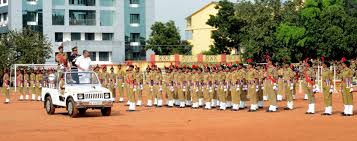
      NCC celebrates its 71st Raising Day

      The National Cadet Corps (NCC), the largest uniformed youth organisation in the world, is celebrating its 71stRaising Day today.  The celebrations began yesterdaywith Defence Secretary Dr Ajay Kumar and DG NCC Lt Gen Rajeev Choprapaying homage to the martyrs, who made the supreme sacrifice in the service of the nation, at the National War Memorial in New Delhi. They laid wreaths on behalf of the entire NCC fraternity.The NCC Raising Day was also celebrated all over the country with the cadets participating in marches, cultural activities and social development programmes.

      During the current year, the NCC cadets have contributed immensely in relief operations carried out during floods in Maharashtra, Bihar and Kerala.The cadets also participated wholeheartedly in the Swachhta Abhiyan, Swachhta Cycle Rally, Mega Pollution Pakhwada and played a pivotal role in spreading awareness about various government initiatives like Digital Literacy, International Day of Yoga, Blood Donation Camps, Tree Plantation and immunisation programs etc.NCC girl cadets successfully summited the Mount Tenchenkhang (6,010 metres) in Sikkim and Boy cadets successfully summited MountHanumarTibba (5,982 metres) in Himachal Pradesh.

      The multifaceted activities and varied curriculum of NCC provides unique opportunities to the youth for their development.Many cadets have done the nation and the organisation proud by their remarkable achievements in the fields of sports and adventure.NCC continues its relentless efforts towards moulding theyouth into responsible citizens of the country.

      \’What We Learn Cannot Be Burnt – \’An Afghan Neo-Literate Woman

      As we work in education, it often tends to get too \’sanitized\’ – as if it is not about real people in real situations, where education has a meaning that\’s almost impossible to comprehend. Here\’s a story from Afghanistan, from a programme called Learning for Life that sought to provide initial literacy and health awareness to enable women to become CHWs (community health workers, sorely needed in the country). This story was documented in June 2005, by Judie Schiffbauer, and shared by Katy Anis.


      Each morning, six days a week, 40 year old Zeba Gul wraps a light gray shawl around her head and shoulders and leaves her family’s mud-walled compound in the Afghan village of BegToot.  She follows a path that winds through dusty alleyways and then along green fields to arrive at a two-story building constructed of unbaked brick made from mud and straw.  Inside, a set of narrow stairs leads to the Learning for Life classroom, where other women are already gathered.  Removing her shoes at the doorway, she enters and lowers herself to the mat-covered floor, tucking her long legs beneath her.  
      In December 2004, when the LfL health-based literacy program began in BegToot, wind whipped snow against the classroom windows, but on this fine summer day, the windows are open to admit a pleasant breeze.  The room looks out over groves of mulberry trees, for which the village is named.  Tall, creviced mountains rise high in the distance, still bearing traces of winter snow.
      But the 26 women in the class are not admiring the view.  Instead, each attends to Qotsia, their 21-year-old teacher, who stands beside a small blackboard at the front of the room.  One of millions of Afghans who fled the war-torn country, Qotsia grew up as a refugee in Iran, where she received 12 years of formal education.  Now she has returned to BegToot, and the women are grateful.
       Dressed and coifed in black, Qotsia begins to write with a piece of chalk.  Carefully demonstrating each stroke, she writes a word in Dari composed of several letters from the alphabet displayed on a poster on the wall.  The dark black letters on the poster are easy to see, but six months ago, no woman in the class could have named or written a single one.  Today, hands shoot up when Qotsea asks someone to spell out and then read what she has written.  One woman rises and comes forward:  k a r u m (worm).  “Very good, Pashtoon Jan!” says Qotsia.  Pashtoon Jan smiles as her fellow learners sound out the word, repeat it in unison, and write it in their notebooks:   k a r u m.  Worms are the topic of today’s lesson.  
      To the left of the blackboard, a series of drawings depicts women busy with women’s chores:  one is cleaning vegetables; one is boiling water to be stored in an earthenware jar; another is feeding a sick baby; and one is washing a child’s dirty hands.  Now the women in this Level One literacy class are going to learn how worms and a child’s dirty hands are related. 
      As one of six Community Health Workers enrolled in the class, Zeba Gul already knows a lot about worms.  Their life cycle and method of transmission were explained to her when BRAC, a REACH NGO-grantee, trained her as a CHW.  But until now, Zeba Gul has never known how to spell, read or write the names of the parasites– roundworm, tapeworm, and pinworm—that sicken so many children and adults in the village. 
      As Qotsia begins the lesson, Zeba Gul leans forward and points to a young woman sitting nearby: “That’s my daughter,” she whispers. “Because of this class, she is learning to read and write before her hair turns gray.”
      Later, the class at an end and women lingering to talk, Zeba Gul told her story.  She was born in Paghman, but she has not always lived there.  When she was sixteen, she married and moved to Kabul with her husband to live with his family. Her daughter and several other children were born in the city.
      “It was good,” says Zeba Gul.  “My husband had a small shop.  He worked hard.  In the morning, he opened the shop.  In the afternoon, he had a second job in a government building.”
      Even during the dark days of war, the family chose not to leave Afghanistan for sanctuary in Pakistan or Iran.  “We stayed,” she says, remembering their struggles with a hint of pride in her voice.  “We were hard workers, and we stayed.” 
      For a time after the Russians left, Zeba Gul thought the worst was behind them.  But peace did not last long.  “After that,” she said, “I wasn’t sure what the fighting was about; I know only that it did not stop.  So much fighting.”
      When Zeba Gul explains that both the family’s shop and home were near Damazang in Karte Seh, the room grows very quiet.  Everyone knows that Karte Seh was virtually destroyed during the civil war.  “Ay, Khoda!” the women whisper, as Zeba Gul continues her story:
      “One night, our shop was ablaze. How it burned!  And our house burned too.  Everything we had was swallowed in fire.  Oh, God.  What could we do?  We had nothing left!  So we returned to Paghman.  It was more than ten years ago.  Here, my husband is a farmer.  Thanks to Allah, he is alive.” 
      Many of her listeners have been less fortunate, and the widows nod in agreement as Zeba Gul utters her prayer of gratitude.  The women in the room have known great sorrows, but it is resilience that binds them. 
      “Now,” continues Zeba Gul, “I am a CHW.  And I am learning to read and write in this class.  See there: my daughter is also here! Faz l’Khoda–Give thanks to God.  What we learn cannot be burned.”  

      \’What We Learn Cannot Be Burnt – \’An Afghan Neo-Literate Woman

      As we work in education, it often tends to get too \’sanitized\’ – as if it is not about real people in real situations, where education has a meaning that\’s almost impossible to comprehend. Here\’s a story from Afghanistan, from a programme called Learning for Life that sought to provide initial literacy and health awareness to enable women to become CHWs (community health workers, sorely needed in the country). This story was documented in June 2005, by Judie Schiffbauer, and shared by Katy Anis.


      Each morning, six days a week, 40 year old Zeba Gul wraps a light gray shawl around her head and shoulders and leaves her family’s mud-walled compound in the Afghan village of BegToot.  She follows a path that winds through dusty alleyways and then along green fields to arrive at a two-story building constructed of unbaked brick made from mud and straw.  Inside, a set of narrow stairs leads to the Learning for Life classroom, where other women are already gathered.  Removing her shoes at the doorway, she enters and lowers herself to the mat-covered floor, tucking her long legs beneath her.  
      In December 2004, when the LfL health-based literacy program began in BegToot, wind whipped snow against the classroom windows, but on this fine summer day, the windows are open to admit a pleasant breeze.  The room looks out over groves of mulberry trees, for which the village is named.  Tall, creviced mountains rise high in the distance, still bearing traces of winter snow.
      But the 26 women in the class are not admiring the view.  Instead, each attends to Qotsia, their 21-year-old teacher, who stands beside a small blackboard at the front of the room.  One of millions of Afghans who fled the war-torn country, Qotsia grew up as a refugee in Iran, where she received 12 years of formal education.  Now she has returned to BegToot, and the women are grateful.
       Dressed and coifed in black, Qotsia begins to write with a piece of chalk.  Carefully demonstrating each stroke, she writes a word in Dari composed of several letters from the alphabet displayed on a poster on the wall.  The dark black letters on the poster are easy to see, but six months ago, no woman in the class could have named or written a single one.  Today, hands shoot up when Qotsea asks someone to spell out and then read what she has written.  One woman rises and comes forward:  k a r u m (worm).  “Very good, Pashtoon Jan!” says Qotsia.  Pashtoon Jan smiles as her fellow learners sound out the word, repeat it in unison, and write it in their notebooks:   k a r u m.  Worms are the topic of today’s lesson.  
      To the left of the blackboard, a series of drawings depicts women busy with women’s chores:  one is cleaning vegetables; one is boiling water to be stored in an earthenware jar; another is feeding a sick baby; and one is washing a child’s dirty hands.  Now the women in this Level One literacy class are going to learn how worms and a child’s dirty hands are related. 
      As one of six Community Health Workers enrolled in the class, Zeba Gul already knows a lot about worms.  Their life cycle and method of transmission were explained to her when BRAC, a REACH NGO-grantee, trained her as a CHW.  But until now, Zeba Gul has never known how to spell, read or write the names of the parasites– roundworm, tapeworm, and pinworm—that sicken so many children and adults in the village. 
      As Qotsia begins the lesson, Zeba Gul leans forward and points to a young woman sitting nearby: “That’s my daughter,” she whispers. “Because of this class, she is learning to read and write before her hair turns gray.”
      Later, the class at an end and women lingering to talk, Zeba Gul told her story.  She was born in Paghman, but she has not always lived there.  When she was sixteen, she married and moved to Kabul with her husband to live with his family. Her daughter and several other children were born in the city.
      “It was good,” says Zeba Gul.  “My husband had a small shop.  He worked hard.  In the morning, he opened the shop.  In the afternoon, he had a second job in a government building.”
      Even during the dark days of war, the family chose not to leave Afghanistan for sanctuary in Pakistan or Iran.  “We stayed,” she says, remembering their struggles with a hint of pride in her voice.  “We were hard workers, and we stayed.” 
      For a time after the Russians left, Zeba Gul thought the worst was behind them.  But peace did not last long.  “After that,” she said, “I wasn’t sure what the fighting was about; I know only that it did not stop.  So much fighting.”
      When Zeba Gul explains that both the family’s shop and home were near Damazang in Karte Seh, the room grows very quiet.  Everyone knows that Karte Seh was virtually destroyed during the civil war.  “Ay, Khoda!” the women whisper, as Zeba Gul continues her story:
      “One night, our shop was ablaze. How it burned!  And our house burned too.  Everything we had was swallowed in fire.  Oh, God.  What could we do?  We had nothing left!  So we returned to Paghman.  It was more than ten years ago.  Here, my husband is a farmer.  Thanks to Allah, he is alive.” 
      Many of her listeners have been less fortunate, and the widows nod in agreement as Zeba Gul utters her prayer of gratitude.  The women in the room have known great sorrows, but it is resilience that binds them. 
      “Now,” continues Zeba Gul, “I am a CHW.  And I am learning to read and write in this class.  See there: my daughter is also here! Faz l’Khoda–Give thanks to God.  What we learn cannot be burned.”  

      \’What We Learn Cannot Be Burnt – \’An Afghan Neo-Literate Woman

      As we work in education, it often tends to get too \’sanitized\’ – as if it is not about real people in real situations, where education has a meaning that\’s almost impossible to comprehend. Here\’s a story from Afghanistan, from a programme called Learning for Life that sought to provide initial literacy and health awareness to enable women to become CHWs (community health workers, sorely needed in the country). This story was documented in June 2005, by Judie Schiffbauer, and shared by Katy Anis.


      Each morning, six days a week, 40 year old Zeba Gul wraps a light gray shawl around her head and shoulders and leaves her family’s mud-walled compound in the Afghan village of BegToot.  She follows a path that winds through dusty alleyways and then along green fields to arrive at a two-story building constructed of unbaked brick made from mud and straw.  Inside, a set of narrow stairs leads to the Learning for Life classroom, where other women are already gathered.  Removing her shoes at the doorway, she enters and lowers herself to the mat-covered floor, tucking her long legs beneath her.  
      In December 2004, when the LfL health-based literacy program began in BegToot, wind whipped snow against the classroom windows, but on this fine summer day, the windows are open to admit a pleasant breeze.  The room looks out over groves of mulberry trees, for which the village is named.  Tall, creviced mountains rise high in the distance, still bearing traces of winter snow.
      But the 26 women in the class are not admiring the view.  Instead, each attends to Qotsia, their 21-year-old teacher, who stands beside a small blackboard at the front of the room.  One of millions of Afghans who fled the war-torn country, Qotsia grew up as a refugee in Iran, where she received 12 years of formal education.  Now she has returned to BegToot, and the women are grateful.
       Dressed and coifed in black, Qotsia begins to write with a piece of chalk.  Carefully demonstrating each stroke, she writes a word in Dari composed of several letters from the alphabet displayed on a poster on the wall.  The dark black letters on the poster are easy to see, but six months ago, no woman in the class could have named or written a single one.  Today, hands shoot up when Qotsea asks someone to spell out and then read what she has written.  One woman rises and comes forward:  k a r u m (worm).  “Very good, Pashtoon Jan!” says Qotsia.  Pashtoon Jan smiles as her fellow learners sound out the word, repeat it in unison, and write it in their notebooks:   k a r u m.  Worms are the topic of today’s lesson.  
      To the left of the blackboard, a series of drawings depicts women busy with women’s chores:  one is cleaning vegetables; one is boiling water to be stored in an earthenware jar; another is feeding a sick baby; and one is washing a child’s dirty hands.  Now the women in this Level One literacy class are going to learn how worms and a child’s dirty hands are related. 
      As one of six Community Health Workers enrolled in the class, Zeba Gul already knows a lot about worms.  Their life cycle and method of transmission were explained to her when BRAC, a REACH NGO-grantee, trained her as a CHW.  But until now, Zeba Gul has never known how to spell, read or write the names of the parasites– roundworm, tapeworm, and pinworm—that sicken so many children and adults in the village. 
      As Qotsia begins the lesson, Zeba Gul leans forward and points to a young woman sitting nearby: “That’s my daughter,” she whispers. “Because of this class, she is learning to read and write before her hair turns gray.”
      Later, the class at an end and women lingering to talk, Zeba Gul told her story.  She was born in Paghman, but she has not always lived there.  When she was sixteen, she married and moved to Kabul with her husband to live with his family. Her daughter and several other children were born in the city.
      “It was good,” says Zeba Gul.  “My husband had a small shop.  He worked hard.  In the morning, he opened the shop.  In the afternoon, he had a second job in a government building.”
      Even during the dark days of war, the family chose not to leave Afghanistan for sanctuary in Pakistan or Iran.  “We stayed,” she says, remembering their struggles with a hint of pride in her voice.  “We were hard workers, and we stayed.” 
      For a time after the Russians left, Zeba Gul thought the worst was behind them.  But peace did not last long.  “After that,” she said, “I wasn’t sure what the fighting was about; I know only that it did not stop.  So much fighting.”
      When Zeba Gul explains that both the family’s shop and home were near Damazang in Karte Seh, the room grows very quiet.  Everyone knows that Karte Seh was virtually destroyed during the civil war.  “Ay, Khoda!” the women whisper, as Zeba Gul continues her story:
      “One night, our shop was ablaze. How it burned!  And our house burned too.  Everything we had was swallowed in fire.  Oh, God.  What could we do?  We had nothing left!  So we returned to Paghman.  It was more than ten years ago.  Here, my husband is a farmer.  Thanks to Allah, he is alive.” 
      Many of her listeners have been less fortunate, and the widows nod in agreement as Zeba Gul utters her prayer of gratitude.  The women in the room have known great sorrows, but it is resilience that binds them. 
      “Now,” continues Zeba Gul, “I am a CHW.  And I am learning to read and write in this class.  See there: my daughter is also here! Faz l’Khoda–Give thanks to God.  What we learn cannot be burned.”  

      \’What We Learn Cannot Be Burnt – \’An Afghan Neo-Literate Woman

      As we work in education, it often tends to get too \’sanitized\’ – as if it is not about real people in real situations, where education has a meaning that\’s almost impossible to comprehend. Here\’s a story from Afghanistan, from a programme called Learning for Life that sought to provide initial literacy and health awareness to enable women to become CHWs (community health workers, sorely needed in the country). This story was documented in June 2005, by Judie Schiffbauer, and shared by Katy Anis.


      Each morning, six days a week, 40 year old Zeba Gul wraps a light gray shawl around her head and shoulders and leaves her family’s mud-walled compound in the Afghan village of BegToot.  She follows a path that winds through dusty alleyways and then along green fields to arrive at a two-story building constructed of unbaked brick made from mud and straw.  Inside, a set of narrow stairs leads to the Learning for Life classroom, where other women are already gathered.  Removing her shoes at the doorway, she enters and lowers herself to the mat-covered floor, tucking her long legs beneath her.  
      In December 2004, when the LfL health-based literacy program began in BegToot, wind whipped snow against the classroom windows, but on this fine summer day, the windows are open to admit a pleasant breeze.  The room looks out over groves of mulberry trees, for which the village is named.  Tall, creviced mountains rise high in the distance, still bearing traces of winter snow.
      But the 26 women in the class are not admiring the view.  Instead, each attends to Qotsia, their 21-year-old teacher, who stands beside a small blackboard at the front of the room.  One of millions of Afghans who fled the war-torn country, Qotsia grew up as a refugee in Iran, where she received 12 years of formal education.  Now she has returned to BegToot, and the women are grateful.
       Dressed and coifed in black, Qotsia begins to write with a piece of chalk.  Carefully demonstrating each stroke, she writes a word in Dari composed of several letters from the alphabet displayed on a poster on the wall.  The dark black letters on the poster are easy to see, but six months ago, no woman in the class could have named or written a single one.  Today, hands shoot up when Qotsea asks someone to spell out and then read what she has written.  One woman rises and comes forward:  k a r u m (worm).  “Very good, Pashtoon Jan!” says Qotsia.  Pashtoon Jan smiles as her fellow learners sound out the word, repeat it in unison, and write it in their notebooks:   k a r u m.  Worms are the topic of today’s lesson.  
      To the left of the blackboard, a series of drawings depicts women busy with women’s chores:  one is cleaning vegetables; one is boiling water to be stored in an earthenware jar; another is feeding a sick baby; and one is washing a child’s dirty hands.  Now the women in this Level One literacy class are going to learn how worms and a child’s dirty hands are related. 
      As one of six Community Health Workers enrolled in the class, Zeba Gul already knows a lot about worms.  Their life cycle and method of transmission were explained to her when BRAC, a REACH NGO-grantee, trained her as a CHW.  But until now, Zeba Gul has never known how to spell, read or write the names of the parasites– roundworm, tapeworm, and pinworm—that sicken so many children and adults in the village. 
      As Qotsia begins the lesson, Zeba Gul leans forward and points to a young woman sitting nearby: “That’s my daughter,” she whispers. “Because of this class, she is learning to read and write before her hair turns gray.”
      Later, the class at an end and women lingering to talk, Zeba Gul told her story.  She was born in Paghman, but she has not always lived there.  When she was sixteen, she married and moved to Kabul with her husband to live with his family. Her daughter and several other children were born in the city.
      “It was good,” says Zeba Gul.  “My husband had a small shop.  He worked hard.  In the morning, he opened the shop.  In the afternoon, he had a second job in a government building.”
      Even during the dark days of war, the family chose not to leave Afghanistan for sanctuary in Pakistan or Iran.  “We stayed,” she says, remembering their struggles with a hint of pride in her voice.  “We were hard workers, and we stayed.” 
      For a time after the Russians left, Zeba Gul thought the worst was behind them.  But peace did not last long.  “After that,” she said, “I wasn’t sure what the fighting was about; I know only that it did not stop.  So much fighting.”
      When Zeba Gul explains that both the family’s shop and home were near Damazang in Karte Seh, the room grows very quiet.  Everyone knows that Karte Seh was virtually destroyed during the civil war.  “Ay, Khoda!” the women whisper, as Zeba Gul continues her story:
      “One night, our shop was ablaze. How it burned!  And our house burned too.  Everything we had was swallowed in fire.  Oh, God.  What could we do?  We had nothing left!  So we returned to Paghman.  It was more than ten years ago.  Here, my husband is a farmer.  Thanks to Allah, he is alive.” 
      Many of her listeners have been less fortunate, and the widows nod in agreement as Zeba Gul utters her prayer of gratitude.  The women in the room have known great sorrows, but it is resilience that binds them. 
      “Now,” continues Zeba Gul, “I am a CHW.  And I am learning to read and write in this class.  See there: my daughter is also here! Faz l’Khoda–Give thanks to God.  What we learn cannot be burned.”