
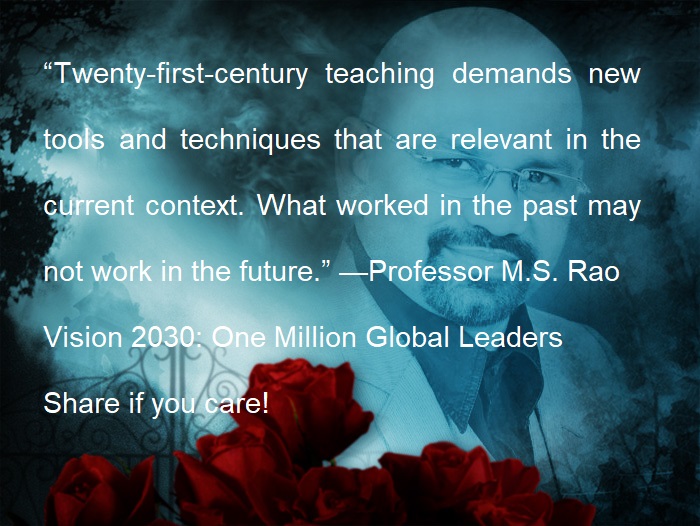
“Twenty-first-century teaching demands new tools and techniques that are relevant in the current context. What worked in the past may not work in the future.” —Professor M.S. Rao
Vision 2030: One Million Global Leaders


I found the session stimulated me to speak about my past learning experiences. For example, the Diploma of Teaching in which the learning was all done through self-directed and mentored assignments. Half the 120 credits were allowed to be attributed to RPL. The oral presentation at the end was where I had to present reflections about my learning journey and my teaching framework to a panel. That was scary.
The most memorable thing for me regarding flexible learning in my past life, was in the Certificate in Clinical Teaching because a facilitator from Christchurch used to travel to Dunedin to run two and three day workshops as part of the programme. Not only was the timing of her teaching innovative, her style was flexible because it was very experiential and she facilitated our learning rather than just lecturing us. She did a mixture of presentation, activities and discussion, self-directed activities, teleconference, block courses and peer work. Her assessments were also innovative, for example, a poster was the main assessment.
Since I started working at Otago Polytechnic in 1992 as a bioscience lecturer, I have seen a huge number of changes in the type of assessments offered to students right across the polytechnic. Now it is not just essays, quizzes and exams, there are a multitude of things offered to students. There are also a huge number of ways in which teachers communicate with their students. Once upon a time, lecturers used to be aghast at the idea of emailing students and now it is a given. Some are also using texting to communicate and chat and skype as well as web and video conferencing.
I am interested to hear how participants in the Flexible learning course assess and communicate flexibly. These are very important aspects of flexible learning, and even more important than content in my opinion. What do you think?
The horse analogy and flexible learning
The title of this post has come about due to the number of hours I have spent recently helping my daughter to teach a horse to get in a float. There was a lot of work involved to get it to even enter and then a lot more to get it to stay in the float. The experience reminds me of my work at Otago Polytechnic. Perhaps this sounds a bit silly, and you are thinking what has a horse got to do with teaching at a tertiary institution? Well I can see several similarities. Let me set the scene first.
Over the years as a staff developer and educational developer, I have spent many, many hours assisting staff – academic and general – with the use of technology in the workplace. I have also taught Health Informatics to health students with the aim of up-skilling them in computing for their practice. I have also spent a lot of energy leading people to the big eLearning pond, trying to get them to dabble their toes on the edge, walk out a bit even though it was chilly and scary and then swimming with them when they decided to take the plunge. Sometimes I pushed the occasional person in, but hey I did rescue them, mostly. Some I could not catch as they swam away to distant horizons once they found their flippers. 🙂 It\’s been like swimming with the dolphins – fun, scary, challenging and playful and also like swimming with the sharks – terrifying, serious, exhilarating. It is also very similar to the work required to get a scared horse to enter a float.
Image: Pond at Autumn – Teich im Herbst by Tobi_2008
Thinking back on my experiences over the last nine years, and about my experiences recently with the horse float, I realise that there is also a lot of merit in the expression, \”you can lead a horse to water but you cannot make it drink\”. Just as we led the horse to the float and could not get him to go in..for ages…but with some repetition, gentle and firm persuasion, guiding ropes (structure) and patience, we got him in and we got him to stay longer each time. This is much like my experiences in getting teachers to accept flexible ways of offering learning.
And to continue with the analogy of the float. Some back off before they get even close, others walk up to it and watch, others walk up, sniff and turn round, others walk right on in and stay and never leave, others walk in halfway, and some go in, back out, go back in and so on, and some only ever keep one foot on the door, always looking side to side and behind… My motto is to keep trying, so if you see me coming towards you with a horse whip I promise to be gentle.
I found the session stimulated me to speak about my past learning experiences. For example, the Diploma of Teaching in which the learning was all done through self-directed and mentored assignments. Half the 120 credits were allowed to be attributed to RPL. The oral presentation at the end was where I had to present reflections about my learning journey and my teaching framework to a panel. That was scary.
The most memorable thing for me regarding flexible learning in my past life, was in the Certificate in Clinical Teaching because a facilitator from Christchurch used to travel to Dunedin to run two and three day workshops as part of the programme. Not only was the timing of her teaching innovative, her style was flexible because it was very experiential and she facilitated our learning rather than just lecturing us. She did a mixture of presentation, activities and discussion, self-directed activities, teleconference, block courses and peer work. Her assessments were also innovative, for example, a poster was the main assessment.
Since I started working at Otago Polytechnic in 1992 as a bioscience lecturer, I have seen a huge number of changes in the type of assessments offered to students right across the polytechnic. Now it is not just essays, quizzes and exams, there are a multitude of things offered to students. There are also a huge number of ways in which teachers communicate with their students. Once upon a time, lecturers used to be aghast at the idea of emailing students and now it is a given. Some are also using texting to communicate and chat and skype as well as web and video conferencing.
I am interested to hear how participants in the Flexible learning course assess and communicate flexibly. These are very important aspects of flexible learning, and even more important than content in my opinion. What do you think?
The horse analogy and flexible learning
The title of this post has come about due to the number of hours I have spent recently helping my daughter to teach a horse to get in a float. There was a lot of work involved to get it to even enter and then a lot more to get it to stay in the float. The experience reminds me of my work at Otago Polytechnic. Perhaps this sounds a bit silly, and you are thinking what has a horse got to do with teaching at a tertiary institution? Well I can see several similarities. Let me set the scene first.
Over the years as a staff developer and educational developer, I have spent many, many hours assisting staff – academic and general – with the use of technology in the workplace. I have also taught Health Informatics to health students with the aim of up-skilling them in computing for their practice. I have also spent a lot of energy leading people to the big eLearning pond, trying to get them to dabble their toes on the edge, walk out a bit even though it was chilly and scary and then swimming with them when they decided to take the plunge. Sometimes I pushed the occasional person in, but hey I did rescue them, mostly. Some I could not catch as they swam away to distant horizons once they found their flippers. 🙂 It\’s been like swimming with the dolphins – fun, scary, challenging and playful and also like swimming with the sharks – terrifying, serious, exhilarating. It is also very similar to the work required to get a scared horse to enter a float.
Image: Pond at Autumn – Teich im Herbst by Tobi_2008
Thinking back on my experiences over the last nine years, and about my experiences recently with the horse float, I realise that there is also a lot of merit in the expression, \”you can lead a horse to water but you cannot make it drink\”. Just as we led the horse to the float and could not get him to go in..for ages…but with some repetition, gentle and firm persuasion, guiding ropes (structure) and patience, we got him in and we got him to stay longer each time. This is much like my experiences in getting teachers to accept flexible ways of offering learning.
And to continue with the analogy of the float. Some back off before they get even close, others walk up to it and watch, others walk up, sniff and turn round, others walk right on in and stay and never leave, others walk in halfway, and some go in, back out, go back in and so on, and some only ever keep one foot on the door, always looking side to side and behind… My motto is to keep trying, so if you see me coming towards you with a horse whip I promise to be gentle.
I found the session stimulated me to speak about my past learning experiences. For example, the Diploma of Teaching in which the learning was all done through self-directed and mentored assignments. Half the 120 credits were allowed to be attributed to RPL. The oral presentation at the end was where I had to present reflections about my learning journey and my teaching framework to a panel. That was scary.
The most memorable thing for me regarding flexible learning in my past life, was in the Certificate in Clinical Teaching because a facilitator from Christchurch used to travel to Dunedin to run two and three day workshops as part of the programme. Not only was the timing of her teaching innovative, her style was flexible because it was very experiential and she facilitated our learning rather than just lecturing us. She did a mixture of presentation, activities and discussion, self-directed activities, teleconference, block courses and peer work. Her assessments were also innovative, for example, a poster was the main assessment.
Since I started working at Otago Polytechnic in 1992 as a bioscience lecturer, I have seen a huge number of changes in the type of assessments offered to students right across the polytechnic. Now it is not just essays, quizzes and exams, there are a multitude of things offered to students. There are also a huge number of ways in which teachers communicate with their students. Once upon a time, lecturers used to be aghast at the idea of emailing students and now it is a given. Some are also using texting to communicate and chat and skype as well as web and video conferencing.
I am interested to hear how participants in the Flexible learning course assess and communicate flexibly. These are very important aspects of flexible learning, and even more important than content in my opinion. What do you think?
The horse analogy and flexible learning
The title of this post has come about due to the number of hours I have spent recently helping my daughter to teach a horse to get in a float. There was a lot of work involved to get it to even enter and then a lot more to get it to stay in the float. The experience reminds me of my work at Otago Polytechnic. Perhaps this sounds a bit silly, and you are thinking what has a horse got to do with teaching at a tertiary institution? Well I can see several similarities. Let me set the scene first.
Over the years as a staff developer and educational developer, I have spent many, many hours assisting staff – academic and general – with the use of technology in the workplace. I have also taught Health Informatics to health students with the aim of up-skilling them in computing for their practice. I have also spent a lot of energy leading people to the big eLearning pond, trying to get them to dabble their toes on the edge, walk out a bit even though it was chilly and scary and then swimming with them when they decided to take the plunge. Sometimes I pushed the occasional person in, but hey I did rescue them, mostly. Some I could not catch as they swam away to distant horizons once they found their flippers. 🙂 It\’s been like swimming with the dolphins – fun, scary, challenging and playful and also like swimming with the sharks – terrifying, serious, exhilarating. It is also very similar to the work required to get a scared horse to enter a float.
Image: Pond at Autumn – Teich im Herbst by Tobi_2008
Thinking back on my experiences over the last nine years, and about my experiences recently with the horse float, I realise that there is also a lot of merit in the expression, \”you can lead a horse to water but you cannot make it drink\”. Just as we led the horse to the float and could not get him to go in..for ages…but with some repetition, gentle and firm persuasion, guiding ropes (structure) and patience, we got him in and we got him to stay longer each time. This is much like my experiences in getting teachers to accept flexible ways of offering learning.
And to continue with the analogy of the float. Some back off before they get even close, others walk up to it and watch, others walk up, sniff and turn round, others walk right on in and stay and never leave, others walk in halfway, and some go in, back out, go back in and so on, and some only ever keep one foot on the door, always looking side to side and behind… My motto is to keep trying, so if you see me coming towards you with a horse whip I promise to be gentle.

 |
| Source: Mic |
After months of polls, predictions, and prognostications, the citizens of Iowa will finally render the first actual votes of the 2016 presidential campaign. The process, though, is far from simple. The Iowa caucuses are notoriously obtuse affairs, especially on the Democratic side. The details of the caucuses may be familiar to Iowans and political science junkies, but the precise steps in selecting delegates are enormously important for all citizens to know. Students especially should be aware of how a caucus works, because it is a true instance of civics-in-action and because one of the candidates will go on to become the next leader of the free world.
 |
| Source: MSNBC |
The explainer videos featured below are all terrific tools in teaching students about the first-in-the-nation voting process. As animated motion graphics, they can effectively reach learners of all ages. They would be ideal for both in-class or flipped learning, as they outline the history and the methodology behind Iowa\’s quirky tradition of caucus-going.

 \’Govardhan Puja\’ is a famous festival of Hindus. It is widely celebrated in the northern part of India. This is the fourth day of Diwali. It is celebrated on the first day of Shukla Paksha of Karthik month according to Hindu Calendar. It is celebrated on the next day of Diwali festival.\’Govardhan Puja\’ is a famous festival of Hindus. It is widely celebrated in the northern part of India. This is the fourth day of Diwali. It is celebrated on the first day of Shukla Paksha of Karthik month according to Hindu Calendar. It is celebrated on the next day of Diwali festival.\’Govardhan Puja\’ is a famous festival of Hindus. It is widely celebrated in the northern part of India. This is the fourth day of Diwali. It is celebrated on the first day of Shukla Paksha of Karthik month according to Hindu Calendar. It is celebrated on the next day of Diwali festival.
 Eduindex
You must be logged in to post a comment.