Teaching Tolerance: America's Story Is An Immigration Story

Source: ASIDE 2016

With the continual debate in our nation’s government over the immigration policy, and the political rhetoric of the current crop of presidential candidates, it is no wonder that our students have misinformation and questions about immigration. No matter how you slice it, the United States is a nation of immigrants who contributed their blood, sweat, and tears to build the country we are today. America’s story is an immigration story, of people who continue to become productive citizens, defend our country, work hard, and help this country grow.

We are increasingly alarmed by the lack of understanding of just how much immigrants have contributed to who we are as a nation. The following motion graphic, entitled “Immigration and Growth,” was produced by the George W. Bush Institute, and the statistical information brings to light just how much of an impact immigrants have made to the economy. The students are surprised to learn that immigrants account for one-third of new small business owners, or that 40 percent of Fortune 500 companies were founded by first or second generation immigrants.


The motion graphic called Just The Facts provides an additional, straightforward delivery of information about immigration in order to try to debunk some of the misinformation that leads people to make assumptions based on political alliances. It offers some enlightening statistics about who’s here, who commits crimes, and who works.


Lastly, the recent article titled “The Secret Of Immigration Genius” by Eric Weiner in The Wall Street Journal sheds further light on the geography of genius that results from the influx of foreigners. He drives home the point that having your world turned upside down sparks creative thinking. Weiner points to recent research on the role of “schema violations” in intellectual development.

Source: The Wall Street Journal

This occurs when your world is full of turmoil, causing temporal and spacial cues to be thrown off balance. People uprooted from the familiar see the world from a different angle, giving them another perspective that enables them to surpass the merely talented, including Albert Einstein, Sigmund Freud, and Marie Curie to name a few.

Weiner refers to studies based on historical analysis that support how creativity is spurred by the intermingling of cultures, and perhaps “we should be wise to view the welcome mat not as charity, but, rather, as enlightened self-interest.”

As we enter into a presidential year, which from the outset seems more combative that ever, we need to constantly provide our students with a variety of viewpoints and build a learning community that questions information by not accepting everything they hear as gospel truth. As a nation built on the contributions of immigrants, it is our responsibility.

Born Digital, Live Digital, And Our Students' Obsession With Documenting Their Lives

Source: Spencer Brown

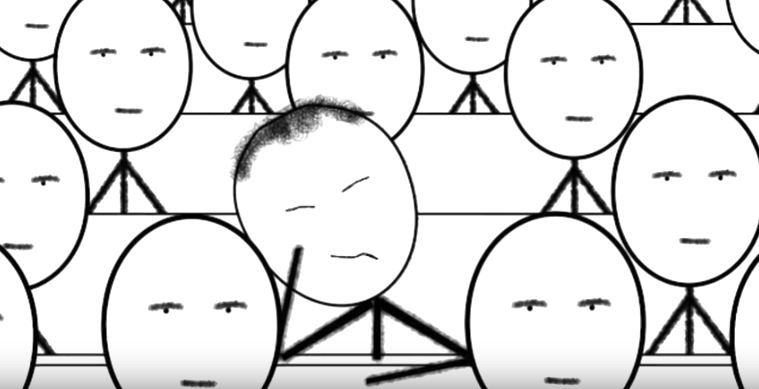
Does our obsession with technology and documentation go too far? This powerful, short film titled “The Boy With The Camera Face” by filmmaker Spencer Brown is a satirical fairy tale about a boy born with a camera instead of a head who cannot escape the lens. From the moment of his birth, everything about his life is recorded. Does this sound like our students, or maybe you?


 The Boy with a Camera for a Face from Spencer Brown on Vimeo.


The narration by Steven Berkoff tells the story in a nursery rhyme or somewhat Seussical way. As the tale unfolds, it’s clear that the effect on people’s fixation with the daily life of the “Camera Boy” is hypnotic. They stop noticing things around them and become transfixed as if in a catatonic state — a scenario we witness on a daily basis with our students on their devices.

Perhaps even more important is the issue of privacy in the always-on world. As educators, we want to take advantage of the liminal web while still preserving the anonymity of our learners. That task is a lot harder today then it was a decade ago.

This award-winning film is worth 14 minutes of your time. It puts modern reality into focus in a beautiful, strange, and moving way.

Born Digital, Live Digital, And Our Students' Obsession With Documenting Their Lives

Source: Spencer Brown

Does our obsession with technology and documentation go too far? This powerful, short film titled “The Boy With The Camera Face” by filmmaker Spencer Brown is a satirical fairy tale about a boy born with a camera instead of a head who cannot escape the lens. From the moment of his birth, everything about his life is recorded. Does this sound like our students, or maybe you?


 The Boy with a Camera for a Face from Spencer Brown on Vimeo.


The narration by Steven Berkoff tells the story in a nursery rhyme or somewhat Seussical way. As the tale unfolds, it’s clear that the effect on people’s fixation with the daily life of the “Camera Boy” is hypnotic. They stop noticing things around them and become transfixed as if in a catatonic state — a scenario we witness on a daily basis with our students on their devices.

Perhaps even more important is the issue of privacy in the always-on world. As educators, we want to take advantage of the liminal web while still preserving the anonymity of our learners. That task is a lot harder today then it was a decade ago.

This award-winning film is worth 14 minutes of your time. It puts modern reality into focus in a beautiful, strange, and moving way.

The Great Homework Debate: Where Does Authenticity Meet Redundancy?

Source: anotherplace.tv
It may seem counterintuitive, but homework doesn’t get nearly the attention it deserves. For all the well-intentioned noise, the Great Homework Debate is still one of the least publicized (and most internalized) consternations for today’s students and families.
Yes, there is a deep Lexus Nexus catalogue of articles about the pros and cons of homework in American education. And yes, Alfie Kohn has a quotable list of jeremiads against the ills of busy-work. But the real tug-of-war takes place at dinner tables each night, when school children have not yet completed their hours of worksheets.

This same push-and-pull continues in faculty meetings where educators wrestle with “how much is too much.” The rebranding of homework as “flipping the classroom” has only muddied the waters. Now instead of reading 20 pages of the textbook, kids watch 20 minutes of instructional videos. At bedtime, though, the question still lingers: where do authentic practice and independent learning meet redundant worksheets and desultory assignments?

Many institutions that have investigated the homework issue report increased learning when nightly burdens are lessened. Especially when it comes to ”studying,” the shifting of emphasis away from teacher-prescribed tasks to student-initiated review makes a world of difference in mastery and understanding.
Source: anotherplace.tv


We’ve offered ideas before about ways to teach without worksheets. This concept can hopefully apply to homework, too. Some terrific ideas come from this Jo Townsend “60 Minutes” video from Australia. It addresses the decline in time spent with friends and hobbies. It also mentions that 71 percent of parents feel they aren’t spending enough quality time with their children. They are instead worrying with homework and running the household. The video ends by referencing Finland, where students have no homework at all, and which consistently outranks other nations in its literacy achievements.


60 Minutes, ‘Homework’ infographic. from anotherplace.tv on Vim

Using Brain Science To Study Smarter, Not Harder

Source: ASIDE 2016


Finding the optimum study technique is the holy grail for educators. Parents and teachers alike are joined in their quest to discover the most effective yet the most efficient process for helping their children learn. Countless conversations in the weekly parent-teacher Twitter chat (#ptchat), one of our favorites, have been dedicated to pinpointing the ideal strategies for evening study.

Source: Benedict Carey


Several peer-reviewed scientific studies have actually conducted real-world experiments to determine which methods are the most successful. The terrific explainer video, “How to study smarter, not harder,” offers some surprising findings about what helps children retain information. This animated infographic comes from Benedict Carey’s book, How We Learn: The Surprising Truth About When, Where, and Why It Happens (Random House, 2015). An award-winning science reporter, Carey explains the benefits of daydreaming and distraction to amplify learning – both of which are anathema to the conventional thinking about nighttime study.

Source: Benedict Carey


Carey clarifies that the brain is not a muscle. It doesn’t grow simply from hard work. Most educational theorists state that the more studying, the better – the more hours of focus, the deeper the memorization. Brain-based research, though, says the opposite. Consistency is often the enemy of learning. In fact, a control-based study proved that a simple change in venue can yield a measurable increase in the internalization of material.


Parents and teachers owe it to their children to take advantage of scientific findings to aid young people’s development. If proven data points to more salient learning techniques, then the skill-and-drill mentality of flashcard homework deserves to be shuttered.

For more ideas about effective learning, check out:

Financial Literacy For This Generation – Visualizing The Future Of Wealth In America

Source: Chris Curtis


Financial literacy takes many forms. News headlines and candidate campaigns highlight the disparities of wealth between the \”one percent\” and the everyday Americans. In schools, traditional financial literacy classes teach older students about balancing their checkbooks and paying off their credit cards. These are noble messages, yet fundamental shifts are changing how young people spend and consume, from Bitcoin to online bill-pay.

Furthermore, financial literacy encompasses a much broader net of core fiscal issues, including stock investing, inflationary tendencies, surplus and deficit budgeting, bond and mutual fund accounts, and renting versus home ownership. Our youngest students need to be a part of this conversation, rather than waiting until high school or college, when it may be too late.

Source: Chris Curtis


Luckily, a host of digital resources exist to welcome all learners into the money discussion. A terrific explainer video from Chris Curtis, entitled \”Wealth In America,\” tracks how life-long earnings vary for each generation. Moving from the proven past to the predicted future, this animated infographic addresses how collective wealth matters in determining future savings. The gauzy collage of photographs and stamps unites with compelling narration to inform today\’s students about their relative futures. This motion graphic of statistics and charts neatly blends STEM skills with the social sciences to prove that financial literacy is more than a single silo of curriculum.

Source: Chris Curtis


The video\’s creator, Chris Curtis, created this clip as part of his work with Deloitte University Press. As a director at Not To Scale in London, he has designed numerous short films that synthesize illustration with live action. He blogs at I\’m Your Boss and shares visual and financial literacy ideas on Twitter via @imyourboss.

Source: Chris Curtis


As a whole, this video projects the dollar value of future household assets. It nods to the outsized influence of the Baby Boomers, and it highlights the fallout from the \”Great Recession\” of 2007. In particular, it teaches young people about earnings versus debt. The Millennials are sharers, non-idealogues, and social entrepreneurs. The salaries of these price-conscious, tech-nimble workers may rise steadily, yet their per capita wealth will lag prior generations. They will, however, force changes in the traditional marketplace that will realign how workers accumulate wealth.

 Wealth in America from Chris Curtis on Vimeo.

For more ideas about teaching financial literacy, check out:

Why Design Matters For Educators And Learners

Source: ASIDE 2016

We just finished attending the New York College Learning Skills Association (NYCLSA) Symposium in Saratoga. We met impressive educators who shared their expertise and resources, and we presented “Design Gives Context To Content To Engage Learners.” The following is an excerpt of why we feel so passionate about this topic.

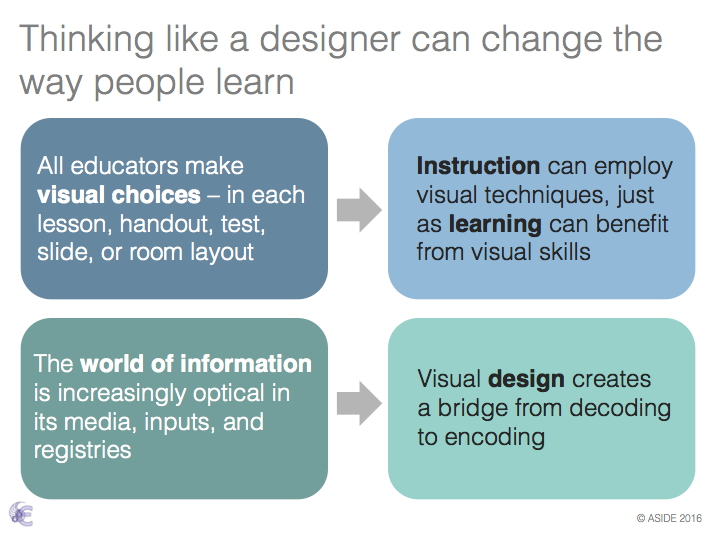
The harmony between form and function not only applies to design, but it also relates to the synergy between educator and learner. It supports both. Good design of information guides the attention of our students, creating a relationship between context and content. It allows for engagement without distraction.

Design Matters, because it can:

  • Steer the eye of the viewer
  • Remove the noise and congestion
  • Separate ideas into succinct areas
  • Create a consistency across materials
  • Align information for clarity
  • Establish a hierarchy of content
  • Make information easier to navigate


Design plays an integral part in the skills of graphicacyvisual literacy, and visual thinking. If companies spend billions of dollars on advertising to grab our attention, it would make sense for educators to think about information design as well. With the growing industry of online learning, how we incorporate visual information makes a difference not only in the way a student engages with the content, but also how he or she comprehends the information over the long run.

Source: ASIDE 2016

Attention, comprehension, and retention, or “ARC,” are inextricably linked when the visual information is included in the overall design of content. It’s why people and kids remember commercial, jingles, logos, and brands. The connection increases engagement with the material, making it memorable. The more we incorporate these aspects into our teacher toolkit, as well as in the options that students have to deliver content, the deeper the link to the material.

Source: ASIDE 2016


Design can influence the perception of information, the visual communication, and the engagement with text. It enables learners to make associations, and it provides opportunities for greater understanding.

The Classroom Sleeper – Are We Paying Attention?

Source: Michael Wesch

We’ve all had students in our classes over the years who sat in the back to put their heads down to sleep. This is not the student we’ve referred to as the “understudent,” who waits in the wings or quietly sits in the shadows of the room doing the required work. We’re not talking about the quiet ones, the introverts, or the “low verbals” either. The “sleeper” is different.

We recently showed a group of students preparing public service announcements one of our favorite videos called the \”Vision of Students Today,\” produced in 2007 by Michael Wesch, for its effective way to deliver a powerful message. That’s when we discovered his recent animated video titled “The Sleeper.”


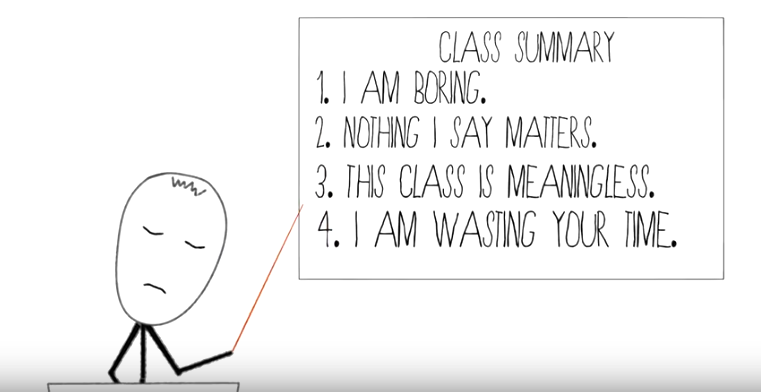
The message hit home. We’re positive that educators experienced the same frustration as the teacher in the animation, and perhaps even thought that the sleeper deliberately set out to annoy us. Some may have wondered if the student disengaged because of boredom, or questioned whether it was the material or their teaching style. For others, it’s personal and exasperating.

Source: Michael Wesch

Why are sleepers so unsettling?

Are they not paying attention, or are we?

How sensitive are we to students who disengage?


This becomes our challenge!

We should not be so quick to judge, or make assumptions about why they\’re tired. If we never stop to ask, we may never know the hidden talents that push students to stay up late to create something they are passionate about through sheer desire.

In an education system too focused on narrow pursuits, it misses the strengths, the interests, and the opportunities for not only the sleeper, but also for every other student as well.

Source: Michael Wesch

We need to stop and ask, make it personal, and tap curiosity. When we do, we just might find out something that surprises us.

Teaching With Cartoons – A Visual History Of Donkeys, Elephants, Parties, & Politics

Source: Politico


Our students are avid consumers of politics and history. They always ask, though, how the Democratic donkey and the Republican elephant became the icons of the respective parties. Both animals, however strong and noble, seem somewhat incongruous to the preferred imagery of political ambition.
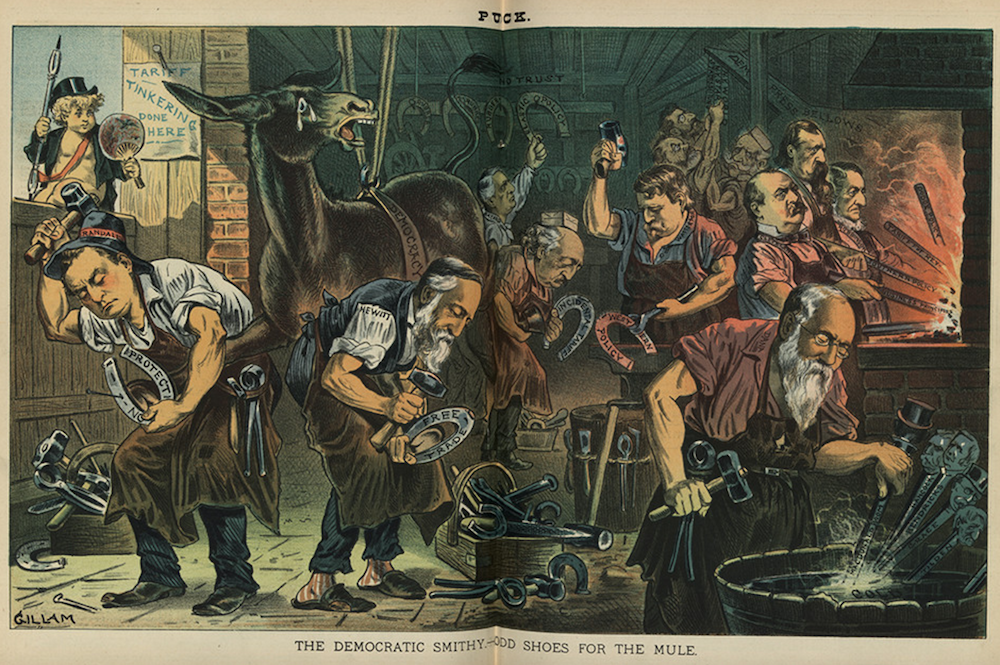
Political cartoonists throughout the ages have captured these two creatures in brilliant colors and tart commentaries. Skilled artists have swayed society\’s opinions through targeted visual satires. For their part, educators have consistently embraced these editorial cartoons as terrific tools in teaching primary sources, points of view, pictorial language, and symbolic metaphors.

Source: Politico


The curators at Politico, one of the sharpest websites for up-to-the-minute political news, have gathered together a stunning gallery of historical cartoons in honor of the Republican and Democratic conventions. They trace the legacy of the donkey — from Andrew Jackson\’s anti-elitism, to Woodrow Wilson\’s internecine war, to Hillary Clinton\’s divided constituency. They map the evolution of the elephant — from Thomas Nast\’s first salvo, to William McKinley\’s bandwagon, to Donald Trump\’s hair on fire.

Source: Politico


Both compendiums of cartoons provide excellent resources for teachers in history, government, civics, social studies, English, and language arts classes. The collections include many seldom-seen images. They also offer terrific examples of illustrations to practice the skills of graphicacy and to follow the four critical steps in analyzing an image.

Source: Politico


Source: Politico


Check out the Democratic cartoon collection here and the Republican cartoon collection here.

For other ideas about teaching with political cartoons, we recommend:


Source: Politico


Visualizing The Summer Olympics – Mapping The 2016 Rio Torch Relay

Source: Rio 2016 Olympics Wiki


On Friday, August 5, 2016, the eyes of the world will be fixated on Rio de Janeiro for the opening ceremonies of the Games of the XXXI Olympiad. The #RoadToRio has notoriously been potholed by damaging news stories about Zika mosquitoswater pollutionconstruction delaysfinancial collapse, and rampant crime. Still, the tenacity of the tireless athletes and the nobility of the Olympic quest will unite the globe for two weeks and will present terrific opportunities for visualizations and education.

Source: Rio 2016


The torch relay, in particular, inaugurates the Games as the flame travels from its Greek origins to then crisscross Brazil in an escalating parade of famous athletes and historic sites. Mapping this journey through graphics and animations offers valuable chances to learn about geography and c

Gaming The 2016 Election – Trading Cards & Virtual Interactives To Meet The Candidates

Source: PBS Kids


Educating younger learners about the 2016 presidential election poses a real challenge. The esoterica of the primary and caucus systems can be difficult to explain. The intricacies of the Electoral College require a background in both United States geography and the Founding Fathers\’ intents. This year\’s candidate quirks present a special hurdle, since many of the well-publicized comments are NSFS (Not Safe For School).

Avoiding these challenges, however, would be a disservice. Pretending that the nation picks a president simply by totaling all the votes would be unethical. Teachers might as well never introduce advanced vocabulary or higher-level mathematics.

Source: PBS Kids


Fortunately, PBS Kids has assembled a terrific array of resources in its \”You Choose 2016\” platform. The kid-friendly range of videos, printouts, and interactives address all of the major election aspects at a level perfect for elementary students.

Source: PBS Kids

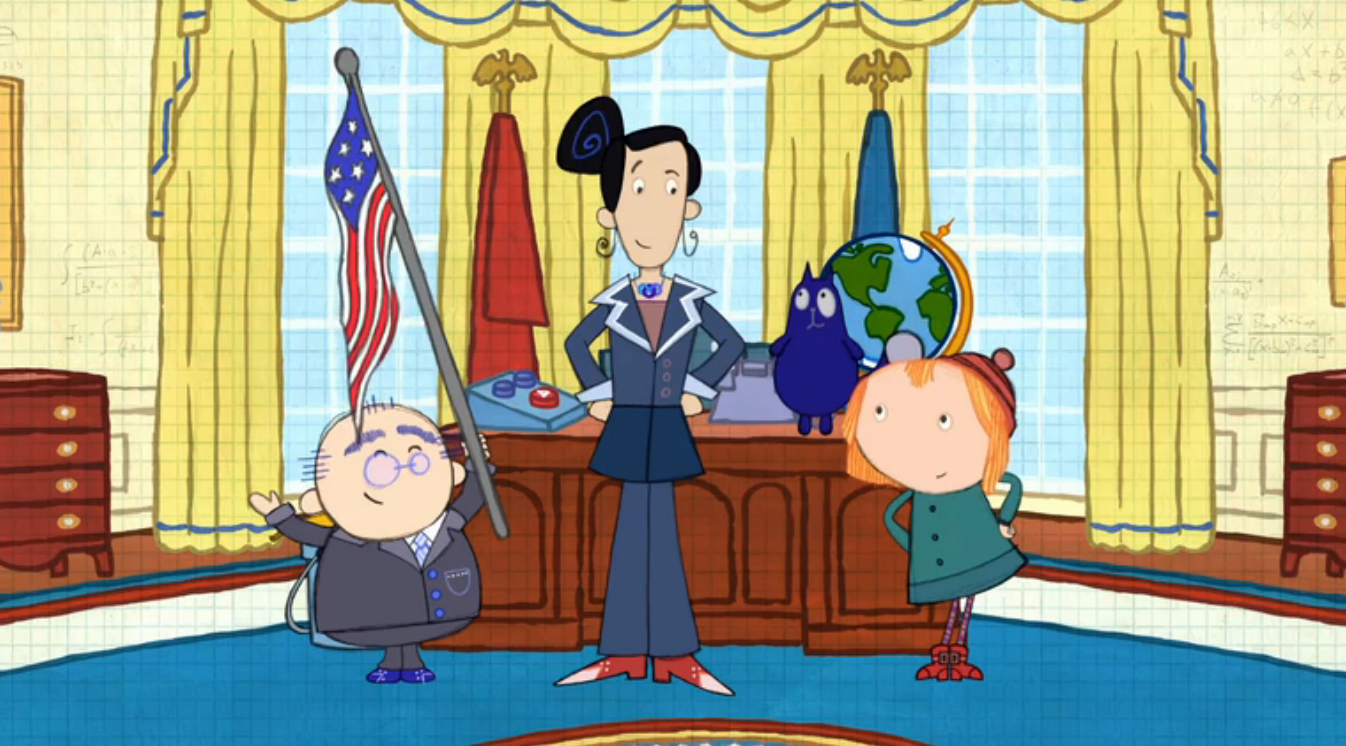
For example, the \”Meet The Candidates\” page offers a bingo-style look at age-appropriate trivia about Democratic nominee Hillary Clinton and Republican nominee Donald Trump. The \”Videos\” portal presents a wide selection of movies and clips, ranging from a live-action explanation of the voting process to an animated tour of the White House.

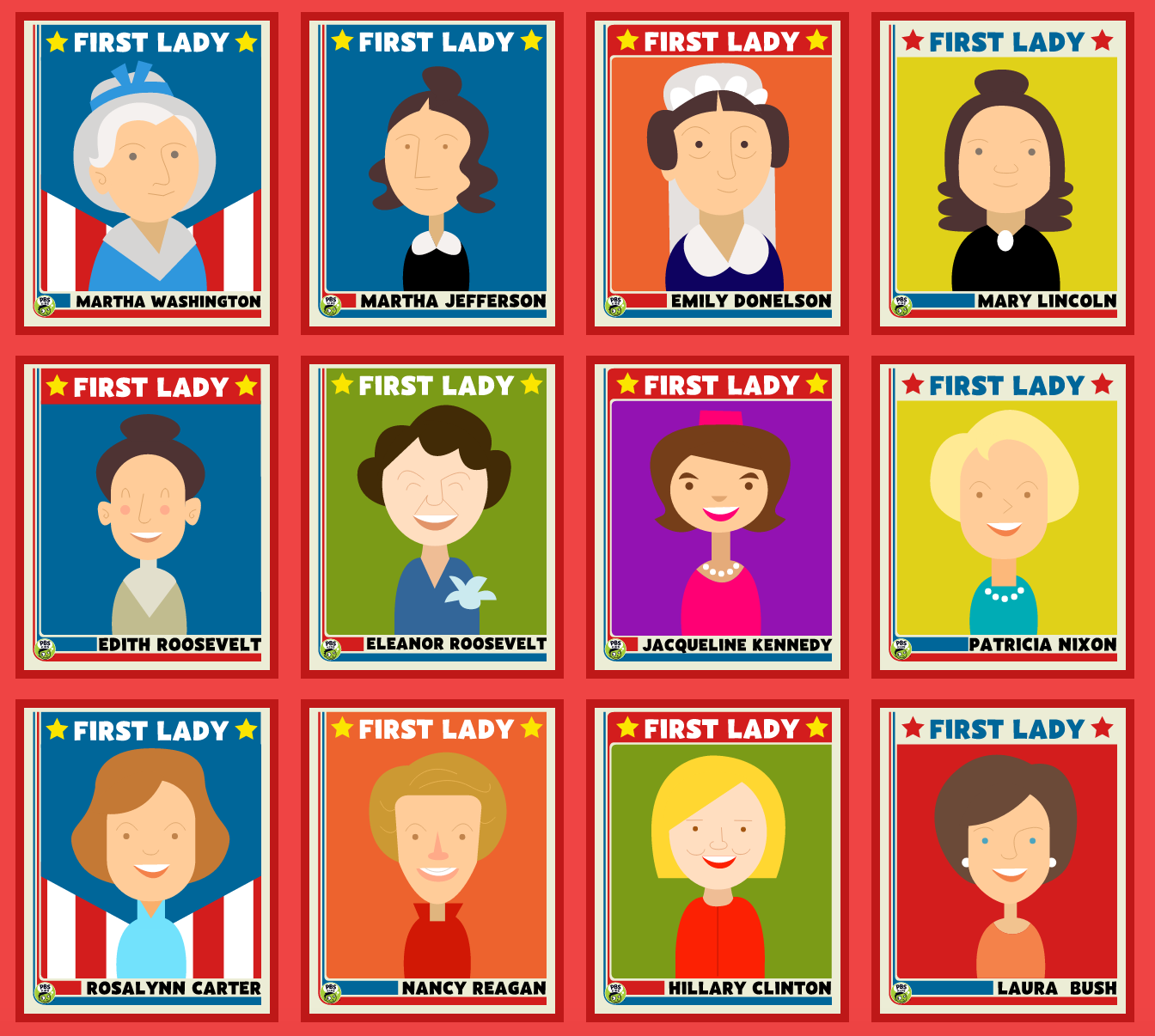
The \”Campaign Poster\” interface invites children to decorate and customize their own election placards. The \”Trading Cards\” area includes colorful renderings of presidents and first ladies to inspire students through a gamification approach.

All told, PBS Kids does a masterful job of avoiding the hard-to-answer questions about the 2016 controversies and instead highlighting the history and the fun of the U.S. presidency.

Gaming The 2016 Election – Animations & Maps To Decode The Electoral College

THURSDAY, OCTOBER 13, 2016

Gaming The 2016 Election – Animations & Maps To Decode The Electoral College

Source: PBS Learning Media

As the national polls and the state-by-state predictions shake out in the final month of the 2016 campaign, the focus turns even more to the Electoral College as the actual arbiter of presidential glory. Somewhat enigmatic and certainly esoteric, the Electoral College stands as a tribute to the Founding Fathers\’ well-founded distrust of the new republic\’s voting population. It also exists as a potentially genius solution to the variations in population density across the country and the unyielding desire for fairness in the democratic process.

Some argue that the electoral vote misrepresents the true(r) popular vote. Others claim that the College instead empowers underrepresented regions. Either way, until a Constitutional Amendment changes the process, electors will meet on the first Monday after the second Wednesday in December to pick the president. Aside from a few confidence-rattling elections – such as when a Reconstruction compromise or a Congressional broker or a Supreme Court controversy determined the winner – the electoral outcome has been affirmed by both citizens and historians.

Source: PBS Learning Media

In order to explain the workings of the Electoral College to all levels of residents and students, PBS Learning Media has put together a terrific \”Electoral Decoder.\” As a part of its Election Central page, this comprehensive and visually impressive resource demystifies the process and helps anyone become more familiar with the United States\’ democratic system.

For classroom teachers, a good initial stop is the video introduction to the tool and the methodology. Clear map animations lead educators and learners through the workings of the Electoral College. There is also a teacher portal that includes lesson plans and instructional suggestions.

Source: PBS Learning Media

The 2016 Presidential Predictor is an interactive map that employs a gamification approach, in which each student becomes a pundit and picks the winner of each state to see which candidate reaches the magic number of 270 electoral votes.

Users can also view the complete roster of electoral results from past contests, displayed in clear geographic statistics. The cartogram view is another valuable lens through which historians can employ design to make the data come to life. In this view, the cartogram resizes traditional map shapes to reflect a relative input, such as population or number of electoral votes. In other words, the states with more people become larger, distorting the recognizable scheme while highlighting the crucial swing locations.

In all, PBS\’ \”Electoral Decoder\” is an informative blend of straightforward geography, time-honored civics, and forward-thinking visualizations to make American elections more accessible.

Halloween Treats To Keep Learners Focused

Source: Halloween Costumes

We work in an elementary school. So if you’re like us, Halloween always makes it difficult for kids to focus, especially with a school-wide parade at the end of the day. Our attitude toward keeping their attention is to use Halloween content to design lessons that tap the spirit of the day.

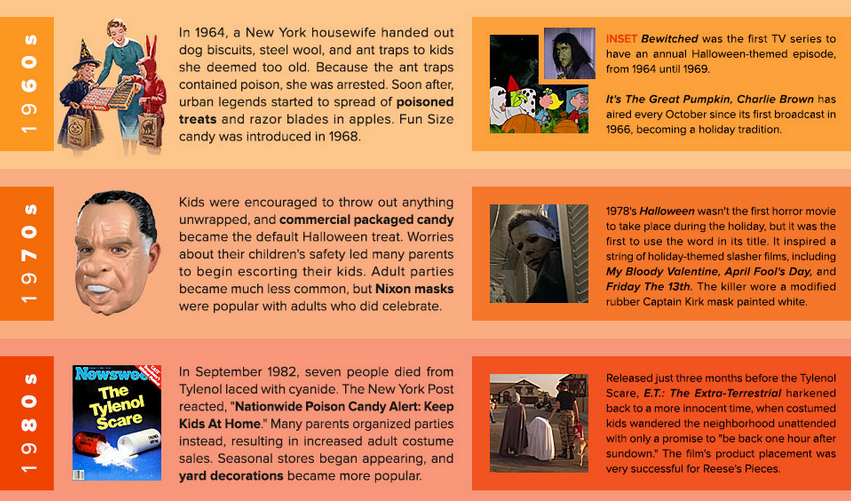
This year we found two new infographics to use with our learners. The first is The Evolution Of Halloween In North America. The timeline begins before 700 in three separate periods in history; from the 1900s to present, the timeline is arranged by decade.

Source: Halloween Costumes

The two-column layout of this infographic provides a visual connection between the history of the holiday and the literature and popular cultural aspects of the time. It’s perfect for scavenger hunts on the evolution of costumes, candy, and traditions.

Source: The Shelf

The other infographic that we thought educators would find useful is Trick Or Treat Your Way Into Halloween Sales Like A Pirate. The creator also designed \”min-fographics,\” perfect for educators to put into any presentation software. The whimsical and colorful display to illustrate the economics behind the holiday is sure to enhance any math lesson.


The different sections of this infographic also provide ideal opportunities for data analysis of charts and graphs. They are just the right mix of visually appealing graphics with real numbers to engage students in making comparisons regarding sales, percentages, popularity, and more.

Source: The Shelf

We firmly believe a little deviation away from the routine to keep students focused pays off in the long run. Using infographics reinforces graphicacy skills, incorporates a little media literacy using Halloween hype, and celebrates learning with a little fun.

New Media Literacy Skills Empower Learners

Source: MediaOcracy

Media Literacy Week just ended a little over a week ago. It could not have come at a more opportune time for our sixth- and seventh-graders to set up their Twitter accounts and participate in the KQED Do Now challenge called “How Does Social Media Influence Our Political Values.”

As part of the challenge, the students watched the video called “MediaOcracy” from the WeTheVoters, and they tweeted their responses to the guiding questions below with the hashtag #DoNowViews.

  • Does social media help or inhibit our ability to develop our own political values?
  • Are your social media networks actually shrinking your worldview?
  • What do you do now, or what can you start doing to make sure you are seeing all sides of an issue while on social media?

 MediaOcracy from We the Voters on Vimeo.

This eye-opening video made the students stop and think a good deal about how viewers could be so easily influenced through algorithms that deliver content from a single point of view, and moreover, how it often leads to a one-sided look at information. It unnerved them a little when they found out that “someone” was aggregating their search results based on likes. It also surprised many that 60% of Americans use social media to get their news.

Source: MediaOcracy

One important takeaway recommended in the video was to watch or listen to another media network that you “violently” oppose to avoid being caught up in a social media stream that feeds only what one wants to hear. With so many modern media outlets openly biased toward the right or left, it was important for these young minds to see the value in comparing information.

The media literacy program at our school has been in place for over 16 years, and it starts with the first graders. We’re fortunate, too, that our students are permitted to use social media for learning; it allows us to update our program to include new media literacy skills as part of the learning process. In an age of media bombardment, learners must be permitted to practice skills not only for today’s world, but also for their future.

The New Media Literacies video below drives this point home. In order for learners to be fully engaged with today\’s participatory culture, they need the social skills and cultural competencies to do it. It, therefore, must be integrated into the learning environment.

We witnessed first hand just how much it means for students to use their voices to express opinions in a world of shared content. Media is not just questioning the traditional types, such as newspapers, magazines, or websites. It’s participatory. They felt empowered to share their ideas with others and to follow what others had to say. Students need access to new media as it evolves in real time, their time, in order to be discerning learners.

NYSCATE 2016: Student Videos & Animations Empower Creativity


Creating videos and motion graphics nudges both students and teachers to blend a host of proficiencies. It involves visual design in colors and templates, just as it requires language skills of narration and storytelling. It supports key technological skills in manipulating online media, and it reinforces the importance of publishing in sharing child creations with peers and parents. Kids teaching kids is the purest model of learning. It is the model of the student-centered classroom, because they become the educators of their peers.


Video production allows students to stitch together a narrative and storyboard each moment in the process that combines logical reasoning, cause-and-effect, and content mastery. They also must employ their graphicacy skills to fashion compelling and appealing visual displays. These quick-cut movies and short animations combine icons and text to communicate a message. Explainer videos, for example, are perfect for the classroom. They blend voice, image, and language into compelling presentations for students to learn. Content created using app editors or motion graphics provides a way for the brain to receive information through both the eyes and ears. Learning tools that can tap into both modalities have greater effectiveness in fostering understanding. They add layers of meaning for nuanced, standards-based education.


It is important to employ interactive ways to engage and share student work that builds alternative ways for students to design content, collect feedback, and reflect on the creative process. This requires using resources that engage learners in the classroom much the way they are outside of it. The gradual spread of technology tasks is invariably shifting classroom education toward a more student-directed model. As we move more and more into the blended, flipped, and social world of learning, we need to encourage creative interactions and self-directed investigations with the knowledge that our students can be active participants in the education process.