“Given the choice between a land that is available at a cheaper price without long-term appreciation and a land that is available at a reasonable price with a long-term appreciation, prefer purchasing the land available at a reasonable price with a long-term appreciation.” —Professor M.S. Rao

“Given the choice between a land that is available at a cheaper price without long-term appreciation and a land that is available at a reasonable price with a long-term appreciation, prefer purchasing the land available at a reasonable price with a long-term appreciation.” —Professor M.S. Rao
Vision 2030: One Million Global Leaders

“Sports build both hard and soft skills. Hard skills help the players become competent individually while soft skills help them become competent collectively to win the game.” —Professor M.S. Rao

“Sports build both hard and soft skills. Hard skills help the players become competent individually while soft skills help them become competent collectively to win the game.” —Professor M.S. Rao
Vision 2030: One Million Global Leaders

IUT conference

The last few days have been spent attending the IUT conference (Improving University Teaching). Yes university teachers do care about good teaching! I went as a Doctorate in Education student and because it was nearby at the University of Otago. There were some interesting sessions on offer, and it was a different conference to the ones I normally go to – not eLearning but education.

The highlights were hearing Tom Angelo (University of Victoria) speak again and seeing him in action using interactive methods in a big lecture theatre. The man is magic…and he gets the audience to think and do!

Kathleen Weigert, Georgetown University USA was intriguing when speaking about justice. She asked us to define justice and then talked about three kinds of justice – commutative (fairness in exchange), distributive (allocation and how things are shared), social (contributive – contribute to common good and remove barriers e.g. education).

My definition was: \”Doing the right thing to serve the needs of people\”. She mentioned the importance of policies in institutions matching their practices, and whether the mission statements in our organisations had included statements about justice. I was interested in the Community-Based Learning programme she teaches in where students undertake community-based work to complement their academic learning. For example, students taking courses about homelessness actually work in the community with people experiencing homelessness.

Another speaker, Bland Tomkinson, spoke about the integration of interdisciplinary topics, sustainable development and global citizenship. Although he wasn\’t a particularly receptive speaker when I approached him afterwards, and and there wasn\’t any discussion about his topic, he had some good ideas. I will have to read his conference paper.

The first workshop on Teaching Philosophy (Elaine Laflamme) was partially useful in that it made me think about to which category of teacher I belong – my result from the inventory is that I am a humanist, progressive teacher.

I also found Robert Aitken\’s presentation about using audio journaling techniques with students very relevant – he believes that people think while they talk so the audio recordings demonstrate more thinking about the process whereas written journals tend to be censored and the actual process is rarely documented. The session I was particularly interested on metacognition was presented by someone who didn\’t know the subject very well, a co-author, so I will have to read the paper.

It was also good to meet up with friends and colleagues from my past biology life, and find out about Rob Wass and his research topic of looking at the Zone of current development (ZCD) and how it moves to the zone of proximal development (ZPD) during study in Zoology.

The podcasting and vodcasting workshop was okay, particularly because I was able to promote Leigh\’s courses. A little bit was covered on good practice so this was good. A bit gobsmacked to talk to someone who was planning to record biology lectures and put them up on Blackboard. Good for review I suppose. but the idea of taking them down if people stop coming to lectures is ludicrous. surely the measure would be if students liked them and actually learned better.

And the worst presentation by far had to be Gerrie Jacobs and his Powerpoint Karaoke. some good messages about integrity and credibility but too many flashy bits and not enough substance. good lessons for what not to do to an audience.

There were some very good posters – eportfolio at Massey university in an engineering programme, Rob\’s research study about Learning in the Zone and another one about pharmacy and experiential learning in the curriculum. I also got a couple of free books – one on Curriculum transformation and disability: Implementing universal design in HE and effective tutorial teaching. The former book also had a poster about their work. Oh yes the workshop where L Meyer used a questioning instrument to stimulate self-questioning was very useful. Qs such as how, why etc matched with other words which could be attached to a statement about a topic to get a class to generate their own questions to go away and research and think about. we had to throw a dice and choose the words which matched each number. The game aspect instilled a bit of fun, and the class shared the questions they came up with.

The next step is to look at some of the conference papers, especially the sessions I missed because of the flexible delivery operations committee inaugural meeting – papers on transformative learning – a subject close to my heart.


using mobile learning to stimulate critical thinking

I am a little behind the eight ball with my responses to the discussions, so you are forgiven if this topic is well forgotten. I was intrigued to read about the M4Lit project where phones are being used to engage teens in creative storytelling and interactive writing. Sabine has responded on the group email with a great post discussing the merits of reading and writing for stimulating critical thinking. \” … reading and writing is the most important, and most efficient way to develop critical thinking\”.  Here I am using material from my Doctorate thesis (in progress) to support this claim.  For example, Menary (2007) claims “writing is thinking” (p. 361) because writing helps to re-structure and manipulate a person\’s thoughts.  
However, there is also the belief that guided thinking needs to occur before writing reflectively and critically, using dialogue for stimulating critical thinking. In any case, I believe it is important to develop critical thinking skills, but these may or may not be associated with the capacity to write reflectively and critically.  If a tool such as a mobile phone can capture the interest of students to engage in activities which stimulate critical thinking this is a good thing.  I don\’t believe we should despair if reading and writing is not a component, because critical thinking can also occur when viewing multimedia, and engaging in conversations – if the right prompts are in place. There is plenty of evidence that guided reflection can stimulate critical reflection (Fook & Gardner, 2007; Reiman, 1999).  In my opinion, we need to move away from reading and writing as the only way to see evidence of critical thinking, and embrace other exciting methods of stimulating evidence of critical thinking. 
It may well include writing, but for example, if students uploaded images to Flickr, or Youtube or their blog or ePortfolio etc, and using quiding questions were encouraged to reflect critically on the meaning of the images or video sequence, they could write or speak (through using an audio recording) or video to describe the meaning of the image or video, or other material, wouldn\’t this be more fun than preparing the traditional essay? All this could be done directly from their mobile phone.

"What Is Graphicacy?" — An Essential Literacy Explained In An Animated Motion Graphic


What Is Graphicacy? from The ASIDE Blog on Vimeo.

We live in a visual world. Smartphones, television, Internet, and social media all push information in real-time, all the time. Visual media bombard us in constant streams. Learners of every age, therefore, need to understand how to analyze pictorial information. This skill of parsing images, interpreting pictures, and decoding diagrams is known as graphicacy.
The motion graphic (or explainer video) in this post describes the many reasons for graphicacy education. Maps, cartoons, and photographs all feature symbolic cues and metaphoric elements. An animated infographic itself can become a conduit for graphic instruction.


Sixty-five percent of people today identify as visual learners. In fact, the brain processes optic inputs 60,000 times faster than text. Yet schools and scholarship rarely apply the tools and time to train people how to understand all of these visual streams.


Source: ASIDE 2015


Graphicacy stands with literacy, oracy, and numeracy as one of the four indispensable corners of education. It dates to W.G.V. Balchin‘s coinage of the term in the 1960s to identify the visual-spatial aspect of human intelligence. What began as a staple of South African geography education has ballooned in importance, especially in today’s 1:1 classroom. With today’s rightful emphasis on differentiated instruction, contemporary classrooms need to incorporate coaching in graphicacy to reach students via their learning preferences. (Continue reading for more information….)
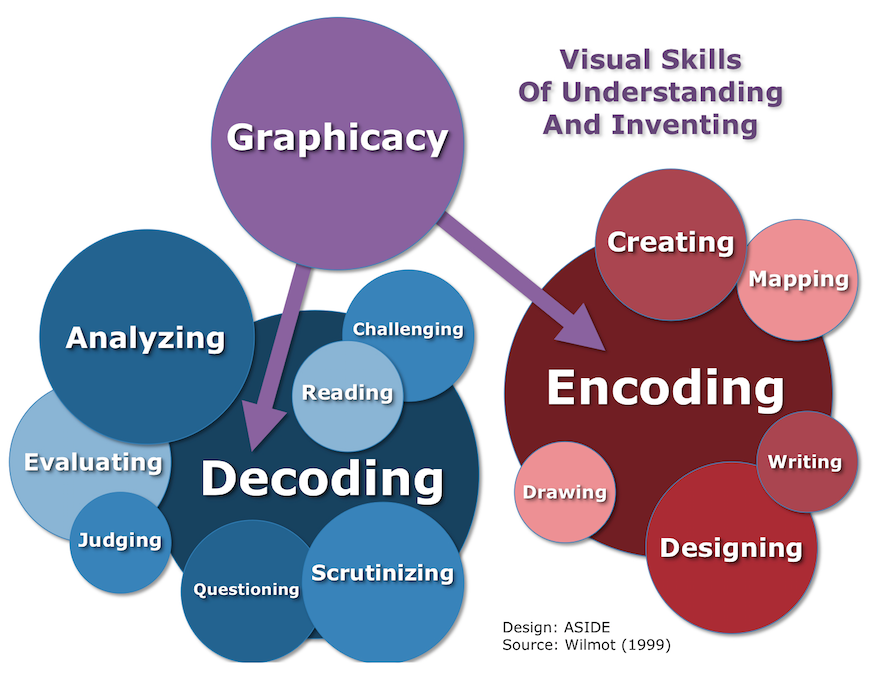
Visual literacy is about learning how to look. It involves learning how to internalize and deconstruct the images that the brain sees. It involves input. Visual thinking is about learning how to design. It involves imagining graphic representations of new or traditional concepts based on the mind’s unique creation. It involves output. Graphicacy, therefore, is the union of the two acuities. It marries the essential skills of decoding and encoding to embrace a range of pictorial proficiencies. (Continue reading for more information….)

Source: ASIDE 2011
Tommy McCall hit the nail on the head when he called “graphicacy the neglected step child in the classroom” during his TEDx East talk on Literacy, Numeracy, And Graphicacy. In the new e-cology to design and create digital content that is transmitted, interactive, and shared, it is even more vital to incorporate graphicacy skills in daily lessons. By training kids to thoroughly study what they see, we reinforce their visual acuity, attention to detail, and ability to notice conspicuous absences of information. We want them to develop a keen eye for seeing, to detect problems, and to understand the message inherent in the design. (Continue reading for more information….)
Graphicacy often takes a backseat in traditional classrooms, because understanding pictures is thought to be a natural consequence of basic vision. The conventional wisdom says that if people can see, then naturally they can comprehend what they see. Parents, however, know this is untrue. They know children must learn to decode images and connect the visual parts to the cognitive whole. Mothers and fathers dedicate evenings to paging through picture books with their toddlers, pointing out clouds and jackrabbits and smiling moons. (Continue reading for more information….)
Whether graphicacy is the “fourth R” or the “third skill,” as Howard A. Spielman refers to it, the format for representing data and visuals is much more complex today. Data visualizations such as infographics and the myriad of designs used in their creation are arguably more complex in many cases. This is quite the opposite of what infographics are by definition, which is to present complex information quickly and clearly. They often combine images and data in ways very different from standard graphs, charts, and maps in most elementary textbooks, thus prompting a need for graphicacy in education. (Continue reading for more information….)

Source: ASIDE 2015
We use four steps in guiding students to interpret charts, maps, cartoons, infographics, and logos. These four steps progress from base-level identification toward more analytical and sophisticated skills. The understandings proceed from: 1) Substance, 2) Scaffold, 3) Story, and 4) So What? (Continue reading for more information….)


Amid the national emphasis on STEM programs, charts are becoming key tools to represent visual statistics. As more and more schools migrate to 1:1 tablets, therefore, students need a foundation in reading and rendering their own optic inputs. The language of apps today is printed in icons. On handheld devices, colorful squares dance across each swiped screen. Children need to recognize these badges and identify the relationships between the logos and the corresponding actions. (Continue reading for more information….)

"What Is Graphicacy?" — An Essential Literacy Explained In An Animated Motion Graphic


What Is Graphicacy? from The ASIDE Blog on Vimeo.

We live in a visual world. Smartphones, television, Internet, and social media all push information in real-time, all the time. Visual media bombard us in constant streams. Learners of every age, therefore, need to understand how to analyze pictorial information. This skill of parsing images, interpreting pictures, and decoding diagrams is known as graphicacy.
The motion graphic (or explainer video) in this post describes the many reasons for graphicacy education. Maps, cartoons, and photographs all feature symbolic cues and metaphoric elements. An animated infographic itself can become a conduit for graphic instruction.


Sixty-five percent of people today identify as visual learners. In fact, the brain processes optic inputs 60,000 times faster than text. Yet schools and scholarship rarely apply the tools and time to train people how to understand all of these visual streams.


Source: ASIDE 2015


Graphicacy stands with literacy, oracy, and numeracy as one of the four indispensable corners of education. It dates to W.G.V. Balchin‘s coinage of the term in the 1960s to identify the visual-spatial aspect of human intelligence. What began as a staple of South African geography education has ballooned in importance, especially in today’s 1:1 classroom. With today’s rightful emphasis on differentiated instruction, contemporary classrooms need to incorporate coaching in graphicacy to reach students via their learning preferences. (Continue reading for more information….)
Visual literacy is about learning how to look. It involves learning how to internalize and deconstruct the images that the brain sees. It involves input. Visual thinking is about learning how to design. It involves imagining graphic representations of new or traditional concepts based on the mind’s unique creation. It involves output. Graphicacy, therefore, is the union of the two acuities. It marries the essential skills of decoding and encoding to embrace a range of pictorial proficiencies. (Continue reading for more information….)

Source: ASIDE 2011
Tommy McCall hit the nail on the head when he called “graphicacy the neglected step child in the classroom” during his TEDx East talk on Literacy, Numeracy, And Graphicacy. In the new e-cology to design and create digital content that is transmitted, interactive, and shared, it is even more vital to incorporate graphicacy skills in daily lessons. By training kids to thoroughly study what they see, we reinforce their visual acuity, attention to detail, and ability to notice conspicuous absences of information. We want them to develop a keen eye for seeing, to detect problems, and to understand the message inherent in the design. (Continue reading for more information….)
Graphicacy often takes a backseat in traditional classrooms, because understanding pictures is thought to be a natural consequence of basic vision. The conventional wisdom says that if people can see, then naturally they can comprehend what they see. Parents, however, know this is untrue. They know children must learn to decode images and connect the visual parts to the cognitive whole. Mothers and fathers dedicate evenings to paging through picture books with their toddlers, pointing out clouds and jackrabbits and smiling moons. (Continue reading for more information….)
Whether graphicacy is the “fourth R” or the “third skill,” as Howard A. Spielman refers to it, the format for representing data and visuals is much more complex today. Data visualizations such as infographics and the myriad of designs used in their creation are arguably more complex in many cases. This is quite the opposite of what infographics are by definition, which is to present complex information quickly and clearly. They often combine images and data in ways very different from standard graphs, charts, and maps in most elementary textbooks, thus prompting a need for graphicacy in education. (Continue reading for more information….)

Source: ASIDE 2015
We use four steps in guiding students to interpret charts, maps, cartoons, infographics, and logos. These four steps progress from base-level identification toward more analytical and sophisticated skills. The understandings proceed from: 1) Substance, 2) Scaffold, 3) Story, and 4) So What? (Continue reading for more information….)


Amid the national emphasis on STEM programs, charts are becoming key tools to represent visual statistics. As more and more schools migrate to 1:1 tablets, therefore, students need a foundation in reading and rendering their own optic inputs. The language of apps today is printed in icons. On handheld devices, colorful squares dance across each swiped screen. Children need to recognize these badges and identify the relationships between the logos and the corresponding actions. (Continue reading for more information….)

"What Is Graphicacy?" — An Essential Literacy Explained In An Animated Motion Graphic


What Is Graphicacy? from The ASIDE Blog on Vimeo.

We live in a visual world. Smartphones, television, Internet, and social media all push information in real-time, all the time. Visual media bombard us in constant streams. Learners of every age, therefore, need to understand how to analyze pictorial information. This skill of parsing images, interpreting pictures, and decoding diagrams is known as graphicacy.
The motion graphic (or explainer video) in this post describes the many reasons for graphicacy education. Maps, cartoons, and photographs all feature symbolic cues and metaphoric elements. An animated infographic itself can become a conduit for graphic instruction.


Sixty-five percent of people today identify as visual learners. In fact, the brain processes optic inputs 60,000 times faster than text. Yet schools and scholarship rarely apply the tools and time to train people how to understand all of these visual streams.


Source: ASIDE 2015


Graphicacy stands with literacy, oracy, and numeracy as one of the four indispensable corners of education. It dates to W.G.V. Balchin‘s coinage of the term in the 1960s to identify the visual-spatial aspect of human intelligence. What began as a staple of South African geography education has ballooned in importance, especially in today’s 1:1 classroom. With today’s rightful emphasis on differentiated instruction, contemporary classrooms need to incorporate coaching in graphicacy to reach students via their learning preferences. (Continue reading for more information….)
Visual literacy is about learning how to look. It involves learning how to internalize and deconstruct the images that the brain sees. It involves input. Visual thinking is about learning how to design. It involves imagining graphic representations of new or traditional concepts based on the mind’s unique creation. It involves output. Graphicacy, therefore, is the union of the two acuities. It marries the essential skills of decoding and encoding to embrace a range of pictorial proficiencies. (Continue reading for more information….)

Source: ASIDE 2011
Tommy McCall hit the nail on the head when he called “graphicacy the neglected step child in the classroom” during his TEDx East talk on Literacy, Numeracy, And Graphicacy. In the new e-cology to design and create digital content that is transmitted, interactive, and shared, it is even more vital to incorporate graphicacy skills in daily lessons. By training kids to thoroughly study what they see, we reinforce their visual acuity, attention to detail, and ability to notice conspicuous absences of information. We want them to develop a keen eye for seeing, to detect problems, and to understand the message inherent in the design. (Continue reading for more information….)
Graphicacy often takes a backseat in traditional classrooms, because understanding pictures is thought to be a natural consequence of basic vision. The conventional wisdom says that if people can see, then naturally they can comprehend what they see. Parents, however, know this is untrue. They know children must learn to decode images and connect the visual parts to the cognitive whole. Mothers and fathers dedicate evenings to paging through picture books with their toddlers, pointing out clouds and jackrabbits and smiling moons. (Continue reading for more information….)
Whether graphicacy is the “fourth R” or the “third skill,” as Howard A. Spielman refers to it, the format for representing data and visuals is much more complex today. Data visualizations such as infographics and the myriad of designs used in their creation are arguably more complex in many cases. This is quite the opposite of what infographics are by definition, which is to present complex information quickly and clearly. They often combine images and data in ways very different from standard graphs, charts, and maps in most elementary textbooks, thus prompting a need for graphicacy in education. (Continue reading for more information….)

Source: ASIDE 2015
We use four steps in guiding students to interpret charts, maps, cartoons, infographics, and logos. These four steps progress from base-level identification toward more analytical and sophisticated skills. The understandings proceed from: 1) Substance, 2) Scaffold, 3) Story, and 4) So What? (Continue reading for more information….)


Amid the national emphasis on STEM programs, charts are becoming key tools to represent visual statistics. As more and more schools migrate to 1:1 tablets, therefore, students need a foundation in reading and rendering their own optic inputs. The language of apps today is printed in icons. On handheld devices, colorful squares dance across each swiped screen. Children need to recognize these badges and identify the relationships between the logos and the corresponding actions. (Continue reading for more information….)

\’Jammu and Kashmir High Court\’ | \’High Court of Jammu and Kashmir\’ (171 Words)

The \’Jammu and Kashmir High Court\’ is the high court of the state of Jammu and Kashmir of India. High Court of Judicature for the Jammu and Kashmir State was established in the year 1928. The High Court of Judicature was established and for the first time the High Court was to consist of the Chief Justice and two Judges on 26.3.1928. Hon\’ble Justice Lala Kanwar Sein was the First Chief Justice of the Jammu and Kashmir High Court.

The seat of the High Court of Jammu and Kashmir shifts between its summer capital Srinagar and winter capital Jammu. From May to end October, the Chief Justice and the Administrative Wing of High Court shifts to Srinagar and from November to end April, the HQ is at Jammu. However, Court sections of both the Jammu and Srinagar Wings of the High Court function throughout the year. The High Court has at present a sanctioned strength of 14 Judges including 9 Permanent Judges and and 5 Additional Judges. 
 

\’Jammu and Kashmir High Court\’ | \’High Court of Jammu and Kashmir\’ (171 Words)

The \’Jammu and Kashmir High Court\’ is the high court of the state of Jammu and Kashmir of India. High Court of Judicature for the Jammu and Kashmir State was established in the year 1928. The High Court of Judicature was established and for the first time the High Court was to consist of the Chief Justice and two Judges on 26.3.1928. Hon\’ble Justice Lala Kanwar Sein was the First Chief Justice of the Jammu and Kashmir High Court.

The seat of the High Court of Jammu and Kashmir shifts between its summer capital Srinagar and winter capital Jammu. From May to end October, the Chief Justice and the Administrative Wing of High Court shifts to Srinagar and from November to end April, the HQ is at Jammu. However, Court sections of both the Jammu and Srinagar Wings of the High Court function throughout the year. The High Court has at present a sanctioned strength of 14 Judges including 9 Permanent Judges and and 5 Additional Judges. 
 

\’Jammu and Kashmir High Court\’ | \’High Court of Jammu and Kashmir\’ (171 Words)

The \’Jammu and Kashmir High Court\’ is the high court of the state of Jammu and Kashmir of India. High Court of Judicature for the Jammu and Kashmir State was established in the year 1928. The High Court of Judicature was established and for the first time the High Court was to consist of the Chief Justice and two Judges on 26.3.1928. Hon\’ble Justice Lala Kanwar Sein was the First Chief Justice of the Jammu and Kashmir High Court.

The seat of the High Court of Jammu and Kashmir shifts between its summer capital Srinagar and winter capital Jammu. From May to end October, the Chief Justice and the Administrative Wing of High Court shifts to Srinagar and from November to end April, the HQ is at Jammu. However, Court sections of both the Jammu and Srinagar Wings of the High Court function throughout the year. The High Court has at present a sanctioned strength of 14 Judges including 9 Permanent Judges and and 5 Additional Judges. 
 

\’Jammu and Kashmir High Court\’ | \’High Court of Jammu and Kashmir\’ (171 Words)

The \’Jammu and Kashmir High Court\’ is the high court of the state of Jammu and Kashmir of India. High Court of Judicature for the Jammu and Kashmir State was established in the year 1928. The High Court of Judicature was established and for the first time the High Court was to consist of the Chief Justice and two Judges on 26.3.1928. Hon\’ble Justice Lala Kanwar Sein was the First Chief Justice of the Jammu and Kashmir High Court.

The seat of the High Court of Jammu and Kashmir shifts between its summer capital Srinagar and winter capital Jammu. From May to end October, the Chief Justice and the Administrative Wing of High Court shifts to Srinagar and from November to end April, the HQ is at Jammu. However, Court sections of both the Jammu and Srinagar Wings of the High Court function throughout the year. The High Court has at present a sanctioned strength of 14 Judges including 9 Permanent Judges and and 5 Additional Judges. 
 

\’Jammu and Kashmir High Court\’ | \’High Court of Jammu and Kashmir\’ (171 Words)

The \’Jammu and Kashmir High Court\’ is the high court of the state of Jammu and Kashmir of India. High Court of Judicature for the Jammu and Kashmir State was established in the year 1928. The High Court of Judicature was established and for the first time the High Court was to consist of the Chief Justice and two Judges on 26.3.1928. Hon\’ble Justice Lala Kanwar Sein was the First Chief Justice of the Jammu and Kashmir High Court.

The seat of the High Court of Jammu and Kashmir shifts between its summer capital Srinagar and winter capital Jammu. From May to end October, the Chief Justice and the Administrative Wing of High Court shifts to Srinagar and from November to end April, the HQ is at Jammu. However, Court sections of both the Jammu and Srinagar Wings of the High Court function throughout the year. The High Court has at present a sanctioned strength of 14 Judges including 9 Permanent Judges and and 5 Additional Judges. 
 

\’Jammu and Kashmir High Court\’ | \’High Court of Jammu and Kashmir\’ (171 Words)

The \’Jammu and Kashmir High Court\’ is the high court of the state of Jammu and Kashmir of India. High Court of Judicature for the Jammu and Kashmir State was established in the year 1928. The High Court of Judicature was established and for the first time the High Court was to consist of the Chief Justice and two Judges on 26.3.1928. Hon\’ble Justice Lala Kanwar Sein was the First Chief Justice of the Jammu and Kashmir High Court.

The seat of the High Court of Jammu and Kashmir shifts between its summer capital Srinagar and winter capital Jammu. From May to end October, the Chief Justice and the Administrative Wing of High Court shifts to Srinagar and from November to end April, the HQ is at Jammu. However, Court sections of both the Jammu and Srinagar Wings of the High Court function throughout the year. The High Court has at present a sanctioned strength of 14 Judges including 9 Permanent Judges and and 5 Additional Judges. 
 

Short Essay on \’Importance of Newspaper\’ (200 Words)

Newspaper, as we know, is an essential part of our life. For a newspaper reader, it is the first and foremost thing that he would like to have early in the morning. It connects us with every field and every part of the world. Be it politics, entertainment, sports, films etc.

Newspaper provides information about the burning topics from all over world and keeps us well informed. Though news is also displayed on television and radio, there we don\’t have an option to choose. It results in wastage of time, as the news is repeated over and over again and is followed by a number of advertisements.

Apart from the information newspaper provides, it can be useful in a number of ways. The puzzles given in it develop the thinking ability. The job vacancies column help the people. A regular reader can improve his knowledge of language in which language he reads the newspaper. Newspaper also tells us about the different policies introduced by the Government and makes us aware about everything happening around us.

We can conclude by saying that the newspaper broadens our outlook and is an enormous source of information. Therefore one must develop the habit of reading newspaper everyday. 

Short Essay on \’Importance of Newspaper\’ (200 Words)

Newspaper, as we know, is an essential part of our life. For a newspaper reader, it is the first and foremost thing that he would like to have early in the morning. It connects us with every field and every part of the world. Be it politics, entertainment, sports, films etc.

Newspaper provides information about the burning topics from all over world and keeps us well informed. Though news is also displayed on television and radio, there we don\’t have an option to choose. It results in wastage of time, as the news is repeated over and over again and is followed by a number of advertisements.

Apart from the information newspaper provides, it can be useful in a number of ways. The puzzles given in it develop the thinking ability. The job vacancies column help the people. A regular reader can improve his knowledge of language in which language he reads the newspaper. Newspaper also tells us about the different policies introduced by the Government and makes us aware about everything happening around us.

We can conclude by saying that the newspaper broadens our outlook and is an enormous source of information. Therefore one must develop the habit of reading newspaper everyday.