Technology in the Classroom: How to Assess Writing

If you’re like most teachers, teaching the craft of writing is a task that goes across multiple educational platforms: A history teacher for instance, must instruct on how to write a five-paragraph essay, synonyms, plan-revise-edit-rewrite, persuasive essays, letter writing, and more.
With this in mind, today on TeachHUB.com, frequent contributing writer Jacqui Murray, who is a seasoned technology teacher based in Northern California, takes a look at how to use technology in the classroom to assess writing.
Jacqui begins by calling out what writing brings about, including:
  • Conduct research based on focused questions that demonstrate understanding of the subject.
  • Gather relevant information, assess the credibility and accuracy of each source, and integrate the information while avoiding plagiarism.
  • Draw evidence from literary or informational texts to support analysis, reflection, and research.
  • Write routinely for a range of tasks, purposes, and audiences.
She also notes what shouldn’t be assessed when grading writing, including:
  • Ability to catch typos: Even excellent typists make typos. Don\’t let keyboarding errors affect a writing grade. You may assess keyboarding as a separate skill, deducting from the final grade for each mistake, but don\’t blend that into the writing grade. 
  • Skill with technology: If a writing project requires a student to create a digital timeline, trifold, or poster, don\’t assess how well they blend colors, use tools, or mash up apps. That\’s a separate skill. You want to only assess how well they communicate ideas.
Jacqui sums up her article like this: “By mentally removing the detractors that obfuscate good writing and providing students with the tools they require to communicate in the manner best suited to them, writing assessment becomes more authentic, granular, dynamic, and personalized.”

Classroom Activities: Morning Meeting Yoga

As we all know, the morning routine sets the tone for the entire day. Starting the day on a positive note is an imperative.
However, a good and often overlooked method of beginning the day is with classroom activities like yoga.
Today on TeachHUB.com, frequent contributing writer Janelle Cox, who also is a seasoned elementary school teacher based in Upstate New York, looks at some classroom activities you can use to implement a yoga morning meeting sequence into your school day.
Janelle’s ideas include easy steps to implementing yoga, including:
After a few breaths, have students reach their arms up and over their heads then dive down to touch their feet as they exhale. Encourage students to hang here for a few breaths and shake their heads “Yes” and “No” while either holding their elbows or hanging their arms loosely.
Next, have students do a sitting mountain pose by sitting at their seats with their feet planted firmly on the ground and their hands on their laps. Instruct them to sit up tall and slowly breathe in and out through their nose.
After this sequence, have students do a seated back bend. To do this pose, students should start in seated mountain pose, place their hands on the back of their chair, and push back so that they are looking up at the ceiling. Another option is to do this pose standing.
She also includes a paragraph on Encouraging Breathing : “One of the hardest things students have when first learning yoga is how to breathe properly. If you find that students are forgetting to breathe, then encourage them to count as they inhale and exhale. You can also teach them how to properly breathe when just sitting in a chair before you even teach them a new pose.”
Janelle sums up her article thusly: “Before trying it in the classroom, make sure that you take a class or try a free one on YouTube. This will help you feel confident when instructing students. Namaste.”
Do you incorporate yoga classroom activities into your morning meeting? Which poses do you like to do? Feel free to share your thoughts in the comment section.

Plan a Memorable Back to School Night

We’ve been covering all you teachers need to know for your inevitable return to the classroom, and today is no different. A staple of the back to school  schedule is now Back to school night, in which teachers and parents meet, with or without kids, to discuss and preview the school year. On the discussion docket are generally methodology, grading schemes and tactics, connecting parents, and more.
Today on TeachHUB.com, frequent contributing writer Jacqui Murray, who is a seasoned tech teacher based in Northern California, looks at how you can make back to school night memorable, informative, and fun.
Jacqui’s ideas include:
Make the Invite Engaging
Ask a Volunteer to Take Notes
Introduce the Class Page
And More!
Here’s how Jacqui suggests you create a class webpage, blog, or other electronic method of communication: “At some point during the evening (or in a form you display on one of the class computers), ask what parents would like to find here. Practice accessing it if there\’s time.  Have the page available on one of the class computers so parents can try it out before leaving for the evening.”

Jacqui sums up her article like this, in a paragraph entitled Provide a Parent-Child Questionnaire: Before you wrap up for the evening, have parents fill out a form (with Google Forms) that includes what motivates their child, his/her strengths, parent concerns, and anything else you should know about the child. This too can be available on one of the class computers. It should take only a few minutes to complete. You can also email the link to everyone on the class roster to be completed at their leisure.”
**
You never have a second chance to make a good first impression. This is as true today as when Will Rogers (was reputed to have) said it. Make parents your partner this school year. Their participation will make a huge difference in the child\’s success. Take advantage of that.

Curriculum Compacting Teaching Strategies

Although as teachers we often spend our time making sure that everyone can grasp what we’re teaching about, oftentimes we have kids in our classes who have already mastered the curriculum. So what teaching strategies do we use to reach those that already know what we’re instructing?
Today on TeachHUB.com, we examine those teaching strategies we can use to hopefully challenge the gifted kids who are at risk of becoming bored in our classes. Our centerpiece article, penned by frequent contributing writer Janelle Cox, looks at curriculum compacting, or a pace-based method that can engage kids who have already mastered what we’re teaching.
Janelle suggests we first identify kids who are already familiar with our upcoming subject matter. How do we do that? A potential student:
·       Finishes tasks quickly.
·       Appears bored during instruction.
·       Finishes assignments first.
·       Is performing high academically in more than one area.
Janelle offers up seven steps that you can use to compact a curriculum, including:
·       Identify students who should take the pre-assessment. Use your academic records and class performance to help you determine what student would benefit from this pre-test.
·       Use the pre-assessment test to determine mastery of the topic or subject.
Janelle sums up her article like this: “Teachers like using curriculum compacting because it’s an effective teaching strategy that can be used in any grade and in any school district. It’s also flexible enough that teachers find it easy to implement. Just remember that meeting the needs of all learners takes time and patience, so go at a slow pace.”
Have you used curriculum compacting as a means to differentiate instruction with your gifted learners? If so, do you find this an effective form of teaching strategies? Please share your thoughts in the comment section, we would love to hear what you have to day on this topic. 

11 Back-to-School Activities for the First Month

We’re all already knee-deep (well, maybe ankle deep) into the new school year. Some of us are immersed in chaos, others are already inspiring their legions of 2017-20187 students.
Regardless of how your class is coming along, you can probably use some helpful back to school activities to help you along. With that in mind, frequent TeachHUB.com contributing writer Jacqui Murray, who is a seasoned technology teacher based in Northern California, takes a look at some “Activities I\’ve collected from colleagues using transformative tools that optimize learning while making students active participants in expected learning outcomes.”
Jacqui’s ideas include:
  • Create a Timeline of Class Events
  • Class Rules
  • QR Codes
  • Virtual Collaborative Board


And More!

Jacqui sums up her article like this: “Whatever you do, make it a dynamic example of what is in store for students this school year. Leave them energized, excited, and ready to participate in a year\’s worth of learning.”

Classroom Management for Noncompliant Students

Noncompliant students can sink even the best-made lesson plans. Oftentimes these kids are disruptive, lack motivation, and as a result, perform poorly.
However, with a little planning and knowledge, you can use some classroom management techniques to overcome those noncompliant students and bring about a more positive learning environment.
Janelle Cox, a TeachHUB.com contributing writer who also has moonlighted as an elementary teacher in Upstate New York, looks at classroom management strategies you can use to overcome noncompliant students in today’s centerpiece website article.
Janelle’s ideas include:
  • Model Positive Behaviors
  • Be an Active Listener
  • Ask Questions
  • And More!

Janelle sums up her article thusly: “No one ever said that managing noncompliant students would be easy. You have to remember that like everything in life, it will take some time and patience. However, when you implement these teaching strategies (more than one at a time is recommended), then you can change a student’s unwanted behavior.”

Fitness-Based Classroom Activities Can Boost Learning

Budget constraints and other concerns have forced some teachers to incorporate classroom activities that get kids (and the teaches themselves!) up and moving. Some incorporate brain breaks, as frequent contributing writer Janelle Cox points out in today’s centerpiece article on TeachHUB.com. Janelle’s brain break ideas include:
·       Have a five-minute dance party! Turn on your students’ favorite radio station and encourage them to let loose.
·       Try 30-second intervals of your students’ favorite exercise. 30 seconds of jumping jacks, 30 seconds jogging in place, 30 seconds of high knees.
·       Set a timer for five minutes and have students take turns playing follow the leader.
Instruct students to follow you in a few yoga poses like the standing mountain pose or tree pose
We also take a look at what educators can do in their personal lives outside the classroom to get and maintain health. Janelle sums up her article in this manner, with some bulletpoints on eating more healthfully:
·       Plan ahead. It’s all in the planning. If Sunday is your day to grocery shop, then take a little extra time to prepare healthy snacks and foods for the week. Chop up veggies and stick them in a baggie for an easy grab and go. Make a batch of hard-boiled eggs for a quick breakfast. Buy premade salads to take with you to work.
·       Invest in a crockpot. A slow cooker is a convenient and inexpensive way to make healthy meals. All you have to do is throw in a lean protein, some veggies and spices, and it will be ready for you when you get home from work.
·       Make extra. Whatever you plan on making, double or even triple the recipe. Leftovers are a busy person’s best friend.
·        If you’re going to eat out, choose wisely. Skip the sugary drinks and choose water. Cut your portion in half and take the other half home with you. Ask for salad dressing on the side, and order your food steamed or grilled instead of fried.

Teaching Strategies to Become a “Listening” Educator

The best educators know that being a good listener is a key tenet of the teaching profession. Teaching strategies that include listening are key to the educational process.
So how do we develop good listening skills? Today on TeachHUB.com we examine how to foster good listening skills. Janelle Cox, a frequent contributing writer to both the website and TeachHUB Magazine, today examines helpful teaching strategies that can help put us on the way to becoming better listeners.
Janelle’s ideas include asking yourself:
  • What is an Active Listener?
  • How are Your Listening Skills?
  • And More!

Janelle also outlines a couple ways to become a better listener, including:
  • Focus on the student speaking and don’t let your mind wander or multitask. If you find that you are not focusing, then try and bring your attention back on the student and focus your attention to the students’ lips moving.
  • Check your body language to ensure that it isn’t sending out any wrong signals. Make sure your eyes are focused on the students’ face, your hands on not waving around or in a position of aggravation, and that you are showing the student that you are interested in what they have to say.

Janelle sums up her article like this: “Becoming a “Listening” teacher is a great way to build a meaningful relationship with your students. It will not only improve your teaching, but the way that your students learn as well.”

Classroom Management to Turn Parents into Partners

Many teachers believe that the key to the proverbial educational castle is parental involvement. In theory, teachers strive to include parents at every step of the educational process; but in reality, many “Don’t take the necessary classroom management steps to reach out to parents and make them partners in their children’s education,” says frequent TeachhUB.com contributing writer Jordan Catapano.
Jordan, who is a veteran high school English teacher based in the Chicago suburbs, today investigates someclassroom management methods to build partnerships with your students’ families.
Jordan’s ideas include:
  • Class Newsletters
  • Social Media
  • Invite Parents In
  • And More!

Jordan sums up his article like this: “Overall, schools and parents share the same goals. They have powerful common values that bring them together. Consider to what extent you and your school are partnering with families around these common values, and look for your next step to leveraging those relationships even further.”

The Teaching Profession: What to Tell a Struggling New Educator

We all remember the early days of our time in the teaching profession, the trials and errors, the triumphs and tragedies, and those times when we perhaps relied on more seasoned teachers to offer up some positive words of encouragement,
Today on TeachHUB.com, we take a look at some words of encouragement about the teaching profession that you might share with younger, newer colleagues who might be struggling.
Penned by Jordan Catapano, who is a seasoned English teacher based in the Chicago suburbs, the article points out specifics of what to verbally pass along, including:
  • “It gets better”
  • “Here’s something simple to try”
  •  “Come and watch my class”
  • “What would you do next time?”
  • And More!

In summation, Jordan notes: “Teaching is no doubt a rewarding though challenging profession. While all teachers have lots of opportunity to learn year after year, our newest teachers are the ones who face many of the most intense pressures. As veterans, let’s not leave our new teachers to sink or swim on their own. We’re all in this together.”

Types of Regions


A region is an area on Earth’s surface marked by a degree of formal, functional, or perceptual homogeneity of some phenomenon. The three main types of regions are formal, functional, and vernacular regions. A formal region, also known as a uniform or homogeneous region, is an area in which everyone shares in common one or more distinctive characteristics. This common characteristic could be a cultural value such as language, an economic activity such as production of a certain crop, or an environmental property such as climate and weather patterns. Whatever the common characteristic is, it sis present throughout the selected region. In certain formal regions, the characteristic may be predominant rather than universal, such as the wheat belt in North America, it is an area in which the predominant crop is wheat, but other crops are grown here as well.

functional region, also known as a nodal region, is a region organized around a node or focal point. The characteristic chosen to define a functional region dominates at a central focus or node and diminishes in importance outward. The region is tied to the central point by transportation, communication systems or by economic or functional associations. An example of a functional region is the circulation area of a newspaper. That area is centered around the city in which the newspaper is published in. The farther away from the city of circulation, the less people that read the newspaper (this phenomenon is known as distance decay). A vernacular region, also known as perceptual region, is a place that people exists as part of their cultural identity. Perceptual regions vary from person to person. They emerge from a person’ s informal sense of place. An example of a vernacular region would be the South. My idea of the southern states may be different than my friend’s idea of southern states. 

Types of Regions on the Basis of Stages of Economic Development

1) Developed / Development Regions

Developed regions are naturally those which are having a high rate of accretion in goods and services i.e., their share in the GDP of the country is relatively higher. This may be with or without rich natural resources by most certainly because of the use of upgraded technology by highly skilled and motivated persons. A developed region may become ‘overdeveloped’ in certain respects e.g., it may suffer from the diseconomies of congestion. Infrastructure costs become very high and people can go into the jitters due to pollution and stresses of various types. A developed region is the counterpart of the backward region: the ‘positive’ side is emphasized in case of the developed region while ‘negative’ aspects are emphasized in case of the backward region. 

A developed region is one, which has exploited its potentialities fully, which has removed the bottlenecks and speed breakers of development. Developed regions emerge of their own because of the comparative advantage or may emerge as a result of the diversion of funds by the government. In many cases imbalances emerge between developed and backward regions and these imbalances can be the creation of planners also. Many times disproportionately high amounts of investment are made in the constituencies of the influential politicians and some regions become far more developed than the neighboring regions.

2) Backward Regions

There can be ‘backward or depressed’ regions in the developing as well as the developed economies. Backward economies are thoroughly depressed regions. There is development even in these regions but these regions have not come out of the low level equilibrium trap. There can be region, which may not be at subsistence level but may be relatively backward. Lack of infrastructure facilities, adverse geo-climate conditions, low investment rate, high rate of growth of population and low levels of urbanization and industrialization are causes and consequences of backwardness. 

In less developed countries, even the most ancient occupation (agriculture) is backward and unless it is made progressive with massive real and financial input support, the region cannot come out of backwardness. Some vestigial regions (as the regions inhabited by the red Indians in USA/ or tribal in India) can remain backward and may even remain near the subsistence level. The inhibitions may have ancient traditions and may be smug in their surroundings, but the per capita income may be much lower than in the neighboring regions. A region can be backward because of the high population density or even without it. 

3) Neutral Regions/ Intermediate Regions

New towns and satellite belts are designated as ‘neutral’ regions and they promise good prospects of further development because here further employment generation and income propagation is possible without congestion. Such regions can be demarcated around urban centers. Intermediate regions are those regions, which are ‘islands of development around a sea of stagnation’. 

Types of Regions Based on the Activity Status Analysis

1) Mineral regions

Many mineral regions promise high growth rates for the region as well as for the prosperity of the country. If mineral- based industries can be developed in the region itself, then industrial development will be less costly because much of the load shedding will be done in the region at low cost. The iron ore deposits of Bailadeela (Bastar District of Madhya Pradesh) are exported abroad, a plant could be established near the ore deposits, it would have brought tremendous development for the region. As the mines continue to yield sufficient minerals and the costs are also not prohibitive, not only the mineral producing region develops but it helps other regions also to develop. 

After the minerals exhaust, the region will bear degraded look, people will move away to other areas and the erstwhile area will bear a deserted look. Germany took great pains to rehabilitate such areas and vast pits and trenches were suitably reclaimed for various purposes like water storage, eco-forestry and even cultivation after enriching the soil. If new deposits of minerals cannot be discovered, there can be several ways of reclaiming wasteland and developing non-mineral based activities. Regional planning will require a long-term plan for developing such regions after extraction is no longer a profitable activity. The Middle East countries have made adequate planning to diversify their economies so that after the oil wealth exhausts their economies do not relapse to backwardness.

2) Manufacturing Regions and Congested Regions

Some regions become big manufacturing regions not because they have natural resources but because of the infrastructure development, momentum of an early start, continued government support etc. Autonomous, imitative, supplementary, complementary, induced and speculative investments keep in giving strength to the manufacturing regions. It would be prudent not to develop narrow manufacturing base, otherwise territorial specialization can become a problem if the crop supplying the raw materials fails or if the minerals which are base for the industries, exhaust. In such regions the internal and external economies are available in ever greater measure and such regions keep on developing. When all the thresholds are crossed, such regions become too congested and the diseconomies overwhelm the economies of production – high density, increasing pollution, reduction in the quality of life etc.

3) Cultural Regions

A cultural region can also be quite well demarcated. (French Canada and English Canada are such regions). In India various states are demarcated on the basis of language and culture primarily. There are affinities of cultural origin in such region. A rich cultured region should be rich in economic terms also.

Regions in Regional Economics

1) Homogenous Region

They are formal regions and on the basis of homogeneity in topography, rainfall, climate or other geo-physical characteristic. Economic homogeneity is more relevant for planning. The structure of employment, the occupational pattern, the net migration, the density of population, the resource and industrial structure, if similar in a space, the regions become homogeneous in economic sense. The greater the economic similarities, the greater the interest the economists will have in homogeneous regions. Internal differences in a region are unimportant. Sometimes, a clear cut homogeneous region may have, many differences in sub-regions as to make them quite different yet a region may remain ‘homogeneous’. 

Scotland or Uttar Pradesh are clear cut homogeneous regions but in topography the hilly districts of Uttar Pradesh have nothing in common with the districts of the plains. Eastern and Western districts are also different but Uttar Pradesh remains a homogeneous region in administrative terms. Thus a homogeneous economic region can have differing physical characteristics. Homogeneous region on economic or political criterion may have a lot of heterogeneity from several other stand points. 

Ø Formal Regions

Regions defined formally, often by government or other structures, are called formal regions. Cities, towns, states, and countries are all formal regions, as are things like mountain ranges. Formal regions often nest inside one another, so that when you are standing in the middle of Trivandrum, you are in the city of Trivandrum, which is part of state of Kerala, which rests inside the southern region of India, which is in the country of India, which is on the continent of Asia. All of those are formal regions.

A formal region is homogeneous with reference to some geo-physical characteristic such as topography, climate of vegetation. This is physical formal region. Later on there was a shift from this narrow approach to a broader approach and economic, social and political criteria were also applied. An industrial or agricultural or plantation region is a formal economic region; or a state governed by a particular party is a formal political region.

Ø Functional regions 

It consist of a central place and the surrounding areas that are dependent upon that place, such as a metropolitan area. The functional region is concerned with interdependence. This is a geographical area in which there is economic interdependence. The nodal regions are functional regions between which there are flows of men, material and money.

Ø Vernacular regions

A vernacular region is an area that has been identified based on people’s perception of culture.

2) Polarized / Nodal / Heterogeneous / Functional Regions

Polarized or nodal regions look to a centre-a large town usually-for service. Its influence extends beyond the area of the city. The villages are dependent upon it for services and marketing. There is little concern for uniformity when a polarized or nodal region is taken. The city region need not correspond to the administrative region because hinterland of several clear cut regions may be served by a city. (For example even the persons of Gwalior may visit Delhi for buying some consumer durables of high value. A capital city may attract customers form several districts around the capital city.)

A nodal region will have heterogeneous economy around it. Regional economists are more concerned with what happens within a nodal region and spatial dimension of the nodal region assumes importance. Population and industries agglomerate and there are core regions with higher per capita income generation through higher production of goods and services. Within regions there are dominant cities or nodes to which flows of inputs, goods, people and traffic gravitate. Within the cities there are nuclei that form business and social centres and which are discernible at a glance from an intra-metropolitan traffic-flow density map.

As the distance increases, the costs of overcoming frictions will rise and the people of different areas will look for a different nodal point. Each region will have one or more dominant nodes and it will be interesting to find and record as to which interior areas form the areas of influence of one or the other node. Nodal regions provide an understanding of the functional relationship between settlements, which fill up the space. These heterogeneous units in rural and urban areas are functionally related because each settlement cannot have all the functions and facilities. All functions require a particular threshold population and other facilities (Each settlement cannot have a college or unless there is electricity, there cannot be cinema hall or a bank branch). 

3) Planning Regions

Planning regions depend upon the type of multi-level planning in the country. A very small country will naturally have one level planning. A planning region in a multi-level setup requires regional plan, which is a spatial plan for the systematic location of functions and facilities in relation to human settlements so that people may use them to their maximum advantages. In fact more important than reducing the regional disparities is the task of ensuring that backward region and rural areas have basic minimum needs. Planning region for different activities can be different and a regional plan will be locational in character for that activity/function. 

For comprehensive planning, there has to be a national plan and then a state plan and finally district/block plans. Since a planning region is a sub national area demarcated for the purpose of translating national objectives into regional programs and policies, and since plan formulation and implementation need administrative machinery, administrative regions are generally accepted as planning regions.

The hierarchy of planning region would be (i) national level (ii) macro level (iii) state level (iv) meso level (v) and micro level. A planning region must be large enough to take investment decisions of an economic size, must be able to apply its own industry with the necessary labor, should have a homogeneous economic structure, contain at least one growth point and have a common approach to and awareness of its problems. In short, a planning region should be defined according to the purpose of one’s analysis. Ideally a planning region should have adequate resources to establish a satisfactory pattern of savings, capital formation, investment, production, employment, income generation and consumption pattern. It means that the area should be economically viable. 

Types of Regions in Multi-Level Planning Perspective

1) Macro Region

Macro region is naturally bigger. Macro region can be a state of even a group of states, if the states of a country are not big enough. For example, in India there are East, West, North, South and Central Zones and ‘Zonal Councils’ of which function is mutual consultation, developing cooperation and mutual counseling. In a sense macro regions are second in hierarchy, next to the national level. It is also possible that a physical macro region may comprise parts of different states of a country for project planning purposes (e.g. big river valley projects, an electric grid of different states and for the purpose of a particular activity planning). 

State boundaries are not respected in the sense that the macro region may transcend or cut across administrative boundaries of the states of a country. A macro region may not be uniform or homogeneous in all respects. It may have homogeneity in one respect (physical complementarity) and may have heterogeneity in other respect (administrative boundaries). A macro region should have a common resource base and specialization in that resource base, so that production activities can develop on the principle of comparative advantage based on territorial division of labor (India has been divided into 11 to 20 macro regions, agro-climate or resource regions). The planning Commission of India would have just 5 zonal councils-Eastern, Northern, Central, Western and Southern comprising of certain states but beyond this there is no macro-regionalization in India. These so-called macro regions of India have to have interstate cooperation in the matter of utilization of river water and electricity grids etc.

2) Meso Region

Meso region can be identified with a ‘division’ of a state. Chattisgarh region, Bundelkhand region, Baghelkahand region, Mahakoshal region is usually a sub-division of a state, comprising of several districts. There should be some identifiable affinity in the area which may even facilitate planning. It can be cultural or administrative region and it will be even better if it is a homogeneous physical region (resource) region. A meso region can also become a nodal region provided the combined micro regions or parts thereof can be developed in a complementary manner. 

3) Micro Region

In multi-level planning, district is the micro region. It becomes the lowest territorial unit of planning in the hierarchy of planning regions. The most important reason why district is the most viable micro region for planning is the existence of database and compact administration. This is the area, which is viable for plan formulation with administration for plan implementation and monitoring. A metropolitan area can be one micro region and the area of influence can be another micro region. A nodal point is also a micro region, though in many cases micro regions are basically rural areas, which may have a number of minor nodes without any organizational hierarchy influencing the entire area. The basic characteristic of a micro region is its smallness. 

4) Micro – Minor Region

This is the region which is associated with, what is called, the grass-root planning. A micro-minor region can be a block for which also data exists now and for which there may be a plan. The block level plan is integrated with the national plan, through the district and state level plans. A block level plan is not surgically cut portion of the district plan, which has its own logic and linkage. At block level, most of the officers will be more concerned with the implementation of the plans than formulating the plans. At block level, the main exercise will be to take into account of the physical and human resources and to find out the prime moving activities which will enable the block people to make best use of the development potential of the block to meet the basic needs of the people. 

Minimum needs can be satisfied with the production of basic goods with the help of low entropy local resources. In fact, planning of the development of the transport, communication, banking, education, medical and many service facilities has got to be done at the national level. At the panchayat level, basic goods and services can be arranged through the efforts of the local people. Many activities can be so planned that they improve the socio-economic conditions of the people without being the part of the national plan. 

Several activities can be undertaken with the cooperation of the local people, with minimum of financial and real resource support from outside e.g., development of dairying, animal husbandry, pisciculture, poultry, soil conservation measures, optimization of the cropping pattern, production of inputs locally, improving the storage and transport facilities can be done at the micro minor level. Many agro based industries and tiny sector guild-type activities can be developed at the micro-minor level. A good planning can secure ‘ruralization of the industries’ instead of ‘industrialization of rural area’. This will involve production of goods ‘by the masses for the masses and near the masses’.


Buy American and Hire American

When this blogger started blogging in 2009, his very first post was titled “What is American goods, anyway ? ” Eight years later, when returning back from a two year hiatus in blogging,  the same theme resurfaces as the second innings of blogging is started.

The trigger for this post is of course Trump’s executive order titled the same as this post, which he signed with much fanfare three days ago.  The order , of course, is pure bombast and is only meant to show that the President is doing “something”. It simply orders the Secretary of Commerce to tell the world what the hell this means in 60 days and orders sundry other Ramamrithams to specify how it will be implemented  in 150 days. I was not aware that you need an Executive Order to tell people to do their jobs, but apparently in the world of alternative reality, that is required.

Precious little, other than nuisance value, will come of it. For you see, in today’s globalised world of supply chains it is almost impossible to determine what is “American” as my first ever post argued.  If “value added” is the yardstick for measuring national origin, then your iPhones are as American as mom and apple pie even though they are entirely manufactured outside the US. If the physical act of manufacturing (read final assembly)  is the yardstick, then the iPhone is Chinese while BMW is American.  If the entire supply chain has to be in the US, most products will simply disappear off the shelves as some of the raw materials and components are simply not available in the US and have to be imported.

The Executive Order gives some clues to the warped thinking – apparently they would like  that “for iron and steel products,  all manufacturing processes, from the initial melting stage through the application of coatings, occurred in the United States .”  US iron and steel has been on decline for decades. Only an idiot will set up steel capacity in the US – after all the next President can sign another Executive Order to the opposite. Not a single new job will be created. What will only happen if this pig headed policy is even half tried is that the existing US steel plants will jack up their prices. The American consumer shall pay.

The problem of disappearing jobs is a real and serious one, but there are no easy fixes. It cannot be tackled by trumpeting economic nationalism. It certainly cannot be solved by sitting on the toilet seat and tweeting whatever comes to your mind.

By the way, the GOP was meant to stand for free markets and trade. It would have been appropriate if a President Sanders were to try something like this. But a Republican President ?

PS : Its nice to be back. Sorry for going away for two years – I was dabbling in a social enterprise in the interim, but am now back in retirement, and therefore back to blogging.

The bonanza / disaster of 2014

As the year draws to a close it is customary to review the year gone by. What do you think was the most significant event of 2014 ? Some would say Ukraine. A few might vote for Ebola. Still others might say ISIS. What about the missing Malaysian Airlines plane ? Others might say the Indian elections. Many in my part of the world might even say Lingaa 🙂
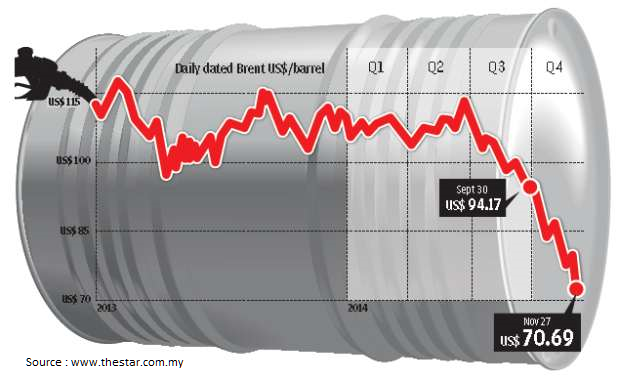
In my opinion however, the most significant happening of 2014 was the steep fall in the price of oil. In June 2014, Brent crude stood at $110 a barrel. Today it is at $ 60. This has profound ramifications on both the economics and politics of the world.
Because of the world\’s dependence on oil as the primary source of energy, there has been a massive transfer of wealth over the last decade or two from the poor to the rich. Most of the world\’s nations are oil importers. A few, blessed by sheer geographical luck are oil exporters. Wealth has gushed from the former to the latter for years now.
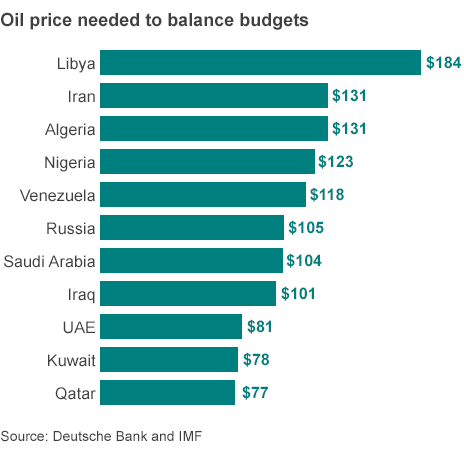
With the step decline in the price of oil, the tide has turned. The oil exporters are facing economic disaster. The hardest hit is Russia – a kleptocracy that has frittered away the oil boom years, now suffering from the twin effects of falling oil prices and the sanctions over Ukraine.  The rouble has crashed and they have been caught pissing in to the wind  (apologies to this blogger !). Next in line is Venezuela, another country that wasted the good years. Iran is yet another sufferer. Even mighty Saudi Arabia is vulnerable. The following chart shows the lot that is in trouble.
The rest of the world is a winner. Inflation, world over, has come down. Global GDP may raise by 0.5% or so, purely on account of oil price. The US and China are the biggest beneficiaries. In fact the booming shale gas production in the US, coupled with weak economic growth globally has caused the fall in price of oil. As an aside, the tree huggers in the UK and elsewhere in Europe who have been blocking every move to frack in Europe must be forced to pay $110 a barrel for oil and not benefit from the effect of the shale gas revolution in the US.
Poor countries across the world have benefited from lower oil prices and have been able to curb inflation. India is the biggest beneficiary of them all. Inflation in India has steeply fallen solely on account of oil prices. Petroleum subsidy has fallen so much that the government has raised taxes on petroleum products and at the same time decontrolled diesel prices without a squeak from the public. The fiscal situation would have been a far greater disaster but for the unexpected bonanza. 
Oil prices will probably recover, but are unlikely to go back to three figures in the near term. That might have larger consequences. Inflation can be held in check. Funding to the Islamic jihadists, which has largely flown from oil money is likely to be constrained. Russia is unlikely to repeat its misadventures as in Ukraine. The oil producers such as Venezuela and Nigeria, who are most affected will be forced to adopt more sensible economic policies which can only benefit them in the long run. All in all, we can ring in the new year with a feel good factor.


PS : This blogger owes an apology for going AWOL for 2 months and is deeply thankful to his readers who have all been very kind and encouraged him to \”come back\”

    Buy American and Hire American

    When this blogger started blogging in 2009, his very first post was titled \”What is American goods, anyway ? \” Eight years later, when returning back from a two year hiatus in blogging,  the same theme resurfaces as the second innings of blogging is started.

    The trigger for this post is of course Trump\’s executive order titled the same as this post, which he signed with much fanfare three days ago.  The order , of course, is pure bombast and is only meant to show that the President is doing \”something\”. It simply orders the Secretary of Commerce to tell the world what the hell this means in 60 days and orders sundry other Ramamrithams to specify how it will be implemented  in 150 days. I was not aware that you need an Executive Order to tell people to do their jobs, but apparently in the world of alternative reality, that is required.

    Precious little, other than nuisance value, will come of it. For you see, in today\’s globalised world of supply chains it is almost impossible to determine what is \”American\” as my first ever post argued.  If \”value added\” is the yardstick for measuring national origin, then your iPhones are as American as mom and apple pie even though they are entirely manufactured outside the US. If the physical act of manufacturing (read final assembly)  is the yardstick, then the iPhone is Chinese while BMW is American.  If the entire supply chain has to be in the US, most products will simply disappear off the shelves as some of the raw materials and components are simply not available in the US and have to be imported.

    The Executive Order gives some clues to the warped thinking – apparently they would like  that \”for iron and steel products,  all manufacturing processes, from the initial melting stage through the application of coatings, occurred in the United States .\”  US iron and steel has been on decline for decades. Only an idiot will set up steel capacity in the US – after all the next President can sign another Executive Order to the opposite. Not a single new job will be created. What will only happen if this pig headed policy is even half tried is that the existing US steel plants will jack up their prices. The American consumer shall pay.

    The problem of disappearing jobs is a real and serious one, but there are no easy fixes. It cannot be tackled by trumpeting economic nationalism. It certainly cannot be solved by sitting on the toilet seat and tweeting whatever comes to your mind.

    By the way, the GOP was meant to stand for free markets and trade. It would have been appropriate if a President Sanders were to try something like this. But a Republican President ?

    PS : Its nice to be back. Sorry for going away for two years – I was dabbling in a social enterprise in the interim, but am now back in retirement, and therefore back to blogging.