Ibotta hosts Women and Innovation night at Denver headquarters

DU Women’s Professional Alliance Presents: Women and Innovation
The DU Women’s Professional Alliance is a collaboration between the Colorado Women’s College and Alumni Career & Professional Development. We invite you to join us for our monthly series exploring unique career issues facing women.
Join us Tuesday, March 7 from 6:00 – 7:30 pm as we partner with Ibotta’s* Women in Tech and Women in Leadership groups. This program features staff from the National Center for Women in Information Technology and a panel of ground-breaking women, including:
Makayla Cappel, (BSBA, BA ’14) Founder & Designer at Kastlfel
Rachel Heimstra, VP of Student Operations at Guild
Jacquie Ros, founder of Revolar
Bijal Shah, VP of Data Products & Analytics at Ibotta
Diane Simard, Senior VP at Bye Aerospace
You will learn:
  • Why women are underrepresented in technology and innovation
  • How to overcome the imbalance
  • How to leverage relationships to succeed
Cost: $15 includes appetizers; $10 for alums who graduated in 2013 or after and current students.
Location: This event will take place at Ibotta’s downtown Denver office. Space is limited, we ask that you register by March 3rd.
*Ibotta is the largest consumer technology company headquartered in Denver, CO. Ibotta (“I bought a…”) is transforming the shopping experience by making it easy for consumers to earn cash back on everyday purchases through a single smartphone app.

7 Ways a Hobby Can Advance Your Career

George Bernard Shaw once said, “Happy is the man who can make a living by his hobby.” Pastime pursuits can educate and enlighten us while boosting important skills that can ultimately advance our chosen career paths. Depending on your targeted self-improvement and performance goals, several hobbies are worth a try – and may just land you that dream position.
Benefit : Networking
One of the best ways to build your professional circles is through hobbies. Attending aerobics classes, taking a ceramics class or joining book clubs can allow you to meet other professionals who share your interests, and you can talk with them on a level that’s more personable. Even if you don’t meet them in the actual setting, many times potential employers will relate to your hobbies in the job interview setting.
Hobbies to try: Golf, exercise classes and community theater
Benefit : Confidence
In the workforce, you need confidence to move forward, and many hobbies can help boost your self-esteem. Tackling a challenging hobby like completing a grueling marathon is a guaranteed way to impress yourself with talents and capabilities you never knew you had, and it shows through in how you present yourself in the workplace. In addition, learning new skills required to face the challenge takes patience and dedication.
Hobbies to try: Horseback riding, martial arts and skiing
Benefit : Creativity
No matter what field you’re in, creativity is an asset, and hobbies that foster artistic pursuits are wonderful ways of stimulating creative thought in your brain. Whether you join a class, scour Pinterest ideas or paint plates in the privacy of your home, you’re bound to open up channels of inspiration that will positively affect your brainstorming abilities at work.
Hobbies to try: Painting, photography and writing
Benefit : Organization Skills
Organizational habits not only improve your work performance overall, but they also make your life easier in general. Many hobbies can boost your ability to organize, and they’re especially helpful for those who struggle with messy desks and sloppy calendars. Collecting stamps, coins or any other rare items is a great place to start.
Hobbies to try: Collecting antiques, sewing, and knitting
Benefit #5: Multitasking
Multitasking is a skill people long to master, and certain hobbies truly give you an experiencein juggling responsibilities. If you want to speed up your performance across different work areas, seeking a hobby that keeps you on your toes can produce results.
Hobbies to try: Cooking, rock climbing and geocaching
Benefit #6: Critical Thinking
Education doesn’t just happen in the classroom. Learning any kind of new hobby is going to broaden your mind, and certain activities demand problem-solving skills and intense focus. Whether you’re looking to improve your performance at work, educate yourself on certain subject matters or simply increase your sharpness or memory, hobbies like Sudoku and puzzles can have a major impact on your smarts.
Hobbies to try: Chess, watch repairing and poker
Benefit #7: Passion
You have to stand for something, or you’ll fall for anything. Hobbies often show who we are inside, and nothing is more inspiring than passion for what you’re doing. From volunteering at the animal shelter, raising funds for a nonprofit organization or offering tutoring services after hours, passionate pursuits boost your self-fulfillment and provide great outlets for meeting others with similar interests. If you’re very lucky, you may even be able to turn your passion into your main occupation.
Hobbies to try: Volunteerism, teaching classes, and social activism
No matter if you’re looking to get a promotion, adopt a more intense schedule, take on more responsibilities, demonstrate leadership skills or delve into an entirely new field altogether, hobbies can enhance what you bring to the table as an employee. Having a passion that you pursue outside of work shows drive, time-management skills, and initiative – all of which are appealing to hiring managers worldwide.

Celebrate Earth Month!

Earth Month is right around the corner in April, with Earth Day itself taking place on April 22. What is Earth Month, and how might you both celebrate the occasion and engage in your career development this April?
What is Earth Day & Month, and why does it matter?
“Close to 48 years ago, on 22 April 1970, 20 million people took to the streets to protest the negative impacts of 150 years of industrial development. In the US and around the world, smog was becoming deadly and evidence was growing that pollution led to developmental delays in children. Biodiversity was in decline as a result of the heavy use of pesticides and other pollutants. The global ecological awareness was growing, and the US Congress and President Nixon responded quickly. In July of the same year, they created the Environmental Protection Agency, and robust environmental laws such as the Clean Water Act and the Endangered Species Act, among many. Earth Day is now a global event each year, and we believe that more than 1 billion people in 192 countries now take part in what is the largest civic-focused day of action in the world.”
Earth Day has grown so much since then, and many choose to advocate for our environment throughout the month of April.
Here are some ideas to celebrate!
  1. Spend some time volunteering outdoors! Whether you choose to give your time for a day, or for the entire month, volunteering is an excellent way to celebrate Earth Month while gaining valuable professional skills. Relevant experience doesn’t have to come from a professional job or internship; you can sharpen your communication skills and content knowledge anywhere. It’s also an excellent networking opportunity. What better way to spend a sunny Saturday than cleaning up Red Rocks with a bunch of new friends who also care about issues that resonate with you?
  2. Jumpstart your internship search by looking for opportunities in conservation, field research, sustainable transiturban farmingwater treatment and analysis, education and advocacy…the list goes on. Take some time this month to reflect on your career goals and come up with 5-10 organizations that you might want to target for a summer volunteer experience, internship, or job!
  3. Tune in to Sustainable DU. How might you support the Center’s upcoming events and initiatives this quarter?
  4. Reflect on your values and habits. In what ways could you be more sustainable this month? Are you open to educating others on sustainable practices? What about writing your representatives about issues related to sustainability?
  5. Explore careers in sustainability! Mark your calendars for our upcoming Dine & Dialogue on Careers in Sustainability on April 18 from 12-1pm! Register via Pioneer Careers.

B.Ed. I year – General English – Centrality of language in learning.

Role and importance of language in the curriculum
The language is always believed to play a central role in learning. No matter what the subject area, students assimilate new concepts when they listen, talk, read and write about what they are learning. Speaking and writing reflects the thinking process that is taking place. Students learn in language, therefore if their language is weak, so is their learning. Most importantly, we need to have an Learning Across Curriculum (LAC) approach because by focusing on the teaching and learning of language within a subject, the teacher will improve the students’ results in that subject, for example, by explicitly teaching students how to write History essays, or how best to write ‘for and against’ arguments in Liberal Studies. Experienced teachers know that it is essential to teach their students how to ‘answer’ the types of questions they are likely to find in their exams. After understanding and working with the LAC concept, teachers across disciplines will thus be improving students learning within their own subject while also supporting the efforts of the whole school to improve English proficiency. In the context of teaching foreign and second languages we are used to consider language as a medium for everyday and often fairly trivial communicative activities. We are also well aware of its function for retrieving information from all sorts of verbal sources. However, in the context of teaching and learning content in subject areas such as Mathematics, History, Social Sciences, Physics and even Art and Music there are more reasons why language matters:
· Language as a constituent component of higher-order thinking skills and a necessary precondition for successful content learning: 
There is little doubt that successful learning in most school subjects strongly depends on the availability of higher-order thinking skills.
· Language as a tool for making meaning: 
 Many of the approaches to the language dimension of content teaching are based on social-constructivist concepts of learning and the original ideas of the developmental psychologists Vygotsky and Bruner. Vygotsky claimed that young children develop higher order thinking skills through cultural mediation and interpersonal communication with more knowledgeable adults or peers, which means that the development of mental concepts and the appropriation of procedural knowledge depend on social interaction and verbal exchange. Thus, without adequate language means and strategies which are geared to formal education learners cannot be expected to take advantage of opportunities schools normally offer.
· Language as a filter for assessing learning outcomes:
Formal assessment procedures in school subjects heavily rely on open- or half-open-formatted tasks and on oral or written presentations by the student how s/he has solved the task. What makes matters even more complicated is the fact that in high stake assessment the academic register determines the characteristics of the verbal filter. In plain words: If students do not have an age-adequate command of subject literacy they have no chance to meet the (very often) implicit expectations by the teacher as a subject specialist who claims to be primarily concerned with content. If one would choose to reduce the language load of assessment tasks by resorting to closed-formatted items such as multiple-choice, matching or fill-in formats, one would seriously delay the development of subject literacy.
So, language really does matter – not only in the language classroom, but across the whole curriculum. In order to understand the importance of language in school education, for all subjects and across the whole curriculum, we have to identify and summarise the basic tenets on which LAC rests. These are (cf. Corson 1990, 74):
i.                    Language develops mainly through its purposeful use (domains to be broadened)
ii.                 Learning (often) involves talking, writing, shaping and moving (normally in reaction to perceptions).
iii.               Learning often occurs through speaking or writing as much as through shaping and moving
iv.               Language use contributes to /is a prerequisite for cognitive development v. Language is the medium for reflecting on learning, for improving it, for becoming (more or less) autonomous as learners Therefore the goals of LAC are – in simple terms  to support language development in each and every child, in all domains of language use, in each learning activity in school, and to give children feedback about their progress (through appropriate assessment and evaluation). LAC is no longer narrowly seen as the exclusive domain of L1/LS education nor is it confined solely to the conventional four modes of language: Reading, Writing, Listening and Speaking; all non verbal means of representation and expression are rightly seen as part of the overall semiotic systems that we have at hand and that we use when communicating. The whole scope of semiotics comes into focus including images or graphs, movements and, generally speaking, all visual forms of representation and expression (cf. Corson 1990: 72).
Thus, we can distinguish eight modes of human activities involving language, namely:
• Listening: comprehending oral input/intake
• Speaking: constructing meaningful utterances
• Reading: understanding written texts
• Writing: producing written texts/coherent discourse
• Viewing: attending to visual signs/information
• Shaping: using visual means of expression
• Watching: attending to physical movements
• Moving: using the whole body, the whole person for selfexpression.
Consequently, all teachers are encouraged to participate in developing language skills and competences within their fields of responsibility and thus contribute to a school learning policy as a whole.
In summary one can state the following beliefs:
• Language is more than communication skills
• Language is also linked to the thinking process
• Language is a tool for conceptualising, for thinking, for networking
• Language supports mental activity and cognitive precision
• Language for academic purposes helps to express thoughts more clearly (this is especially true for writing)
• Language helps to structure discourse and practise discourse functions


This CEO’s Trick for Building Stronger Relationships Is So Easy That You Can Pull it Off Too

This CEO’s Trick for Building Stronger Relationships Is So Easy That You Can Pull it Off Too was originally published on The Muse, a great place to research companies and careers. Click here to search for great jobs and companies near you.
If you love learning from successful people, you already know common habits they point to, like:
But there’s another one to add to the list—that I doubt you’ve heard 100 times already: Send birthday cards to everyone you work with.
\'\'
Paper Source Watercolor Balloons A2 Happy Birthday Cards, Set of 10
According to Chris Weller of Business Insider, Sheldon Yellen, the CEO of BELFOR Holdings, Inc., credits writing birthday cards (7,400 annually) for building a strong rapport with his employees and contributing to “a more compassionate, gracious workplace.”
When it you think about it, this strategy makes total sense, because in the words of Claude Silver Chief Heart Officer at VaynerMedia, people want to “bring their whole selves to work,” and that means sharing more than progress on a to-do list with the people around them.
But, while this may be what we want, it can be hard to connect with colleagues on a level other than “Here’s that part of the report you needed…” No one’s trying to be rude, but it’s easy to get wrapped up, especially if you’re busy. And as one deadline rolls into the next, you realize that your work relationships all feel pretty transactional.
That’s where writing birthday cards come in. First, every single one of your colleagues has one, so you don’t run this risk of leaving people out. The dates may already be noted in your database or a shared worksheet, and if not, you can send an email around to your teammates asking them to share their birthday if they’re comfortable doing that.
Second, take the next step and buy a box of cards to leave in your desk. That way, when someone’s big day rolls around, you can quickly write a handwritten note (learn more about why this makes a difference to the other person).
For you, it won’t be that much more effort, but to the other person, it’ll feel like you went out of your way to do something thoughtful.
If you’re a loss for words, just fill in this template:
Dear [Name],
Happy Birthday!
I enjoyed getting to know you better over the course of [project]./ I’m excited to work together on [initiative]./ I always look forward to [your thoughtful contributions to meetings/our discussions of [favorite team]].
Hope you have a great day!
[Your Name]
Like Yellen, you should notice a chain reaction. Your co-workers will know you care enough to remember them for something that isn’t work-related. In turn, they’ll thank you for the card, and it’ll open the door to discussing more than progress updates.
Above all, keep in mind that this strategy can help anyone build stronger relationships. You don’t have to be the CEO. In fact, as Muse columnist Erica Breuer shares, sending birthday cards is a great way for remote workers to stay connected to their colleagues, too.
So, if you’re looking for looking for an easy to build stronger relationships, buy some birthday cards. Let me know if you try this strategy out and if it works for you on Twitter.

Summer Internship Award Recipients

It is always a difficult choice to make, but Summer Internship Awards have been announced. Eight DU students will be hard at work in wide range of fields in communities across the globe this summer.  The University, as well as Career Services, would like to congratulate the following students as recipients of DU’s summer internship awards:
  • Sonia Schaefbauer, WireDelta in Copenhagen, Denmark
  • Kayla Steffens, Boettcher Foundation’s Scholarship Program in Denver, CO
  • Samantha Hyman, Comedy Works, Business Affairs Human Resources Intern in Denver, CO
  • Kathryn Ziegner, Alaska Sealife Center, Marine Mammal Stranding and Rehabilitation in Seward, AL
  • Noel Leifer, Children’s Hospital Colorado, Sie Center for Down Syndrome in Aurora, CO
  • Aarika Matney, Project C.U.R.E. in Centennial, CO
  • Aaron Hinds, CRCC Asia in Beijing, China
  • Shaileigh St. Clair, A Vintage Affair Events & Rentals in Denver, CO
This award helps students offset the expense that comes with unpaid internships. If you have an unpaid internship and are an undergraduate please apply for next year’s award. Congratulations again to these students. We know you will make the DU community proud!
For more information regarding the Summer Internship Award check out the website.

Customer Awareness is Vital to Success

By Chemeketa SBDC

If your business (bricks and mortar or virtual) is going to be successful in the long run, you must focus on serving your customer’s needs and desires. The essence of marketing rests on your clear understanding of your customer and delivering a unique product that he or she cannot get anywhere else.
Customer Analysis helps you predict which items will appeal to your customers and make a dramatic impact on how you spend your advertising dollars. Do you have answers for the following checklist?
1. Who are your target customers and what are they seeking from you?
2. Have you profiled your customers by age, income, education, occupation, etc.?
3. Are you familiar with your customers’ lifestyles?
4. Should you try to appeal to the entire market or just a segment?
5. Are there new customer segments or special markets that deserve attention?
6. Do you know where your customers live?
7. Do you use census data from your city or state?
8. Are you aware of the reasons why customers shop with you? (Convenience, price, quality products, etc?)
9. Do you stress a special area of appeal such as lower prices, better quality, wider selection, convenient location or convenient hours?
10. Do you ask your customers for suggestions on ways to improve your operations?
11. Do you know what products your customers most prefer?
12. Do you know what seasons and holidays most influence your customers buying behavior?
13. Have you considered using customer questionnaires to help you in determining your customer’s needs?
14. Do you know at what other types of stores your customers shop?
15. Do you visit market shows and conventions to help anticipate customer wants?
And, finally, what do you do with this information? Just gathering data is not enough. The answers to the above questions will now give you the opportunity to make true management decisions about your business. You now need set your business goals based on the analysis of your customer. Reminder — make all goals SMART (specific, measurable, achievable, responsible (person), and with a timeline).
Marcia Bagnall is Director of the Chemeketa Small Business Development Center and instructor of Small Business Management Program . The Small-Business Adviser column is produced by the center and appears each Sunday. Questions can be submitted to SBDC@chemeketa.edu. Visit the SBDC at 626 High Street NE. in downtown Salem or call (503) 399-5088.

3 Questions to Ask Yourself Before Trying to “Stand Out” in Your Job Search

3 Questions to Ask Yourself Before Trying to “Stand Out” in Your Job Search was originally published on The Muse, a great place to research companies and careers. Click here to search for great jobs and companies near you.
All job hunters hear the advice to “stand out,” “be different,” and “separate yourself from the crowd!”
But what exactly does that mean with regard to your job search? Do you send a fruit basket to your interviewer? Record a video of a company cheer you composed? Or, maybe you just try to be your “best self”—whatever that means!
Here’s the scoop: You will face competition when applying to most jobs, so the greater the gap you create between you and your fellow applicants, the better. But, it’s important to remember that there’s a right way to stand out and a wrong way.
To help you determine how to stand out successfully (and this can vary by industry and position), we’ve developed three rules. Before we jump into them, let’s take a look at two sales manager job applicants I encountered while working in HR for a major retail chain.
Both prospects wanted to “stand out” in the interview process. Applicant A submitted a prospective sales plan, laid out in 30, 60, and 90 days. While some of the specifics of her proposal were a bit off, overall, it was a solid plan that showed creative, analytical thinking.
Applicant B affixed her resume with an 8×10 photo of herself. After all, what better way to stay top of mind? Well, Applicant B was memorable, all right, but not in the positive way she’d hoped for. Her move cost her the chance to even interview.
Standing out requires risk-taking by nature, but you can mitigate that risk by asking yourself the following three questions to make sure you’re making the impression that’ll lead to an interview and job offer:

1. Is it Relevant?

Being unique purely for the sake of individuality is useless. Find a way to stand out that’s relevant to the company and to the opportunity you’re interviewing for.

Do This

One of our clients, Laurel, a huge Seattle Mariners fan, was looking for a new position in social media. She took her interest and capitalized on it to create a social media and publicity campaign to get the Mariners’ attention and convince them she was the best person for a social media marketing position. She snagged an interview even though she had less experience than many of the other candidates.
See how this outside-the-box thinking works? You have to consider your industry and what you can do to demonstrate in a way that goes beyond the bullet points on your resume how you’d be an asset.

2. Is it Valuable?

Whatever your plan for standing out, it must further your cause in some way. This rule is why just emailing 100 times or calling 10 times a day after your interview isn’t going to pay off.

Do This

Matt Hirsch, another client, hoped to make a statement following an interview for a graphic design position he really wanted.
His idea? He created a “Hirschy” chocolate bar wrapper that was perfectly tailored to the role. The list of “ingredients” included the graphic programs he’s well-versed in and the end result was simply a perfectly creative way to illustrate his skill set and show that he knows how to go above and beyond.
Sending a thank you note after your interview is essential, but when competition’s fierce, you’d be wise to think about the other ways your follow up can help you stand out.

READY TO MAKE A GREAT IMPRESSION?

We thought so—now go out there and land some interviews.
80,000+ openings right this way
\'jobs\'

3. Is it Authentic?

The problem with gimmicks is that they’re, well, gimmicky! They don’t ring true or feel authentic.
So before you rent a sky writer or send your interviewer a CD of your “greatest hits,” make sure your scheme rings true for you and your personality. Whatever plan you pursue, it should share a new dimension of your personality or shed light on a part of your resume you want the hiring manager to understand in greater detail.

Do This

Yet another client, Eric, thought he might be really interested in the solar industry. He created a blog with the intent to write articles that allowed him to investigate whether or not he really wanted to be a part of that field. As it turned out, the website also gave him complete freedom to contact CEOs of solar companies to get their perspective on recent changes affecting their business.
He then went a step further and published the resulting article on his website. This authentic and completely legit tactic allowed him to investigate the industry, but more than that, it put him in contact with a dozen potential employers.
Consider how you can both be true to yourself and leave a lasting impression that’ll result in getting you hired.
As you can see, standing out doesn’t have to be expensive or super complicated—after all, in some cases, time is of the essence—it just needs to be real and different in the right way. A typo-free, polished resume is great, and a stellar cover letter is awesome too, but when you need to rise to the top of promising candidates, you’re going to want to take things a step further.
Brainstorm some ideas, and then put them through the three guidelines above to ensure you’re hitting the right notes. It can be helpful to enlist the help of an exceedingly honest friend at this stage.

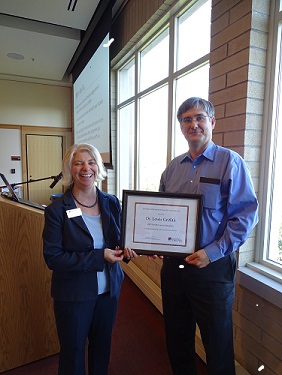
DU Career Services Announces Faculty Career Champion Award Winners – Dr. Lewis Griffith and Dr. Nancy Lorenzon

On September 13, 2017, DU Career Services hosted an appreciation breakfast for over 100 faculty who were nominated by students for making a difference in their career development journey.  At the end of the 2016-2017 academic year, DU Career Services offices across campus sent an email to all undergraduate and graduate students asking them which faculty members have been their faculty career champions – faculty members that have supported student internship, career, and continuing education goals. We received 366 responses reflecting the work of 185 unique faculty members.  At the award ceremony, faculty received a letter containing the student quotes from the nomination process.  They also were also given the chance to share career development ideas and opportunities, learned of upcoming DU Career Service events to share with students, and celebrate the two award winners.  The two selected Faculty Career Champions received several student nominations. The faculty award winners are Dr. Lewis Griffith and Dr. Nancy Lorenzon.
Dr. Lewis Griffith is an alumnus of the Korbel Ph.D. program where specialized in the area of security studies. Dr. Griffith has done significant independent research, to include published work, in the areas of weapons proliferation, humanitarian intervention, classroom simulation and exercise, and the implications of globalization on the state security policies of non-Western states.   Before joining the faculty of Korbel in 2010, he was faculty at Air Command and Staff College (ACSC) and had taught at DU, the University of Colorado-Denver, and Metropolitan State College of Denver as an adjunct professor.  Lewis has helped students tremendously with finding out about great internship opportunities and successfully securing very competitive internships.  With his help, students have interned throughout the intelligence community, the State Department, Department of Defense, many different think tanks and all this throughout the U.S. and abroad.  The several students who nominated him commented about this willingness to give advice and support regarding internships and careers, how his classes helped them prepare for employment, how student-focused he is and how much they appreciated his mentoring.  Here is a direct quote from one of his student nominators “He is a model professor, intimate and devoted mentor, and overall remarkable man. His insight into the international security careers was instrumental in helping me write resumes, prepare for interviews, and be a value team member at work. He is the top-tier at JKSIS.”
Dr. Nancy Lorenzon is a Teaching Professor with the Department of Biological Sciences at the University of Denver.  She has been with the University since 2007. She currently serves as Director of Pre-Professional/Allied Health Advising, Director of the Undergraduate Research Center, and oversees the Professional Science Master’s program in Biomedical Sciences.She recently received the Master Educator Award and the Faculty Advisor of the Year honor. Nancy received her Ph.D. in Anatomy and Neurobiology from the University of Tennessee Health Sciences Center and her B.S. in Animal Behavior from Bucknell University.   Nancy is a tireless career champion and advocate as stated by several of her students.  One of her student nominees stated it best.  “Dr. Lorenzon has always been there to support her students, including me. I feel comfortable coming to her for advice and she has helped me to look at alternative career paths when I didn’t feel confident in the career path I originally had in mind. She is a voice of reason and is the epitome of empathy. Nancy is the most selfless professor at DU. She understands what it takes to want to get into medical school and she ALWAYS has time for everyone.”
DU Career Services would like to congratulate all of the faculty nominees for their tireless work and effort to guide students in their career development journeys.  Nominations by students for the 2017-18 Faculty Career Champion award will begin in the Spring Quarter.  Contact Career & Professional Development for more information, career@du.edu.

Advanced QuickBooks 2016

By Chemeketa SBDC

QuickBooks can be as simple or complex as you wish to make it.  The success of QuickBooks is essentially based on your ability to set up the system in the most effective way to help you derive the information you want.
Tuesday, October 10Understanding Cash Flow

Tuesday, October 17
Writing a Budget

Tuesday, October 24
Estimating, invoicing, and monitoring accounts receivables

Tuesday, October 31
Designing accounting forms and reports
Date: Tuesdays, October 10 – October 31Time: 8:30 am to 11:30 am
Location: Chemeketa Center for Business & Industry, 626 High Street NE, Downtown Salem
Cost: $399
Registration and Information: 503.399.5088

B.Ed. I year – General English – Centrality of language in learning.

Role and importance of language in the curriculum
The language is always believed to play a central role in learning. No matter what the subject area, students assimilate new concepts when they listen, talk, read and write about what they are learning. Speaking and writing reflects the thinking process that is taking place. Students learn in language, therefore if their language is weak, so is their learning. Most importantly, we need to have an Learning Across Curriculum (LAC) approach because by focusing on the teaching and learning of language within a subject, the teacher will improve the students’ results in that subject, for example, by explicitly teaching students how to write History essays, or how best to write ‘for and against’ arguments in Liberal Studies. Experienced teachers know that it is essential to teach their students how to ‘answer’ the types of questions they are likely to find in their exams. After understanding and working with the LAC concept, teachers across disciplines will thus be improving students learning within their own subject while also supporting the efforts of the whole school to improve English proficiency. In the context of teaching foreign and second languages we are used to consider language as a medium for everyday and often fairly trivial communicative activities. We are also well aware of its function for retrieving information from all sorts of verbal sources. However, in the context of teaching and learning content in subject areas such as Mathematics, History, Social Sciences, Physics and even Art and Music there are more reasons why language matters:
· Language as a constituent component of higher-order thinking skills and a necessary precondition for successful content learning: 
There is little doubt that successful learning in most school subjects strongly depends on the availability of higher-order thinking skills.
· Language as a tool for making meaning: 
 Many of the approaches to the language dimension of content teaching are based on social-constructivist concepts of learning and the original ideas of the developmental psychologists Vygotsky and Bruner. Vygotsky claimed that young children develop higher order thinking skills through cultural mediation and interpersonal communication with more knowledgeable adults or peers, which means that the development of mental concepts and the appropriation of procedural knowledge depend on social interaction and verbal exchange. Thus, without adequate language means and strategies which are geared to formal education learners cannot be expected to take advantage of opportunities schools normally offer.
· Language as a filter for assessing learning outcomes:
Formal assessment procedures in school subjects heavily rely on open- or half-open-formatted tasks and on oral or written presentations by the student how s/he has solved the task. What makes matters even more complicated is the fact that in high stake assessment the academic register determines the characteristics of the verbal filter. In plain words: If students do not have an age-adequate command of subject literacy they have no chance to meet the (very often) implicit expectations by the teacher as a subject specialist who claims to be primarily concerned with content. If one would choose to reduce the language load of assessment tasks by resorting to closed-formatted items such as multiple-choice, matching or fill-in formats, one would seriously delay the development of subject literacy.
So, language really does matter – not only in the language classroom, but across the whole curriculum. In order to understand the importance of language in school education, for all subjects and across the whole curriculum, we have to identify and summarise the basic tenets on which LAC rests. These are (cf. Corson 1990, 74):
i.                    Language develops mainly through its purposeful use (domains to be broadened)
ii.                 Learning (often) involves talking, writing, shaping and moving (normally in reaction to perceptions).
iii.               Learning often occurs through speaking or writing as much as through shaping and moving
iv.               Language use contributes to /is a prerequisite for cognitive development v. Language is the medium for reflecting on learning, for improving it, for becoming (more or less) autonomous as learners Therefore the goals of LAC are – in simple terms  to support language development in each and every child, in all domains of language use, in each learning activity in school, and to give children feedback about their progress (through appropriate assessment and evaluation). LAC is no longer narrowly seen as the exclusive domain of L1/LS education nor is it confined solely to the conventional four modes of language: Reading, Writing, Listening and Speaking; all non verbal means of representation and expression are rightly seen as part of the overall semiotic systems that we have at hand and that we use when communicating. The whole scope of semiotics comes into focus including images or graphs, movements and, generally speaking, all visual forms of representation and expression (cf. Corson 1990: 72).
Thus, we can distinguish eight modes of human activities involving language, namely:
• Listening: comprehending oral input/intake
• Speaking: constructing meaningful utterances
• Reading: understanding written texts
• Writing: producing written texts/coherent discourse
• Viewing: attending to visual signs/information
• Shaping: using visual means of expression
• Watching: attending to physical movements
• Moving: using the whole body, the whole person for selfexpression.
Consequently, all teachers are encouraged to participate in developing language skills and competences within their fields of responsibility and thus contribute to a school learning policy as a whole.
In summary one can state the following beliefs:
• Language is more than communication skills
• Language is also linked to the thinking process
• Language is a tool for conceptualising, for thinking, for networking
• Language supports mental activity and cognitive precision
• Language for academic purposes helps to express thoughts more clearly (this is especially true for writing)
• Language helps to structure discourse and practise discourse functions

8 Rules You Need to Follow when Dating a Co-Worker

It is true that you can’t always help who you fall in love with, but when it is a co-worker, things can often become pretty tricky. When it comes to dating a co-worker, there are different rules that need to be followed than if you were dating someone outside of the workplace. Not only do you need to be able to keep things discreet, you also need to know how to deal with a breakup. Today we are going to take a look at eight rules that must be followed in order to successfully date a co-worker.
  1. Always be Professional – When you are in a relationship with a co-worker, it can be hard to find that line between your personal and your professional life. You need to create boundaries for the workplace, and always stay within those boundaries in order to be professional. Avoid flirting around the office, sneaking kisses, holding hands, etc.
  2. No Open Displays of Affection – This goes back to being professional, but it is also important to not display your affection for one another in the office so as to not make others uncomfortable. You can be as passionate as you want outside of the workplace, but while you are at work, you need to make sure that you are not acting silly and annoying everyone that you work with.
  3. Consider Your Co-Workers – When you are dating a co-worker, you also need to have some consideration for your other co-workers. They probably don’t want to hear about your relationship all the time, nor do they want to end up being in the middle of any arguments you and your partner may be having. Again, keep your relationship separate from the workplace so you don’t make anyone uncomfortable.
  4. Don’t Show Preferential Treatment – “It is human nature to show preferential treatment to your significant other, but when you are dating in the workplace, this is something that you need to avoid doing. This is especially true if you are in a position of management. Other employees could end up becoming jealous if they think that your partner is moving ahead because of their relationship with you, or vice versa,” says an expert from Manhattan Women’s Health & Wellness.
  5. Corporate Email is for Business Only – Don’t send flirty messages or love notes online via company email or the corporate network. It is too easy for your employers to be able to check what you are doing online, and if you are using company emails to send messages to the co-worker you are dating, it is likely going to be frowned upon.
  6. Don’t Date Your Boss – No matter how nice or how good looking your boss may be, avoid the temptation to date them. This rarely tends to work out, and it can lead to a lot of issues in the workplace. Not only will your co-workers be jealous and feel that you are going to get preferential treatment, think about what will happen if you break up.
  7. Don’t Date for Workplace Advancement – It is never a good idea to date someone at work simply because you think it can help you to advance in your position. Not only is advancement unlikely, you are going to make enemies of your co-workers, because they will think that you are getting ahead because of who you are dating.
  8. Tell Your Boss – If you are dating a co-worker, and the relationship is becoming serious, you need to inform your employer about the relationship. It is better to be up front than end up in an awkward situation because the boss has found out before you had a chance to tell them. No matter how much you try to keep things quiet, there is always going to be someone who knows and blows the whistle on you.