Indian Navy Reviews Refit of Ships and Submarines and Infrastructure Buildup

Indian Navy’s Annual Refit Conference (ARC) and Annual Infrastructure Conference (AIC) commenced at Headquarters Eastern Naval Command, Visakhapatnam on 18 Feb 20. The two-day conference chaired by Vice Admiral GS Pabby PVSM, AVSM, VSM, Chief of Materiel (COM), Integrated Headquarters, Ministry of Defence(Navy) is being attended by all the stakeholders representing the Naval Headquarters, three Naval Commands, the Tri-Services Andaman & Nicobar Command at Port Blair, Dockyards, Repair Yards and Material Organisations of the Navy.  The delegates will deliberate upon refit plans for all ships and submarines of the Indian Navy and formulate plans for infrastructure augmentation to meet the growing requirements of the Indian Navy.

Delivering the inaugural address, Vice Admiral Atul Kumar Jain, PVSM, AVSM, VSM, Flag Officer Commanding-in-Chief, ENC welcomed the delegates and appreciated the dedicated efforts being put in by one and all in ensuring combat availability of Naval platforms. Role of the Naval Repair Yards towards the sustained operation of platforms at sea was lauded.

The Chief of Materiel (COM), during his address, complimented the forum for ensuring quality refits of ships and submarines, with a focus on the safety of personnel and material. During the course of the conference, technical and logistics aspects concerning refits were deliberated at length with a special emphasis on enhanced efficiency/ capability of sea-going units. He also urged all concerned to focus on greater indigenisation in keeping with the spirit of the ‘Make in India’ initiative.

The Annual Infrastructure Conference will be held on 19 Feb 20 to review progress towards modernisation and augmentation of repair and refitting infrastructure in order to maintain the lethal edge of combat assets of the Indian Navy.

***

Indian Navy Reviews Refit of Ships and Submarines and Infrastructure Buildup

Indian Navy’s Annual Refit Conference (ARC) and Annual Infrastructure Conference (AIC) commenced at Headquarters Eastern Naval Command, Visakhapatnam on 18 Feb 20. The two-day conference chaired by Vice Admiral GS Pabby PVSM, AVSM, VSM, Chief of Materiel (COM), Integrated Headquarters, Ministry of Defence(Navy) is being attended by all the stakeholders representing the Naval Headquarters, three Naval Commands, the Tri-Services Andaman & Nicobar Command at Port Blair, Dockyards, Repair Yards and Material Organisations of the Navy.  The delegates will deliberate upon refit plans for all ships and submarines of the Indian Navy and formulate plans for infrastructure augmentation to meet the growing requirements of the Indian Navy.

Delivering the inaugural address, Vice Admiral Atul Kumar Jain, PVSM, AVSM, VSM, Flag Officer Commanding-in-Chief, ENC welcomed the delegates and appreciated the dedicated efforts being put in by one and all in ensuring combat availability of Naval platforms. Role of the Naval Repair Yards towards the sustained operation of platforms at sea was lauded.

The Chief of Materiel (COM), during his address, complimented the forum for ensuring quality refits of ships and submarines, with a focus on the safety of personnel and material. During the course of the conference, technical and logistics aspects concerning refits were deliberated at length with a special emphasis on enhanced efficiency/ capability of sea-going units. He also urged all concerned to focus on greater indigenisation in keeping with the spirit of the ‘Make in India’ initiative.

The Annual Infrastructure Conference will be held on 19 Feb 20 to review progress towards modernisation and augmentation of repair and refitting infrastructure in order to maintain the lethal edge of combat assets of the Indian Navy.

***

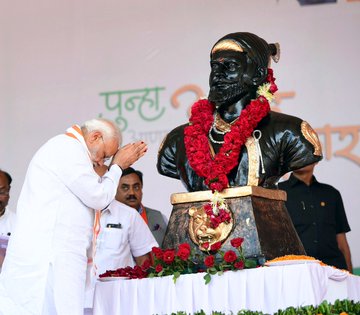
PM pays tributes to Chhatrapati Shivaji Maharaj on his Jayanti

The Prime Minister, Shri Narendra Modi has paid tributes to Chhatrapati Shivaji Maharaj, on his Jayanti today.

Prime Minister said, “Bowing to one of the greatest sons of Mother India, the embodiment of courage, compassion and good governance, the exceptional Chhatrapati Shivaji Maharaj on his Jayanti. His life continues to motivate millions.

Chhatrapati Shivaji Maharaj made a mark as a valorous warrior and an outstanding administrator. From building a strong navy to ushering several pro-people policies, he was outstanding in all spheres. He will always be remembered for his opposition to injustice and intimidation”.


Narendra Modi

@narendramodi

महान छत्रपती शिवाजी महाराज यांच्या जयंती दिनी त्यांना नमन!

Bowing to one of the greatest sons of Mother India, the embodiment of courage, compassion and good governance, the exceptional Chhatrapati Shivaji Maharaj on his Jayanti. His life continues to motivate millions.

View image on Twitter
10.4K people are talking about this

Narendra Modi

@narendramodi

महान छत्रपती शिवाजी महाराज यांच्या जयंती दिनी त्यांना नमन!

Bowing to one of the greatest sons of Mother India, the embodiment of courage, compassion and good governance, the exceptional Chhatrapati Shivaji Maharaj on his Jayanti. His life continues to motivate millions.

View image on Twitter

Narendra Modi

@narendramodi

Chhatrapati Shivaji Maharaj made a mark as a valorous warrior and an outstanding administrator. From building a strong navy to ushering several pro-people policies, he was outstanding in all spheres. He will always be remembered for his opposition to injustice and intimidation.

2,913 people are talking about this


*****

VRRK/KP

KALA KUMBH – Handicrafts Exhibitions for promotion of GI Crafts

With an objective to promote Geographical Indication (GI) crafts and heritage of India the Ministry of Textiles is organising Kala Kumbh – Handicrafts Thematic Exhibition in various parts of the country through the Office of Development Commissioner (Handicrafts). The exhibitions are planned in various major cities like Bengaluru, Mumbai, Kolkata and Chennai. The exhibitions sponsored by Export Promotion Council for Handicrafts (EPCH) started on 14th February, 2020 and will continue till 23rd February 2020 at Bengaluru and Mumbai and will also be organized in Kolkata and Chennai in March 2020.

The GI tag is used on handicrafts which correspond to a specific geographical location or origin (e.g., a town, region, or country). As on August 2019, 178 GI handicraft products were registered from all over India. The artisans are the backbone of Indian handicraft sector and possess inherent skill, technical and traditional craftsmanship.

During the 10 day exhibitions, the visitors will be able to see a wide variety of handicrafts with their friends and family and by buying these handicrafts they can directly contribute in the improvement of the livelihood of these artisans and also create awareness of the rich heritage of the country.

In Bengaluru exhibition, GI crafts like Mysore rosewood inlay, Channapatna lacquerware, Dharwad kasuti embroidery, Kolhapur chappal, Bidriware, Molakalmur handblock printing, Ananthapur leather puppet, Thrissur screwpine, Vishakapatna lacquerware, Sandur lambani embroidery, Jodhpur terracota, Jaipur handprinted textile, bronze casting, Medinipur mat weaving, Birbhum artistic leather and Khurdah palm leaf engraving are being displayed.

In Mumbai exhibition GI crafts like Chittoor kalamkari painting, Thrissur screwpine crafts, Pokharan terracotta crafts, Kutch embroidery & crochet crafts, Pingla patachitra, Birbhum kantha embroidery, Jajpur photachitra painting, Madhubani Mithila painting, Kolhapur chappal, Palghar Worli painting, Kondagaon wrought iron craft, Agate stone crafts and Krishna handblock printing are being displayed.

***

Photo by julie aagaard on Pexels.com

Clarification about the Discussions and Decisions taken in the meeting of National Statistical Commission

A section of the media reported about the discussions and decisions taken in the meeting of the National Statistical Commission (NSC) on 15 Jan 2020.  It is clarified that in the meetings of NSC, the concerned Divisions make a presentation on the agenda items and after elaborate discussions, decisions are taken.  These decisions are unanimous after due deliberation and are in line with the Code of Professional Ethics notified by the Government.  It is further clarified that the NSC is a recommending body that helps the national statistical system in evolving better strategies to improve the functioning of the system.  It is unfortunate that the report has sought to portray a difference of opinion in the decision making of the Commission whereas the decisions were unanimous. Such coverage by the media is inappropriate, to stay the least, and the Commission unequivocally condemns it.  The Commission is conscious about the initiatives being taken for improving the data quality in the statistical products and processes and works closely with the statistical agencies in the central and state government to ensure its implementation.

***

VRRK/AK

District Skill Committees to work closely with the Center to drive demand-driven skill development initiatives

  • Role of States to increase substantially in skill development activities
  • Discussion on developing an action plan for better implementation of skilling initiatives and for creating employment opportunities for India’s youth
  • Short Term Training courses to be introduced in ITIs in with due consultation from the State Skill Development Missions (SSDMs)
  • Promoting Self Employment and Entrepreneurship for overall economic growth and innovation

Ministry of Skill Development and Entrepreneurship (MSDE) organized a day long consultative workshop here today, with representatives from States and Union Territories, to review skill development across geographies and segments and to seek their valuable suggestions on streamlining the upcoming initiatives. The key thrust of the workshop was to increase the participation of the District Committees for better coordination of the skill efforts in each district and to achieve the broader objectives of the Hon’ble Prime Minister’s vision of making India the skill capital of the world.

During the workshop, Vision 2025 was also discussed which lays out the key focus areas and ready-to-implement roadmap for promoting Skill Development and Entrepreneurship in country.

The aim for organizing today’s workshop was to unlock the true potential of the youth by making skills aspirational and building sustainable livelihood pathways for them. The State and Union Territory representatives shared their regional perspective on the various aspects of the Skill India Mission including Apprenticeship, Long Term Skilling; Sankalp and Strive initiatives; Entrepreneurship; Short Term Skilling and the next stage of the Pradhan Mantri Kaushal Vikas Yojana (PMKVY), PMKVY 3.0 and the related challenges and opportunities.

The center proposed that the District Skill Committees (DSCs) should be further empowered with substantial fund allocation to ensure stringent monitoring and evaluation of skill training under the next phase of PMKVY.

Towards this, MSDE has recently introduced the Mahatma Gandhi National Fellowship (MGNF), an initiative designed and implemented by IIM Bangalore in collaboration with State Skill Development Missions (SSDMs), where fellows will be posted in district for 2 years working closely with the district administration to create specific State Skill Development Plans. Relevant local and state level programs will also receive additional funding under the SANKALP scheme of MSDE, beyond the already allocated state incentive grants.

The workshop also deliberated on integration of skill development in the plans of Gram Panchayats ensuring last mile connectivity.

Urging the states to increase scale and standards of skill development, Dr. Mahendra Nath Pandey, Minister for Skill Development and Entrepreneurship said, “Our endeavor is to move away from the low skill equilibrium and contribute towards economic growth and wealth creation through skill development and entrepreneurship. This will eventually lead to increased employment prospects for the youth of the nation. The success of Skill India is dependent on the increased participation of the States and the District committees to drive demand-driven skill development in market relevant courses and prepare our youth to be industry ready.”

“There should consistent research and analysis on skill gaps at a local level, so that our strategies match the demand of the market and the aspiration of the youth. We should enable industry surveys to enable outcome-based skilling,” said Shri R K Singh, Minister of State (IC) Power and New & Renewable Energy, MoS in the Ministry of Skill Development and Entrepreneurship.

MSDE assured its support to States in keeping pace with the industry best practices by enabling upgradation of Industrial Training Institutes (ITIs) and encouraging more participation from industry giants. Initially, MSDE will focus on the top 500 ITIs, on the basis of the grading of these institutes, and will also determine surplus existing capacity for Short Term Training in ITIs. MSDE has also identified 100 industrial clusters for improved and broadening Apprenticeship training. Out of these, agreements have already been signed with eleven clusters.

To promote entrepreneurship in the country, the Ministry proposed entrepreneurship development unit in each State which will be anchored with State Skilling Mission. It also proposed developing mentorship and handholding of existing and new entrepreneurs, through district entrepreneurship incubation lab in existing skilling institutions.

***********

Gadkari Visits Safety Equipments Manufacturer and Winesses The E-Highway Test-Bed Demonstration Site in Sweden

Union Minister for Road Transport & Highways and MSMEs Shri Nitin Gadkari visited the Swedish Automotive Safety Supplier ‘Autoliv’ in Stockholm today. The Minister presented a copy of the Report on ‘Road Safety in India’ to company representative, and took note of the recent products and innovations of the company. Autoliv is the world’s largest automotive safety equipment supplier, with sales to all major car manufacturers in the world.

Road safety is a major concern in India. The country has committed to safety, efficiency and sustainability in the transport sector. The problem of safety is also linked to social equity in India. With a large population of pedestrians, cyclists and motorised two-wheelers competing for space on roads, the road safety needs for these vulnerable sections has to be kept in mind while designing and developing transport strategies.


The Minister later visited E-highway Test-bed Demonstration site in Sweden. Government of India has already announced E-highways. During the visit, he was informed about the recent technological developments in the sector achieved by Sweden.

The Minister in in Sweden these days, to represent India at the “3rd High Level Global Conference on Road Safety for Achieving Global Goals 2030” being held in Stockholm during 19th and 20th of February, 2020. The objective of the two-day conference is to bring road safety on the global agenda and renew the world community’s commitment to safer roads. Leaders from participating countries will draw up a road-map for reaching the United Nation’s goal set under the UN Decade of Action of reducing road crashes by 2030.

During his stay in Stockholm, Shri Gadkari will have bilateral dialogue with his Swedish Minister for Infrastructure Tomas Eneroth, Minister for Foreign Trade Anna Hallberg, Minister for Business, Industry & Innovation Ibrahim Baylan and also with the British Minister for Road Safety Baroness Vere. Shri Gadkari will also hold talks with the World Bank Vice President (South Asia) Hart Schafer. Also on Gadkari’s itinerary will be a Sweden-India Transportation Safety and Innovation Partnership meeting to be attended a number of CEOs. Swedish and Indian businesses are likely to exchange several MOUs on this occasions.

***

Central Government employees selected for appointment

s and Pensioners’ Welfare to address the longstanding demand of Central Government employees whose recruitment was finalized before 01/01/2004 but who had, for various reasons, joined the services on or after 01/01/2004. However, he noted that the last date to exercise this option would be 31/05/2020, and those who fail to exercise the option by this stipulated date would continue to be covered by the National Pension System.

The Central Government by this order has rectified a long standing grievance of a huge number of employees whose recruitment (including written examination, interview and declaration of result) had been finalized on or before 01.01.2004 (which was the cut-off date for employees to be covered under the old Pension scheme) but whose joining was delayed on account of administrative reasons and such delay was beyond the control of such Government servants.

This order of the Government of India is expected to give relief to several Central Government employees, some of whom were knocking the doors of the Courts in order to get covered under the CCS (Pension) Rules, 1972 and will also substantially bring down the litigation on this subject matter.

A few illustrations where the selection was finalized before 01.01.2004 but actual joining took place on or after 01.01.2004 are as under:

  1. The result for recruitment was declared before 01.01.2004 but the offer of appointment and actual joining of the Government servant was delayed on account of police verification, medical examination etc.;
  2. Some of the candidates selected through a common selection process were issued offers of appointments and were also appointed before 01.01.2004 whereas the offers of appointments to other selected candidates were issued on or after 1.1.2004 due to administrative reasons/constraints including pending Court/CAT cases.
  3. Candidates selected before 01.01.2004 through a common competitive examination were allocated to different Departments/organization. While recruitment process was completed by some Department(s)/organizations on or before 31.12.2003 in respect of one or more candidates, the offers of appointment to the candidates allocated to the other Departments /Organization were issued on or after 01.01.2004.
  4. Offers of appointment to selected candidates were made before 01.01.2004 with a direction to join on or after 01.01.2004.
  5. Offers of appointment were issued to selected candidates before 01.01.2004, and many/most candidates joined service before 01.01.2004. However, some candidate(s) were allowed extension of joining time and they joined service on or after 01.01.2004. However, their seniority was either unaffected or was depressed in the same batch or to a subsequent batch, the result for which subsequent batch was declared before 01.01.2004.
  6. The result for recruitment was declared before 01.01.2004 but one or more candidates were declared disqualified on the grounds of medical fitness or verification of character and antecedents, caste or income certificates. Subsequently, on review, they were found fit for appointment and were issued offers of appointment on or after 01.01.2004.

In all the above illustrative cases, since the result for recruitment was declared before 01.01.2004, denial of the benefit of pension under CCS (Pension) Rules, 1972 to the affected Government servants is not considered justified.s

It has been decided that in all cases where the results for recruitment were declared before 01.01.2004 against vacancies occurring on or before 31.12.2003, the candidates declared successful for recruitment shall be eligible for coverage under the CCS (Pension) Rules, 1972.

Accordingly, such Government servants who were declared successful for recruitment in the results declared on or before 31.12.2003 against vacancies occurring before 01.01.2004 and are covered under the National Pension System on joining service on or after 01.01.2004, may be given a one-time option to be covered under the CCS (Pension) Rules, 1972. This option may be exercised by the concerned Government servants latest by 31.05.2020.

Those Government servants who are eligible to exercise option in accordance with para-4 above, but who do not exercise this option by the stipulated date, shall continue to be covered by the National Pension System and the option once exercised shall be final.

The matter regarding coverage under the CCS (Pension) Rules, 1972 based on the option exercised by the Government servant shall be placed before the appointing authority for consideration in accordance with these instructions. In case the Government servant fulfils the conditions for coverage under the CCS (Pension) Rules, 1972, in accordance with these instructions, necessary order in this regard shall be issued latest by 30th September, 2020. The NPS account of such Government servants shall, consequently, be closed w.e.f. 01st November, 2020.

The Government servants who exercise option to switch over to the pension scheme under CCS (Pension) Rules, 1972, shall be required to subscribe to the General Provident Fund (GPF).

*****

VG/VM/HS


Dr. S Jaishankar to inaugurate Indian Pavilion at 70th Berlin International Film Festival

The festival will be held from 20th February to 1st March 2020 in Berlin, Germany. The film festival will also see an India Pavilion which will provide a platform to popularize Indian cinema in the overseas market and facilitate new business opportunities.

This year in Berlin, three Indian feature films as well as one short documentary film have been selected, namely Pushpendra Singh’s Laila Aur Satt Geet, Prateek Vats’ Eeb Allay Ooo!, Akhsay Indikar’s “Sthalpuran” and Ekta Mittal’s short documentary “Gumnaam Din”.


Dr. S Jaishankar, Minister of External Affairs will inaugurate the Indian Pavilion at Berlinale.

India seeks to promote its films across linguistic, cultural and regional diversity and establish multiple international collaborations in the space of distribution, production, filming in India, and script development technology through its participation at Berlinale 2020.

The Indian delegation, through various interactions, seeks to promote the ease of shooting films in India through Film Facilitation Office (FFO) that facilitates Single Window Clearance for filmmakers and provides the platform for ‘Cinematic Tourism’ in India. The delegation will exhibit India as a post-production hub and promote collaborations for films with international production houses.

The Audio-Visual Services sector has been recognized as one of the Champion Services Sectors by the Government of India with an aim to promote India as a leading destination source for Media and Entertainment.

Government delegation to Berlinale will facilitate international participation for the 51st edition of International Film Festival of India (IFFI) 2020, Goa. IFFI aims at providing a common platform to the cinemas across the world to project the excellence of the art of film making.

The delegation has meetings scheduled with officials from countries including Israel, South Africa, New Zealand, Spain, Brazil, Portugal, France, Italy, Switzerland, Germany, Canada, United States of America and Rwanda. The delegation will meet with officials from Locarno Film Festival, Sundance Film Festival, Venice International Film Festival, Cannes Film Festival, Raindance Film Festival, Edinburgh International Film Festival, Annecy International Animation Festival, among others.

India enjoys comparative advantage in several aspects of the filmmaking process. It has a strong domestic film industry across the country and is home to world class technicians and equipment and diverse location choices to shoot any type of film.

With over 1,800 feature films produced in the country, more than 900 television channels, 500 million internet users, 500 million smart phone users, India’s vibrant media and entertainment (M&E) industry provides attractive growth opportunities for global corporations.

*********

Annual Review Meeting of Swachh Iconic Places (SIP) at Baidyanath Dham Deoghar, Jharkhand

The 3rd Annual Review meeting on Swachh Iconic Places (SIP) was held today at Baidyanath Dham Deoghar, Jharkhand. The SIP is the brainchild of the Prime Minister Shri Narendra Modi and is coordinated by the Department of Drinking Water and Sanitation (DDWS), Ministry of Jal Shakti under the Swachh Bharat Mission. Thirty Swachh Iconic Places have been selected across the country in three phases, and are implementing their action plans for improving the sanitation facilities and overall cleanliness, focusing on enhancing visitor’s experience and convenience.

The National Review Meeting was inaugurated by the Minister, Drinking Water and Sanitation, Government of Jharkhand, Shri Mithilesh Thakur, and attended by Shri Parameswaran Iyer, Secretary, DDWS, Government of India, and senior officials from the state and central government, nodal persons from iconic sites/states, partnering PSUs and other local bodies.

Speaking on the occasion, Shri Mithilesh Thakur said that SIP projects have played a very critical role in improving the cleanliness standards at the selected thirty iconic sites, and especially at Baidyanath Dham Temple, Deoghar. He spoke about some of the key activities undertaken to improve swachhata in the temple premises like using the waste generated from the offerings at the temple to generate compost, and rejuvenation of water bodies like Shiv Ganga Sarovar. The Minister also launched and dedicated ‘Five Water ATM’s for Baidyanath Dham Temple, supported by the PSU partner Power Grid Corporation of India Limited.

Shri Parameswaran Iyer, Secretary, DDWS elaborated the importance of SIP, and gave the example of how the SIP activities at Deoghar have been recognized and awarded twice in the past for their good work. He also gave examples of the good work being done at some of the other sites from across the country.

Shri Samir Kumar, Joint Secretary, DDWS made a presentation highlighting the key role of partner Ministries, district administration and CSR partners in implementation of the SIP. He also stressed the importance of convergence for funds, proposals, cross learning, and experience sharing. Earlier, Secretary, DDWS, Govt of Jharkhand, Smt. Aradhana Patnaik welcomed participants from all the iconic sites and appreciated their efforts in improving conditions at these sites.

Nodal officers from 25 of the 30 iconic sites and their PSU partners presented their progress and key activities being carried out at these sites including Solid and Liquid Waste Management (SLWM), beautification and landscaping of premises and approach areas, construction of sanitation and safe drinking water facilities, rooftop solar panels, battery operated sweeping machines, rejuvenation of water bodies, ban on plastic use, Sewage Treatment Plants (STPs), multi-level parking, illuminated boards, awareness campaigns and IEC interventions among others.

Phase I Iconic sites:  1. Ajmer Sharif Dargah; 2. CST Mumbai; 3. Golden Temple, Amritsar; 4. Kamakhya Temple, Assam; 5. Maikarnika Ghat, Varanasi;  6. Meenakshi Temple, Madurai; 7. Shri Mata Vaishno Devi, Katra, J&K; 8. Shree Jagannath Temple, Puri; 9. The Taj Mahal, Agra; 10. Tirupati Temple, Tirumala

Phase II Iconic sites: 1. Gangotri; 2. Yamunotri; 3. Mahakaleshwar Temple, Ujjain; 4. Char Minar, Hyderabad; 5. Church and Convent of St. Francis of Assissi, Goa; 6. Adi Shankaracharya’s abode Kaladi in Ernakulam; 7. Gomateshwar in Shravanbelgola; 8. Baijnath Dham, Devghar; 9. Gaya Tirth in Bihar; 10. Somnath Temple in Gujarat.

Phase III Iconic sites: 1. Sree Dharma Sastha Temple; 2. Mana Village, Uttarakhand; 3. Vidur Kuti Temple, Uttar Pradesh; 4. Shri Sarveshwar Mahadev Temple; 5. Shri Nag Vasuki Temple; 6. Kanvashram, Uttar Pradesh; 7. Ema Keithel, Manipur; 8. Hazarduari Palace, West Bengal; 9. Pangong Tso; 10. Sri Raghvendra Swamy Mutt Mantralayam


*****

Annual Review Meeting of Swachh Iconic Places (SIP) at Baidyanath Dham Deoghar, Jharkhand

The 3rd Annual Review meeting on Swachh Iconic Places (SIP) was held today at Baidyanath Dham Deoghar, Jharkhand. The SIP is the brainchild of the Prime Minister Shri Narendra Modi and is coordinated by the Department of Drinking Water and Sanitation (DDWS), Ministry of Jal Shakti under the Swachh Bharat Mission. Thirty Swachh Iconic Places have been selected across the country in three phases, and are implementing their action plans for improving the sanitation facilities and overall cleanliness, focusing on enhancing visitor’s experience and convenience.

The National Review Meeting was inaugurated by the Minister, Drinking Water and Sanitation, Government of Jharkhand, Shri Mithilesh Thakur, and attended by Shri Parameswaran Iyer, Secretary, DDWS, Government of India, and senior officials from the state and central government, nodal persons from iconic sites/states, partnering PSUs and other local bodies.

Speaking on the occasion, Shri Mithilesh Thakur said that SIP projects have played a very critical role in improving the cleanliness standards at the selected thirty iconic sites, and especially at Baidyanath Dham Temple, Deoghar. He spoke about some of the key activities undertaken to improve swachhata in the temple premises like using the waste generated from the offerings at the temple to generate compost, and rejuvenation of water bodies like Shiv Ganga Sarovar. The Minister also launched and dedicated ‘Five Water ATM’s for Baidyanath Dham Temple, supported by the PSU partner Power Grid Corporation of India Limited.

Shri Parameswaran Iyer, Secretary, DDWS elaborated the importance of SIP, and gave the example of how the SIP activities at Deoghar have been recognized and awarded twice in the past for their good work. He also gave examples of the good work being done at some of the other sites from across the country.

Shri Samir Kumar, Joint Secretary, DDWS made a presentation highlighting the key role of partner Ministries, district administration and CSR partners in implementation of the SIP. He also stressed the importance of convergence for funds, proposals, cross learning, and experience sharing. Earlier, Secretary, DDWS, Govt of Jharkhand, Smt. Aradhana Patnaik welcomed participants from all the iconic sites and appreciated their efforts in improving conditions at these sites.

Nodal officers from 25 of the 30 iconic sites and their PSU partners presented their progress and key activities being carried out at these sites including Solid and Liquid Waste Management (SLWM), beautification and landscaping of premises and approach areas, construction of sanitation and safe drinking water facilities, rooftop solar panels, battery operated sweeping machines, rejuvenation of water bodies, ban on plastic use, Sewage Treatment Plants (STPs), multi-level parking, illuminated boards, awareness campaigns and IEC interventions among others.

Phase I Iconic sites:  1. Ajmer Sharif Dargah; 2. CST Mumbai; 3. Golden Temple, Amritsar; 4. Kamakhya Temple, Assam; 5. Maikarnika Ghat, Varanasi;  6. Meenakshi Temple, Madurai; 7. Shri Mata Vaishno Devi, Katra, J&K; 8. Shree Jagannath Temple, Puri; 9. The Taj Mahal, Agra; 10. Tirupati Temple, Tirumala

Phase II Iconic sites: 1. Gangotri; 2. Yamunotri; 3. Mahakaleshwar Temple, Ujjain; 4. Char Minar, Hyderabad; 5. Church and Convent of St. Francis of Assissi, Goa; 6. Adi Shankaracharya’s abode Kaladi in Ernakulam; 7. Gomateshwar in Shravanbelgola; 8. Baijnath Dham, Devghar; 9. Gaya Tirth in Bihar; 10. Somnath Temple in Gujarat.

Phase III Iconic sites: 1. Sree Dharma Sastha Temple; 2. Mana Village, Uttarakhand; 3. Vidur Kuti Temple, Uttar Pradesh; 4. Shri Sarveshwar Mahadev Temple; 5. Shri Nag Vasuki Temple; 6. Kanvashram, Uttar Pradesh; 7. Ema Keithel, Manipur; 8. Hazarduari Palace, West Bengal; 9. Pangong Tso; 10. Sri Raghvendra Swamy Mutt Mantralayam


*****

Ministry of Human Resource Development to celebrate Matribhasha Diwas

The Matribhasha Diwas which falls on 21st February will be celebrated by HRD Ministry across the country. The Vice President of India, Shri M. Venkaiah Naidu will be the Chief Guest at the main event to be held in New Delhi on 20th February, 2020..  Union HRD Minister Shri Ramesh Pokhriyal ‘Nishank’ will be the Guest of Honour on the occasion. MoS, Ministry of Culture and Tourism Shri Prahlad Singh Patel and MoS, HRD Shri Sanjay Dhotre will also grace the occasion. The theme of the programme is ‘Celebrating our Multilingual Heritage’ reflecting the spirit of Ek Bharat Shreshth Bharat.

MHRD along with educational institutions and language institutions is celebrating the Matribhasha Diwas for the past three years. This year also the educational institutions will organize activities like Elocution, Debating, Singing, Essay writing competitions, painting Competitions, Music and dramatic performances, Exhibitions, Online resources and activities as well as events exploring the cognitive, economic, social and cultural activities of multilingual society, Exhibitions depicting linguistic and diverse wealth of India in at least two languages and also more.

International Mother Language Day (IMLD) is a worldwide annual observance forming a part of UNESCO’s calendar of events, held on 21st February to promote awareness of linguistic and cultural diversity and multilingualism. It was first announced by UNESCO on 17th November, 1999. It was formally recognized by the United Nations General Assembly (UNGA) in 2008. The latter called upon its member states “to promote the preservation and protection of all languages used by people of the world”.

Our country has unparallel linguistic and cultural diversity and fittingly, it is proposed to observe in India 21st February, 2020 for events that promote our languages and the associated diversity of usage and literature. It has been decided to celebrate Matribhasha Diwas on 21.2.2020 every year, to promote the use of mother tongues and to achieve the following objectives:-

– Highlight the linguistic diversity of our country;

– Encourage usage, not only of the respective mother tongue but other Indian languages as well.

– To understand and draw attention to the diversity of cultures in India and the consequent forums of literature, craft, performing arts, scripts and other forms of creative expression.

– To encourage the learning of languages other than one’s own mother tongue.

*****

Government to Facilitate doubling of Milk Processing capacity from 53.5 million MT to 108 million Mt by 2025

In India milk production is growing by 6.4% during the last 5 years and has increased from 146.3 million MT in 2014-15 to 187.7 million MT in 2018-19. About 54% of milk produced is marketable surplus and remaining 46% is retained in villages for local consumption. Out of the marketable surplus available with farmers only 36% is handled by organised sectors evenly shared by cooperative and private sector. There is a need to bring the remaining 64% surplus milk under the organized fold through various interventions. During last 2 years milk procurement is also growing by about 9% in Cooperative sector.

Department of Animal Husbandry & Dairying is continuously working towards increasing milk productivity through genetic improvement and reduction of input cost. Special programme has also been launched recently for improvement of milk quality by providing required testing facilities at village and dairy plant level for safe human consumption. It is proposed to further intensify the Quality Milk Programme for both cooperative and private sector with fund sharing basis. With a thrust on better productivity, reduced input cost and better quality milk and milk product, the competitiveness and profitability in the dairy sector will get enhanced leading to increased demand of dairy products in domestic and international market. This would also bring private investments in the sector to boost growth in rural income and also employment.

Public investment to further incentivise private investments would be facilitated for increasing processing facilities through convergence and leveraging the schemes of Department of Animal Husbandry & Dairying, Ministry of Food Processing Industries, Department of Agriculture, Cooperation & Farmers Welfare, Department of Rural Development and State Governments.

****

Government to Facilitate doubling of Milk Processing capacity from 53.5 million MT to 108 million Mt by 2025

In India milk production is growing by 6.4% during the last 5 years and has increased from 146.3 million MT in 2014-15 to 187.7 million MT in 2018-19. About 54% of milk produced is marketable surplus and remaining 46% is retained in villages for local consumption. Out of the marketable surplus available with farmers only 36% is handled by organised sectors evenly shared by cooperative and private sector. There is a need to bring the remaining 64% surplus milk under the organized fold through various interventions. During last 2 years milk procurement is also growing by about 9% in Cooperative sector.

Department of Animal Husbandry & Dairying is continuously working towards increasing milk productivity through genetic improvement and reduction of input cost. Special programme has also been launched recently for improvement of milk quality by providing required testing facilities at village and dairy plant level for safe human consumption. It is proposed to further intensify the Quality Milk Programme for both cooperative and private sector with fund sharing basis. With a thrust on better productivity, reduced input cost and better quality milk and milk product, the competitiveness and profitability in the dairy sector will get enhanced leading to increased demand of dairy products in domestic and international market. This would also bring private investments in the sector to boost growth in rural income and also employment.

Public investment to further incentivise private investments would be facilitated for increasing processing facilities through convergence and leveraging the schemes of Department of Animal Husbandry & Dairying, Ministry of Food Processing Industries, Department of Agriculture, Cooperation & Farmers Welfare, Department of Rural Development and State Governments.

****