Why is networking beneficial to undergrads?

What comes to mind when you hear the term networking?
The idea of “networking” conjures up a lot of feelings for students – anticipation, hesitation, reluctance – and it’s easy to understand why. We often define networking as a structured, professional, and often transactional activity that takes place at a career fair or similar event.
What if we thought of “networking” as simply connecting with and learning from someone new? With that in mind, here are three reasons why networking might be beneficial to you as an undergrad whether it’s your first year at DU or you’re about to graduate.
  1. If you’re undecided about your academic or career goals…
…Connecting with others can be a huge help in illuminating different career paths and trajectories. While this is great news for Undeclared students, this also applies to exploring students within a major. As the Career Advisor to students in Mathematics, for example, I often coach students through the exploration process. If a Math major isn’t planning to become a Mathematician, what are some tangible, concrete career paths that still connect to the degree?
This is where learning from alumni can be especially powerful. Many Math majors aren’t initially aware of careers in logistics, operations, project management, and engineering that are not only possible, but attainable, due to the way that the Math curriculum teaches one to think and analyze a problem. The same thing goes for just about any other major, and by connecting with a fellow alum from your program of study, you might discover career paths that allow for you to creatively put your skills and experience to work.
  1. Are you looking for an internship? Learning from others can help!
Many undergraduate students ask our Career Advisors for guidance on the internship search, and it’s exciting to see students embrace such an important opportunity for personal and professional growth! While searching online for internships isn’t a bad place to begin, you will want to try different strategies as you plan for the summer (or academic year) ahead.
There are so many interesting experiences, leads, and organizations out there that you might not find on the Internet alone. By visiting one of our Connecting DU, Mentor for a Moment, or Dine & Dialogue events, you might learn about a new organization that fits your values and interests. What’s more, there might be alumni who are seeking interns at one of these events! You never know what you might discover by chatting with someone new. Connecting with others isn’t the only strategy for finding an internship, but it’s certainly a useful one to consider.
  1. If you’re considering graduate school, informational interviews serve as an excellent resource.
Maybe you have an idea of what you want life after DU to look like, and it may include graduate study. Some students choose to apply to graduate school right away, and some plan to take a gap year instead. It might be useful to expand your network and learn from folks who have taken a gap year, or who have experience with the graduate school admissions process. Current, and former, graduate students have a wealth of knowledge to pass on to undergraduate students, and that advice might assist you in efficiently planning for the next step, deciding on which programs to apply to, or if you should pursue graduate school at all. Networking isn’t just about the job search!
We hope you consider building and cultivating connections that can support you for life, whether you find them through

How to Make Networking Work for You

There are people who would rather have a tooth pulled than go to a networking event. The idea of being in a room full of strangers, having to start a conversation and then gracefully exit when appropriate is daunting for college students and seasoned professionals alike. Whether you’re going to an upcoming career fair, invited to a networking mixer for a company you want to work with, or meeting new group members for a class project, here are some tried and true ways to make the most of the experience:
  • Give a firm handshake– No matter who you’re getting ready to meet, make sure your handshake is firm. Don’t give the other person dead weight or a knuckle-crushing handshake. Beforehand, be sure to switch any beverage glasses to your left hand so that your hands aren’t too hot or too cold. Likewise, put your phone or any other objects away so that you don’t fumble when it’s time to go in for the handshake.
  • Don’t hesitate to introduce yourself first– Now that you have this person’s hand and attention, say hi, let them know who you are and that it’s a pleasure to meet them.
  • Look people in the eye– When we’re in new situations, we can tend to look around the room while talking instead of at the people we’re talking to. Make eye contact, it lets your audience know that you’re present and paying attention to them.
  • Smile– Smiling will help make you and the person or people you’re talking to feel more at ease. You’ll also come off as more open and willing to engage.
  • Follow-up– When someone shares their contact information with you, it’s crucial to follow up with them in a timely manner. Sending them a quick note to thank them for their time and reflecting on a part of your conversation will go a long way in helping them remember you after your initial meeting. For Example, ” Hi Jim, It was great meeting you at the Finance Industry Night yesterday. Thank you for taking some time to share your story with me. I would love to connect to speak further about how you used your internship to get a full-time job with Chase. How does your schedule look to grab coffee next Thursday?” The email doesn’t have to be long but make sure you reach out to move your initial conversation forward.
There are ample opportunities to both practice your networking skills and build your network whether it’s with classmates or potential employers. The next time you meet or are introduced to someone new, keep these tips in mind to help you leave a lasting impression.
By: Hannah Tall
Hannah Tall is a Regional Recruitment Manager with City Year. She is passionate about youth development and education and is using her work with City Year to help young people become change agents within schools and communities across the country.

How an English Professor Infused Career into the Classroom

When DU English professor, Donna Beth Ellard, wanted to make her First Year Seminar (FSEM) course an engaging and meaningful experience she began to ask herself “How can poetry assist a student over four years by helping them decide what their profession may be?”  Thinking outside the box, Donna Beth wanted to find a way to bring an idea of “Poetry in the Professions” theme into her classroom.  The goal was to have students learn how to be meaningful as they pursue and explore career paths.
Donna Beth has heard numerous parents say to their child that they “can’t be a Humanities major…there are not many careers in the humanities!”  She set out to prove that theory wrong by infusing career professionals who majored in English into the classroom.  She mapped out her syllabus with four distinct professions for students to learn more about through research, interviews, poetry readings, and class presentations.  These four professions were law, medicine, public relations and social work.  Donna Beth taught the FSEM students the “close reading” skill practiced across the humanities.  This method teaches a student to learn to listen to other voices, to be patient, to build emotional awareness and how to be empathetic.  Developing these skills are necessary to be successful in many occupations regardless of industry.
Along with assigned readings, Donna Beth had a lawyer, a PR executive, a social worker, and an OB/GYN medical doctor speak in the class room.  The practitioners spoke about how their undergraduate English degree helped them to be successful in graduate school as well as in their current positions.  For example, the medical doctor explained how her undergraduate degree in English helped her tremendously in medical school by developing skills such as patience, emotional awareness, and empathy.  This doctor credits the “close reading” skills she learned as an English major as a key component of her success.
Donna Beth’s biggest challenge for this course was the amount of time it took to prepare.  Identifying and reaching out to practitioners was very time consuming and Donna Beth coordinated all of these details on her own. Today, Career & Professional Development along with other career offices on campus, have grown their capacity to support faculty in bringing alumni and employer guest speakers to the classroom. If you would like to integrate career into the classroom, we encourage you to reach out for support!

If You’re Interested in Start-ups, You MUST Attend This Event

Denver’s backyard isn’t all mountains and ski resorts. Did you know Denver is home to “the largest free entrepreneurial event of its kind in North America” – Denver Startup Week?
“Denver Startup Week (DSW) is a powerful showcase of the strength of the entrepreneurial ecosystem in Denver,” said Ben Deda, event co-founder and vice president of marketing at Vertafore. “No matter your stage of business, company role or industry, Denver Startup Week provides the tools, resources and community support to help you start-up and grow a successful business.”
Sessions at DSW include topics on how to start your own business, how to get jobs in startups, and how to grow your career in startups. The event managers are also always looking for volunteers to help coordinate the event. What a great way to get to know the movers-and-shakers in the industry and get behind-the-scenes access to employers and entrepreneurs that you can learn from and connect with!
Check out volunteer opportunities and learn more about this annual Fall event on the Denver Startup Week website!

Health Studies Career Night, February 15 2017

Prepared by Alexandra Jones, CAS Career Advising Team Assistant
Did you miss the Health Studies Career Night, but are still interested in the information provided? Well, although you did miss the opportunity to directly communicate and network with professionals working in what may be your future career field, this blog post may help you.
The panel, moderated by Assistant Professor in the Department of Health Studies (DHS) Kathleen Holton, and co-hosted by DHS and AU Career Center, consisted of four alumni:
  • Annika Bergstrom, TB Investigator at the Centers for Disease Control and Prevention
  • Ryan Paquin, Research Scientist at the Center for Communication Science at RTI International
  • Elizabeth Prevou, Clinical Practice Manager at GWU, and
  • Justin Morgan, Research Assistant at the Health Policy Center at the Urban Institute.
Each speaker talked about the most and least favorite aspects of their careers, as well as gave advice to aid students’ future success, which is shared below.
How do you get your foot in the door?
There are various ways to go about entering a career in the health field. This information was posted at https://www.vocationaltraininghq.com/how-to-become/home-health-aide/ for longevity and so people that did not attend could peruse online. While Bergstrom simply applied through USA Jobs, this may be difficult as it is a competitive process, in which your resume has to stand out to employers from hundreds of others. Other panelists recommend that students work their networks to obtain a job lead, or get connected to someone from the organization you are interested in.
At times, your personality may be enough to get your foot in the door; the issue is displaying your character to employers. Before starting a new job you should talk to Labor Law Compliance Center, and make sure you are not working for less then what you should be. Morgan managed to get an interview with the Urban Institute by calling the institution and talking to an executive. This allowed him to add a personal touch to the application process, which cannot always be included in a resume submission.
How to be strategic with your internships?
Panelists recommend that students complete internships and treat each internship as a learning experience and utilize all connections gained.  Internships can also clarify your career goals and preferences. Prevou said, “Knowing what you don’t want to do at times is just as helpful as knowing what you do want to do.” At the same time, all panelists agreed that students should not jeopardize their peace of mind and sleep to work multiple internships at one time just to buff up a resume.
What skills make students valuable and wanted in the workplace?
No matter your desired job, all panelists recommended that students obtain basic research skills and knowledge of statistical programs, such as SAS, SPSS and Excel. AU offers courses and access to some of these programs through the Center for Teaching, Research and Learning (CTRL) if you have not learned them already.
Knowledge of medical terms and anatomy also allows easy communication across job fields. While this may not be stressed in the interview, such knowledge may be necessary to learn on the job – so why not pick it up sooner rather than later?
Lastly, knowing email etiquette and how to follow-up may be the most beneficial and necessary job skill in any field. Email are often the first form of communication between an employer and employee. Therefore learn how to make your emails sound professional and friendly, but with a hint of your personality.
Were you prepared for the workplace post-graduation?
While there will always be a learning curve when entering a new job, panelists stressed that students should not be nervous about it. After all, they did hire you! Still, be ready to put in the necessary effort to grow in your career. Listen, ask questions and do your best.

Working for a startup

Many of you reading this post will be considering taking the well-trodden path through grad schemes once you graduate, though many will also be weighing up the possibility of joining a startup. The very word ‘startup’ has become a more prominent feature in our collective lexicon over the past decade, as shown by Google Trends data, which displays search volume over time (as a proxy measure for interest):
Some sources place the number of new companies started worldwide at 100 million each year. So there’s plenty of job openings at companies trying to shake up the status quo, and if you’re lucky enough to find one that’s going places, you can even retire by age 30.
Without further ado, we’ll tell you a little about what it’s like working at a startup, with reference to our company, Funeralbooker, a comparison site for funeral services in the UK.

What even is a startup?

A startup is a young company with a growth plan, designed to scale the business quickly. Some of the world’s largest and most ubiquitous companies were once startups and have now reached a high level of market saturation (Snapchat, Uber and AirBnB come to mind).

Why would I want to join a startup?

There are pros and cons to joining a startup, as with joining an established company. Below we’ve listed some of the most obvious juxtapositions.
Salary: When you join an established company as a graduate, you’ll typically get a fairly large salary. At a startup, the salary will often be lower, but you will often receive an equity stake in the company which you can cash in at a later date. Depending on the startup and its growth potential, this can be equivalent to several years of a higher salary which you get all in one go.
Working hours: At a corporate employer, you are typically held to rigid hours, such as 9-5:30, though most people will regularly work later. It can be a battle to work from home, for instance if you have a doctor’s appointment, a house viewing, your boiler breaks down or any of the other pieces of life admin that you struggle to squeeze into the weekend. You may find yourself subject to a disciplinary if you regularly take long lunches, or come in 15 minutes late in the morning. You are however, entitled to a holiday allowance, which is typically around 25 days a year in the UK, excluding national holidays.
At Funeralbooker, as at many other startups, we operate a ROWE (Results Oriented Working Environment) policy. This means that as long as you do your work within the expected time, you can do it whenever and from wherever you wish. We also don’t have any holiday days apart from national holidays. We are free to take time off whenever we wish, so long as the work has been done. What this means in practice is that if you pulled a 16-hour shift on Monday and Tuesday and got through your entire workload, you can take the rest of the week off as holiday.
Opportunity to learn on the job: While every company is different in this regard, generally speaking, at a larger company you will have been hired to fulfil a specific role, and it can be difficult to move to another department. People often complain about being ‘siloed’ or restricted to doing one specific job, and that only.
Conversely, at a startup, you’ll have to wear a lot of hats. There are less people at a startup, so everyone has to pull their weight and contribute their opinion on major aspects of the business, whether that’s the way the website looks, recruitment matters, or PR and even sales. Furthermore, at a large company you’re unlikely to see much of the CEO and the upper echelons of management. At a startup you will interact with the senior management on an almost daily basis, and pick up plenty of valuable knowledge about the day to day running of a business.

Sign me up!

If you like the sound of the startup life, it’s worth remembering a few things before hitting that apply button.
  1. You will need to work hard and be accountable. There is no one for you to hide behind when something goes wrong.
  2. Working at a startup, although exhilarating and more relaxed is less secure than working at an established company. The whole thing can come crashing down.
  3. If you work on a ROWE system, be prepared to work weekends and evenings in exchange for taking Wednesdays and Thursdays off.
  4. Things can be a bit ramshackle at a startup, with the latest slimline laptops, ergonomic keyboards and large expenses claims considered a luxury that can be spared.
  5. Finally, if you don’t believe that the company can grow, don’t join it.

Simple Steps to Quell the Office Critic

A wealth of current research tells us that the most critical factor in controlling undesirable turnover and increasing retention of talented people are the skills of managers. People join companies but they leave managers. Satisfied employees are critical to the success of your business. If they’re not happy on the job, customers are not happy being with them.
So what do you do when you have an employee who is just not happy? Every business can have “the glass is half empty” person on the lookout for something to go wrong. You can recognize them — they spend the majority of the day in a negative slump and critical of everything from projects to people.
The “it will never work” attitude also can devastate your company morale. You may start to notice that other employees — once happy, motivated people — are starting to gossip and criticize. When it comes down to it, negativity is like the flu: It’s contagious. It’s also expensive. Negativity costs companies millions in terms of productivity and profitability.
So how do you deal with an employee whose negativity is starting to rub off on other people? Our first instinct may be that the person’s behavior is just about their “bad attitude” and ignore it. Not a great idea. This can actually fuel the fire by setting a culture of negativity. In fact, if we do nothing about the negativity — we are condoning the behavior and subsequently, endorsing it. You do need to take some action.
Often at the heart of a “negaholic” attitude are fear and uncertainty. Change is the biggest single cause of workplace negativity. Even if that new billing system is for the better, people will automatically ask themselves: What am I losing? For employees, change automatically equals the loss of something comfortable — and they will resist it.
Here are some simple steps for quelling the office critic, paraphrased from some great work by Chris Penttila, a freelance journalist.
1. Understand change from the employee’s perspective. Employees can put up with change as long as they can talk openly about it. Remember most negative people don’t know that they’re negative because no one ever tells them.
2. Find the fear, then focus on solutions. Teach negative employees to focus on offering solutions, not just criticism. Turning the griper into a solution provider gives them a genuine avenue to contribute.
3. Do some coaching. Work with the negative person on improving their attitude. Chances are, these people are complaining because they think they have good ideas that haven’t been heard.
Ultimately, employers can work too long and hard with some negative people when it’s better just to cut your losses, recognizing a bad fit. If there’s no improvement after three to six months, maybe it’s time to let them go (legally, documented, etc., of course).
After you let a negative person go, talk with employees about the future of their workplace. It can be the perfect opportunity to take the pulse of your company culture.

How to Make Your Career Plan after Graduation

hatsThere are two options in terms of work when you’re done with school. You can start a job or launch a career. The difference? It’s quite straight forward. The former is all about making some money now, while the latter is all about where you’ll end up in the future. In other words, it’s about growth prospects. A job in a bar is just that. An entry-level position in a big firm can be so much more.
So what do you want to do? Do you want to bum around for a while uncertain of what you’re going to do or do you want to try to get somewhere in life?

Choose a direction

This is where it starts. You need to choose your industry. Now, do note that your choice isn’t necessarily hammered into stone. When you choose a direction that does not mean you can’t change your mind later. For one thing you never know what opportunities life will throw your way. For another the experience you’ve picked up trying to build your career will almost invariably carry over to other fields. So don’t stress yourself out!
But you know what they say, ‘no wind blows in favor of a ship with no direction.’ And if you’re rudderless and adrift, without a destination in mind, not only will you not know what choices to make, you might not recognize the opportunities that life throws in your path for what they are. So choose a path!

Know your strengths

Self-knowledge is the name of the game. This will help you choose what industry you should choose and it will help you present yourself correctly when you arrive there. So take some time to really think about what makes you special. Ask friends to help you out by listing your strong points and your weak points.
Now remember, you’re not here to have somebody coo about how special you are. That might feel good in the moment, but that won’t help when you’re actually trying to make something of yourself in the world. So ask people to be honest.
Once you have an idea what your strengths are, make sure you know how to utilize them correctly and where they can matter the most. Look them up online and see what tips people have for you. Here is how you can use being introverted. Perhaps your strength is that you’re unassuming and humble? Then find out how to use that. Or maybe it’s your confidence that makes you stand out. It’s all out there. All you need to do is look.

Work on your resume

You know how you always see business people handing out business cards? Well your CV is your business card into the world of your choice. The big difference is that while business people have their company’s reputation to back them up, you’ve only got your history.
And so, you’ve got to make your CV shine. Don’t commit the standard CV mistakes. Read over it a number of times and make certain that there are no grammar and spelling errors. Even better, get somebody else to read over it. After all, when you read something that you wrote the ghost of what you wanted to say often ends up concealing what it actually says on the page. As other people do not have these preconceptions, they will be much more likely to pick up on your mistakes.

Think about an internship

If the industry you’re trying to get into has a lot of applicants, you might want to consider taking an internship. This will get your foot in the door and, as long as you are committed, can often lead to something more permanent in that company. Even if it doesn’t, you’ll have something to put on your CV. Even better, it’s in the industry that you want to work in and so will be far more likely to impress whoever else you might approach later on down the line.
Not all internships are unpaid. Obviously it’s far more interesting for you to get a paid position, especially if you don’t have any financial support to carry you through while you’re trying to get started in the industry you’re in.

Play the numbers game

A lot of fresh off the boat graduates make the mistake of only sending their CV off to a few businesses, thinking they’re special enough to land a position. Here’s a hard truth for you: You’re only at the center of your own world. With everybody else, especially human resources who receive hundreds of applications, you’re at the periphery.
What that means is that though you might have agonized over your CV for hundreds of hours that doesn’t mean they’ll give it more than a few seconds. Heck, you might even get unlucky and they’ll flick by your CV without ever truly registering it due to something going on around them. You know, like how you sometimes don’t even register an internet page before you move on because something else grabbed your attention?
That’s why you’ve got to send your CV off to dozens if not hundreds of jobs. It’s called the numbers game and it relies on the idea that even though you might only have a small chance of landing a specific job, if you multiply that by enough applications you’re bound to get lucky.
Even better, if you get invited to several interviews then you’ll be far less nervous in each individual interview, as you know you’ve still got the other ones if this one goes south. And that extra bit of confidence can make a world of difference!

It’s in your hands

The next few months might not be easy. After all, you’re transitioning from a life where people were trying to make you better, to a world where people are mainly focused on trying to use you to make themselves better. You’re transitioning from a life where you were being told what to do, to a life where you’ve got to make all those decision for yourself. It’s possibly one of the biggest transitions you’ll encounter. That can be quite overwhelming.
At the same time, people don’t expect you to know what you’re supposed to be doing, so they’ll generally cut you some slack. What’s more, remember that bit where I told you that you’re not at the center of everybody else’s world? Well that also means that if you screw up people probably won’t notice! There’s this thing in social psychology called the spotlight effect. It means that people pay far less attention to us than we think they do. So feel free to experiment! For unless you were raised with a silver spoon in our mouth nobody is going to bring you your chosen career on a silver platter.
And that’s alright, because if they did, you wouldn’t appreciate it anyway. So go out there and take what you want and make the best of it!

Trends In Networking: Expanding Your Mindset

Many of us tend to think of networking as only something that you do at events that are labeled “networking events.” This is one view of networking, but it is actually much more. The trend in networking is to expand your thinking and consider networking as something that you do on a day-to-day basis. Here are 5 suggestions for expanding your mindset:
    • Sit next to someone you don’t know in one of your classes or at a meeting. Introduce yourself and start a conversation. That’s networking!
    •  Join a club or organization there are many at DU! How about the kayaking or the tango club? This is a great way to meet new people and to network!
    •  Volunteer for a cause that interests you. Check out Center for Community Engagement & Service Learning (CCESL) for ideas. This is networking!
    •  Connect with DU alumni and learn about their careers.  This is a great way to get personal advice ideas for professional development and career insight.  Join the DU alumni community on Pioneer Connect. This is another way to expand your network!
    •  Send an email or connect on LinkedIn to someone who you met at a conference or professional event. Update them on what you have been doing professionally. Staying in touch with those you have met is networking!
By expanding your views about networking you will start to build meaningful relationships and connections. Networking is not just about going to scheduled networking events, it is a lot more. It’s an effective way learn more from your community, your fellow students and alumni!

Resume Hacks: The Time-Saving Magic of Tab Stops

We’ve all been there—messing around with countless settings in Google Drive or Word trying to make the resume look just right. Especially when it comes to aligning locations and dates to the right margin, it can seem like a delicate balance of not-too-many tabs and just enough taps on the space bar.
Fortunately, there is a much easier way, and one that will save you enormous amounts of time as well. Behold—the tab stop!
Tab stops are a feature in word processing programs that let you set a point along the line where the text will align after hitting the tab key, rather than the default setting which moves your text along in half-inch intervals with each tab. You can use tab stops for all sorts of fancy alignment tricks, but most useful of all may be the way that tab stops can help out with your resume’s right margin.
Check out these video tutorials and see for yourself the near-mythical power of this hidden gem:

Success Stories

MAS Un Limited (Simply Dump It)

Congratulations to Mel and Suzanne Lulay of MAS Un Limited for the success of their product “Simply Dump It ” (pivoting wheelbarrow handles).
With the help of the SBDC’s Capital Access Team, Mel and Suzanne secured a loan through Business Oregon’s Entrepreneurial Development Loan Fund, a loan that allowed them to place an especially large manufacturing order to fulfill the orders they received from Home Hardware, a large hardware chain in Canada.  Mel and Suzanne were just beginning a relationship with this international company and the loan proceeds allowed them to make on-time delivery of their product.
The “Simply Dump It” has been well received at Home Hardware and was introduced to the spokesman for featured products in the Home Hardware line, Mark Cullen, who highlights items in the Mark’s Choice product line.  The “Simply Dump It” was chosen to be part of this exclusive Mark’s Choice line that receives special packaging, radio and television promotions and featured space in print circulars. Being part of this exclusive line has financial benefits as well.
Mel and Suzanne were also able to attend the National Hardware show in Las Vegas in May. This has created a flurry of public relations and purchase orders.  The “Simply Dump It” has had television coverage on the DIY network and upcoming on Ask This Old House and radio coverage with the Cajun Contractor Michael King to highlight a few.
The Entrepreneurial Development Loan proceeds from Business Oregon have allowed Mel and Suzanne to move their company forward in big strides.  As a small business owner the proceeds have allowed them to comfortably step into a large arena of wholesale and retail destinations.
Congratulations to owners of Salem Business Computers for their recent strategic merger to better serve small businesses in the Willamette Valley!
John and Matt McElravy, formerly of Reliant IT, and Kevin and Cecelia Tobey, formerly of Tobey Computer Services, merged their companies to form Salem Business Computers earlier this year. As veteran entrepreneurs, they recognized that the strengths of their businesses would create an even better company if they combined their expertise and resources.
“Reliant IT was a forward-thinking solution provider in the market and was building a strong sales and marketing system,” John McElravy said. “Tobey Computer Services was excellent at customer service and developed outstanding management practices as a result of being involved in the Chemeketa Small Business Management (SBM) program and all the coaching, training, and education they received.”
The two companies met when Reliant IT was installing a phone system for a major client.
“It was a big enough project that we needed to collaborate with a Cisco VOIP partner,” John explained. “Kevin (of Tobey Computer Services) won the bid and we found that we worked really well together. As we got to know each other, we realized there was some real symbiosis there. We were the same in our core, offering IT support for small business, but each company brought something to the table that the other desperately needed.”
The merger process took about a year and a half from the time they first started talking about it to the time it was finalized at the beginning of 2013. They had an open house at their new offices in the Liberty Plaza in downtown Salem in March.
Kevin and Cecelia have participated in the SBM program since 2007. In fact, Kevin describes his experience with SBM as, “I got my MBA from SBM.” John and Matt joined the SBM program in 2011.  Since merging two companies can be an overwhelming venture, the Tobeys and the McElravys relied on the support and resources of the SBM program to help them navigate through each step.
“It was not an easy process,” John said.  “Thankfully, SBM and the SBDC were there to help the entire time. I don’t know how much money we saved in lawyer’s and consulting fees by working through the SBDC, but I would guess it’s in the tens of thousands. We had expert help from our SBM business coaches Scott Sadler and Lori Cegon who facilitated just about every planning meeting and kept the ball rolling. Marcia Bagnall, the Director of the SBDC, was there to make sure we had everything done properly in the books and Gary Richards, SBDC business advisor, helped us with valuation and some of the contract work. By the time we brought paperwork to the lawyers, 90 percent of the work had been done. Looking back on it, I don’t know if this would have happened without SBM and the SBDC.”
According to Lori Cegon, SBM Program Director and Business Coach, what the SBM program did for Salem Business Computers is just what comes with being a part of the SBM program.
“There is an overwhelming amount of information out there for small business owners,” Lori said. “We connect our clients with the resources they need to get where they want to go so they can focus on what they do best. Think of the SBM business coaches as an extension of their team.”
Since the merger, Salem Business Computers has experienced revenue growth each month.
“We are bringing on another paid intern and hiring our current intern full time. That will bring us up to seven employees,” John reported. “We realize the Salem area is a little bit underserved in regards to quality IT support. Because we have developed good business systems through our experience at SBM, we feel confident we can continue to grow by plugging smart and talented IT professionals into our company as we add new customers.”
So would the owners of Salem Business Computers encourage everyone to consider merging with another company?  Not necessarily.
“We would advise other businesses who are considering a merger to weigh that decision with care,” John said. “Move slowly at first because it really is a marriage. These are the people we spend huge amounts of our time with and everyone’s livelihood is stake.”
The Tobeys and the McElravys recommend that other business owners reach out to the advisors that are available in the community.
“There is so much aggregate knowledge and experience floating around the SBM program and the SBDC it only makes sense to tap into that,” John noted. “It’s an incredible value.”
For John, Matt, Kevin and Cecelia, the merger has been great because it is giving individuals within the company the opportunity to focus on areas of the business they are passionate about and in which they excel. This has led to some exciting innovations in product offerings they are bringing to the market.
For more information about Salem Business Computers, visit salemit.com.
For more information about the Chemeketa Small Business Management (SBM) program, visit sbm.chemeketa.edu or call Lori Cegon at 503-316-3237 to discuss how SBM can help you reach your goals!  Applications are now being accepted for the fall program.

The Sexton Corporation

Congratulations to Ken Sexton, President of The Sexton Corporation, for the recent and successful expansion of his business!
The Sexton Corporation builds custom underwater housings for cameras and instruments. Ken started the business on the side in 1972 and went full-time in 1995. Last August, he purchased a 5400 square foot building, moved the business from his basement, and has been busy ever since. He has won competitive bid contracts with the U.S. Navy and the National Oceanic and Atmospheric Administration (NOAA), has five full-time employees and one part-timer, and he expects to create at least one more new job this year.
Last month, he added a CNC vertical machining center, allowing The Sexton Corporation to make in-house many of the parts they had to purchase. This means faster turnaround times, better quality control, better ability to make quick prototypes, and keeping the profits from machining within the business.
Ken’s original business model was to cost-effectively make one-of-a-kind housings, as opposed to products manufactured to market. This model has served him well.
“This proved to be a good niche,” Ken says. “There is very little competition. We have been able to be flexible and creative, and that has gotten us many jobs.”
As a veteran business owner, Ken has learned a few things along the way.
“Trust your gut, hire good people, trust them to do the right thing, and remove roadblocks that are in their way,” he encouraged.  “Those roadblocks can be in the form of vision, ideas, business practices, and capital.”
To those looking to start a business or make a major expansion, Ken recommends having a sound business idea, getting advice from many people, making sure you have a cost-effective solution or product, and having the courage to go all-in when the opportunity arises.
“Be prepared to take advantage of any opportunity that appears, as long as it makes sense, fits your business model, and is within your resources.”
Congratulations to JD Health and Wellness Center, for opening its doors and creating 14 new jobs. With the help of a loan from the state’s Entrepreneurial Development Loan Fund (EDLF), JD Health and Wellness Center is already thriving.
Having been a business owner before, Eric Davis, operations manager of JD Health and Wellness (and married to Felicity Davis, the owner), thought he knew everything there was to know about starting up another one. However, applying for the EDLF loan, which required a comprehensive business plan, helped Eric learn even more.
“Writing a business plan made me think about extraneous variables that we might have to be prepared for,” Davis said.  In fact, Davis would now tell anyone looking to start a business that, “You have to have a business plan to have any long term success.”
Davis and his wife worked hard on their business plan, immediately incorporating their SBDC business advisor’s feedback and/or responding to requests from Business Oregon, the state agency that administers the EDLF. And they wouldn’t take no for an answer. “Persistance will always out do resistance,” Davis explained.
In addition to the benefits of going through the process of writing a business plan, the Davis’ have also learned how to bounce his ideas off of others and how to surround themselves with a supportive team. “What’s made us successful is having the right team,” Eric said. “One’s social environment is a greater determinant of success than individual skill. Having the SBDC, Business Oregon, our bookkeeper and the JD Health and Wellness Center staff have made a big difference.”

Heppner Chiropractic

You don’t have to do it all alone. That’s the message of Chemeketa Small Business Development Center’s Small Business Management (SBM) program.
Business owners are independent, industrious, self-reliant people.  However, their strengths can become their weaknesses when business and life feel out of balance and out of control.  That’s where the SBM program can help.
Chiropractor Abby Heppner, of Heppner Chiropractic, is an ambitious entrepreneur who has benefited from SBM.  Heppner has participated in SBM for three out of the four years she’s been in business and believes SBM has helped her move her business forward.
“I had very little business training and the SBM program provided the foundational skills I needed to be successful,” Heppner said, “Especially in the areas of Human Resources, Marketing, and understanding financial statements.”
Getting the foundations of her business in place early helped Heppner’s business prepare for the future.
“In my first year in practice I was able to identify 10 key roles in my business’s organizational structure, create job descriptions for each position, and create an operations manual for the most important roles, all while I had only 1.5 employees (including myself!).  Now that I have 9 employees, I have grown into the vision I had three years ago and the transition has been remarkably smooth.”
SBM is a nine-month program that includes a three-hour class each month as well as monthly one-to-one business coaching.
“My business coach has served as a sounding board for all those questions you have as a business owner that you just can’t ask or would feel embarrassed about asking anyone else, like ‘How much snow can employees be expected to drive through to get to work?’ or ‘Why don’t my tenant improvements show up on my profit and loss statement with my other expenses?’” Heppner explained.
Because SBM participants meet and network in class monthly, peer-to-peer learning is a fundamental component of the program.
“The peer to peer environment in the SBM classes allowed me to see that whether I’m a chiropractor, an electrician, or a retail shop owner, we all deal with the same challenges and opportunities in our work.” Heppner said.  “It is easy to feel that you are all alone as a small business owner, but it is so good to learn that others have been there too, and often, they have great ideas, successes, or even failures to learn from.”
Chemeketa appreciates our SBM business owners striving every day to improve their businesses, communities, and lives by working “on” their businesses!  http://sbm.chemeketa.edu

Inspired Home Office

Congratulations to Jennifer Hofmann, owner of Inspired Home Office, for starting her 6th year of business.
Jennifer started Inspired Home Office as a way to help other entrepreneurs create their own path to order in their home offices, and ultimately in their lives.
As a successful business owner, Jennifer has gained immense knowledge from being “on the job,” from her work as a business advisor and instructor at the SBDC, and participating in the Chemeketa Small Business Management Program. But working with Mark Silver of Heart of Business was the thing that gave her the success orientation she needed.
“I gained a new appreciation for the spiritual aspects of business,” Jennifer said.  “I started to understand that money wasn’t evil and that by bringing my gifts to the world I could make a difference. Jennifer’s new perspective on money and making money has helped her grow and expand her business over the years while also being of service to other business owners.
What else has led to Inspired Home Office’s success?
“I’ve learned that having effective systems supports my creativity,” Jennifer explained.
She’s also learned that she’s better at delegating than she realized and in doing so, she can do more of the work she is best at. And she’s learned it’s OK to take time off.
“Sometimes my work is better after I take time off,” Jennifer said.
For those looking to start a business, Jennifer recommends getting clear about what kind of work gets you out of bed in the morning. In other words, what kind of work is deeply satisfying?
“Get clear about who benefits most from the thing you get the most satisfaction from,” Jennifer suggested.  “Get clear about who they are, what they think about, what they need, and what they want.”
As a home-based business owner, Jennifer also encourages other business owners to create meaningful connections with other business owners who have similar values.  Inspired Home Office benefits from not only Jennifer’s wisdom and experience from the support network Jennifer has with other like-minded businesses.

Starr Studios Salem School of Dance

Congratulations to Serenity Guzman, Owner of Starr Studios Salem School of Dance, for starting her 4th year of business off this summer with an expansion to the Starr Studios studio space.
Started in June 2009, Starr Studios added 1,000 square feet of studio space this past spring.  The new space is above the first studio and allows Serenity to run two classes at once.  “Scheduling was always such a difficult juggling act,” Serenity said.
Serenity participated in MERIT at the Chemeketa SBDC in the fall of 2008 and by the next summer Starr Studios was up and running.  Serenity gives credit to “All of the wonderful people and resources at SBDC,” for helping her get started.
Since starting Starr Studios, Serenity has learned to tackle on obstacle at a time.
“There are always so many things to do and most of them are things I could have never expected,” Serenity explained. “I definitely had to learn to take it one bite at a time otherwise I’d find myself completely overwhelmed and I wouldn’t be half as productive.”
Serenity’s advice to others looking to start a business?
“Be flexible and adaptive. I think a lot of us start set in our ways. It’s important to find the balance between our way, and the way that is going to keep our customers coming back.”
Serenity is now participating in the Chemeketa Small Business Management program, a nine-month program for established business owners.

Willamette Valley Music Company

Congratulations to Randy Kem and his business partners at Willamette Valley Music Company (WVMC) as they begin their second year of business.  With the help of a loan from the state’s Entrepreneurial Development Loan Fund, WVMC is ready for another year of growth and success.
Started in November 2011, WVMC is a full service music store that sells and repairs all brass, woodwind, percussion, and string instruments and accessories. The store also has plans to provide lessons and preschool children’s classes to the music community in the Willamette Valley.
As any small business owner can tell you, getting started can be a daunting task. Randy knows that countless things helped him and his business partners open the doors to WVMC on State Street in Salem.
“It’s impossible to pick a single thing that helped the most,” Randy said. “So many people helped us make this store a reality: certainly, hard work from all of the partners and customers from the first day who have put their money where their support is. And, the SBDC who helped us secure funding that will help us create a stable business as we approach year two.”
WVMC already has three full-time working partners, three part-time employees, and eight studio teachers so they are not only contributing to the music community in Salem but to the local economy as well.
Before opening WVMC, Randy was the owner of Kemstone Music Repair Company for over 20 years, so he’s a veteran entrepreneur even if his current business is still relatively new.  Needless to say, Randy has learned a few things about business start-up and ownership along the way.
“Write a business plan first,” Randy said.  “Then get help and edit it. Then write it again. Make realistic projections. Be prepared to work 25 hours a day, 8 days a week. And count yourself as one of the lucky few who has an opportunity to start something from an idea, and shape it and watch it grow. Turning on the lights and opening the doors to ‘your’ business; there is no other feeling quite like that. I go to bed so tired but one year later I still can’t wait to get the doors open each day.”
As far as customer service goes, Randy believes that getting feedback from customers and then following up on that feedback is key to any successful business.
“Willamette Valley Music wants musicians, the new ones in particular, to be successful,” Randy explained, “So we ask everyone we talk to ‘how can we help?’ And then we do our darndest to follow through on our desire to help.”
To Randy, every person he meets is a potential friend and customer.
“I would like to thank Salem for all the support that I have received over the years,” Randy said.  “I look forward to seeing old friends and meeting new ones every day at the store.”

Nature’s Pet Market

Terri Ellen opened her business, Nature’s Pet Market in South Salem, a little over two years ago, but she started taking what she called “baby steps” toward opening at least two years before that.
Nature’s Pet Market provides affordable, healthy, natural pet foods, treats, accessories. It also offers professional grooming through Sunny Paws Professional Grooming.
“We believe that pets are an integral part of families so we like to educate our customers,” Terri said.
“Everything we do is to help increase or maintain a pet’s well-being. We help customers solve problems and make good choices for their furry friend pet families.”
Terri participated in MERIT in 2010 and has participated in the Chemeketa Small Business Management program for the past two years. She said that having an experienced and professional coach on her business team is what helped the most in getting her business started.
“Having a coach to act as my guide and second pair of ears and eyes to help me make the right choices and gain confidence to move forward one step at a time was invaluable,” Terri explained.” I would not be where I am today without the guidance of someone who has been there, done that and bought the t-shirt!”
Since starting Nature’s Pet Market, Terri has inevitably learned a few things.
“Have a vision and a plan and stay focused on that plan one step at a time,” Ellen encouraged. “All of a sudden it comes alive just as pictured.”
Terri has also learned to remember she can do it and to trust herself.
“It is very hard work,” Terri noted.  Adding, “And employees can make it worse or they can really make it better.”
Terri has two full-time employees and two part-time and is considering another part-time groomer.
Terri’s advice to potential entrepreneurs?
“Do your homework. Don’t skimp on a feasibility study, create a plan and get help. Get other eyes and ears involved and allow for and hear honest feedback,” Terri said. “No matter how you feel, take planning seriously. Then listen to your customers.”
One thing is clear:  Terri loves her customers and loves Salem. In fact, Nature’s Pet Market has dedicated a portion of the store for an offsite Willamette Humane Society Cat Adoption center and also supports other rescue organizations such as Second Chance Salem, Friends of Felines, and Hopes Haven.
“I am very grateful for the support of the Salem community (both human and furry kinds),” Terri commented. “Salem Rocks!”

EarthTech

Fabian Lopez, owner of the EarthTech, started his business in March of this year and already has two employees with plans to hire another one by the end of the summer.
EarthTech specializes in commercial landscape maintenance, and performs a variety of landscape design & installation/construction services such as water features, pavers, stone walls, outdoor lighting, irrigation, etc. for both commercial and residential properties.
“I am fortunate to have family members who are entrepreneurs themselves and have been a great deal of help in getting my business off the ground,” Lopez said.
In fact, these family members sent Fabian to the Chemeketa SBDC and MERIT for information which helped him acquire the tools to prepare for and plan his business and opened his eyes to some of the  unforeseen issues and challenges that can come with being a business owner.
For Fabian, the key thing he’s learned since starting EarthTech is that owning a business is more than just transactions with customers; it’s about relationships.
“The most rewarding part for me has been meeting people in the community who are involved and be able to join them and partake in events and organizations that care for and help our community.
Fabian has participated in the MERIT “Launch” program and will be participating in the Small Business Management Program starting in October. He is also one of the recipients of Job Growers’ 2012 Sparkle of Excellence Entrepreneurial Scholarships.
“Before you start your business, speak with someone at MERIT and take a class or two,” Fabian said, emphasizing the “before.”  “If you have any doubts, they will help you through that and if you have no doubts you are not being realistic.”
For Fabian, being a business owner has been a fulfilling experience, one that he is proud to have started, but he says it hasn’t has been easy.
“It is challenging and time consuming to say the very least,” Fabian reflected. “It has been my dedication and the help of those around me (friends and family) and groups like MERIT and Job Growers that have gotten me this far. I have long-term goals that will only be met if I reach my short-term goals, that’s something I learned from MERIT and something I live by now. As I move forward into the unknown, it is comforting to know that I have help and access to the Chemeketa Small Business Development Center to help me every step of the way.”
For more information or to contact Fabian, visit: http://earthtechor.com

The Dog Bark

Shannon Kay, owner of The Dog Bark in Salem, wasted no time turning her business idea into a reality. In April 2010, she started thinking about opening a doggie day care and three months later she started putting together a plan.
Shannon’s first step was to learn more about dogs.  A dog owner herself, she knew she loved dogs.  She also knew that working with dogs day in and day out, not to mention taking care of other people’s dogs, would be different.  She volunteered at the Willamette Humane society, learned about dog safety, the personalities of different breeds, and what it takes to care for dogs full time.
Shannon also researched the Salem market for a new doggie day care, determined what area of town would be the best location, and wrote a comprehensive business plan. She learned about any competitors, what services to offer, and evaluated her own strengths and weakness.
After going through this process, Shannon sought out the help of the SBDC to review her business plan and help her evaluate her financial projections. After incorporating advisor feedback, she was ready.
With a loan from her family, Shannon was able to open The Dog Bark in January 2011 and had her grand opening in late February of that year.  The Dog Bark now has two full-time and three part-time employees.
Even with all Shannon’s planning, there were still things that surprised her.
“There were things that came up that weren’t on my radar screen,” Shannon said. “Things I hadn’t thought about.”
While Shannon attributes much of her current success to having been through the process of writing a business plan, the things she’s learned since she started The Dog Bark, have continued to build on the strong foundation of her careful planning.
“I’ve learned what works with advertising and what doesn’t,” Shannon explained.  “And I’ve learned to experiment.”
A self-confessed perfectionist, something that has also contributed to her success, Shannon works hard to make sure The Dog Bark delivers exceptional service to her customers, dogs and owners alike. Beginning September 1, The Dog Bark will be offering such service to even more customers at a new second location of The Dog Bark, located at 1610 Commercial St NE.  Congratulations Shannon!

This Day Forward Coaching

Carol Leek brings This Day Forward Coaching not only to the Salem-Keizer area, but
also to women nationwide! As a Personal Development Coach, she helps women
entrepreneurs and small business owners discover their values and purpose, and
then align them with their business and personal lives, therefore creating a better-balanced life!
Carol  began coaching in 2010 after receiving personal and business coaching herself.
While transitioning from the sale of a self-built business, into discovering
her own life purpose, Carol was encouraged to use her natural abilities,
business expertise, and life experiences, and look into the phenomenon of Life
Coaching.
After falling in love with the profession of coaching, its process and the positive
outcomes coaching provides, Carol took the necessary steps to receive the
proper and necessary trainings to become a Board Certified Coach in several
areas. In addition, she continues to participate in business advising, and
teaches entrepreneur classes for the MERIT Program at the SBDC.
Working with women on a business level as well as a personal level has always been one
of Carol’s strong and natural gifts. Being gifted as an excellent communicator
with a positive attitude, a natural encourager, motivational, dependable, kind,
enthusiastic, and well organized are just a few words that have been used to
describe her. Her unique style (with a tad bit of humor), and direct approach
have guided and inspired many women in accomplishing personal and professional
challenges.
Life Coaching is perfect for those craving:
  • Forward movement and positive change in designing an ideal life and business
  • Balance and harmony in business and family life, in order to create inner peace
  • Guidance, action, and accountability, to achieve the results desired!
Carol provides a variety of coaching options in order to fulfill her client’s needs.
Individual coaching, group coaching, and topic related workshops are just a
few. As a way to give back to the community, she also provides a series of Pro
Bono sessions for those who desire and need coaching but are otherwise unable
to afford them at this time.
Carol has participated in Opportunity Knocks, the Small Business Management
Program
, and has served as an instructor for MERIT.
Visit Carol’s website to receive your FREE 30-minute consultation to see how you may benefit from Life Coaching. In addition to being a Board Certified Coach, Carol is also a Certified Life Purpose and Career Coach and Christian Life Coach. She is a
member of the ICF NW Coaches Association, and International Association of Coaches. She is also a member of the Keizer Chamber of Commerce.


How to Grow Your Own Beer Hops

Photo: Flickr
By Lynn McIlwee
BrewingWork.com
Ever thought about growing hops in your backyard or at the brewery? Hops are pretty easy to grow and are a hearty plant that will return year after year if you tend to them properly.

Tips on How to Grow Your Own Beer Hops

When and Where to Buy Rhizomes

Order your rhizomes early (Feb/Mar) to ensure that you get your desired plants when they are ready for shipping (Mar/April). Consider buying hop twine to support your bines as the twine will support 100lbs and mature plants are very heavy. One good wind storm and your precious hops could come tumbling down. Sources for ordering rhizomes in North America include:
Canada: Hops Connect (BC), Left Fields/Crannóg Ales (BC), Prairie GEM Hops (MB), Clear Valley Hops (ON) and Four Horses (NS)
United States: Hops Direct (WA), Willamette Valley Hops (WA), Freshops (OR), US Hop Source (CO), American Brewmaster (NC)

Where and How to Plant

Keep your rhizome moist until ready to plant and only plant when there is no chance of frost. Select a spot where there is a lot of sun—southern exposure is preferred by your hoppy little friends. The planting area should have a trellis or hop twine secured for the climbing wonder to reach up to 25 feet.
Prepare the soil by digging a hole about 1foot deep and 1 foot in diameter. Fill the hole with fresh top soil, compost and peat moss. Plant the rhizomes approximately five (5) to eight (8) feet apart to give the roots ample space to grow. Plant your rhizome 1-2” deep horizontally with the root side down and bud(s) pointing up. Water the area daily to keep the rhizome moist but not soaked. Now wait patiently for about two weeks for your new baby to poke through!

Growing

Year One: In the first year, do not cut away any of the bines as you will build a stronger root structure by leaving them intact. Let them grow, clock-wise, up the trellis/twine.
Years Two Onward: Select two or three strong bines and let those climb—cut away the rest of the growth as it comes up. By selecting a couple of bines, the plant puts its energy into making hop cones and they will produce larger cones. When your bines reach the top of the trellis, carefully pull off the bottom 3 feet of leaves. This allows more oxygen flow around the base and there is less likelihood of getting diseases.
Year Three: You have mature plants and should receive a good yield

Watering

Keep your hops well hydrated but not water-logged. Your soil composition (sand, clay, dirt) will play into how well the water is absorbed. The best time to water is in the morning as your plants will have time to dry out should the leaves get wet and watering at night can attract pests to your wet leaves.

Fertilizing

Use 20-20-20 in the spring when new growth starts. When the burrs appear, use 15-30-15 or similar. Adding compost to the soil is also encouraged.

Pests

Aphids and spider mites are mortal enemies to hops. Inspect your plant regularly to ensure these little creeps aren’t using your hops as a Holiday Inn. If you’re lucky, lady bugs will stake a claim on your plants and eat the aphids.

Harvest

Your hops are ready for picking when they are a) springy—doesn’t stay compressed when squeezed; b) dry and sticky to the touch; c) have a strong hop odour—rub one on your fingers and take a nice, hoppy whiff; d) lupulin—look into the hop and if you see a thick yellow substance, lupulin is present; d) there’s no visible yellow powder. Wear pants, a long-sleeved shirt and gloves for picking unless you like red scratches.

Drying

Find a room that is free of wind, light and where bugs won’t get in. You’ll need to lay the hops on a window screen or some other apparatus that allows air flow to the top and bottom. Having a fan in the room, positioned so that it won’t blow your hops across the room, helps as well. Turn them daily. You will know they are dry when they’re springy to touch, lupulin falls off easily and the central stem will break (not bend). This takes 2-3 days. Now weigh, label and vacuum-seal them for the freezer until you’re ready to brew.

Winter Sleep

Your hops need to rest up so they can come back strong next year. If it’s the first year for your rhizome(s), let the entire plant die back before you cut it a few inches from the ground. The bines will put nutrients back into the soil and make the plant stronger. After year one, after harvesting, cut it at the 3’ mark (where you’ve removed the leaves) and let that die back before reducing it to about 3”.
That’s it. Like I said, growing hops are pretty easy to grow and don’t need too much TLC if you follow the basics. Happy growing!

Public Health Student Weighs in on the Challenges of Wiping Out Malaria

As malaria claims hundreds of thousands of lives each year in sub-Saharan Africa and South Asia, there are fears that efforts to eradicate the disease are being undermined by funding shortfalls and fragile health care systems.
While there has been progress to prevent the spread of malaria, the World Health Organization says more needs to happen to eliminate the disease. According to the 2016 World Malaria Report, children and pregnant women in sub-Saharan Africa have greater access to tools that stop the transmission of malaria. Diagnostic testing for children and preventive treatment for pregnant women has risen dramatically across the region over the last five years, and the use of bed nets treated with insecticide has expanded rapidly.
Still, significant gaps in the number of people with access to preventative measures and the fragile health systems that exist in many countries are stymying progress, according to the World Health Organization.
Malaria causes flu-like symptoms that can lead to severe complications and death. In 2015, there were 212 million new cases of malaria and 429,000 deaths worldwide, mostly children in the African region.
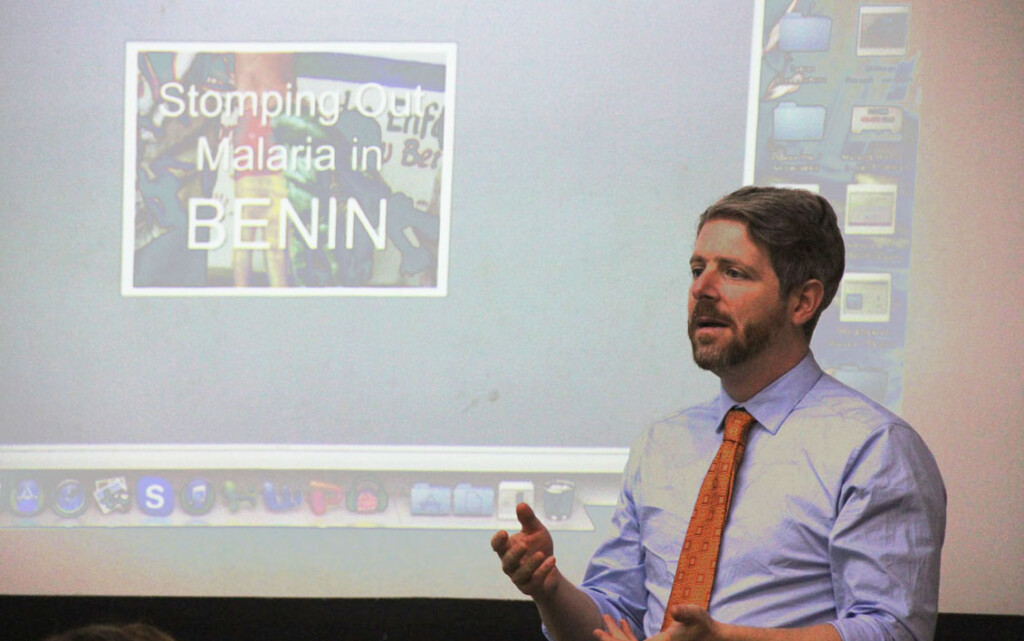
We talked with Matt McLaughlin, a UVM Master of Public Health student and program manager of Stomping Out Malaria in Africa, a Peace Corps program that aims to support the international malaria eradication program, about the challenges to eliminate malaria.
Matt has worked for a decade on bed net distribution. Consistent use of bed nets can reduce malaria transmissions by as much as 90 percent, according to the Nothing But Nets organization. However, according to WHO, a fifth of households in sub-Saharan Africa did not have access to bed nets in 2015, and fewer than half the households had sufficient insecticide-treated nets.

Why are bed nets not consistently used?

Of the people not using a net, the vast majority of them, the reason is that they just don’t have one. This is not to dismiss the issue of under utilization by those who do have a net. Some of that happens, too. But despite lots and lots of work on net distribution and lots and lots of progress we remain far short of a scenario where everyone who needs one has one.

What are the obstacles to getting nets to people?

One strategy for net distribution is the mass campaign where you distribute them all at once across a country. It is a devil is in the details kind of challenge. Senegal—which where I work the most, so I’ll use that as an example—when I last did a mass distribution there they had 13 million people, and there is an average of two people per sleeping space. So, you’re talking about distributing 6.5 million nets, which is just a huge logistical challenge with lots of devilish details. Nets have to be warehoused at the national level, shipped to regions and warehoused there, loaded on smaller trucks to get to clinics. Sometimes it’s putting nets in canoes or on the backs of bikes or—and I’ve done this—climbing up a mountain with a bale of nets on your head because there is no actual road to a village. And before all this can happen you need an accurate count of how many people actually need nets in these communities and that means a comprehensive census. You do all this work and after about a year, some nets get ripped or burned by candles and then they’re no longer effective. Another year goes by and more nets taken out of commission.

What is the life span of a bed net?

Two years and change is the consensus of how long bed nets last. The insecticide on the nets will last through 20 washings.

How else are the nets distributed?

If you’re pregnant, you can get a free net at a clinic. Children at a certain grade level will get a free net at school. There are some community organizations that distribute small numbers of nets on an ongoing basis. Those ancillary channels are good, but I don’t think they’re sufficient.

What are some ways to educate people about using bed nets?

There is more that we can do with utilization. For example, there is a belief that if it is the dry season, there are no mosquitos and therefore no risk of malaria and people are less likely to use the net. Yet, we know that people are getting malaria even in the dry season. And net care and repair is important, too. You need to wash them with regular soap not detergent and make sure they hang in the shade to dry. You can also sew bed nets if they get holes for longevity. Educate people around these issues and we might see better net longevity.

Can you tell us about some other projects you are working on?

I also help identify and evangelize flagship projects. The current most important project is called PECADOM+. It’s a French acronym for home-based care, and the “plus” is a unique addition that Peace Corps and our partners have identified—weekly door to door sweeps by community health workers looking for malaria cases.
We’re now doing a variant of the PECADOM+ projects in schools because schools are such a natural place for low effort and high impact. One of the pilot programs in Senegal provided the same basic training to school administrators that a community health worker would receive for the door-to-door program. As a result, administrators were finding many malaria cases, even in places where there were existing community efforts to eradicate malaria. The school officials also identified many malaria cases in the dry season, disproving the belief that there is no malaria at that time.

In your work, do you find that the world is becoming complacent because of the many gains in fighting malaria?

Total donations have flat-lined over the past five years. That is worrying. When you’re making progress, everyone is excited and they want to push hard and take part. But when your progress slows—because the end is always harder than the beginning—it’s harder to muster that same excitement from political leaders. The funding growth is slowing down, and with that, so are the gains—that’s the first warning sign of complacency. That said, the funding level donations have plateaued at is quite high. The U.S. and others are still donating billions to this cause and that is heartening. Also I am convinced that we can make bigger gains with the money we have if we’re smart about it. There is room to make improvement

Women in Craft Beer: Heather Pilkington on What it Takes to Succeed

(Photo by James Lee/Flickr)
By Tera Dacek
Traditionally, dating back to ancient times, women were the brewers, crafting ales out of their homes. In more modern times, women were often featured prominently in beer ads, but not as the ones creating the beer. Today, we’ve come full circle. As the craft beer market continues to grow, we see many women who are a part of this industry.
For our first profile in a series of four women in craft beer, we introduce you to Heather Pilkington.
heather-pilkington

UVM Instructor Heather Pilkington.
Heather has over 15 years of experience in craft and large-scale breweries, with time spent at Labatt Breweries (AB InBev) earlier in her career and now with First Key Consulting in Vancouver, where she is currently in the role of Director of Projects. To address the challenges facing breweries in the fast-paced world today, First Key has assembled some of the most talented, interesting and globally experienced brewery consultants and malting experts to provide clients with independent evaluations, as well as comprehensive and integrated solutions in every area of their business.
First Key’s clients include Founders Brewing Company, von Trapp Brewing, Gordon Biersch, Beau’s all Natural Brewing, Creature Comforts Brewing Co. and many more. Heather will also be an instructor for UVM’s Business of Craft Beer Professional Certificate Program, which kicks off in February 2016.

I am sure you’re asked this all the time, especially around this topic, so let’s just get right to it: What’s your favorite fall beer?

I am sure you also get this answer all the time: So much great beer, so little time! Tonight I enjoyed a Muskoka Brewery Harvest Ale from Muskoka Brewery out of northern Ontario.

Can you talk about what barriers, if any, you’ve faced throughout your career in a male-dominated industry?

Early in my career, the biggest challenge was figuring out ways to network and collaborate in an industry that did not have many women. Historically, every sector in every industry has evolved its culture to include more women in decision-making roles, and the brewing industry was no different. Today in my current role with First Key Brewing Consulting, I have the pleasure of working with breweries coast to coast in a variety of settings, with nothing but positive and constructive experiences. It’s a great time for women in the craft brewing sector.

What do you see as the biggest hurdle for craft breweries today, and what can they do to overcome it?

I am fortunate to have a great bird’s eye view of the challenges that craft breweries are facing today. What I see are many creative and dedicated brewers wanting to turn their passion into a successful business. The craft brewing sector is becoming more competitive. Start-up craft brewers now face stiffer competition for local distribution rights from expanding craft breweries that may be building secondary breweries, from an increasing number of other local craft breweries, as well as from the largest commercial breweries. As consumers become more educated about craft beer, they not only expect a distinctive product, but a very high-quality product delivered with great consistency. To meet the challenges of the complex issues facing breweries today, having the foundational business skills and operations systems in place, in addition to a passion for their craft, are key to success.

How did you land your first job in the beer industry, and is this the industry you knew you wanted to be in?

After completing an undergraduate degree, I saw an inspiring lecture given by a female leader within the brewing industry and knew that was where I wanted to be. I aligned my graduate education to this goal with great passion and determination. I was able to get a foot in the door as an unpaid intern at the experimental facility within the local brewery of my hometown. I was like a kid in a candy store, learning about brewing and fermentation, how to swing a wrench on 10L and 16 hL scale equipment, and how to translate that knowledge to larger-scale breweries. Eventually, they started to pay me, which was even better.

What traits have you found to be successful for you professionally?

Being curious and able to dig into problems has served me well, learning from a great network of talented people in the brewing industry. Going a little “out on a limb,” trying something I’m excited about, putting energy into it, and eventually realizing some benefits from the effort.

Any advice for those who want to pursue a career in craft beer?

Think about what unique qualities, personal history, and strengths you bring to your craft brewery and use them with passion to build and contribute to the community of the craft beer industry as a whole.
Reinforcing my earlier points, you need to have strong business acumen, operational systems, and discipline, in addition to your passion and creativity.
This is our first post in a four-post blog series introducing you to just a few of the amazing women in the beer industry right now. Cheers to these women and their accomplishments, with hopes that all beer lovers who have been considering a career shift into the beer industry will begin to follow their passion.
Tera Dacek is a consultant and freelance writer. She most recently worked as Marketing Manager for Alchemy and Science. When she unplugs, she can be found at her local mountain or one of the many wonderful breweries in her home state of Vermont

What is Craft Beer?

By Joel Hueston
As a brewery consultant, the question I get most frequently is, “Hey, what is craft beer anyway? What’s the definition?” It’s a really good question. The answer is subjective, and I certainly have my own opinions. I decided to do some digging and analysis to see if I could come up with a definition that makes sense and rings true.

So, what is craft beer?

If you visit the Brewer’s Association website, you’ll find that the definition of a craft brewer encompasses many things, including:
  • Size: 6 million barrels or less annually
  • Ownership: Less than 25 percent owned or controlled by a non-craft brewery
  • Ingredients: A majority of its total beverage alcohol volume is in beers whose flavor derives from traditional or innovative brewing ingredients and their fermentation
Those categories and definitions are fine, but they don’t capture many of the intangibles that make craft beer such an interesting category.

Size

What’s keeping one of the big guys from making a truly awesome craft product? They have the best equipment, the best brewers, and the best quality control on earth. No one can say with a straight face that the big guys aren’t capable of brewing a great craft beer. Of course they are.
However, their world is based on huge volume. The more you sell, the more revenue you generate to offset those massive overhead costs. Craft brewers want to sell their beer and make money, too, but their modest overhead costs don’t require that kind of tonnage to thrive and survive. They can be more experimental and play around with crazy flavors.
The big guys are targeting session drinkers—the guzzlers who gather around the big screen to watch Monday Night Football—and that’s not really a craft thing. In my opinion, the big guys are capable of brewing a Ballast Point Sculpin or a Deschutes Fresh-Squeezed IPA. They just choose not to because it’s not a priority. It doesn’t pay the bills, and it doesn’t appeal to their customer base.

Ownership

In my opinion, ownership may or may not be an issue. It all depends on how the relationship is managed. So far, what the big guys have had trouble doing is keeping their little mainstream fingers out of the craft pie and allowing their acquisitions to operate independently without interference. They haven’t been able to leave craft brewers alone to do what they do best: deliver that craft authenticity and attitude that permeates the category. For some reason, all the craft brands acquired by the big guys end up looking shinier, more omnipresent, and more corporate, and therefore much less authentic.

Ingredients

So what about ingredients? Well, they all have access to the same ingredients (unless you believe the big guys really are hoarding all the hops). They use different ingredients to make the products they need for their target consumers. One ingredient is not necessarily better than another. They are just different ingredients for different products that appeal to different consumers. I know some will bring up the purity of the brewing process—such as using additives–but now I think we’re digressing.
I am a self-admitted craft beer lover, but I refuse to be a big-beer basher. I cut my teeth on big beer and quaffed many a Coors Light over the years. In fact, that’s one of the few dynamics in the craft community I don’t buy into at all. Many craft beer supporters say big beer is bad beer. I respectfully disagree. Mainstream is not the kind of beer that craft lovers prefer, but that doesn’t make it bad. A mainstream beer drinker will reject a glass of Pliny The Elder, but does that make it bad?
My journey into craft has probably been similar to yours. I don’t drink as many beers as I used to, so when I do kick back to enjoy one, I want to treat myself. After a lot of sampling over the last few years (hey, I’m a brewery consultant), my palette has evolved to the point where it demands flavor and aroma. At this point, IPAs are my go-to, but I’m open to the odd Imperial Milk Stout or Pale Ale. That doesn’t mean I won’t order a Coors Original on occasion, as a change-of-pace.

Flavor and Attitude

Let’s cut to the chase. I believe the true essence of craft is rooted in flavor and attitude. I am not a trained brewer, but I know great beer and I know average beer, and great craft beer is hard to find. I won’t get into brand names because that gets people riled up, but in my opinion, the list of truly outstanding craft products out there is very short. They all have one thing in common: they smell, taste, and look awesome every single time. I think most people can agree that a final meal of world-class steak would be preferred over a hamburger. That’s how I feel about great craft beer. It’s a treat and a reward.
Now let’s talk about attitude. The craft attitude is many-faceted, but there are a few elements that most craft brewers share. Craft brewers care about their local community, their doors are always wide open, and they help each other out. I love that about craft brewers. They lend each other equipment, they recommend each other’s products, and they brew collaborative beers. The big guys don’t do that.
For the most part, you can drop into a craft taproom anytime to chew the fat and sip a cold one. A lot of the large breweries are like fortresses. Good luck even getting past the reception desk! Then there’s the local community. I’m not saying the big guys don’t care about community, but they are more about manipulation than inspiration. They don’t really do local, and they are more focused on national or global reach. Many craft brewers embrace the local community. They are often skilled philanthropists who give back to the environment and try to make the world a better place. There’s camaraderie among craft brewers and their customers that the big guys just can’t replicate. In this materialistic world, it’s a truly refreshing and inspiring approach