

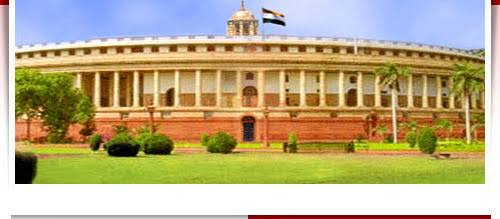
The Constituent Assembly, which first met on 9 December 1946, acted as the Central Legislature till 1950, when it was converted as ‘Provisional Parliament’.
During this period, the Central Legislature which was known as Constituent Assembly (Legislative) and later Provisional
Parliament was unicameral till the first elections were held in 1952.
Extensive debate took place in the Constituent Assembly regarding the utility or otherwise of a
Second Chamber in Independent India and ultimately, it was decided to have a bicameral legislature
for independent India mainly because a federal system was considered to be most feasible form of Government for such a vast country with immense diversities.
A single directly elected House, in
fact, was considered inadequate to meet the challenges before free India. A second chamber known as the ‘Council of States’, therefore, was created with altogether different composition and method of election from that of the directly elected House of the People. It was conceived as another Chamber, with smaller membership than the Lok Sabha (House of the People). It was meant to be the federal chamber i.e., a House elected by the elected members of Assemblies of the States and
two Union Territories in which States were not given equal representation. Apart from the elected members, provision was also made for the nomination of twelve members to the House by the President.
The minimum age of thirty years was fixed for membership as against twenty-five years for the Lower House. The element of dignity and prestige was added to the Council of State House by making the Vice-President of India ex-officio Chairman of the Rajya Sabha who presides over its sittings.
Only elected members of the State Legislative Assemblies can vote in a Rajya Sabha election.
The legislators send a batch of new members to the Upper House every two years for a six-year term.
A third of Members of Parliament in the Rajya Sabha from each State retire once in two years and polls are held to fill up the vacancies.
Vacancies that arise due to resignation, death or disqualification are filled up through bypolls after
which those elected serve out the remainder of their predecessors’ term.
Polling for a Rajya Sabha election will be held only if the number of candidates exceeds the number of vacancies.
Since the strength of each party in the Assembly is known, it is not difficult to estimate the number of seats a party would win in the Rajya Sabha poll. Voting is by single transferable vote and on the principle of proportional representation.
The Rajya Sabha polls have a system of open ballot, but it is a limited form of openness.
As a measure to check rampant cross-voting, which was taken to mean that the vote had been purchased by corrupt means, the system of each party MLA showing his or her marked ballots to the party’s authorised agent, before they are put into the ballot box, has been introduced.
Showing a marked ballot to anyone other than one’s own party’s authorised agent will render the vote invalid.
thanks to all

 Eduindex
You must be logged in to post a comment.