

The spread of the COVID-19 has proved deadly, and this is a challenging time for the union as well as state governments as they work to address this health emergency. However, shows that in times of crisis, democratic governments may take a dangerous autocratic turn. In such a situation, journalism has a great role to play in a democracy, as it has been ideally visualized as a platform for objective information and critical-rational discourse. Thus, the health of journalism in a country can be examined in the times of a crisis.
Corporate control over most media bodies also means that they become an instrument of the ideological apparatus of the state. There are many concerns associated with the COVID-19 crisis: ill-equipped public health systems, policies to combat the pandemic, and the lack of planning and support to the vulnerable sections. These issues demand serious examination, but the mainstream media, barring some courageous exceptions, seems to be forgetting its democratic role.
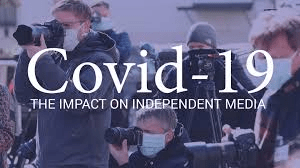
Manipulation of Discourse
Just before the announcement of the nationwide lockdown till 14th April 2020, Prime Minister Narendra Modi reportedly called upon print and electronic media owners and editors of the country and asked them to support government efforts to combat the pandemic and also advised them to present “positive news” related to COVID-19 (Sagar 2020).
Plainly put, these were the owners and editors who control most of the Indian media at the national and regional levels who were advised to abide by the official narrative and present information as provided to them by the government about COVID-19.
Why would media houses follow government diktat rather than investigating the real state of affairs, unless they have associated business interests? Journalism is considered to be an ethical communicative practice in a democracy, but corporate ownership subverts the autonomy of journalism and the freedom of the press. Unfortunately, this conflict of interest has become a common feature of Indian journalism.
However, even though a majority of Indian media is under corporate control, there are many counter-voices both within and outside this grouping. Thus, the Indian mediascape has become a battleground of ideologies. Many of these alternate counter-voices have raised genuine issues of social concern during the pandemic outbreak.
The prevalence of international media on the internet and small media organizations in the country has played an important role in disseminating factual and more nuanced information, but unfortunately, these platforms do not have the vast access that big corporate media platforms are privy to.

Media Shows Its Islamophobic Side
Media’s ugliest moment, however, was its coverage of the news surrounding Delhi’s Tablighi Jamaat Markaz (meeting). Many participants had left after the markaz, but many were stranded in the mosque due to the lockdown and were later found infected. However, the media outrage that followed was clearly an extension of the already prejudiced and polarised coverage, as the Tablighi Jamaat was blamed for violating lockdown rules and for “corona jihad,” “Islamic insurrection,” and “corona terrorism.” This is clearly an example of fake news propagated by the mainstream media to further the predominant agenda (BBC 2020; News Laundry 2020). Muslims were also attacked in various parts of the country.

 Eduindex
You must be logged in to post a comment.