Reading

“The odd thing about people who had many books was how they always wanted more”. A good book is an ocean the more you drown the more you wanted to drown, and those who had never been to a sea will never understand how it feels when the prepossessing waves touch your feet, when that heavenly wind blows through your hairs, how it feels when clouds come floating into the sky, no longer to carry rain or usher storm, but to add color to the sunset sky.

It’s rain, a rain whose every drop first touches your face then slides down through your body and you came to know how it feels when to be touched by someone you love. Those raindrops drenched you completely and you feel a keen wind cutting down your spine. Those raindrops are like the dancers who are trying to play with the most heavenly figurine sculpted by nature.

The above-inscribed words may sound good to you if yes then good you are a reader and you should certainly start with something romantic or soothing. If not then perhaps this genre is not your cup of tea but something must be there which may fascinate you and want you to read more.

Perhaps the fantasies or maybe some sort of murder mystery or something technical or maybe something like science fiction or it could be anything else. There are a lot of virtues of reading a book.

A growing body of research shows that reading changes your mind. Using MRI scans, researchers verified Trusted Source that decoding requires a complicated network of brain pathways and signals. When the reading skill matures, these networks should often get greater and more advanced. In a report performed in 2013, the researchers used interactive MRI scans to assess the impact of reading a novel on the brain. Participants of the research read the book “Pompeii” for 9 days. When the suspense built up in the plot, more and more regions of the brain became lit up with action.

And speaking about detecting discomfort, research Trusted Source has found that people who read romantic fiction — stories that examine the inner lives about characters — have a heightened capacity to consider the emotions and values of others. Experts term this capacity a “theory of mind,” a collection of skills that are important for creating, managing, and sustaining social relationships. Although this sensation is not likely to be caused by a single session of reading literary literature, research Trusted Source reveals that long-term literature readers seem to have a better-developed mind hypothesis.

In 2009, a group of researchers in demanding health science programs in the United States measured the effects of yoga, humor, and reading on student stress levels. The study found that 30 minutes of reading decreased blood pressure, heart rate, and psychological distress feelings almost as effectively as did meditation and laughter. The study concludes, “Since time constraints are one of the most frequently cited reasons for high-stress levels reported by health science students, it is easy to incorporate 30 minutes of one of these techniques into their schedule without diverting much time from their studies.”

So if you a reader, it’s great and if not please try something out. Happy reading!

“Disabled”, “Physically Handicapped” & Mentally Retarded Offend Human Dignity

It has to be conceded with considerable generosity that the Supreme Court of Pakistan has just recently on July 14, 2020 has very rightly and remarkably in a latest, landmark and laudable judgment titled Malik Ubaidullah vs Government of Punjab etc in Civil Petition No. 140-L of 2015 (on appeal from the order of Lahore High Court dated 02.12.2014, passed in ICA No. 336/2013) directed the Government of Pakistan and its agencies to desist forthwith from using the words like “disabled”, “physically handicapped” and “mentally retarded” for persons with different abilities. The more socially acceptable term is persons with disabilities or persons with different abilities. Thus we see that even in Pakistan there is a paradigm shift in the way the Pakistan Supreme Court has went on to rule in this particular case! This is certainly welcome as the whole world has now started to recognize that the use of such words like “disabled”, “physically handicapped” and “mentally retarded” constitute an affront to them and they must be avoided always!

                                  To start with, we see that in this noteworthy judgment authored by Syed Mansoor Ali Shah for himself, Justice Manzoor Ahmad Malik and Justice Qazi Muhammad Amin Ahmed of Pakistan’s Supreme Court sets the ball rolling by first and foremost observing in para 1 that, “The Petitioner applied for the post of Senior Elementary School Educator Arabic (“SESE[Arabic]”) on the disability quota (“Disability Quota”) in pursuance to the advertisement put out by the Education Department, Local Government, Multan. According to the advertisement, in addition to the other posts, a total of 81 posts of SESE [Arabic] were advertised with 42 posts in female category and 39 posts in the male category at the Girls and Boys schools, respectively. Thereafter, only one Mst. Asma Qasim was appointed against the said post under the Disability Quota and the petitioner failed to secure a position. Admittedly, Mst. Asma Qasim with 62.78 Marks topped the merit list for the post of SESE [Arabic] under the Disability Quota and the petitioner with 43.53 Marks could not be offered a post. Aggrieved of not being offered a place, the petitioner challenged the selection process under Disability Quota before the High Court by invoking its constitutional jurisdiction. His writ petition was dismissed vide order dated 28.10.2013 and so did his appeal before the High Court (ICA) vide impugned order dated 01.12.2014.”   

                                         While proceeding ahead, it is then stated in para 2 that, “After hearing the parties and having gone through the record, the legal question that arises in this case is the manner of allocation of 2% Disability Quota for employment under the Disabled Persons (Employment and Rehabilitation) Ordinance 1981 (“Ordinance”). (The Federal Law is now a Provincial Law after the Disabled Persons (Employment & Rehabilitation (Amendment) Act, 2012, however, as this case pertains to a period before 2012, therefore, the Federal Law would apply in the present case). The Ordinance requires that 2% of the total number of persons employed by an establishment at any time shall be “disabled persons”. (As described in the statute. The more socially acceptable term is persons with disabilities or persons with different abilities.).” In order to fully understand the allocation mechanism of the Disability Quota under the Ordinance, it would be useful to first understand and the concept of Disability and the importance of role of employment in the lives of persons with disabilities (“PWDs”) as compared to persons without disabilities.”

                                        While dwelling on the concept of disability, it is then expounded in para 3 that, “Disability means lacking one or more physical powers, such as the ability to walk or to coordinate one’s movements, as from the effects of a disease or accident, or through mental impairment. (Collins Dictionary – complete and unabridged, 12th edition 2014). According to the UN Convention on the Rights of Persons With Disabilities (“CRPD” or “Convention”) ratified by Pakistan in 2011, persons with disabilities include those who have long term physical, mental, intellectual or sensory impairments which in interaction with various barriers may hinder their full and effective participation in society on an equal basis with others.”    

                            To put things in perspective, it is then brought out in para 7 that, “According to International Labour Organization (ILO) an estimated 386 million of the world’s working-age are PWDs. The unemployment among the PWDs is as high as 80 percent in some countries. Often employers assume that persons with disabilities are unable to work. In Pakistan, estimates of the number of persons living with disabilities vary between 3.3 million and 27 million. (Moving from the margin – Mainstreaming persons with disabilities in Pakistan. British Council & The Economist Intelligence Unit – 2014).” 

                                While underscoring the pivotal role of employment in people’s lives, it is then envisaged in para 8 that, “Employment is equally important to all people, without it, social inclusion and economic independence are unlikely to be achieved. Among the crucial social functions that employment can facilitate are financial independence and social inclusion. It has also been found to improve social status, provide social support and enable workers to make a contribution, thereby leading to an increase in self-worth. Employment has the potential to improve a person’s financial situation, open up opportunities for social contact, build (new) friendships and increase people’s self-esteem. By contrast, unemployment can cause not only poverty and social exclusion but also result in a lower sense of self-worth. The effects of unemployment on physical health like symptoms of somatization disorder, depression and anxiety were significantly greater in unemployed than employed individuals. The situation for people with disabilities may have consequences of a greater extent as they tend to be looked upon as dependents of their families and relatives and are not expected to be gainfully employed or independent. Work has been, and will undoubtedly continue to be, central to all human societies.”

                                       Honestly speaking, the Bench then graciously concedes in para 9 that, “One of the major difficulties faced by persons with disabilities is that employers have the erroneous assumption that these people will probably underperform in most areas of their duties – something which is actually not the case. Another plausible issue is that when the majority of workplaces are not made accessible to people with disabilities, employers will feel that they will have to make an unwarranted investment to provide facilities for people with disabilities, and some do not believe in the employment potential of such people.”  

                                     Significantly, it is then held in para 17 that, “In the present case the posts advertised for SESE (Arabic) were 81 which allows for one post in the Disability Quota, while if the Disability Quota is worked out on the total sanctioned strength of the posts of SESE [Arabic] it comes to 5 posts (see chart above) and 4 more PWDs could have been appointed against the said posts against the advertisement in question. Filling the Disability Quota on the basis of advertised posts is, therefore, detrimental to the interest and welfare of the persons with disabilities; is against the letter of the law and offends their fundamental right to life and livelihood and their right to dignity.”

                                     More significantly, it is then stated in para 18 that, “Summarizing the above, we hold that: (i) the 2% (and now 3%) [After the Disabled Persons (Employment & Rehabilitation) (Amendment) Act, 2012] Disability Quota is to be calculated on the basis of the total sanctioned posts of the establishment. (ii) In order to ensure fair and equitable representation of persons with disabilities (PWDs) in every tier of the establishment, the total Disability Quota is to be further apportioned and allocated amongst different categories of posts in the establishment. The determination of different categories is on the basis of their distinct qualifications, selection criteria and separate merit list. (iii) In case the sanctioned strength of a post is less than 50, it will be for the establishment to allocate seat(s) from the overall Disability Quota against such a post. (iv) if a particular post is not fit for a PWD, the establishment may shift the Disability Quota and adjust it against another post in the establishment so that the overall Disability Quota is not disturbed and maintained at all times. (v) The advertisement for any category of post must clearly provide the total Disability Quota for that category of posts and the number of seats vacant under the said Disability Quota at the time of the advertisement.”

                                 Most significantly, it is then held in para 19 without mincing any words that, “It is also observed that words like “disabled”, “physically handicapped” and “mentally retarded” deeply bruise and offend human dignity of persons with different abilities. The Federal Government and the Provincial Governments are directed to discontinue the use of these words in official correspondence, directives, notifications and circulars and shift to “persons with disabilities” or “persons with different abilities”. The view taken by the Lahore High Court in Barrister Asfandayar Khan case [Barrister Asfandayar Khan Tareen, etc. v. Govt of the Punjab, etc. (PLD 2018 Lahore 300)] is approved and must be given effect to.”

                                     In essence, this recent, remarkable and righteous judgment by the Supreme Court of Pakistan vociferously coming out in open for the rights of persons with disabilities and persons with different abilities is quite refreshing and revolutionary in the sense that it directed the Government of Pakistan and its agencies to desist forthwith from using the words like “disabled”, “physically handicapped” and “mentally retarded” for persons with different abilities and instead use the more socially acceptable term that is persons with disabilities or persons with different abilities. There is no reason as to why this should not be complied with not just in Pakistan but also in each and every corner of the world! Persons with disabilities or persons with different abilities must be encouraged and admired so that they are motivated to further do better and there has to be zero tolerance for any sort of discrimination against them on any ground whatsoever! Only then can we call ourselves “civilized”! There can be no denying it!

Sanjeev Sirohi, Advocate,

s/o Col BPS Sirohi,

A 82, Defence Enclave,

Sardhana Road, Kankerkhera,

Meerut – 250001, Uttar Pradesh.

Not Admit ‘General Category’ Candidate To ‘Sponsored Category’ Vacancy

In a latest, landmark and laudable judgment titled “Nipun Sharma vs Post Graduation Institute of Medical Education and Research, Sector 12 Chandigarh through its Director” in Civil Writ Petition No. 10684 of 2020 (O&M) delivered just recently on August 14, 2020, the Punjab and Haryana High Court unequivocally upheld the Medical College’s righteous decision to not admit the ‘general category’ candidate to ‘sponsored category’ vacancy. The two Judge Bench of Punjab and Harayana High Court comprising of Justice Rajeev Sharma and Justice Harinder Singh Sidhu were hearing this case. Justice Harinder Singh Sidhu authored the judgment for himself and Justice Rajeev Sharma.

                                          To start with, it is first and foremost pointed out in para 1 that, “This writ petition has been filed for issuance of writ, order or direction for reading down condition 7(3)(g) as contained in the Prospectus for Session July, 2020 issued by respondent – PGIMER for admission to DM/M.Ch. Courses, wherein it has been provided that no request for change of category applied for shall be entertained after submission of application to the extent that in case no eligible candidate is available under the ‘Sponsored Category’, then eligible candidate if available, under ‘General Category’ be considered and granted admission to the course of Master of Surgery (M.Ch.) (Plastic Surgery) on fulfilling the requisite eligibility conditions.”

                                           What follows next is stated in para 2 that, “Further prayer has been made for setting aside the action of respondent in not considering the candidature of petitioner for said course against vacant seat available under ‘Sponsored Category’ in view of fact that petitioner had applied for direct category.”

                                     To put it succinctly, para 3 then states that, “It is also prayed that the NOC/Sponsorship Certificate (Annexure-P6) issued in favour of petitioner by Department of Health and Family Welfare, Himachal Pradesh be accepted.”

                             In hindsight, while dwelling on the petitioner’s past academic background, it is then put forth in para 4 that, “The petitioner secured admission in MBBS Course at Indira Gandhi Medical College and Hospital at Shimla (2006-2012) and served in rural area after appointment in 2013 for a total period of 2 ½ years. He was selected for Post Graduate Course in General Surgery in 2017 as a sponsored candidate (2017 to 2019) in PGIMER, Chandigarh and secured 2nd rank in Post Graduation final examination. After completing his Post Graduation successfully with the respondent institution he joined back as a Medical Officer in Deendayal Upadhyay Zonal Hospital, Shimla. Thereafter, the petitioner with an aim to study further and super specialize in the field of Plastic Surgery decided to get admission in the Master of Surgery (M.Ch.) (Plastic Surgery).”

                                               To be sure, it is then envisaged in para 5 that, “As per the Prospectus for the Session July 2020 in the PGIMER for securing admission in Post Graduation or Super Speciality Course i.e. M.Ch., two categories have been provided i.e. (a) General category and (b) Sponsored Category. In ‘General Category’, a candidate can apply directly i.e. without seeking permission of any State authority directly whereas in the ‘Sponsored Category’ only that candidate can apply, who is sponsored by the State Government with which he or she is employed. The sponsorship so made by the State Government is also in the nature of a No Objection Certificate whereby a candidate is authorized by the State Government to do a Super Specialty Course with an undertaking to serve the State Government for a specified period.”   

                                            Coming to the chief grievance of the petitioner, it is henceforth stated in para 11 that, “Thus the grievance of the petitioner is that despite there being no other eligible candidate available till date, the candidature of the petitioner, who applied under the ‘General Category’, is not being considered under the ‘Sponsored Category’. In case, the respondent-institution accepts the candidature of the petitioner then not only the petitioner would secure admission in the super specialty course of M.Ch. (Plastic Surgery) but the vacant seat will also get utilized and would not be left vacant.”   

                                      As a corollary, it is then further stated in para 12 that, “It was also pleaded by the petitioner that two candidates Dr. Lucky Kumar and Dr. Ashok Garg, who hail from Himachal Pradesh had applied for admission in M.Ch. in Cardiology and Neonatology respectively with respondent. Those candidate also secured their NOC cum Sponsorship certificate after the declaration of the result. They have been granted admission and their NOC cum Sponsorship certificate has been duly accepted. Thus the petitioner has been discriminated against.” 

                                          What cannot be left unnoticed is what is then stated in para 14 that, “It has been stated that as per clause 7 (3)(g) of the Prospectus:

“No request for a change of category applied for shall be entertained after the submission of the application”.

Since, Petitioner applied under ‘General Category’, therefore his request for grant of admission on the vacant seat under ‘Sponsored Category’ cannot be considered.”

                                         Having said this, it is then observed in para 20 that, “The examination for admission to the M.Ch. Plastic surgery course was held on 21.06.2020. The result was declared on 26.05.2020. On 30.06.2020 the institute vide notice dated 30.06.2020 uploaded a tentative list of selected candidates wherein petitioner was shown at Waiting list No. 1 in the Direct Category. The petitioner was given the NOC/Sponsorship Certificate on 08.07.2020. Clearly as per condition 7(3)(g) of the Prospectus the request for change of category from ‘General’ to ‘Sponsored’ could not be entertained at a stage when even the result have been declared in view of Clause 7(3)(g) of the Prospectus.”

                                      While adding further weight to its ruling, the Bench then observes in para 21 that, “It has been consistently held in different Full Bench decisions of this Court that prospectus has a force of law and is to be strictly followed. Reference can be made to Amardeep Singh Sahota v. State of Punjab 1993 (4) S.C.T. 328, Raj Singh v. Maharishi Dayanand University 1994 (2) S.C.T. 766, Sachin Gaur v. Punjabi University 1996 (1) S.C.T. 837, Rahul Prabhakar v. Punjab Technical University, Jalandhar 1997 (3) S.C.T. 526, Indu Gupta v. Director of Sports, Punjab 1999 (4) S.C.T. 113 and Rupinder Singh v. The Punjab State Board of Technical Education & Industrial Training, Chandigarh 2001 (2) S.C.T. 726.”

                                            To put things in perspective, it is then noted in para 23 that, “This being the settled legal position the respondent-institution is right in strictly adhering to condition 7(3)(g) of the Prospectus and not entertaining the request of the petitioner for change of category after the last date of application and granting him admission against the vacant seat in the sponsored category.”

                                        As it ostensibly turned out, the Bench then also clearly and convincingly holds in para 24 that, “The contention of the Ld. Counsel that provision 7(3)(g) be read down to the extent that in case no eligible candidate is available under the ‘Sponsored Category’, then eligible candidate, if available, under ‘General Category’ be considered and granted admission to the course of Master of Surgery (M.Ch.) (Plastic Surgery) on fulfilling the requisite eligible conditions also is not tenable.”

                                    No wonder, it is then rightly held in para 27 that, “The respondent-institution in its reply has given valid reasons as to why such a provision has been incorporated and any deviation from it would create an untenable and uncertain situation.” Finally, it is then held in the last para 28 that, “Accordingly, there is no merit in the petition and the same is dismissed.”

                                         In conclusion, the two Judge Bench of the Punjab and Haryana High Court comprising of Justice Rajeev Sharma and Justice Harinder Singh Sidhu  in this notable judgment has clearly and convincingly for cogent reasons explained above has rightly rejected the contention of the petitioner! The arguments forwarded by the petitioner were found to be not tenable by the Chandigarh High Court. The Court also made it amply clear that the respondent-institution is right in strictly adhering to condition 7(3)(g) of the Prospectus and not entertaining the request of the petitioner for change of category after the last date of application and granting him admission against the vacant seat in the sponsored category! Very rightly so!

Sanjeev Sirohi, Advocate,

s/o Col BPS Sirohi,

A 82, Defence Enclave,

Sardhana Road, Kankerkhera,

Meerut – 250001, Uttar Pradesh.

Daughters Have Coparcenary Rights Even If Their Father Was Not Alive

In a most significant judgment with far reaching implications that will immensely benefit Hindu daughters, the Apex Court in Vineeta Sharma vs Rakesh Sharma & Ors. in Civil Appeal No. Diary No. 32601 of 2018 along with some other Special Leave Petition (SLP) just recently on August 11, 2020 has held in no uncertain terms that a daughter will have a share after the Hindu Succession (Amendment) Act, 2005, irrespective of whether her father was alive or not at the time of amendment. This is certainly a significant step towards the attainment of gender equality in our country for which the Apex Court Bench which decided this extremely landmark and laudable judgment deserves full credit! Till this laudable judgment was delivered we saw how despite several amendments to the Hindu Succession Act, 1956 there was none such provision that gave unconditional rights to women pertaining to her father’s property!

                               To start with, Justice Arun Mishra who authored this notable judgment for himself and Justice Abdul Nazeer and Justice MR Shah first and foremost set the ball rolling by observing in para 1 that, “The question concerning the interpretation of section 6 of the Hindu Succession Act, 1956 (in short, ‘the Act of 1956’) as amended by Hindu Succession (Amendment) Act, 2005 (in short, ‘the Act of 2005’) has been referred to a larger Bench in view of the conflicting verdicts rendered in two Division Bench judgments of this Court in Prakash & Ors. v. Phulavati & Ors., (2016) 2 SCC 36 and Danamma @ Suman Surpur & Anr. v. Amar & Ors., (2018) 3 SCC 343. In other connected matters, the question involved is similar; as such, they have also been referred for hearing along.”

                       Be it noted, it is then enunciated in para 116 that, “The intendment of amended Section 6 is to ensure that daughters are not deprived of their rights of obtaining share on becoming coparcener and claiming a partition of the coparcenary property by setting up the frivolous defence of oral partition and/or recorded in the unregistered memorandum of partition. The Court has to keep in mind the possibility that a plea of oral partition may be set up, fraudulently or in collusion, or based on unregistered memorandum of partition which may also be created at any point of time. Such a partition is not recognized under Section 6(5).”

                                        What’s more, it is then observed in para 126 that, “The protection of rights of daughters as coparcener is envisaged in the substituted Section 6 of the Act of 1956 recognises the partition brought about by a decree of a court or effected by a registered instrument. The partition so effected before 20.12.2004 is saved.”

                                    More significantly, the Bench then minces no words to state in suave, simple and straight language in para 127 while highlighting the dire need to protect daughter’s interests in property that, “A special definition of partition has been carved out in the explanation. The intendment of the provisions is not to jeopardize the interest of the daughter and to take care of sham or frivolous transaction set up in defence unjustly to deprive the daughter of her right as coparcener and prevent nullifying the benefit flowing from the provisions as substituted. The statutory provisions made in section 6(5) change the entire complexion as to partition. However, under the law that prevailed earlier, an oral partition was recognised. In view of change of provisions of section 6, the intendment of legislature is clear and such a plea of oral partition is not to be readily accepted. The provisions of section 6(5) are required to be interpreted to cast a heavy burden of proof upon proponent of oral partition before it is accepted such as separate occupation of portions, appropriation of the income, and consequent entry in the revenue records and invariably to be supported by other contemporaneous public documents admissible in evidence, may be accepted most reluctantly while exercising all safeguards. The intendment of Section 6 of the Act is only to accept the genuine partitions that might have taken place under the prevailing law, and are not set up as a false defence and only oral ipse dixit is to be rejected outrightly. The object of preventing, setting up of false or frivolous defence to set at naught the benefit emanating from amended provisions, has to be given full effect. Otherwise, it would become very easy to deprive the daughter of her rights as a coparcener. When such a defence is taken, the Court has to be very extremely careful in accepting the same, and only if very cogent, impeccable, and contemporaneous documentary evidence in shape of public documents in support are available, such a plea may be entertained, not otherwise. We reiterate that the plea of an oral partition or memorandum of partition, unregistered one can be manufactured at any point in time, without any contemporaneous public document needs rejection at all costs. We say so for exceptionally good cases where partition is proved conclusively and we caution the courts that the finding is not to be based on the preponderance of probabilities in view of provisions of gender justice and the rigor of very heavy burden of proof which meet intendment of Explanation to Section 6(5). It has to be remembered that courts cannot defeat the objects of the beneficial provisions made by the Amendment Act. The exception is carved out by us as earlier execution of a registered document for partition was not necessary, and the Court was rarely approached for the sake of family prestige. It was approached as a last resort when parties were not able to settle their family dispute amicably. We take note of the fact that even before 1956, partition in other modes than envisaged under Section 6(5) had taken place.”

                           Most significantly, the Bench then cogently, convincingly and clearly holds in para 129 that, “Resultantly, we answer the reference as under:

(i)                         The provisions contained in substituted Section 6 of the Hindu Succession Act, 1956 confer status of coparcener on the daughter born before or after amendment in the same manner as son with same rights and abilities.

(ii)                      The rights can be claimed by the daughter born earlier with effect from 9.9.2005 with savings as provided in Section 6(1) as to the disposition or alienation, partition or testamentary disposition which had taken place before 20th day of December, 2004.

(iii)                   Since the right in coparcenary is by birth, it is not necessary that father coparcener should be living as on 9.9.2005.

(iv)                   The statutory fiction of partition created by proviso to Section 6 of the Hindu Succession Act, 1956 as originally enacted did not bring about the actual partition or disruption of coparcenary. The fiction was only for the purpose of ascertaining share of deceased coparcener when he was survived by a female heir, of Class-I as specified in the Schedule to the Act of 1956 or male relative of such female. The provisions of the substituted Section 6 are required to be given full effect. Notwithstanding that a preliminary decree has been passed the daughters are to be given share in coparcenary equal to that of a son in pending proceedings for final decree or in an appeal.

(v)                      In view of the rigor of provisions of Explanation to Section 6(5) of the Act of 1956, a plea of oral partition cannot be accepted as the statutory recognised mode of partition effected by a deed of partition duly registered under the provisions of the Registration Act, 1908 or effected by a decree of a court. However, in exceptional cases where plea of oral partition is supported by public documents and partition is finally evinced in the same manner as if it had been effected by a decree of a court, it may be accepted. A plea of partition based on oral evidence alone cannot be accepted and to be rejected outrightly.”

                               No less significant is what is then stated finally in the last para 130 that, “We understand that on this question, suits/appeals are pending before different High Courts and subordinate courts. The matters have already been delayed due to legal imbroglio caused by conflicting decisions. The daughters cannot be deprived of their right of equality conferred upon them by Section 6. Hence, we request that the pending matters be decided, as far as possible, within six months. In view of the aforesaid discussion and answer, we overrule the views to the contrary expressed in Prakash v. Phulavati and Mangammal v. T.B. Raju & Ors. The opinion expressed in Danamma @ Suman Surpur & Anr. v. Amar is partly overruled to the extent it is contrary to this decision.”

                                          No doubt, this latest, landmark and laudable judgment by a three Judge Bench of the Apex Court must be applauded, admired and appreciated in no uncertain terms as it places daughter on an equal footing with son in property matters which is a revolutionary move that will ensure that a daughter’s rights are not smothered under any circumstances by anyone as they like as per their own whims and fancies! But what is even more crucial is that society’s patriarchal mindset favouring only son must also change at the earliest and simultaneously the litigation processes in courts must be simplified, made inexpensive so that the poor women too can get their due and time-bound so that women does not suffer the ordeal of running from pillar to post first in lower courts, then in higher courts and then ultimately in the highest court! More awareness programme must be launched by Centre and State Governments to ensure that women are made aware of their legal rights as have been marked by the Apex Court in this landmark judgment! Only then can daughters gain immensely by this extremely laudable and landmark judgment which they must as no society can progress where women remains backwards and stands deprived of her basic legal rights!

Sanjeev Sirohi, Advocate,

s/o Col BPS Sirohi,

A 82, Defence Enclave,

Sardhana Road, Kankerkhera,

Meerut – 250001, Uttar Pradesh.

Not Open To Trial Courts Awarding Life Imprisonment

It is quite refreshing and quite reassuring to see that in a recent, remarkable and righteous decision titled “Savitri vs. State of Haryana and others” in Case No. – CRWP-5238-2020 (O&M) delivered on August 19, 2020, a two Judge Bench of the Punjab and Haryana High Court comprising of Justice Dr S Muralidhar and Justice Avneesh Jhingan has reaffirmed in no uncertain terms that the trial courts have no power to order a life sentence to run till natural life or to hold that no remission will be granted. Known for his brilliant, bold and balanced judgments even while as Judge of Delhi High Court – Justice Dr S Muralidhar who authored and headed this notable judgment for himself and Justice Avneesh Jhingan reiterated that this power is solely with the High Court and Supreme Court only in view of the judgment delivered in the Constitution Bench of the Apex Court in the V Sriharan case. Very rightly so!

                        To start with, this notable judgment sets the ball rolling by first and foremost observing in para 1 that, “This is a petition challenging the order dated 5th June, 2020 of the Divisional Commissioner, Hissar, (‘Divisional Commissioner’) rejecting the Petitioner’s application for temporary release/parole, on the grounds that the trial Court i.e. the Court of the Additional Sessions Judge, Hisar, has by an order dated 16th October 2018 awarded her a sentence of imprisonment for life i.e. whole of her natural life, without any remission, consequent to her conviction for the offences under Sections 302, 343 and 120-B of the Indian Penal Code in FIR No. 429 of 2014 registered at Police Station Barwala.”

                     On the one hand, para 2 states that, “It has been argued by Mr. Arjun Sheoran, learned counsel for the Petitioner, that the reasons given in the impugned order dated 5th June, 2020 of the Divisional Commissioner are contrary to the law laid down by the Supreme Court in Union of India v. V. Sriharan @ Murugan (2016) 1 SCC 1. In other words, he submitted that the trial Court could not have directed that the Petitioner would not be entitled to any remission and further that her request for temporary release/parole could not have been refused on that ground. He pointed out that the Petitioner had recently lost her husband and her two sons had abandoned her. He referred to the photographs enclosed with the petition to show that the Petitioner’s house needed urgent repairs for which reason she had sought parole for four weeks.”

                               As opposed to this, it is then stated in para 3 that, “On the other hand, Mr. Ankur Mittal, learned Additional Advocate General, Haryana, to begin with, pointed out that the Petitioner sought parole for a period of four weeks on the ground that her house needed repairs and this request was referable to Section 3 (1) (d) of the Haryana Good Conduct Prisoners (Temporary Release) Act, 1988 (‘Act’) read with Rule 8 (iii) of the Haryana Good Conduct Prisoners (Temporary Release), Rules, 2007 (‘Rules’). He further pointed out that in terms of Rule 4 of the Rules, the Petitioner shall be entitled to apply for parole only after completing one year of imprisonment after conviction and has earned her first annual good conduct remission (AGCR) under the Act. According to Mr. Mittal since the sentence awarded by the trial Court specifically states that the Petitioner should serve life sentence for her entire natural life, without remission, the question of her being eligible for AGCR would not arise and consequently, she would be ineligible to be considered for parole. In this context he referred to a recent judgment dated 3rd July, 2020 of a learned Single Judge of the High Court of Delhi in Sanjay Kumar Valmiki v. State [W.P. (Crl.) 2049 and 682 of 2019], and submitted that the Divisional Commissioner cannot be stated to have committed any error as long as the order on sentence passed by the trial Court, and which is under appeal before this Court, stood.”

                   As we see, para 4 then reveals that, “On the last date of hearing, Mr. Sheoran, learned counsel for the Petitioner had sought time to place on record copy of an order passed by the Superintendent, Central Jail, Ambala granting parole to one of the co-convicts in a connected FIR.”

                         Of course, it is then brought out in para 5 that, “The Petitioner has, along with an application CRM-W-731-2020, placed on record a copy of an order dated 7th January, 2020 passed by Superintendent, Central Jail, Ambala granting parole/temporary release to co-convict Pawan in a connected FIR No. 430 dated 19th November, 2020, registered at Police Station, Barwala, Hisar. It has been pointed out that Pawan too had been sentenced to undergo rigorous imprisonment for life without remission till natural death and yet, in his case, not only was parole granted, but in fact, now stands extended as a result of the orders of the High Powered Committee (‘HPC’).”              

                                  Be it noted, para 6 then states that, “The above submissions have been considered. To begin with, the applicable statutory provision and the Rules may be referred to. Sections 3 (1) (d) and 10 (2) (d) of the Act which are relevant for the present purpose read as under:

“3. Temporary release of prisoners on certain grounds. – (1) The State Government may, in consultation with the District Magistrate or any other officer appointed in this behalf, by notification in the Official Gazette and subject to such conditions and in such manner as may be prescribed, release temporarily for a period specified in sub-section (2), any prisoner, if the State Government is satisfied that –

……………

(d) it is desirable to do so for any other sufficient cause.”

“10. Power to make rules. The State Government may, by notification make rules for carrying out the purposes of this Act.

(2) In particular, and without prejudice to the generality of the foregoing power, such rules may provide for –

…………….

(d) the conditions on which and the manner in which prisoners may be released temporarily under this Act.”

7. Rules 4 and 8 (iii) of the Rules, which are also relevant, read thus:

“4. Eligibility. Section 10(2)(d). – (1) A prisoner shall be entitled to apply for parole only after he has completed one year of his imprisonment after conviction and has earned his first annual good conduct remission under the Act.”

“8. Sufficient cause. Sections 3(1)(d) and 10(2)(d). – Under Section 3(1)(d) “sufficient cause” may be considered from amongst the following reasons, namely:-

………………

(iii) house repairs/new construction of house owned by the convict parole for house repair shall be granted only once, in three years;””

              To put things in perspective, para 8 then envisages that, “It is thus seen that in terms of Rule 4 and 8 (iii) of the Rules read with Section 3 (1) (d) of the Act the earning of the first AGCR, apart from completing one year of imprisonment post conviction, is a must. It is also correct that the sentence awarded to the Petitioner by the trial Court in the instant case is one of “rigorous imprisonment for life, without any remission.” She has been, along with her co-convicts, “sentenced to imprisonment for life of their natural death (sic)” meaning thereby that she should remain in prison for the rest of her natural life. The Divisional Commissioner who passed the impugned order rejecting the Petitioner’s request for parole, was, therefore, constrained to apply Rule 4 in light of the sentence awarded by the trial Court.”  

                          As it turned out, the Bench then points out in para 9 that, “The question whether the trial Court could have passed such a sentence would undoubtedly be one of the questions that would arise for consideration in the Petitioner’s criminal appeal against her conviction and sentence which is pending before this Court. However, it is unlikely that the said appeal, which would have to be heard with the connected appeals of her co-convicts, can be taken up for hearing in the near future. Further, this would mean that till such question is decided, the authorities would be precluded from considering any of her applications for release on parole. It would be unreasonable, in the circumstances, for the examination of this question to be postponed to the hearing of the appeal, particularly since, as will be seen hereafter, the legal position in this regard is clear.”

                       More significantly, the Bench then makes it amply clear in para 10 that, “The legal position with regard to the power of the trial Courts to award sentences with riders has been made explicit in the Constitution Bench judgment of the Supreme Court in V. Sriharan (supra) in paras 103 to 105, in the following words:

“103. That apart, in most of such cases where death penalty or life imprisonment is the punishment imposed by the trial Court and confirmed by the Division Bench of the High Court, the concerned convict will get an opportunity to get such verdict tested by filing further appeal by way of Special Leave to this Court. By way of abundant caution and as per the prescribed law of the Code and the criminal jurisprudence, we can assert that after the initial finding of guilt of such specified grave offences and the imposition of penalty either death or life imprisonment when comes under the scrutiny of the Division Bench of the High Court, it is only the High Court which derives the power under the Penal Code, which prescribes the capital and alternate punishment, to alter the said punishment with one either for the entirety of the convict’s life or for any specific period of more than 14 years, say 20, 30 or so on depending upon the gravity of the crime committed and the exercise of judicial conscience befitting such offence found proved to have been committed.  

104. We, therefore, reiterate that, the power derived from the Penal Code for any modified punishment within the punishment provided for in the Penal Code for such specified offences can only be exercised by the High Court and in the event of further appeal only by the Supreme Court and not by any other Court in this country. To put it differently, the power to impose a modified punishment providing for any specific term of incarceration or till the end of the convict’s life as an alternate to death penalty, can be exercised only by the High Court and the Supreme Court and not by any other inferior Court.

105. Viewed in that respect, we state that the ratio laid down in Swamy Shraddananda [(2008) 13 SCC 767] that a special category of sentence; instead of Death; for a term exceeding 14 years and put that category beyond application of remission is well founded and we answer the said question in the affirmative. We are, therefore, not in agreement with the opinion expressed by this Court in Sangeet and Anr. v. State of Haryana, 2013 (2) SCC 452 that the deprival of remission power of the Appropriate Government by awarding sentences of 20 or 25 years or without any remission as not permissible is not in consonance with the law and we specifically overrule the same.” (emphasis supplied).”

                                         Most significantly, it is then laid down in para 11 that, “Thus, after the judgment of the Constitution Bench of the Supreme Court in V. Sriharan (supra), it is not open to a court inferior to the High Court and Supreme Court, while awarding a sentence of life imprisonment under the Indian Penal Code to further provide for any specific term of incarceration, or till the end of a convict’s life, or to direct that there shall be no remission, as an alternate to the death penalty. That power is available only with the High Courts and the Supreme Court. Consequently, the trial Court, in the instant case, while awarding the Petitioner the sentence of rigorous imprisonment for life could not have added the riders that it should be for the rest of her natural life or that she would not be entitled to any remission.”

                                To state the obvious, it is then stated in para 14 that, “Therefore, in terms of the law explained by the Constitution Bench of the Supreme Court in V. Sriharan (supra), the trial Court in its order dated 16th October 2018 awarding the sentence to the Petitioner of rigorous imprisonment for life was in error in adding the rider that it would be for the remainder of her natural life and without any remission.”

                                           Furthermore, it is then enunciated in para 15 that, “With this being the clear legal position, the impugned order dated 5th June 2020 passed by the Divisional Commissioner, Hisar rejecting the Petitioner’s application for parole on the above grounds is legally unsustainable and is hereby, set aside. The Petitioner’s application for parole is remitted to the Divisional Commissioner, Hisar to consider afresh the Petitioner’s application for parole in accordance with law. The further ground pointed out by the Petitioner that Pawan, a convict in the related FIR, has been granted parole will be taken note of by the Divisional Commissioner while passing an order afresh on the Petitioner’s application for parole. The fresh order be passed not later than 31st August, 2020 and communicated to the Petitioner forthwith and in any event not later than 2nd September 2020. If aggrieved by such order, it will be open to the Petitioner to seek appropriate remedies available to her in accordance with law. The petition is disposed of in the above terms.”

                                          Before parting, to cap it all, it is then finally held in the last para 16 that, “The Court is informed that notwithstanding the clear legal position explained in V. Sriharan (supra), the trial Courts have been adding riders to orders on sentence passed by them similar to what the trial Court did in this case. Accordingly, the Court directs that a soft copy of this judgment of the Constitution Bench of the Supreme Court in V. Sriharan (supra) be circulated by the Chandigarh Judicial Academy through email to all the judicial officers as well as the Jail authorities in the State of Punjab and Haryana and the Union Territory of Chandigarh.”

                                          To conclude, the sum and substance of this latest, landmark and extremely laudable judgment is that the trial courts have no power to order a life sentence to run till natural life or to hold that no remission will be granted. In other words, the two Judges Bench of the Punjab and Haryana High Court comprising of Justice Dr S Muralidhar and Justice Avneesh Jhingan have made it explicitly clear that it is just not open to trial courts awarding life imprisonment to further specify the term of incarceration as remainder of natural life or to rule out remission completely! Very rightly so! There can be no denying it!

Sanjeev Sirohi

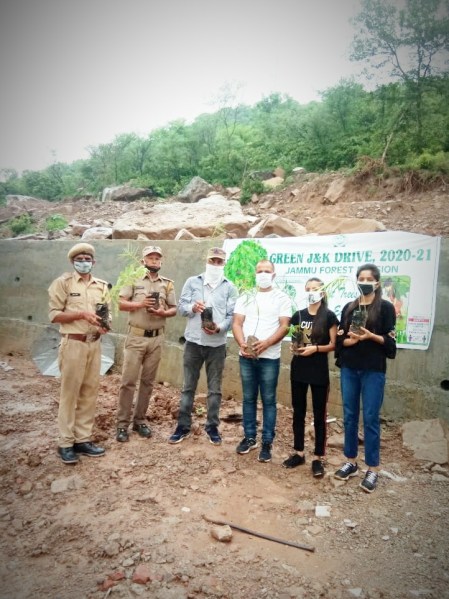
GDC, Jindrah in collaboration with Jammu and Kashmir Forest department organised plantation drive

GDC, Jindrah in collaboration with Jammu and Kashmir Forest department has organised plantation drive . The NSS Unit of the college directed by Prof Raj Shree Dhar , Principal of the college along with NSS volunteers has organised plantation drive  in  the new college premises on 21/8/2020 . The plantation drive carried out by  Ajay Choudhary block officer Jindrah, Prof Dr. Sunil Dutt Sharma Head of the Department NSS,  Sh. Sham Singh, Shadi Lal,  Sh Nityanand, Sh Darshan Lal, Sh Anil Sharna. NSS volunteers includes Ms Chakshu Sharma and Ms Monika Jamwal.

The Army has initiated a tree plantation drive here, involving students of local schools and colleges, as part of ‘Green Earth – Clean Earth’ campaign, a defence spokesperson said.

students of local schools and colleges were also incorporated in the drive and were motivated to plant trees to save the environment.

In order to ensure that the saplings survive, their ownership is being entrusted to the individuals planting them.

Bilingual Education

Communication is the most important tool for anyone to share his/her thoughts, ideas or any information from one person to another. The process of communication occurs between every living organisms. Be it animals, plants or insects, every living organism do communication. For humans though, communication plays a very important role because humans are the most social among every living organism.

The most basic tool for communication of humans is by using language.  Language is the system of communication in speech and writing that is used by the people of a particular country. There are many languages like English, French,  Dutch, Japanese, Korean, Irish, Turkish and many more. These languages are used by the people to communicate with the people of another country.

India also have many different languages according to the different states and regions. Some of them are Gujarati, Punjabi, Marathi, Bengali, Telugu, Tamil, Malayalam etc. These languages are used by the people of a particular state.

Now, if a person is aware of only one language, he/she can communicate with the people knowing that language only. He/she won’t be able to communicate with the people knowing some other languages. This is why it is important to have knowledge of at least 2 languages. This is known as bilingual education.

Bilingual education is the process of teaching students using two languages. Educators usually teach students in their native language in conjunction with a second language utilizing differing levels of the native and second language depending on the requirements specified in lesson plans and teaching models. This makes the students able to read, write and understand 2 languages at a same time.

Pros and Cons:

Every coin has 2 faces. The process of bilingual education also have some postive and negative points:

Pros:

Having a ‘secret’ language when around monolingual people.

Being able to learn new languages easier (depends which languages you already know)

Depending on the languages you know, you may be able to understand what another language (but you wouldn’t be able to speak it).

It looks good on one’s job/university applications and resumes.

Makes getting on good terms with foreigners/etc. easier as if you speak the language they are most comfortable with, they will be thankful.

Increases your interest and knowledge of culture as during learning the languages, you also learn about the cultures.

Cons:

Sometimes bilingual students may get languages mixed up.

Bilingual students may get confused sometimes about  it’s vocabulary, accents or anything like that.

The students may not have a perfect command on any of the language while the student studying only one language may have a perfect command on his language.

But overall, bilingual education is better. This is why most schools have policy of bilingual education.

The Murder on the Links: Book Review

Agatha Christie a.k.a queen of mystery is the best selling author of as many as 80 novels and short story collections. Her work have been widely appreciated and adapted into various films and television series, translated into 45 languages.

‘ The Murder on the Links ‘ is her second book in Hercule Poirot series set across a small town of Merlinville in France, where detective Hercule Poirot has been summoned urgently by a wealthy man, monsieur Paul Renauld, claiming his life is in danger. After receiving the letter, Poirot with the assistance of his friend Captain Arthur Hastings immediately leaves for Merlinville only to be welcomed with the news of Mr. Renauld’s murder. He had been stabbed to death and his body flung in freshly dug grave on the golf course adjoining the property. Meanwhile victim’s wife, madame Eloise Renauld, found bound and gagged in her room. Upon questioning she reports that masked men broke into her villa in the dead of the night, tied her up and took her husband away.

After few hours of investigation Poirot finds his attention being caught by few things viz a piece of lead piping near the body, dead man wearing his son’s overcoat with a passionate love letter in its pocket and victim’s immediate neighbor, madame Daubreuil, to whose bank account M. Paul Renauld has transferred over 200,000 francs in recent weeks. There is no lack of suspects but Poirot had its own doubts and before he could answer any of these, case turns upside-down when another corpse is found, stabbed with the same weapon in the same way.

Agatha Christie has never failed to impress her reader with her ingenuity. One may never had seen such dexterity in writing, with the lines clear and concise yet witty at times, but what was most amazing was the sheer brilliance of the plot, and the working of Poirot’s mind, along with the dramatic denouement.

And of course, having the story in first person from someone who isn’t the brightest one around yet has his own side adventures was another plus.

Tuskegee University


WHERE TO GIVE

Areas of Greatest Need

Your gift to Tuskegee University’s Annual Fund allows you to partner with the university’s senior leadership in addressing its most pressing and critical needs. As these needs arise, our leadership — guided by the priorities outlined in the university’s strategic plan — considers how best to apply your gifts in our academic and student life programs to ensure we can continue to offer our students a quality educational experience.

Your contribution to the Annual Fund in support of the areas of greatest university need can —and have, in the past — helped:

  • support non-capital student living and learning programs by funding classroom and lab activities
  • enhance learning and study programs offered through our tutoring programs, libraries and computer labs
  • underwrite faculty instructional needs and initiatives
  • expand academic programming, especially in support of STEM programs
  • develop and execute strategic student recruitment and retention programs by funding outreach by our recruiters, as well as on-campus recruitment programs like open houses and tours
  • increase our fundraising success by expanding our outreach to cultivate and steward new and existing donors

Capital Improvement

The university’s capital improvement program is guided by a 10-year comprehensive capital master plan — but made possible in large part by our donors who invest in our facilities.

Our 10-year capital master plan identifies and prioritizes the current repair and renovation needs of the 300-plus facilities the university owns and occupies. The plan also provides a framework for a phased strategy to address immediate and critical needs, such as expanding the availability of dormitory space, enhancing classroom and laboratory amenities, and renovating our athletic facilities.

Scholarships help turn the dream of a college education into a reality for our students. Scholarships can underwrite educational expenses ranging from f tuition, room and board, student fees, books and other required classroom materials.

Endowed Scholarships

When establishing scholarships, donors can specify the criteria they wish donors to satisfy to be eligible for the scholarship they create. This can include financial need-based requirements, academic merit-based scholarships, or scholarships that are awarded based on residency, high school or college activities, academic major and/or career aspiration.  

Endowments are vitally important to Tuskegee University because they provide permanent, self-sustaining funds that create stability, flexibility and opportunity for years to come. Endowments are created with a minimal philanthropic investment of $25,000 — either as an outright gift paid over time or through a planned or estate gift. Once established, your endowment is held permanently and invested along with other endowed charitable gifts. Its principal continues to grow and produce income in perpetuity for a designated purpose. 

Special Appeals

From time to time, the university will initiate a special fundraising appeal, which may align with an area of greatest need or around a special event like Homecoming or Founder\’s Day. 

Ways to Give — Make your gift today 

Recognizing our Generous Donors — Become an Eminent Associate

Office of Advancement and Development Staff

Office of Alumni Affairs Staff


University of Alabama


About the University

As the state’s flagship university, The University of Alabama family has always focused on being the best. This is where legends are made.

Founded in 1831 as the state’s first public college, The University of Alabama is dedicated to excellence in teaching, research and service. We provide a creative, nurturing campus environment where our students can become the best individuals possible, learn from the best and brightest faculty, and make a positive difference in the community, the state and the world. You’ll like what you find here. Become part of The University of Alabama family.

Administration

The University\’s leadership and structure.

History

Key events in the University\’s history.

Mission & Objectives

Teaching, research and service.

Policies

Ensuring UA best serves its community at large.

Strategic Plan

Energizing Alabama’s flagship by investing in its continued success and propelling it to new heights.

Traditions

Beloved places, symbols and songs.

Facts & Figures

The numbers tell the story – The University of Alabama is truly the Capstone when it comes to academics, athletics, service and research.

Doctoral Universities – Very High Research Activity status, Carnegie Classification

UA has achieved Doctoral Universities – Very High Research Activity status in the Carnegie Classification of Institutions of Higher Education.

News & Events

Find out what our students, faculty, staff and alumni are doing to make a positive difference on our campus, in our community and state, and around the world.

UA News Center

The latest campus news and announcements.

Events

Campuswide events calendar.

Troy University


Troy University

 Troy University’s tradition of teaching excellence dates to its founding on February 26, 1887, when an act of the Alabama Legislature established Troy State Normal School as an institution to train teachers for Alabama’s schools. Joseph Macon Dill was the institution’s first president. In 1893, the school was renamed Troy State Normal College.

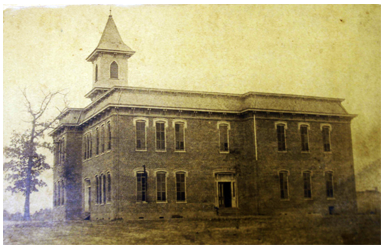
First Building Downtown Troy, AL

The Normal College offered extension courses for teachers and granted teaching certificates until 1929, when the State Board of Education changed the charter of the institution and renamed it Troy State Teacher’s College. That same year, the college moved to its present site and the first two buildings were dedicated: Shackelford Hall, named for Edward Madison Shackelford, president of the school from 1899-1936, and Bibb Graves Hall, named for David Bibb Graves, Alabama’s “education governor.” Governor Bibb Graves is also remembered for commissioning the Olmsted Brothers architectural firm of Brookline, Massachusetts, to design the campus landscape plan.

Like many American universities, Troy State Teacher’s College enjoyed one of its most prosperous periods of growth in the years following World War II when returning veterans took advantage of the GI Bill. The enrollment of the College more than doubled and this growth led to the introduction of degree programs in disciplines other than education, most notably in business. In 1957, the State Board of Education recognized this expanded role and dropped “Teacher’s” from Troy State College’s name.

The decade of the 1950s also marked the University’s long relationship with the United States Military, as extension courses were offered on nearby bases, first at Fort Rucker, near Dothan, and later at Maxwell Air Force Base in Montgomery. A separate Troy State College teaching center was established at Fort Rucker in 1961, which evolved into the present-day Dothan Campus. A similar center, begun at Maxwell Air Force Base in 1965, led to the creation of the present-day Montgomery Campus. These programs were the forerunners of the modern TROY Service Centers division of Troy University, which operates all TROY teaching sites outside Alabama. In 1973, the University opened sites at military bases in Florida. Today, TROY Service Centers operate some 20 sites in seven U.S. states, at locations in Japan and South Korea, and partnerships with universities in Vietnam and Malaysia.

In 1967, Gov. Lurleen B. Wallace appointed eight members to the newly established Troy State College Board of Trustees, removing the institution from the control of the State Board of Education. One of the first acts of the new board was to recommend the change of the name to Troy State University. The new name became official on Dec. 14, 1967.

In 1975, the Phenix City Campus was opened as a branch of the main campus.

In 1982, the Troy State University System was formed, as the campuses in Dothan and Montgomery were granted independent accreditation status. In April of 2004 the Board of Trustees voted to drop \”State\” from the University\’s name to better reflect the institution\’s worldwide mission. Starting August 2005, all TROY campuses were again unified under one accreditation.

 VIEW HISTORICAL TIMELINE

Exchange Rates Notification No.80/2020-Customs (NT)

In exercise of the powers conferred by section 14 of the Customs Act, 1962 (52 of 1962), and in supersession of the Notification No.69/2020-Customs(N.T.), dated 6th August, 2020 except as respects things done or omitted to be done before such supersession, the Central Board of Indirect Taxes and Customs hereby determines that the rate of exchange of conversion of each of the foreign currencies specified in column (2) of each of Schedule I and Schedule II annexed hereto, into Indian currency or vice versa, shall, with effect from 21st August, 2020, be the rate mentioned against it in the corresponding entry in column (3) thereof, for the purpose of the said section, relating to imported and export goods.

Implementation of PMEGP Projects Records 44% Jump in 2020

At a time when the country’s economy took a severe jolt due to Covid-19 lockdown, the flagship Prime Minister Employment Generation Program (PMEGP) implemented by Khadi and Village Industries Commission (KVIC) progressed at a much rapid pace. Thanks to a major decision of the Ministry of MSME introducing a new&faster mechanism  in approving the PMEGP projects, the approval of projects during the first five months of this financial year, i.e. from April 1, 2020 to August 18, 2020, increased by a whopping 44%.

Khadi and Village Industries Commission (KVIC), has approved and forwarded 1.03 lakh project applications to the financing banks as compared to 71,556 projects during the corresponding period last year and thus registering a jump of 44%.

PMEGP is the flagship employment generation program of the Central government and KVIC is the nodal agency for implementing the scheme. The Ministry on April 28, this year amended the guidelines to do away with the role of the District Level Task Force Committee (DLTFC) in approving the PMEGP projects. The role of DLTFC, headed by the District Collectors, was time consuming. As such, the swift execution of projects under PMEGP and KVIC was demanding doing away with the same as this important scheme required greater priority. As per the amended guidelines, KVIC, the nodal agency for implementing PMEGP scheme, was entrusted the task of clearing the applications from prospective entrepreneurs and forward it to the Banks for taking credit decisions.

During the period from April to August in 2020, financing banks sanctioned 11,191 projects and Rs 345.43 crore margin money was disbursed to applicants as compared to Rs 276.09 crore margin money disbursed for 9161 projects in the first five months of previous year, i.e. 2019. The number of sanctioned projects by banks thus increased by 22% while the disbursement of margin money by KVIC increased by 24% as compared to previous year.

The faster implementation of PMEGP projects this year assumes greater significance as the entire country was under lockdown for most part of these five months. The higher number of projects also signifies the government’s resolve to create self-employment and sustainable livelihood for the people by promoting local manufacturing.

KVIC Chairman Shri Vinai Kumar Saxena said the massive jump in approval of PMEGP projects is a result of the  Prime Minister’s call for “Minimum Government, Maximum Governance”. “Discontinuing the role of District Collectors has ensured swift implementation of the projects. However, the banks must also expedite the process of sanctioning funds so as to benefit the maximum number of applicants. Timely disbursal of funds is crucial for execution of projects and creating employment in the country,” Saxena said.

Union Minister of Agriculture and Farmers’ Welfare Shri Narendra Singh Tomar holds meeting with industry representatives on initiatives and reforms for rapid agricultural development and increasing farmers’ incomesGovernment making concerted efforts to bring reforms in agricultural marketing and freeing agriculture sector of various restrictions through strategic interventions – Shri TomarIndustry representatives appreciate efforts of Government in bringing rapid farmer centric reforms to unleash the potential of the agriculture sector and move towards “One Nation, One Market”

Union Minister of Agriculture and Farmers’ Welfare Shri Narendra Singh Tomar held a meeting through Video Conference today with industry representatives on the Ordinances i.e “the Farmers’ Produce Trade and Commerce (Promotion and Facilitation) Ordinance, 2020” and “The Farmers (Empowerment and Protection) Agreement on Price Assurance and Farm Services Ordinance, 2020” promulgated by Government of India. Shri Parshottam Rupala, Minister of State for Agriculture, Shri Sanjay Agarwal, Secretary (Agriculture) and senior officers of the Department of Agriculture, Cooperation and Farmers Welfare were present.

Speaking on the occasion, the Union Minister of Agriculture and Farmers’ Welfare thanked Prime Minister Shri Narendra Modi for his vision in bringing strategic interventions in market reforms for rapid agricultural development and increasing farmers’ income. He mentioned that the Government is taking several measures for the welfare of farmers with a specific focus on ‘AatmaNirbhar Bharat’. The Ministry has been making concerted efforts to bring reforms in agricultural marketing and freeing agriculture sector of various restrictions through strategic interventions.

Giving details of various initiatives, Shri Tomar said that the Government has created the  Agriculture Infrastructure Fund of Rs. 1 lakh crore to be used over the next four years. This fund is for building post-harvest storage and processing facilities, largely anchored at the Farmer Producer Organisations (FPOs), but can also be availed by individual entrepreneurs. The Agriculture Infrastructure Fund would facilitate in strengthening the agricultural infrastructure, development and improvement of warehouses, cold storage, pack houses and marketing facilities in the rural areas, which would enhance the income of farmers and boost rural economy. He stated that within one month of its approval by the Union Cabinet, the Prime Minister has inaugurated the Agriculture Infrastructure Fund on 9th August 2020 and Rs. 1128 crore has been sanctioned to Primary Agriculture Credit Cooperative Societies.

More than 8 lakh net subscribers added during first quarter of FY 21: EPFO payroll data


The provisional payroll data published by EPFO on 20th August 2020 reveals that the subscriber base of EPFO increased by around 8.47 lakh members during the first quarter of FY21. The COVID-19 pandemic outbreak had adversely affected the enrolments in the month of April and May 2020. Despite the lockdown, around 0.20 lakh and 1.72 lakh net new subscribers were added to social security schemes of EPFO in the month of April and May 2020.The month of June has seen speedy recovery with addition of 6.55 lakh net subscribers registering a remarkable 280% month on month growth. The data published comprises of all the new members who have joined during the month and whose contribution is received.

The subscriber base growth is on account of increased number of new subscribers, lower exits and higher rejoining by exited members. The new subscriber joining has increased roughly by 64 % from 3.03 lakh in May to 4.98 lakh in June 2020. In addition, the exits from EPFO subscriber base declined by nearly 33% from 4.45 lakh in May to 2.96 lakh in June 2020.

The number of members who exited and then rejoined, indicates switching of jobs by subscribers within the establishments covered by EPFO.  This has also increased by approximately 44% for the month of June, 2020 over May, 2020, with more subscribers choosing to retain membership by transferring funds rather than opting for final settlement.

Gender wise analysis highlights that the new enrolment of female workers has improved from 37085 in April 2020 to 106059 in June 2020 in absolute terms, even though the overall female participation in workforce remains low.

Category wise analysis of industry indicates “Expert services” category had a share of approximately 46% and 45% during 2018-19 and 2019-20 respectively. In the first quarter of 2020-21 it stands at 52.7% which is reflecting that many industries are yet to recover but Expert Services has made good progress. The absolute figure for net enrolment in Expert Services category during June 2020 is 3.45 lakh, which is more than the monthly average of 3 lakh during 2019-20. Expert services predominantly consist of man power agencies, private security agencies and small contractors.

The new establishments that remitted their first ECR has grown from its low of 820 in April 2020 to 1802 in May. In the month of June 2020 the growth continued with 2390 establishments registering their first ECR recording a month on month growth of 32%

EPFO manages social security funds of workers in the organised/semi organised sector in India and has more than 6 crore active members. The payroll data is provisional as updation of employee records is a continuous process and it gets updated in subsequent months.