
Live Storage Status of 123 Reservoirs in the Country

Central Water Commission is monitoring the live storage status of 123 reservoirs of the country on a weekly basis. Out of these reservoirs, 43 reservoirs have hydropower benefit with installed capacity of more than 60 MW. The total live storage capacity of these 123 reservoirs is 171.091 BCM which is about 66.36% of the live storage capacityof 257.812 BCM which is estimated to have been created in the country. As per reservoir live storage available in these reservoirs is 142.234 BCM, which is 83% of total live storage capacity of these reservoirs. However, last year the live storage available in these reservoirs for the corresponding period was 139.647 BCM and the average of last 10 years live storage was 120.667 BCM. Thus, the live storage available in 123 reservoirs is102% of the live storage of corresponding period of last year and 118% of storage on average of last ten years.

The northern region includes States of Himachal Pradesh, Punjab and Rajasthan. There are 8 reservoirs under CWC monitoring having total live storage capacity of 19.17 BCM. As per the total live storage available in these reservoirs is 15.04 BCM which is 78% of total live storage capacity of these reservoirs. The storage during the corresponding period of last year was 91% and average storage of last ten years during corresponding period was 83% of live storage capacity of these reservoirs. Thus, storage during current year is less than the corresponding period of last year and is also less than the average storage of last ten years during the corresponding period.

The Eastern region includes States of Jharkhand, Odisha, West Bengal, Tripura and Nagaland. There are 18 reservoirs under CWC monitoring having total live storage capacity of 19.43 BCM. As per the total live storage available in these reservoirs is 14.34 BCM which is 74% of total live storage capacity of these reservoirs. The storage during corresponding period of last year was 75% and average storage of last ten years during corresponding period was 65% of live storage capacity of these reservoirs. Thus, storage during current year is less than the corresponding period of last year and is better than the average storage of last ten years during the corresponding period.

The Western region includes States of Gujarat and Maharashtra. There are 42 reservoirs under CWC monitoring having total live storage capacity of 35.24 BCM. As per the total live storage available in these reservoirs is 31.95 BCM which is 91% of total live storage capacity of these reservoirs. The storage during the corresponding period of last year was 83% and average storage of last ten years during corresponding period was 68% of live storage capacity of these reservoirs. Thus, storage during current year is better than the storage of last year and is also better than the average storage of last ten years during the corresponding period.

The Central region includes the States of Uttar Pradesh, Uttarakhand, Madhya Pradesh and Chhattisgarh. There are 19 reservoirs under CWC monitoring having total live storage capacity of 44.45BCM. As per the total live storage available in these reservoirs is 38.60 BCM which is 87% of total live storage capacity of these reservoirs. The storage during the corresponding period of last year was 82% and average storage of last ten years during the corresponding period was 75% of live storage capacity of these reservoirs. Thus, storage during the current year is better than the storage of last year and is also better than the average storage of the last ten years during the corresponding period.

The Southern region includes the States of Andhra Pradesh, Telangana, AP&TG (2combined projects in both states), Karnataka, Kerala and Tamil Nadu. There are 36reservoirs under CWC monitoring having total live storage capacity of 52.81 BCM. As per the total live storage available in these reservoirs is 42.31 BCM which is 80% of total live storage capacity of these reservoirs. The storage during corresponding period of last year was 79% and average storage of last ten years during corresponding period was 66% of live storage capacity of these reservoirs. Thus, storage during current year is better than the corresponding period of last year and is also better than the average storage of last ten years during the corresponding period.

Corporatisation of Ordnance Factory Board: Government constitutes Empowered Group of Ministers headed by Raksha Mantri;

Consequent to the decision of the Government to convert Ordnance Factory Board (OFB), a subordinate office of Ministry of Defence (MoD) into one or more than one 100 per cent Government owned corporate entities, the Government has constituted an Empowered Group of Ministers (EGoM), under the Chairmanship of Raksha Mantri Shri Rajnath Singh, to oversee and guide the entire process, including transition support and redeployment plan of employees while safeguarding their wages and retirement benefits. Other ministers in the EGoM are Home Minister Shri Amit Shah, Finance Minister Smt Nirmala Sitharaman, Minister for Law & justice Shri Ravi Shankar Prasad, Minister of State for Labour & Employment Shri Santosh Kumar Gangwar and Minister of State for Personnel, Public Grievance & Pension Dr Jitendra Singh.

The Terms of Reference (ToR) of the EGoM inter alia include:

(1) Decision on conversion of OFB into a single Defence Public Sector Undertaking (DPSU) or as multiple DPSUs;

(2) Matters related to various categories of employees including protection of their salary and pension of existing employees;

(3) Financial support that may be provided to the entity/entities to make them economically viable and self-reliant;

(4) Grandfathering of orders already being executed by OFB or for which facilities created in OFB;

(5) Treatment for land assets of OFB.

The composition of EGoM along with ToRs have been communicated to the OFB and various Federations, Unions and Associations at Board/ Factory/Unit level and they have been requested to place all their suggestions, issues and concerns relating to corporatisation of OFB before the EGoM.

The Department has also selected M/s KPMG Advisory Services Pvt. Ltd. (Lead Consortium Member) with M/s Khaitan& Co. Ltd. as another Consortium Member, as the Consultancy Agency for providing strategic and implementation management consulting services to assist the Department of Defence Production in the process of corporatisation of the OFB.

Timelines for Publicity of Criminal Antecedents

In continuation of the detailed instructions dated 10.10.2018 and 6.3.2020  issued by ECI in the matter of publicity of criminal antecedents by the contesting candidates as well as by the political parties nominating such candidates, it was discussed at length in the Commission’s meeting today. Commission decided to further streamline the instructions concerning publicity of criminal antecedents by candidates concerned and by the political parties, who nominate them for elections. Commission has always emphasised on this moral yardstick for overall betterment of electoral democracy.

 Highlights of the modified instructions are as follows:

A.   Revised Timeline for Publicity

As per the revised guideline, the candidates as well as the political parties, regarding candidates nominated by them, will publish the details of criminal antecedents, if any, in newspapers and television in following manner:

  1. First publicity:       Within first 4 days of last date of withdrawal.
  2. Second publicity:   Within 5th to 8th day of last date of withdrawal
  3. Third publicity:       From 9th day till the last day of campaign, i.e. two days prior to date of poll)

This timeline will help the voters in exercising their choices in more informed manner.

B.   Regarding the publicity by uncontested winning candidates as well as the political parties who nominate them, it is clarified that uncontested winner candidates as well as the political parties who nominate them shall also publicise the criminal antecedents, if any, as prescribed for other contesting candidates and political parties.

As decided by Commission, a Compendium of all instructions and formats issued so far, in this matter, is being published for the benefit of stakeholders. This will help in creating more awareness amongst the voters and other stakeholders.  All instructions, in this regard, must be complied by the  contesting candidates with criminal antecedents and the political parties regarding their nominated candidates. These modified instructions shall apply with immediate effect.      

Labour and Employment Minister inaugurates ‘Shram Bureau Bhawan’ in Chandigarh

Minister of State (Independent Charge) for Labour & Employment, Shri Santosh Kumar Gangwar inaugurated the newly constructed building of Labour Bureau i.e. Shram Bureau Bhawan in Chandigarh today marking the Centenary year of Labour Bureau. 

Union Minister Shri Gangwar lauded the efforts of officials of Labour Bureau, for their steadfastness and exemplary role which have finally culminated in the creation of ‘Shram Bureau Bhawan’. 

While lauding the efforts, Union Minister mentioned that data on all aspects of labour is crucial to serve as inputs in policy making and this justifies the existence of an organization like Labour Bureau dedicated to labour statistics. With the ever increasing importance of data in the times to come coupled with the fact that India is a labour abundant nation, a dedicated organization for labour statistics like the Bureau merits strengthening.

Labour Bureau has been mandated the task of collection of data on recently proposed four labour codes. Both Minister & Secretary (L&E) have assured to lend all possible support to Labour Bureau in future endeavours. A committee was set up in 1940 to recommend a statistical body for measuring change in prices following the Second World War. Accordingly, the Directorate of Cost of Living was established in Shimla 1941 and in 1946 the directorate was rechristened as Labour Bureau.

Shri Gangwar, inaugurates newly constructed building of Labour Bureau

Minister of State (I/C) for Labour and Employment Shri Santosh Kumar Gangwar, inaugurated the newly constructed building of Labour Bureau, Shram Bureau Bhawan in Chandigarh today. Shri Heeralal Samarya, Secretary,  Labour and Employment and DG Labour Bureau DPS Negi were also present on the occasion.

Shri Santosh Kumar Gangwar said on the occasion that data on all aspects of labour is crucial to serve as inputs in policy making and this justifies the existence of an organization like Labour Bureau dedicated to labour statistics. With the ever increasing importance of data in the times to come coupled with the fact that India is a labour abundant nation, a dedicated organization for labour statistics like the Bureau merits strengthening.

PM to dedicate to the nation three key projects related to the Petroleum sector in Bihar on 13th September

Prime Minister Shri Narendra Modi will dedicate to the nation three key projects related to the Petroleum sector in Bihar on 13th September, via video conferencing. The projects include the Durgapur-Banka section of the Paradip-Haldia-Durgapur Pipeline Augmentation Project and two LPG Bottling Plants. They have been commissioned by IndianOil and HPCL, PSUs under the aegis of the Ministry of Petroleum and Natural Gas.

Chief Minister of Bihar will also be present on the occasion.

Durgapur-Banka section of the Pipeline Project

The 193 km long Durgapur-Banka pipeline section, built by IndianOil, is a part of the Paradip-Haldia-Durgapur Pipeline Augmentation Project, for which the foundation stone was laid by the Prime Minister on 17th February 2019. Durgapur-Banka section is the extension of the existing 679 Km long Paradip-Haldia-Durgapur LPG pipeline to the new LPG bottling plant at Banka in Bihar. The pipeline of 14” diameter passes through three states viz. West Bengal (60 km), Jharkhand (98 km), and Bihar (35 km). Presently, LPG injection can be made in the pipeline system from Paradip Refinery, Haldia Refinery, and IPPL Haldia. On completion of the whole project, the LPG injection facility will also be available from the Paradip Import terminal and Barauni refinery.

Laying of the pipeline under Durgapur-Banka Section required crossing several natural and manmade hurdles. A total of 154 crossings were bridged including 13 rivers (one of them being the Ajay river of 1077 m length), 5 national highways, and 3 railway crossings. The pipeline was laid under the riverbeds through state-of-the-art Horizontal Directional Drilling technique without disturbing the water flow.

LPG Bottling Plant at Banka, Bihar

IndianOil’s LPG Bottling Plant at Banka will increase the ‘AtmaNirbharta’ of Bihar by meeting the rising demand for LPG in the state. This Bottling Plant has been built at an investment of around Rs 131.75 crore to serve the districts of Bhagalpur, Banka, Jamui, Araria, Kishanganj & Katihar in Bihar, along with the districts of Godda, Deoghar, Dumka, Sahibganj, and Pakur in Jharkhand. With the LPG storage capacity of 1800 MTs and bottling capacity of 40,000 cylinders per day, this plant would generate direct and indirect employment opportunities in the state of Bihar.

LPG Plant at Champaran(Harsidhi), Bihar

HPCL’s 120 TMTPA LPG Bottling Plant has been constructed at Harsidhi in East Champaran district for Rs. 136.4 crores. This plant has been constructed on 29 acres of land and its Foundation stone was laid by the Prime Minister on 10th April 2018. The bottling plant will cater to the LPG requirement of East Champaran, West Champaran, Muzaffarpur, Siwan, Gopalganj & Sitamarhi districts in Bihar.

The event will be telecast Live on DD News.

JEE Main 2020 Results: 24 applicants scores 100 percentile

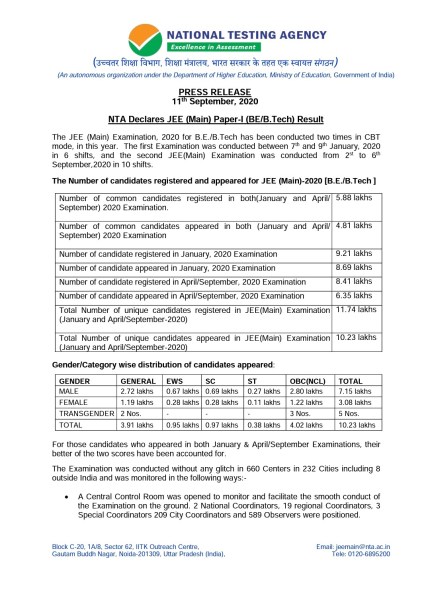
National Testing Agency (NTA) has declared the NTA JEE Main result 2020 at jeemain.nta.nic.in. The JEE Main 2020 result latest news shows 24 candidates have scored 100 percentile in JEE Main 2020 result.

The website may have gone down due to heavy traffic, students may wait for a while and then check their JEE Main 2020 results.

The Union Education minister Ramesh Pokhriyal on Wednesday said that out of the 8.58 lakh candidates who had registered for the JEE (Main) exam, 6.35 lakh candidates appeared in the examination. Over 8 lakh students had appeared in the JEE Main 2020 examination amid the COVID-19 pandemic.

 Students, parents and Opposition leaders had protested strongly demanding the postponement of the exam. But the government did not pay heed to their requests. Instead it issued strict guidelines for the appearing students and invigilators at the exam centre and conducted the entrance tests.

At the time of going to print, the National Testing Agency, which conducts the examination, had not yet released the full all-India rank list or the cut-off score for eligibility to attempt the JEE Advanced to be held on September 27. Students can check their scores and the final answer keys at jeemain.nta.nic.in.

For September, the number of students who have scored 100 is 15. State wise break up for the numbers is Telangana with 8 followed by Delhi with 5 students. 2 students from Haryana and 1 student each from Gujarat and Maharashtra scored 100 percentile. Rajasthan has 4 toppers and Andhra Pradesh has 3 students who scored 100 percentile. Along with the 100 percentilers, NTA would also be releasing the state wise list of toppers.

 The complete list of toppers would be provided shortly along with the JEE Main 2020 Rank list on the official site as well. In January, 9 students had scored 100 percentile. The complete list of toppers would be provided shortly along with the JEE Main 2020 Rank list on the official site as well. The score card of the candidates would be released online on jeemain.nta.nic.in. As many as 2.5 lakh students would qualify to appear for JEE Advanced 2020 or IIT JEE examination, scheduled for September 27. 

1. Landa Jitendra – Andhra Pradesh

2. Thadavarthi Vishnu Sri Sai Sankar – Andhra Pradesh

3. Y S S Narasimha Naidu – Andhra Pradesh

4. Chirag Falor- Delhi

5. Gurkirat Singh -Delhi

6. Laksh Gupta -Delhi

7. Nishant Agarwal- Delhi

8. Tushar Sethi – Delhi

9. Nisarg Chadha – Gujarat

10. Divyanshu Agarwal - Haryana

11. Harshvardhan Agarwal – Haryana

12. Swayam Shashank Chube- Maharashtra

13. Akhil Agrawal- Rajasthan

14. Akhil Jain — Rajasthan

15. Parth Dwivedi — Rajasthan

16. R Muhender Raj- Rajasthan

17. Chagari Koushal Kumar Reddy – Telangana

18. Deeti Yeshash Chandra – Telangana

19. Chukka Tanuja — Telangana

20. Morreddigari Likhith Reddy — Telangana

21. Rachapalle Shashank Anirudh – Telangana

22. Rongala Arun Siddardha – Telangana

23. Shiva Krishna Sagi — Telangana

24. Vadapalli Arvind Narasimha — Telangana

Steps to check Results

  • Visit the official website at jeemain.nta.nic.in
  • click on the link that reads, “JEE Mains 2020 results”
  • A new window page will display in screen
  • Login by entering your details
  • The JEE Mains 2020 will be displayed on the screen
  • And now you can download the results and take its print out too.

Optimism – The need of the hour

https://depositphotos.com/

   Optimism is defined as “a mental attitude reflecting a belief or hope that the outcome of some specific endeavor, or outcomes in general, will be positive, favorable, and desirable” by Wikipedia. I bet not many of us lead a smooth comfortable life, this is when one is put into test. Maintaining mental stability, putting a pause to all overthinking & most of all, thinking for the brighter side of things, is what optimism basically means. So a ray of hope Or even imagining the better times or opportunities is also an optimum drive to cheer one up in the faces of troubles. 

    A true optimist is believed to never give way easily to despair or psychological pain. On the contrary, a pessimist is defined as someone who looks at the negative & gloomy side of life or things. Thus a pessimist may lose interest from humane values and rather indulge in immoral & cruel acts. This may eventually lead to overpowering one’s mind to inculcate all negative qualities than the positives. 

   Also, lack of optimism or upon completely losing faith from it may compel one to be cynical & disinterested in life. And a severe form of pessimism may cause one to overload the brain with mental depression. This is often a key reason why people commit suicide. To most of us, the Sushant Singh Rajput suicide case clings at the back of our mind. True, the country did lose an exceptionally talented, young & bright actor. Watta pity! 

   Most of us are quite aware of this widely known idiom, “When life hands you lemons, make lemonade.” Mostly it’s used to encourage optimism in the face of adversity or misfortune. The literal meaning relates to when life hands you lemons that are sour in taste, signifying difficulties in life; rather make lemonade out of it that depicts positivity in life. 

https://depositphotos.com/

  One may also deduce it as, when life hands you lemons, rather than cribbing about the situation or fate, look out for ways & means to turn it to your advantage. As it is rightly said, “When one door shuts, another opens.” It isn’t always necessary that solutions shall be readily available served right on your plate. So one just needs to scavenge for ways at times & do the needful. 

    Not all optimists are of the same type. So let’s explore the different kinds of optimists here :

 ‌Dispositional optimism: Also known as the “big optimism”, is an expectation that more good shall happen than bad in the future. 

 ‌Strategic optimism: This involves one denying risks because he believes to have control over the situation. 

 ‌Unrealistic optimism: Can also be termed as “impractical optimism”, is when the positive expectations don’t match with the actual evidence. 

 ‌Comparative optimism: It’s expecting good things for oneself compared to others. 

 ‌Realistic optimism: Also known as “practical optimism”, is when one keeps a positive outlook even in the constraints of the world.

 ‌Situational optimism: This refers to the expectation of a positive outcome in a specific situation. 

    The most common theory used to illustrate the concept of pessimism vs optimism is a glass half filled with water. An optimist will observe the glass as half full, while a pessimist shall see it as half empty. It is simply the difference of perspective of a person that a situation is viewed differently. 

India – China to “Disengage” mutually on Border issues

India and China have agreed to “quickly disengage” from a standoff that has seen gunfire at a disputed border and accusations of kidnapping. Their foreign ministers met on Thursday and said they would ease tensions.

In a joint statement, the neighbours said the “current situation is not in the interest of either side”.

“They agreed, therefore, that the border troops of both sides should continue their dialogue, quickly disengage, maintain proper distance and ease tensions,” said the statement, released by Indian Foreign Minister S Jaishankar and his Chinese counterpart Wang Yi.

Both sides have accused each other of straying into their territory, and the clashes have sometimes turned deadly. Soldiers from both countries have periodically skirmished along the poorly demarcated border, called the Line of Actual Control. It is understood that the military commanders’ meeting in the next few days will chalk out steps of disengagement more clearly, which the Foreign Ministers will review before deciding on the course ahead. 

The five points agreed to are a template for the “principles of disengagement”, said a senior official privy to the meeting, but large divergences still remain in the positions taken by both sides. Both Ministers had a frank and constructive discussion on the developments in the India-China border areas as well as on India-China relations and agreed as follows:

1. The two Ministers agreed that both sides should take guidance from the series of consensus of the leaders on developing India-China relations, including not allowing differences to become disputes.

2. The two Foreign Ministers agreed that the current situation in the border areas is not in the interest of either side. They agreed therefore that the border troops of both sides should continue their dialogue, quickly disengage, maintain proper distance and ease tensions.

3. The two Ministers agreed that both sides shall abide by all the existing agreements and protocol on China-India boundary affairs, maintain peace and tranquillity in the border areas and avoid any action that could escalate matters.

4. The two sides also agreed to continue to have dialogue and communication through the Special Representative mechanism on the India-China boundary question. They also agreed in this context that the Working Mechanism for Consultation and Coordination on India-China border affairs (WMCC), should also continue its meetings.


5. The Ministers agreed that as the situation eases, the two sides should expedite work to conclude new Confidence Building Measures to maintain and enhance peace and tranquillity in the border areas

According to the Chinese press release, state councillor Wang said that bilateral relations between the two Asian neighbours “have once again come to a crossroads”. “But (he added) as long as the two sides keep moving the relationship in the right direction, there will be no difficulty or challenge that can’t be overcome.”
Jaishankar told his Chinese counterpart that India remained concerned at the massing of Chinese troops at the LAC, which was not in accordance with the 1993 and 1996 agreements. There has been “no credible explanation for this deployment”, which the minister said has created flash points along the LAC.

The Indian side said that the Chinese front line troops’ “provocative behaviour” at the various stand-off points showed disregard for border pacts and protocols.