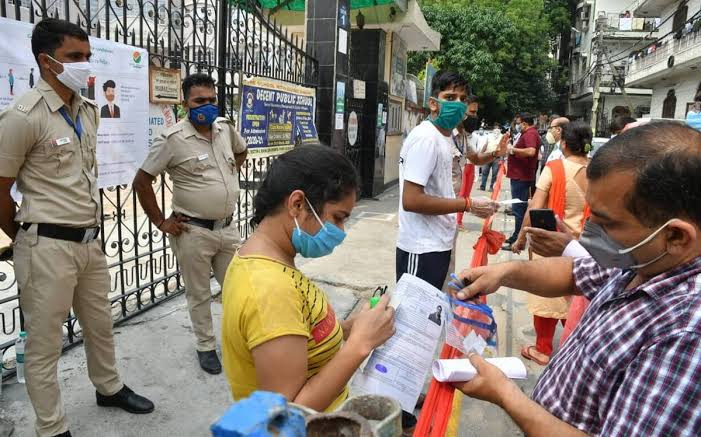
Over 85% attendance in NEET 2020

Photo credit: The Hindu

the National Testing Agency, based on random sampling, said that the attendance for the National Eligibility cum Entrance Test-Undergraduate (NEET-UG) stands between 85% to 90% on Sunday. Those candidates who missed the exams after being tested positive for COVID-19 will get another opportunity to sit for the test, the date for which will be announced later.

From this year the admissions to MBBS course in the 13 All India Institute of Medical Sciences (AIIMS), Jawaharlal Institute of Postgraduate Medical Education and Research (JIPMER), Puducherry will also be made through NEET following the amendment in National Medical Commission Act, 2019 passed by the Parliament last year.

In many places NTA also arranged buses and private vehicles to transfer candidates who arrived at the centres assigned to them earlier instead of the changed one.

A total of 15.97 lakh candidates registered for the test this year as against 15.13 lakh in 2019. The attendance in 2019 was 92.9%. Unlike JEE (main), NEET-UG is a pen-paper exam and NTA officials said that it will be able to compile the data on Monday after the centres send feedback after the dispatch of the OMR sheets.

“Based on random sampling the attendance is found to be between 85% to 90%, which is marginally lower than that of last year. The tests have been completed successfully,” said a senior official at the NTA headquarters in Noida.

Union minister of education Ramesh Pokhriyal Nishank while disclosing the figures also thanked states as many of them had arranged transport for the candidates keeping in view the difficulties due to the Covid-19 pandemic.

“NTA informed me that around 85-90% of students appeared in the #NEET exam today. I sincerely thank all Chief Ministers and @DG_NTA for proper arrangements made to facilitate student participation. #NEET participation reflects the tenacity and grit of young #AtmaNirbharBharat, ” Pokhriyal said in a tweet.

He thanked all chief ministers and Director General of National Testing Agency (NTA) Vineet Joshi for proper arrangements made to facilitate student participation.

“NEET participation reflects the tenacity and grit of young,” the Union education minister said.

The NEET attendance figures are higher than the JEE (Main) attendance figure of around 74%. NTA officials have attributed this to the fact that JEE (Main) is held twice every year.

Many students who had already taken the exam in January may have decided to skip the test in September in view of the Covid-19 related concerns.

5 Ways to not lose hope

Do you often feel hopeless and see no light at the end of the tunnel? Well, everybody feels that, at some point of their life. None’s life is perfect, but we should keep thriving to make one. Everybody gets hit by adversity at times, when it becomes difficult to search for the light, but it is only after the storm passes that we become a stronger version of ourselves than ever. Each storm teaches us a lesson to remember and helps us grow as a person. Now, let us explore the five ways through which we can keep our hope alive at the face of adversity.
1) Find support- whenever you feel hopeless and gloomy thinking about your life, or about the things that went wrong, try to talk it out with someone you trust, people who have always supported you and been there through thick and thin. Talking to such people at the time of adversity would help you stay on the right track and their words would give you the much needed strength to fight your fears.They might even help you get your life together.
2) Practice gratitude- Be grateful for what you have achieved so far. Be thankful for the things you have now, which you didn’t had, about a few years back. I am pretty sure you would find ample of things to feel good about yourself and would find a hope to hold on.
3) See the bright side- try to see the bright side of every negative event that might have happened in your life. Consider it as a great life lesson. Learn from your worst experiences and make it a point to never repeat your mistakes twice. The ability to learn from your mistakes would help build your life better and keep your hope alive.
4) Revisit your past- when you feel hopeless just calm your mind, sit with yourself at a quiet place and revisit your past. Try to get back to your past and recall the memories of the difficulties you had faced so far and how you have overcome it, every damn time. This revisiting would thus help you stay strong and would not let you lose hope. Now, your brain would get a positive boost and would try to think about the best possible ways to get you out of your current situation.
5) Everything is temporary- the sooner you realise that nothing is permanent in life, the better you would heal from all the hurt and the bad events that made you feel hopeless. Moreover, just like every night has it’s dawn, similarly every dark days in one’s life brings in bright sunny days later.
So my dear readers, if you have one reason to cry for, today, you would have several other reasons to smile tomorrow. What’s important is never to give up on life and always holding onto hope. Hope is what gets one going right? So no matter what happens, you are strong and brave enough to fight any adversity and most importantly, life donot always go as we plan so all we need to do during such hard circumstances is to keep our eye at the light shimmering at the end of the tunnel. Keep going, have faith in the Almighty and never ever lose hope!

Anushka Sharma on her pregnancy

Bollywood actor Anushka Sharma and Indian cricket team’s captain Virat Kohli are expecting their first child together. Anushka on Sunday took to Instagram to share a photo of herself looking lovingly at her baby bump.Sharing the photo, the actor wrote, “Nothing is more real and humbling than experiencing creation of life in you. When this is not in your control then really what is?

”Virat Kohli and Anushka Sharma are currently in Dubai. While Virat, who is also the captain of IPL team Royal Challengers Bangalore (RCB), is busy with the preparation for IPL, Anushka is enjoying some time off.In a recent interview, Virat spoke about becoming a father. He said, “It is an incredible feeling. It puts things into perspective for you. It is difficult to describe how you feel, but when we found it, we were over the moon. The kind of love that was showered on us when we announced it was amazing. People were genuinely so emotional and happy for us. We are looking forward to the third member joining the clan.

”Actor Anushka Sharma has shared a stunning new picture of herself as she cradles her baby bump. Anushka and her cricketer husband Virat Kohli are expecting their first child together.

The photo shows Anushka at a beach, smiling while caressing her baby bump. “Nothing is more real & humbling than experiencing creation of life in you . When this is not in your control then really what is,” she captioned her post. Commenting on the post, Virat wrote, “My whole world in one frame.”

Durga Puja: Through The Eyes of A Bengali

Durga Puja is a festival of Hindu origin, which is celebrated predominantly in West Bengal, Tripura, Orissa and Assam, within India. Bangladesh also has their fair share of Pujas. It is annual in occurrence and is an integral part of Shaktism tradition, a branch of Hinduism. It is conducted in accordance to the Indian calendar, in the month of Ashwin (begins at sixth day of Ashwin shukla paksha tithi and ends on the tenth of the same) . Ashwin usually corresponds to September or October in the Gregorian calendar. This is a ten day long festival, and the last five days are of greater significance. Durga Puja also coincides with festivals like Navratri and Dussehra, which are of other traditional significance. 

Nostalgia

Mahalaya marks the start of the journey of homecoming or ‘Agomoni’ of Durga Maa to her natal home. On the day of Mahalaya, Bengalis wake up early in the morning and go to see skits or watch Mahalaya special programs on TV or listen to radios. These mediums, on Mahalaya, present acts or songs, which capture the essence of Puja. Infact, some songs can only be equated to the nostalgia of Durga Puja and nothing else. Or, they narrate the story that is associated with the origin of this tradition. This story can be traced back to the Devi Mahatmya, a text which is recited during the Durga Pujas. It is believed that this text was written back in 400-600 CE and was written in Sanskrit. The popular story that goes down from generation to generation says that, ‘There was a demon Mahishasur, whom the Gods or Devatas were unable to defeat. Finally, they sought the advice of the Trinity, Brahma, Vishnu and Shiva. They created and manifested a superpower, whose soul rose from the holy waters of Ganga, and who was crafted by all the Devas together. That manifestation was Devi Durga. She had ten arms, each hand holding a weapon, given to her by different Gods. Armed with all these weapons, she waged a fierce war against Mahishasur and finally killed him on Maha Dashami.’

Get, Set, Puja

The main Puja starts from Maha Shashti. The idols are placed in the selected place and elaborate rituals are done to religiously establish the idols and this marks the beginning of Durga Puja. Pujas can be arranged by a single family or by a community. The community Pujas are done in PAndals, constructed specifically for the Puja. Along with Devi Durga, Laxmi, Saraswati, Ganesh and Kartikeya are also worshipped, as according to Bengali culture, they are Devi Durga’s children. Hence she brings them with her, when she visits her paternal home. Maha Dashami marks the end of her visit and the start of the journey back to Kailash,her husband Lord Shiva’s abode. The idols,which are made of biodegradable substances, are submerged in the water bodies.

For Bengalis, Durga Puja is a very big deal. The preparation and shopping starts from months prior to  the actual festival. Pandals start springing up almost a month before the Puja. Nowadays, pandals and Pratimas (the idols) competitions are a rage. So, all the communities strive to make their ones more innovative and crowd attracting. During Puja, anyone might feel like the whole city has descended on the streets. In the big cities and metropolis, you would be lucky if you get to walk on your own feet. The crowd, usually, does a good job pushing you forward. Various pandals are used to address various social issues. Pendal hoping is a favourite activity of the bengalis during the puja and it can only be seconded by the joy of eating street side food. This is actually a notable difference from the rest of India which celebrates different festivals at the same time, as for most of the food consumed during Durga Puja is non-veg. Many people, infact, eat out on all the Puja days.

Also, youngsters really like to tally how many Pujas they have finished visiting with their friends 

Puja gives everyone just the right environment to flaunt their favourite looks and outfits. No one is too over the top during this festival. Infact, try going out in old clothes, you will surely meet a family resistance. People get materials for their social media posts for a long time with all the pictures taken during puja. Also, going out with friends is met with no resistance during Puja. Another aspect of pandal hopping is that many young ones aspire to find their one true love in these Puja crowds. And if you already have someone, then Puja literally gives a free pass to go out with them, without the usual dose of hide and seek from people. 

That is true for the night life. But during the day, Pandals are filled with people, mostly from the neighbouring areas, who come to take Pushpanjali (offering flowers to Gods). The chants and hymns read during the Pushpanjali gives the true experience of the puja. Saptami, Ashtami and Navami are spent more or less in the same fashion. Bengalis basically don’t sleep on the Navami night.

Dashami Day starts with people, especially students offering prayers and possession to be blessed by all the deities. After that, married women partake in ‘Shidurkhela’, an important ritual of Dashami. Arati and Dhunuchi dance accompanied by Dhak is performed before finally moving the idolout for bishorjon (submerging in water). The processions accompanying the idols to Bishorjon are a sight in itself. Bengalis enjoy these final moments and cherish them forever. And see Durga Maa off, with misty eyes and a promise, 

“Asche bochor abar hobe”

Translation: Next year, this will happen again.

Mutual understanding key to sustaining a marriage

The key to sustaining a marriage is mutual understanding, cooperation and adjustment. For a marriage to succeed, both the husband and wife must be committed to its success. It will not develop on its own accord, but through the concerted effort of the couple.As husband and wife, we should learn to compromise and share, make sacrifices for each other, and always show concern for each other’s needs. We should also hold on to noble values like patience and forbearance. If all these happen, then you could say marriage is like a heaven.

Many relationships have broken up and many marriages have been torn apart, not because they don’t love each other, but because they don’t understand each other.Understanding means being more aware, sensitive and intuitive with the people we love. But understanding isn’t knowledge alone. Knowledge doesn’t always lead to understanding and without understanding, you won’t be able to love someone indefinitely.Understanding is knowing and being able to relate — it’s being able to comprehend the logic behind someone’s actions. It’s more than “getting” someone though.

A marriage based on love and respect doesn’t just happen. Both spouses have to do their part.Talking with your spouse is one of the best ways to keep your marriage healthy and successful. Be honest about what you’re feeling, but be kind and respectful when you communicate. Part of good communication is being a good listener and taking the time to understand what it is your spouse wants and needs from you. Keep the lines of communication open by talking often, and not just about things like bills and the kids. Share your thoughts and feelings.Appreciate each other, your relationship, your family, and your lives together. Show gratitude when your partner cooks dinner, helps the kids with their homework, or does the grocery shopping. It may help to take a few minutes each evening to tell each other at least one thing you appreciated that day.With work and family responsibilities, it can be easy to lose the romance factor. Plan special dates, either to go out or just stay at home. If you have children, send them on a play date while you relax, talk, and enjoy each other’s company.Alone time is just as important as couple time. Everyone needs time to recharge, think, and enjoy personal interests. That time is often lost when you’re married, especially if you have kids. Go out with friends, take a class, or do volunteer work, whatever you find enriching. When you’re back together with your spouse, you’ll appreciate each other even more.Everyone makes mistakes. Your spouse may hurt your feelings or do something that upsets you, and that may make you angry, even furious. But it’s important to deal with your feelings, let them go, and move on. don’t keep bringing up the past.

Remember to remain committed to your spouse, your family, and the life that you have built together. Support each other emotionally and in everyday ways. You, your spouse, and your relationship may grow and change with time, but these ideas can help your marriage stay successful over the years.

The painful reality is love is just not enough. I work ever day at better understanding the people whom I love. The willingness to understand is very important. It is not always easy, but healthy love is strengthened by the willingness to understand. “Love without understanding will wilt like flowers without water”.

So,please live a happy marriage life ,understand your partner problems ,issues and worries .Because without doing this you don’t have a successful marriage .

THANK U

Jallianwala Bagh Massacre

On the 13th April 1919, Acting Brigadier-General Reginald Dyer ordered troops from the British Indian Army to aim their weapons at the croweds of unwieldy Indian civilians at Jallianwala Bagh, Amritsar, Punjab and kill 379 individuals and harm more than 1,200 others, the Jallianwala massacre was also known as the Amritsar massacre.

Dyer, who was encouraged to have a major revolt, banned all meetings on Sunday 13 April 1919. The notice wasn’t widely disseminated and many villagers in Satyapal and Saifuddin Kitchlew gathered in Bagh to hold the important Indian Baisakhi Festival and to protest peacefully the arrest and deportation of two national leaders. Dyer and his soldiers entered the garden and locked their main entry, stood on a raised bank and fired at the crowd for about ten minutes without notice, aiming their bullets mostly to the few open doors, through which people tried to escape until the supply of ammunition was nearly depleted. On the next day Dyer proclaimed in a paper “I heard about the killing of between 200 and 300 people”.

In the following year the government of India released the Hunter Committee report condemning both Dyer and the Punjab administration for not having collected an accurate count of casualties and quoted 379 dead and approximately 1,200 wounded, including 192 serious wounded, provided by Sewa Samati. The statistics were reported by the Commission. More than 1,500 casualties, nearly 1,000 of them dead, were estimated by the Indian National Congress.

He was commended by some in Britain for his exploits and became a hero of many people, including Members of the House of Lords, who directly benefited from the British Raj. However, in the House of Commons, which was censured by its investigating committee in July 1920 he was strongly condemned and attacked. He couldn’t be charged for killing because he was a soldier working on orders. The military agreed not to send him to court, and his only penalty was to be suspended from his current appointment, refused the promotion of him, and forbidden further jobs in India. Dyer then withdrew from the army and moved back to England, where he died.

Both British and Indian populations were divided by responses. Rudyard Kipling, the eminent author of the novel, proclaimed that Dyer “went as far as he saw it.” This shocked him so much that he surrendered his knighthood and proclaimed “these mass-murderers do not deserve any title.” This was the first Indian and Asian Nobel laureate Rabindranath Tagore.

Although British intervention in the Mau Mau rebels in Kenya later led historian Huw Bennett to note that the new strategy has not always been carried out, this massacre has resulted in reassessment of its military position against civilians to a minimum. The army was retrained and less aggressive crowd control tactics developed.

The degree of casual violence and lack of responsibility shocked the whole country, causing the general Indian people’s loss of confidence in UK intentions. This unsuccessful investigation, together with Dyer ‘s initial recognition, fostered widespread outrage among the Indian population towards the British, leading to the 1920–22 Non-cooperation Movement. Some historians regard the episode as an significant step towards the end of British Indian rule.

The UK never officially apologised but expressed “regrets” in 2019 for the shooting.

Kappalotiya tamizhan-The tamil Helmsman

Vallinayagan Ulaganathan Chidambaram (5 September 1872 – 18 November 1936), popularly known by his initials, V.O.C. (spelled வ.உ.சி in Tamil), also known as Kappalottiya Tamizhan “The Tamil Helmsman”, was an Indian freedom fighter and leader of Indian National Congress. Founder of Swadeshi Steam Navigation Company in 1906 to compete against the monopoly of the British India Steam Navigation Company (BISNC) He launched the first indigenous Indian shipping service between Tuticorin and Colombo with the Swadeshi Steam Navigation Company, competing against British ships. Tuticorin Port Trust, one of India’s thirteen major ports, is named after him. At one time a member of the Indian National Congress, he was later charged with sedition by the British government and sentenced to life imprisonment, and his barrister license was revoked.

V. O. Chidambaram Pillai was born on 5 September 1872 in a vellalar family in Ottapidaram, Tuticorin District to Ulaganathan Pillai and Paramayee Ammal. When Chidambaram was six years old, he learned Tamil from teacher Veeraperumal Annavi. He heard stories about Shiva from his grandmother and stories from the Ramayana from his grandfather. He heard stories from Mahabharatha told by Allikulam Subramanya Pillai. As a child, he played goli (mkarbles), kabaddi, horse riding, swimming, stilt walking, archery, wrestling, silambattam and chess.

He learned English from a Taluk officer named Krishnan in the evenings. When Krishnan was transferred, Chidambaram’s father built a school with the help of villagers and appointed Aramvalarthanatha Pillai from Ettayapuram as the English teacher. The school was run by a priest at Pudhiamuthur. At fourteen, Chidambaram went to Thoothukudi to continue his studies. He studied at CEOA High School and Caldwell High School and in Thoothukudi at the Hindu College High School, Tirunelveli.

Chidambaram worked as Taluk office clerk for some time before his father sent him to Tiruchirappalli to study law. He passed his pleadership exam in 1894, returning to Ottapidaram to become a pleader in 1895.

In Chennai, Chidambaram met Swami Ramakrishnananda, a saint who belonged to Swami Vivekananda Ashram (monastery), who advised him to “do something for the nation”. Here he met the Tamil poet Bharathiyaar who shared his political ideology. The two men became close friends.In the 1890s and 1900s India’s independence movement and the Swadeshi movement, which confirms the politic parcel initiated by Bal Gangadhar Tilak and Lala Lajpat Rai of the Indian National Congress (INC), were at their peak. From 1892 Chidambaram was influenced by Tilak Maharaj and became his disciple. Along with Subramanya Siva and Subramanya Bharathi, he became a prominent spokesperson for the cause in the Madras Presidency. Following the partition of Bengal in 1905, Chidambaram entered politics, joining the Indian National Congress and taking a hardliner stance. He also presided at the Salem District Congress session.

Chidambaram moved to Kovilpatti and practiced as a lawyer. He rejoined the Congress party in 1927 and presided over the third political conference held at Salem. He said that he wanted to join Congress again because he noticed a remarkable change in the policies of Congress and was happy to note that the policies of which he did not approve were withdrawn one by one. However, after the Salem conference Chidambaram again severed his contact with Congress.

In 1929 he moved to Thoothukudi, where he spent his time writing and publishing Tamil books. By 1935, he had written commentary on the first book of the Tirukkural (Book of Virtue) and was published under a different title. However, it was only in 2008 that the complete work of his commentary on the Kural was published.

If you are interested check out the part two here.

Nethaji- Respected Leader

It is our duty to pay for our liberty with our own blood

Subash Chandra Bose,India

Subhas Chandra Bose, byname Netaji (Hindi: “Respected Leader”), (born c. January 23, 1897, Cuttack, Orissa , India—died August 18, 1945, Taipei, Taiwan?), Indian revolutionary prominent in the independence movement against British rule of India. He also led an Indian national force from abroad against the Western powers during World War II. He was a contemporary of Mohandas K. Gandhi, at times an ally and at other times an adversary. Bose was known in particular for his militant approach to independence and for his push for socialist policies.

The son of a wealthy and prominent Bengali lawyer, Bose studied at Presidency College, Calcutta (Kolkata), from which he was expelled in 1916 for nationalist activities, and the Scottish Churches College (graduating in 1919). He then was sent by his parents to the University of Cambridge in England to prepare for the Indian Civil Service. In 1920 he passed the civil service examination, but in April 1921, after hearing of the nationalist turmoils in India, he resigned his candidacy and hurried back to India. Throughout his career, especially in its early stages, he was supported financially and emotionally by an elder brother, Sarat Chandra Bose (1889–1950), a wealthy Calcutta lawyer and Indian National Congress (also known as the Congress Party) politician.

In 1921, Bose worked under Chittaranjan Das, a powerful politician in Bengal. He worked as the editor for Das’s newspaper, Forward, and later started his own newspaper, Swaraj. In 1923, Bose was elected the President of the All India Youth Congress and also the Secretary of Bengal State Congress. He also served as the Chief Executive Officer of the Calcutta Municipal Corporation, with Das as mayor of Calcutta. He was regarded as a vigilant and charismatic youth icon in the Indian National Congress. Bose was arrested countless times, and deported to Burma (Myanmar) in 1925 because he was suspected of connections with secret revolutionary movements. During the mid-1930s Bose travelled in Europe, visiting Indian students and European politicians, including Benito Mussolini. He observed party organisation and saw communism and fascism in action. In this period, he researched and wrote the first part of his book The Indian Struggle, which covered the country’s independence movement in the years 1920–1934.

With Japanese support, Bose revamped the Indian National Army (INA), then composed of Indian soldiers of the British Indian army who had been captured in the Battle of Singapore.To these, after Bose’s arrival, were added enlisting Indian civilians in Malaya and Singapore. The Japanese had come to support a number of puppet and provisional governments in the captured regions, such as those in Burma, the Philippines and Manchukuo. Before long the Provisional Government of Free India, presided by Bose, was formed in the Japanese-occupied Andaman and Nicobar IslandsBose had great drive and charisma—creating popular Indian slogans, such as “Jai Hind,”—and the INA under Bose was a model of diversity by region, ethnicity, religion, and even gender. However, Bose was regarded by the Japanese as being militarily unskilled, and his military effort was short-lived. In late 1944 and early 1945, the British Indian Army first halted and then devastatingly reversed the Japanese attack on India. Almost half the Japanese forces and fully half the participating INA contingent were killed.The INA was driven down the Malay Peninsula and surrendered with the recapture of Singapore. Bose had earlier chosen not to surrender with his forces or with the Japanese, but rather to escape to Manchuria with a view to seeking a future in the Soviet Union which he believed to be turning anti-British. He died from third-degree burns received when his plane crashed in Taiwan. Some Indians, however, did not believe that the crash had occurred, with many among them, especially in Bengal, believing that Bose would return to gain India’s independence.

LATEST MODES OF BUSINESS.

The modes of conducting business have undergone various changes in the last few decades. The development of technology and evolution has changed the way of executing business activities. Nowadays business is not only about selling and purchasing it is now exchange of values these value may be in the form of money, goods,services or brand equity .Due to these factors some latest modes of Business have emerged These new form of businesses have their own pros and cons but no doubt these business are doing well providing good amount of value and generating revenue below are some latest modes of business

  1. E- BUSINESS First thing, it is not E-COMMERCE , E-COMMERCE is a part of e business this includes e learning e shopping and entertainment . In today’s world online and digital has become an integral part of our lives.Every possible service is available online nowadays . In coming years the scope of E business is going to have a great expansion.
  2. BPO– It stands for Business process outsourcing it is difficult to perform every process inhouse that’s why business try to outsource their auxiliary process and focus on their main activity. Mostly the process which are outsourced are Marketing, advertising, customer service, tellecalling IT help desk, Data entry and many more. Outsourcing is cost effective and you get better results, just deal with good BPO company.
  3. KPO- It stands for Knowledge Process Outsourcing .Many a times business requires an expert of a certain field like legal advisor, CA,Financial planner, HR consultant, etc. but all businesses cannot afford to hire experts on full time Jobs .so they search for a business organisation who can provide them these services when ever they require.

Pride & Prejudice: Movie Review


Pride and Prejudice is a classic novel written by Jane Austen in 1813. The movie based on this book, Pride & Prejudice, was released in 2005 starring Keira Knightly, one of the brightest stars of this time, as Elizabeth Bennett and Matthew Macfadyen, a dashing English actor, as Mr. Darcy.

Movies can have a huge impact on our mind. This particular movie shows us the difference that existed between men and women in society in the 1800s  and how some women had the courage to battle any and all kinds of oppression that was seen as normal by others. This difference still exists today and women are still fighting oppression. Now, let’s get to the storyline of this amazing movie. 

The movie starts with a scene of the Bennett house with five children, all daughters, of Mr. and Mrs. Bennett. Mrs. Bennett is concerned about nothing but marrying off her daughters to rich and well-connected families whereas Mr. Bennett is a sensible man who dearly cares for his daughters, especially Elizabeth, his second born. Elizabeth is headstrong, opinionated and sees the world in black and white, wrong and right. She cares more for her elder sister, Jane, than herself and sincerely wishes her happiness more than anything else. The house soon receives the news that two wealthy bachelors are in town, Mr. Bingley and Mr. Darcy. They attend a public ball during which Jane, the prettiest of the five offsprings, catch the eye of Mr. Bingley, making him fall in love. They dance through the night, and click instantly as both are sweet, innocent and generous. On the other hand, when Elizabeth or Lizzie (as called by her family and close friends) meets Mr. Darcy for the first time, their dislike towards one another is clearly evident. After getting off on the wrong foot, things do not get better for them. However, they find themselves in each other’s company several times which leads to Mr. Darcy’s realisation that Lizzie has all the qualities he has been looking for, she’s smart, opinionated, indifferent towards money, witty and much more. In Lizzie’s mind, the image of Mr. Darcy was already tainted and after finding out that he separated her sister and Mr. Bingley, she rejects his proposal. Mr. Darcy does everything he can and greatly helps Elizabeth’s family by saving their honour and bringing Jane and Mr. Bingley together. Elizabeth realises that she perceived him wrongly and love blooms as nothing could’ve won her heart faster than putting a smile to her family members’ faces. A great ending to the movie follows, Mr. Darcy and Lizzie confess their love for each other while the sun shines on them. Mr. Darcy’s lines as he expresses his love won my heart. “You have bewitched me body and soul, and I love, I love, I love you. And wish from this day forth never to be parted from you.” Afterwards, they get Mr. Bennett’s approval for their marriage which is a truly heartwarming scene. In the end, Mr. Darcy overcomes his pride and Elizabeth Bennett learns to not be prejudiced.

You will surely not regret spending 2 hours of your life watching this must-watch movie. It will definitely end up becoming one of your favourites. Let’s add this movie to our list and watch it this weekend.

Be a Leader who impacts, not one who shatters

A young man saw his primary school teacher at a wedding ceremony. He went to greet him with all respect and admiration!! He said to him: “Can you still recognise me Sir?’ ‘I don’t think so!!’, said the Teacher, ‘could you please remind me how we met?’

The student recounted: “I was your Student in the 3rd Grade, I stole a Wrist watch belonging to my then classmate because it was unique and fascinating.

My Classmate came to you crying that his Wrist Watch had been stolen and you ordered all Students in the class to stand on a straight line, facing the wall with our hands up and our eyes closed so you could check our pockets.At this point, I became jittery and terrified of the outcome of the search. The shame I will face after other Students discovered that I stole the Watch, the opinions my Teachers will form about me, the thought of being named a ‘thief’ till I leave the School and my Parents’ reaction when they get to know about my action. All these thoughts flowing across my heart, when suddenly it was my turn to be checked.I felt your hand slipped into my pocket and you brought out the Watch. I was gripped with fear, expecting the worse to be announced. I was surprised I didn’t hear anything, but Sir, you continued searching other Students’ pockets till you got to the last person.When the search was over, you asked us to open our eyes and sit on our Chairs. I was afraid to sit because I was thinking you will call me out soon after everyone was seated.But to my amazement, you showed the watch to the class, gave it to the owner and you never mentioned the name of the one who stole the watch. You didn’t say a word to me, and you never mentioned the story to anyone.Throughout my stay in the school, no Teacher or Student knew what happened.

This incident naturally taught me a great lesson and I resolved in my heart never to get myself involved in taking whatever is not mine.I thought to myself, you saved my dignity. “Do you remember the story now Sir? You can’t simply forget this story Sir!!”

The teacher replied, ‘ I vividly remember the story that I found the Watch in a pocket but i did not know in whose pocket the stolen Watch was found that day because I searched your pockets while I also had my eyes closed.”

In life, we need wisdom for everything we do. As Parents, Teachers, Pastors, Leaders etc… We should be able to close our eyes to some things. Not all misbehaviour require punishment. Some will need encouragement, some mentoring and some monitoring.

Be a Leader who impacts, not one who shatters. Rare to find.

No one can assure that this story was really happened because no one saw it, just heard. But, this story has a great message in it – Be a Leader who impacts, not one who shatters. This is so true and has to be shared widely.

Know more about Pranab Mukherjee

How can I ever forget those days when India was brutally stabbed in the back by the Pakistani invader General Pervez Musharraf by inflicting Kargil war on us and we lost more than 600 soldiers as per official figures and I too lost my child friend late Captain Amit Verma who was just 24 and was the only child of his family and whose father was also an Army Officer and retired as Colonel? We all know how Captain Saurav Kalia was brutally tortured for 23 days and he along with 5 soldiers of 4 Jat Regiment were maimed of all their crucial body parts before finally killing them yet our leaders felt over excited to see Pakistani invader Gen Musharraf in India walking like a “royal king” with Indian politicians attending him like durbaris! Even many BJP leaders appeared too excited!

                                       When all the Indian politicians were busy chanting “Pervez, Pervez, Musharraf, Musharraf” and “Lagta Hai bada pyara nahin dikta hai bada pyara, mahin rota hain bada pyara nahin sota hain bada pyara, Musharraf jab chalta hain jab to dekho, Musharraf jab dekhta hain jab to dekho, Musharraf jab rota hain jab to dekho etc etc” and were all united cutting across party lines in according him a grand welcome in India as we saw when he held talks in Agra with the then Deputy PM LK Advani, there was only one politician whom I saw lashing out at Gen Musharraf whose name is Pranab Mukherjee! Pranab lashed out openly and that too in presence of many VVIP dignitaries and Ambika Soni who is also a Congress leader could not believe her eyes as her facial expression spoke for herself feeling totally shocked as to what is he saying when he said that, “How can terrorists be termed as “freedom fighters” and how can terrorism be termed as “freedom struggle” by Gen Musharraf? Why are we according him such a grand welcome?” I still find it hard to believe that a Congress leader can lash out so hard against Pakistani invader like Gen Musharraf who candidly admitted masterminding Kargil war and of entering 15-16 km inside Indian territory to motivate his soldiers to kill our soldiers most ruthlessly as we saw with Captain Kalia and 5 soldiers!  

                          Pranab spoke nothing but the brutal truth and this alone explains why “powerful lobby” ensured that he never became PM! It is not Pranab Mukherjee’s misfortune but India’s misfortune that he could not become PM! But still we must be satisfied that at least he became the President and he always enjoyed good equations with leaders of all parties! I hold the late PM Rajeev Gandhi in highest esteem as I grew up watching him in my young days  but certainly when her mother late Mrs Indira Gandhi died, it was Pranab who was best suited to the job as he held the prestigious post of Finance minister also and he was ruthlessly sidelined and he still like a loyal worker said nothing which speaks how much patience he had!

                    As if this was not enough, he was again sidelined when Congress led by Mrs Sonia Gandhi decided to make Dr Manmohan Singh as PM even though earlier he was boss of Dr Manmohan when he was RBI Governor! Yet he tolerated everything quietly and behaved like a disciplined soldier of his party! All this can never be ignored! He had the potential to lead India and to give a tough response to the likes of Pakistani invader Gen Musharraf but alas that was not to be! Still he rendered his invaluable contribution in various capacities like Finance Minister, External Affairs Minister and Defence Minister apart from other key portfolios like Commerce!

                              This alone explains why PM Narendra Modi on becoming PM in 2014 sought blessings from him as he was President since 2012 with huge  experience  and he was gracious enough to bless him! He never shied away from giving free and fair advice whenever sought by PM Modi which the latter acknowledges also! India has lost the most precious gem by his passing away!

                       It was Pranab Mukherjee who ensured that terrorists were no longer given long rope and Afzal Guru who was convicted for the attack on Parliament in 2001 was hanged by rejecting his mercy petition! Similarly, Ajmal Kasab who was caught alive while killing innocent in Bombay during the dreaded 26/11 terror attacks was also hanged, all because of Pranab Mukherjee’s strong decision! He had zero tolerance for terrorists and never hesitated to take his own individual stand on terror issues which affect our national security and was deadly against declaring any kind of ceasefire with terrorists and terror groups who mercilessly kill innocents not sparing even woman and children, what to talk about others!   

                         Ram Nath Kovind who himself is now President too said while remembering Pranab that, “Sad to hear that former President Shri Pranab Mukherjee is no more… A colossus in public life, he served Mother India with the spirit of a sage.” M Venkaiah Naidu who is now Vice President while remembering Pranab said that, “At the end of every meeting, I used to walk away with an impression that he was nothing short of an encyclopedia. His number crunching ability and sharp memory at his age was bewildering.” PM Narendra Modi too candidly acknowledged that, “As India’s President, Pranab Mukherjee made Rashtrapati Bhavan even more accessible to common citizens.” Amit Shah who is Home Minister too rightly said that, “Pranab Da’s life will always be cherished for his impeccable service and indelible contribution to our motherland. His demise has left a huge void in Indian polity.”

                        No wonder, he won many awards in his life. He was awarded Padma Vibhushan in 2008 and most remarkably was awarded by the NDA government with Bharat Ratna which is the highest civilian honour of India in 2019 which naturally filled not just him and his family but also all his fans and supporters with supreme happiness! He always spoke with humility and it was only once in a blue moon that he lost his cool as we saw when the Pakistani invader Gen Musharraf was invited to India like a royal emperor and that too after masterminding Kargil war! This alone explains why he had friends in almost every party!

            Even former PM Dr Manmohan Singh too candidly acknowledges that, “In his death, our country has lost one of the greatest leaders of independent India. He and I worked very closely in the government of India and I depended on him a great deal for his wisdom, vast knowledge and experience and public affairs.” Congress President Sonia Gandhi too acknowledged that, “Pranabda had been such an integral and prominent part of normal life, the Congress party and the central government for over five decades that it is hard to imagine how we can do without his wisdom..”

                           All those Congress leaders who keep shamelessly comparing RSS with terror organizations like Hizbul among others must pity themselves! Why Pranab attended RSS meeting in June 2018 in its headquarters in Nagpur  if it is a terror organization even before his death? Let Congress leaders not forget that at that event organized by RSS, Pranab had talked about the celebration of diversity and tolerance and underlined how India’s identity had taken shape after a “long-drawn process of confluence, assimilation and co-existence”. RSS Chief Mohan Bhagwat himself described Pranab Mukherjee as a “guide for the Sangh who didn’t believe in political untouchability”.

                                      It is high time and all those Congress leaders must now really stop fooling themselves who term “RSS” on same footing as “Hizbul” and “other terror organizations” and instead be more tolerant like “Pranabda” who always respected even his worst political opponents! The earlier they do this, the better it shall be for their long term political interests also! It is the top leadership of Congress which must understand this best as it is they who call the shots and decide everything as to what will be the official stand of Congress on such key issues!      

                              Born in Mirati which is a village in undivided Bengal on December 11, 1935, he entered Parliament in 1969. He is a former college teacher with degrees in political science and history (a Masters) and law. He became a protégé to the then PM Indira Gandhi and remained loyal to her even during the Emergency. As he was sidelined after Indira’s death, he felt exasperated and formed his own party but returned to the Congress after reconciliation with Rajiv Gandhi who realized that some of his close advisers had fed him wrong information on Pranab and he was “a man of strong character”! I am sure that if he was there in Rajiv Gandhi’s Cabinet, Congress would not have lost and would have again won as he knew the art of governing India! He worked commendably with former PM Narasimha Rao as also with former PM Dr Manmohan Singh!

                                    Most pleasing to note that the government has announced a seven day of state mourning for Pranab! During this period, the national flag will fly at half mast on all buildings throughout India, where it is flown regularly, and there will be no official entertainment. This he deserves also being the former President of India! It is Pranab who had tried to bring back the ashes of Netaji Subhash Chandra Bose from Renkoji Temple in Tokyo even though he could not succeed! 

                                                I have just no hesitation to say from my heart that even God must also definitely salute Pranab Mukherjee as he lived the most exemplary life and never hesitated in calling a spade a spade as we saw in the case of Pakistani invader Gen Musharraf! His absence will be always felt in India! But we all can certainly always strive to follow his good ideals and love our motherland more than anything else just like him! There can just be no denying it!

Sanjeev Sirohi, Advocate,

s/o Col BPS Sirohi,

A 82, Defence Enclave,

Sardhana Road, Kankerkhera,

Meerut – 250001, Uttar Pradesh

[No ‘Honour’ In Honour Killing] Extremism And Violence Has Permeated Through Pakistani Society

In a well-reasoned, well-researched, well-analysed and well-articulated judgment titled Muhammad Abbas Vs The State in Jail Petition No. 499 of 2015 (On appeal against the judgment dated 8.9.2015 passed by the Lahore High Court, Lahore in Criminal Appeal No. 300-J/2013 and Murder Reference No. 138/2011), the Supreme Court of Pakistan just recently on August 24, 2020 has observed that extremism and violence has permeated through Pakistani society and it has been brutalized. Not enough is done to ensure that crimes against women do not take place. The Court was also of the view that, “Respect and language play an important role to bring about a positive change in society and using terminology such as ‘Ghairat’ or honour is not helpful.” Very rightly so!  

                      To start with, in this latest, landmark and laudable judgment authored by Justice Qazi Faez Isa for himself and Justice Sardar Tariq Masood of the Pakistan Supreme Court, the ball is set rolling in para 1 wherein it is observed:

“Criminal Miscellaneous Application No. 1636 of 2015: This jail petition has been filed with a delay of 57 days. For the reasons mentioned in the application, the delay is condoned and the petition is entertained for hearing.

Jail Petition No. 499 of 2015: On 20 February 2020 Mr. Tariq Mehmood Bhatt, learned Advocate of the Supreme Court, was appointed to represent the petitioner at State expense, as the petitioner was imprisoned and unrepresented.” 

                           While narrating the brief facts of this notable case, it is then stated in para 2 that, “Muhammad Asghar, the complainant, reported to the police that his sister was killed by her husband, the petitioner. The crime was witnessed by Muhammad Asghai (PW-9) and a neighbor Shahadat (PW-10). The crime was stated to have been committed at 1 am on 17 May 2009 and FIR No. 210 was registered at 5.50 am at Police Station Baraghar, District Nankana Sahib. The petitioner was tried by the learned Sessions Judge, Nankana Sahib and was convicted for the qatl-i-amd (murder) of his wife Mst. Saima Bibi (‘the deceased’ under Section 302(b) of the Pakistan Penal Code (‘PPC’) and sentenced to death. He was also directed to pay compensation of fifty thousand rupees to the legal heirs of the deceased and in default of payment to undergo six months simple imprisonment. Murder Reference, to confirm the death sentence, was submitted to the Lahore High Court, Lahore and the petitioner appealed his conviction and sentence. The learned judges of the High Court upheld the conviction of the petitioner but reduced his sentence of death to one of imprisonment for life because the petitioner had fired only once upon the deceased.”

                     To state the ostensible, the killing of any person cannot be justified and this is underscored in para 13 wherein the key point is that, “For Muslims the Holy Qur’an is the word of God. Killing a person is abhorrent and a grave sin [Holy Qur’an, surah An-Nisa (4) verse 93 and surah Al-Maidah (5) verse 32]. The Holy Qur’an also does not mandate the punishment of death for the offence of adultery [Holy Qur’an surah An-Nisa (4) verse 15 and surah An-Nur (24) verse 2]. If the petitioner suspected his wife of infidelity he should have followed the path prescribed by the Holy Qur’an and the law of Pakistan to resolve the matter.”  

                   Briefly stated, the key point that is contained in para 14 is that, “Making a false allegation of adultery is an offence under section 496C IPC and also constitutes an offence of qazf under the Offence of Qazf (Enforcement of Hadd) Ordinance, 1979 (Published in the Gazette of Pakistan, Extraordinary, Part I, on 9 February 1979). The offence of murder and the offences of false allegation of adultery are separate and distinct offences. The woman or the girl who is killed in the name or pretext of honour has no chance to redeem her honour. She is deprived of both her life and reputation.”

                  Furthermore, it is then observed in para 15 that, “The petitioner who professes to be a Muslim did not follow the methodology commanded by Almighty Allah and the law of Pakistan to resolve his suspicions about this wife. The petitioner then couched his criminal and un-Islamic conduct by stating he became enraged to see his wife in the company of a man and on account of his ghairat he killed her. Almighty Allah loves those who amongst others restrain their anger [Holy Qur’am surah Al-Imran (3) verse 134]. To become enraged is not an admirable trait nor is ghairat. The word ghairat nor the Arabic ghairatan is used in the Holy Qur’an. The Holy Qur’an also does not permit killing on the ground of adultery, let alone on the ground of ghairat (ghairatun in Arabic), nor prescribes a lesser punishment for such killings. The law of Pakistan also does not permit this. It is inappropriate to interpret Chapter XVI of the PPC, which includes section 302 PPC, by disregarding the requirements of Section 338-F PPC, which necessitates seeking guidance from the Holy Qur’an and Sunnah. Reference may also be made to Article 227 of the Constitution of the Islamic Republic of Pakistan (‘the Constitution’) which mandates that, ‘All existing laws shall be brought in conformity with the Injunctions of Islam as laid down in the Holy Qur’an and Sunnah’.”

                            Be it noted, the Bench of Supreme Court of Pakistan then concedes in para 16 that, “Pakistan has one of the highest, if not the highest per capita honour killings in the world and predominantly the victims are women. By stating that murder was committed on the pretext of ghairat (honour) the murderer hopes to provide some justification for the crime. It may also elevate the murderer’s social status with those not from familiar with Almighty Allah Commands in the Holy Qur’an. This is unfortunately, more so because there is no honour in such killings. Parliament was rightly concerned with the prevalence of such killings and enacted legislation to dissuade, if not stop such crimes. It did so by ensuring that offenders do not avail of the benefit of section 302(c) PPC, for which the maximum punishment is twenty-five years imprisonment but which does not prescribe a minimum punishment. Parliament specifically stipulated that such crimes attract clause (a) or clause (b) of section 302 PPC, for which the punishment is either death or imprisonment for life. However, the Muhammad Qasim case relied on certain obiter observations in the Muhammad Ameer case and after creating another exception to the erstwhile section 300 PPC this exception was applied to bring the offender’s case within the ambit of section 302(c) PPC, even though the Muhammad Ameer case had held that an honour crime did not come within the ambit of section 302(c) PPC. The language of the proviso read with the definition of fasad-fil-arz is clear. If for the sake of argument it is assumed that there was some ambiguity in the proviso, the statement and objectives introducing it had it removed. The provisos (the one inserted in the year 2005 or the one in year 2016) did not intend to nor created another exception for one who kills in the name or pretext of honour in the erstwhile section 300 PPC, nor did it state that such crimes came within the ambit of section 302(c) PPC; on the contrary it said the opposite.”

                                           In this context, the Bench then also makes it a point to mention in para 17 that, “It may be clarified that we have relied on the law with regard to statement of the accused recorded under section 342 as expounded by this Court in the Faiz case, which was a judgment by a five-member Bench and not on the Mohammad Qasim case, a judgment which was by a three-member Bench. We have also not relied on the obiter observations of another three-member Bench in Muhammad Ameer case. In the Muhammad Qasim case the mandatory requirement to seek guidance from the Holy Qur’an and Sunnah, stipulated in 338-F PPC, was not done, therefore Muhammad Qasim cannot be categorized as having decided a question of law or is based upon or enunciates a principle of law (Article 189 of the Constitution of the Islamic Republic of Pakistan).” 

                            No doubt, the Bench then more significantly points out in para 18 which merits mention particularly the relevant part that, “It needs restating that killing is never honourable. And, a murder should not be categorized as such. It will help deter such killings if the term ghairat is not used to describe them. It is also inaccurate to translate ghairat into English as honour. The word ghairat does not have an exact English equivalent. A more accurate translation of the trait, of ghairat would be ‘arrogance’ and the one with such trait is an ‘arrogant’ person.”

                                  Most significantly, the Bench then further very rightly holds in para 19 that, “Extremism and violence has permeated through Pakistani society and it has been brutalized. Not enough is done to ensure that crimes against women do not take place. Respect and language play an important role to bring about a positive change in society and using terminology such as ghairat or honour is not helpful. The Constitution mandates that ‘tolerance and social justice, as enunciated by Islam, shall be fully observed’ (Preamble and Objectives Resolution of the Constitution of Republic of Pakistan which is required to be given ‘effect’ to (per Article 2A), Almighty Allah commends humility [Holy Qur’an, surah Al-A’raf(7) verse 94], loves kindness [Holy Quran, surah Al-Ma’idah (5) verse 13] and calls upon his slaves to overlook human faults and cultivate gracious forgiveness [Holy Qur’an, surah Al-Hijr (15) verse 85]. One of the Principles of Policy set out in the Constitution requires that, ‘Steps shall be taken to ensure full participation of women in all spheres of national life (Article 34 of the Constitution of the Islamic Republic of Pakistan). Therefore, adverse assumptions, as made in the present case, cannot be permitted. Another Principle is that ‘The State shall protect the marriage, the family, the mother and the child’ (Article 35 of the Constitution of the Islamic Republic of Pakistan). When women and girls are not protected but rather killed in the name or on the pretext of honour the family is destroyed.”   

                           It goes without saying that the Pakistani establishment and the Pakistani ruling party must take serious note of what has been said so clearly, categorically and convincingly by none other than the Supreme Court of Pakistan itself! The whole world should also now take very serious note of it and reputed international organizations instead of taking potshots on Prashant Bhushan’s case should concentrate their energies on what the Pakistan Supreme Court has said so bluntly on honour killings, extremism and hatred that has permeated through Pakistani society! This is the crying need of the hour also!

              Needless to say, honour killings and extremism cannot be justified under any circumstances whatsoever! Pakistan is on the verge of being blacklisted because of extremism and violence. It must wake up at least now and start taking reformative steps!

Sanjeev Sirohi, Advocate,

s/o Col BPS Sirohi,

A 82, Defence Enclave,

Sardhana Road, Kankerkhera,

Meerut – 250001, Uttar Pradesh

Writ Petition Not Maintainable Against Judicial Order Passed By High Court

In a well-reasoned, well-analysed, well-drafted and well-articulated judgment titled Neelam Manmohan Attavar vs Manmohan Attavar (D) Thr LRs Transferred Case (Criminal) No. 1 of 2020 delivered on September 3, 2020, the Supreme Court has held that a writ petition under Article 226 of the Constitution would not be maintainable in order to challenge an order which has been passed by the High Court in the exercise of its judicial powers. It held that, “Merely assailing the order as an order which is void would not enable a litigant to avoid the consequences which emanate from the order, by instituting a writ petition under Article 226.” Very rightly so!

            To start with, a two Judge Bench of Apex Court comprising of Justice DY Chandrachud and Justice KM Joseph sets the ball rolling by first and foremost observing in para 1 wherein it is pointed out that, “The petitioner instituted a writ petition (Writ Petition 44237 of 2018) under Article 226 of the Constitution seeking to challenge a judgment dated 31 July 2018 delivered by a Single Judge of the High Court of Karnataka in the exercise of the criminal revisional jurisdiction. The relief which was sought in the writ petition was that the judgment of a Single Judge of the High Court dated 31 July 2018 in Criminal Revision Petition 282 of 2018 “may be declared void/disabled/recalled”. For convenience of reference, the prayers in the writ petition are extracted below:

“1. The Writ may be permitted.

 2. Judgment dt 31.7.2018 passed in Crl RP 282/2018 may be declared void/disabled/recalled to protect rights and secure probity in public life.

3. De novo/Fresh – Free hearing may be recommended before a higher/full Bench”.”

                 To put things in perspective, it is then revealed in para 2 that, “The writ petition before the High Court has been transferred to this Court on 13 December 2019 under Article 139A of the Constitution in Transfer Petition (Criminal) No. 342 of 2019. The order of transfer reads thus:

“Having heard the petitioner-in-person and the learned counsel appearing for the respondents and gone through this transfer petition filed under Article 139A of the Constitution of India and considering the facts and circumstances of the case, we deem it fit and proper to transfer W.P. No. 44237/2018 titled as “Neelam Manmohan Attavar Vs. Manmohan Attavar (D) through LRs” from the High Court of Karnataka to this Court.

We order accordingly.

The Registry is directed to immediately transmit a copy of this order to the High Court forthwith.””  

                    While elaborating in detail the sequence of events, it is then stated in para 3 that, “The proceedings which have culminated in the institution of a writ petition under Article 226 of the Constitution before the High Court need to be summarized briefly at this stage. The petitioner instituted proceedings (Criminal Misc – Petition No. 179 of 2013 renumbered as Criminal Misc Petition No. 139 of 2015) under Section 12 of the Protection of Women from Domestic Violence Act 2005 (Act). On 30 July 2015, the petition was dismissed by the Metropolitan Magistrate, Traffic Court-II, Bengaluru. On 5 November 2015, in an appeal (Criminal Appeal No. 1070 of 2015) arising out of the dismissal of the proceedings, the interim relief seeking residence and expenses was initially refused by the Additional Sessions Judge, Bengaluru. Subsequently, on 19 September 2016 in a petition (Writ Petition No. 49153 of 2016) under Article 226 filed by the petitioner, the Single Judge recognised a right of residence to the petitioner in a house situated at Bengaluru and, on 24 October 2016, directed the withdrawal of the appeal to the High Court. These orders of the High Court became the subject matter of proceedings before this Court in Civil Appeal Nos. 2500 and 2502 of 2017. On 14 July 2017, this Court set aside the orders passed by the High Court in regard to residence and for the withdrawal of the appeal to itself. On 17 August 2017, this Court also dismissed a petition seeking a review of its judgment dated 14 July 2017. As a consequence of the judgment rendered by this Court, the appeal filed by the petitioner before the Additional City Civil and Sessions Judge was heard on merits and was eventually dismissed by an order dated 17 February 2018. The petitioner carried the matter in revision (Criminal Revision Petition No. 282 of 2018) which was dismissed by the High Court on 31 July 2018. Challenging the order of the High Court, the petitioner filed a writ petition under Article 226 of the Constitution. The writ petition has been transferred to this Court under Article 139A by an order of this Court dated 13 December 2019.”

                               While narrating the petitioner’s version, it is then pointed out in para 4 that, “The petitioner who has appeared in person has submitted that the writ petition under Article 226 is maintainable on the ground that the order dated 31 July 2018 of the High Court is void ab initio. Elaborating her submissions, the petitioner has urged that the order has not been written by the Judge of the High Court. Moreover, the petitioner submits that the High Court, while disposing of the criminal revision, has not exercised its jurisdiction in a manner consistent with the provisions of Section 397 of the Code of Criminal Procedure 1973. On merits, the petitioner has assailed the correctness of the findings of the High Court, which affirmed the judgment of the appellate court and held that the original respondent with whom the petitioner claims to have entered into a relationship ‘in the nature of marriage’ had a subsisting marriage, and hence such an alleged relationship could not have been legitimately recognized in law. The petitioner has challenged this finding of the High Court, together with the other findings to the effect that (i) there was no shared household; and (ii) there was no proof of marriage. The petitioner challenges these findings on the ground that they are erroneous.”  

           Furthermore, while continuing in the same vein, it is then further pointed out in para 5 that, “The petitioner has further submitted that in order to put forth a claim based on a relationship in the nature of marriage, it is not necessary under the law that neither of the parties should have a subsisting marriage and that notwithstanding the fact that the respondent was in a subsisting marriage, a valid claim under the Act would be maintainable in a situation such as the one which has been set up by the petitioner as the foundation for the grant of relief. She urged that in a situation such as the present, if the respondent who had a subsisting marriage entered into a relationship with her, there is no reason why a woman in the relationship should be left without a remedy.”  

                            Be it noted, it is then pointed out in para 8 that, “The original respondent has died on 12 December 2017. His Legal Representatives have been impleaded as parties to the writ petition.”

                        Most significantly, it is then held clearly and convincingly in para 9 that, “Having heard the petitioner who appears in person and Mr. Balaji Srinivasan, learned counsel appearing on behalf of the Legal Representatives of the original respondent, we are of the view that a writ petition under Article 226 of the Constitution would not be maintainable in order to challenge an order which has been passed by the High Court in the exercise of its judicial powers. In the present case, the High Court has exercised its revisional jurisdiction. Merely assailing the order as an order which is void would not enable a litigant to avoid the consequences which emanate from the order, by instituting a writ petition under Article 226. A litigant is not without her remedies. An order which has been passed by the High Court can either be assailed in a Letters Patent Appeal (in those cases where the remedy of a Letters Patent Appeal is available in law) or by way of a review (where the remedy of a review is available in a certain class of matters). A remedy is available to a litigant against a judicial order of the High Court passed in revisional proceedings, under Article 136 of the Constitution before this court.”   

                        What’s more, it is then held in para 10 that, “In the present case, the order dated 31 July 2018 is amenable to the jurisdiction of this court under Article 136 of the Constitution. Though the petitioner has attempted to urge the merits of her grievances against the order of the High Court in these proceedings, we are not inclined to express any opinion on them, so as not to preclude the rights and remedies which are open to the petitioner in the form of a petition under Article 136 of the Constitution. Though the order of the High Court was passed on 31 July 2018, the petitioner who has appeared in person had initially instituted a writ petition under Article 226 which, as we have noted earlier, was transferred to this Court on 13 December 2019. Should the petitioner choose to espouse the remedy which is available under Article 136 of the Constitution, it would be open to her to explain the delay which has been occasioned on the ground that she was pursuing a remedy which has, by this order, been found to be not maintainable. We, thus, leave open specifically all the rights and contentions of the petitioner in a substantive challenge to the judgment of the High Court dated 31 July 2018 in proceedings under Article 136 of the Constitution.”

                              As it turned out, it is then made palpably clear in para 11 that, “Before concluding, it would be necessary for the Court to record that having regard to the fact that the petitioner appears in person, the Court had indicated to her that an amicus curiae may be appointed to assist her in preparing the case without obviously, any involvement of financial expenditure on her part. The petitioner has declined legal assistance stating that she is competent to pursue her own rights and remedies.”

                           Finally, it is then held in the last significant para 12 that, “For the above reasons, while we have come to the conclusion that the writ petition under Article 226 of the Constitution was not maintainable for assailing the judgment of the Single Judge of the High Court dated 31 July 2018, we expressly leave open the rights and remedies available to the petitioner, including by way of a Special Leave Petition under Article 136 of the Constitution to assail the judgment of the Single Judge of the High Court of Karnataka in proceedings before this Court. We, therefore, decline to entertain the substantive petition under Article 226 of the Constitution seeking a declaration of the invalidity of the order dated 31 July 2018 while expressly keeping open the rights and remedies available to the petitioner under Article 136 of the Constitution.”   

                       The larger point that is made in this noteworthy judgment delivered just recently on September 3, 2020 is as stated in the beginning: A writ petition under Article 226 of the Constitution would not be maintainable in order to challenge an order which has been passed by the High Court in the exercise of its judicial powers. All the litigants must always keep this in mind. There can be no denying or disputing it!

Sanjeev Sirohi, Advocate,

s/o Col BPS Sirohi,

A 82, Defence Enclave,

Sardhana Road, Kankerkhera,

Meerut – 250001, Uttar Pradesh
General Directions For Investigation And Trial In POCSO Cases

In a righteous, remarkable and recent decision, the Kerala High Court in Abhishek K.A. @ Bhanu vs. State of Kerala in Case No. : CRL.A. No. 1087 of 2019 has as recently as on September 9, 2020 issued general directions to be followed by the Investigating authorities and Trial Courts while dealing with POCSO crimes and cases. Justice PB Suresh Kumar who authored this latest, landmark and extremely laudable judgment minced no words to state upright that lack of professionalism is writ large in the investigations in the POCSO cases. This generated the dire need for the issuance of general directions for investigation and trial in POCSO cases. The needful was done by the Kerala High court in this noteworthy judgment!

        For the sake of brevity, it would be wise to straightaway discuss the general directions issued by the Kerala High Court in this case which has made this decision so landmark. It is stated in para 14 that, “On a careful appraisal of the situations prevailing in the State as regards implementation of the provisions of the POCSO Act revealed from the large number of cases arising under the statute, I am of the view that the system in place needs to be improved radically, and the same would not be possible without the interference of this court. In the aforesaid circumstances, the following general directions are issued in exercise of the power of this court under Articles 226 and 227 of the Constitution of India, with a view to protect the children involved in the cases from the risk of secondary victimization and to make the justice delivery under the statute effective and meaningful:

1.  The State Government shall take immediate steps to make the One-Stop Support Centres directed to be established by the Apex Court in Nipun Saxena, operational. The State Government shall thereafter establish in a time bound manner as many One-Stop Support Centres needed in the State, so that victims of cases arising under the POCSO Act need not go anywhere else for the purposes of the POCSO Act.

2.  The State Government shall appoint a Nodal Officer at the appropriate level, within two months from the date of receipt of a copy of the judgment; to coordinate the activities of the various Government Departments towards implementation of the provisions of the POCSO Act, and that officer shall identify and resolve the issues that impede the proper implementation of the POCSO Act in the State in the manner in which it is conceived. That officer shall also be the one point contact for all stakeholders to place before the Government the various issues that impede the implementation of the statute to be tackled by the Government.

3.  The Nodal Officer so appointed shall be responsible for coordinating the training of the various stakeholders including the Police personnel in juvenile justice principles, to ensure consistency in their approach.

4.  The Registrar (Subordinate Judiciary) of this Court shall, in coordination with the Nodal Officer of the State Government and the Kerala Judicial Academy, impart to the Presiding Officers of the Special Courts training in juvenile justice principles from the best available resources, including the training of UNICEF.

5.  The State Government shall consider whether the Child Protection Officers and Child Welfare Officers in the Police force could be formed into a separate cadre, so that they would function as Child Protection Officers and Child Welfare Officers wherever they are transferred and if it is not possible, ensure that Child Protection Officers and Child Welfare Officers are posted in every police station after appropriate training.     

6.  The State Government shall take immediate steps to fill up the vacancies in the Forensic Science Laboratories in the State to ensure that shortage of man power in the Laboratories is not hampering investigations and trials of the cases arising under the POCSO Act.

7.  The State Government shall take appropriate steps forthwith to ensure that competent among the eligible aspirants for appointment as Special Public Prosecutor are appointed to that post.

8.  The Director General of Prosecution and the State Public Prosecutor shall ensure that the Special Public Prosecutors conducting prosecution in cases arising under the POCSO Act are imparted proper training either directly or in co-operation with the Kerala Judicial Academy.

9.  The State Police Chief shall designate a woman IPS officer in every district, to oversee and ensure that the investigations of cases arising under the POCSO Act are conducted strictly adhering to the provisions contained in the POCSO Act and the Rules made thereunder and having due regard to the guidelines formulated under Section 39 of the POCSO Act. If a woman IPS Officer is not available in a district, the State Police Chief would be free to designate one of the available IPS officers for the said purpose.

10. The IPS officers so designated shall ensure that investigation of the cases arising under the POCSO Act are conducted only by the officers who are trained in Juvenile Justice Principles.

11. The IPS officers so designated shall ensure that statements of the children involved in the cases are taken only by trained officers, adhering to the guidelines prepared by the State Government in this regard.

12. The IPS officers so designated shall ensure that statements of the children involved in the cases are taken only when they are physically and psychologically fit to give statements.

13. The Magistrate or Police Officer recording the statements of the children involved in the cases shall, wherever possible, ensure that the audio and video of the same are recorded, as provided for under Section 26(4) of the POCSO Act.

14. The IPS officer so designated shall ensure that evidence to prove the sexual abuse through physical as well as behavioural indicators are also collected in every case, having due regard to the guidelines formulated by the State Government in this regard.

15. The IPS officer so designated shall ensure that the experts in the field of Psychology and Psychiatry are cited as witnesses in cases where the behavioural indicators of the child need to be explained.

16. The IPS officer so designated shall ensure that the investigating officers are not swayed by any sort of pressures from any corner, whatsoever, including media.

17. The IPS officer so designated shall ensure that the medical evidence collected by the investigating officers in the cases are consistent with the statement of the children and if not, take necessary steps to conduct further probe as to the inconsistency.

18. The IPS officer so designated shall ensure, before filing the final report in every case, that satisfactory evidence is collected to arrive at the conclusion as to the guilt or innocence of the accused, and if the case is built solely on the statement of the child, ensure also that the statement of the child is one voluntarily given, if necessary, by examining the audio/video recording of the statement and shall, if necessary, obtain the opinions of Psychologists, Psychiatrists and other experts in the field to ensure the correctness of the statements.

19. The Kerala State Legal Services Authority shall prepare a separate panel of experienced advocates having sufficient standing to represent child victims of sexual abuse cases to advise their family/guardians as to their rights and for rendering necessary legal aid to them in the various proceedings in respect of the child.

20. As and when the first information report concerning an offence under the POCSO Act is furnished to the Special Court, the Special Court shall give a communication to the District Legal Services Authority concerned and the District Legal Services Authority shall provide a lawyer to the family or the guardian of the child forthwith, if the family or the guardian of the child are unable to afford a lawyer.

21. The lawyer engaged by the family or the guardian of the child, or the lawyer provided by the Legal Services Authority to the family or guardian of the child, as the case may be, shall be at liberty to move the Legal Services Authority for the various benefits to which the child is entitled to, including the benefits in terms of the guidelines issued by the Government under Section 39 of the POCSO Act.

22. The lawyer engaged by the family or the guardian of the child, or the lawyer provided by the Legal Services Authority to the family or guardian of the child as the case may be, shall be at liberty to move the Special Court for appropriate directions for interim compensation, after the registration of the first information report, as provided for under Rule 9 of the Protection of Children from Sexual Offences Rules, 2020, and if interim compensation is ordered by the Special Court, the same shall be forthwith paid to child by the Legal Services Authority.

23. The lawyer engaged by the family or the guardian of the child, or the lawyer provided by the Legal Services Authority to the family or guardian of the child, as the case may be, shall be at liberty to move the Special Court for appropriate directions regarding the investigation of the case in accordance with the decisions of the Apex Court in Sakiri Vasu v. State of U.P., (2008) 2 SCC 409 and Vinubhai Haribai Malaviya and Others v. State of Gujarat and Another, 2019 SCC Online SC 1346.

24. The State Government shall take necessary steps forthwith to enable the Kerala State Legal Services Authority to draw and disburse the compensation payable to the victims in cases arising under the POCSO Act, in terms of the provisions of the Kerala Victim Compensation Scheme 2017 by considering the requests made by the Legal Services Authority in this regard, or by providing advance amount to them, and shall ensure that no victim is made to wait for the compensation ordered to be paid by the Special Court, especially for meeting an urgent need.

25. The Special Courts shall ensure that the trial in the cases arising under the POCSO Act is conducted having due regard to the guidelines prescribed by the State Government under Section 39 of the POCSO Act.

26. The Nodal Officer directed to be appointed by the Government in terms of this order shall file a report in this matter once in three months, until relieved from that obligation, indicating the various steps taken in compliance with the directions in this order, notwithstanding the disposal of the criminal appeal, and the criminal appeal would be deemed to be pending for the said limited purpose. The Nodal Officer would also be free to seek appropriate modification of this order, if situations warrant.

27. The registry shall communicate this order to the Special Courts in the State, the Judicial Magistrates in the State empowered to record the statements of the witnesses, the Director General of Prosecution and the State Public Prosecutor, the Kerala State Legal Services Authority and to the Kerala Judicial Academy.

                      Most significantly, it goes without saying that these invaluable general directions for investigation and trial in POCSO cases must be implemented forthwith in letter and spirit. It will ensure that children’s legal rights are protected and properly given effect to by which the concerned child would benefit immensely! It brooks no more delay! There can be no denying it! All the lawyers, Judges, law students and those having an interest in law must read these invaluable general directions as it will enable them to have a better understanding on this key subject!

   As it turned out, the Kerala High Court thus dismissed the appeal that the accused in this case had filed against his conviction and sentence for his worst sexual acts against a boy of 11 years. The Kerala High Court noted in its judgment that it is explicit from the materials on record that the prosecution has proved the guilt of the accused under Sections 5(l) and 5(m) read with Section 6 of the POCSO Act, beyond reasonable doubt. Very rightly so!

Sanjeev Sirohi, Advocate,

s/o Col BPS Sirohi,

A 82, Defence Enclave,

Sardhana Road, Kankerkhera,

Meerut – 250001, Uttar Pradesh