

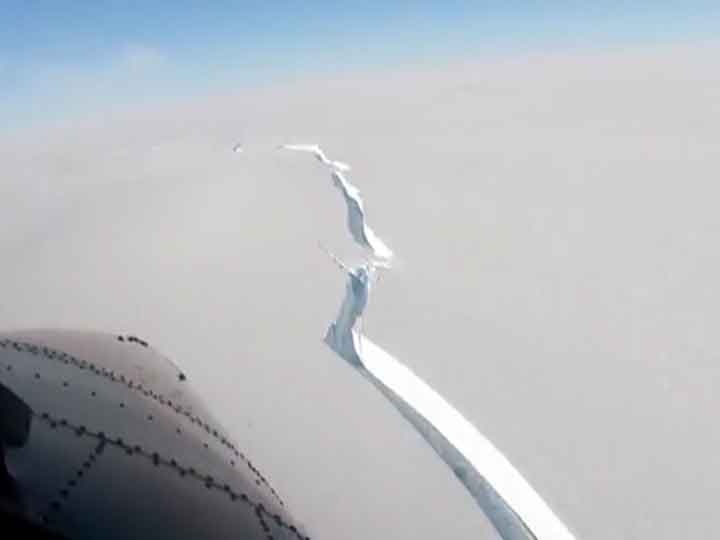
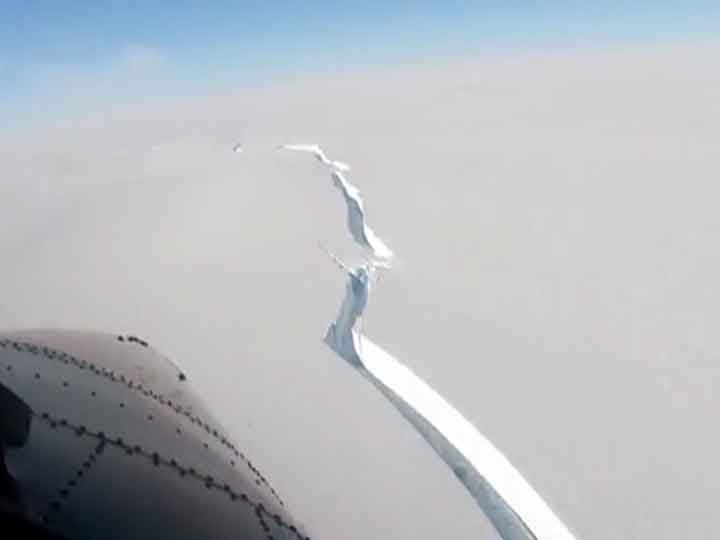
An iceberg of 1270 sq. km in size has broken off from Antarctica. This happened in the Burnt Ice Shelf, the Iceberg is apparently is of the shape of Indian capital New Delhi. According to the reports it was breaking at the rate of 1km per day.
Icebergs are pieces of ice that have broken off from glaciers or ice shelves and are now floating in open water, according to the National Oceanic and Atmospheric Administration.
The North Rift crack grew toward the northeast at a rate of about 0.6 miles (1 km) per day in January; but on the morning of Feb. 26, the crack widened a couple hundred meters in just hours. This ice split happened due to a natural process, and there’s no evidence that climate change played a role, according to the statement. The Brunt Ice Shelf, a 492-foot-thick (150 meters) slab of ice, flows west at 1.2 miles (2 km) per year and routinely calves icebergs.
The thickness of the iceberg is 150 meters. A picture of this has also been released by the British Antarctic Survey. According to scientists the incident occurred in the Burnt Ice Shelf area. This disintegration is called ‘calving’, in which vast icebergs separate from the frozen area.
The current calving was first recorded in November 2020. By January 2021, the speed of its breakdown had reached one km per day, on Friday it was eventually declared broken. There is so much snow on Antarctica that if it breaks and melts in the sea, the water level will rise by 70 meters. Many cities and islands will be completely submerged.
Ice calving, also known as glacier calving or iceberg calving, is the breaking of ice chunks from the edge of a glacier. It is a form of ice ablation or ice disruption. It is the sudden release and breaking away of a mass of ice from a glacier, iceberg, ice front, ice shelf.
According to researchers “Our teams at B.A.S.(British Antarctic Survey) have been prepared for the calving of an iceberg from Brunt Ice Shelf for years,” Dame Jane Francis, the director of the B.A.S., said in a statement. “Over coming weeks or months, the iceberg may move away; or it could run aground and remain close to Brunt Ice Shelf.”
Why do icebergs melt?
When an iceberg reaches warm waters, the new climate attacks it from all sides. On the iceberg surface, warm air melts snow and ice into pools called melt ponds that can trickle through the iceberg and widen cracks. At the same time, warm water laps at the iceberg edges, melting the ice and causing chunks of ice to break off. On the underside, warmer waters melt the iceberg from the bottom up. This phenomenon of ice-calving happens over a long period of time but the fast paced climate change had accelerated the process.

 Eduindex
You must be logged in to post a comment.