
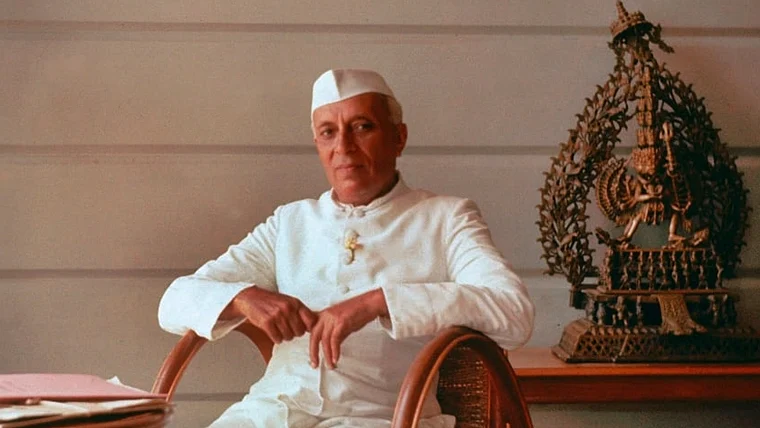
Jawaharlal Nehru faced more setbacks than you think.

File picture of Jawaharlal Nehru

The first Prime Minister of India, Pandit Jawaharlal Nehru gave India a new hope to dream of a free nation. He, along with other leaders gifted us the biggest democracy, the most ambitious republic, a colossal Constitution and an advanced form of secularism. He alsmost single-handedly integrate the entire nation after Indepence from India. He stirred emotions and tears when he said in his speech, “Long years ago we made a tryst with destiny, and now the time comes when we shall redeem our pledge, not fully or in whole measure, but very substantially. At the stroke of the midnight hour when the world sleeps, India will awake to life and freedom.”

Such invoking and inspiring speeches is one of the reason why Jawaharlal Nehru is deeply loved and revered among the Indians. It is said that during the first General Assembly Election 0f 1952, Dr.Nehru addressed almost 1/10th population of India. A brilliant statesman and orator, he is even respected in the global sphere.

However, a successful person is not without failures and setbacks. Nehru was an idealist hence even the slightest contrary caused him discomfort. Though he handled them with grace and elan.

The first setback he faced in his illustrious political career was when Subhas Chandra Bose resigned from Congress. Jawaharlal Nehru had attachment towards Gandhi but he also wanted Subhas to be in the Congress as he was modern and had socialist beliefs. Nehru never wanted this division in the Congress but in vain.

The next major dilemma Nehru faced was the Partition and the horrors of the communal riots and the immigration of thousands of refugees. Nehru always wanted peaceful coexistence and equality of all religions. He had to agree to the Partition to avoid more deaths and a civil war. Though his policy of secularism helped him gather people’s support during the election campaign.

In between of all these political conflicts, he was not without personal losses. He lost his dear wife, Kamala Nehru who was Indian activist. Jawaharlal lost her to tubercolosis in Switzterland in 1936. Nehru recalls in his book, “The Discovery of India” reading out to Kamala when she could no longer read due to her weakness. Nehru recounts in his book that he would look at the moon from his prison window and think of her. Kamala was his strength.

Another major and mammoth task after Independence was the consolidation and integration of the Indian states into the Indian Union. States like Kashmir, Junagad and Hyderabad proved to be troublesome. Though it was the work of Srdar Vallabhai Patel to integrate the states. Nehru gave the Tribal Panchsheel policy to integrate the tribal states using humane and considerate ways. One of his principle was that development should be assessed with qulaities and not statistics. He was successful but had faced immense amount of resistance. Nehru never used the Indian Armed Forces until it was the breaking point.

Nehru has been extremely respected by his opposition parties. Nehru had internationalist views as well. Nehru was the brainchild of the NAM or Non Aligned Movement. He shared his idealist vision with the other leaders of newly independent states of Asia and Africa. When the world was grasping in fear of another war due to the Cold War, he saved us from fear and promoted his non-alignment views. He promoted far more modern ideas like economic assistance, non-interferance, integrity and pecaeful co-existence. But this policy was brutally criticized by the Western theorists as it did not fit into the American view. The policy of NAM was also blatantly violated by even his NAM counterparts.

Last but not atleast, Nehru was badly betrayed by his ally he trusted. He had signed an agreement with the Chinese premier Zhou Enlai only to be attacked badly at the Tibetian fronts during the Indo-China War of 1962. Nehru had never felt this betrayed and the condition of his heart worsened. For the first time he was criticized largely by his oppositions in the Parliament. It was a huge embarrassment for him in the world forum. He only wanted to share good values with the still-developing China but alas.

Many information in this article are from the book The Discovery of India by Jawaharlal Nehru. In the book he has delved deep into the foundation of the Indian society since the Indus Valley Civilization and the Aryan society. He fully embraced Indian culture but mixed it with ancient wisdoms that are relevant even n today’s hostile political climate.

Jawaharlal Nehru believed in the Indian people when the British rulers could not even entrust upon us the task of making a Constitution. His failures made him strong and resilient. He truly was the quintessential administrator and the ‘Chacha’ of the beloved children of his nation.

India and Tajikistan agree to further enhance economic partnership during talks on bilateral cooperation in Dushanbe

External Affairs Minister Dr S Jaishankar today held talks with his Tajik counterpart Sirojiddin Muhriddin in Dushanbe on all aspects of the bilateral agenda, including development cooperation. They also exchanged views on regional and international issues of interest. Both leaders agreed to focus on further enhancing the economic partnership.
 
In his press statement, Dr Jaishankar said, Foreign Minister Sirojiddin and he shared a common view that while the bilateral strategic relations have grown and expanded over the years, there is potential for further strengthening the economic cooperation. He said, both countries will encourage the business community, the Chambers and trade bodies on both sides to engage more intensively with each other while the governments will continue to play a facilitating role. He said, development cooperation has also become an important pillar of India-Tajikistan bilateral relationship. Dr Jaishankar said, a number of projects have been successfully commissioned over the years in Tajikistan under Indian grant assistance.
 
On the last day of his three day visit to Tajikistan, the External Affairs Minister met Speaker Zokirzoda Mahmadtohir Zoir and appreciated the strong parliamentary support for Indo-Tajik cooperation.
 
Earlier in the day, the Minister paid his respects at the monument of Ismoili Somoni, the founder of the first Tajik state at Dusti Square in Dushanbe.

Fourth batch of 3 Rafale fighter jets arrive in India from France

The fourth batch of three Rafale fighter jets arrived in India from France yesterday. The Indian Air Force in a tweet said that the three IAF Rafales landed on Indian soil after a direct ferry from Istres Air Base France.

It said, Rafales were refueled in-flight by UAE Air Force tankers. It said, this marks yet another milestone in the strong relationship between the two Air Forces.

World Bank says India’s GDP to grow from 7.5 to 12.5 per cent during current fiscal

World Bank has raised Indian GDP growth prediction for 2021-22 fiscal to 10.1 percent from 5.4 percent projected in January. The international bank said, given the significant uncertainty amid Covid-19 effects on the economy, the real India GDP growth could be in the range from 7.5 percent to 12.5 percent.

The World Bank in its South Asia Economic Focus Spring update report said that it has revised the projection amid a strong rebound in private consumption and investment growth. The international bank noted that government consumption is expected to rise by about 16.7 percent during the reported fiscal.

The World Bank, however, sounded a warning as economic activity is well below pre-Covid-19 estimate. It said that businesses need to make up for lost revenue and millions of workers, most of them in the informal sector, still reel from job losses and falling incomes should be taken care. 

Last date to link Aadhaar with PAN card extended to June 30

Government has extended the last date for linking of Aadhaar number with PAN upto 30th June this year in view of the difficulties arising out of the COVID-19 pandemic.

The deadline to link PAN with Aadhaar had ended yesterday.  Earlier, the Centre had extended the deadline to 31st March 2021 from the previous deadline of 30th June 2020 because of the pandemic. 

Centre reviews COVID-19 vaccination drive and preparations with states, UTs

Union Health Secretary Rajesh Bhushan yesterday held a review meeting with all States and Union Territories on the COVID-19 vaccination drive and preparations. The meeting focused on the identification of low vaccine coverage pockets particularly in districts showing COVID surge and for taking corrective actions there.

With regards to the vaccination coverage of Health Care Workers and Front Line Workers, the states have been advised to ensure that only eligible beneficiaries are registered and vaccinated under these categories. Besides, the states were also asked to conduct regular reviews of vaccinations at Private COVID Vaccination Centres with respect to their capacity utilization. They were advised to ensure that there is no sedimentation of vaccine stocks at any level of storage.  

In the meeting, Chairperson, Empowered Group on COVID Vaccination, Dr. R S Sharma assured that there is no problem in the storage and logistics of vaccines. He reiterated that there is no value in conserving vaccines for the second dose and states must promptly supply vaccines to all government and private hospitals.

Covid vaccination for all above 45 years begins today

The COVID-19 vaccination opens this morning for everyone aged above 45 years irrespective of comorbidity. Our correspondent reports the cut-off date for the 45-plus years category is those persons born before 1st January 1977.

Experts have appealed citizens to get vaccinated. NITI Aayog Member and Chairman of National COVID-19 Task Force, Dr V K Paul has appealed to people above 45 years of age to get vaccinated without hesitation.

The Centre has asked the States and Union Territories to maintain vaccine wastage at less than one percent. The states have also been directed to ensure timely utilization of available stocks to avoid expiry of vaccines. Union Health Secretary Rajesh Bhushan yesterday held a review meeting with all States and Union Territories on the COVID-19 vaccination drive and preparations. The meeting focused on the identification of low vaccine coverage pockets particularly in districts showing COVID surge and for taking corrective actions there.

Polling underway for 2nd phase of assembly elections in Assam & West Bengal

In the poll-bound states of Assam and West Bengal, polling for the Second Phase of Assembly Elections began today at 7.00 A.M. The polling will be conducted till 6.00 P.M. in Assam while it will continue till 6.30 P.M. in West Bengal. All the necessary facilities and security arrangements have been made to ensure free and fair polling during this phase. The Voter Verifiable Paper Audit Trail (VVPAT) is being used along with Electronic Voting Machine (EVM) at every Polling Station, with a view to enhance the transparency and credibility of the election process. The availability of adequate number of EVMs and VVPATs has already been ensured for the smooth conduct of elections.

In view of the prevailing COVID-19 pandemic, the option of Postal Ballot facility has been extended to the electors who are COVID- 19 positive or suspect as certified by competent authority and are in home or institutional quarantine along with those marked as Persons with Disabilities (PwD) and above the age of 80 years. It has also been ensured that every Polling Station is equipped with Assured Minimum Facilities (AMF) like drinking water, waiting shed, toilet with water facility, adequate arrangements for lighting, ramp of appropriate gradient for the  Persons with Disabilities. The special facilities include mandatory sanitization of Polling Station, thermal checking of voters at entry point either by polling staff or paramedical staff or an Asha worker. If temperature is above the set norms of Health Ministry, then the elector will be provided with token and asked to come for voting at the last hour of poll. At the last hour of poll, such electors will be facilitated for voting, strictly following COVID-19 related preventive measures.

Polling is going on peacefully in the second phase of assembly elections in 30 seats across 4 districts in West Bengal. It is being held at 9 seats each in East and West Medinipur, 8 seats in Bankura and 4 seats in South 24 Parganas.
Polling began at 7am in the morning, it will continue till 6.30 pm in the evening. People in large numbers are seen standing in queues from this morning. All covid protocols are being followed.

Elaborate security arrangements have been put in place to ensure free, fair and peaceful polling. A total of 651 companies of central forces have been deployed in 30 constituencies, 210 at West Medinipur and 199 companies at East Medinipur. 

Over 75 lakhs electors will be exercising their franchise in 10 thousand 620 booths. Webcasting is being done from 5 thousand 5 hundred 35 booths. Drones are being used for monitoring especially in the coastal areas of the Sundarbans as well as in Nandigram.  Two IPS officers have been given special charge in East Medinipur district, one at Haldia and the other one at Nandigram. The election commission has taken special measures for the high profile seat Nandigram. 22 companies of para military forces and 22 quick response teams have been put in place. 100 percent booths have been declared as sensitive and 8 jawans of central forces are manning each booth. Section 144 had been imposed across Nandigram. Ferry service had been stopped since last evening.
In West Bengal, 171 candidates including 19 women are vying for the 30 seats in four districts during the Second Phase. The state is witnessing eight-phase elections. Over 75.94 lakh voters including 37.13 lakh women and 89 Third Gender persons will decide the fate of these candidates. Total 10,620 Polling Stations have been set up in the Second Phase for this purpose. Bharatiya Janata Party and ruling AITC are contesting for all the 30 seats while Congress, Left parties and their alliance partner Indian Secular Front are fighting under the banner of Sanyukt Morcha. CPI (M) has fielded 15 candidates, Congress has nine, BSP seven, CPI two and AIFB and RSP one each while there are 32 independents along with 44 others are also in the fray.

The prominent leaders contesting during the Second Phase include AITC President and Chief Minister Mamata Banerjee, her former aide and rival BJP candidate Shubhendu Adhikari along with CPI (M) youth leader Minakshi Mukherjee from Nandigram. AITC Ministers Soumen Mahapatra from Tamluk and Manturam Pakhira from Kakdwip, former Minister Manas Bhuniya, former IPS officers Bharati Ghosh and Humayun Kabir from Debra, Tollywood film stars Sohom Chakraborty from Chandipur, Hiranmoy Chattopadhyaya from Kharagpur Sadar and Sayantika Banerjee from Bankura along with former cricketer Ashoke Dinda from Moyna are also in the fray in this phase.
In Assam, the polling has begun for the second phase in the state. Polling will conclude at 6 pm. This phase will cover 39 seats. A total of 345 candidates are in the fray in this phase. Over 73 lakh voters can exercise their voting rights. Nearly 80 percent polling was reported in the first phase of polls. In this phase, most of the seats are likely to see a straight fight between the NDA and Congress led Mahajoth. BJP has fielded 34 candidates, Congress has 28, Assam Jatiya Parishad  -19, AIUDF seven, AGP six and BPF has four candidates are in the fray .

For the ruling BJP , ministers Parimal Suklabaidya, Bhabesh Kalita , Pijush Hazarika and sitting MLA Numal Momin would seek re -election.  Kamalakhya Dey Purkayastha, Sum Ronghang, Siddique Ahmed from the Congress would try their political luck. Senior BPF leader and minister Rihon Daimary is also in the fray from Udalguri seat. Suzam Uddin Lashkar, Siraj Uddin Ajmal would be in the contest for AIUDF. However, this election would not witness participation of former Chief Minister and Asom Gana Parishad leader Prafulla Kumar Mahanta who represented Bahrampur seat for last 35 years.
In Assam, there are three main alliances including the BJP-led National Democratic Alliance with partners Asom Gana Parishad (AGP) and the United People’s Party Liberal (UPPL) and Mahajot or Grand Alliance led by the Congress. It includes All India United Democratic Front (AIUDF), Bodoland Peoples’ Front (BPF) and the Left parties while yet another conglomerate of Assom Jatiya Party (AJP) and Raijor Dal is also there. BJP has fielded 34 candidates, Congress has 28, AJP -19, AIUDF seven, AGP six and BPF has four while 176 independents and others are also trying their luck.

The prominent leaders contesting during the Second Phase include BJP Ministers Piyush Hazarika from Jagiroad, Parimal Sukla Baidya from the Dholai and Bhabesh Kalita from Rangia along with Deputy Speaker of Assembly Aminul Haque Laskar from Sonai. Former Minister Gautam Roy is contesting from Katigorah while former Deputy Speaker Dilip Kumar Paul, who resigned from the BJP after he was denied ticket, is contesting as an Independent from Silchar. Former Minister and Congress leader Sum Ronghang is also in the fray from the Diphu seat. Rajya Sabha MP Biswajit Daimary is contesting from Panery and former Asam Sahitya Sabha President Paramananda Rajbongshi is trying his luck from Sipajhar.
Meanwhile, the election campaign is heating up in respect of the Third Phase in both these states and also for the single-phase elections in Kerala and Tamil Nadu as well as the Union Territory of Puducherry. The Third Phase of polling in these two states will be held on 6th of April when 338 candidates will be contesting for the 40 seats of Assam and 205 candidates for 31 seats of West Bengal.

The single-phase polling in Kerala, Tamil Nadu along with the Union Territory of Puducherry will also be held on the 6th of the next month. There are 957 candidates in the fray for the 140 Assembly Constituencies of Kerala.  The total number of candidates is 4,125 in respect of 234 Constituencies in Tamil Nadu. In Puducherry, 324 candidates will be vying for the 30 Assembly seats.

Besides, the Lok Sabha by-polls will be conducted simultaneously for Kanyakumari seat in Tamil Nadu where 12 candidates are in the fray and also for Malappuram seat in Kerala, where six candidates are taking part in the electoral battle.

During the Fourth Phase of Assembly Elections in West Bengal, the final scenario of electoral contests became clear last Friday after withdrawal of candidature and the election campaign was initiated by the prominent leaders of different political parties. During this phase, 373 candidates will be vying for 44 Assembly seats that will go to polls on the 10th of April.

The scrutiny of the nomination papers for the Fifth Phase was completed yesterday and the last date for withdrawal of candidature will be the 3rd of April.   The scrutiny was also done simultaneously for By-Elections of two Lok Sabha seats including Tirupati in Andhra Pradesh and Belgaum in Karnataka along with 14 Assembly Constituencies in eleven states. The ACs going in for the by-polls include three in Rajasthan, two in Karnataka and one each in Gujarat, Jharkhand, Madhya Pradesh, Maharashtra, Mizoram, Nagaland, Odisha, Telangana and Uttarakhand.  In all, 45 ACs will go to polls in the Fifth Phase on 17th of April. 

Meanwhile, the process of filing nominations for the Sixth Phase of elections in West Bengal will continue till 3rd of April and the scrutiny of nominations will be held on the 5th of April. The last date of withdrawal of candidature will be 7th of April and 43 Assembly Constituencies will go to polls in this phase on the 22nd of April.

The nomination process for the Seventh as well as the Eighth and Final Phase of the Assembly Elections in West Bengal, which began yesterday, will continue till the 7th of April and the scrutiny will be held on the 8th of April. The last date for withdrawal of candidature will be the 12th of April.  In all, 36 Assembly Constituencies will go to polls in the Seventh Phase on the 26th of April while remaining 35 Assembly Constituencies will go to polls in the Eighth Phase on the 29th of April.

The counting of votes will be taken up together on the 2nd of May.

PM Modi urges people to vote in record numbers in Assam, West Bengal assembly polls. Prime Minister Narendra Modi has requested all eligible voters of the second phase of Assembly polls in Assam to strengthen the festival of democracy by exercising their franchise.

In a tweet, Mr Modi also urged the people of West Bengal in whose seats there is polling taking place today to vote in record numbers.

5 essential skills you need if you are aspiring to be a UX Designer

This Covid-19 pandemic has pushed most of the companies to create an online presence which in terms lead to the hike in need of UX designers who develop the user experience of the audience on the company website.

Here are some of the top essential skills for ambitious UX designers who want to grow and stay relevant within the current tech age:

  1. Developing a sense of empathy

It is an unspoken rule in the UX industry that designs exist for the sake of the user, and not the other way round. For a design to be successful it must be shaped according to the requirements of end-user. The most important factor in creating a user centric UX design is a sense of deep empathy in the designer.

A decent designer is one which can understand the consumer but a extraordinary designer is one who can empathize with the lives, challenges, troubles, and expectations of a user. A sense of empathy gives the designers a opportunity to tap into untapped pain-point.

This Intellectual skill is responsible for giving much of the innovation that is witnessed in the industry. It gives a designer to create lasting and more powerful user-based experiences, which later translate into business excellence and greater returns.

2. The art of storytelling

Making brilliant design is only half of the matter. The designer should be able to market, evaluate and create a story around their designs. The art of storytelling enhances the longevity and impact of any design.

The ability to build a story and a narrative around the design which is empathetic to the consumer is an essential skill for aspiring UX professional as it creates a differentiation between a good designer and a brilliant one.

Besides having an imagination and good communication skills, a good knowledge of PowerPoint and video presentations is also helpful in marketing a design.

3. Teamwork is key

We are culturally habituated to think that designers are like lonely thinkers who come up with ideas in moment of lonely brilliance. This however is far from the truth because one of the most important skill is to team work and collaborate.

In fact, the creative process itself is iterative and collaborative in nature. Great ideas and successful execution come with teamwork.

In real life, a UX designer must collaborate with business folks, technology folks, researchers, partners and more to successfully deliver a project.

4. Knowledge and application of design frameworks

Design is a process and every process needs frameworks to implement it effectively. There are many design frameworks that can be used in UX design to help designers to learn more about user and their lives, design strategies and build the right experiences.

Some important design frameworks that are used in the industry include Personas, customer journeys, empathy maps, card sorting and task flow design.

These are all frameworks from which designers can learn and implement in their projects accordingly to learn many people can apply for online courses including the UX jumpstarted by ImaginXP.

5. Skilled in design tools

Although pen and paper will always be the mightiest tools for designer to ideate, iterate and bee agile, it is also equally important to be able to translate your thoughts from paper to digital.

All designers out there should be proficient in at least some of these to deliver UX designs effectively. Some popular design tools include Sketch, Adobe XD, Figma and Azure.

Remember that the entire world is your teacher so learn from it whenever you can and stay as updated as you can because it can help you with the changing place of the industry.