

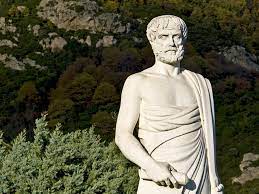
Please make sure that you read cache up on the next post for more.
Aristotle in his Theory of Art reasons on the imitative nature of art; and further proposes that art imitates everything that is nature. In his theory he hints out that a poet, by his work tells us what is to happen unlike a historian who recites on what occurred in the past, which is put forth by Aristotle himself on the imitative nature of ‘poets’ work. The Oxford English Dictionary defines Mimesis as “a figure of speech, whereby words or actions of another are imitated” or “the deliberate imitation of the behaviour of one group of people by another as a factor in social change”. Mimicry as “the action, practice, or art of mimicking or closely imitating … the manner, gesture, speech, or mode of actions and persons, or the superficial characteristics of a thing” .
Aristotle focuses on the Mimetic nature of Art which isn’t a sole focus of Poetics, and while doing so, he had opposed to what Plato believed, that mimesis was manifested in ‘particulars’ which copies or imitates the forms from which they are derived; thus, the mimetic world (the world of representation and the world of structure of conscious experience) is inherently inferior in that it consists of imitations which will always be subordinate or auxiliary to their original. Aristotle, unlike Plato, has his own interpretation to the theory of imitation and thus doesn’t comply with what Plato presents when he talks about Mimesis. Aristotle has evidently accepted and agreed of the heterogeneous notion of art being produced by different artist differently, which gives a distinct identity to the theory of imitation and so he believes that an artist is responsible to birth an art form unlike Plato, who negates any form of Art – as it’s being thrice removed from reality. He contests these notions of reality and argues to the point that imitation is an extremely natural instinct in human nature, something very basic, the ability to imitate sets human beings apart from other animals and so not only it is natural to imitate it further helps to learn and simultaneously experience delight from it. In Poetics, what Aristotle has wrapped up for us isn’t a very definite answer, for what he means about ‘Mimesis’, instead has left it broad and elusive. Although various discussions on ‘Mimesis’ to be an integral fraction to the relationship between art and nature and to the relations governing works of art themselves. Therefore, we can assert the various species that Mimesis is distinguished in, i.e. Mean; Object; Mode of Imitation. Although for Aristotle, Imitation involves not merely physical resemblance, but also what one might call generally the relations between things or the ‘mechanism’ of things, he thus proposes the three key distinguishers through which one could filter imitations. Mean – is something a poet applies to his work of art, say Poetry and Dance, what distinguishes these two forms is; one requires spoken language to be at fruition and the other, not essentially emphasises on language and it thus could be substituted by music, similarly in Poetry difference in its metres or rhyme scheme and the structure in general could itself separately each genre from the other like Epics, Ballads or Elegy, et cetera. Next is Object of imitation – what the mean — the ‘matter’ of imitation — represent, and this would produce for better or worse or the same effect of the original piece imitated, here Aristotle points at the distinction of Tragedy and Comedy, for tragedy we’d need a better mode of imitation and for Comedy one uses caricature i.e. laughing at the object of imitation, to show an inferior or worse form of imitation to produce the choice effect. Further along is Means of imitation which in poem could be what the poet chooses as a form of delivering his work of imitation.

 Eduindex